ELECTROLYTES
DR NISHMA BAJRACHARYA
FCPS 1ST YR RESIDENT, OB/GYN
Copyright 2009, John Wiley & Sons, Inc.
Body Fluid Compartments
Electrolytes
• solutes that are found in various concentrations and measured in
terms of milliequivalent (mEq) units
• Can be negatively charged (anions) or positively charged (cations)
Sodium Na+
• 135-145mEq/L
• Major Cation, Chief electrolyte of the ECF
Determines ECF & ICF Osmolality
Serum osmolality = 2x Na+ + glucose/18 + urea/2.8
Normal – 275-290mOsm/kg
• Regulates volume of body fluids
• Needed for nerve impulse & muscle fiber transmission (Na/K pump)
• Regulated by kidneys/ hormones
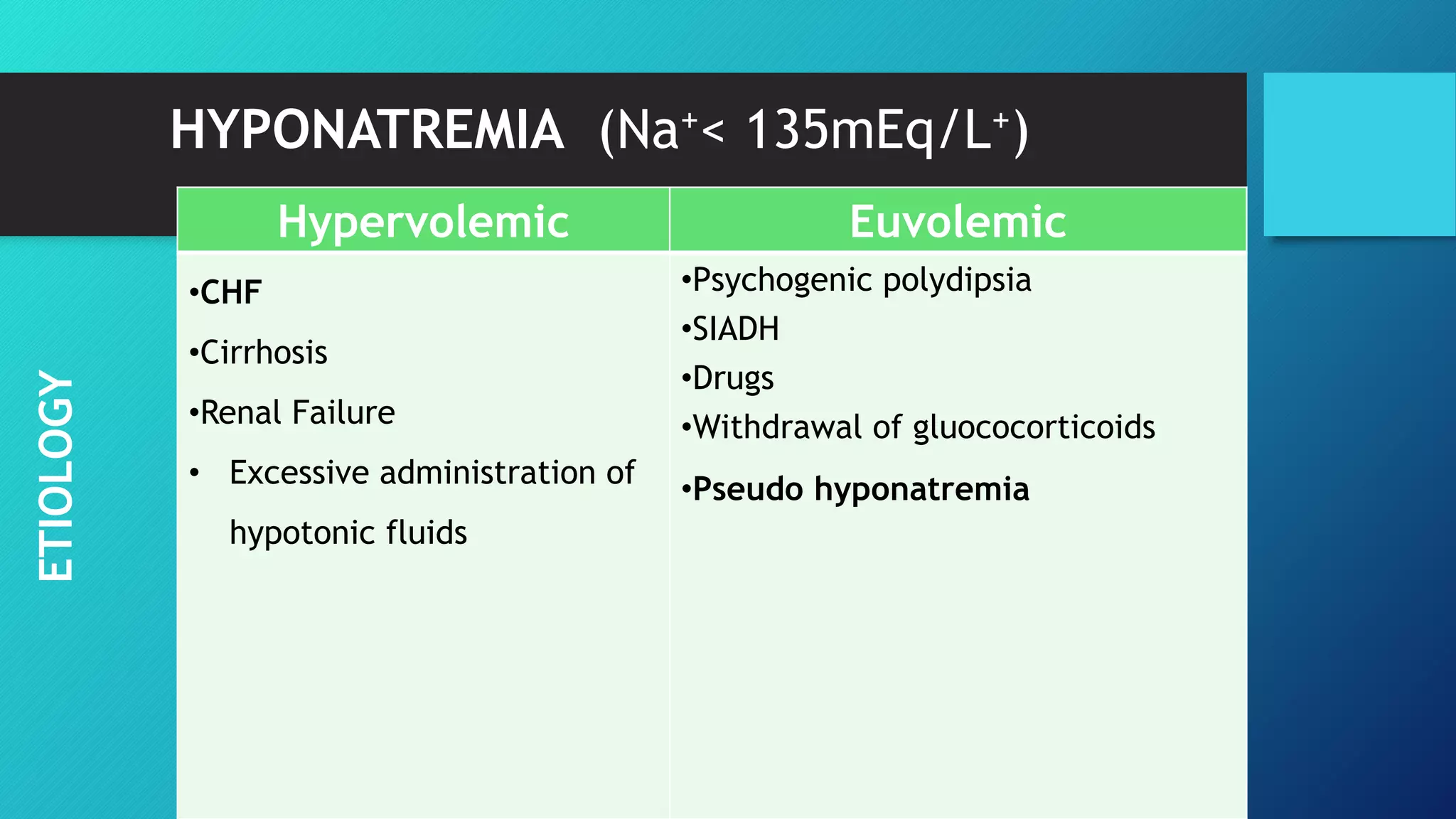
HYPONATREMIA (Na+< 135mEq/L+)
ETIOLOGY
Hypervolemic Euvolemic
•CHF
•Cirrhosis
•Renal Failure
• Excessive administration of
hypotonic fluids
•Psychogenic polydipsia
•SIADH
•Drugs
•Withdrawal of gluococorticoids
•Pseudo hyponatremia
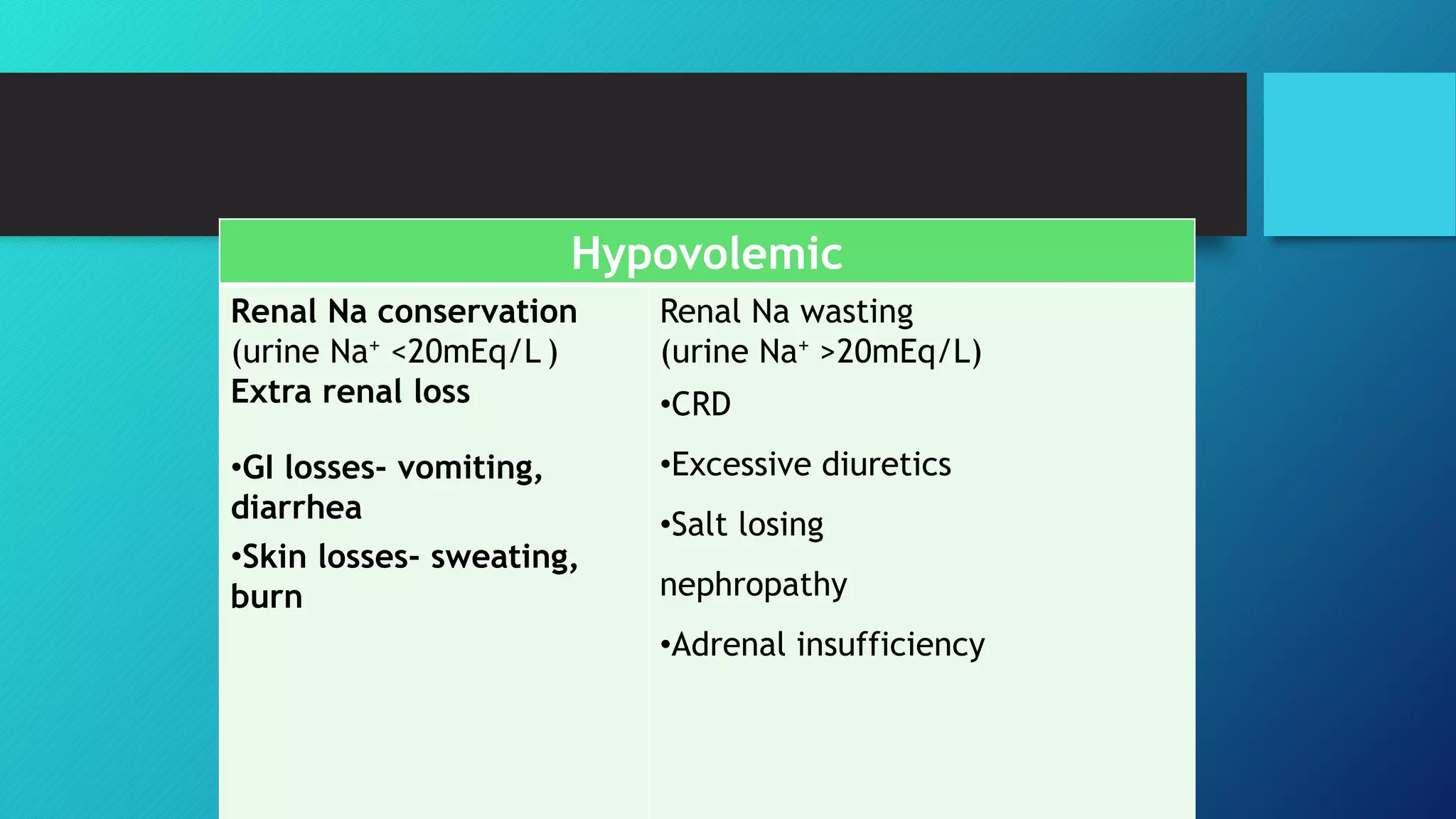
Hypovolemic
Renal Na conservation
(urine Na+ <20mEq/L )
Extra renal loss
•GI losses- vomiting,
diarrhea
•Skin losses- sweating,
burn
Renal Na wasting
(urine Na+ >20mEq/L)
•CRD
•Excessive diuretics
•Salt losing
nephropathy
•Adrenal insufficiency
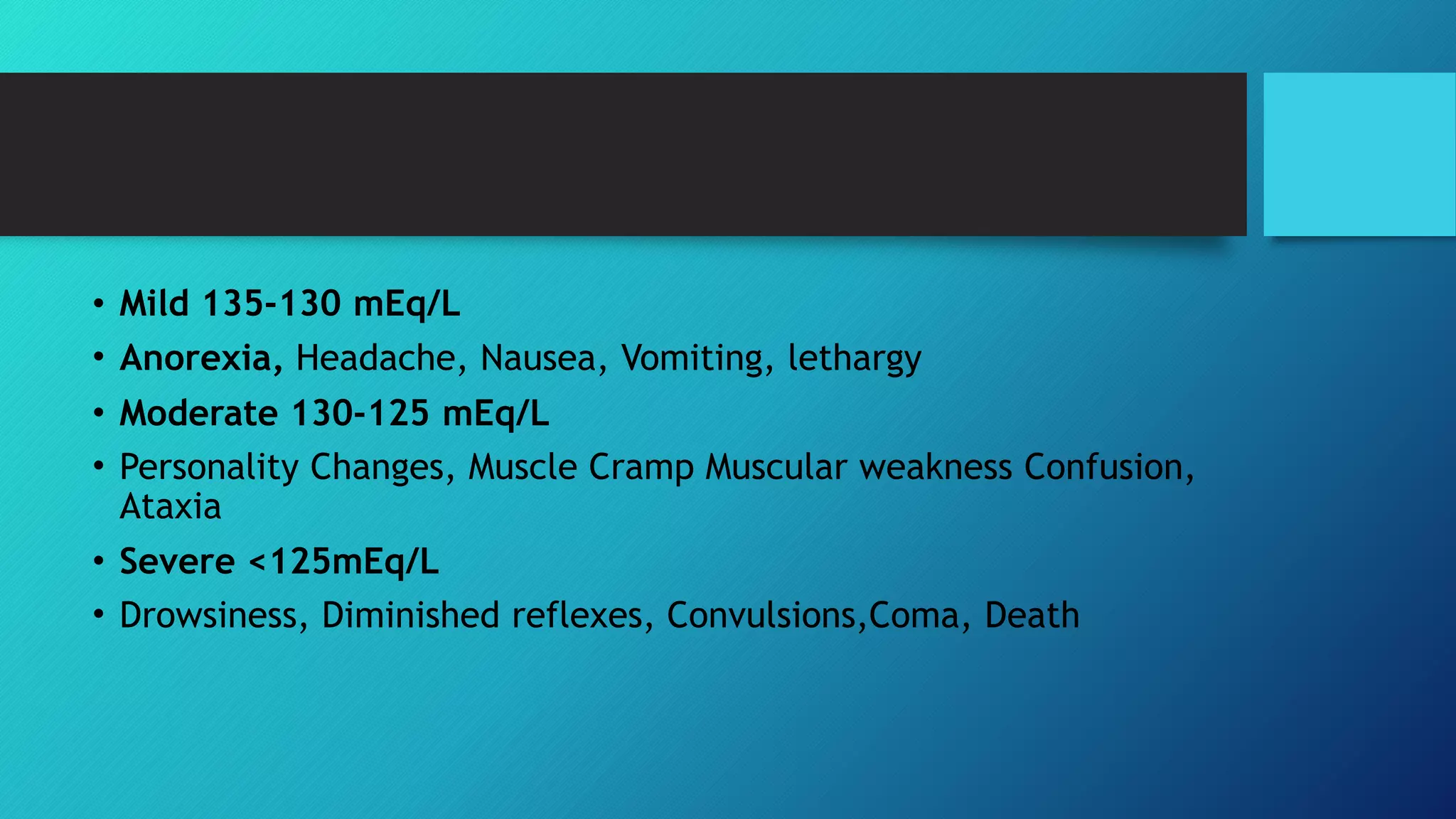
• Mild 135-130 mEq/L
• Anorexia, Headache, Nausea, Vomiting, lethargy
• Moderate 130-125 mEq/L
• Personality Changes, Muscle Cramp Muscular weakness Confusion,
Ataxia
• Severe <125mEq/L
• Drowsiness, Diminished reflexes, Convulsions,Coma, Death
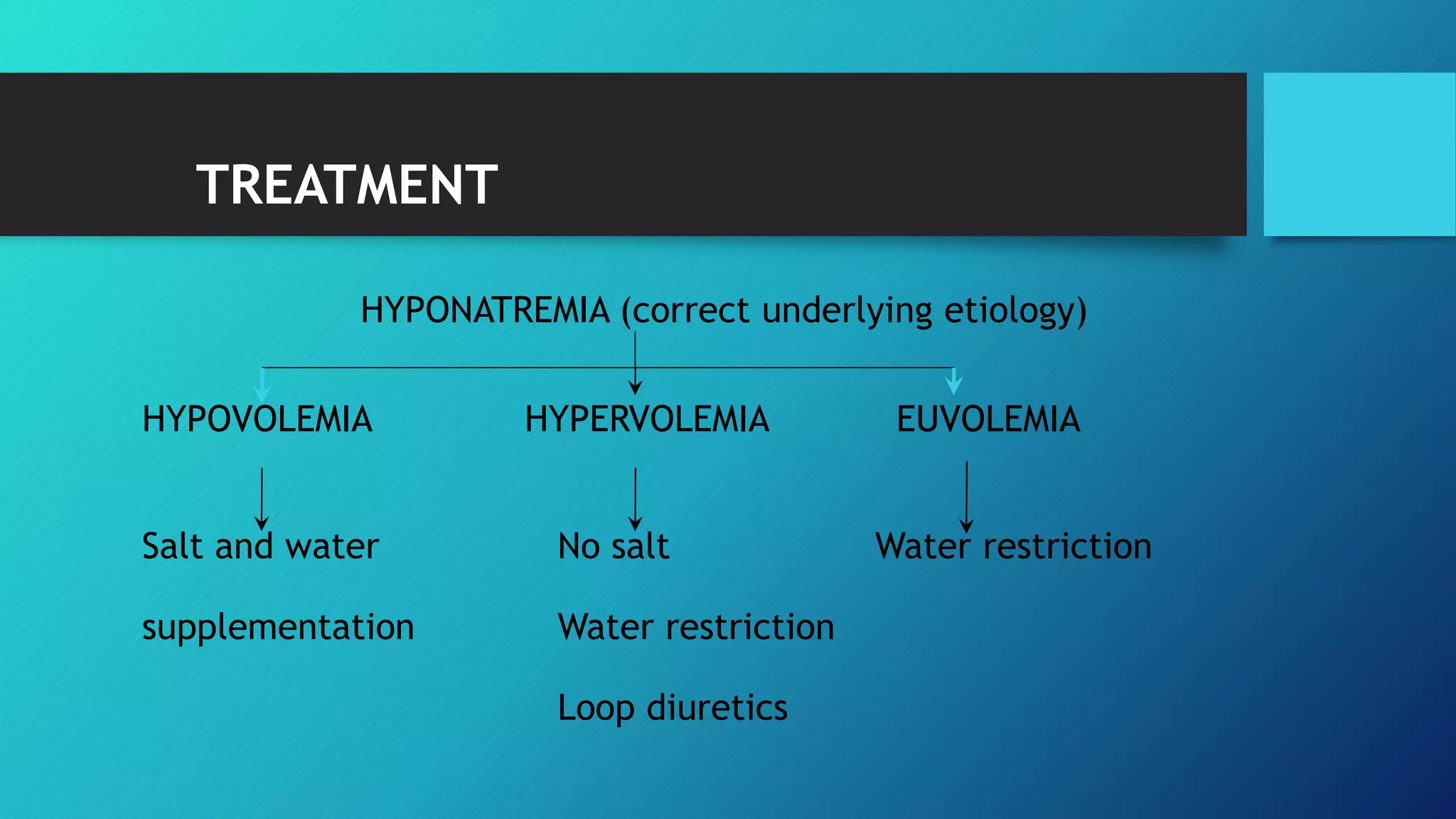
TREATMENT
HYPONATREMIA (correct underlying etiology)
HYPOVOLEMIA HYPERVOLEMIA EUVOLEMIA
Salt and water No salt Water restriction
supplementation Water restriction
Loop diuretics
ACUTE hyponatremia with severe neurological symptoms
• Rapid correction with hypertonic saline
1 – 2mEq/L /hr until Na reaches 125 mEq/L
Safe plasma Na+ concentration : 120-125mEq/L
• Correction using 3% NaCL (513 mEq/L)
• Na Requirement- 0.6 x total body weight x (desired Na – actual
Na)
TREATMENT
TREATMENT
Chronic asymptomatic hyponatremia (>48hrs):
• Rate of correction - 0.5 to 1.0 mEq/L/hour.
• MAX 8mEq/L per day.
• Rapid correction  Central pontine demyelination
Dysarthria, dysphagia, flaccid paralysis or coma
Diagnosed by CT or MRI (more accurate)
• Example- 71 Kg woman with neurologic symptoms has
serum Na 113 mEq/L,
• correction to serum Na level of 125 is achieved as follows
• 0.6 x 71 (weight) x (125- 113) = 511 mEq Na
• Patient requires 1 L of 3% saline to increase the level by
12 mEq
• Correction In 6-12 hrs appropriate
•
HYPERNATREMIA
(Na+>145mEq/L)
Etiology – Usually : water deficit
Hypernatremia associated with formation of concentrated
urine (U osm/ Posm >1.5 urine spc >1.015)
• Excess nonrenal water loss- Hot environment, fever,
hyperventilation- Urine output <35 ml/h
• Solute diuresis- due to inadequate water intake owing to
large volumes of renal solute excretion- Urine output >35
ml/h
• Hypernatremia associated with formation of dilute urine
(Uosm/Posm <1, sp gr <1.010)
• Renal loss
• Diabetes insipidus
• central (ADH deficiency) urine (Uosm/Posm <0.5, sp gr <1.005)
• Nephrogenic –
• Renal tubular Damage- ability to concentrate or dilute the urine is
decreased
when water loss exceed water intake- hypernatremia
CLINICAL FEATURES
Polyuria and thirst
Neurological symptoms: altered mental status, weakness,
neuromuscular irritability, focal neurological deficit,
seizures & coma
 Hypertonicity  contracts ICF volume  brain cell volume  subarachnoid
or intra-cerebral hemorrhage
TREATMENT
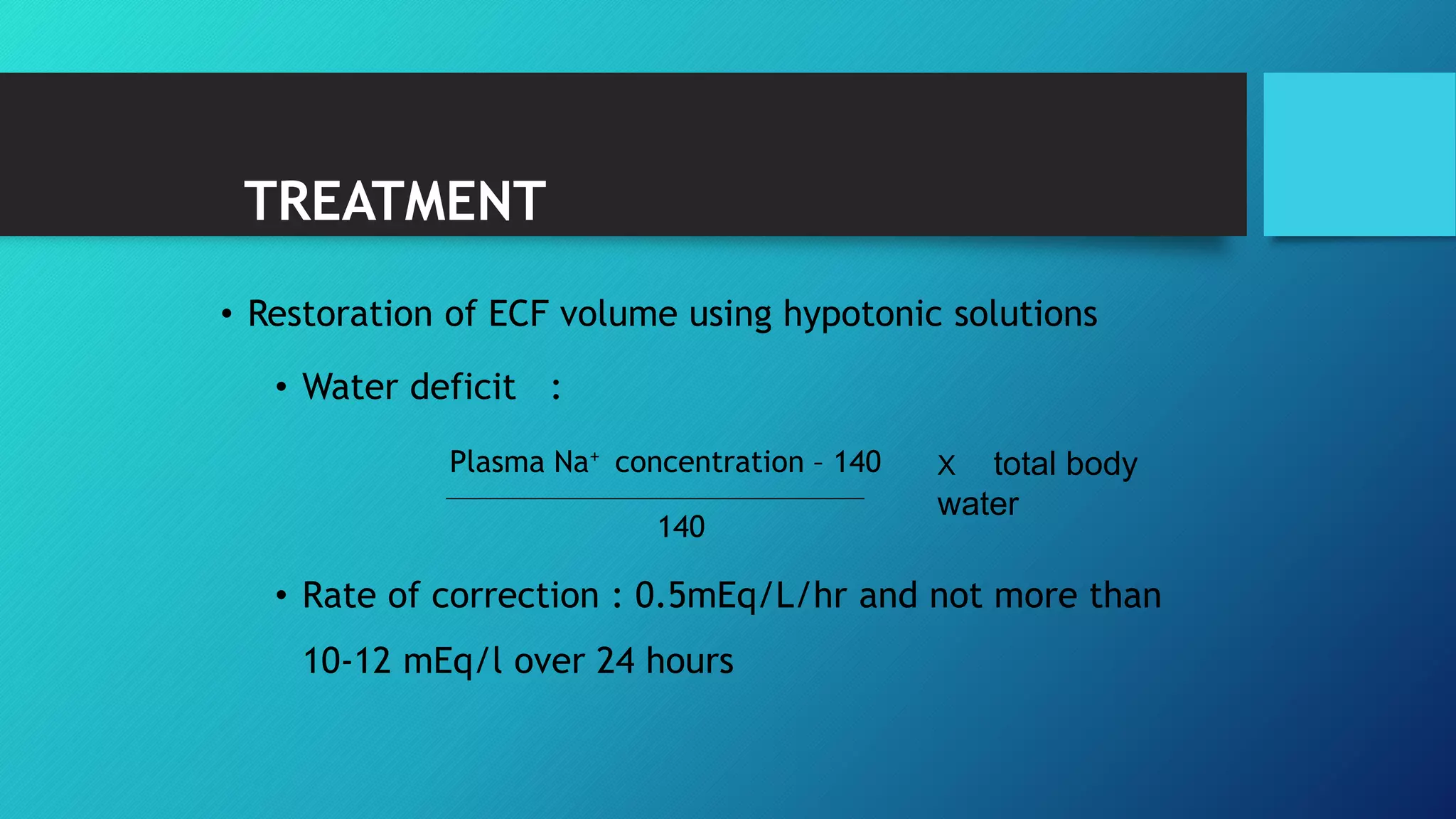
• Restoration of ECF volume using hypotonic solutions
• Water deficit :
Plasma Na+ concentration – 140
140
• Rate of correction : 0.5mEq/L/hr and not more than
10-12 mEq/l over 24 hours
X total body
water
POTASSIUM (K+)
3.5- 5.5 mEq/L
Determines excitability of nerves and muscle cells
including the myocardium.
Most abundant intracellular cation: 98% intracellular.
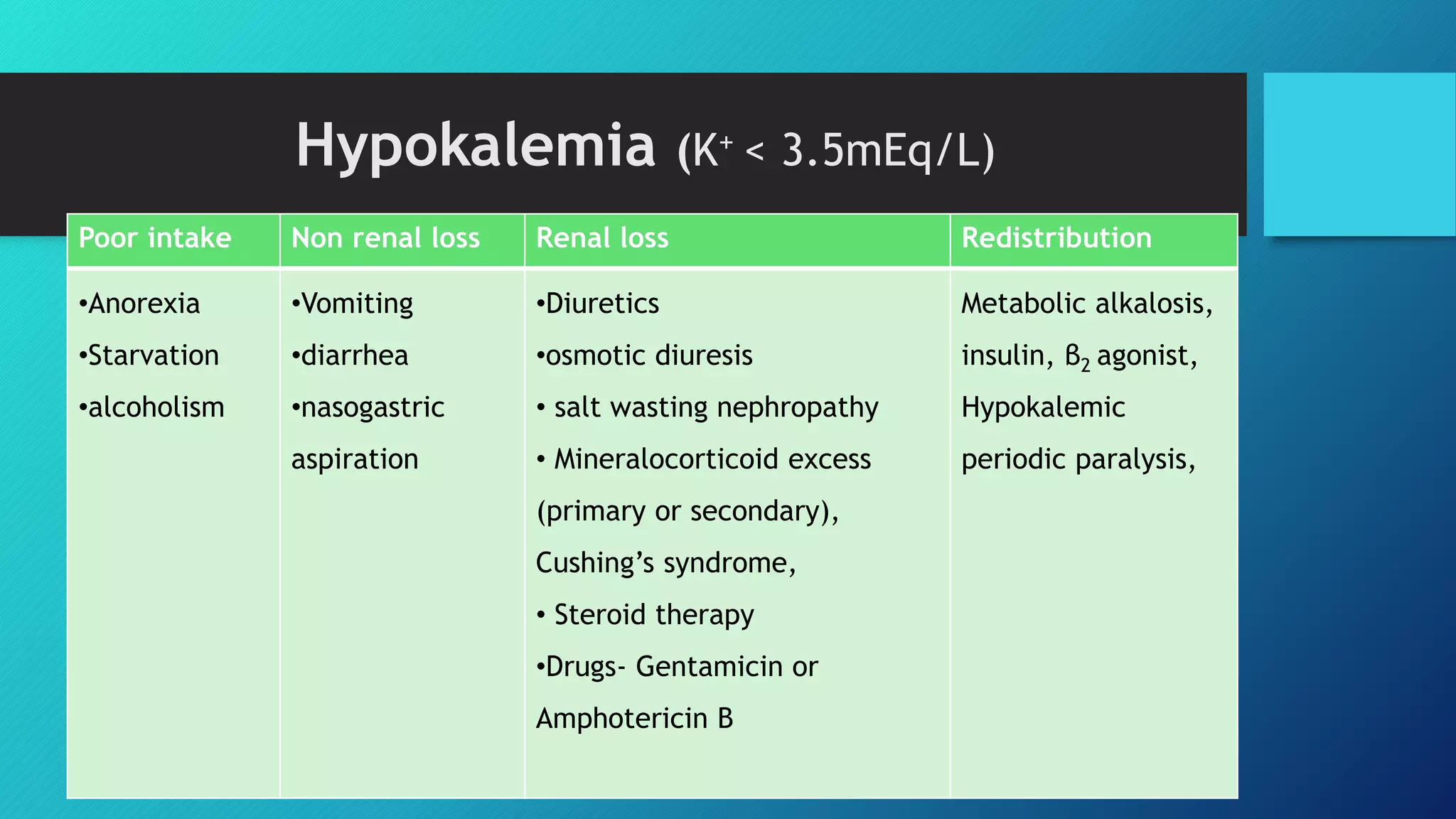
Poor intake Non renal loss Renal loss Redistribution
•Anorexia
•Starvation
•alcoholism
•Vomiting
•diarrhea
•nasogastric
aspiration
•Diuretics
•osmotic diuresis
• salt wasting nephropathy
• Mineralocorticoid excess
(primary or secondary),
Cushing’s syndrome,
• Steroid therapy
•Drugs- Gentamicin or
Amphotericin B
Metabolic alkalosis,
insulin, β2 agonist,
Hypokalemic
periodic paralysis,
Hypokalemia (K+ < 3.5mEq/L)
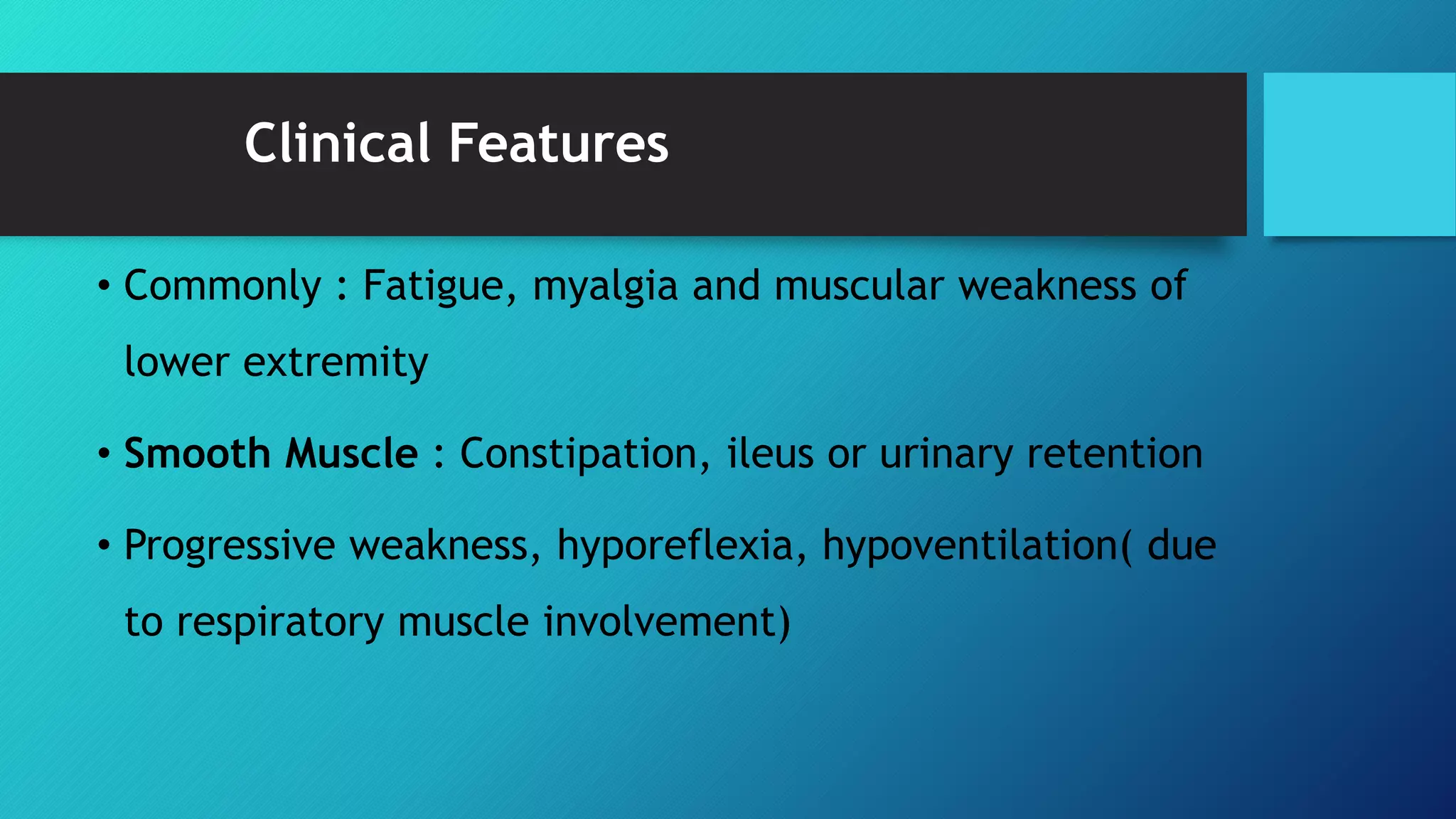
Clinical Features
• Commonly : Fatigue, myalgia and muscular weakness of
lower extremity
• Smooth Muscle : Constipation, ileus or urinary retention
• Progressive weakness, hyporeflexia, hypoventilation( due
to respiratory muscle involvement)
Early changes
Flattening or inversion of T waves
Prominent U waves
ST segment depression
Prolonged QT interval
Flattening of T waves
SEVERE HYPOKALEMIA
• Prolonged PR interval
• Decreased voltage
• Widening of QRS
• Ventricular arrythmia :VPC, ventricular tachycardia
TREATMENT
3.5 to 4 mEq/L :
• No potassium supplementation
• Add potassium sparing diuretics or decrease dose of diuretics
3 to 3.5 mEq/L :
• Treat in high risk groups
<3 mEq/L :
• Needs definitive treatment
IV KCl Therapy
 Reserved for symptomatic and severe cases
Common Guidelines
• Don’t give > 10- 20 mEq/L/ hour (typically 0.5mEq/kg/hr)
• Don’t give more than 240mEq/ day
• Continuous ECG monitoring required if using higher rate
• Use oral replacement whenever possible
TREATMENT
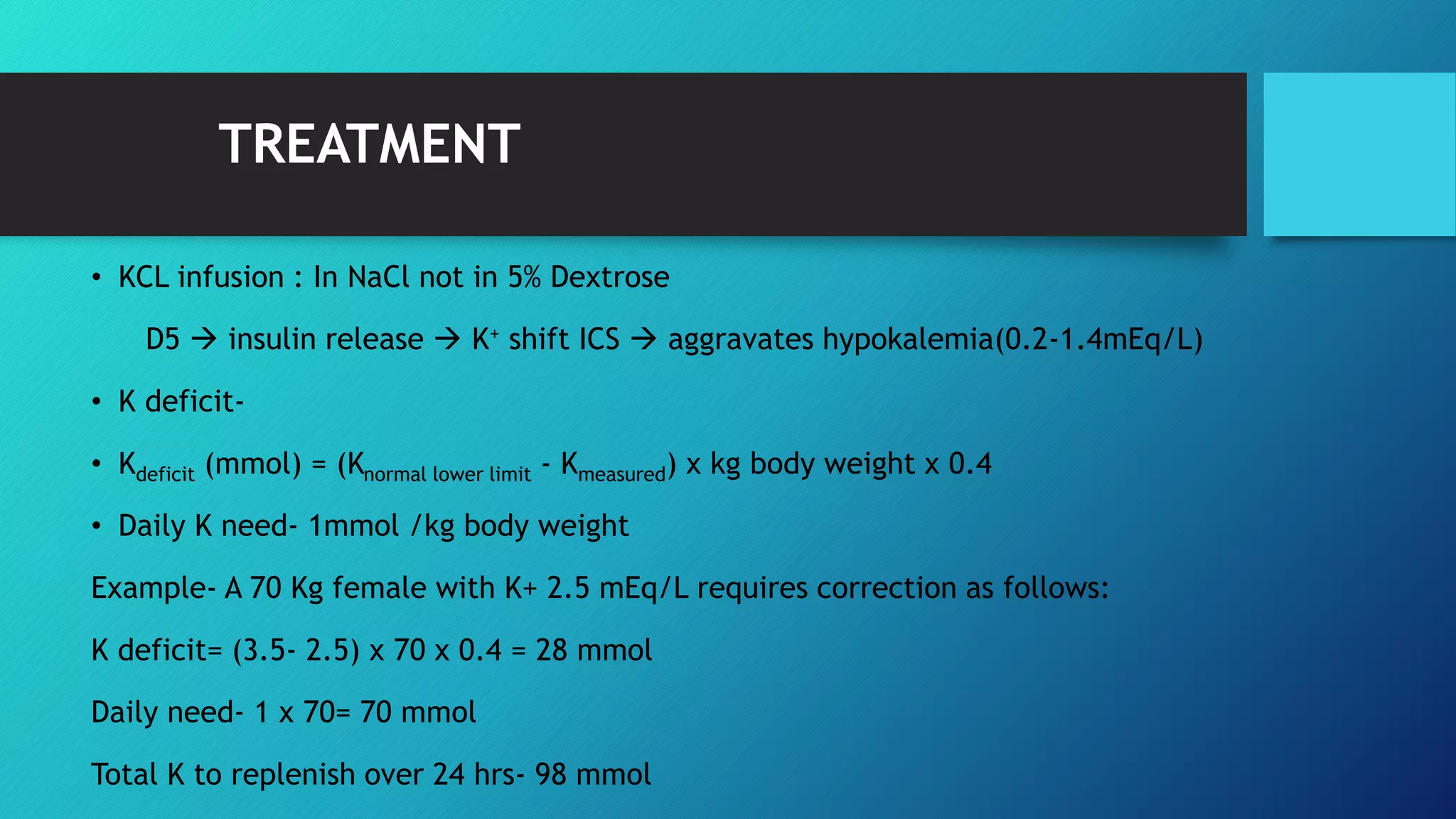
• KCL infusion : In NaCl not in 5% Dextrose
D5  insulin release  K+ shift ICS  aggravates hypokalemia(0.2-1.4mEq/L)
• K deficit-
• Kdeficit (mmol) = (Knormal lower limit - Kmeasured) x kg body weight x 0.4
• Daily K need- 1mmol /kg body weight
Example- A 70 Kg female with K+ 2.5 mEq/L requires correction as follows:
K deficit= (3.5- 2.5) x 70 x 0.4 = 28 mmol
Daily need- 1 x 70= 70 mmol
Total K to replenish over 24 hrs- 98 mmol
HYPERKALEMIA (K+ > 5.5mEq/L)
 Etiology
•Increased intake
o I.V fluids containing potassium- RL (4.0 mEq/L), Isolyte M
(35mEq/L)
o Transfusion of blood stored for prolonged periods
o High potassium containing foods
o Potassium containing Drugs- spironolactone
HYPERKALEMIA
• Tissue breakdown
Hemolysis, Rhabdomyolysis
Catabolic State
• Shift of potassium
Tissue damage
Metabolic acidosis
Uncontrolled Diabetes due to insulin deficiency
Hyperkalemic periodic paralysis, Succinylcholine
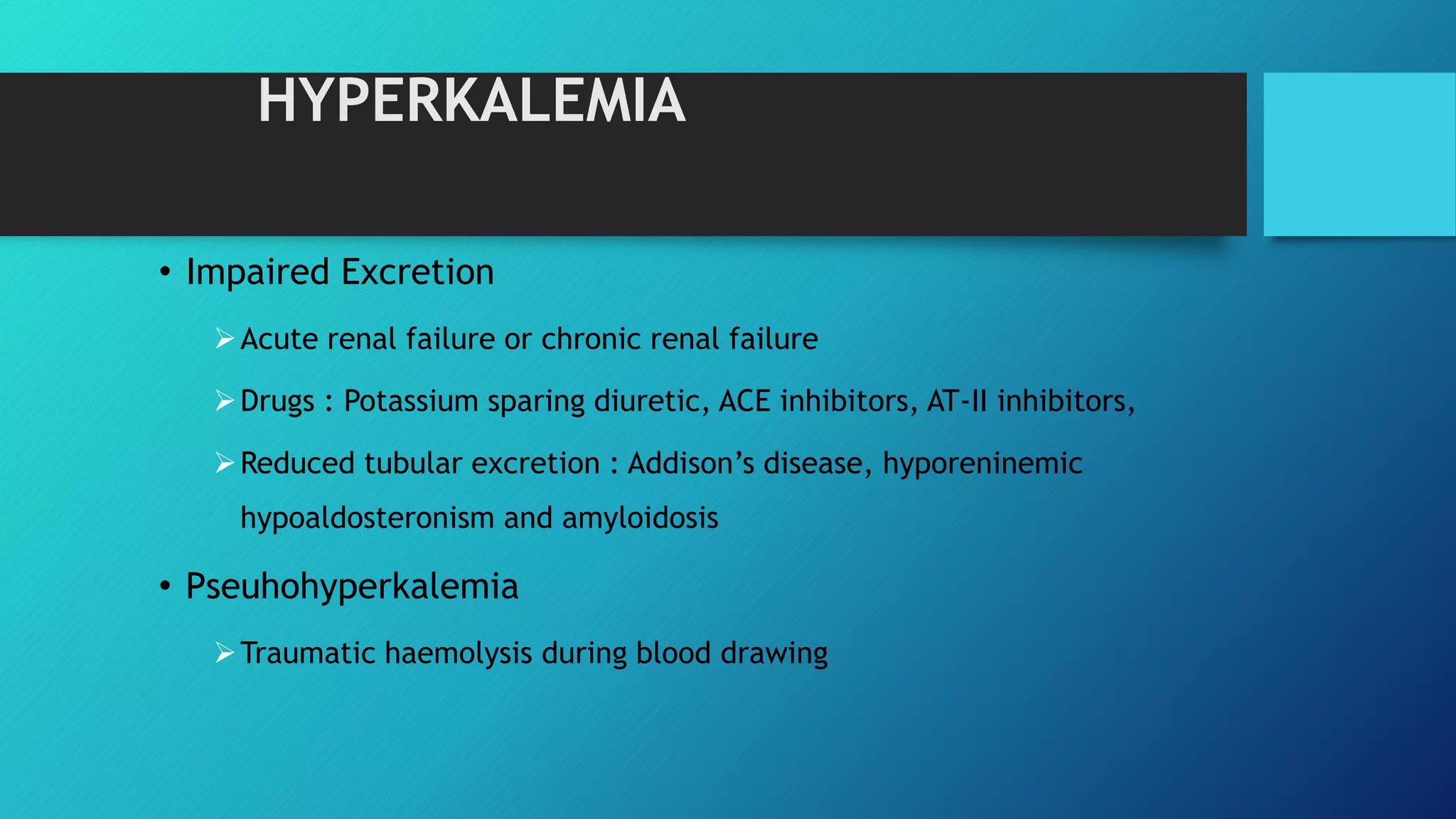
• Impaired Excretion
Acute renal failure or chronic renal failure
Drugs : Potassium sparing diuretic, ACE inhibitors, AT-II inhibitors,
Reduced tubular excretion : Addison’s disease, hyporeninemic
hypoaldosteronism and amyloidosis
• Pseuhohyperkalemia
Traumatic haemolysis during blood drawing
HYPERKALEMIA
CLINICAL FEATURES
 Muscle weakness  hyporeflexia  paralysis
affecting legs, trunk and arms (in that order) and
at last respiratory muscles.
Cardiac Arrythmia
6-7 mEq/L : Tall peaked T waves
7-8 mEq/L : loss of P waves, widening of QRS complex
8-10 mEq/L: QRS merges with T waves forming sine wave
 >9mEq/L : AV dissociation,
Ventricular tachycardia or
fibrillation , Diastolic arrest.
Severe elevation (7 mEq/L with toxic ECG changes)
• Calcium Gluconate 10% 10-20ml over 5-10mins
to reduce the effects of potassium at the myocardial cell
membrane (lowers risk of ventricular fibrillation)
Onset of action- few min
Avoid if patient is on digitalis.
TREATMENT
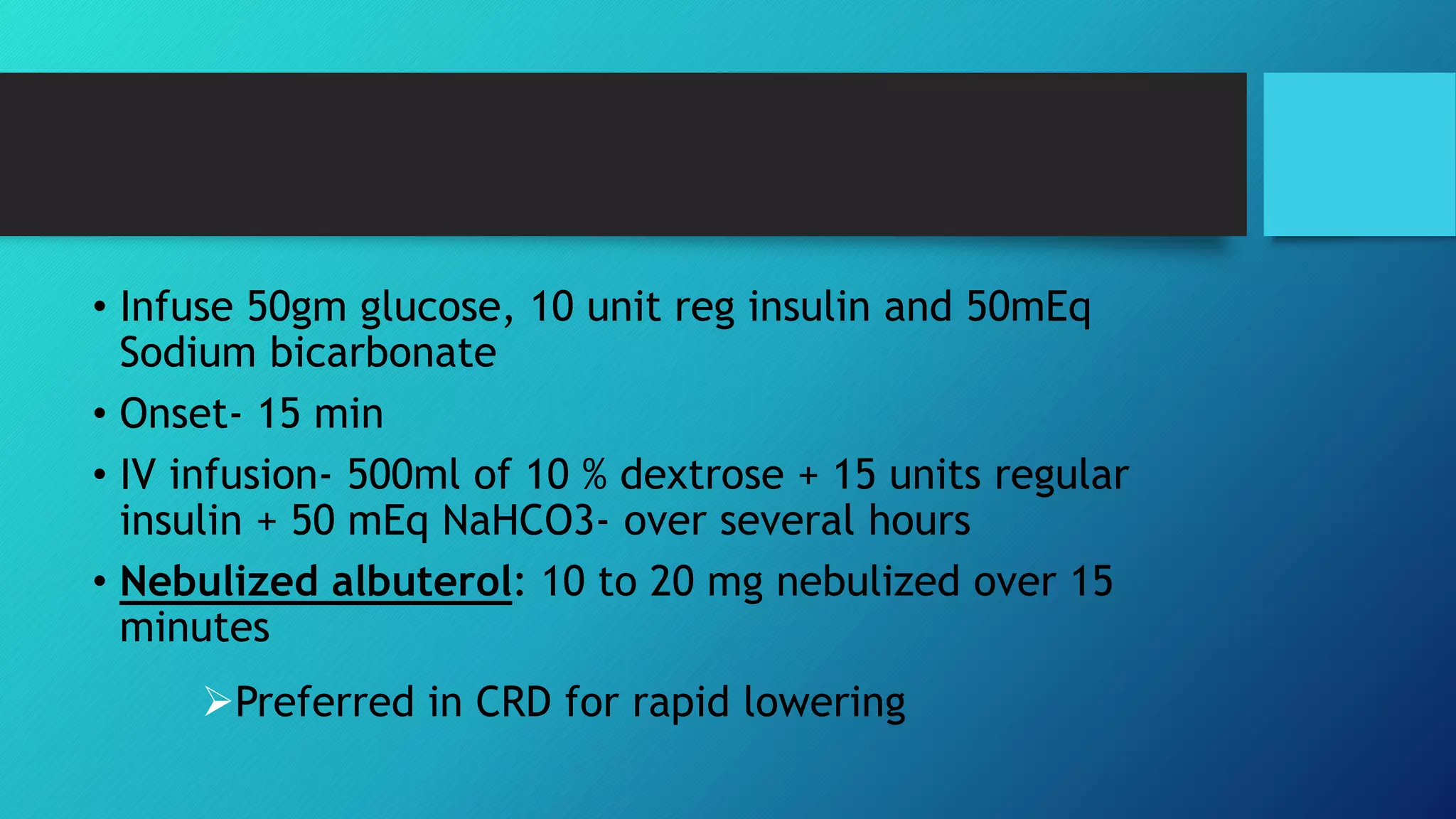
• Infuse 50gm glucose, 10 unit reg insulin and 50mEq
Sodium bicarbonate
• Onset- 15 min
• IV infusion- 500ml of 10 % dextrose + 15 units regular
insulin + 50 mEq NaHCO3- over several hours
• Nebulized albuterol: 10 to 20 mg nebulized over 15
minutes
Preferred in CRD for rapid lowering
• Na Polystyrene sulfonate (Kayexalate) by mouth, NG tube
(20-40 gm every 2-4 hrs)
• - ion exchange resin, that removes K by binding K and
releasing Na into body fluids
• Hemodialysis
…TREATMENT
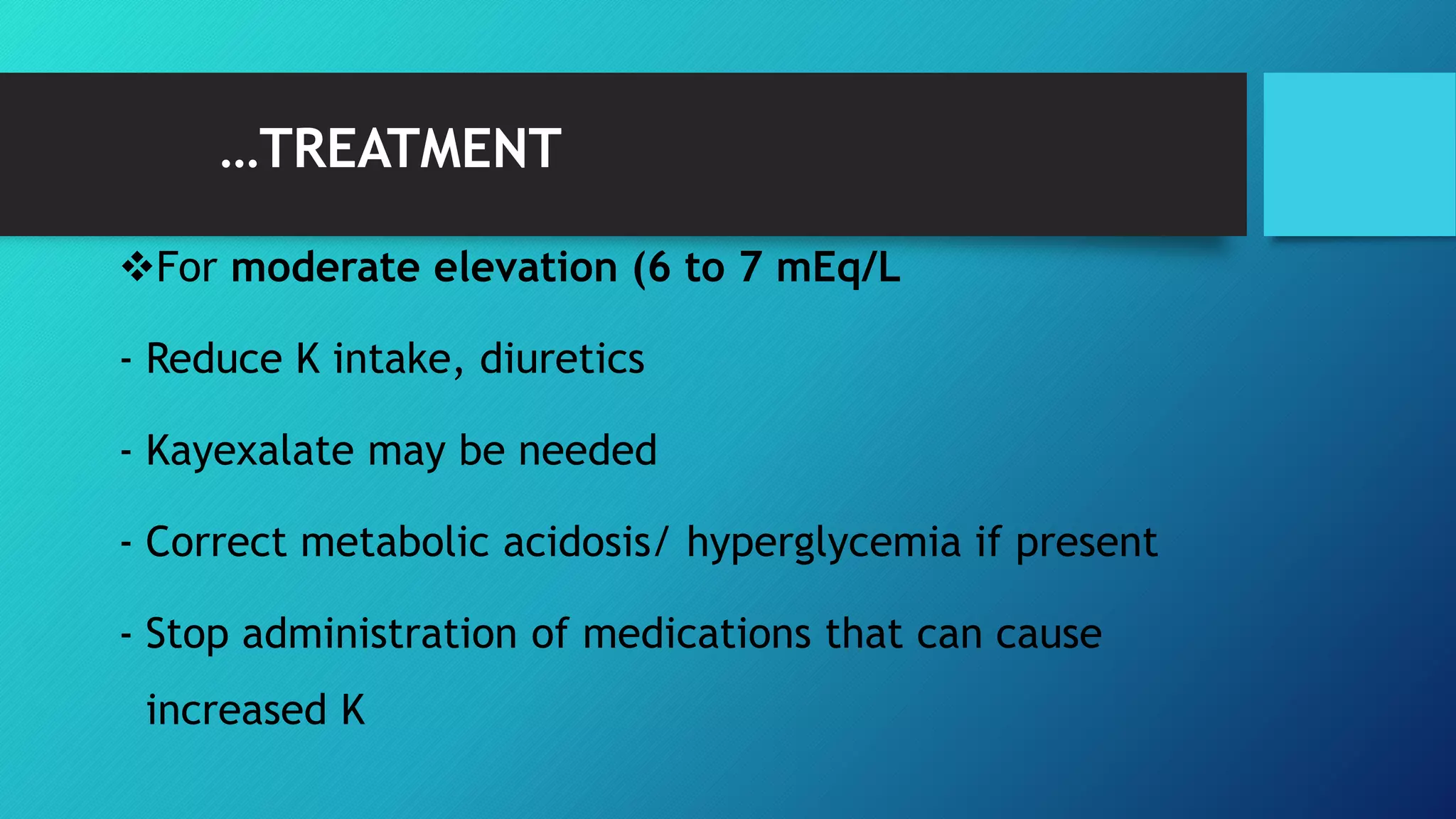
For moderate elevation (6 to 7 mEq/L
- Reduce K intake, diuretics
- Kayexalate may be needed
- Correct metabolic acidosis/ hyperglycemia if present
- Stop administration of medications that can cause
increased K
CALCIUM
8-12 mg/dl
99% present in bones, 1% in cells and 0.15% in ECF.
40% bound to Plasma proteins
Unbound form or ionized- physiologic activity
Total calcium- measure of both bound and unbound
form
Mediates :Muscle contraction and nerve conduction
Functions in coagulation cascade
• PTH major hormone effecting Ca homeostasis (with
presence of Vit D)
HYPOCALCEMIA Ca <8-8.5mg/dl)
• Weakness
• Circumoral and distal paraesthesia
• Muscle spasm : carpopedal spasm, tetany.
• Mental changes: irritability, depression and psychosis.
• ECG- prolonged QT interval- can lead to heartblock or VF
CHOVSTEK’S SIGN
TROUSSEAU’S SIGN
ECG CHANGES
Causes
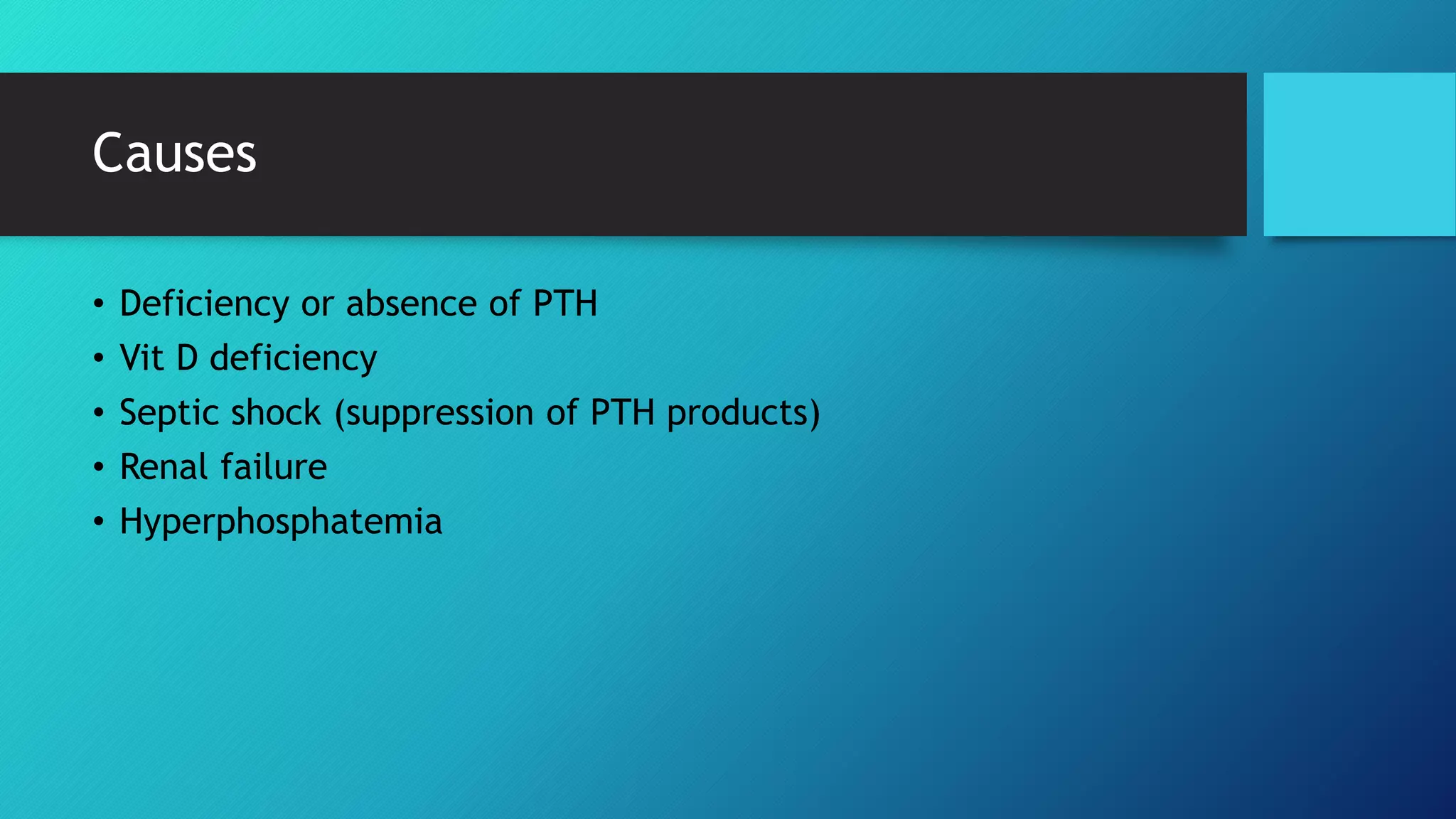
• Deficiency or absence of PTH
• Vit D deficiency
• Septic shock (suppression of PTH products)
• Renal failure
• Hyperphosphatemia
TREATMENT
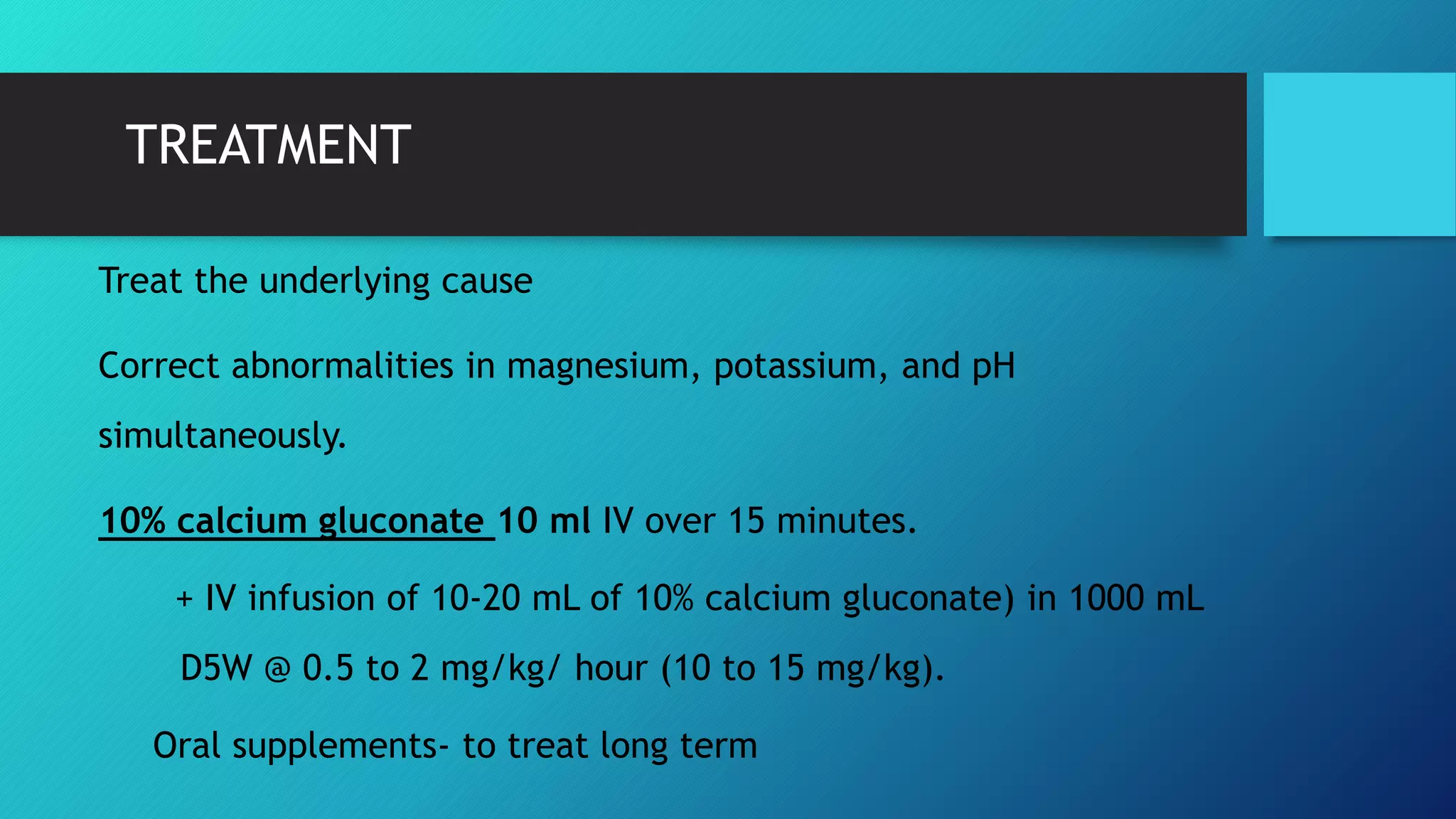
Treat the underlying cause
Correct abnormalities in magnesium, potassium, and pH
simultaneously.
10% calcium gluconate 10 ml IV over 15 minutes.
+ IV infusion of 10-20 mL of 10% calcium gluconate) in 1000 mL
D5W @ 0.5 to 2 mg/kg/ hour (10 to 15 mg/kg).
Oral supplements- to treat long term
HYPERCALCEMIA
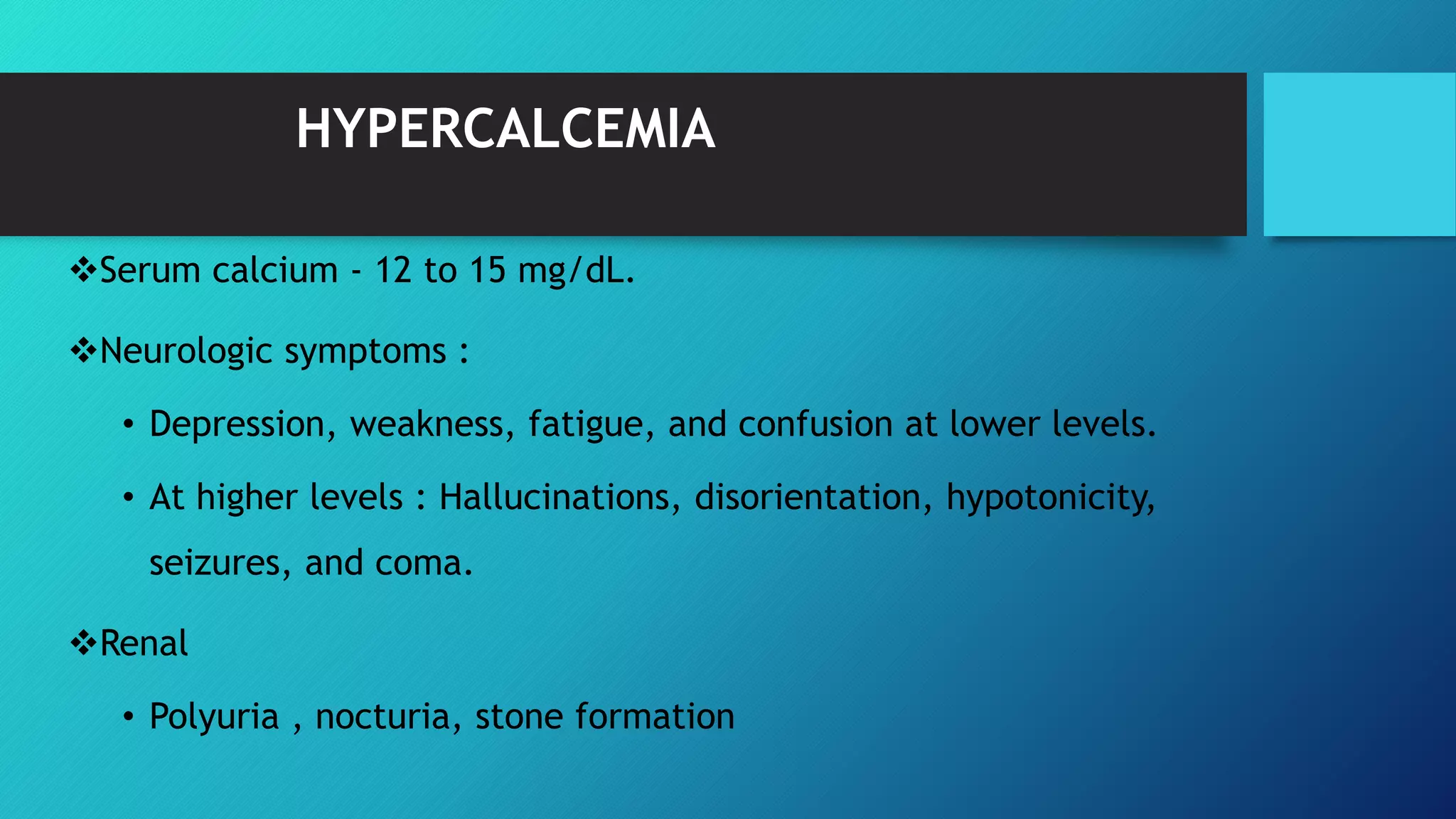
Serum calcium - 12 to 15 mg/dL.
Neurologic symptoms :
• Depression, weakness, fatigue, and confusion at lower levels.
• At higher levels : Hallucinations, disorientation, hypotonicity,
seizures, and coma.
Renal
• Polyuria , nocturia, stone formation
CLINICAL FEATURES
 Gastrointestinal symptoms:
• Dysphagia, Constipation, peptic ulcers, and pancreatitis
 Cardiovascular symptoms:
• Upto 15mg/dl myocardial contractility increases
• The QT interval typically shortens when the serum calcium is> 13mg/dL.
• PR and QRS intervals are prolonged.
• AV block may develop and progress to complete heartblock and even
cardiac arrest when the total serum calcium is > 15 to 20 mg/dL.
• Hypercalcemia can worsen digitalis toxicity and may cause hypertension.
Causes
• Hyperparathyroidism
• Thiazide diuretics, Vit D intoxication
• Malignancy
• - increased bone resorption and decreased renal excretion
• -metastasis to bones- increase in osteoclastic activity
TREATMENT
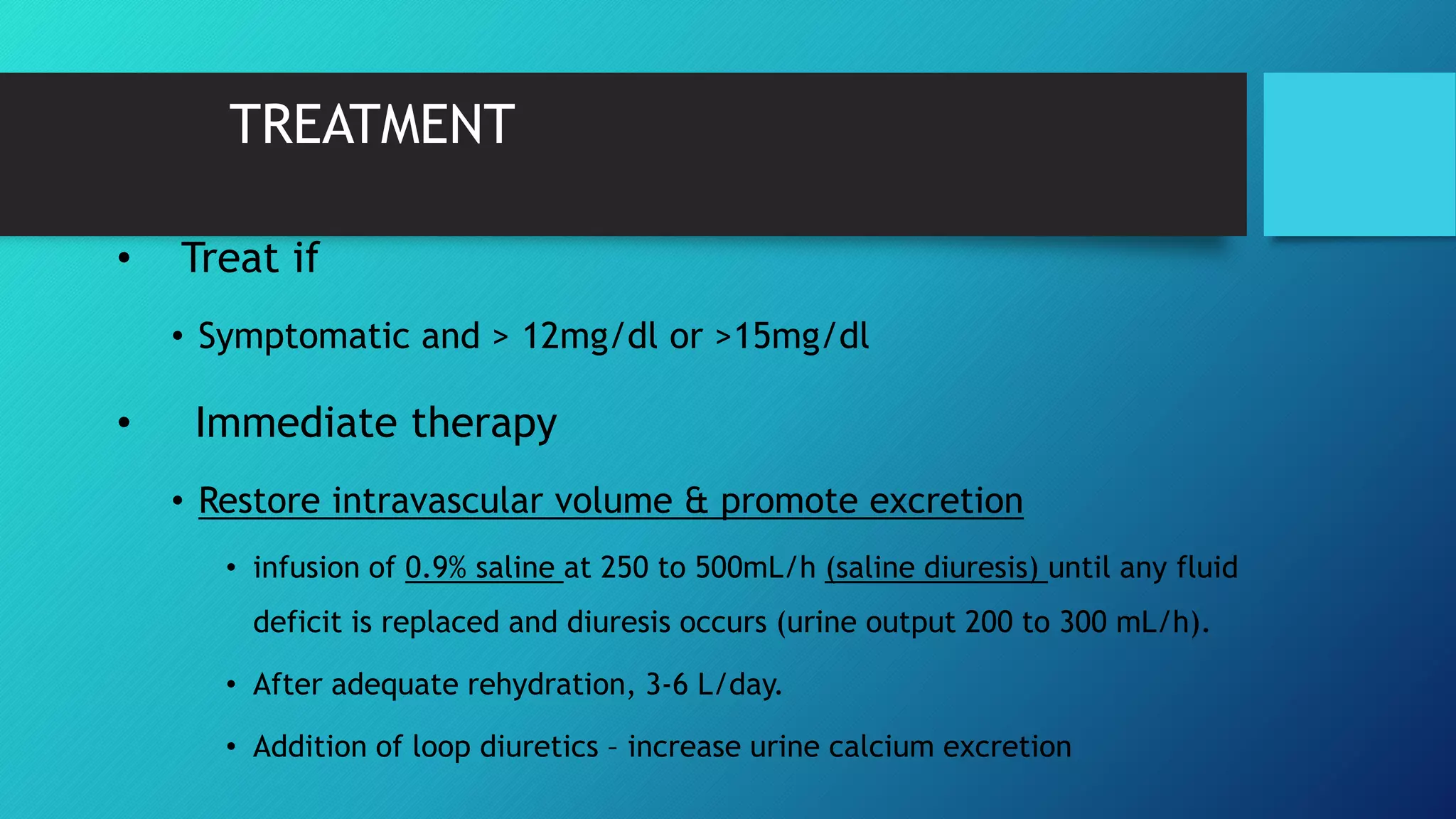
• Treat if
• Symptomatic and > 12mg/dl or >15mg/dl
• Immediate therapy
• Restore intravascular volume & promote excretion
• infusion of 0.9% saline at 250 to 500mL/h (saline diuresis) until any fluid
deficit is replaced and diuresis occurs (urine output 200 to 300 mL/h).
• After adequate rehydration, 3-6 L/day.
• Addition of loop diuretics – increase urine calcium excretion
TREATMENT
Biphosphonates – inhibit osteoclast precursors
Eg- Etidronate Disodium, pamidronate, zoledronic acid
Calcitonin- inhibit renal excretion of calcium and inhibits
osteoclastic activity
Glucocorticoids- decrease intestinal absorption of Ca, promote
urinary excretion
MAGNESIUM
Magnesium is the fourth most common mineral
second most abundant intracellular cation
Normal serum Mg2+ 1.2 – 2.2mg/dl
Magnesium is necessary for the
• movement of sodium, potassium, and calcium into and out of cells
• magnesium plays an important role in stabilizing excitable membranes.
• Enzyme co-factor in protein and carbohydrate metabolism
Reabsorbed in ascending limb of Loop of Henle, less in PCT and DT
Obstetric practice
• Powerful tocolytic – Manage premature labour.
• Prophylaxis and treatment of eclampsia.
HYPOMAGNESEMIA <1.8mg/dl
Result from decreased GI absorption due to chronic diarrhea,
malabsorption , NG suction
Muscular tremors and fasciculations, Tetany
Altered mental state
Cardiac arrhythmias such as torsades de pointes.
Often seen together with hypocalcemia, hypokalemia
ECG findings- prolonged PT and QT intervals
TREATMENT
For severe or symptomatic hypomagnesemia:
1 to 2 g of IV MgSO4 over 5 to 20 minutes.
• Followed by continuous infusion of 1mEq/kg/24hours.
For seizures (Eclampsia) – loading dose 4 g IV MgSO4 (20%) over 5
mins followed by 10 gm MgSO4( 50%) deep IM
Maintenance- 5gm MgSO4 (50%) IM 4 hrly
Administration of calcium is usually appropriate because most
patients with hypomagnesemia are also hypocalcemic.
 Caution and monitoring MgSO4 therapy
• Check deep tendon reflex every 15mins (knee jerk)
• Periodic monitoring of serum Mg concentration.
• Reduce dose in renal failure.
• Contraindicated in heart block or extreme myocardial damage
• Maintain urine output – >30ml/hr
• Overtreatment  10% calcium gluconate 10-20ml followed by
fluid loading and diuretics.
TREATMENT
HYPERMAGNESEMIA (>3mg/dl)
 Etiology
• Renal failure patients : most common cause
• Treatment of pre-eclampsia with I.V MgSO4.
• Therapy with Mg containing antacids,
laxatives.
CLINICAL FEATURES
• Nausea vomiting, somnolence
• Muscular weakness muscular paresis leading to respiratory
depression and respiratory failure.
• Hypotension: peripheral vasodilatation
• Bradyarrhythmia, asystole
• ECG changes- Prolonged PR interval, QRS duration and QT
interval, Complete heart block
TREATMENT
Eliminate source
10% calcium gluconate 10-20 ml IV over 10 min
IV saline diuresis (administration of IV normal saline and furosemide
[1 mg/kg]) can be used to increase renal excretion of magnesium until
dialysis can be performed.
Dialysis is the treatment of choice for severe hypermagnesemia.
Artificial respiration
PHOSPHORUS
3-4.5 mg/dl
Major Buffer anion for ICF & ECF
• Rapid shifting can occur
Functions
• Muscle, red blood cells & nervous system
• Maintains acid-base balance
Adequate renal function necessary to maintain normal balance by PTH
 90% excreted by kidneys
HYPOPHOSPHATEMIA<2.5mg/dl
• Paresthesia, Muscle pain/weakness
• Confusion/coma
• Causes- malabsorption, Vit D deficiency,
Hyperparathyrodism
TREATMENT
Diet/supplements (mild)
IV replacement (severe)- infusion 2.5 – 5 mg
elemental phosp/ kg every 6 hrs
• Concomitant Ca supplements
HYPERPHOSPHATEMIA (> 4.5mg/dl)
• Tachycardia, Restlessness
• Anorexia, Nausea and vomiting
• Tetany, Tingling & numbness of fingers/lips
• Muscle spasms
• Causes- renal failure, rhabdomyolysis, tumor lysis
syndrome, hypoparathyroidism
TREATMENT
Diet restrictions
Administer phosphate binding products
• Calcium acetate and calcium carbonate or aluminum
hydroxide
Dialysis in severe renal failure.
FLUID AND ELECTROLYTES IN POST OPERATIVE
PERIOD
• After surgery modification in normal physiology of fluid
and electrolytes balance.
• ACUTE STRESS increased sympathetic stimuli-
tachycardia, vasoconstriction & stress.
• Increased ACTH stimulate adrenal gland
• --secretes large amount of hydrocortisone to fight acute
stress and aldosterone which leads to Na retention and
urinary loss of K.
• Increased ADH secretion causes water retention ,
reduction in U.O to as low as 500 ml on 1st post op day.
• NPO status leads to hypovolemia prior to surgery, pt
becomes hypotensive during surgery & anaesthesia.
• Fluid loss
• Surgical stress or direct damage of kidney, brain ,lung ,
skin or GI tract.
Goal of fluid therapy
• Aim to maintain
• B.P >100/70 mm of Hg
• Pulse rate of less than 120 bpm
• Hourly U.O between 30 and 50 ml
• Normal temperature, warm skin , normal respiration and
sensorium.
When and how long to give post-op iv fluid ?
• Short operative procedure ( no handling of intestine or viscera )
– maintenance i.v fluid to correct deficit due to NPO state.
• After 4-5 hours oral fluid is restarted & iv fluid is not needed.
• Major surgeries ( handling of intestinal viscera ) – requires post
op iv fluid for few days.
• After ensuring normal movement of intestine oral fluid intake is
restarted.
• Major surgery ( handling of intestinal viscera not done )
• Most of OBS/GYNE surgeries – I.V fluid is required for only 24 to 48
hrs.
Factors to consider for post op iv fluid
• Age , weight , vital data, hydration status and U.O.
• Nature of surgery, blood loss , nature and vol of fluid and
blood replaced intraoperatively.
• Drain output , fluid lost at operative site.
• Renal status, associated illness ( HT,DM) and associated
electrolytes and acid base disorders, if any.
• Insensible loss due to atmospheric temp, pyrexia,
hyperventilation etc.
On the 1st post op day
Increased ADH and aldosterone secretion –salt and fluid
retention by the kidney .
K is avoided in I.V fluids
So preferred- 5% dextrose, isotonic saline
• Maintenance fluid - steady rate over an 18 to 24 hrs
period.
Volume Excess
• Blood excess – pulmonary congestion.
• Saline excess- weight gain, periorbital puffiness,
hoarseness or dysnoea on exertion.
• Hypotonic fluid excess ( 5% dextrose) – hyponatremia
Fluid volume deficit
• Decreased U.O < 30 ml/hr
• Postural hypotension
• Tachycardia
• Diminished skin turgor
• Decreased capillary refill time
• Inc BUN out of proportion to creatinine
TREATMENT
Depends on the type of fluid lost , can be done with isotonic solutions –NS or LR.
Electrolyte Imbalances
• Hyponatremia-
• Excess ADH- retention of water In excess of sodium.
• Excess 5% dextrose
• Water administration consistently which exceeds water loss.
• Nausea without vomiting, drowsy, weak, confused or gets convulsion.
TREATMENT
Avoid using hypotonic solution.
Avoid excessive use of electrolyte free solutions during the first 2-4 post
op days.
• Hypokalemia – most common
• Lost through urine or GI.
• Post op infusion of mannitol or diuretics.
• Prolonged administration of potassium free i.v fluids.
• Extreme weakness , muscular hypotonia , paralytic ileus.
Treatment
Daily supplement 60 -100 mEq QD.
• Hypernatremia and Hyperkalemia – Uncommon
Fluid management in Hypertension
• Strictly over 24 hrs and not faster.
• Sodium containing fluids cause water retention and rise in B.P
• Strict B.P monitoring should be done on 1st post op day.
• Furesemide will drop the b.p , increase the urine output but can
cause disturbance in electrolyte levels.
Fluid management in Diabetes
• high chances of development of diabetic ketoacidosis.
• Avoid using dextrose on 1st post op day as already due to
excess glucocorticoids the level of glucose is on the
higher side.
• GKI drip.
References
• Te linde’s Operative Gynecology, 11th Edition
• UpToDate.com
Thank you

Electrolyte and post op fluid requirement

  • 1.
  • 2.
    Copyright 2009, JohnWiley & Sons, Inc. Body Fluid Compartments
  • 3.
    Electrolytes • solutes thatare found in various concentrations and measured in terms of milliequivalent (mEq) units • Can be negatively charged (anions) or positively charged (cations)
  • 4.
    Sodium Na+ • 135-145mEq/L •Major Cation, Chief electrolyte of the ECF Determines ECF & ICF Osmolality Serum osmolality = 2x Na+ + glucose/18 + urea/2.8 Normal – 275-290mOsm/kg • Regulates volume of body fluids • Needed for nerve impulse & muscle fiber transmission (Na/K pump) • Regulated by kidneys/ hormones
  • 5.
    HYPONATREMIA (Na+< 135mEq/L+) ETIOLOGY HypervolemicEuvolemic •CHF •Cirrhosis •Renal Failure • Excessive administration of hypotonic fluids •Psychogenic polydipsia •SIADH •Drugs •Withdrawal of gluococorticoids •Pseudo hyponatremia
  • 6.
    Hypovolemic Renal Na conservation (urineNa+ <20mEq/L ) Extra renal loss •GI losses- vomiting, diarrhea •Skin losses- sweating, burn Renal Na wasting (urine Na+ >20mEq/L) •CRD •Excessive diuretics •Salt losing nephropathy •Adrenal insufficiency
  • 7.
    • Mild 135-130mEq/L • Anorexia, Headache, Nausea, Vomiting, lethargy • Moderate 130-125 mEq/L • Personality Changes, Muscle Cramp Muscular weakness Confusion, Ataxia • Severe <125mEq/L • Drowsiness, Diminished reflexes, Convulsions,Coma, Death
  • 8.
    TREATMENT HYPONATREMIA (correct underlyingetiology) HYPOVOLEMIA HYPERVOLEMIA EUVOLEMIA Salt and water No salt Water restriction supplementation Water restriction Loop diuretics
  • 9.
    ACUTE hyponatremia withsevere neurological symptoms • Rapid correction with hypertonic saline 1 – 2mEq/L /hr until Na reaches 125 mEq/L Safe plasma Na+ concentration : 120-125mEq/L • Correction using 3% NaCL (513 mEq/L) • Na Requirement- 0.6 x total body weight x (desired Na – actual Na) TREATMENT
  • 10.
    TREATMENT Chronic asymptomatic hyponatremia(>48hrs): • Rate of correction - 0.5 to 1.0 mEq/L/hour. • MAX 8mEq/L per day. • Rapid correction  Central pontine demyelination Dysarthria, dysphagia, flaccid paralysis or coma Diagnosed by CT or MRI (more accurate)
  • 11.
    • Example- 71Kg woman with neurologic symptoms has serum Na 113 mEq/L, • correction to serum Na level of 125 is achieved as follows • 0.6 x 71 (weight) x (125- 113) = 511 mEq Na • Patient requires 1 L of 3% saline to increase the level by 12 mEq • Correction In 6-12 hrs appropriate •
  • 12.
    HYPERNATREMIA (Na+>145mEq/L) Etiology – Usually: water deficit Hypernatremia associated with formation of concentrated urine (U osm/ Posm >1.5 urine spc >1.015) • Excess nonrenal water loss- Hot environment, fever, hyperventilation- Urine output <35 ml/h • Solute diuresis- due to inadequate water intake owing to large volumes of renal solute excretion- Urine output >35 ml/h
  • 13.
    • Hypernatremia associatedwith formation of dilute urine (Uosm/Posm <1, sp gr <1.010) • Renal loss • Diabetes insipidus • central (ADH deficiency) urine (Uosm/Posm <0.5, sp gr <1.005) • Nephrogenic – • Renal tubular Damage- ability to concentrate or dilute the urine is decreased when water loss exceed water intake- hypernatremia
  • 14.
    CLINICAL FEATURES Polyuria andthirst Neurological symptoms: altered mental status, weakness, neuromuscular irritability, focal neurological deficit, seizures & coma  Hypertonicity  contracts ICF volume  brain cell volume  subarachnoid or intra-cerebral hemorrhage
  • 15.
    TREATMENT • Restoration ofECF volume using hypotonic solutions • Water deficit : Plasma Na+ concentration – 140 140 • Rate of correction : 0.5mEq/L/hr and not more than 10-12 mEq/l over 24 hours X total body water
  • 16.
    POTASSIUM (K+) 3.5- 5.5mEq/L Determines excitability of nerves and muscle cells including the myocardium. Most abundant intracellular cation: 98% intracellular.
  • 17.
    Poor intake Nonrenal loss Renal loss Redistribution •Anorexia •Starvation •alcoholism •Vomiting •diarrhea •nasogastric aspiration •Diuretics •osmotic diuresis • salt wasting nephropathy • Mineralocorticoid excess (primary or secondary), Cushing’s syndrome, • Steroid therapy •Drugs- Gentamicin or Amphotericin B Metabolic alkalosis, insulin, β2 agonist, Hypokalemic periodic paralysis, Hypokalemia (K+ < 3.5mEq/L)
  • 18.
    Clinical Features • Commonly: Fatigue, myalgia and muscular weakness of lower extremity • Smooth Muscle : Constipation, ileus or urinary retention • Progressive weakness, hyporeflexia, hypoventilation( due to respiratory muscle involvement)
  • 19.
    Early changes Flattening orinversion of T waves Prominent U waves ST segment depression Prolonged QT interval Flattening of T waves
  • 20.
    SEVERE HYPOKALEMIA • ProlongedPR interval • Decreased voltage • Widening of QRS • Ventricular arrythmia :VPC, ventricular tachycardia
  • 21.
    TREATMENT 3.5 to 4mEq/L : • No potassium supplementation • Add potassium sparing diuretics or decrease dose of diuretics 3 to 3.5 mEq/L : • Treat in high risk groups <3 mEq/L : • Needs definitive treatment
  • 22.
    IV KCl Therapy Reserved for symptomatic and severe cases Common Guidelines • Don’t give > 10- 20 mEq/L/ hour (typically 0.5mEq/kg/hr) • Don’t give more than 240mEq/ day • Continuous ECG monitoring required if using higher rate • Use oral replacement whenever possible
  • 23.
    TREATMENT • KCL infusion: In NaCl not in 5% Dextrose D5  insulin release  K+ shift ICS  aggravates hypokalemia(0.2-1.4mEq/L) • K deficit- • Kdeficit (mmol) = (Knormal lower limit - Kmeasured) x kg body weight x 0.4 • Daily K need- 1mmol /kg body weight Example- A 70 Kg female with K+ 2.5 mEq/L requires correction as follows: K deficit= (3.5- 2.5) x 70 x 0.4 = 28 mmol Daily need- 1 x 70= 70 mmol Total K to replenish over 24 hrs- 98 mmol
  • 24.
    HYPERKALEMIA (K+ >5.5mEq/L)  Etiology •Increased intake o I.V fluids containing potassium- RL (4.0 mEq/L), Isolyte M (35mEq/L) o Transfusion of blood stored for prolonged periods o High potassium containing foods o Potassium containing Drugs- spironolactone
  • 25.
    HYPERKALEMIA • Tissue breakdown Hemolysis,Rhabdomyolysis Catabolic State • Shift of potassium Tissue damage Metabolic acidosis Uncontrolled Diabetes due to insulin deficiency Hyperkalemic periodic paralysis, Succinylcholine
  • 26.
    • Impaired Excretion Acuterenal failure or chronic renal failure Drugs : Potassium sparing diuretic, ACE inhibitors, AT-II inhibitors, Reduced tubular excretion : Addison’s disease, hyporeninemic hypoaldosteronism and amyloidosis • Pseuhohyperkalemia Traumatic haemolysis during blood drawing HYPERKALEMIA
  • 27.
    CLINICAL FEATURES  Muscleweakness  hyporeflexia  paralysis affecting legs, trunk and arms (in that order) and at last respiratory muscles.
  • 28.
    Cardiac Arrythmia 6-7 mEq/L: Tall peaked T waves 7-8 mEq/L : loss of P waves, widening of QRS complex 8-10 mEq/L: QRS merges with T waves forming sine wave  >9mEq/L : AV dissociation, Ventricular tachycardia or fibrillation , Diastolic arrest.
  • 29.
    Severe elevation (7mEq/L with toxic ECG changes) • Calcium Gluconate 10% 10-20ml over 5-10mins to reduce the effects of potassium at the myocardial cell membrane (lowers risk of ventricular fibrillation) Onset of action- few min Avoid if patient is on digitalis. TREATMENT
  • 30.
    • Infuse 50gmglucose, 10 unit reg insulin and 50mEq Sodium bicarbonate • Onset- 15 min • IV infusion- 500ml of 10 % dextrose + 15 units regular insulin + 50 mEq NaHCO3- over several hours • Nebulized albuterol: 10 to 20 mg nebulized over 15 minutes Preferred in CRD for rapid lowering
  • 31.
    • Na Polystyrenesulfonate (Kayexalate) by mouth, NG tube (20-40 gm every 2-4 hrs) • - ion exchange resin, that removes K by binding K and releasing Na into body fluids • Hemodialysis
  • 32.
    …TREATMENT For moderate elevation(6 to 7 mEq/L - Reduce K intake, diuretics - Kayexalate may be needed - Correct metabolic acidosis/ hyperglycemia if present - Stop administration of medications that can cause increased K
  • 33.
    CALCIUM 8-12 mg/dl 99% presentin bones, 1% in cells and 0.15% in ECF. 40% bound to Plasma proteins Unbound form or ionized- physiologic activity Total calcium- measure of both bound and unbound form
  • 34.
    Mediates :Muscle contractionand nerve conduction Functions in coagulation cascade • PTH major hormone effecting Ca homeostasis (with presence of Vit D)
  • 35.
    HYPOCALCEMIA Ca <8-8.5mg/dl) •Weakness • Circumoral and distal paraesthesia • Muscle spasm : carpopedal spasm, tetany. • Mental changes: irritability, depression and psychosis. • ECG- prolonged QT interval- can lead to heartblock or VF
  • 36.
  • 37.
  • 38.
  • 39.
    Causes • Deficiency orabsence of PTH • Vit D deficiency • Septic shock (suppression of PTH products) • Renal failure • Hyperphosphatemia
  • 40.
    TREATMENT Treat the underlyingcause Correct abnormalities in magnesium, potassium, and pH simultaneously. 10% calcium gluconate 10 ml IV over 15 minutes. + IV infusion of 10-20 mL of 10% calcium gluconate) in 1000 mL D5W @ 0.5 to 2 mg/kg/ hour (10 to 15 mg/kg). Oral supplements- to treat long term
  • 41.
    HYPERCALCEMIA Serum calcium -12 to 15 mg/dL. Neurologic symptoms : • Depression, weakness, fatigue, and confusion at lower levels. • At higher levels : Hallucinations, disorientation, hypotonicity, seizures, and coma. Renal • Polyuria , nocturia, stone formation
  • 42.
    CLINICAL FEATURES  Gastrointestinalsymptoms: • Dysphagia, Constipation, peptic ulcers, and pancreatitis  Cardiovascular symptoms: • Upto 15mg/dl myocardial contractility increases • The QT interval typically shortens when the serum calcium is> 13mg/dL. • PR and QRS intervals are prolonged. • AV block may develop and progress to complete heartblock and even cardiac arrest when the total serum calcium is > 15 to 20 mg/dL. • Hypercalcemia can worsen digitalis toxicity and may cause hypertension.
  • 43.
    Causes • Hyperparathyroidism • Thiazidediuretics, Vit D intoxication • Malignancy • - increased bone resorption and decreased renal excretion • -metastasis to bones- increase in osteoclastic activity
  • 44.
    TREATMENT • Treat if •Symptomatic and > 12mg/dl or >15mg/dl • Immediate therapy • Restore intravascular volume & promote excretion • infusion of 0.9% saline at 250 to 500mL/h (saline diuresis) until any fluid deficit is replaced and diuresis occurs (urine output 200 to 300 mL/h). • After adequate rehydration, 3-6 L/day. • Addition of loop diuretics – increase urine calcium excretion
  • 45.
    TREATMENT Biphosphonates – inhibitosteoclast precursors Eg- Etidronate Disodium, pamidronate, zoledronic acid Calcitonin- inhibit renal excretion of calcium and inhibits osteoclastic activity Glucocorticoids- decrease intestinal absorption of Ca, promote urinary excretion
  • 46.
    MAGNESIUM Magnesium is thefourth most common mineral second most abundant intracellular cation Normal serum Mg2+ 1.2 – 2.2mg/dl Magnesium is necessary for the • movement of sodium, potassium, and calcium into and out of cells • magnesium plays an important role in stabilizing excitable membranes. • Enzyme co-factor in protein and carbohydrate metabolism Reabsorbed in ascending limb of Loop of Henle, less in PCT and DT
  • 47.
    Obstetric practice • Powerfultocolytic – Manage premature labour. • Prophylaxis and treatment of eclampsia.
  • 48.
    HYPOMAGNESEMIA <1.8mg/dl Result fromdecreased GI absorption due to chronic diarrhea, malabsorption , NG suction Muscular tremors and fasciculations, Tetany Altered mental state Cardiac arrhythmias such as torsades de pointes. Often seen together with hypocalcemia, hypokalemia ECG findings- prolonged PT and QT intervals
  • 49.
    TREATMENT For severe orsymptomatic hypomagnesemia: 1 to 2 g of IV MgSO4 over 5 to 20 minutes. • Followed by continuous infusion of 1mEq/kg/24hours. For seizures (Eclampsia) – loading dose 4 g IV MgSO4 (20%) over 5 mins followed by 10 gm MgSO4( 50%) deep IM Maintenance- 5gm MgSO4 (50%) IM 4 hrly Administration of calcium is usually appropriate because most patients with hypomagnesemia are also hypocalcemic.
  • 50.
     Caution andmonitoring MgSO4 therapy • Check deep tendon reflex every 15mins (knee jerk) • Periodic monitoring of serum Mg concentration. • Reduce dose in renal failure. • Contraindicated in heart block or extreme myocardial damage • Maintain urine output – >30ml/hr • Overtreatment  10% calcium gluconate 10-20ml followed by fluid loading and diuretics. TREATMENT
  • 51.
    HYPERMAGNESEMIA (>3mg/dl)  Etiology •Renal failure patients : most common cause • Treatment of pre-eclampsia with I.V MgSO4. • Therapy with Mg containing antacids, laxatives.
  • 52.
    CLINICAL FEATURES • Nauseavomiting, somnolence • Muscular weakness muscular paresis leading to respiratory depression and respiratory failure. • Hypotension: peripheral vasodilatation • Bradyarrhythmia, asystole • ECG changes- Prolonged PR interval, QRS duration and QT interval, Complete heart block
  • 53.
    TREATMENT Eliminate source 10% calciumgluconate 10-20 ml IV over 10 min IV saline diuresis (administration of IV normal saline and furosemide [1 mg/kg]) can be used to increase renal excretion of magnesium until dialysis can be performed. Dialysis is the treatment of choice for severe hypermagnesemia. Artificial respiration
  • 54.
    PHOSPHORUS 3-4.5 mg/dl Major Bufferanion for ICF & ECF • Rapid shifting can occur Functions • Muscle, red blood cells & nervous system • Maintains acid-base balance Adequate renal function necessary to maintain normal balance by PTH  90% excreted by kidneys
  • 55.
    HYPOPHOSPHATEMIA<2.5mg/dl • Paresthesia, Musclepain/weakness • Confusion/coma • Causes- malabsorption, Vit D deficiency, Hyperparathyrodism
  • 56.
    TREATMENT Diet/supplements (mild) IV replacement(severe)- infusion 2.5 – 5 mg elemental phosp/ kg every 6 hrs • Concomitant Ca supplements
  • 57.
    HYPERPHOSPHATEMIA (> 4.5mg/dl) •Tachycardia, Restlessness • Anorexia, Nausea and vomiting • Tetany, Tingling & numbness of fingers/lips • Muscle spasms • Causes- renal failure, rhabdomyolysis, tumor lysis syndrome, hypoparathyroidism
  • 58.
    TREATMENT Diet restrictions Administer phosphatebinding products • Calcium acetate and calcium carbonate or aluminum hydroxide Dialysis in severe renal failure.
  • 59.
    FLUID AND ELECTROLYTESIN POST OPERATIVE PERIOD
  • 60.
    • After surgerymodification in normal physiology of fluid and electrolytes balance. • ACUTE STRESS increased sympathetic stimuli- tachycardia, vasoconstriction & stress. • Increased ACTH stimulate adrenal gland • --secretes large amount of hydrocortisone to fight acute stress and aldosterone which leads to Na retention and urinary loss of K.
  • 61.
    • Increased ADHsecretion causes water retention , reduction in U.O to as low as 500 ml on 1st post op day. • NPO status leads to hypovolemia prior to surgery, pt becomes hypotensive during surgery & anaesthesia. • Fluid loss • Surgical stress or direct damage of kidney, brain ,lung , skin or GI tract.
  • 62.
    Goal of fluidtherapy • Aim to maintain • B.P >100/70 mm of Hg • Pulse rate of less than 120 bpm • Hourly U.O between 30 and 50 ml • Normal temperature, warm skin , normal respiration and sensorium.
  • 63.
    When and howlong to give post-op iv fluid ? • Short operative procedure ( no handling of intestine or viscera ) – maintenance i.v fluid to correct deficit due to NPO state. • After 4-5 hours oral fluid is restarted & iv fluid is not needed. • Major surgeries ( handling of intestinal viscera ) – requires post op iv fluid for few days. • After ensuring normal movement of intestine oral fluid intake is restarted. • Major surgery ( handling of intestinal viscera not done ) • Most of OBS/GYNE surgeries – I.V fluid is required for only 24 to 48 hrs.
  • 64.
    Factors to considerfor post op iv fluid • Age , weight , vital data, hydration status and U.O. • Nature of surgery, blood loss , nature and vol of fluid and blood replaced intraoperatively. • Drain output , fluid lost at operative site. • Renal status, associated illness ( HT,DM) and associated electrolytes and acid base disorders, if any. • Insensible loss due to atmospheric temp, pyrexia, hyperventilation etc.
  • 65.
    On the 1stpost op day Increased ADH and aldosterone secretion –salt and fluid retention by the kidney . K is avoided in I.V fluids So preferred- 5% dextrose, isotonic saline • Maintenance fluid - steady rate over an 18 to 24 hrs period.
  • 67.
    Volume Excess • Bloodexcess – pulmonary congestion. • Saline excess- weight gain, periorbital puffiness, hoarseness or dysnoea on exertion. • Hypotonic fluid excess ( 5% dextrose) – hyponatremia
  • 68.
    Fluid volume deficit •Decreased U.O < 30 ml/hr • Postural hypotension • Tachycardia • Diminished skin turgor • Decreased capillary refill time • Inc BUN out of proportion to creatinine TREATMENT Depends on the type of fluid lost , can be done with isotonic solutions –NS or LR.
  • 69.
    Electrolyte Imbalances • Hyponatremia- •Excess ADH- retention of water In excess of sodium. • Excess 5% dextrose • Water administration consistently which exceeds water loss. • Nausea without vomiting, drowsy, weak, confused or gets convulsion. TREATMENT Avoid using hypotonic solution. Avoid excessive use of electrolyte free solutions during the first 2-4 post op days.
  • 70.
    • Hypokalemia –most common • Lost through urine or GI. • Post op infusion of mannitol or diuretics. • Prolonged administration of potassium free i.v fluids. • Extreme weakness , muscular hypotonia , paralytic ileus. Treatment Daily supplement 60 -100 mEq QD. • Hypernatremia and Hyperkalemia – Uncommon
  • 71.
    Fluid management inHypertension • Strictly over 24 hrs and not faster. • Sodium containing fluids cause water retention and rise in B.P • Strict B.P monitoring should be done on 1st post op day. • Furesemide will drop the b.p , increase the urine output but can cause disturbance in electrolyte levels.
  • 72.
    Fluid management inDiabetes • high chances of development of diabetic ketoacidosis. • Avoid using dextrose on 1st post op day as already due to excess glucocorticoids the level of glucose is on the higher side. • GKI drip.
  • 73.
    References • Te linde’sOperative Gynecology, 11th Edition • UpToDate.com
  • 74.