A.I.D.S.
A disease of human immune
system
Caused by H.I.V 1 or 2
Burden- 2007
33.2 million people with AIDS
2.5 million newly infected
2.1 million deaths
Transmission
Direct contact of mucous membrane or
skin with infected body fluids- blood,
semen, vaginal fluid, milk
HIVAIDS
Progressive damage to
CD4 +ve T-cells,
macrophages, dendritic/glial cells
Progression
Median time from HIV infection to
AIDS- 9-10 years
Median survival after AIDS-
9-10 months, untreated
Effects
Increased opportunistic infection
& cancers
Common OI
 TB, MAC infection
 PCP- Pneumocystis jirovecii
 Esophagitis- candida or viral
 Chronic diarrhea- bacterial, fungal, viral
 Toxoplasma encephalitis
 Cryptococcal meningitis
 Progressive multifocal leucoencephalopathy
 CMV retinitis
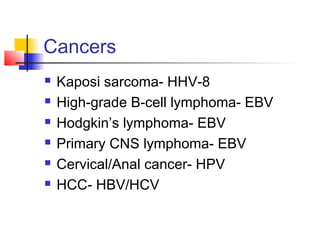
Cancers
 Kaposi sarcoma- HHV-8
 High-grade B-cell lymphoma- EBV
 Hodgkin’s lymphoma- EBV
 Primary CNS lymphoma- EBV
 Cervical/Anal cancer- HPV
 HCC- HBV/HCV
WHO staging
 Stage I- asymptomatic HIV infection
 Stage II- minor mucocutaneous
manifestations & recurrent URTI
 Stage III- unexplained weight loss/fever,
chronic diarrhea, severe bacterial infection,
pulmonary TB, low Hb/ANC/platelets
 Stage IV- other OI or cancers
 CDC- HIV +ve with CD4 T-cell <200
or <14% of all
lymphocytes
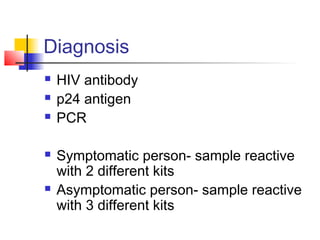
Diagnosis
 HIV antibody
 p24 antigen
 PCR
 Symptomatic person- sample reactive
with 2 different kits
 Asymptomatic person- sample reactive
with 3 different kits
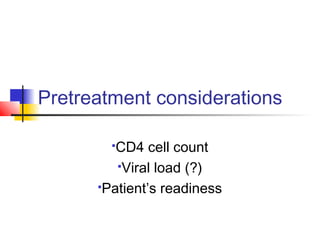
Pretreatment considerations
CD4 cell count
Viral load (?)
Patient’s readiness
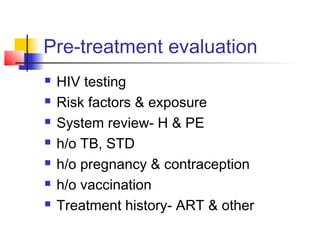
Pre-treatment evaluation
 HIV testing
 Risk factors & exposure
 System review- H & PE
 h/o TB, STD
 h/o pregnancy & contraception
 h/o vaccination
 Treatment history- ART & other
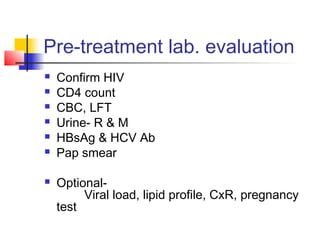
Pre-treatment lab. evaluation
 Confirm HIV
 CD4 count
 CBC, LFT
 Urine- R & M
 HBsAg & HCV Ab
 Pap smear
 Optional-
Viral load, lipid profile, CxR, pregnancy
test
Treatment
No cure or vaccine, yet.
HAART- highly active
anti-retroviral therapy
Goals of ART
 Clinical- prolongation of life &
improvement in quality of life
 Virological- greatest reduction in viral
load for as long as possible
 Immunological- immune reconstitution
 Therapeutic- rational drug use to
maximise benefit & avoid resistance
 Reduction of transmission
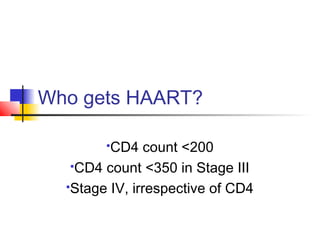
Who gets HAART?
CD4 count <200
CD4 count <350 in Stage III
Stage IV, irrespective of CD4
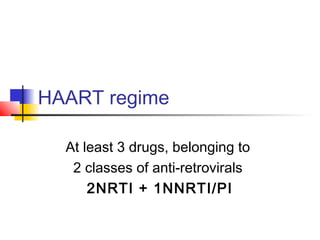
HAART regime
At least 3 drugs, belonging to
2 classes of anti-retrovirals
2NRTI + 1NNRTI/PI
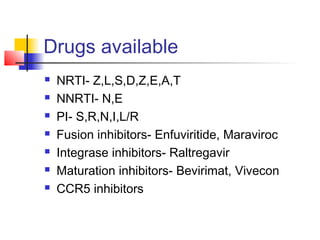
Drugs available
 NRTI- Z,L,S,D,Z,E,A,T
 NNRTI- N,E
 PI- S,R,N,I,L/R
 Fusion inhibitors- Enfuviritide, Maraviroc
 Integrase inhibitors- Raltregavir
 Maturation inhibitors- Bevirimat, Vivecon
 CCR5 inhibitors
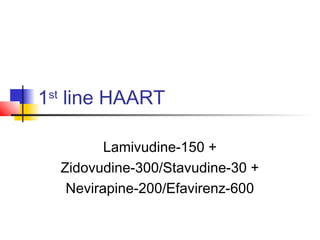
1st
line HAART
Lamivudine-150 +
Zidovudine-300/Stavudine-30 +
Nevirapine-200/Efavirenz-600
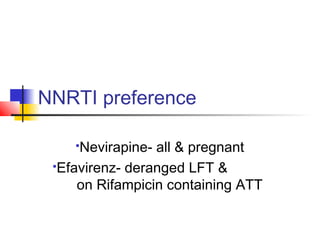
NNRTI preference
Nevirapine- all & pregnant
Efavirenz- deranged LFT &
on Rifampicin containing ATT
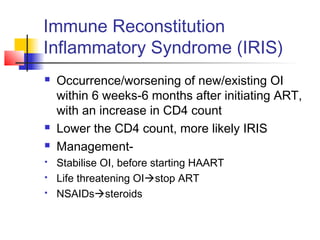
Immune Reconstitution
Inflammatory Syndrome (IRIS)
 Occurrence/worsening of new/existing OI
within 6 weeks-6 months after initiating ART,
with an increase in CD4 count
 Lower the CD4 count, more likely IRIS
 Management-
 Stabilise OI, before starting HAART
 Life threatening OIstop ART
 NSAIDssteroids
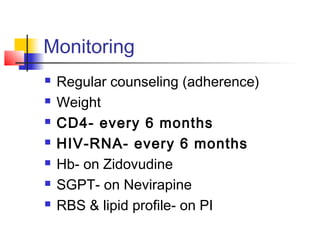
Monitoring
 Regular counseling (adherence)
 Weight
 CD4- every 6 months
 HIV-RNA- every 6 months
 Hb- on Zidovudine
 SGPT- on Nevirapine
 RBS & lipid profile- on PI
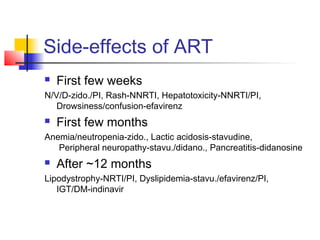
Side-effects of ART
 First few weeks
N/V/D-zido./PI, Rash-NNRTI, Hepatotoxicity-NNRTI/PI,
Drowsiness/confusion-efavirenz
 First few months
Anemia/neutropenia-zido., Lactic acidosis-stavudine,
Peripheral neuropathy-stavu./didano., Pancreatitis-didanosine
 After ~12 months
Lipodystrophy-NRTI/PI, Dyslipidemia-stavu./efavirenz/PI,
IGT/DM-indinavir
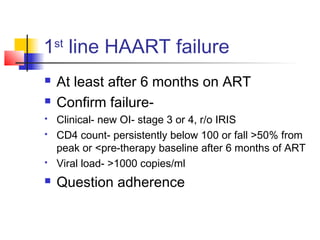
1st
line HAART failure
 At least after 6 months on ART
 Confirm failure-
 Clinical- new OI- stage 3 or 4, r/o IRIS
 CD4 count- persistently below 100 or fall >50% from
peak or <pre-therapy baseline after 6 months of ART
 Viral load- >1000 copies/ml
 Question adherence
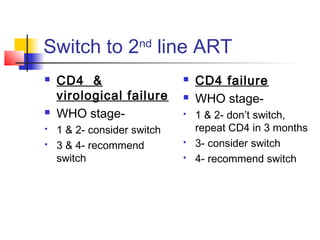
Switch to 2nd
line ART
 CD4 &
virological failure
 WHO stage-
 1 & 2- consider switch
 3 & 4- recommend
switch
 CD4 failure
 WHO stage-
 1 & 2- don’t switch,
repeat CD4 in 3 months
 3- consider switch
 4- recommend switch
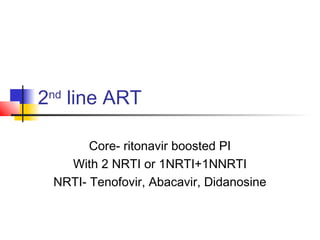
2nd
line ART
Core- ritonavir boosted PI
With 2 NRTI or 1NRTI+1NNRTI
NRTI- Tenofovir, Abacavir, Didanosine
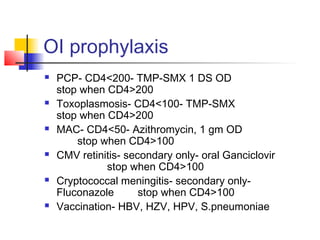
OI prophylaxis
 PCP- CD4<200- TMP-SMX 1 DS OD
stop when CD4>200
 Toxoplasmosis- CD4<100- TMP-SMX
stop when CD4>200
 MAC- CD4<50- Azithromycin, 1 gm OD
stop when CD4>100
 CMV retinitis- secondary only- oral Ganciclovir
stop when CD4>100
 Cryptococcal meningitis- secondary only-
Fluconazole stop when CD4>100
 Vaccination- HBV, HZV, HPV, S.pneumoniae
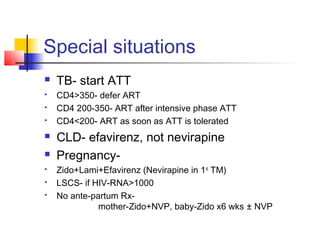
Special situations
 TB- start ATT
 CD4>350- defer ART
 CD4 200-350- ART after intensive phase ATT
 CD4<200- ART as soon as ATT is tolerated
 CLD- efavirenz, not nevirapine
 Pregnancy-
 Zido+Lami+Efavirenz (Nevirapine in 1st
TM)
 LSCS- if HIV-RNA>1000
 No ante-partum Rx-
mother-Zido+NVP, baby-Zido x6 wks ± NVP
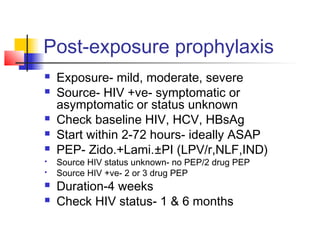
Post-exposure prophylaxis
 Exposure- mild, moderate, severe
 Source- HIV +ve- symptomatic or
asymptomatic or status unknown
 Check baseline HIV, HCV, HBsAg
 Start within 2-72 hours- ideally ASAP
 PEP- Zido.+Lami.±PI (LPV/r,NLF,IND)
 Source HIV status unknown- no PEP/2 drug PEP
 Source HIV +ve- 2 or 3 drug PEP
 Duration-4 weeks
 Check HIV status- 1 & 6 months
Prevention
 Protected sexual intercourse- condom
 Precaution by healthcare workers to
prevent exposure to infected fluids
 Proper disposal of sharps & waste
 Needle exchange programmes for IVDU
 Perinatal treatment of mother &
newborn
 Avoid breast-feeding

Acquired immunodeficiency syndrome aids

  • 1.
    A.I.D.S. A disease ofhuman immune system Caused by H.I.V 1 or 2
  • 2.
    Burden- 2007 33.2 millionpeople with AIDS 2.5 million newly infected 2.1 million deaths
  • 3.
    Transmission Direct contact ofmucous membrane or skin with infected body fluids- blood, semen, vaginal fluid, milk
  • 4.
    HIVAIDS Progressive damage to CD4+ve T-cells, macrophages, dendritic/glial cells
  • 5.
    Progression Median time fromHIV infection to AIDS- 9-10 years Median survival after AIDS- 9-10 months, untreated
  • 6.
  • 7.
    Common OI  TB,MAC infection  PCP- Pneumocystis jirovecii  Esophagitis- candida or viral  Chronic diarrhea- bacterial, fungal, viral  Toxoplasma encephalitis  Cryptococcal meningitis  Progressive multifocal leucoencephalopathy  CMV retinitis
  • 8.
    Cancers  Kaposi sarcoma-HHV-8  High-grade B-cell lymphoma- EBV  Hodgkin’s lymphoma- EBV  Primary CNS lymphoma- EBV  Cervical/Anal cancer- HPV  HCC- HBV/HCV
  • 9.
    WHO staging  StageI- asymptomatic HIV infection  Stage II- minor mucocutaneous manifestations & recurrent URTI  Stage III- unexplained weight loss/fever, chronic diarrhea, severe bacterial infection, pulmonary TB, low Hb/ANC/platelets  Stage IV- other OI or cancers  CDC- HIV +ve with CD4 T-cell <200 or <14% of all lymphocytes
  • 10.
    Diagnosis  HIV antibody p24 antigen  PCR  Symptomatic person- sample reactive with 2 different kits  Asymptomatic person- sample reactive with 3 different kits
  • 11.
    Pretreatment considerations CD4 cellcount Viral load (?) Patient’s readiness
  • 12.
    Pre-treatment evaluation  HIVtesting  Risk factors & exposure  System review- H & PE  h/o TB, STD  h/o pregnancy & contraception  h/o vaccination  Treatment history- ART & other
  • 13.
    Pre-treatment lab. evaluation Confirm HIV  CD4 count  CBC, LFT  Urine- R & M  HBsAg & HCV Ab  Pap smear  Optional- Viral load, lipid profile, CxR, pregnancy test
  • 14.
    Treatment No cure orvaccine, yet. HAART- highly active anti-retroviral therapy
  • 15.
    Goals of ART Clinical- prolongation of life & improvement in quality of life  Virological- greatest reduction in viral load for as long as possible  Immunological- immune reconstitution  Therapeutic- rational drug use to maximise benefit & avoid resistance  Reduction of transmission
  • 16.
    Who gets HAART? CD4count <200 CD4 count <350 in Stage III Stage IV, irrespective of CD4
  • 17.
    HAART regime At least3 drugs, belonging to 2 classes of anti-retrovirals 2NRTI + 1NNRTI/PI
  • 18.
    Drugs available  NRTI-Z,L,S,D,Z,E,A,T  NNRTI- N,E  PI- S,R,N,I,L/R  Fusion inhibitors- Enfuviritide, Maraviroc  Integrase inhibitors- Raltregavir  Maturation inhibitors- Bevirimat, Vivecon  CCR5 inhibitors
  • 19.
  • 20.
    NNRTI preference Nevirapine- all& pregnant Efavirenz- deranged LFT & on Rifampicin containing ATT
  • 21.
    Immune Reconstitution Inflammatory Syndrome(IRIS)  Occurrence/worsening of new/existing OI within 6 weeks-6 months after initiating ART, with an increase in CD4 count  Lower the CD4 count, more likely IRIS  Management-  Stabilise OI, before starting HAART  Life threatening OIstop ART  NSAIDssteroids
  • 22.
    Monitoring  Regular counseling(adherence)  Weight  CD4- every 6 months  HIV-RNA- every 6 months  Hb- on Zidovudine  SGPT- on Nevirapine  RBS & lipid profile- on PI
  • 23.
    Side-effects of ART First few weeks N/V/D-zido./PI, Rash-NNRTI, Hepatotoxicity-NNRTI/PI, Drowsiness/confusion-efavirenz  First few months Anemia/neutropenia-zido., Lactic acidosis-stavudine, Peripheral neuropathy-stavu./didano., Pancreatitis-didanosine  After ~12 months Lipodystrophy-NRTI/PI, Dyslipidemia-stavu./efavirenz/PI, IGT/DM-indinavir
  • 24.
    1st line HAART failure At least after 6 months on ART  Confirm failure-  Clinical- new OI- stage 3 or 4, r/o IRIS  CD4 count- persistently below 100 or fall >50% from peak or <pre-therapy baseline after 6 months of ART  Viral load- >1000 copies/ml  Question adherence
  • 25.
    Switch to 2nd lineART  CD4 & virological failure  WHO stage-  1 & 2- consider switch  3 & 4- recommend switch  CD4 failure  WHO stage-  1 & 2- don’t switch, repeat CD4 in 3 months  3- consider switch  4- recommend switch
  • 26.
    2nd line ART Core- ritonavirboosted PI With 2 NRTI or 1NRTI+1NNRTI NRTI- Tenofovir, Abacavir, Didanosine
  • 27.
    OI prophylaxis  PCP-CD4<200- TMP-SMX 1 DS OD stop when CD4>200  Toxoplasmosis- CD4<100- TMP-SMX stop when CD4>200  MAC- CD4<50- Azithromycin, 1 gm OD stop when CD4>100  CMV retinitis- secondary only- oral Ganciclovir stop when CD4>100  Cryptococcal meningitis- secondary only- Fluconazole stop when CD4>100  Vaccination- HBV, HZV, HPV, S.pneumoniae
  • 28.
    Special situations  TB-start ATT  CD4>350- defer ART  CD4 200-350- ART after intensive phase ATT  CD4<200- ART as soon as ATT is tolerated  CLD- efavirenz, not nevirapine  Pregnancy-  Zido+Lami+Efavirenz (Nevirapine in 1st TM)  LSCS- if HIV-RNA>1000  No ante-partum Rx- mother-Zido+NVP, baby-Zido x6 wks ± NVP
  • 29.
    Post-exposure prophylaxis  Exposure-mild, moderate, severe  Source- HIV +ve- symptomatic or asymptomatic or status unknown  Check baseline HIV, HCV, HBsAg  Start within 2-72 hours- ideally ASAP  PEP- Zido.+Lami.±PI (LPV/r,NLF,IND)  Source HIV status unknown- no PEP/2 drug PEP  Source HIV +ve- 2 or 3 drug PEP  Duration-4 weeks  Check HIV status- 1 & 6 months
  • 30.
    Prevention  Protected sexualintercourse- condom  Precaution by healthcare workers to prevent exposure to infected fluids  Proper disposal of sharps & waste  Needle exchange programmes for IVDU  Perinatal treatment of mother & newborn  Avoid breast-feeding