ELECTROLYTE
IMBALANCES
Na & K
DR. MATE SHILULI
HYPONATREMIA
• Mostly from impaired water excretion & less commonly from
hypertonic urine loss or excess water ingestion.
• Common in 15% of hospital patients, mostly predicts poorer prognosis
in many diseases such as heart, liver, kidney and brain
• Mild (135-130, Moderate (129-125) Severe (less than 120) mml/L
Classification Of Hyponatremia
i. Hypotonic (hypo-osmotic) – commonest.
Subclassified into: hypo-, eu-, & hyper-volemic
ii. Hypertonic – increase glucose or mannitol pull water into ECF
iii. Isotonic “pseudo-hyponatremia” – artefact of measurement due to
increased proteins/lipids e.g. in multiple myeloma
Hypotonic hyponatremia
Causes:
Renal – increased Na in urine leads to decrease Na in serum
Non-renal – decrease Na in urine leads to decrease Na in serum
Hypovolemic (dry): low water, low salt
• Extra renal sodium loss/deficiency:
• GI: ↓oral fluid intake, diarrhea and vomiting. 3rd space: burns. pancreatitis,
peritonitis
• Renal sodium loss: Excess diuretics, esp. thiazides.
• Mineralocorticoid deficiency (Addison’s).
• Renal salt losing disease e.g. interstitial nephritis, polycystic kidney disease.
• Cerebral salt wasting, post trauma or surgery
Euvolemic: ↑H2O, ↔Na+
• Excess H2O intake, or at least greater than the kidney can excrete in the
context of an illness or stressor that reduces renal blood flow.
• Urine Na+ <20, due to:
• Excess IV fluid. A common cause in hospital, especially post-surgery.
• Excess oral fluid (polydipsia). Rare in normal contexts, but can occur among
endurance athletes who follow fixed intake regimens and don't just rely on thirst. May
also happen in the context of psychiatric illness (primary polydipsia) or drug use e.g.
MDMA (ecstasy)
Cont.…
• Failure of renal H2O excretion, with urine Na+ >20:
• Syndrome of inappropriate ADH secretion (SIADH).
• Endocrine: hypothyroidism (sometimes via SIADH), secondary
adrenal insufficiency.
• NSAIDs: reduces prostaglandin-mediated suppression of ADH's
renal effects
Hypervolemic (edematous): ↑↑H2O,↑Na+
• Organ failure, with urine Na+ <20:
• Heart failure
• Cirrhosis
• Nephrotic syndrome (rare as a cause of ↓Na+).
With urine Na+ >20:
Advanced renal failure (AKI or CKD)
Signs & symptoms
Symptoms:
• Headache
• Nausea, vomiting, and anorexia.
• Muscle cramps
• Tired, dizzy, disorientated.
• If severe: seizures, coma, cerebral edema.
• Signs of altered volume: ↓BP, Peripheral edema.
•Symptoms with gradual onset:
• Symptoms may be mild if onset is gradual, with Na+ falling over
days to weeks. This is due to cerebral adaptation, with neurons
releasing inorganic (Na+, Cl-, K+) and organic osmolytes to
preserve osmolality.
• However, it is possible that a lot of apparently 'asymptomatic'
hyponatremia in fact leads to an increased risk of falls due to subtle
neurological effects.
Investigations
• UECS – Na elevated
• Other relevant patient centered studies based on suspected cause:
CBC, LFTS, TFT,…
Management
• Asymptomatic or mild symptoms:
• Investigate cause & initiate treatment before investigations complete if patients are
symptomatic.
• Slowly give normal saline if hypovolemic, otherwise fluid restrict.
• If cause unclear (hypo vs. euvolemic), give 2 L normal saline challenge over 24 hours
→ Na+ rise = hypovolemia.
• Re-check Na+ regularly.
• Consider demeclocycline (ADH antagonist) or a vaptan (ADH-R antagonist aka
vasopressin receptor antagonist) if fluid restriction ineffective.
Cont.…
• Severe symptoms (coma/seizures):
• HDU/ICU transfer & 3% saline 1-2 ml/kg/hr.
• Loop diuretic (furosemide) if not hypovolemic.
• Re-check Na+ every 2 hours.
• Aim to increase Na+ by 0.5 mmol/L/hr., up to 10mmol/L/24hr, until 125
mmol/L or clinically well.
• Investigate cause once stabilized.
HYPERNATREMIA
• Na+ >145 mmol/L, though significant symptoms rare until >160 mmol/L.
• Pathophysiology:
• Due to H2O loss/deficit or Na+ excess.
• In general, it is rare, as the body triggers ADH then thirst to avoid this at
all costs, even if it means becoming very hypervolemic.
• When it does happen, it is usually in elderly patients due to a lack of
H2O intake.
Causes:
• Extra-renal H2O loss/deficit: Lack of intake, loss through diarrhea or
vomiting, skin
• Renal H2O loss: Osmotic diuresis, Diabetes insipidus (DI), Diuretics, Endocrine: Conn’s,
• Excess Na+ intake (rare)
• Excess hypertonic fluids, sea water ingestion.
Signs and symptoms
• Tired, weak, thirsty.
• Signs of dehydration: ↓skin turgor, dry mouth, oliguria, tachycardia,
orthostatic hypotension.
• Irritable, confused.
• Seizures, coma.
Investigations
• ↑Na+
• Check other electrolytes for co-morbid imbalances.
• Glucose to check for osmotic diuresis.
• Urine and serum osmolality if you suspect DI.
• Hypertonic urine is an appropriate renal response to hypernatremia so
suggests extrarenal fluid loss as a cause, while hypotonic urine suggests
diabetes insipidus.
Management
• Fluids:
• Hypotonic fluids: 5% dextrose, 0.45% saline, or oral water.
• Monitor Na+ to ensure slow correction, dropping no more than 10
mmol/L/24hr.
• If in shock, isotonic fluid to restore circulating volume first.
• Desmopressin in patients with central DI
HYPOKALEMIA
• Classified as:
• Mild (<3.5 mmol/L), Moderate (<3 mmol/L), or Severe (<2.5 mmol/L)
• Main pathological effect is muscle weakness.
• Pathophysiology - ↓K+ in the serum ECF → ↑chemical gradient with
ICF → ↑K+ leakage from ICF → hyperpolarization of myocyte
membrane (inc. cardiac) → ↓muscle excitability.
Causes
• GI: Loss: diarrhea, vomiting, gastroenteritis, eating disorders, pyloric stenosis, fistula, ↓
Intake
• Kidney: diuretics, metabolic alkalosis.
• DKA: hyperosmolarity and ↓insulin → K+ leaves cells → lost in urine.
Overall body deficit though serum levels may remain high.
• Movement of K+ from ECF→ICF: Insulin, β-2 agonists.,
• Hypokalemic periodic paralysis: congenital, periodic, 72 hr long ↓K+.
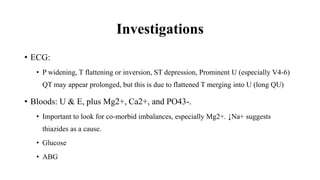
Investigations
• ECG:
• P widening, T flattening or inversion, ST depression, Prominent U (especially V4-6)
QT may appear prolonged, but this is due to flattened T merging into U (long QU)
• Bloods: U & E, plus Mg2+, Ca2+, and PO43-.
• Important to look for co-morbid imbalances, especially Mg2+. ↓Na+ suggests
thiazides as a cause.
• Glucose
• ABG
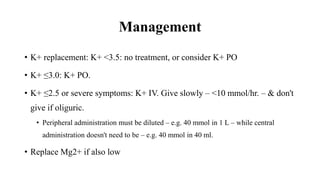
Management
• K+ replacement: K+ <3.5: no treatment, or consider K+ PO
• K+ ≤3.0: K+ PO.
• K+ ≤2.5 or severe symptoms: K+ IV. Give slowly – <10 mmol/hr. – & don't
give if oliguric.
• Peripheral administration must be diluted – e.g. 40 mmol in 1 L – while central
administration doesn't need to be – e.g. 40 mmol in 40 ml.
• Replace Mg2+ if also low
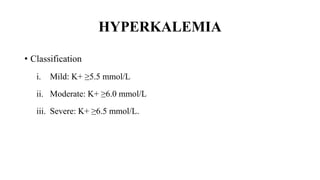
HYPERKALEMIA
• Classification
i. Mild: K+ ≥5.5 mmol/L
ii. Moderate: K+ ≥6.0 mmol/L
iii. Severe: K+ ≥6.5 mmol/L.
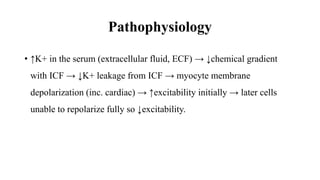
Pathophysiology
• ↑K+ in the serum (extracellular fluid, ECF) → ↓chemical gradient
with ICF → ↓K+ leakage from ICF → myocyte membrane
depolarization (inc. cardiac) → ↑excitability initially → later cells
unable to repolarize fully so ↓excitability.
Causes
• ↓Excretion of K+: Kidney failure(AKI/CKD), drugs (spironolactone, amiloride,
ACEi, A2RB, NSAIDs), Addison’s, metabolic acidosis.
• Tissue damage: rhabdomyolysis, tumor lysis syndrome.
• ↑Intake of K+: KCl (iatrogenic).
• Large blood transfusions.
• A false positive test, pseudohyperkalaemia, caused by: Hemolysis, poor sample
collection, delayed analysis
Signs & symptoms
• CVS:
• May be asymptomatic but have ECG changes.
• Arrhythmias: altered HR, palpitations, light-headed.
• CNS:
• Paresthesia
• Flaccid weakness
• ↓Reflexes
Investigations
• ↑K+ detected on U&E
• ECG if K+ >6: tented T, prolonged PR, flattened or absent P, wide QRS,
bradycardia, ST elevation.
• FBC to rule out pseudohyperkalaemia.
• Blood gas may show acidosis. Will also give instant K+ reading.
• Ca2+ and CK in suspected rhabdomyolysis.
• Glucose if diabetic.
Management
• Treat underlying cause
• Stop drugs: ACEi, K+-sparing diuretics, NSAIDs.
• Mild (≥5.5 mmol/L or moderate ≥6) & normal ECG: reduce dietary intake.
• If moderate, consider insulin IV + glucose IV ± salbutamol nebs.
• GI cation exchangers remove K+ from the body by binding it in GI tract: kayexalate
Cont.…
• Severe (≥6.5 mmol/L) or ECG changes is an emergency
• Stabilize cardiac membrane if there are ECG changes: Calcium
gluconate IV
• Shift K+ into cells: Insulin IV and Glucose IV. Salbutamol nebs
• Remove K+ from body: furosemide or – if severe renal impairment
– dialysis.
…END…
THANK YOU

Na &amp; k

  • 1.
  • 2.
    HYPONATREMIA • Mostly fromimpaired water excretion & less commonly from hypertonic urine loss or excess water ingestion. • Common in 15% of hospital patients, mostly predicts poorer prognosis in many diseases such as heart, liver, kidney and brain • Mild (135-130, Moderate (129-125) Severe (less than 120) mml/L
  • 3.
    Classification Of Hyponatremia i.Hypotonic (hypo-osmotic) – commonest. Subclassified into: hypo-, eu-, & hyper-volemic ii. Hypertonic – increase glucose or mannitol pull water into ECF iii. Isotonic “pseudo-hyponatremia” – artefact of measurement due to increased proteins/lipids e.g. in multiple myeloma
  • 4.
    Hypotonic hyponatremia Causes: Renal –increased Na in urine leads to decrease Na in serum Non-renal – decrease Na in urine leads to decrease Na in serum
  • 5.
    Hypovolemic (dry): lowwater, low salt • Extra renal sodium loss/deficiency: • GI: ↓oral fluid intake, diarrhea and vomiting. 3rd space: burns. pancreatitis, peritonitis • Renal sodium loss: Excess diuretics, esp. thiazides. • Mineralocorticoid deficiency (Addison’s). • Renal salt losing disease e.g. interstitial nephritis, polycystic kidney disease. • Cerebral salt wasting, post trauma or surgery
  • 6.
    Euvolemic: ↑H2O, ↔Na+ •Excess H2O intake, or at least greater than the kidney can excrete in the context of an illness or stressor that reduces renal blood flow. • Urine Na+ <20, due to: • Excess IV fluid. A common cause in hospital, especially post-surgery. • Excess oral fluid (polydipsia). Rare in normal contexts, but can occur among endurance athletes who follow fixed intake regimens and don't just rely on thirst. May also happen in the context of psychiatric illness (primary polydipsia) or drug use e.g. MDMA (ecstasy)
  • 7.
    Cont.… • Failure ofrenal H2O excretion, with urine Na+ >20: • Syndrome of inappropriate ADH secretion (SIADH). • Endocrine: hypothyroidism (sometimes via SIADH), secondary adrenal insufficiency. • NSAIDs: reduces prostaglandin-mediated suppression of ADH's renal effects
  • 8.
    Hypervolemic (edematous): ↑↑H2O,↑Na+ •Organ failure, with urine Na+ <20: • Heart failure • Cirrhosis • Nephrotic syndrome (rare as a cause of ↓Na+). With urine Na+ >20: Advanced renal failure (AKI or CKD)
  • 9.
    Signs & symptoms Symptoms: •Headache • Nausea, vomiting, and anorexia. • Muscle cramps • Tired, dizzy, disorientated. • If severe: seizures, coma, cerebral edema. • Signs of altered volume: ↓BP, Peripheral edema.
  • 10.
    •Symptoms with gradualonset: • Symptoms may be mild if onset is gradual, with Na+ falling over days to weeks. This is due to cerebral adaptation, with neurons releasing inorganic (Na+, Cl-, K+) and organic osmolytes to preserve osmolality. • However, it is possible that a lot of apparently 'asymptomatic' hyponatremia in fact leads to an increased risk of falls due to subtle neurological effects.
  • 11.
    Investigations • UECS –Na elevated • Other relevant patient centered studies based on suspected cause: CBC, LFTS, TFT,…
  • 12.
    Management • Asymptomatic ormild symptoms: • Investigate cause & initiate treatment before investigations complete if patients are symptomatic. • Slowly give normal saline if hypovolemic, otherwise fluid restrict. • If cause unclear (hypo vs. euvolemic), give 2 L normal saline challenge over 24 hours → Na+ rise = hypovolemia. • Re-check Na+ regularly. • Consider demeclocycline (ADH antagonist) or a vaptan (ADH-R antagonist aka vasopressin receptor antagonist) if fluid restriction ineffective.
  • 13.
    Cont.… • Severe symptoms(coma/seizures): • HDU/ICU transfer & 3% saline 1-2 ml/kg/hr. • Loop diuretic (furosemide) if not hypovolemic. • Re-check Na+ every 2 hours. • Aim to increase Na+ by 0.5 mmol/L/hr., up to 10mmol/L/24hr, until 125 mmol/L or clinically well. • Investigate cause once stabilized.
  • 14.
    HYPERNATREMIA • Na+ >145mmol/L, though significant symptoms rare until >160 mmol/L. • Pathophysiology: • Due to H2O loss/deficit or Na+ excess. • In general, it is rare, as the body triggers ADH then thirst to avoid this at all costs, even if it means becoming very hypervolemic. • When it does happen, it is usually in elderly patients due to a lack of H2O intake.
  • 15.
    Causes: • Extra-renal H2Oloss/deficit: Lack of intake, loss through diarrhea or vomiting, skin • Renal H2O loss: Osmotic diuresis, Diabetes insipidus (DI), Diuretics, Endocrine: Conn’s, • Excess Na+ intake (rare) • Excess hypertonic fluids, sea water ingestion.
  • 16.
    Signs and symptoms •Tired, weak, thirsty. • Signs of dehydration: ↓skin turgor, dry mouth, oliguria, tachycardia, orthostatic hypotension. • Irritable, confused. • Seizures, coma.
  • 17.
    Investigations • ↑Na+ • Checkother electrolytes for co-morbid imbalances. • Glucose to check for osmotic diuresis. • Urine and serum osmolality if you suspect DI. • Hypertonic urine is an appropriate renal response to hypernatremia so suggests extrarenal fluid loss as a cause, while hypotonic urine suggests diabetes insipidus.
  • 18.
    Management • Fluids: • Hypotonicfluids: 5% dextrose, 0.45% saline, or oral water. • Monitor Na+ to ensure slow correction, dropping no more than 10 mmol/L/24hr. • If in shock, isotonic fluid to restore circulating volume first. • Desmopressin in patients with central DI
  • 19.
    HYPOKALEMIA • Classified as: •Mild (<3.5 mmol/L), Moderate (<3 mmol/L), or Severe (<2.5 mmol/L) • Main pathological effect is muscle weakness. • Pathophysiology - ↓K+ in the serum ECF → ↑chemical gradient with ICF → ↑K+ leakage from ICF → hyperpolarization of myocyte membrane (inc. cardiac) → ↓muscle excitability.
  • 20.
    Causes • GI: Loss:diarrhea, vomiting, gastroenteritis, eating disorders, pyloric stenosis, fistula, ↓ Intake • Kidney: diuretics, metabolic alkalosis. • DKA: hyperosmolarity and ↓insulin → K+ leaves cells → lost in urine. Overall body deficit though serum levels may remain high. • Movement of K+ from ECF→ICF: Insulin, β-2 agonists., • Hypokalemic periodic paralysis: congenital, periodic, 72 hr long ↓K+.
  • 21.
    Investigations • ECG: • Pwidening, T flattening or inversion, ST depression, Prominent U (especially V4-6) QT may appear prolonged, but this is due to flattened T merging into U (long QU) • Bloods: U & E, plus Mg2+, Ca2+, and PO43-. • Important to look for co-morbid imbalances, especially Mg2+. ↓Na+ suggests thiazides as a cause. • Glucose • ABG
  • 22.
    Management • K+ replacement:K+ <3.5: no treatment, or consider K+ PO • K+ ≤3.0: K+ PO. • K+ ≤2.5 or severe symptoms: K+ IV. Give slowly – <10 mmol/hr. – & don't give if oliguric. • Peripheral administration must be diluted – e.g. 40 mmol in 1 L – while central administration doesn't need to be – e.g. 40 mmol in 40 ml. • Replace Mg2+ if also low
  • 23.
    HYPERKALEMIA • Classification i. Mild:K+ ≥5.5 mmol/L ii. Moderate: K+ ≥6.0 mmol/L iii. Severe: K+ ≥6.5 mmol/L.
  • 24.
    Pathophysiology • ↑K+ inthe serum (extracellular fluid, ECF) → ↓chemical gradient with ICF → ↓K+ leakage from ICF → myocyte membrane depolarization (inc. cardiac) → ↑excitability initially → later cells unable to repolarize fully so ↓excitability.
  • 25.
    Causes • ↓Excretion ofK+: Kidney failure(AKI/CKD), drugs (spironolactone, amiloride, ACEi, A2RB, NSAIDs), Addison’s, metabolic acidosis. • Tissue damage: rhabdomyolysis, tumor lysis syndrome. • ↑Intake of K+: KCl (iatrogenic). • Large blood transfusions. • A false positive test, pseudohyperkalaemia, caused by: Hemolysis, poor sample collection, delayed analysis
  • 26.
    Signs & symptoms •CVS: • May be asymptomatic but have ECG changes. • Arrhythmias: altered HR, palpitations, light-headed. • CNS: • Paresthesia • Flaccid weakness • ↓Reflexes
  • 27.
    Investigations • ↑K+ detectedon U&E • ECG if K+ >6: tented T, prolonged PR, flattened or absent P, wide QRS, bradycardia, ST elevation. • FBC to rule out pseudohyperkalaemia. • Blood gas may show acidosis. Will also give instant K+ reading. • Ca2+ and CK in suspected rhabdomyolysis. • Glucose if diabetic.
  • 28.
    Management • Treat underlyingcause • Stop drugs: ACEi, K+-sparing diuretics, NSAIDs. • Mild (≥5.5 mmol/L or moderate ≥6) & normal ECG: reduce dietary intake. • If moderate, consider insulin IV + glucose IV ± salbutamol nebs. • GI cation exchangers remove K+ from the body by binding it in GI tract: kayexalate
  • 29.
    Cont.… • Severe (≥6.5mmol/L) or ECG changes is an emergency • Stabilize cardiac membrane if there are ECG changes: Calcium gluconate IV • Shift K+ into cells: Insulin IV and Glucose IV. Salbutamol nebs • Remove K+ from body: furosemide or – if severe renal impairment – dialysis.
  • 30.

Editor's Notes

  • #12 Plasma osmolarity
  • #14 Beware rapid Na+ replacement as there is a risk of osmotic demyelination syndrome (aka central pontine myelinolysis), which can present at 2-5 days with:Altered mental status: confusion, fatigue, coma. Motor impairment: pseudobulbar palsy, quadriplegia
  • #16 Lack of intake: elderly, mentally ill. Loss through diarrhea or vomiting. Skin: sweat, burns. Osmotic diuresis: glycosuria inc. HHS, urea, mannitol. Diabetes insipidus (DI). Diuretics: loop, thiazide. Endocrine: Conn's, Cushing’s.
  • #26 Kidney failure – AKI or CKD – and its causes e.g. hypovolaemia, sepsis. Drugs: spironolactone, amiloride, ACEi, A2RB, NSAIDs. Addison’s Metabolic acidosis. Drugs: digoxin, mannitol, β-blockers.
  • #28 Digoxin levels if taking.
  • #30 Calcium chloride but requires central line due to the risk of irritation and necrosis of peripheral lines