Dr.P.Sharath Chandra
Definition
 Hypokalemia is defined as a persistently low
levels of serum potassium lower than 3.6
mEq/L.
 Normal serum levels are 3.5-5mEq/L.
 98% of body potassium is intracellular
(150mEq/L) whereas only 2% of it is
intracellular (3.5-5mEq/L)
Potassium
 It is the major intracellular cation,essential for the
maintainance of acid-base balance, isotonicita and
electrodynamic cellular function.
 Essential for transmission of nerve
impulse,contraction of skeletal,cardiac and smooth
muscle cells, gastric secretion, renal function, tissue
synthesis and carbohydrate metabolism.
 Reduces mean SBP and DBP
 Glucose-Insulin-Potassium/GIK therapy is benificial
on ischemic myocardium by decreasing circulating
FFAs and myocardial uptake of FFAs shown to be
toxic to ischaemic myocardium. It stimulates
myocardial potassium uptake and provides glucose
as a substrate for glycolytic ATP production.
Potassium excretion
 Potassium excretion is chiefly renal.
 20mEq of k is lost daily regardless of levels of dietary
intake.
 Potassium excretion is determined by regulated secretion
in the cortical collecting duct(CCD) and the connecting
segment(CNT) of the distal nephron by principal cells.
 Na is reabsorbed and K+ is secreted in the amiloride
sensitive ENaC and is dependent on adequate delivery of
luminal Na+ to the CNT and CCD and k+ secretion
ceases when luminal Na+ drops below 8mmol/L.
 Dietary restriction of sodium decreases K+ secretion and
is enhanced by excess intake.
 Other channels like the small conductance SK ,ROMK,
maxi-k channels are also present in the distal nephron.
Potassium reabsorption
 The proximal tubule and loop of henle
mediate the bulk of potassium
reabsorption and a considerable fraction
is reabsorbed prior to entering the distal
tubules.
 In addition to secretion, distal nephron
can reabsorb K+ during dietary
restriction in the outer medullary
collecting ducts via the H+-K+ATPase
pumps
Importance
 Occurs in 20% of hospitalised patients.
 10 fold increase in mortality rates by its adverse
effects on cardiac rhythm,BP, Respiratory
depression.
 Precipitates hepatic encephalopathy in patients with
liver disease.
 Worsens BP in HTN patients on treatment with
diuretics.
 Leads to AKI and ESRD in longstanding
hypokalemia.
 Hypokalemic myopathy leading to rhabdomyolysis.
 Increased risk of arrythmias in patients on digitalis
therapy.
Causes
 Decreased intake
 Redistribution / intracellular shifts
 Non renal losses(urinary k <15mEq/L)
 Renal losses (urinary K >15mEq/L)
 Spurious hypokalemia: Delay in sample
analysis may cause hypokalemia due to time
dependent intracellular shift of K+.
Rarely profound leukocytosis due to acute
leukemia may cause artefactual hypokalemia
without any clinical or ECG manifestations.
This can be avoided by analysing sample
immediately after venepunture.
Decreased intake
 K+ deficit I.V fluids,TPN.
 Decreased dietary intake when on
diuretic therapy, anorexia nervosa,
hypo-caloric protein diets for rapid
weight loss.
Redistribution of potassium
 Due to intracellular shift of K.
 Exogenous Insulin glucose infusion
increases K+ entry into skeletal and
hepatic cells by promoting Na-K-ATPase
activity. This effect is more prominent when
administered in settings of DKA or
nonketotic hyperglycemia.
 Carbohydrate load in malnourished patient
leading to endogenous insulin release can
cause the same effects.
Redistribution of potassium
 Increased beta-adrenergic activity: Promote
Na-K-ATPase activity.
-Beta adrenergic agonists like salbutamol,
ritodrine.
-Caffeine and theophylline intoxication by
downstream activation of cAMP.
-Occult sources of sympathomimetics like cough
syrup and slimming agents contain
pseudoephedrine and ephedrine, which are
commonly overlooked.
-Stress induced release of epinephrine and
cortisol in Alcohol withdrawal, head injury,MI leads
to transient hypokalemia.
Redistribution of potassium
 Metabolic alkalosis: Extracellular K+
exchanged by intracellular H+ ions to
maintain pH. Administration of sodium
bicarbonate to treat metabolic acidosis can
cause this condition.
 Increased hematopoiesis: GM-CSF used to
treat neutropenia and B-12 and folic acid to
treat megaloblastic anemia may cause
sharp rise in cell production and increased
K+ entry into cell causes hypokalemia.
Redistribution of potassium
 Hypokalemic periodic paralysis(HOKP):
 HOKP type-1 is commoner and is due to AD
mutations in the CACNA1S gene encoding the
alpha subunit of L-type calcium channels.
 HOKP type-2 is due to mutations in SCN4A
gene encoding the skeletal Na channel.
 Andersen syndrome: AD mutations in the
KCNJ2 gene encoding for the inwardly
rectifying K+ channel cause periodic paralysis,
arrythmias, and dysmorphic features.
Hypokalemic periodic
paralysis(HOKP)
 Reversible attacks of hypokalemia with
paralysis, typically precipitated by rest after
exercise or carbohydrate rich meal as
insulin potentiates muscle weakness by
inhibiting ATP sensitive inward rectifying K+
(K-ATP) channels.
 Acute attacks lower Sr.K+ levels to 1.5-2.5
mEq/L.
 Paralysis usually starts in the lower limbs
and progresses to quadriparesis.
 Often accompanied by hypophosphatemia
and hypomagnesemia.
Thyrotoxic periodic
paralysis
 Excess thyroid hormone increases Na-K-
ATPase activity , increased B-adrenergic
response and predisposes to paralytic attacks
with profound hypokalemia, Sr.K+ ranging
between 1.1-2.5 mEq/L.
 Typically presents between 1AM to 6AM with
weakness of limb girdles and extremities.
 High dose propranolol @ 3mg/Kg rapidly
reverses dyselectrolytemia and paralysis with
no rebound hyperkalemia whereas K+
replacement in TPP is associated with 25%
risk of rebound hyperkalemia.
A case report of HOKP
Redistribution of potassium
 Barium toxicity: Barium is a potent inhibitor if
passive K+ efflux channels. It occurs in suicidal or
accidental ingestion of barium carbonate
(rodenticide),barium containing shaving cream and
hair remover. Treatment with K+ repletion serves to
both rising serum K+ and to displace barium from
efflux channels. Hemodialysis is also effective.
 Chloroquine toxicity: Causes intracellular shift of K+
by an unclear mechanism and this can be
exacerbated by use of epinephrine to treat
intoxication.
 Hypothermia: Results In a drive of K+ into cells
which is reversible on rewarming.
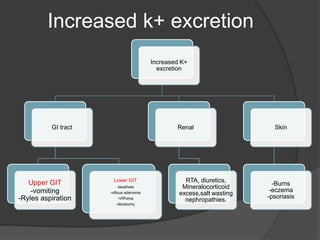
Increased k+ excretion
Increased K+
excretion
GI tract
Upper GIT
-vomiting
-Ryles aspiration
Lower GIT
-laxatives
-villous adenoma
-VIPoma
-ileostomy
Renal
RTA, diuretics,
Mineralocorticoid
excess,salt wasting
nephropathies.
Skin
-Burns
-eczema
-psoriasis
Non-renal losses
 Urinary k<15mEq/L or TTKG <3
 Sweating in extremes of physical exertion.
 Gastric losses (vomiting, ryles aspiration)-
ensuing hypochloremic alkalosis results in
persistent kaluresis due to secondary
hyperaldosteronism and bicarbonaturea.
 Diarrhoea is a known cause of K+ loss and
may present with acute complications like
myopathy and flaccid paralysis.
 Non anion gap acidosis with negative urinary
anion gap suggests diarrhoea as a cause.
Non-renal losses
 Non-infectious processes like ileostomy
villous adenoma,laxative abuse celiac
disease can present with acute
hypokalemic syndromes or with chronic
complications like ESRD.
 Bowel cleansing agents like oral sodium
phosphate can cause GI losses of K+.
Renal losses
 Diuretics:
Diuretics are an important cause of
hypokalemia by increasing distal delivery of
Na and increasing distal flow.
Thiazides cause more hypokalemia than
loop diuretics despite their lower natriuretic
effect due to their differential effect on
calcium excrtetion.
Hypercalciurea caused by loop diuretics
increases luminal calcium which inturn
inhibitd ENaC in the principal cells.
Renal losses
 Non-reabsorbable anions: Non-
reabsorbable anions in the distal
nephron like penicillin, nafacillin,
dicloxacillin,ticarcillin,oxacillin,carbencilli
n and other anions like bicarbonate
increase obligatory K+ excretion and
thereby kaliuresis.
 K+ excretion Increases to balance
negative charge of these anions.
Renal losses
 Tubular toxins: Several tuular toxins can
cause combined K+ and Magnesium
wasting that can masquerade as
Bartter’s syndrome.
 Eg:gentamycin,amphoterecin, foscarnet,
cisplatin, ifosfamide.
 Hpokalemia is refractory to K+ repletion
unless concomitant Mg supplementation
is given.
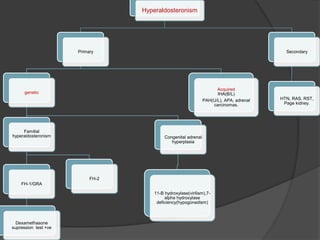
Hyperaldosteronism
Primary
genetic
Familial
hyperaldosteronism
FH-1/GRA
Dexamethasone
supression test +ve
FH-2
Congenital adrenal
hyperplasia
11-B hydroxylase(virilism),7-
alpha hydroxylase
deficiency(hypogonadism)
Acquired
IHA(B/L)
PAH(U/L), APA, adrenal
carcinomas.
Secondary
HTN, RAS, RST,
Page kidney.
Syndromes of apparent minerakocorticoid
excess(SAME)
 Loss of function mutation in the 11-BHSD-2 gene
cause defective peripheral conversion of cortisol to
inactive cortisone.
 Cortisol has similar effects on the mineralocorticoid
receptor as aldosterone.
 11-BHSD2 converts cortisol to cortisone and
prevents this illicit activation of MLR.
 Pharmacological inhibition of 11-BHSD2 is seen with
consumption of liquorice which contains
glycyrrhizinic acid and carbenoxolone.
 Rarely, gain of function mutations on the MLR can
cause SAME.
 Liddle syndrome
Liddle syndrome
 Autosomal dominant gain in function
mutation of amiloride sensitive ENaC
leading to overactivity and
overexpression on the cell membrane.
 Presents with severe HTN, hypokalemia
unresponsive to spironolactone but
responsive to amiloride and triamterene.
 Blunted aldosterone response to ACTH
and decreased urinary aldosterone
excretion.
Familial hypokalemic alkalosis
 Includes Bartter’s and Gitelman syndromes.
 Bartter’s syndrome:
 Mimics loop diuretic effect-defect in TALH Na-K-2Cl
cotransport.
 Polyuria, polydypsia with hypokalemic hypochloremic
alkalosis, hypercalcuria and 20% are hypomagnesemic.
 Raised serum AT-2, aldosterone, rennin.
 Antenatal BS presents early in life with electrolyte
wasting, polyhydramnios, hypercalcuria with
nephrocalcinosis. Increased prostaglandin synthesis
amplify the inhibition on urinary concentrating ability and
COX inhibition with indomethacin is proven to be
benificial.
 Pseudobartter syndrome: Furosemide abuse, laxative
abuse,Bulimia.
Familial hypokalemic alkalosis
 Gitelman syndrome: Mimics thiazide diuretic
effect-defective thiazide sensitive Na-Cl
cotransport in DCT.
 Hypocalciuria is seen and hypomagnesemia
is universal in contrast to BS.
 Pseudo Gitelman syndrome: chemotherapy
with cisplatin,sjogrens syndrome,
tubulointerstitial nephritis may cause
hypokalemic alkalosis with hypomagnesemia
and hypocalciuria.
Clinical features
 Non severe hypokalemia is usually asymptomatic.
 Common acute manifestations are muscle weakness
and ECG changes.
 Prolonged and profound hypokalemia may cause
arrythmias, rhabdomyolysis, renal abnormalitiess.
 History may reveal the cause like
exertion,vomiting,diarrhoea,drugs,B-12 therapy etc.
 Asymptomatic or growth retardation should prompt
the suspicion of RTA.
 S/O volume depletion.
 Kussumal breathing may suggest metabolic acidosis
with respiratory compensation.
 Presence of oedema and HTN may indicate
mineralocorticoid excess.
Clinical features
• Cardiac arrythmias like sinus bradycardia,
premature beats, ventricular fibrillation, AV blocks.
• Skeletal muscle weakness or paralysis usually do
not develop unless hypokalemia develops
slowlyand levels are <2.5mEq/L.
• Constipation and ileus due to smooth muscle
involvement.
• Nausea/vomiting, abdominal cramps.
• Polyuria, nocturia, or polydipsia
• Psychosis, delirium, or hallucinations
• Depression
Clinical features
 Signs of ileus
 Hypotension
 Ventricular arrhythmias
 Cardiac arrest
 Bradycardia or
tachycardia
 Premature atrial or
ventricular beats
• Hypoventilation,
respiratory distress
• Respiratory failure
• Lethargy or other mental
status changes
• Decreased muscle
strength, fasciculations,
or tetany
• Decreased tendon
reflexes
• Cushingoid appearance
(eg, edema)
Investigations
 Sr.Electrolytes,BUN,creatnine.
 ECG
 Urine electrolytes to differentiate non-renal from
renal causes.
 Exclude associated electrolyte abnormalities
especially in alcoholism.
 ABG to detect acidosis or alkalosis when cause is
not apparent.
 Urinalysis and urine pH if RTA is suspected.
 Urinary calcium to exclude Bartters syndrome.
 Aldosterone supression test if aldosterone producing
adenoma is suspected.
 CT abdomen to R/O other pathologies.
ECG changes
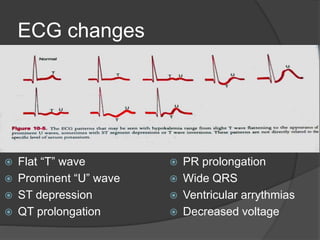
 Flat “T” wave
 Prominent “U” wave
 ST depression
 QT prolongation
 PR prolongation
 Wide QRS
 Ventricular arrythmias
 Decreased voltage
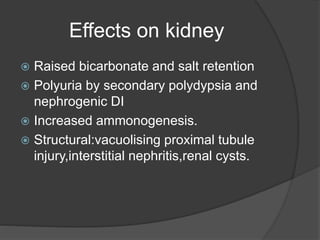
Effects on kidney
 Raised bicarbonate and salt retention
 Polyuria by secondary polydypsia and
nephrogenic DI
 Increased ammonogenesis.
 Structural:vacuolising proximal tubule
injury,interstitial nephritis,renal cysts.
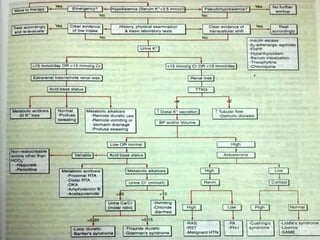
Diagnostic approach
 History(drugs,diet,diarrhoea/vomiting)
 Physical examination(BP,s/o
hyperthyroidsm,cushings)
 Lab tests(serum
electrolytes,BUN,Sr.creatnine,CBP,urinary pH)
 ECG
Treatment goals
 Prevent hypokalemia
 Correct hypokalemia
 Prevent complications
 Minimize losses
 Correct underlying etiology
Prevention
 Especially important in patients on
digitalis,hepatic failure,previous MI,DM.
 Normal daily intake of 60mEq/day
 Supplementation in patients on
digitalis,diuretics and long term
steroids,hepatic failure.
When to treat?
 3.5-5mEq/L: No supplement needed
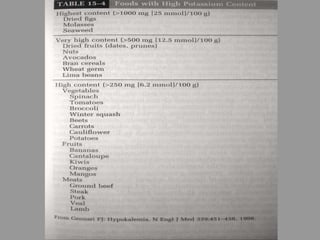
Potassium rich foods
Change diuretics
 3-3.5mEq/L: Treatment needed in high
risk patients(h/o MI,CHF)
 <3mEq/L: Needs definitive treatment.
Precautions
 Oliguria/anuria
 Patients on ACE inhibitots,k-sparing
diuretics,renal failure.
 Digitalis (slower infusions <20mEq/hr)
 Continuous ECG monitoring if infusion
rates >20 mEq/hr.
 Deficit should be corrected slowly over
four days.
Treatment
 Oral supplementation preferred if patient tolerates oral K+ and if there is
no DKA or non-ketotic hyperglycemia.
 Serum K+ can raise by 1-1.5 mEq after an oral dose of 40-50mEq of K+.
 I.V KCL may be used as an adjunct if large doses are required as higher
oral doses cause gastric irritation.
 Oral potassium phosphate in patients with associated
hypophosphatemia.
 Oral potassium bicarbonate/potassium citrate in patients concomitant
acidosis.
 Correct Mg deficiency.
 Oral supplements are best taken after meal with a glass of water.
 Usually dose of 20mEq 3-4 times a day is given and should not exceed
200mEq/day in adults and it should not exceed 3mEq/kg/day in pediatric
patients.
 In severe/symptomatic hypokalemia, upto 40mEq/6hrs can be given
under close ECG monitoring.
 Oral KCL solutions contain 20mEq/15ml of solution and a KCL tablet
contains 8mEq of K+.
Treatment
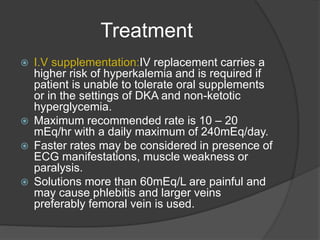
 I.V supplementation:IV replacement carries a
higher risk of hyperkalemia and is required if
patient is unable to tolerate oral supplements
or in the settings of DKA and non-ketotic
hyperglycemia.
 Maximum recommended rate is 10 – 20
mEq/hr with a daily maximum of 240mEq/day.
 Faster rates may be considered in presence of
ECG manifestations, muscle weakness or
paralysis.
 Solutions more than 60mEq/L are painful and
may cause phlebitis and larger veins
preferably femoral vein is used.
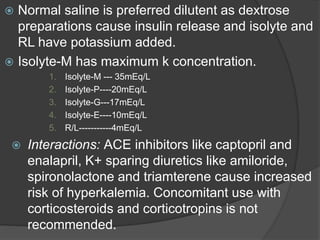
 Normal saline is preferred dilutent as dextrose
preparations cause insulin release and isolyte and
RL have potassium added.
 Isolyte-M has maximum k concentration.
1. Isolyte-M --- 35mEq/L
2. Isolyte-P----20mEq/L
3. Isolyte-G---17mEq/L
4. Isolyte-E----10mEq/L
5. R/L-----------4mEq/L
 Interactions: ACE inhibitors like captopril and
enalapril, K+ sparing diuretics like amiloride,
spironolactone and triamterene cause increased
risk of hyperkalemia. Concomitant use with
corticosteroids and corticotropins is not
recommended.
Thank you

Hypokalemia

  • 1.
  • 2.
    Definition  Hypokalemia isdefined as a persistently low levels of serum potassium lower than 3.6 mEq/L.  Normal serum levels are 3.5-5mEq/L.  98% of body potassium is intracellular (150mEq/L) whereas only 2% of it is intracellular (3.5-5mEq/L)
  • 3.
    Potassium  It isthe major intracellular cation,essential for the maintainance of acid-base balance, isotonicita and electrodynamic cellular function.  Essential for transmission of nerve impulse,contraction of skeletal,cardiac and smooth muscle cells, gastric secretion, renal function, tissue synthesis and carbohydrate metabolism.  Reduces mean SBP and DBP  Glucose-Insulin-Potassium/GIK therapy is benificial on ischemic myocardium by decreasing circulating FFAs and myocardial uptake of FFAs shown to be toxic to ischaemic myocardium. It stimulates myocardial potassium uptake and provides glucose as a substrate for glycolytic ATP production.
  • 4.
    Potassium excretion  Potassiumexcretion is chiefly renal.  20mEq of k is lost daily regardless of levels of dietary intake.  Potassium excretion is determined by regulated secretion in the cortical collecting duct(CCD) and the connecting segment(CNT) of the distal nephron by principal cells.  Na is reabsorbed and K+ is secreted in the amiloride sensitive ENaC and is dependent on adequate delivery of luminal Na+ to the CNT and CCD and k+ secretion ceases when luminal Na+ drops below 8mmol/L.  Dietary restriction of sodium decreases K+ secretion and is enhanced by excess intake.  Other channels like the small conductance SK ,ROMK, maxi-k channels are also present in the distal nephron.
  • 5.
    Potassium reabsorption  Theproximal tubule and loop of henle mediate the bulk of potassium reabsorption and a considerable fraction is reabsorbed prior to entering the distal tubules.  In addition to secretion, distal nephron can reabsorb K+ during dietary restriction in the outer medullary collecting ducts via the H+-K+ATPase pumps
  • 6.
    Importance  Occurs in20% of hospitalised patients.  10 fold increase in mortality rates by its adverse effects on cardiac rhythm,BP, Respiratory depression.  Precipitates hepatic encephalopathy in patients with liver disease.  Worsens BP in HTN patients on treatment with diuretics.  Leads to AKI and ESRD in longstanding hypokalemia.  Hypokalemic myopathy leading to rhabdomyolysis.  Increased risk of arrythmias in patients on digitalis therapy.
  • 7.
    Causes  Decreased intake Redistribution / intracellular shifts  Non renal losses(urinary k <15mEq/L)  Renal losses (urinary K >15mEq/L)  Spurious hypokalemia: Delay in sample analysis may cause hypokalemia due to time dependent intracellular shift of K+. Rarely profound leukocytosis due to acute leukemia may cause artefactual hypokalemia without any clinical or ECG manifestations. This can be avoided by analysing sample immediately after venepunture.
  • 8.
    Decreased intake  K+deficit I.V fluids,TPN.  Decreased dietary intake when on diuretic therapy, anorexia nervosa, hypo-caloric protein diets for rapid weight loss.
  • 9.
    Redistribution of potassium Due to intracellular shift of K.  Exogenous Insulin glucose infusion increases K+ entry into skeletal and hepatic cells by promoting Na-K-ATPase activity. This effect is more prominent when administered in settings of DKA or nonketotic hyperglycemia.  Carbohydrate load in malnourished patient leading to endogenous insulin release can cause the same effects.
  • 10.
    Redistribution of potassium Increased beta-adrenergic activity: Promote Na-K-ATPase activity. -Beta adrenergic agonists like salbutamol, ritodrine. -Caffeine and theophylline intoxication by downstream activation of cAMP. -Occult sources of sympathomimetics like cough syrup and slimming agents contain pseudoephedrine and ephedrine, which are commonly overlooked. -Stress induced release of epinephrine and cortisol in Alcohol withdrawal, head injury,MI leads to transient hypokalemia.
  • 11.
    Redistribution of potassium Metabolic alkalosis: Extracellular K+ exchanged by intracellular H+ ions to maintain pH. Administration of sodium bicarbonate to treat metabolic acidosis can cause this condition.  Increased hematopoiesis: GM-CSF used to treat neutropenia and B-12 and folic acid to treat megaloblastic anemia may cause sharp rise in cell production and increased K+ entry into cell causes hypokalemia.
  • 12.
    Redistribution of potassium Hypokalemic periodic paralysis(HOKP):  HOKP type-1 is commoner and is due to AD mutations in the CACNA1S gene encoding the alpha subunit of L-type calcium channels.  HOKP type-2 is due to mutations in SCN4A gene encoding the skeletal Na channel.  Andersen syndrome: AD mutations in the KCNJ2 gene encoding for the inwardly rectifying K+ channel cause periodic paralysis, arrythmias, and dysmorphic features.
  • 13.
    Hypokalemic periodic paralysis(HOKP)  Reversibleattacks of hypokalemia with paralysis, typically precipitated by rest after exercise or carbohydrate rich meal as insulin potentiates muscle weakness by inhibiting ATP sensitive inward rectifying K+ (K-ATP) channels.  Acute attacks lower Sr.K+ levels to 1.5-2.5 mEq/L.  Paralysis usually starts in the lower limbs and progresses to quadriparesis.  Often accompanied by hypophosphatemia and hypomagnesemia.
  • 14.
    Thyrotoxic periodic paralysis  Excessthyroid hormone increases Na-K- ATPase activity , increased B-adrenergic response and predisposes to paralytic attacks with profound hypokalemia, Sr.K+ ranging between 1.1-2.5 mEq/L.  Typically presents between 1AM to 6AM with weakness of limb girdles and extremities.  High dose propranolol @ 3mg/Kg rapidly reverses dyselectrolytemia and paralysis with no rebound hyperkalemia whereas K+ replacement in TPP is associated with 25% risk of rebound hyperkalemia.
  • 15.
  • 16.
    Redistribution of potassium Barium toxicity: Barium is a potent inhibitor if passive K+ efflux channels. It occurs in suicidal or accidental ingestion of barium carbonate (rodenticide),barium containing shaving cream and hair remover. Treatment with K+ repletion serves to both rising serum K+ and to displace barium from efflux channels. Hemodialysis is also effective.  Chloroquine toxicity: Causes intracellular shift of K+ by an unclear mechanism and this can be exacerbated by use of epinephrine to treat intoxication.  Hypothermia: Results In a drive of K+ into cells which is reversible on rewarming.
  • 17.
    Increased k+ excretion IncreasedK+ excretion GI tract Upper GIT -vomiting -Ryles aspiration Lower GIT -laxatives -villous adenoma -VIPoma -ileostomy Renal RTA, diuretics, Mineralocorticoid excess,salt wasting nephropathies. Skin -Burns -eczema -psoriasis
  • 18.
    Non-renal losses  Urinaryk<15mEq/L or TTKG <3  Sweating in extremes of physical exertion.  Gastric losses (vomiting, ryles aspiration)- ensuing hypochloremic alkalosis results in persistent kaluresis due to secondary hyperaldosteronism and bicarbonaturea.  Diarrhoea is a known cause of K+ loss and may present with acute complications like myopathy and flaccid paralysis.  Non anion gap acidosis with negative urinary anion gap suggests diarrhoea as a cause.
  • 19.
    Non-renal losses  Non-infectiousprocesses like ileostomy villous adenoma,laxative abuse celiac disease can present with acute hypokalemic syndromes or with chronic complications like ESRD.  Bowel cleansing agents like oral sodium phosphate can cause GI losses of K+.
  • 20.
    Renal losses  Diuretics: Diureticsare an important cause of hypokalemia by increasing distal delivery of Na and increasing distal flow. Thiazides cause more hypokalemia than loop diuretics despite their lower natriuretic effect due to their differential effect on calcium excrtetion. Hypercalciurea caused by loop diuretics increases luminal calcium which inturn inhibitd ENaC in the principal cells.
  • 21.
    Renal losses  Non-reabsorbableanions: Non- reabsorbable anions in the distal nephron like penicillin, nafacillin, dicloxacillin,ticarcillin,oxacillin,carbencilli n and other anions like bicarbonate increase obligatory K+ excretion and thereby kaliuresis.  K+ excretion Increases to balance negative charge of these anions.
  • 22.
    Renal losses  Tubulartoxins: Several tuular toxins can cause combined K+ and Magnesium wasting that can masquerade as Bartter’s syndrome.  Eg:gentamycin,amphoterecin, foscarnet, cisplatin, ifosfamide.  Hpokalemia is refractory to K+ repletion unless concomitant Mg supplementation is given.
  • 23.
    Hyperaldosteronism Primary genetic Familial hyperaldosteronism FH-1/GRA Dexamethasone supression test +ve FH-2 Congenitaladrenal hyperplasia 11-B hydroxylase(virilism),7- alpha hydroxylase deficiency(hypogonadism) Acquired IHA(B/L) PAH(U/L), APA, adrenal carcinomas. Secondary HTN, RAS, RST, Page kidney.
  • 24.
    Syndromes of apparentminerakocorticoid excess(SAME)  Loss of function mutation in the 11-BHSD-2 gene cause defective peripheral conversion of cortisol to inactive cortisone.  Cortisol has similar effects on the mineralocorticoid receptor as aldosterone.  11-BHSD2 converts cortisol to cortisone and prevents this illicit activation of MLR.  Pharmacological inhibition of 11-BHSD2 is seen with consumption of liquorice which contains glycyrrhizinic acid and carbenoxolone.  Rarely, gain of function mutations on the MLR can cause SAME.  Liddle syndrome
  • 25.
    Liddle syndrome  Autosomaldominant gain in function mutation of amiloride sensitive ENaC leading to overactivity and overexpression on the cell membrane.  Presents with severe HTN, hypokalemia unresponsive to spironolactone but responsive to amiloride and triamterene.  Blunted aldosterone response to ACTH and decreased urinary aldosterone excretion.
  • 26.
    Familial hypokalemic alkalosis Includes Bartter’s and Gitelman syndromes.  Bartter’s syndrome:  Mimics loop diuretic effect-defect in TALH Na-K-2Cl cotransport.  Polyuria, polydypsia with hypokalemic hypochloremic alkalosis, hypercalcuria and 20% are hypomagnesemic.  Raised serum AT-2, aldosterone, rennin.  Antenatal BS presents early in life with electrolyte wasting, polyhydramnios, hypercalcuria with nephrocalcinosis. Increased prostaglandin synthesis amplify the inhibition on urinary concentrating ability and COX inhibition with indomethacin is proven to be benificial.  Pseudobartter syndrome: Furosemide abuse, laxative abuse,Bulimia.
  • 27.
    Familial hypokalemic alkalosis Gitelman syndrome: Mimics thiazide diuretic effect-defective thiazide sensitive Na-Cl cotransport in DCT.  Hypocalciuria is seen and hypomagnesemia is universal in contrast to BS.  Pseudo Gitelman syndrome: chemotherapy with cisplatin,sjogrens syndrome, tubulointerstitial nephritis may cause hypokalemic alkalosis with hypomagnesemia and hypocalciuria.
  • 28.
    Clinical features  Nonsevere hypokalemia is usually asymptomatic.  Common acute manifestations are muscle weakness and ECG changes.  Prolonged and profound hypokalemia may cause arrythmias, rhabdomyolysis, renal abnormalitiess.  History may reveal the cause like exertion,vomiting,diarrhoea,drugs,B-12 therapy etc.  Asymptomatic or growth retardation should prompt the suspicion of RTA.  S/O volume depletion.  Kussumal breathing may suggest metabolic acidosis with respiratory compensation.  Presence of oedema and HTN may indicate mineralocorticoid excess.
  • 29.
    Clinical features • Cardiacarrythmias like sinus bradycardia, premature beats, ventricular fibrillation, AV blocks. • Skeletal muscle weakness or paralysis usually do not develop unless hypokalemia develops slowlyand levels are <2.5mEq/L. • Constipation and ileus due to smooth muscle involvement. • Nausea/vomiting, abdominal cramps. • Polyuria, nocturia, or polydipsia • Psychosis, delirium, or hallucinations • Depression
  • 30.
    Clinical features  Signsof ileus  Hypotension  Ventricular arrhythmias  Cardiac arrest  Bradycardia or tachycardia  Premature atrial or ventricular beats • Hypoventilation, respiratory distress • Respiratory failure • Lethargy or other mental status changes • Decreased muscle strength, fasciculations, or tetany • Decreased tendon reflexes • Cushingoid appearance (eg, edema)
  • 31.
    Investigations  Sr.Electrolytes,BUN,creatnine.  ECG Urine electrolytes to differentiate non-renal from renal causes.  Exclude associated electrolyte abnormalities especially in alcoholism.  ABG to detect acidosis or alkalosis when cause is not apparent.  Urinalysis and urine pH if RTA is suspected.  Urinary calcium to exclude Bartters syndrome.  Aldosterone supression test if aldosterone producing adenoma is suspected.  CT abdomen to R/O other pathologies.
  • 32.
    ECG changes  Flat“T” wave  Prominent “U” wave  ST depression  QT prolongation  PR prolongation  Wide QRS  Ventricular arrythmias  Decreased voltage
  • 33.
    Effects on kidney Raised bicarbonate and salt retention  Polyuria by secondary polydypsia and nephrogenic DI  Increased ammonogenesis.  Structural:vacuolising proximal tubule injury,interstitial nephritis,renal cysts.
  • 34.
    Diagnostic approach  History(drugs,diet,diarrhoea/vomiting) Physical examination(BP,s/o hyperthyroidsm,cushings)  Lab tests(serum electrolytes,BUN,Sr.creatnine,CBP,urinary pH)  ECG
  • 36.
    Treatment goals  Preventhypokalemia  Correct hypokalemia  Prevent complications  Minimize losses  Correct underlying etiology
  • 37.
    Prevention  Especially importantin patients on digitalis,hepatic failure,previous MI,DM.  Normal daily intake of 60mEq/day  Supplementation in patients on digitalis,diuretics and long term steroids,hepatic failure.
  • 38.
    When to treat? 3.5-5mEq/L: No supplement needed Potassium rich foods Change diuretics  3-3.5mEq/L: Treatment needed in high risk patients(h/o MI,CHF)  <3mEq/L: Needs definitive treatment.
  • 39.
    Precautions  Oliguria/anuria  Patientson ACE inhibitots,k-sparing diuretics,renal failure.  Digitalis (slower infusions <20mEq/hr)  Continuous ECG monitoring if infusion rates >20 mEq/hr.  Deficit should be corrected slowly over four days.
  • 40.
    Treatment  Oral supplementationpreferred if patient tolerates oral K+ and if there is no DKA or non-ketotic hyperglycemia.  Serum K+ can raise by 1-1.5 mEq after an oral dose of 40-50mEq of K+.  I.V KCL may be used as an adjunct if large doses are required as higher oral doses cause gastric irritation.  Oral potassium phosphate in patients with associated hypophosphatemia.  Oral potassium bicarbonate/potassium citrate in patients concomitant acidosis.  Correct Mg deficiency.  Oral supplements are best taken after meal with a glass of water.  Usually dose of 20mEq 3-4 times a day is given and should not exceed 200mEq/day in adults and it should not exceed 3mEq/kg/day in pediatric patients.  In severe/symptomatic hypokalemia, upto 40mEq/6hrs can be given under close ECG monitoring.  Oral KCL solutions contain 20mEq/15ml of solution and a KCL tablet contains 8mEq of K+.
  • 42.
    Treatment  I.V supplementation:IVreplacement carries a higher risk of hyperkalemia and is required if patient is unable to tolerate oral supplements or in the settings of DKA and non-ketotic hyperglycemia.  Maximum recommended rate is 10 – 20 mEq/hr with a daily maximum of 240mEq/day.  Faster rates may be considered in presence of ECG manifestations, muscle weakness or paralysis.  Solutions more than 60mEq/L are painful and may cause phlebitis and larger veins preferably femoral vein is used.
  • 43.
     Normal salineis preferred dilutent as dextrose preparations cause insulin release and isolyte and RL have potassium added.  Isolyte-M has maximum k concentration. 1. Isolyte-M --- 35mEq/L 2. Isolyte-P----20mEq/L 3. Isolyte-G---17mEq/L 4. Isolyte-E----10mEq/L 5. R/L-----------4mEq/L  Interactions: ACE inhibitors like captopril and enalapril, K+ sparing diuretics like amiloride, spironolactone and triamterene cause increased risk of hyperkalemia. Concomitant use with corticosteroids and corticotropins is not recommended.
  • 44.

Editor's Notes

  • #5 Reabsorption at medullary CD Secretion at distal tubule and CD
  • #21 CAH and U/L & B/L AH