FLUID & ELECTROLYTE THERAPY BY under supervision of Dr.  ASHRAF THABET
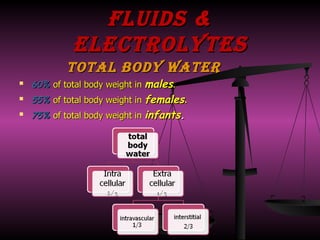
FLUIDS & ELECTROLYTES TOTAL BODY WATER   60%  of total body weight in  males . 55%  of total body weight in  females . 75%  of total body weight in  infants .
WATER SOURCES & LOSSES sources Exogenous 2 – 3 l per day Endogenous ( metabolic water )350 ml/d  Losses -Sensible  urine & faeces -Insensible  sweat & resp water input = water output
ELECTROLYTES METABOLISM Na  is the main  extracellular   cation  135-145 mEq/ litre  Avearge daily requirements is about  5 gm  daily equivalent to  5oo ml  of isotonic saline 0.9 %  K  is the main  intracellular  cation 3.5-5.5 mmol/l  A normal daily intake 1mmol/kg Total normal serum level of  Ca  8.5-10.5 mg/dl Ionized  “  “  “  3.5-4.5  mg/dl  Hypoalbuminemia causes total hypocalcemia without  affecting the physiologically active ionized Ca
PERIOPERATIVE FLUID THERAPY To maintain normovolemia. To maintain electrolyte balance To maintain normoglycemia.
Types of Fluids Crystalloids. Colloids.
Crystalloids Aqueous solutions of low mol.wt. ions(salts) With or without glucose. Sodium is the major osmotically active particle. Crystalloid replacement shoud be 3 to 6 times the volume of lost blood.
Crystalloids Normal saline(NS). Lactated Ringer’s solution(LR). 5% dextose in water (D5W). Ringer’s acetate. D5LR. D5 NS. D5  ½ NS. Hypertonic saline(HS)3%.
Normal Saline 0.9% NaCl (isotonic)  308  mOsm/L. Na  154  mEq/L. Cl  154  mEq/L.PH 5.7 Uses: Hyponatremia. Brain injury Large quantity--  hyperchloremic  metabolic acidosis. The predominant effect of volume resuscitation with crystalloid fluids is to expand the interstitial fluid volume rather than the plasma volume
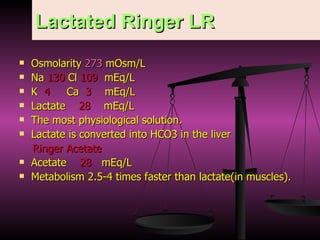
Lactated Ringer LR Osmolarity  273  mOsm/L Na  130  Cl  109   mEq/L K  4  Ca  3   mEq/L Lactate  28  mEq/L The most physiological solution. Lactate is converted into HCO3 in the liver Ringer Acetate Acetate  28   mEq/L Metabolism 2.5-4 times faster than lactate(in muscles).
GLUCOSE 5%  It functions as free water. 50  gm/L isotonic ( 253  mOsm/L). Uses: To maintain normoglycemia. To correct hypernatremia. To keep an IV line open for medication. Not used for volume expantion… as the predominant effect of volume resusscitation with gluc 5 % is to expand the intracellular volume ( cellular  oedema ) During surgery only given for patients at increased risk of hypoglycemia(infants,insulin T). Avoided in critically ill (it increases CO2 production and aggravates ischemic brain injury).
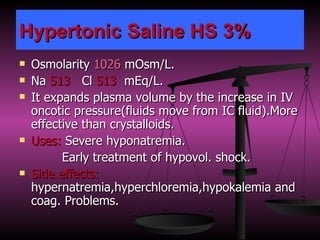
Hypertonic Saline HS 3% Osmolarity  1026  mOsm/L. Na  513   Cl  513   mEq/L. It expands plasma volume by the increase in IV oncotic pressure(fluids move from IC fluid).More effective than crystalloids. Uses:  Severe hyponatremia. Early treatment of hypovol. shock.  Side effects:  hypernatremia,hyperchloremia,hypokalemia and coag. Problems.
Colloids Solutions containing high-molecular weight substances such as proteins or large glucose polymers. Plasma expanders by: volume of colloid. increasing plasma oncotic pressure moving fluids from  IS  to  IV  spaces.
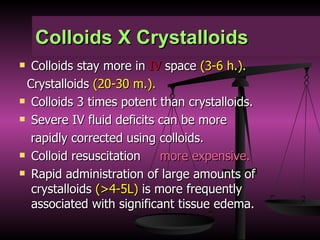
Colloids X Crystalloids Colloids stay more in  IV  space  (3-6 h.). Crystalloids  (20-30 m.). Colloids 3 times potent than crystalloids. Severe IV fluid deficits can be more  rapidly corrected using colloids. Colloid resuscitation  more expensive. Rapid administration of large amounts of crystalloids  (>4-5L)  is more frequently associated with significant tissue edema.
Types of Colloids Blood derived   Human albumin. Synthetic   * Starches. * Gelatins. *Dextrans.
Human Albumin 5%  (isotonic) and  25%  (hypertonic) in NS. Uses: Abnormal protein loss. e.g peritonitis. Severe burns. Expensive. No risk of viral infection. Rare allergic reactions. No effct on coagulation.
Starches Hetastarch  6%   Pentastarch  10%  in NS. More effective than  5%  albumin,gelatins and dextrans. Non antigenic;no effect on crossmatching. Lower cost than albumin. Cleared by the kidneys. Disadvantages: Coag.abnormalities if  >1.5L. Rare anaphylactic reactions. Elevated serum amylase.
Gelatins Haemagel  Relatively cheap. No effect on coagulation or on crossmatching. High incidence of allergic reactions.
Dextrans Dextran  40  and  70  in NS or 5% dextrose. Anti-thrombotic effects. Dextran 70 is preferrd (12h.). Dextran 40 improves blood flow in microcirculat. Uses:  *plasma expander. *To prevent thromboembolism (postop.). * To improve blood flow to isch.limb (dextran  40).
Dextrans Disadvantages: 1- Bleeding tendency. 2- Interfere with biood grouping and crossmatching. 3- Rare anaphylactic reactions. 4- Dextran  40  can precipitate in renal tubules leading to RF.
Perioperative Fluid Therapy Compensatory IV volume expansion. Normal maintenance requirements. Pre-existing deficits. Surgical fluid losses: Blood. Other fluids.
Peri-operative situations factors that need to be considered in the peri-operative period:  -Patient (age, physiological reserve, pre-op status)  -Clinical context (magnitude of surgery, blood loss, etc.)  -Existing deficit  -Stress response - causes salt and water retention.  -Anticipated losses (   Fever Respiratory rate Drain/NG losses, Third space)
Compensatory IV volume expantion 5-7 ml/kg of crystalloid before anaesthesia. This to compensate for vasodilatation and cardiac depression by anaesth. drugs.
Normal maintenance requirements For the first 10 kg: 4 ml/kg/h. For the next 10-20 kg: 2 ml/kg/h. For each kg above 20 kg: add 1 ml/kg/h. Example: Maintenance fluid needs for a 25 kg child: 40+20+5= 65ml/hour.
Postoperative Water: as maintenance. Potassium:  1 mmol/kg/day. Sodium: 1-1.5 mmol/kg/day . 70 kg adult 2640 ml water 70-100 mmol Na 70 mmol K   xxx???,remember rule of 40  Urine output at least40ml/h-Not more than 40mmoladdedto1L-Nofaster than40mmol/h  2L dextrose 5%  100gm glucose 500 ml NS  75 mmol sodium
Preexisting Deficits The deficit can be estimated by multiplying the normal maintenance rate by the length of the fast. 70 kg person fasting 8 h: 40+20+50 ml/h x 8h =880 ml. Consider abnormal losses.
Patients who are eating Usually, patients who are eating  require “supplemental” fluids (i.e., inadequate oral intake) will only require small amounts of fluid. In general, intravenous potassium replacement is not required for these patients (even if they are hypokalaemic, you can usually use oral supplementation). Try to calculate the amount of water actually required. For example, if they need 1L of water in addition to oral intake, then only give 1 litre in a day (as normal saline or dextrose solution). If no other intravenous access is required and intravenous access is difficult, consider a  subcutaneous line   (generally a maximum rate of fluid at about 80 mL/h). Do not put a dextrose solution subcutaneously.
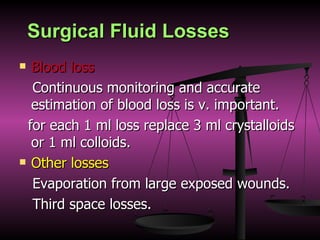
Surgical Fluid Losses Blood loss Continuous monitoring and accurate estimation of blood loss is v. important. for each 1 ml loss replace 3 ml crystalloids or 1 ml colloids. Other losses Evaporation from large exposed wounds. Third space losses.
Guidelines for fluid therapy 1- Short large-bore I.V. cannula. 2- The consequences of hypovolemia carry high mortality and must be treated promp. 3- Do not give inotropes to hypovol. pt. 4- For old,cardiac,hepatic or renal pt,replace gradually.Only half calc. deficit is given initially.CVP is mandatory.
Guidelines for fluid therapy 5- Crystalloids,when given in sufficient amounts are just as effective as colloids. 3-6 times. 6- Severe deficits  correct by colloids. 7- Rapid large amounts of crystalloids(>5L) is more freq. associated with tissue edema 8- Simple monitoring
Clinical  Markers of  perfusion   Capillary refill time   Urine output   Observations (Pulse-BP-CVP) CVP if central venous access present (5-12cmH2O) Patient thirst  Response to fluid challenge  Investigations  E(Na&K)/ Hb  /urine out put more than 0.5ml/kg/h. ABG  -CXR
CLINICAL APPLICATION Water imbalance . Water depletion  Causes 1-lack of intake 2-Diabetes insipidus 3-increased out put( fever-osmotic diuresis) C/P Intense thirst&weakness-decreased skin turgor-oliguria with incr specific gravity TTT Initialy increase in serum Na3mmol=1L  water deficit Na free water e.g,IV5%glucose
WATER EXCESS Causes(iatrogenic) Most common cause over infusion of IV5%glucose in post operative patients Colorectal washout with plain water instead of saline before colonic surgery Excessive uptake of water during TURP Moderate  asymptomatic(increased urine volume-incr body weight (no pitting edema)-decr Na&Heamatocrit) Marked (Na below120meq/L) Edema of brain cells Nausea&vomiting of clear fluid TTT   Mildwater excess require restriction SEVERE induction of diuresis by Mannitol+careful infusion of5%NaCl
  ELECTROLYTE IMBALANCE  Hyponatremia Causes 1-abnormal GIT losses(suction,vomiting,diarrhea)as in obstruction of small bowel 2-loss of ECF externally(burn-marked sweating)internallyas  athird space 3-excessive urine Na wastage(diuretics,salt wasting nephritis,adrenal failure) 4- blood loss  5-decrease intake  6-addision disease C/P   eyes sunken&face drawn&skin dry&wrinkled&tongue dry Peripheral veins contracted hypovolaemia (tachycardia & orthostatic hypotention  & shock) Low CVP decrease urine TTT  NaCl0.9%  blood loss replaced by blood
Hypernatraemia Causes If patientsgiven excessive amount of 0,9%NaCl during Early post operative(some degree of Na retention is to be expected Hyperaldosteronism ( Conn,s disease-liver cirrhosis) Cushing syndrome C/P  puffiness of the face is the only early sign –only reliable sign Oedema-weight gain-HTN Serum Na is usually normal TTT  Na restriction & diuretics
Hypokalemia Since serum K small amount of total body K small reduction in its serum level may reflect large body losses of K CAUSES Excessive vomiting e,g. pyloric stenosis-intestinal obstuction-paralytic illeus –prolonged gastro duodenal aspiration with fluid replcement by IV NaCl  External alimentary fistulae Diarrhoea  &  Diuretics as furosemide Alkalosis (shift of K intra cellular)  & Hyperaldosteronsim C/P   most patient asymptomatic –early sign of K depletion,malaise& weakness Paralytic illeus&distention-muscular paresis ECG prolonged QT-Tachycardia-St segment depression-U wave appearance TTT   1meq of K =35 ampoules SAFE rule is rule of 40
Hyperkalaemia Causes Life-threatening k excess usually withRenal failure Acidosis lead to shift of K out side the cells C/P  arryhythmia,bradycardia,hypotention,cardiac arrest ECG wide QRS&peaked Twave TTT  IV Ca gluconate&IV NaHCO3&glucose,insulin&if previous fail ion exchange resins&the end Dialysis
Calcium Imbalance Hypocalcemia Latent  e,g. hypoparathyriodism following thyriod surgeryC/P (Circumoral tingling,numbness&+ve chvosteks sing) Symptomatic  hypocalcemia in permanent hypoparathyroidism,acute pancreatitis&acute alkalosisC/P(hyperactive deep tendon reflexes,muscle&abdominal cramps,carpopedal spasm ECG prolonged QT interval TTT   IV Ca gluconate or Ca Cl2 Chronic hypocalcaemia vit D, oralCa& AL(OH)3 bind phosphate in the intestine
Acid Base Imbalance I Metabolic Acidosis Causes Over production of organic acid DKA-Lactic acidosis of sepsis and shock [ HIGH ANION GAP ] Renal failure(acute-chronic) Excessive loss of HCO3(diarrhea,pancreatic or small intestinal fistula,uretro sigmoidostmy  [ NORMAL ANION GAP ] C/P  increased rate&depth of breathing TTT  mild to moderate ttt of cause Sever (IV HCO3 causes (1/2body weight X (15-HCO3))
METABOLIC ALKALOSIS PH more than 7.45 Causes Gastrointestinal losses of H due to vomiting,suction(pyloric stenosis) Hypokalemia lead to H movement into the cells(extracellular alkalosis&paradoxical intracellular acidosis) HCO3 retention(NAHCO3 administration,milk alkali syndrome) C/P  Chyne-Stoke & apnea-Tetany TTT  replacement of CL In mild cases saline NaCl is sufficient associated hypokalemia ttt by IV KCl Sever:  IV ammonium  chloride NHCL or hydrogen cholride HCl very slowly TETANY ttt by slow IV10ml Ca gluconate
45 of 45 Thank You

Fluids & Electrolytes

  • 1.
    FLUID & ELECTROLYTETHERAPY BY under supervision of Dr. ASHRAF THABET
  • 2.
    FLUIDS & ELECTROLYTESTOTAL BODY WATER 60% of total body weight in males . 55% of total body weight in females . 75% of total body weight in infants .
  • 3.
    WATER SOURCES &LOSSES sources Exogenous 2 – 3 l per day Endogenous ( metabolic water )350 ml/d Losses -Sensible urine & faeces -Insensible sweat & resp water input = water output
  • 4.
    ELECTROLYTES METABOLISM Na is the main extracellular cation 135-145 mEq/ litre Avearge daily requirements is about 5 gm daily equivalent to 5oo ml of isotonic saline 0.9 % K is the main intracellular cation 3.5-5.5 mmol/l A normal daily intake 1mmol/kg Total normal serum level of Ca 8.5-10.5 mg/dl Ionized “ “ “ 3.5-4.5 mg/dl Hypoalbuminemia causes total hypocalcemia without affecting the physiologically active ionized Ca
  • 5.
    PERIOPERATIVE FLUID THERAPYTo maintain normovolemia. To maintain electrolyte balance To maintain normoglycemia.
  • 6.
    Types of FluidsCrystalloids. Colloids.
  • 7.
    Crystalloids Aqueous solutionsof low mol.wt. ions(salts) With or without glucose. Sodium is the major osmotically active particle. Crystalloid replacement shoud be 3 to 6 times the volume of lost blood.
  • 8.
    Crystalloids Normal saline(NS).Lactated Ringer’s solution(LR). 5% dextose in water (D5W). Ringer’s acetate. D5LR. D5 NS. D5 ½ NS. Hypertonic saline(HS)3%.
  • 9.
    Normal Saline 0.9%NaCl (isotonic) 308 mOsm/L. Na 154 mEq/L. Cl 154 mEq/L.PH 5.7 Uses: Hyponatremia. Brain injury Large quantity--  hyperchloremic metabolic acidosis. The predominant effect of volume resuscitation with crystalloid fluids is to expand the interstitial fluid volume rather than the plasma volume
  • 10.
    Lactated Ringer LROsmolarity 273 mOsm/L Na 130 Cl 109 mEq/L K 4 Ca 3 mEq/L Lactate 28 mEq/L The most physiological solution. Lactate is converted into HCO3 in the liver Ringer Acetate Acetate 28 mEq/L Metabolism 2.5-4 times faster than lactate(in muscles).
  • 11.
    GLUCOSE 5% It functions as free water. 50 gm/L isotonic ( 253 mOsm/L). Uses: To maintain normoglycemia. To correct hypernatremia. To keep an IV line open for medication. Not used for volume expantion… as the predominant effect of volume resusscitation with gluc 5 % is to expand the intracellular volume ( cellular oedema ) During surgery only given for patients at increased risk of hypoglycemia(infants,insulin T). Avoided in critically ill (it increases CO2 production and aggravates ischemic brain injury).
  • 12.
    Hypertonic Saline HS3% Osmolarity 1026 mOsm/L. Na 513 Cl 513 mEq/L. It expands plasma volume by the increase in IV oncotic pressure(fluids move from IC fluid).More effective than crystalloids. Uses: Severe hyponatremia. Early treatment of hypovol. shock. Side effects: hypernatremia,hyperchloremia,hypokalemia and coag. Problems.
  • 13.
    Colloids Solutions containinghigh-molecular weight substances such as proteins or large glucose polymers. Plasma expanders by: volume of colloid. increasing plasma oncotic pressure moving fluids from IS to IV spaces.
  • 14.
    Colloids X CrystalloidsColloids stay more in IV space (3-6 h.). Crystalloids (20-30 m.). Colloids 3 times potent than crystalloids. Severe IV fluid deficits can be more rapidly corrected using colloids. Colloid resuscitation more expensive. Rapid administration of large amounts of crystalloids (>4-5L) is more frequently associated with significant tissue edema.
  • 15.
    Types of ColloidsBlood derived Human albumin. Synthetic * Starches. * Gelatins. *Dextrans.
  • 16.
    Human Albumin 5% (isotonic) and 25% (hypertonic) in NS. Uses: Abnormal protein loss. e.g peritonitis. Severe burns. Expensive. No risk of viral infection. Rare allergic reactions. No effct on coagulation.
  • 17.
    Starches Hetastarch 6% Pentastarch 10% in NS. More effective than 5% albumin,gelatins and dextrans. Non antigenic;no effect on crossmatching. Lower cost than albumin. Cleared by the kidneys. Disadvantages: Coag.abnormalities if >1.5L. Rare anaphylactic reactions. Elevated serum amylase.
  • 18.
    Gelatins Haemagel Relatively cheap. No effect on coagulation or on crossmatching. High incidence of allergic reactions.
  • 19.
    Dextrans Dextran 40 and 70 in NS or 5% dextrose. Anti-thrombotic effects. Dextran 70 is preferrd (12h.). Dextran 40 improves blood flow in microcirculat. Uses: *plasma expander. *To prevent thromboembolism (postop.). * To improve blood flow to isch.limb (dextran 40).
  • 20.
    Dextrans Disadvantages: 1-Bleeding tendency. 2- Interfere with biood grouping and crossmatching. 3- Rare anaphylactic reactions. 4- Dextran 40 can precipitate in renal tubules leading to RF.
  • 21.
    Perioperative Fluid TherapyCompensatory IV volume expansion. Normal maintenance requirements. Pre-existing deficits. Surgical fluid losses: Blood. Other fluids.
  • 22.
    Peri-operative situations factorsthat need to be considered in the peri-operative period: -Patient (age, physiological reserve, pre-op status) -Clinical context (magnitude of surgery, blood loss, etc.) -Existing deficit -Stress response - causes salt and water retention. -Anticipated losses ( Fever Respiratory rate Drain/NG losses, Third space)
  • 23.
    Compensatory IV volumeexpantion 5-7 ml/kg of crystalloid before anaesthesia. This to compensate for vasodilatation and cardiac depression by anaesth. drugs.
  • 24.
    Normal maintenance requirementsFor the first 10 kg: 4 ml/kg/h. For the next 10-20 kg: 2 ml/kg/h. For each kg above 20 kg: add 1 ml/kg/h. Example: Maintenance fluid needs for a 25 kg child: 40+20+5= 65ml/hour.
  • 25.
    Postoperative Water: asmaintenance. Potassium: 1 mmol/kg/day. Sodium: 1-1.5 mmol/kg/day . 70 kg adult 2640 ml water 70-100 mmol Na 70 mmol K xxx???,remember rule of 40 Urine output at least40ml/h-Not more than 40mmoladdedto1L-Nofaster than40mmol/h 2L dextrose 5% 100gm glucose 500 ml NS 75 mmol sodium
  • 26.
    Preexisting Deficits Thedeficit can be estimated by multiplying the normal maintenance rate by the length of the fast. 70 kg person fasting 8 h: 40+20+50 ml/h x 8h =880 ml. Consider abnormal losses.
  • 27.
    Patients who areeating Usually, patients who are eating require “supplemental” fluids (i.e., inadequate oral intake) will only require small amounts of fluid. In general, intravenous potassium replacement is not required for these patients (even if they are hypokalaemic, you can usually use oral supplementation). Try to calculate the amount of water actually required. For example, if they need 1L of water in addition to oral intake, then only give 1 litre in a day (as normal saline or dextrose solution). If no other intravenous access is required and intravenous access is difficult, consider a subcutaneous line (generally a maximum rate of fluid at about 80 mL/h). Do not put a dextrose solution subcutaneously.
  • 28.
    Surgical Fluid LossesBlood loss Continuous monitoring and accurate estimation of blood loss is v. important. for each 1 ml loss replace 3 ml crystalloids or 1 ml colloids. Other losses Evaporation from large exposed wounds. Third space losses.
  • 29.
    Guidelines for fluidtherapy 1- Short large-bore I.V. cannula. 2- The consequences of hypovolemia carry high mortality and must be treated promp. 3- Do not give inotropes to hypovol. pt. 4- For old,cardiac,hepatic or renal pt,replace gradually.Only half calc. deficit is given initially.CVP is mandatory.
  • 30.
    Guidelines for fluidtherapy 5- Crystalloids,when given in sufficient amounts are just as effective as colloids. 3-6 times. 6- Severe deficits correct by colloids. 7- Rapid large amounts of crystalloids(>5L) is more freq. associated with tissue edema 8- Simple monitoring
  • 31.
    Clinical Markersof perfusion Capillary refill time Urine output Observations (Pulse-BP-CVP) CVP if central venous access present (5-12cmH2O) Patient thirst Response to fluid challenge Investigations E(Na&K)/ Hb /urine out put more than 0.5ml/kg/h. ABG -CXR
  • 32.
    CLINICAL APPLICATION Waterimbalance . Water depletion Causes 1-lack of intake 2-Diabetes insipidus 3-increased out put( fever-osmotic diuresis) C/P Intense thirst&weakness-decreased skin turgor-oliguria with incr specific gravity TTT Initialy increase in serum Na3mmol=1L water deficit Na free water e.g,IV5%glucose
  • 33.
    WATER EXCESS Causes(iatrogenic)Most common cause over infusion of IV5%glucose in post operative patients Colorectal washout with plain water instead of saline before colonic surgery Excessive uptake of water during TURP Moderate asymptomatic(increased urine volume-incr body weight (no pitting edema)-decr Na&Heamatocrit) Marked (Na below120meq/L) Edema of brain cells Nausea&vomiting of clear fluid TTT Mildwater excess require restriction SEVERE induction of diuresis by Mannitol+careful infusion of5%NaCl
  • 34.
    ELECTROLYTEIMBALANCE Hyponatremia Causes 1-abnormal GIT losses(suction,vomiting,diarrhea)as in obstruction of small bowel 2-loss of ECF externally(burn-marked sweating)internallyas athird space 3-excessive urine Na wastage(diuretics,salt wasting nephritis,adrenal failure) 4- blood loss 5-decrease intake 6-addision disease C/P eyes sunken&face drawn&skin dry&wrinkled&tongue dry Peripheral veins contracted hypovolaemia (tachycardia & orthostatic hypotention & shock) Low CVP decrease urine TTT NaCl0.9% blood loss replaced by blood
  • 35.
    Hypernatraemia Causes Ifpatientsgiven excessive amount of 0,9%NaCl during Early post operative(some degree of Na retention is to be expected Hyperaldosteronism ( Conn,s disease-liver cirrhosis) Cushing syndrome C/P puffiness of the face is the only early sign –only reliable sign Oedema-weight gain-HTN Serum Na is usually normal TTT Na restriction & diuretics
  • 36.
    Hypokalemia Since serumK small amount of total body K small reduction in its serum level may reflect large body losses of K CAUSES Excessive vomiting e,g. pyloric stenosis-intestinal obstuction-paralytic illeus –prolonged gastro duodenal aspiration with fluid replcement by IV NaCl External alimentary fistulae Diarrhoea & Diuretics as furosemide Alkalosis (shift of K intra cellular) & Hyperaldosteronsim C/P most patient asymptomatic –early sign of K depletion,malaise& weakness Paralytic illeus&distention-muscular paresis ECG prolonged QT-Tachycardia-St segment depression-U wave appearance TTT 1meq of K =35 ampoules SAFE rule is rule of 40
  • 37.
    Hyperkalaemia Causes Life-threateningk excess usually withRenal failure Acidosis lead to shift of K out side the cells C/P arryhythmia,bradycardia,hypotention,cardiac arrest ECG wide QRS&peaked Twave TTT IV Ca gluconate&IV NaHCO3&glucose,insulin&if previous fail ion exchange resins&the end Dialysis
  • 38.
    Calcium Imbalance HypocalcemiaLatent e,g. hypoparathyriodism following thyriod surgeryC/P (Circumoral tingling,numbness&+ve chvosteks sing) Symptomatic hypocalcemia in permanent hypoparathyroidism,acute pancreatitis&acute alkalosisC/P(hyperactive deep tendon reflexes,muscle&abdominal cramps,carpopedal spasm ECG prolonged QT interval TTT IV Ca gluconate or Ca Cl2 Chronic hypocalcaemia vit D, oralCa& AL(OH)3 bind phosphate in the intestine
  • 39.
    Acid Base ImbalanceI Metabolic Acidosis Causes Over production of organic acid DKA-Lactic acidosis of sepsis and shock [ HIGH ANION GAP ] Renal failure(acute-chronic) Excessive loss of HCO3(diarrhea,pancreatic or small intestinal fistula,uretro sigmoidostmy [ NORMAL ANION GAP ] C/P increased rate&depth of breathing TTT mild to moderate ttt of cause Sever (IV HCO3 causes (1/2body weight X (15-HCO3))
  • 40.
    METABOLIC ALKALOSIS PHmore than 7.45 Causes Gastrointestinal losses of H due to vomiting,suction(pyloric stenosis) Hypokalemia lead to H movement into the cells(extracellular alkalosis&paradoxical intracellular acidosis) HCO3 retention(NAHCO3 administration,milk alkali syndrome) C/P Chyne-Stoke & apnea-Tetany TTT replacement of CL In mild cases saline NaCl is sufficient associated hypokalemia ttt by IV KCl Sever: IV ammonium chloride NHCL or hydrogen cholride HCl very slowly TETANY ttt by slow IV10ml Ca gluconate
  • 41.
    45 of 45Thank You