Fluid Management
Dr. Nasiba Hassan
Water intake Water output
Liquid-1.5L Urine-1.5L
Solid foods-750ml Lungs-400ml
Metabolism-
350ml(metabolic
water)
Skin-600ml
Faeces-100ml
Total=2600ml Total=2600ml
45% 55%
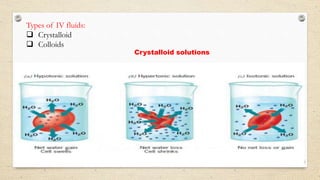
Types of IV fluids:
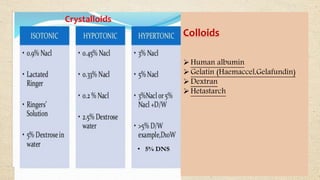
 Crystalloid
 Colloids
()
Crystalloid solutions
Colloids
Human albumin
Gelatin (Haemaccel,Gelafundin)
Dextran
Hetastarch
Crystalloids
• 5% DNS
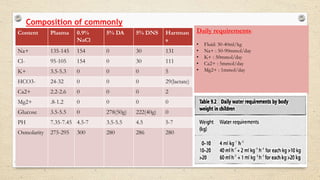
Composition of commonly
used crystalloidsContent Plasma 0.9%
NaCl
5% DA 5% DNS Hartman
s
Na+ 135-145 154 0 30 131
Cl- 95-105 154 0 30 111
K+ 3.5-5.3 0 0 0 5
HCO3- 24-32 0 0 0 29(lactate)
Ca2+ 2.2-2.6 0 0 0 2
Mg2+ .8-1.2 0 0 0 0
Glucose 3.5-5.5 0 278(50g) 222(40g) 0
PH 7.35-7.45 4.5-7 3.5-5.5 4.5 5-7
Osmolarity 275-295 300 280 286 280
Daily requirements:
• Fluid: 30-40ml/kg
• Na+ : 50-90mmol/day
• K+ : 50mmol/day
• Ca2+ : 5mmol/day
• Mg2+ : 1mmol/day
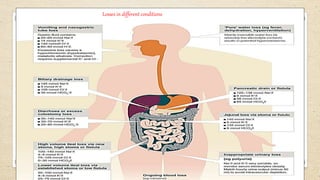
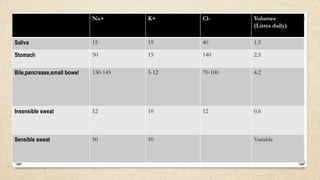
Losses in different conditions
Na+ K+ Cl- Volumes
(Litres daily)
Saliva 15 19 40 1.5
Stomach 50 15 140 2.5
Bile,pancrease,small bowel 130-145 5-12 70-100 4.2
Insensible sweat 12 10 12 0.6
Sensible sweat 50 10 Variable
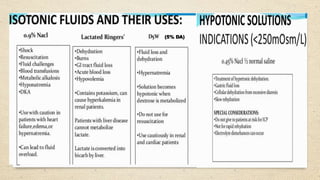
(5% DA)
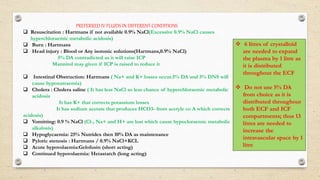
PREFERRED IV FLUIDS IN DIFFERENT CONDITIONS
 Resuscitation : Hartmans if not available 0.9% NaCl(Excessive 0.9% NaCl causes
hyperchloraemic metabolic acidosis)
 Burn : Hartmans
 Head injury : Blood or Any isotonic solutions(Hartmans,0.9% NaCl)
5% DA contradicted as it will raise ICP
Mannitol may given if ICP is raised to reduce it
 Intestinal Obstruction: Hartmans ( Na+ and K+ losses occur.5% DA and 5% DNS will
cause hyponatraemia)
 Cholera : Cholera saline ( It has less NaCl so less chance of hyperchloraemic metabolic
acidosis
It has K+ that corrects potassium losses
It has sodium acetate that produces HCO3- from acetyle co A which corrects
acidosis)
 Vomitting: 0.9 % NaCl (Cl-, Na+ and H+ are lost which cause hypocloraemic metabolic
alkalosis)
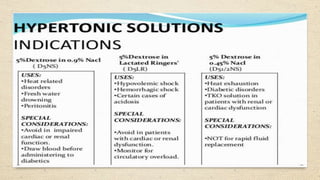
 Hypoglycaemia: 25% Nutridex then 10% DA as maintenance
 Pyloric stenosis : Hartmans / 0.9% NaCl+KCL
 Acute hypovolaemia:Gelofusin (short acting)
 Continued hypovolaemia: Hetastarch (long acting)
 6 litres of crystalloid
are needed to expand
the plasma by 1 litre as
it is distributed
throughout the ECF
 Do not use 5% DA
from choice as it is
distributed throughout
both ECF and ICF
compartments; thus 13
litres are needed to
increase the
intravascular space by 1
litre
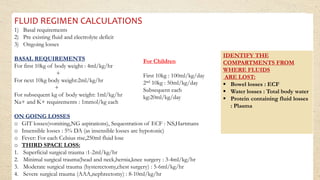
FLUID REGIMEN CALCULATIONS
1) Basal requirements
2) Pre existing fluid and electrolyte deficit
3) Ongoing losses
BASAL REQUIREMENTS
For first 10kg of body weight : 4ml/kg/hr
+
For next 10kg body weight:2ml/kg/hr
+
For subsequent kg of body weight: 1ml/kg/hr
Na+ and K+ requirements : 1mmol/kg each
ON GOING LOSSES
o GIT losses(vomiting,NG aspirations), Sequestration of ECF : NS,Hartmans
o Insensible losses : 5% DA (as insensible losses are hypotonic)
o Fever: For each Celsius rise,250ml fluid lose
o THIRD SPACE LOSS:
1. Superficial surgical trauma :1-2ml/kg/hr
2. Minimal surgical trauma(head and neck,hernia,knee surgery : 3-4ml/kg/hr
3. Moderate surgical trauma (hysterectomy,chest surgery) : 5-6ml/kg/hr
4. Severe surgical trauma (AAA,nephrectomy) : 8-10ml/kg/hr
IDENTIFY THE
COMPARTMENTS FROM
WHERE FLUIDS
ARE LOST:
 Bowel losses : ECF
 Water losses : Total body water
 Protein containing fluid losses
: Plasma
For Children
First 10kg : 100ml/kg/day
2nd 10kg : 50ml/kg/day
Subsequent each
kg:20ml/kg/day
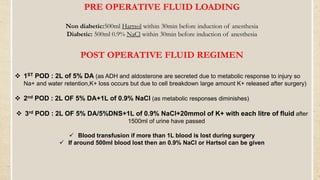
PRE OPERATIVE FLUID LOADING
Non diabetic:500ml Hartsol within 30min before induction of anesthesia
Diabetic: 500ml 0.9% NaCl within 30min before induction of anesthesia
POST OPERATIVE FLUID REGIMEN
 1ST POD : 2L of 5% DA (as ADH and aldosterone are secreted due to metabolic response to injury so
Na+ and water retention,K+ loss occurs but due to cell breakdown large amount K+ released after surgery)
 2nd POD : 2L OF 5% DA+1L of 0.9% NaCl (as metabolic responses diminishes)
 3rd POD : 2L OF 5% DA/5%DNS+1L of 0.9% NaCl+20mmol of K+ with each litre of fluid after
1500ml of urine have passed
 Blood transfusion if more than 1L blood is lost during surgery
 If around 500ml blood lost then an 0.9% NaCl or Hartsol can be given
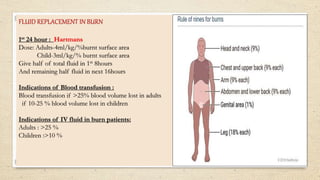
FLUID REPLACEMENT IN BURN
1st 24 hour : Hartmans
Dose: Adults-4ml/kg/%burnt surface area
Child-3ml/kg/% burnt surface area
Give half of total fluid in 1st 8hours
And remaining half fluid in next 16hours
Indications of Blood transfusion :
Blood transfusion if >25% blood volume lost in adults
if 10-25 % blood volume lost in children
Indications of IV fluid in burn patients:
Adults : >25 %
Children :>10 %
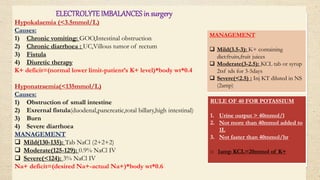
ELECTROLYTE IMBALANCES in surgery
Hypokalaemia (<3.5mmol/L)
Causes:
1) Chronic vomiting: GOO,Intestinal obstruction
2) Chronic diarrhoea : UC,Villous tumor of rectum
3) Fistula
4) Diuretic therapy
K+ deficit=(normal lower limit-patient’s K+ level)*body wt*0.4
Hyponatraemia(<135mmol/L)
Causes:
1) Obstruction of small intestine
2) Exrernal fistula(duodenal,pancreatic,total billary,high intestinal)
3) Burn
4) Severe diarrhoea
MANAGEMENT
 Mild(130-135): Tab NaCl (2+2+2)
 Moderate(125-129): 0.9% NaCl IV
 Severe(<124): 3% NaCl IV
Na+ deficit=(desired Na+-actual Na+)*body wt*0.6
RULE OF 40 FOR POTASSIUM
1. Urine output > 40mmol/l
2. Not more than 40mmol added to
1L
3. Not faster than 40mmol/hr
o 1amp KCL=20mmol of K+
MANAGEMENT
 Mild(3.5-3): K+ containing
diet:fruits,fruit juices
 Moderate(3-2.5): KCL tab or syrup
2tsf tds for 3-5days
 Severe(<2.5) : Inj KT diluted in NS
(2amp)
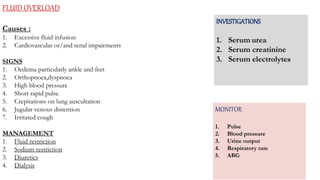
FLUID OVERLOAD
Causes :
1. Excessive fluid infusion
2. Cardiovascular or/and renal impairments
SIGNS
1. Oedema particularly ankle and feet
2. Orthopnoea,dyspnoea
3. High blood pressure
4. Short rapid pulse
5. Crepitations on lung auscultation
6. Jugular venous distention
7. Irritated cough
MANAGEMENT
1. Fluid restriction
2. Sodium restriction
3. Diuretics
4. Dialysis
INVESTIGATIONS
1. Serum urea
2. Serum creatinine
3. Serum electrolytes
MONITOR
1. Pulse
2. Blood pressure
3. Urine output
4. Respiratory rate
5. ABG
• ‘’The eyes can’t see what the mind doesn’t know”-Dr.Judy Wall
THANK YOU

Fluid management

  • 1.
  • 2.
    Water intake Wateroutput Liquid-1.5L Urine-1.5L Solid foods-750ml Lungs-400ml Metabolism- 350ml(metabolic water) Skin-600ml Faeces-100ml Total=2600ml Total=2600ml 45% 55%
  • 3.
    Types of IVfluids:  Crystalloid  Colloids () Crystalloid solutions
  • 4.
  • 5.
    Composition of commonly usedcrystalloidsContent Plasma 0.9% NaCl 5% DA 5% DNS Hartman s Na+ 135-145 154 0 30 131 Cl- 95-105 154 0 30 111 K+ 3.5-5.3 0 0 0 5 HCO3- 24-32 0 0 0 29(lactate) Ca2+ 2.2-2.6 0 0 0 2 Mg2+ .8-1.2 0 0 0 0 Glucose 3.5-5.5 0 278(50g) 222(40g) 0 PH 7.35-7.45 4.5-7 3.5-5.5 4.5 5-7 Osmolarity 275-295 300 280 286 280 Daily requirements: • Fluid: 30-40ml/kg • Na+ : 50-90mmol/day • K+ : 50mmol/day • Ca2+ : 5mmol/day • Mg2+ : 1mmol/day
  • 6.
  • 7.
    Na+ K+ Cl-Volumes (Litres daily) Saliva 15 19 40 1.5 Stomach 50 15 140 2.5 Bile,pancrease,small bowel 130-145 5-12 70-100 4.2 Insensible sweat 12 10 12 0.6 Sensible sweat 50 10 Variable
  • 8.
  • 11.
    PREFERRED IV FLUIDSIN DIFFERENT CONDITIONS  Resuscitation : Hartmans if not available 0.9% NaCl(Excessive 0.9% NaCl causes hyperchloraemic metabolic acidosis)  Burn : Hartmans  Head injury : Blood or Any isotonic solutions(Hartmans,0.9% NaCl) 5% DA contradicted as it will raise ICP Mannitol may given if ICP is raised to reduce it  Intestinal Obstruction: Hartmans ( Na+ and K+ losses occur.5% DA and 5% DNS will cause hyponatraemia)  Cholera : Cholera saline ( It has less NaCl so less chance of hyperchloraemic metabolic acidosis It has K+ that corrects potassium losses It has sodium acetate that produces HCO3- from acetyle co A which corrects acidosis)  Vomitting: 0.9 % NaCl (Cl-, Na+ and H+ are lost which cause hypocloraemic metabolic alkalosis)  Hypoglycaemia: 25% Nutridex then 10% DA as maintenance  Pyloric stenosis : Hartmans / 0.9% NaCl+KCL  Acute hypovolaemia:Gelofusin (short acting)  Continued hypovolaemia: Hetastarch (long acting)  6 litres of crystalloid are needed to expand the plasma by 1 litre as it is distributed throughout the ECF  Do not use 5% DA from choice as it is distributed throughout both ECF and ICF compartments; thus 13 litres are needed to increase the intravascular space by 1 litre
  • 12.
    FLUID REGIMEN CALCULATIONS 1)Basal requirements 2) Pre existing fluid and electrolyte deficit 3) Ongoing losses BASAL REQUIREMENTS For first 10kg of body weight : 4ml/kg/hr + For next 10kg body weight:2ml/kg/hr + For subsequent kg of body weight: 1ml/kg/hr Na+ and K+ requirements : 1mmol/kg each ON GOING LOSSES o GIT losses(vomiting,NG aspirations), Sequestration of ECF : NS,Hartmans o Insensible losses : 5% DA (as insensible losses are hypotonic) o Fever: For each Celsius rise,250ml fluid lose o THIRD SPACE LOSS: 1. Superficial surgical trauma :1-2ml/kg/hr 2. Minimal surgical trauma(head and neck,hernia,knee surgery : 3-4ml/kg/hr 3. Moderate surgical trauma (hysterectomy,chest surgery) : 5-6ml/kg/hr 4. Severe surgical trauma (AAA,nephrectomy) : 8-10ml/kg/hr IDENTIFY THE COMPARTMENTS FROM WHERE FLUIDS ARE LOST:  Bowel losses : ECF  Water losses : Total body water  Protein containing fluid losses : Plasma For Children First 10kg : 100ml/kg/day 2nd 10kg : 50ml/kg/day Subsequent each kg:20ml/kg/day
  • 13.
    PRE OPERATIVE FLUIDLOADING Non diabetic:500ml Hartsol within 30min before induction of anesthesia Diabetic: 500ml 0.9% NaCl within 30min before induction of anesthesia POST OPERATIVE FLUID REGIMEN  1ST POD : 2L of 5% DA (as ADH and aldosterone are secreted due to metabolic response to injury so Na+ and water retention,K+ loss occurs but due to cell breakdown large amount K+ released after surgery)  2nd POD : 2L OF 5% DA+1L of 0.9% NaCl (as metabolic responses diminishes)  3rd POD : 2L OF 5% DA/5%DNS+1L of 0.9% NaCl+20mmol of K+ with each litre of fluid after 1500ml of urine have passed  Blood transfusion if more than 1L blood is lost during surgery  If around 500ml blood lost then an 0.9% NaCl or Hartsol can be given
  • 14.
    FLUID REPLACEMENT INBURN 1st 24 hour : Hartmans Dose: Adults-4ml/kg/%burnt surface area Child-3ml/kg/% burnt surface area Give half of total fluid in 1st 8hours And remaining half fluid in next 16hours Indications of Blood transfusion : Blood transfusion if >25% blood volume lost in adults if 10-25 % blood volume lost in children Indications of IV fluid in burn patients: Adults : >25 % Children :>10 %
  • 15.
    ELECTROLYTE IMBALANCES insurgery Hypokalaemia (<3.5mmol/L) Causes: 1) Chronic vomiting: GOO,Intestinal obstruction 2) Chronic diarrhoea : UC,Villous tumor of rectum 3) Fistula 4) Diuretic therapy K+ deficit=(normal lower limit-patient’s K+ level)*body wt*0.4 Hyponatraemia(<135mmol/L) Causes: 1) Obstruction of small intestine 2) Exrernal fistula(duodenal,pancreatic,total billary,high intestinal) 3) Burn 4) Severe diarrhoea MANAGEMENT  Mild(130-135): Tab NaCl (2+2+2)  Moderate(125-129): 0.9% NaCl IV  Severe(<124): 3% NaCl IV Na+ deficit=(desired Na+-actual Na+)*body wt*0.6 RULE OF 40 FOR POTASSIUM 1. Urine output > 40mmol/l 2. Not more than 40mmol added to 1L 3. Not faster than 40mmol/hr o 1amp KCL=20mmol of K+ MANAGEMENT  Mild(3.5-3): K+ containing diet:fruits,fruit juices  Moderate(3-2.5): KCL tab or syrup 2tsf tds for 3-5days  Severe(<2.5) : Inj KT diluted in NS (2amp)
  • 16.
    FLUID OVERLOAD Causes : 1.Excessive fluid infusion 2. Cardiovascular or/and renal impairments SIGNS 1. Oedema particularly ankle and feet 2. Orthopnoea,dyspnoea 3. High blood pressure 4. Short rapid pulse 5. Crepitations on lung auscultation 6. Jugular venous distention 7. Irritated cough MANAGEMENT 1. Fluid restriction 2. Sodium restriction 3. Diuretics 4. Dialysis INVESTIGATIONS 1. Serum urea 2. Serum creatinine 3. Serum electrolytes MONITOR 1. Pulse 2. Blood pressure 3. Urine output 4. Respiratory rate 5. ABG
  • 17.
    • ‘’The eyescan’t see what the mind doesn’t know”-Dr.Judy Wall THANK YOU