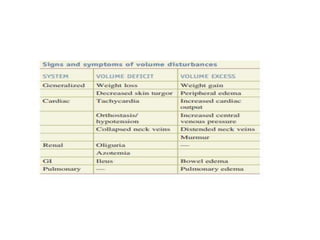
FLUID MANAGEMENT IN
SURGERY
DR. BIPUL THAKUR
INTRODUCTION
• Supplemental fluids used as an IVC therapy to restore or maintain
normal fluid volume and electrolyte balance when oral route is not
feasible.
• Water and Electrolyte balance is important for body hemostasis.
• Fluid and electrolyte management is paramount to the care of the
surgical patient. Changes in both fluid volume and electrolyte
composition occur preoperatively, intraoperatively, and
postoperatively, as well as in response to trauma and sepsis.
• A critical role of kidney is to maintain electrolyte hemostasis within
relatively narrow limit.
INDICATIONS
• For Rapid Resuscitation
• TPN
• Post GI surgeries
• For maintenance, replacement of loss or as a specific fluid
Advantages
• Accurate, controlled and predictable way of administration.
• Immediate response
• Prompt correction of fluid and electrolyte disturbances
Goals
• Resuscitation
• Rehydration/Replacement
• Maintenance
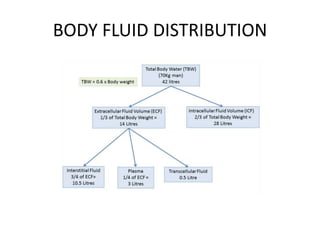
BODY FLUID DISTRIBUTION
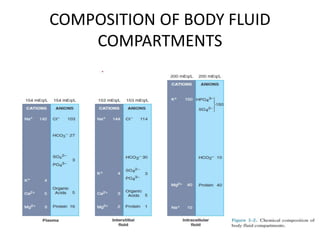
COMPOSITION OF BODY FLUID
COMPARTMENTS
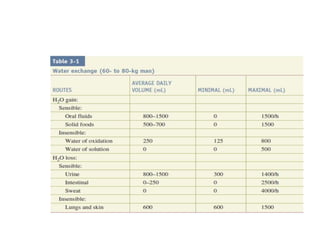
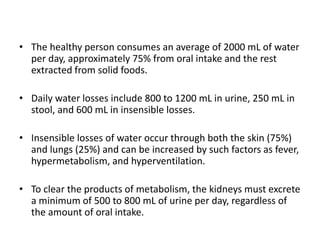
• The healthy person consumes an average of 2000 mL of water
per day, approximately 75% from oral intake and the rest
extracted from solid foods.
• Daily water losses include 800 to 1200 mL in urine, 250 mL in
stool, and 600 mL in insensible losses.
• Insensible losses of water occur through both the skin (75%)
and lungs (25%) and can be increased by such factors as fever,
hypermetabolism, and hyperventilation.
• To clear the products of metabolism, the kidneys must excrete
a minimum of 500 to 800 mL of urine per day, regardless of
the amount of oral intake.
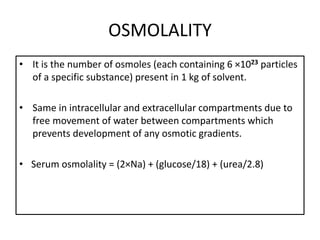
OSMOLALITY
• It is the number of osmoles (each containing 6 ×10²³ particles
of a specific substance) present in 1 kg of solvent.
• Same in intracellular and extracellular compartments due to
free movement of water between compartments which
prevents development of any osmotic gradients.
• Serum osmolality = (2×Na) + (glucose/18) + (urea/2.8)
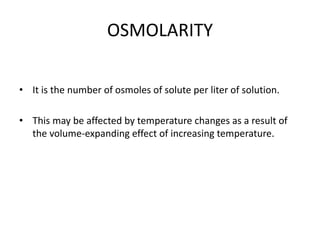
OSMOLARITY
• It is the number of osmoles of solute per liter of solution.
• This may be affected by temperature changes as a result of
the volume-expanding effect of increasing temperature.
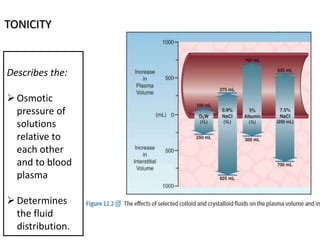
TONICITY
Describes the:
Osmotic
pressure of
solutions
relative to
each other
and to blood
plasma
Determines
the fluid
distribution.
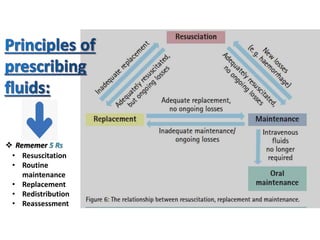
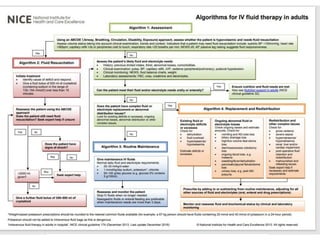
 Rememer 5 Rs
• Resuscitation
• Routine
maintenance
• Replacement
• Redistribution
• Reassessment
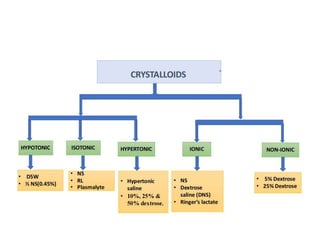
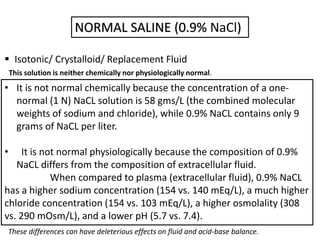
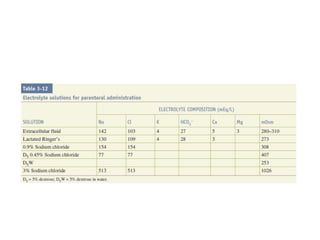
NORMAL SALINE (0.9% NaCl)
 Isotonic/ Crystalloid/ Replacement Fluid
• It is not normal chemically because the concentration of a one-
normal (1 N) NaCL solution is 58 gms/L (the combined molecular
weights of sodium and chloride), while 0.9% NaCL contains only 9
grams of NaCL per liter.
• It is not normal physiologically because the composition of 0.9%
NaCL differs from the composition of extracellular fluid.
When compared to plasma (extracellular fluid), 0.9% NaCL
has a higher sodium concentration (154 vs. 140 mEq/L), a much higher
chloride concentration (154 vs. 103 mEq/L), a higher osmolality (308
vs. 290 mOsm/L), and a lower pH (5.7 vs. 7.4).
This solution is neither chemically nor physiologically normal.
These differences can have deleterious effects on fluid and acid-base balance.
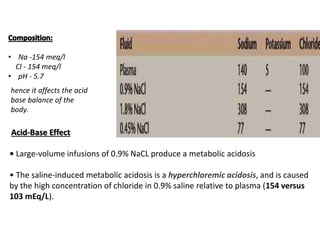
• Na -154 meq/l
Cl - 154 meq/l
• pH - 5.7
Acid-Base Effect
• Large-volume infusions of 0.9% NaCL produce a metabolic acidosis
• The saline-induced metabolic acidosis is a hyperchloremic acidosis, and is caused
by the high concentration of chloride in 0.9% saline relative to plasma (154 versus
103 mEq/L).
hence it affects the acid
base balance of the
body.
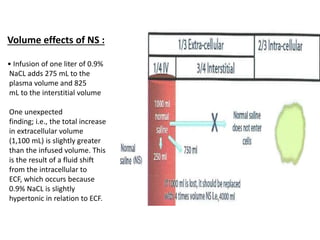
Volume effects of NS :
• Infusion of one liter of 0.9%
NaCL adds 275 mL to the
plasma volume and 825
mL to the interstitial volume
One unexpected
finding; i.e., the total increase
in extracellular volume
(1,100 mL) is slightly greater
than the infused volume. This
is the result of a fluid shift
from the intracellular to
ECF, which occurs because
0.9% NaCL is slightly
hypertonic in relation to ECF.
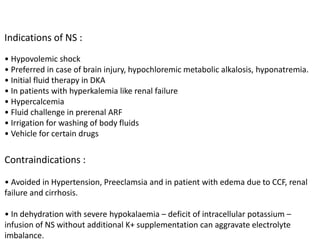
Indications of NS :
• Hypovolemic shock
• Preferred in case of brain injury, hypochloremic metabolic alkalosis, hyponatremia.
• Initial fluid therapy in DKA
• In patients with hyperkalemia like renal failure
• Hypercalcemia
• Fluid challenge in prerenal ARF
• Irrigation for washing of body fluids
• Vehicle for certain drugs
Contraindications :
• Avoided in Hypertension, Preeclamsia and in patient with edema due to CCF, renal
failure and cirrhosis.
• In dehydration with severe hypokalaemia – deficit of intracellular potassium –
infusion of NS without additional K+ supplementation can aggravate electrolyte
imbalance.
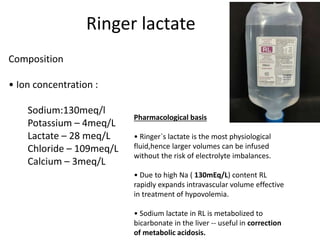
Ringer lactate
Composition
• Ion concentration :
Sodium:130meq/l
Potassium – 4meq/L
Lactate – 28 meq/L
Chloride – 109meq/L
Calcium – 3meq/L
Pharmacological basis
• Ringer`s lactate is the most physiological
fluid,hence larger volumes can be infused
without the risk of electrolyte imbalances.
• Due to high Na ( 130mEq/L) content RL
rapidly expands intravascular volume effective
in treatment of hypovolemia.
• Sodium lactate in RL is metabolized to
bicarbonate in the liver -- useful in correction
of metabolic acidosis.
INDICATIONS of RL :
• Correction of hypovolaemia.
• Replacement of fluid in post-op patients, burns, fractures.
• Maintainance fluid during surgery.
CONTRAINDICATIONS :
• Severe liver disease, severe hypoxia ( impaired lactate metabolism )
• Certain drugs – amphotericin, thiopental, ampicillin, doxycycline should not be
mixed with RL – calcium binds with these drugs and reduces bioavailability and
efficiency.
• Simultaneous infusion of RL and blood - inactivation of anticoagulant by binding
with calcium in RL – clots in recipient blood.
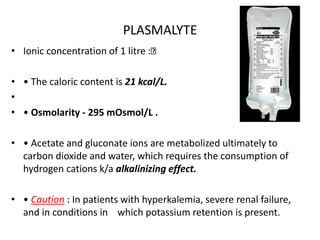
PLASMALYTE
• Ionic concentration of 1 litre :
• • The caloric content is 21 kcal/L.
•
• • Osmolarity - 295 mOsmol/L .
• • Acetate and gluconate ions are metabolized ultimately to
carbon dioxide and water, which requires the consumption of
hydrogen cations k/a alkalinizing effect.
• • Caution : In patients with hyperkalemia, severe renal failure,
and in conditions in which potassium retention is present.
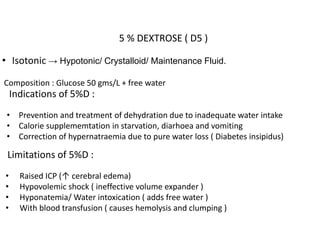
5 % DEXTROSE ( D5 )
• Isotonic → Hypotonic/ Crystalloid/ Maintenance Fluid.
Composition : Glucose 50 gms/L + free water
Indications of 5%D :
• Prevention and treatment of dehydration due to inadequate water intake
• Calorie supplememtation in starvation, diarhoea and vomiting
• Correction of hypernatraemia due to pure water loss ( Diabetes insipidus)
Limitations of 5%D :
• Raised ICP (↑ cerebral edema)
• Hypovolemic shock ( ineffective volume expander )
• Hyponatemia/ Water intoxication ( adds free water )
• With blood transfusion ( causes hemolysis and clumping )
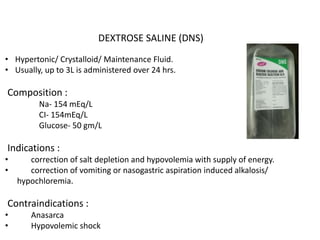
DEXTROSE SALINE (DNS)
• Hypertonic/ Crystalloid/ Maintenance Fluid.
• Usually, up to 3L is administered over 24 hrs.
Composition :
Na- 154 mEq/L
CI- 154mEq/L
Glucose- 50 gm/L
Indications :
• correction of salt depletion and hypovolemia with supply of energy.
• correction of vomiting or nasogastric aspiration induced alkalosis/
hypochloremia.
Contraindications :
• Anasarca
• Hypovolemic shock
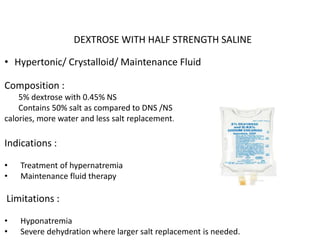
DEXTROSE WITH HALF STRENGTH SALINE
• Hypertonic/ Crystalloid/ Maintenance Fluid
Composition :
5% dextrose with 0.45% NS
Contains 50% salt as compared to DNS /NS and used when there is need for
calories, more water and less salt replacement.
Indications :
• Treatment of hypernatremia
• Maintenance fluid therapy
Limitations :
• Hyponatremia
• Severe dehydration where larger salt replacement is needed.
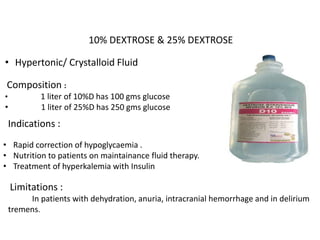
10% DEXTROSE & 25% DEXTROSE
• Hypertonic/ Crystalloid Fluid
Composition :
• 1 liter of 10%D has 100 gms glucose
• 1 liter of 25%D has 250 gms glucose
Indications :
• Rapid correction of hypoglycaemia .
• Nutrition to patients on maintainance fluid therapy.
• Treatment of hyperkalemia with Insulin
Limitations :
In patients with dehydration, anuria, intracranial hemorrhage and in delirium
tremens.
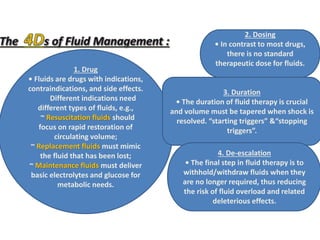
1. Drug
• Fluids are drugs with indications,
contraindications, and side effects.
Different indications need
different types of fluids, e.g.,
~ Resuscitation fluids should
focus on rapid restoration of
circulating volume;
~ Replacement fluids must mimic
the fluid that has been lost;
~ Maintenance fluids must deliver
basic electrolytes and glucose for
metabolic needs.
2. Dosing
• In contrast to most drugs,
there is no standard
therapeutic dose for fluids.
3. Duration
• The duration of fluid therapy is crucial
and volume must be tapered when shock is
resolved. “starting triggers” &“stopping
triggers”.
4. De-escalation
• The final step in fluid therapy is to
withhold/withdraw fluids when they
are no longer required, thus reducing
the risk of fluid overload and related
deleterious effects.
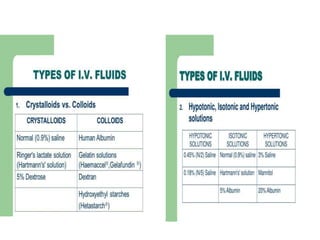
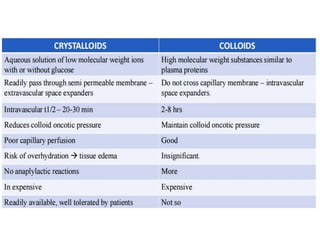
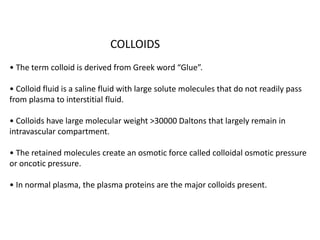
COLLOIDS
• The term colloid is derived from Greek word “Glue”.
• Colloid fluid is a saline fluid with large solute molecules that do not readily pass
from plasma to interstitial fluid.
• Colloids have large molecular weight >30000 Daltons that largely remain in
intravascular compartment.
• The retained molecules create an osmotic force called colloidal osmotic pressure
or oncotic pressure.
• In normal plasma, the plasma proteins are the major colloids present.
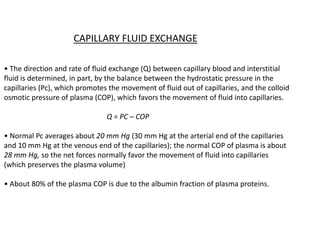
CAPILLARY FLUID EXCHANGE
• The direction and rate of fluid exchange (Q) between capillary blood and interstitial
fluid is determined, in part, by the balance between the hydrostatic pressure in the
capillaries (Pc), which promotes the movement of fluid out of capillaries, and the colloid
osmotic pressure of plasma (COP), which favors the movement of fluid into capillaries.
Q = PC – COP
• Normal Pc averages about 20 mm Hg (30 mm Hg at the arterial end of the capillaries
and 10 mm Hg at the venous end of the capillaries); the normal COP of plasma is about
28 mm Hg, so the net forces normally favor the movement of fluid into capillaries
(which preserves the plasma volume)
• About 80% of the plasma COP is due to the albumin fraction of plasma proteins.
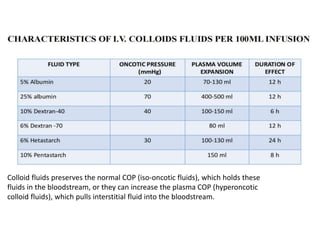
Colloid fluids preserves the normal COP (iso-oncotic fluids), which holds these
fluids in the bloodstream, or they can increase the plasma COP (hyperoncotic
colloid fluids), which pulls interstitial fluid into the bloodstream.
ALBUMIN
• Albumin is a versatile plasma protein synthesized only in the liver and has a half-
life of approximately 20 days.
• Principal determinant of plasma colloid osmotic pressure COP ( 75% of the oncotic
pressure), principal transport protein in blood, has significant antioxidant activity,
and helps maintain the fluidity of blood by inhibiting platelet aggregation.
 5% Albumin : Isotonic/ Natural colloid/ Replacement fluid
 25% Albumin : Hypertonic/ Natural colloid/ Replacement fluid
INDICATIONS :
• Fluid resuscitation (>/=3L/24 hrs bolus crystalloid)
• CPB pump priming
• Large volume paracentesis in cirrhotics(6-8 gm of 25% albumin/L of fluid removed)
• Spontaneous bacterial peritonitis
• Hepatorenal syndrome
• Liver transplant post-op management
Precautions and contraindications :
• 5% albumin is safe to use as a resuscitation fluid, except possibly in traumatic
head injury
• Hyper oncotic (25%) albumin has been associated with an increased risk of renal
injury and death in patients with hemorrhagic shock
• Fast infusion will rapidly increase circulatory volume with resultant vascular
overload and pulmonary oedema
• Contraindicated in severe anemia and cardiac failure
• Should not be used as parenteral nutrition
Disadvantages :
• Cost effectiveness: Albumin is expensive as compared to synthetic colloids
• Volume overload: In septic shock the release of inflammatory mediators has been
implicated in increasing the ‘leakiness’ of the vascular endothelium. The
administration of exogenous albumin may compound the problem by adding to the
interstitial edema.
DEXTRAN
• Isotonic/ Synthetic colloid/ Resuscitation
• Dextran 40(MW 40,000); Dextran 70(MW 70,000)
• Duration of volume expansion : 5-6 hrs
INDICATIONS :
• Improves microcirculatory flow in microsurgical re-implantations and used for
DVT prophylaxis
• Extracorporeal circulation: It has been used in extracorporeal circulation during
cardio-pulmonary bypass
• Hypovolemic shock
DISADVANTAGES :
Hemostatic derangements : ↓ Factor 8 & vWF, ↓ Platelet function, ↑ Fibrinolysis
Interferes with blood cross matching.
The hemostatic effects are minimized by limiting the daily dextran dose to 20 mL/kg.
PRE-OPERATIVE FLUID THERAPY
• The administration of maintenance fluids should be all that is required in
an otherwise healthy individual who may be under orders to receive
nothing by mouth for some period before the time of surgery. This does
not, however, include replenishment of a pre-existing deficit or ongoing
fluid losses.
• This does not, however, include replenishment of a pre-existing deficit or
ongoing fluid losses.
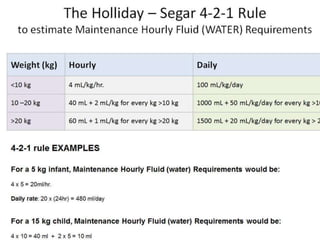
• 4-2-1 RULE
• Appropriate choice of 5% dextrose in 0.45% sodium chloride at 100 mL/h
as initial therapy, with potassium added for patients with normal renal
function
• The diagnosis of an acute volume deficit is primarily clinical
• Acute volume deficits should be corrected as much as possible before the
time of operation.
• Once volume deficit is diagnosed, give isotonic crystalloid.
• Patients with cardiovascular signs of volume deficit should receive a bolus
of 1 to 2 L of isotonic fluid followed by a continuous infusion
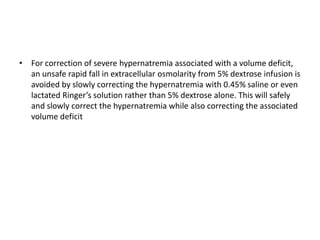
• For correction of severe hypernatremia associated with a volume deficit,
an unsafe rapid fall in extracellular osmolarity from 5% dextrose infusion is
avoided by slowly correcting the hypernatremia with 0.45% saline or even
lactated Ringer’s solution rather than 5% dextrose alone. This will safely
and slowly correct the hypernatremia while also correcting the associated
volume deficit
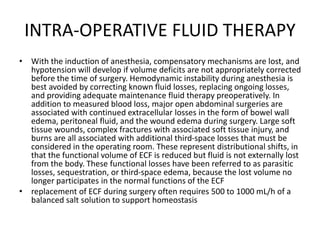
INTRA-OPERATIVE FLUID THERAPY
• With the induction of anesthesia, compensatory mechanisms are lost, and
hypotension will develop if volume deficits are not appropriately corrected
before the time of surgery. Hemodynamic instability during anesthesia is
best avoided by correcting known fluid losses, replacing ongoing losses,
and providing adequate maintenance fluid therapy preoperatively. In
addition to measured blood loss, major open abdominal surgeries are
associated with continued extracellular losses in the form of bowel wall
edema, peritoneal fluid, and the wound edema during surgery. Large soft
tissue wounds, complex fractures with associated soft tissue injury, and
burns are all associated with additional third-space losses that must be
considered in the operating room. These represent distributional shifts, in
that the functional volume of ECF is reduced but fluid is not externally lost
from the body. These functional losses have been referred to as parasitic
losses, sequestration, or third-space edema, because the lost volume no
longer participates in the normal functions of the ECF
• replacement of ECF during surgery often requires 500 to 1000 mL/h of a
balanced salt solution to support homeostasis
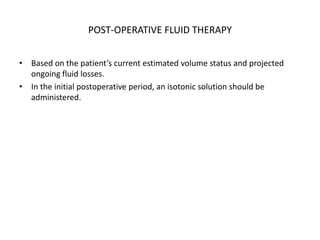
POST-OPERATIVE FLUID THERAPY
• Based on the patient’s current estimated volume status and projected
ongoing fluid losses.
• In the initial postoperative period, an isotonic solution should be
administered.
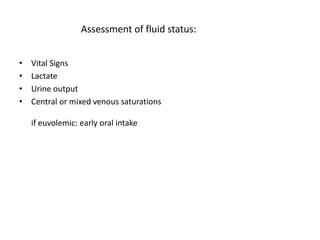
Assessment of fluid status:
• Vital Signs
• Lactate
• Urine output
• Central or mixed venous saturations
if euvolemic: early oral intake
FLUIDS IN SPECIFIC CONDITIONS
HYPOVOLEMIC SHOCK
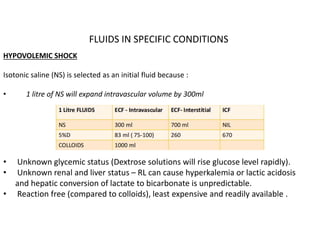
Isotonic saline (NS) is selected as an initial fluid because :
• 1 litre of NS will expand intravascular volume by 300ml
• Unknown glycemic status (Dextrose solutions will rise glucose level rapidly).
• Unknown renal and liver status – RL can cause hyperkalemia or lactic acidosis
and hepatic conversion of lactate to bicarbonate is unpredictable.
• Reaction free (compared to colloids), least expensive and readily available .
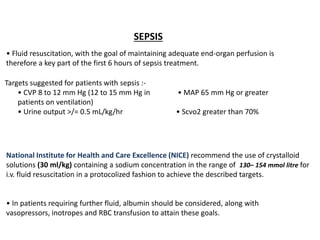
SEPSIS
• Fluid resuscitation, with the goal of maintaining adequate end-organ perfusion is
therefore a key part of the first 6 hours of sepsis treatment.
Targets suggested for patients with sepsis :-
• CVP 8 to 12 mm Hg (12 to 15 mm Hg in • MAP 65 mm Hg or greater
patients on ventilation)
• Urine output >/= 0.5 mL/kg/hr • Scvo2 greater than 70%
National Institute for Health and Care Excellence (NICE) recommend the use of crystalloid
solutions (30 ml/kg) containing a sodium concentration in the range of 130– 154 mmol litre for
i.v. fluid resuscitation in a protocolized fashion to achieve the described targets.
• In patients requiring further fluid, albumin should be considered, along with
vasopressors, inotropes and RBC transfusion to attain these goals.
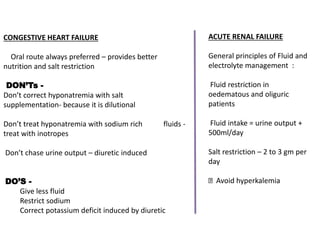
CONGESTIVE HEART FAILURE
Oral route always preferred – provides better
nutrition and salt restriction
DON’Ts -
Don’t correct hyponatremia with salt
supplementation- because it is dilutional
Don’t treat hyponatremia with sodium rich fluids -
treat with inotropes
Don’t chase urine output – diuretic induced
DO’S -
Give less fluid
Restrict sodium
Correct potassium deficit induced by diuretic
ACUTE RENAL FAILURE
General principles of Fluid and
electrolyte management :
Fluid restriction in
oedematous and oliguric
patients
Fluid intake = urine output +
500ml/day
Salt restriction – 2 to 3 gm per
day
Avoid hyperkalemia
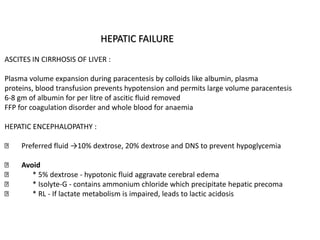
HEPATIC FAILURE
ASCITES IN CIRRHOSIS OF LIVER :
Plasma volume expansion during paracentesis by colloids like albumin, plasma
proteins, blood transfusion prevents hypotension and permits large volume paracentesis
6-8 gm of albumin for per litre of ascitic fluid removed
FFP for coagulation disorder and whole blood for anaemia
HEPATIC ENCEPHALOPATHY :
Preferred fluid →10% dextrose, 20% dextrose and DNS to prevent hypoglycemia
Avoid
* 5% dextrose - hypotonic fluid aggravate cerebral edema
* Isolyte-G - contains ammonium chloride which precipitate hepatic precoma
* RL - If lactate metabolism is impaired, leads to lactic acidosis
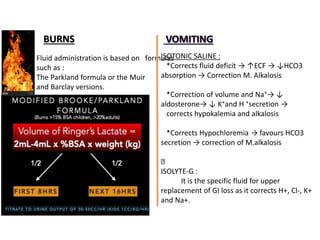
BURNS
Fluid administration is based on formulas
such as :
The Parkland formula or the Muir
and Barclay versions.
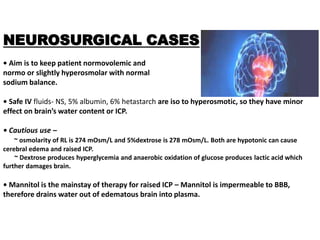
ISOTONIC SALINE :
*Corrects fluid deficit → ↑ECF → ↓HCO3
absorption → Correction M. Alkalosis
*Correction of volume and Na⁺→ ↓
aldosterone→ ↓ K⁺and H ⁺secretion →
corrects hypokalemia and alkalosis
*Corrects Hypochloremia → favours HCO3
secretion → correction of M.alkalosis
ISOLYTE-G :
It is the specific fluid for upper
replacement of GI loss as it corrects H+, Cl-, K+
and Na+.
NEUROSURGICAL CASES
• Aim is to keep patient normovolemic and
normo or slightly hyperosmolar with normal
sodium balance.
• Safe IV fluids- NS, 5% albumin, 6% hetastarch are iso to hyperosmotic, so they have minor
effect on brain’s water content or ICP.
• Cautious use –
~ osmolarity of RL is 274 mOsm/L and 5%dextrose is 278 mOsm/L. Both are hypotonic can cause
cerebral edema and raised ICP.
~ Dextrose produces hyperglycemia and anaerobic oxidation of glucose produces lactic acid which
further damages brain.
• Mannitol is the mainstay of therapy for raised ICP – Mannitol is impermeable to BBB,
therefore drains water out of edematous brain into plasma.
COLLOID – CRYSTALLOID CONUNDRUM
• There is a longstanding debate concerning the type of fluid that is most appropriate for
volume resuscitation, and each type of fluid has its loyalists who passionately defend
the merits of their chosen fluid.
• Crystalloid fluids were popularised for volume resuscitation for their ability to expand
interstitial volume than plasma volume.
• But recently, importance was given to promote cardiac output, systemic oxygen
delivery as the primary focus of volume resuscitation .Here, colloids have proven
to be superior.
• Despite of the superiority, crystalloids remain popular choice for volume resuscitation
because of :
~ Lower cost of crystalloid fluid.
~ Lack of survival benefit with colloid resuscitation.
• The colloid-crystalloid controversy is fueled by the premise that one type of fluid is optimal in
all cases of hypovolemia but this seems unreasonable, since no single resuscitation fluid will
perform optimally in all conditions associated with hypovolemia.
• Example:
• Life threatening hypovolemia due to blood loss – blood products / albumin
• Hypovolemia due to dehydration – crystalloid resuscitation
• Tailoring the type of resuscitation fluid to the specific cause and severity of hypovolemia is a
more reasoned approach than using the same type of fluid for all cases of hypovolemia.
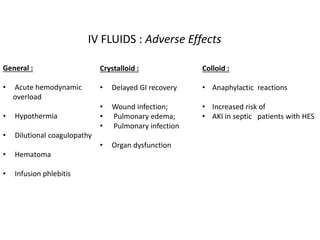
IV FLUIDS : Adverse Effects
General :
• Acute hemodynamic
overload
• Hypothermia
• Dilutional coagulopathy
• Hematoma
• Infusion phlebitis
Crystalloid :
• Delayed GI recovery
• Wound infection;
• Pulmonary edema;
• Pulmonary infection
• Organ dysfunction
Colloid :
• Anaphylactic reactions
• Increased risk of
• AKI in septic patients with HES
REFERENCES :
• Schwartz’s Principles of Surgery – 10th Edition
• Miller’s Anaesthesia - 9th Edition.
FLUID MANAGEMENT IN SURGERY.pptx

FLUID MANAGEMENT IN SURGERY.pptx

  • 1.
  • 2.
    INTRODUCTION • Supplemental fluidsused as an IVC therapy to restore or maintain normal fluid volume and electrolyte balance when oral route is not feasible. • Water and Electrolyte balance is important for body hemostasis. • Fluid and electrolyte management is paramount to the care of the surgical patient. Changes in both fluid volume and electrolyte composition occur preoperatively, intraoperatively, and postoperatively, as well as in response to trauma and sepsis. • A critical role of kidney is to maintain electrolyte hemostasis within relatively narrow limit.
  • 3.
    INDICATIONS • For RapidResuscitation • TPN • Post GI surgeries • For maintenance, replacement of loss or as a specific fluid
  • 4.
    Advantages • Accurate, controlledand predictable way of administration. • Immediate response • Prompt correction of fluid and electrolyte disturbances Goals • Resuscitation • Rehydration/Replacement • Maintenance
  • 5.
  • 6.
    COMPOSITION OF BODYFLUID COMPARTMENTS
  • 8.
    • The healthyperson consumes an average of 2000 mL of water per day, approximately 75% from oral intake and the rest extracted from solid foods. • Daily water losses include 800 to 1200 mL in urine, 250 mL in stool, and 600 mL in insensible losses. • Insensible losses of water occur through both the skin (75%) and lungs (25%) and can be increased by such factors as fever, hypermetabolism, and hyperventilation. • To clear the products of metabolism, the kidneys must excrete a minimum of 500 to 800 mL of urine per day, regardless of the amount of oral intake.
  • 9.
    OSMOLALITY • It isthe number of osmoles (each containing 6 ×10²³ particles of a specific substance) present in 1 kg of solvent. • Same in intracellular and extracellular compartments due to free movement of water between compartments which prevents development of any osmotic gradients. • Serum osmolality = (2×Na) + (glucose/18) + (urea/2.8)
  • 10.
    OSMOLARITY • It isthe number of osmoles of solute per liter of solution. • This may be affected by temperature changes as a result of the volume-expanding effect of increasing temperature.
  • 11.
    TONICITY Describes the: Osmotic pressure of solutions relativeto each other and to blood plasma Determines the fluid distribution.
  • 12.
     Rememer 5Rs • Resuscitation • Routine maintenance • Replacement • Redistribution • Reassessment
  • 17.
    NORMAL SALINE (0.9%NaCl)  Isotonic/ Crystalloid/ Replacement Fluid • It is not normal chemically because the concentration of a one- normal (1 N) NaCL solution is 58 gms/L (the combined molecular weights of sodium and chloride), while 0.9% NaCL contains only 9 grams of NaCL per liter. • It is not normal physiologically because the composition of 0.9% NaCL differs from the composition of extracellular fluid. When compared to plasma (extracellular fluid), 0.9% NaCL has a higher sodium concentration (154 vs. 140 mEq/L), a much higher chloride concentration (154 vs. 103 mEq/L), a higher osmolality (308 vs. 290 mOsm/L), and a lower pH (5.7 vs. 7.4). This solution is neither chemically nor physiologically normal. These differences can have deleterious effects on fluid and acid-base balance.
  • 18.
    • Na -154meq/l Cl - 154 meq/l • pH - 5.7 Acid-Base Effect • Large-volume infusions of 0.9% NaCL produce a metabolic acidosis • The saline-induced metabolic acidosis is a hyperchloremic acidosis, and is caused by the high concentration of chloride in 0.9% saline relative to plasma (154 versus 103 mEq/L). hence it affects the acid base balance of the body.
  • 20.
    Volume effects ofNS : • Infusion of one liter of 0.9% NaCL adds 275 mL to the plasma volume and 825 mL to the interstitial volume One unexpected finding; i.e., the total increase in extracellular volume (1,100 mL) is slightly greater than the infused volume. This is the result of a fluid shift from the intracellular to ECF, which occurs because 0.9% NaCL is slightly hypertonic in relation to ECF.
  • 21.
    Indications of NS: • Hypovolemic shock • Preferred in case of brain injury, hypochloremic metabolic alkalosis, hyponatremia. • Initial fluid therapy in DKA • In patients with hyperkalemia like renal failure • Hypercalcemia • Fluid challenge in prerenal ARF • Irrigation for washing of body fluids • Vehicle for certain drugs Contraindications : • Avoided in Hypertension, Preeclamsia and in patient with edema due to CCF, renal failure and cirrhosis. • In dehydration with severe hypokalaemia – deficit of intracellular potassium – infusion of NS without additional K+ supplementation can aggravate electrolyte imbalance.
  • 22.
    Ringer lactate Composition • Ionconcentration : Sodium:130meq/l Potassium – 4meq/L Lactate – 28 meq/L Chloride – 109meq/L Calcium – 3meq/L Pharmacological basis • Ringer`s lactate is the most physiological fluid,hence larger volumes can be infused without the risk of electrolyte imbalances. • Due to high Na ( 130mEq/L) content RL rapidly expands intravascular volume effective in treatment of hypovolemia. • Sodium lactate in RL is metabolized to bicarbonate in the liver -- useful in correction of metabolic acidosis.
  • 23.
    INDICATIONS of RL: • Correction of hypovolaemia. • Replacement of fluid in post-op patients, burns, fractures. • Maintainance fluid during surgery. CONTRAINDICATIONS : • Severe liver disease, severe hypoxia ( impaired lactate metabolism ) • Certain drugs – amphotericin, thiopental, ampicillin, doxycycline should not be mixed with RL – calcium binds with these drugs and reduces bioavailability and efficiency. • Simultaneous infusion of RL and blood - inactivation of anticoagulant by binding with calcium in RL – clots in recipient blood.
  • 24.
    PLASMALYTE • Ionic concentrationof 1 litre : • • The caloric content is 21 kcal/L. • • • Osmolarity - 295 mOsmol/L . • • Acetate and gluconate ions are metabolized ultimately to carbon dioxide and water, which requires the consumption of hydrogen cations k/a alkalinizing effect. • • Caution : In patients with hyperkalemia, severe renal failure, and in conditions in which potassium retention is present.
  • 26.
    5 % DEXTROSE( D5 ) • Isotonic → Hypotonic/ Crystalloid/ Maintenance Fluid. Composition : Glucose 50 gms/L + free water Indications of 5%D : • Prevention and treatment of dehydration due to inadequate water intake • Calorie supplememtation in starvation, diarhoea and vomiting • Correction of hypernatraemia due to pure water loss ( Diabetes insipidus) Limitations of 5%D : • Raised ICP (↑ cerebral edema) • Hypovolemic shock ( ineffective volume expander ) • Hyponatemia/ Water intoxication ( adds free water ) • With blood transfusion ( causes hemolysis and clumping )
  • 27.
    DEXTROSE SALINE (DNS) •Hypertonic/ Crystalloid/ Maintenance Fluid. • Usually, up to 3L is administered over 24 hrs. Composition : Na- 154 mEq/L CI- 154mEq/L Glucose- 50 gm/L Indications : • correction of salt depletion and hypovolemia with supply of energy. • correction of vomiting or nasogastric aspiration induced alkalosis/ hypochloremia. Contraindications : • Anasarca • Hypovolemic shock
  • 28.
    DEXTROSE WITH HALFSTRENGTH SALINE • Hypertonic/ Crystalloid/ Maintenance Fluid Composition : 5% dextrose with 0.45% NS Contains 50% salt as compared to DNS /NS and used when there is need for calories, more water and less salt replacement. Indications : • Treatment of hypernatremia • Maintenance fluid therapy Limitations : • Hyponatremia • Severe dehydration where larger salt replacement is needed.
  • 29.
    10% DEXTROSE &25% DEXTROSE • Hypertonic/ Crystalloid Fluid Composition : • 1 liter of 10%D has 100 gms glucose • 1 liter of 25%D has 250 gms glucose Indications : • Rapid correction of hypoglycaemia . • Nutrition to patients on maintainance fluid therapy. • Treatment of hyperkalemia with Insulin Limitations : In patients with dehydration, anuria, intracranial hemorrhage and in delirium tremens.
  • 30.
    1. Drug • Fluidsare drugs with indications, contraindications, and side effects. Different indications need different types of fluids, e.g., ~ Resuscitation fluids should focus on rapid restoration of circulating volume; ~ Replacement fluids must mimic the fluid that has been lost; ~ Maintenance fluids must deliver basic electrolytes and glucose for metabolic needs. 2. Dosing • In contrast to most drugs, there is no standard therapeutic dose for fluids. 3. Duration • The duration of fluid therapy is crucial and volume must be tapered when shock is resolved. “starting triggers” &“stopping triggers”. 4. De-escalation • The final step in fluid therapy is to withhold/withdraw fluids when they are no longer required, thus reducing the risk of fluid overload and related deleterious effects.
  • 31.
    COLLOIDS • The termcolloid is derived from Greek word “Glue”. • Colloid fluid is a saline fluid with large solute molecules that do not readily pass from plasma to interstitial fluid. • Colloids have large molecular weight >30000 Daltons that largely remain in intravascular compartment. • The retained molecules create an osmotic force called colloidal osmotic pressure or oncotic pressure. • In normal plasma, the plasma proteins are the major colloids present.
  • 32.
    CAPILLARY FLUID EXCHANGE •The direction and rate of fluid exchange (Q) between capillary blood and interstitial fluid is determined, in part, by the balance between the hydrostatic pressure in the capillaries (Pc), which promotes the movement of fluid out of capillaries, and the colloid osmotic pressure of plasma (COP), which favors the movement of fluid into capillaries. Q = PC – COP • Normal Pc averages about 20 mm Hg (30 mm Hg at the arterial end of the capillaries and 10 mm Hg at the venous end of the capillaries); the normal COP of plasma is about 28 mm Hg, so the net forces normally favor the movement of fluid into capillaries (which preserves the plasma volume) • About 80% of the plasma COP is due to the albumin fraction of plasma proteins.
  • 33.
    Colloid fluids preservesthe normal COP (iso-oncotic fluids), which holds these fluids in the bloodstream, or they can increase the plasma COP (hyperoncotic colloid fluids), which pulls interstitial fluid into the bloodstream.
  • 34.
    ALBUMIN • Albumin isa versatile plasma protein synthesized only in the liver and has a half- life of approximately 20 days. • Principal determinant of plasma colloid osmotic pressure COP ( 75% of the oncotic pressure), principal transport protein in blood, has significant antioxidant activity, and helps maintain the fluidity of blood by inhibiting platelet aggregation.  5% Albumin : Isotonic/ Natural colloid/ Replacement fluid  25% Albumin : Hypertonic/ Natural colloid/ Replacement fluid INDICATIONS : • Fluid resuscitation (>/=3L/24 hrs bolus crystalloid) • CPB pump priming • Large volume paracentesis in cirrhotics(6-8 gm of 25% albumin/L of fluid removed) • Spontaneous bacterial peritonitis • Hepatorenal syndrome • Liver transplant post-op management
  • 35.
    Precautions and contraindications: • 5% albumin is safe to use as a resuscitation fluid, except possibly in traumatic head injury • Hyper oncotic (25%) albumin has been associated with an increased risk of renal injury and death in patients with hemorrhagic shock • Fast infusion will rapidly increase circulatory volume with resultant vascular overload and pulmonary oedema • Contraindicated in severe anemia and cardiac failure • Should not be used as parenteral nutrition Disadvantages : • Cost effectiveness: Albumin is expensive as compared to synthetic colloids • Volume overload: In septic shock the release of inflammatory mediators has been implicated in increasing the ‘leakiness’ of the vascular endothelium. The administration of exogenous albumin may compound the problem by adding to the interstitial edema.
  • 36.
    DEXTRAN • Isotonic/ Syntheticcolloid/ Resuscitation • Dextran 40(MW 40,000); Dextran 70(MW 70,000) • Duration of volume expansion : 5-6 hrs INDICATIONS : • Improves microcirculatory flow in microsurgical re-implantations and used for DVT prophylaxis • Extracorporeal circulation: It has been used in extracorporeal circulation during cardio-pulmonary bypass • Hypovolemic shock DISADVANTAGES : Hemostatic derangements : ↓ Factor 8 & vWF, ↓ Platelet function, ↑ Fibrinolysis Interferes with blood cross matching. The hemostatic effects are minimized by limiting the daily dextran dose to 20 mL/kg.
  • 38.
    PRE-OPERATIVE FLUID THERAPY •The administration of maintenance fluids should be all that is required in an otherwise healthy individual who may be under orders to receive nothing by mouth for some period before the time of surgery. This does not, however, include replenishment of a pre-existing deficit or ongoing fluid losses. • This does not, however, include replenishment of a pre-existing deficit or ongoing fluid losses. • 4-2-1 RULE
  • 39.
    • Appropriate choiceof 5% dextrose in 0.45% sodium chloride at 100 mL/h as initial therapy, with potassium added for patients with normal renal function • The diagnosis of an acute volume deficit is primarily clinical • Acute volume deficits should be corrected as much as possible before the time of operation. • Once volume deficit is diagnosed, give isotonic crystalloid. • Patients with cardiovascular signs of volume deficit should receive a bolus of 1 to 2 L of isotonic fluid followed by a continuous infusion
  • 40.
    • For correctionof severe hypernatremia associated with a volume deficit, an unsafe rapid fall in extracellular osmolarity from 5% dextrose infusion is avoided by slowly correcting the hypernatremia with 0.45% saline or even lactated Ringer’s solution rather than 5% dextrose alone. This will safely and slowly correct the hypernatremia while also correcting the associated volume deficit
  • 42.
    INTRA-OPERATIVE FLUID THERAPY •With the induction of anesthesia, compensatory mechanisms are lost, and hypotension will develop if volume deficits are not appropriately corrected before the time of surgery. Hemodynamic instability during anesthesia is best avoided by correcting known fluid losses, replacing ongoing losses, and providing adequate maintenance fluid therapy preoperatively. In addition to measured blood loss, major open abdominal surgeries are associated with continued extracellular losses in the form of bowel wall edema, peritoneal fluid, and the wound edema during surgery. Large soft tissue wounds, complex fractures with associated soft tissue injury, and burns are all associated with additional third-space losses that must be considered in the operating room. These represent distributional shifts, in that the functional volume of ECF is reduced but fluid is not externally lost from the body. These functional losses have been referred to as parasitic losses, sequestration, or third-space edema, because the lost volume no longer participates in the normal functions of the ECF • replacement of ECF during surgery often requires 500 to 1000 mL/h of a balanced salt solution to support homeostasis
  • 43.
    POST-OPERATIVE FLUID THERAPY •Based on the patient’s current estimated volume status and projected ongoing fluid losses. • In the initial postoperative period, an isotonic solution should be administered.
  • 44.
    Assessment of fluidstatus: • Vital Signs • Lactate • Urine output • Central or mixed venous saturations if euvolemic: early oral intake
  • 45.
    FLUIDS IN SPECIFICCONDITIONS HYPOVOLEMIC SHOCK Isotonic saline (NS) is selected as an initial fluid because : • 1 litre of NS will expand intravascular volume by 300ml • Unknown glycemic status (Dextrose solutions will rise glucose level rapidly). • Unknown renal and liver status – RL can cause hyperkalemia or lactic acidosis and hepatic conversion of lactate to bicarbonate is unpredictable. • Reaction free (compared to colloids), least expensive and readily available .
  • 46.
    SEPSIS • Fluid resuscitation,with the goal of maintaining adequate end-organ perfusion is therefore a key part of the first 6 hours of sepsis treatment. Targets suggested for patients with sepsis :- • CVP 8 to 12 mm Hg (12 to 15 mm Hg in • MAP 65 mm Hg or greater patients on ventilation) • Urine output >/= 0.5 mL/kg/hr • Scvo2 greater than 70% National Institute for Health and Care Excellence (NICE) recommend the use of crystalloid solutions (30 ml/kg) containing a sodium concentration in the range of 130– 154 mmol litre for i.v. fluid resuscitation in a protocolized fashion to achieve the described targets. • In patients requiring further fluid, albumin should be considered, along with vasopressors, inotropes and RBC transfusion to attain these goals.
  • 47.
    CONGESTIVE HEART FAILURE Oralroute always preferred – provides better nutrition and salt restriction DON’Ts - Don’t correct hyponatremia with salt supplementation- because it is dilutional Don’t treat hyponatremia with sodium rich fluids - treat with inotropes Don’t chase urine output – diuretic induced DO’S - Give less fluid Restrict sodium Correct potassium deficit induced by diuretic ACUTE RENAL FAILURE General principles of Fluid and electrolyte management : Fluid restriction in oedematous and oliguric patients Fluid intake = urine output + 500ml/day Salt restriction – 2 to 3 gm per day Avoid hyperkalemia
  • 48.
    HEPATIC FAILURE ASCITES INCIRRHOSIS OF LIVER : Plasma volume expansion during paracentesis by colloids like albumin, plasma proteins, blood transfusion prevents hypotension and permits large volume paracentesis 6-8 gm of albumin for per litre of ascitic fluid removed FFP for coagulation disorder and whole blood for anaemia HEPATIC ENCEPHALOPATHY : Preferred fluid →10% dextrose, 20% dextrose and DNS to prevent hypoglycemia Avoid * 5% dextrose - hypotonic fluid aggravate cerebral edema * Isolyte-G - contains ammonium chloride which precipitate hepatic precoma * RL - If lactate metabolism is impaired, leads to lactic acidosis
  • 49.
    BURNS Fluid administration isbased on formulas such as : The Parkland formula or the Muir and Barclay versions. ISOTONIC SALINE : *Corrects fluid deficit → ↑ECF → ↓HCO3 absorption → Correction M. Alkalosis *Correction of volume and Na⁺→ ↓ aldosterone→ ↓ K⁺and H ⁺secretion → corrects hypokalemia and alkalosis *Corrects Hypochloremia → favours HCO3 secretion → correction of M.alkalosis ISOLYTE-G : It is the specific fluid for upper replacement of GI loss as it corrects H+, Cl-, K+ and Na+.
  • 50.
    NEUROSURGICAL CASES • Aimis to keep patient normovolemic and normo or slightly hyperosmolar with normal sodium balance. • Safe IV fluids- NS, 5% albumin, 6% hetastarch are iso to hyperosmotic, so they have minor effect on brain’s water content or ICP. • Cautious use – ~ osmolarity of RL is 274 mOsm/L and 5%dextrose is 278 mOsm/L. Both are hypotonic can cause cerebral edema and raised ICP. ~ Dextrose produces hyperglycemia and anaerobic oxidation of glucose produces lactic acid which further damages brain. • Mannitol is the mainstay of therapy for raised ICP – Mannitol is impermeable to BBB, therefore drains water out of edematous brain into plasma.
  • 51.
    COLLOID – CRYSTALLOIDCONUNDRUM • There is a longstanding debate concerning the type of fluid that is most appropriate for volume resuscitation, and each type of fluid has its loyalists who passionately defend the merits of their chosen fluid. • Crystalloid fluids were popularised for volume resuscitation for their ability to expand interstitial volume than plasma volume. • But recently, importance was given to promote cardiac output, systemic oxygen delivery as the primary focus of volume resuscitation .Here, colloids have proven to be superior. • Despite of the superiority, crystalloids remain popular choice for volume resuscitation because of : ~ Lower cost of crystalloid fluid. ~ Lack of survival benefit with colloid resuscitation.
  • 52.
    • The colloid-crystalloidcontroversy is fueled by the premise that one type of fluid is optimal in all cases of hypovolemia but this seems unreasonable, since no single resuscitation fluid will perform optimally in all conditions associated with hypovolemia. • Example: • Life threatening hypovolemia due to blood loss – blood products / albumin • Hypovolemia due to dehydration – crystalloid resuscitation • Tailoring the type of resuscitation fluid to the specific cause and severity of hypovolemia is a more reasoned approach than using the same type of fluid for all cases of hypovolemia.
  • 53.
    IV FLUIDS :Adverse Effects General : • Acute hemodynamic overload • Hypothermia • Dilutional coagulopathy • Hematoma • Infusion phlebitis Crystalloid : • Delayed GI recovery • Wound infection; • Pulmonary edema; • Pulmonary infection • Organ dysfunction Colloid : • Anaphylactic reactions • Increased risk of • AKI in septic patients with HES
  • 54.
    REFERENCES : • Schwartz’sPrinciples of Surgery – 10th Edition • Miller’s Anaesthesia - 9th Edition.