Intravenous Fluid
TOTAL BODY WATER
โ–  Approx. 60% Body weight
โ–กVaries with age, gender and body
habitus
โ–  50% BW in females
โ–  80% BW in infants
โ–กLess in obese : fat contain little water
Body Water Compartments
โ–  Intracellular volume : 2/3 of TBW
โ–  Extracellular volume : 1/3 of TBW
- Intravascular : Plasma volume (1/4)
-Extravascular: Interstitial fluid &
others(3/4)
Preoperative Evaluation of Fluid
Status
- Mental status
- H/O intake and output
- Blood pressure: supine and standing
- Heart rate
- Skin turgor
- Urinary output
- CVP
Orthostatic Hypotension
โ€ข Systolic blood pressure decrease of greater than
20mmHg from supine to standing
โ€ข Indicates fluid deficit of 6-8% body weight
- Heart rate should increase as a compensatory
measure
- If no increase in heart rate, may indicate
autonomic dysfunction or antihypertensive
drug therapy
โ–  Osmoles :unit for conc. Of osmotically
active particles
โ–  Osmolality: osmotic active solute per
volume of solution ( mOsm/L)
โ–  Osmolarity : mOsm/Kg
โ–  Plasma osmolarity : 290 mOsm/kg
โ–  Tonicity ( relative osmotic activity )
โ–  Isotonic/ hypotonic/hypertonic
Intravenous Fluids
Therapy
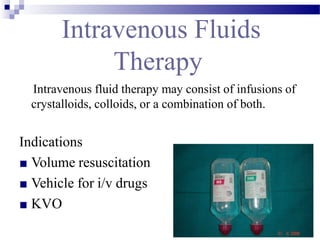
Intravenous fluid therapy may consist of infusions of
crystalloids, colloids, or a combination of both.
Indications
โ–  Volume resuscitation
โ–  Vehicle for i/v drugs
โ–  KVO
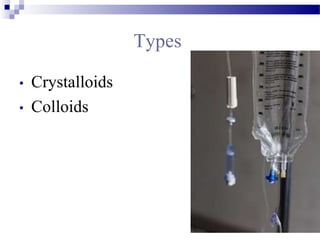
Types
โ€ข Crystalloids
โ€ข Colloids
Crystalloids
โ–  Clear fluids made up of water and electrolyte
solutions; Will cross a semi-permeable membrane
โ–  Grouped as isotonic, hypertonic, and hypotonic
โ–  Eg:
โ–ก Normal saline 0.9%,3 %
โ–ก Dextrose solutions 5 %,10%,20%,25%
โ–กDNS
โ–กRingerโ€™s lactate
โ–ก Isolyte P
Crystalloids
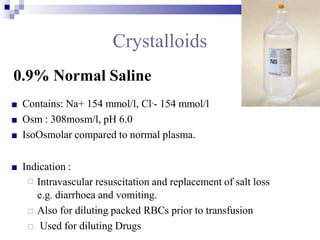
0.9% Normal Saline
โ–  Contains: Na+ 154 mmol/l, Cl-- 154 mmol/l
โ–  Osm : 308mosm/l, pH 6.0
โ–  IsoOsmolar compared to normal plasma.
โ–  Indication :
โ–ก Intravascular resuscitation and replacement of salt loss
e.g. diarrhoea and vomiting.
โ–ก Also for diluting packed RBCs prior to transfusion
โ–ก Used for diluting Drugs
โ–  Distribution:
โ–ก Stays almost entirely in the extracellular space.
Of 1 litre - 750ml extra vascular fluid; 250ml
intravascular fluid.
โ–  Complications:
โ–ก When given in large volume can produces
Hyperchloremic metabolic acidosis because of
high Na+ and Cl- content.
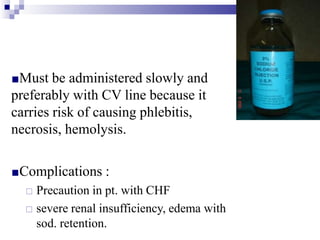
3.0 % Saline = HYPERtonic saline
โ–  3% contain 513 mmol/l of Na+ and Cl-
each,
โ–  osmol of 1026 mOsm/l; pH 5.0
โ–  Indications :
โ–กTreatment of severe symptomatic
hyponatremia (coma, seizure)
โ–กTo resuscitate hypovolemic shock
โ– Must be administered slowly and
preferably with CV line because it
carries risk of causing phlebitis,
necrosis, hemolysis.
โ– Complications :
โ–ก Precaution in pt. with CHF
โ–ก severe renal insufficiency, edema with
sod. retention.
Dextrose
5% Dextrose (often written D5W)
โ–  50g/l of glucose, 252mOsm/l, pH 4.5
โ–  Regarded as โ€˜electrolyte freeโ€™ โ€“ contains
NO Sodium, Potassium, Chloride or
Calcium
โ–  Indication :
โ–ก
โ–ก
โ–ก To maintain water balance in patients
who are not able to take anything by
mouth;
Used post-operatively in conjunction
with salt retaining fluids ie saline
Hypernatremia treatment
โ–  Less than 10% stays in the intravascular space
therefore it is of limited use in fluid resuscitation.
โ–  Side effects:
โ–กIatrogenic hyponatraemia in surgical patient
โ–ก Hyperglycemia
โ–ก Not compatible with blood ,cause hemolysis
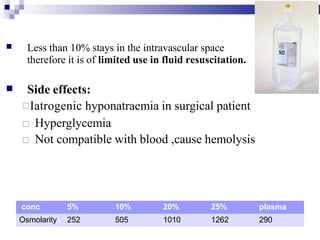
conc 5% 10% 20% 25% plasma
Osmolarity 252 505 1010 1262 290
Ringer Lactate
โ–  Most physiological solution
โ–  Electrolyte composition similar to ECF
โ–  One litre of lactated Ringer's solution contains:
โ–ก Sodium ion= 130 mmol/L.
โ–ก Chloride ion = 109 mmol/L.
โ–ก Lactate = 28 mmol/L.
โ–ก Potassium ion = 4 mmol/L.
โ–ก Calcium ion = 1.5 mmol/L
โ–ก Osmolarity of 273 , pH of 6.5
โ–  Lactate is converted to bicarbonate in liver
โ–  Indications :
โ–ก Deficit ,Intraoperative fluid loss
โ–ก Severe hypovolemia
โ–  Precautions:
โ–ก Severe metabolic acidosis ( impaired lactate conversion)
โ–ก Donโ€™t give with blood product ( Ca bind with citrate
reduced anticoagulant activity )
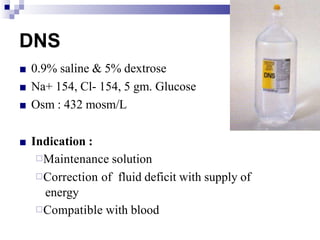
DNS
โ–  0.9% saline & 5% dextrose
โ–  Na+ 154, Cl- 154, 5 gm. Glucose
โ–  Osm : 432 mosm/L
โ–  Indication :
โ–กMaintenance solution
โ–กCorrection of fluid deficit with supply of
energy
โ–กCompatible with blood
IsoLyte -P
Multiple electrolyte & dextrose solution
Na+ : 26
K+ : 20
Mg++ : 03
Cl- : 21
Acetate : 23
Ph+ : 03
Isotonic
Indication :Pediatric maintenance fluid
Colloids
โ–  Particles which do not readily cross semi-
permeable membranes
โ–  Stays (initially) almost entirely within the
intravascular space .
โ–  Stay intravascular for a prolonged period
compared to crystalloids.
โ–  However they leak out of the intravascular space
when the capillary permeability significantly changes
e.g. Severe trauma or sepsis.
โ–  Because of their gelatinous properties they cause
platelet dysfunction and interfere with fibrinolysis and
coagulation factors (factor VIII) โ€“ thus they can cause
significant coagulopathy in large volumes.
โ–  Natural : Albumin
โ–  Artificial : Gelatin and Dextran , HES
ALBUMIN
โ–  Principal natural colloid comprising of 50-60% of all plasma
proteins.
โ–  Synthesized only in liver and has a half life of app. 20 days.
โ–  5% soln is iso oncotic and leads to 80% initial vol expansion
25% soln leads to 200-400% increase in vol.
โ–  Used
โ–ก For emergency treatment of shock especially due to loss of
plasma
โ–  acute management of burns
โ–ก Fluid resuscitation in ICU
โ–ก Hypoalbumineamia.
โ–  Side effects :
โ–ก pruritis, anaphylactoid reactions and coagulation
abnormalities as compared to synthetic colloids.
โ–  Disadvantages
โ–ก cost effectiveness
โ–ก volume overload (in septic shock pt albumin add to
interstitial edema)
DEXTRAN
โ–  Highly branched polysaccharide molecules
โ–  Produced by synthesis using the bacterial enzyme
dextran sucrase from the bacterium Leuconostoc
mesenteroids.
โ–  Most widely used are 6%(dextran 70) and 10%
(dextran 40) soln.
โ–  Excreted via kidney primarily.
โ–  Used mainly to improve microcirculatory flow
in microsurgical re-implantation .
โ–  Also used in extracorporeal circulation during
cardiopulmnary bypass.
โ– Side effects: Anaphylactic reactions,
Coagulation abn, Interference with cross
match, Ppt of ARF.
GELATINS
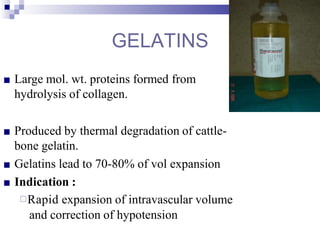
โ–  Large mol. wt. proteins formed from
hydrolysis of collagen.
โ–  Produced by thermal degradation of cattle-
bone gelatin.
โ–  Gelatins lead to 70-80% of vol expansion
โ–  Indication :
โ–กRapid expansion of intravascular volume
and correction of hypotension
โ– Advantage :
โ–กcost effectiveness and no effect of renal
impairment ,does not affect coagulation
โ– Disadvantage :
โ–กHypersensitivity
โ–กAnaphylactoid reactions
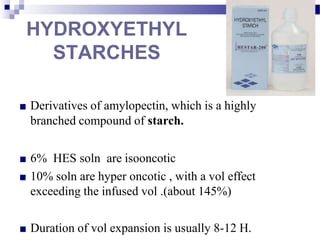
HYDROXYETHYL
STARCHES
โ–  Derivatives of amylopectin, which is a highly
branched compound of starch.
โ–  6% HES soln are isooncotic
โ–  10% soln are hyper oncotic , with a vol effect
exceeding the infused vol .(about 145%)
โ–  Duration of vol expansion is usually 8-12 H.
โ–  Advantage
โ–กCost effective: cheaper and comparable vol of
expansion to albumin.
โ–  Disadvantage: assoc. with 1st & 2ndgeneration HES
- Coagulation abn
- Accumulation
- Anaphylactoid reactions
- Renal impairment
- Increase in amylase level
Colloid or Crystalloid Resuscitation
Recommendations:
โ–  Colloid should NOT be used as the sole fluid
replacement in resuscitation ,volumes infused
should be limited because of side effects and lack
of evidence for their continued use in the acutely
ill.
โ–  Colloid may be used in limited volume to reduce
volume of fluids required or until blood products
are available.
โ– In elective surgical patients
โ–กReplace fluid loss with โ€˜physiological
Ringerโ€™s solutions.
โ–กBlood products and colloid may be
needed to replace intravascular volume
acutely.
Peri- operative Fluid
Requirements
โ€ข The following factors must be taken into
account:
โ€ข C V E
โ€ข Maintenance fluid
โ€ข Deficit
โ€ข Third space losses
โ€ข Replacement of loss
COMPENSATORY INTRAVASCULAR VOLUME
EXPANSION
โ– Fluid must be adm. to expand the blood vol to
compensate for venodilation (GA,RA)
โ– Expansion with 5-7ml/kg of crystalloid must
occur before or simultaneous with the onset of
anaesthesia .
Maintenance Fluid Requirements
โ€ข โ€œ4-2-1 Ruleโ€
- 4 ml/kg/hr for the first 10 kg of body
weight
- 2 ml/kg/hr for the second 10 kg body
weight
- 1 ml/kg/hr subsequent kg body weight
Eg : 70 Kg pt
Maintenance fluid : 40+20+50= 110 ml/hr
Deficit
โ€ข Deficit = number of hours NPO x maintenance
fluid requirement.
Measurable fluid losses, e.g. NG suctioning,
vomiting, stoma output.
โ€ข
โ–  70 kg pt fasting for 8 hrs
โ–  Deficit : 8 X 110 = 880 ml
โ– 
โ– 
Half in first hr
One fourth each in next two hr .
Third Space Losses
โ€ข Isotonic transfer of ECF from functional body
fluid compartments to non-functional
compartments.
โ€ข Depends on location and duration of surgical
procedure, amount of tissue trauma, ambient
temperature, room ventilation.
Replacing Third Space Losses
Minimal Surgical Trauma: 0-2 ml/kg/hr
- e.g. herniorrhaphy
Moderate Surgical Trauma: 2-4 ml/kg/hr
- e.g. cholecystectomy
Severe surgical trauma: 4-6 ml/kg/hr (or even
more)
- e.g. major bowel resection
Blood Loss
โ€ข Replace 4 cc of crystalloid solution per cc of blood
loss (crystalloid solutions leave the intravascular
space)
โ€ข When using blood products or colloids replace blood
loss volume per volume.
Fluid management, starting with a hemoglobin level of 15 g/dL,
for a 70-kg patient undergoing gastrectomy who has been fasting
for 8 hours.
โ–  Maintenance rate is 110 mL/hr,
โ– Deficit of 880 mL
โ– First hr = CVE+ Half of deficit + maintenance + loss+ third space loss
โ–ก 350+440+110+50 + 420
โ–  Second hr = one fourth of deficit + maintenance + loss+ third space loss
โ–ก 220+ 110+ 250 + 420
โ–  Third hr = one fourth of deficit + maintenance + loss+ third space loss
โ–ก 220+ 110+ 250 + 420
โ– Fourth hr = Maintenance + loss+ third space loss
โ–ก 110+ 50 + 420
Summary
โ–  Most physiological :RL
โ–  Rich in sodium : NS,DNS
โ–  Rich in potassium :ISo โ€“p
โ–  Glucose free: ?RL,NS,3% saline
โ–  Sodium free: Dextrose
โ–  Potassium free: NS,DNS,Dextrose
โ–  Can correct acidosis directly : RL,ISo-p
Thank you

29-160826034009.pptx

  • 1.
  • 2.
    TOTAL BODY WATER โ– Approx. 60% Body weight โ–กVaries with age, gender and body habitus โ–  50% BW in females โ–  80% BW in infants โ–กLess in obese : fat contain little water
  • 3.
    Body Water Compartments โ– Intracellular volume : 2/3 of TBW โ–  Extracellular volume : 1/3 of TBW - Intravascular : Plasma volume (1/4) -Extravascular: Interstitial fluid & others(3/4)
  • 4.
    Preoperative Evaluation ofFluid Status - Mental status - H/O intake and output - Blood pressure: supine and standing - Heart rate - Skin turgor - Urinary output - CVP
  • 5.
    Orthostatic Hypotension โ€ข Systolicblood pressure decrease of greater than 20mmHg from supine to standing โ€ข Indicates fluid deficit of 6-8% body weight - Heart rate should increase as a compensatory measure - If no increase in heart rate, may indicate autonomic dysfunction or antihypertensive drug therapy
  • 6.
    โ–  Osmoles :unitfor conc. Of osmotically active particles โ–  Osmolality: osmotic active solute per volume of solution ( mOsm/L) โ–  Osmolarity : mOsm/Kg โ–  Plasma osmolarity : 290 mOsm/kg โ–  Tonicity ( relative osmotic activity ) โ–  Isotonic/ hypotonic/hypertonic
  • 7.
    Intravenous Fluids Therapy Intravenous fluidtherapy may consist of infusions of crystalloids, colloids, or a combination of both. Indications โ–  Volume resuscitation โ–  Vehicle for i/v drugs โ–  KVO
  • 8.
  • 9.
    Crystalloids โ–  Clear fluidsmade up of water and electrolyte solutions; Will cross a semi-permeable membrane โ–  Grouped as isotonic, hypertonic, and hypotonic โ–  Eg: โ–ก Normal saline 0.9%,3 % โ–ก Dextrose solutions 5 %,10%,20%,25% โ–กDNS โ–กRingerโ€™s lactate โ–ก Isolyte P
  • 10.
    Crystalloids 0.9% Normal Saline โ– Contains: Na+ 154 mmol/l, Cl-- 154 mmol/l โ–  Osm : 308mosm/l, pH 6.0 โ–  IsoOsmolar compared to normal plasma. โ–  Indication : โ–ก Intravascular resuscitation and replacement of salt loss e.g. diarrhoea and vomiting. โ–ก Also for diluting packed RBCs prior to transfusion โ–ก Used for diluting Drugs
  • 11.
    โ–  Distribution: โ–ก Staysalmost entirely in the extracellular space. Of 1 litre - 750ml extra vascular fluid; 250ml intravascular fluid. โ–  Complications: โ–ก When given in large volume can produces Hyperchloremic metabolic acidosis because of high Na+ and Cl- content.
  • 12.
    3.0 % Saline= HYPERtonic saline โ–  3% contain 513 mmol/l of Na+ and Cl- each, โ–  osmol of 1026 mOsm/l; pH 5.0 โ–  Indications : โ–กTreatment of severe symptomatic hyponatremia (coma, seizure) โ–กTo resuscitate hypovolemic shock
  • 13.
    โ– Must be administeredslowly and preferably with CV line because it carries risk of causing phlebitis, necrosis, hemolysis. โ– Complications : โ–ก Precaution in pt. with CHF โ–ก severe renal insufficiency, edema with sod. retention.
  • 14.
    Dextrose 5% Dextrose (oftenwritten D5W) โ–  50g/l of glucose, 252mOsm/l, pH 4.5 โ–  Regarded as โ€˜electrolyte freeโ€™ โ€“ contains NO Sodium, Potassium, Chloride or Calcium
  • 15.
    โ–  Indication : โ–ก โ–ก โ–กTo maintain water balance in patients who are not able to take anything by mouth; Used post-operatively in conjunction with salt retaining fluids ie saline Hypernatremia treatment
  • 16.
    โ–  Less than10% stays in the intravascular space therefore it is of limited use in fluid resuscitation. โ–  Side effects: โ–กIatrogenic hyponatraemia in surgical patient โ–ก Hyperglycemia โ–ก Not compatible with blood ,cause hemolysis conc 5% 10% 20% 25% plasma Osmolarity 252 505 1010 1262 290
  • 17.
    Ringer Lactate โ–  Mostphysiological solution โ–  Electrolyte composition similar to ECF โ–  One litre of lactated Ringer's solution contains: โ–ก Sodium ion= 130 mmol/L. โ–ก Chloride ion = 109 mmol/L. โ–ก Lactate = 28 mmol/L. โ–ก Potassium ion = 4 mmol/L. โ–ก Calcium ion = 1.5 mmol/L โ–ก Osmolarity of 273 , pH of 6.5
  • 18.
    โ–  Lactate isconverted to bicarbonate in liver โ–  Indications : โ–ก Deficit ,Intraoperative fluid loss โ–ก Severe hypovolemia โ–  Precautions: โ–ก Severe metabolic acidosis ( impaired lactate conversion) โ–ก Donโ€™t give with blood product ( Ca bind with citrate reduced anticoagulant activity )
  • 19.
    DNS โ–  0.9% saline& 5% dextrose โ–  Na+ 154, Cl- 154, 5 gm. Glucose โ–  Osm : 432 mosm/L โ–  Indication : โ–กMaintenance solution โ–กCorrection of fluid deficit with supply of energy โ–กCompatible with blood
  • 20.
    IsoLyte -P Multiple electrolyte& dextrose solution Na+ : 26 K+ : 20 Mg++ : 03 Cl- : 21 Acetate : 23 Ph+ : 03 Isotonic Indication :Pediatric maintenance fluid
  • 21.
    Colloids โ–  Particles whichdo not readily cross semi- permeable membranes โ–  Stays (initially) almost entirely within the intravascular space . โ–  Stay intravascular for a prolonged period compared to crystalloids.
  • 22.
    โ–  However theyleak out of the intravascular space when the capillary permeability significantly changes e.g. Severe trauma or sepsis. โ–  Because of their gelatinous properties they cause platelet dysfunction and interfere with fibrinolysis and coagulation factors (factor VIII) โ€“ thus they can cause significant coagulopathy in large volumes. โ–  Natural : Albumin โ–  Artificial : Gelatin and Dextran , HES
  • 23.
    ALBUMIN โ–  Principal naturalcolloid comprising of 50-60% of all plasma proteins. โ–  Synthesized only in liver and has a half life of app. 20 days. โ–  5% soln is iso oncotic and leads to 80% initial vol expansion 25% soln leads to 200-400% increase in vol. โ–  Used โ–ก For emergency treatment of shock especially due to loss of plasma โ–  acute management of burns โ–ก Fluid resuscitation in ICU โ–ก Hypoalbumineamia.
  • 24.
    โ–  Side effects: โ–ก pruritis, anaphylactoid reactions and coagulation abnormalities as compared to synthetic colloids. โ–  Disadvantages โ–ก cost effectiveness โ–ก volume overload (in septic shock pt albumin add to interstitial edema)
  • 25.
    DEXTRAN โ–  Highly branchedpolysaccharide molecules โ–  Produced by synthesis using the bacterial enzyme dextran sucrase from the bacterium Leuconostoc mesenteroids. โ–  Most widely used are 6%(dextran 70) and 10% (dextran 40) soln. โ–  Excreted via kidney primarily.
  • 26.
    โ–  Used mainlyto improve microcirculatory flow in microsurgical re-implantation . โ–  Also used in extracorporeal circulation during cardiopulmnary bypass. โ– Side effects: Anaphylactic reactions, Coagulation abn, Interference with cross match, Ppt of ARF.
  • 27.
    GELATINS โ–  Large mol.wt. proteins formed from hydrolysis of collagen. โ–  Produced by thermal degradation of cattle- bone gelatin. โ–  Gelatins lead to 70-80% of vol expansion โ–  Indication : โ–กRapid expansion of intravascular volume and correction of hypotension
  • 28.
    โ– Advantage : โ–กcost effectivenessand no effect of renal impairment ,does not affect coagulation โ– Disadvantage : โ–กHypersensitivity โ–กAnaphylactoid reactions
  • 29.
    HYDROXYETHYL STARCHES โ–  Derivatives ofamylopectin, which is a highly branched compound of starch. โ–  6% HES soln are isooncotic โ–  10% soln are hyper oncotic , with a vol effect exceeding the infused vol .(about 145%) โ–  Duration of vol expansion is usually 8-12 H.
  • 30.
    โ–  Advantage โ–กCost effective:cheaper and comparable vol of expansion to albumin. โ–  Disadvantage: assoc. with 1st & 2ndgeneration HES - Coagulation abn - Accumulation - Anaphylactoid reactions - Renal impairment - Increase in amylase level
  • 31.
    Colloid or CrystalloidResuscitation Recommendations: โ–  Colloid should NOT be used as the sole fluid replacement in resuscitation ,volumes infused should be limited because of side effects and lack of evidence for their continued use in the acutely ill. โ–  Colloid may be used in limited volume to reduce volume of fluids required or until blood products are available.
  • 32.
    โ– In elective surgicalpatients โ–กReplace fluid loss with โ€˜physiological Ringerโ€™s solutions. โ–กBlood products and colloid may be needed to replace intravascular volume acutely.
  • 33.
    Peri- operative Fluid Requirements โ€ขThe following factors must be taken into account: โ€ข C V E โ€ข Maintenance fluid โ€ข Deficit โ€ข Third space losses โ€ข Replacement of loss
  • 34.
    COMPENSATORY INTRAVASCULAR VOLUME EXPANSION โ– Fluidmust be adm. to expand the blood vol to compensate for venodilation (GA,RA) โ– Expansion with 5-7ml/kg of crystalloid must occur before or simultaneous with the onset of anaesthesia .
  • 35.
    Maintenance Fluid Requirements โ€ขโ€œ4-2-1 Ruleโ€ - 4 ml/kg/hr for the first 10 kg of body weight - 2 ml/kg/hr for the second 10 kg body weight - 1 ml/kg/hr subsequent kg body weight Eg : 70 Kg pt Maintenance fluid : 40+20+50= 110 ml/hr
  • 36.
    Deficit โ€ข Deficit =number of hours NPO x maintenance fluid requirement. Measurable fluid losses, e.g. NG suctioning, vomiting, stoma output. โ€ข โ–  70 kg pt fasting for 8 hrs โ–  Deficit : 8 X 110 = 880 ml โ–  โ–  Half in first hr One fourth each in next two hr .
  • 37.
    Third Space Losses โ€ขIsotonic transfer of ECF from functional body fluid compartments to non-functional compartments. โ€ข Depends on location and duration of surgical procedure, amount of tissue trauma, ambient temperature, room ventilation.
  • 38.
    Replacing Third SpaceLosses Minimal Surgical Trauma: 0-2 ml/kg/hr - e.g. herniorrhaphy Moderate Surgical Trauma: 2-4 ml/kg/hr - e.g. cholecystectomy Severe surgical trauma: 4-6 ml/kg/hr (or even more) - e.g. major bowel resection
  • 39.
    Blood Loss โ€ข Replace4 cc of crystalloid solution per cc of blood loss (crystalloid solutions leave the intravascular space) โ€ข When using blood products or colloids replace blood loss volume per volume.
  • 40.
    Fluid management, startingwith a hemoglobin level of 15 g/dL, for a 70-kg patient undergoing gastrectomy who has been fasting for 8 hours. โ–  Maintenance rate is 110 mL/hr, โ– Deficit of 880 mL โ– First hr = CVE+ Half of deficit + maintenance + loss+ third space loss โ–ก 350+440+110+50 + 420 โ–  Second hr = one fourth of deficit + maintenance + loss+ third space loss โ–ก 220+ 110+ 250 + 420 โ–  Third hr = one fourth of deficit + maintenance + loss+ third space loss โ–ก 220+ 110+ 250 + 420 โ– Fourth hr = Maintenance + loss+ third space loss โ–ก 110+ 50 + 420
  • 41.
    Summary โ–  Most physiological:RL โ–  Rich in sodium : NS,DNS โ–  Rich in potassium :ISo โ€“p โ–  Glucose free: ?RL,NS,3% saline โ–  Sodium free: Dextrose โ–  Potassium free: NS,DNS,Dextrose โ–  Can correct acidosis directly : RL,ISo-p
  • 42.