Speaker:
DABHI KASHYAP A.
M. Sc. Biotechnology
Anand Agricultural University
Gujarat, India
1
2
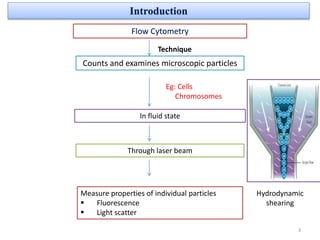
Flow Cytometry
Technique
Counts and examines microscopic particles
Eg: Cells
Chromosomes
In fluid state
Measure properties of individual particles
 Fluorescence
 Light scatter
Through laser beam
Hydrodynamic
shearing
3
Introduction
History
1953
Wallace
Coulter
• Technique of analyzing individual cells in a fluidic channel was first
described and applied to automated blood cell counting
1965
Mack
Fulwyler
• Today's flow cytometers – particularly cell sorter
1968
• First commercial flow cytometer: large, complex, expensive, and
difficult to operate and maintain.
2000- till date
• Current flow cytometers – Analyze13 parameters (forward scatter,
side scatter, 11 colors of immunofluorescence) per cell at rates up to
100,000 cells per second.
4
5
6
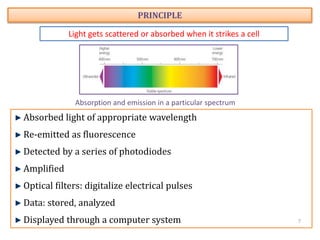
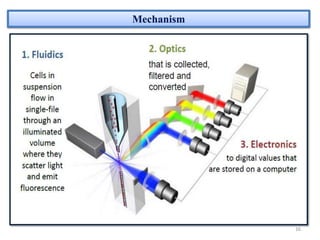
Absorption and emission in a particular spectrum
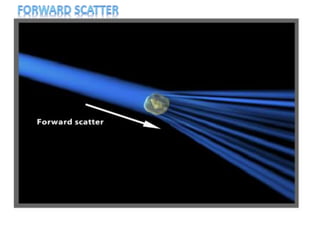
Light gets scattered or absorbed when it strikes a cell
PRINCIPLE
Absorbed light of appropriate wavelength
Re-emitted as fluorescence
Detected by a series of photodiodes
Amplified
Optical filters: digitalize electrical pulses
Data: stored, analyzed
Displayed through a computer system 7
• Light scattering is dependent on the internal structure of the
cell, its size and shape
• Optical filters are essential to block unwanted light and
permit light of the desired wavelength to reach the photo
detector
Conti….
8
Fluorochrome
The process of emission follows extremely rapidly, commonly in the
order of nanoseconds is known as fluorescence.
Fluorescence
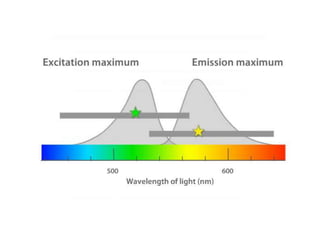
Fluorochromes are essentially dyes, which accept light energy (e.g.
from a laser) at a given wavelength and re-emit it at a longer
wavelength. These two processes are called excitation and
emission.
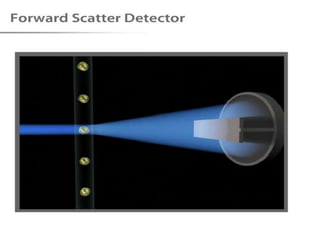
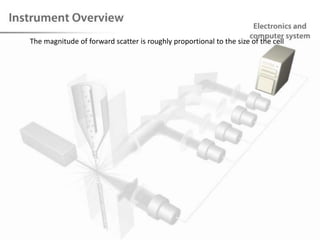
The magnitude of forward scatter is roughly proportional to the size of the cell
Mechanism
16
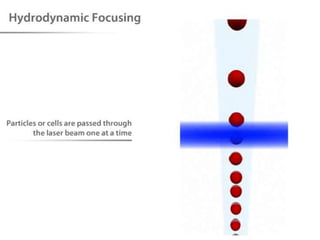
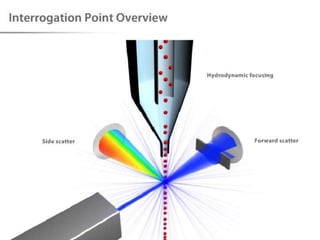
 When the sheath fluid moves, it
creates a massive drag effect on
the narrowing central chamber.
 This alters the velocity of the
central fluid whose flow front
becomes parabolic with greatest
velocity at its center (Fig. ).
 The effect creates a single file of
particles is called hydrodynamic
focusing
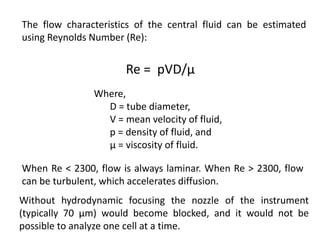
The flow characteristics of the central fluid can be estimated
using Reynolds Number (Re):
Re = pVD/μ
Where,
D = tube diameter,
V = mean velocity of fluid,
p = density of fluid, and
μ = viscosity of fluid.
When Re < 2300, flow is always laminar. When Re > 2300, flow
can be turbulent, which accelerates diffusion.
Without hydrodynamic focusing the nozzle of the instrument
(typically 70 μm) would become blocked, and it would not be
possible to analyze one cell at a time.
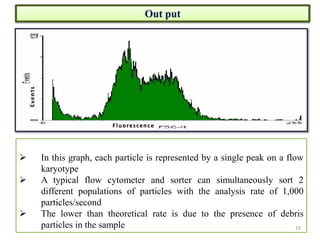
 In this graph, each particle is represented by a single peak on a flow
karyotype
 A typical flow cytometer and sorter can simultaneously sort 2
different populations of particles with the analysis rate of 1,000
particles/second
 The lower than theoretical rate is due to the presence of debris
particles in the sample
Out put
19
• Ploidy analysis
• Estimation of nuclear DNA content
• Cell-cycle analysis
• Physical mapping of genomes
• Flow cytogenetics
• Chromosome sorting (can process 1,000 intact mitotic
plant chromosomes per second)
• Screening and detection of transgenic pollens
• True-to-typeness/ Clonal fidelity
20
• Cell size
• Cell granularity
• Gene expression as the amount messenger RNA for a
particular gene
• Amounts of specific surface receptors
• Amounts of intracellular proteins, or transient signaling
events in living cells
21
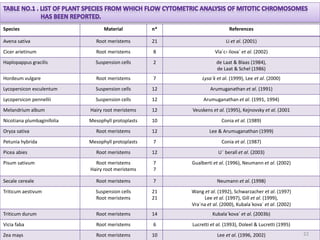
Species Material n* References
Avena sativa Root meristems 21 Li et al. (2001)
Cicer arietinum Root meristems 8 Vla´c› ilova´ et al. (2002)
Haplopappus gracilis Suspension cells 2 de Laat & Blaas (1984),
de Laat & Schel (1986)
Hordeum vulgare Root meristems 7 Lysa´k et al. (1999), Lee et al. (2000)
Lycopersicon esculentum Suspension cells 12 Arumuganathan et al. (1991)
Lycopersicon pennellii Suspension cells 12 Arumuganathan et al. (1991, 1994)
Melandrium album Hairy root meristems 12 Veuskens et al. (1995), Kejnovsky et al. (2001
Nicotiana plumbaginifolia Mesophyll protoplasts 10 Conia et al. (1989)
Oryza sativa Root meristems 12 Lee & Arumuganathan (1999)
Petunia hybrida Mesophyll protoplasts 7 Conia et al. (1987)
Picea abies Root meristems 12 U¨ berall et al. (2003)
Pisum sativum Root meristems
Hairy root meristems
7
7
Gualberti et al. (1996), Neumann et al. (2002)
Secale cereale Root meristems 7 Neumann et al. (1998)
Triticum aestivum Suspension cells
Root meristems
21
21
Wang et al. (1992), Schwarzacher et al. (1997)
Lee et al. (1997), Gill et al. (1999),
Vra´na et al. (2000), Kubala´kova´ et al. (2002)
Triticum durum Root meristems 14 Kubala´kova´ et al. (2003b)
Vicia faba Root meristems 6 Lucretti et al. (1993), Doleel & Lucretti (1995)
Zea mays Root meristems 10 Lee et al. (1996, 2002) 22
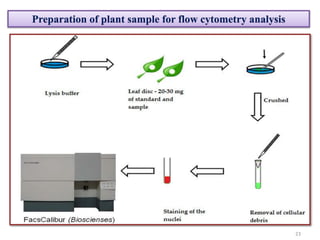
Preparation of plant sample for flow cytometry analysis
23
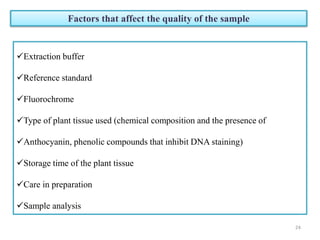
Factors that affect the quality of the sample
Extraction buffer
Reference standard
Fluorochrome
Type of plant tissue used (chemical composition and the presence of
Anthocyanin, phenolic compounds that inhibit DNA staining)
Storage time of the plant tissue
Care in preparation
Sample analysis
24
25
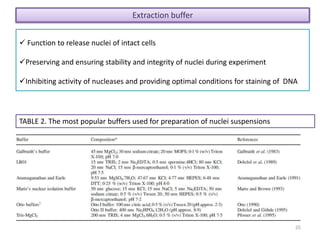
Extraction buffer
 Function to release nuclei of intact cells
Preserving and ensuring stability and integrity of nuclei during experiment
Inhibiting activity of nucleases and providing optimal conditions for staining of DNA
TABLE 2. The most popular buffers used for preparation of nuclei suspensions
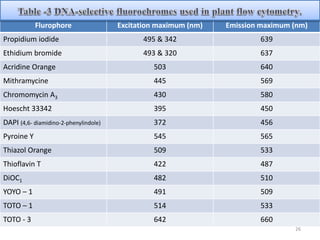
Flurophore Excitation maximum (nm) Emission maximum (nm)
Propidium iodide 495 & 342 639
Ethidium bromide 493 & 320 637
Acridine Orange 503 640
Mithramycine 445 569
Chromomycin A3 430 580
Hoescht 33342 395 450
DAPI (4,6- diamidino-2-phenylindole) 372 456
Pyroine Y 545 565
Thiazol Orange 509 533
Thioflavin T 422 487
DiOC1 482 510
YOYO – 1 491 509
TOTO – 1 514 533
TOTO - 3 642 660
26
27
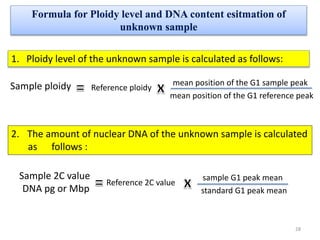
Sample ploidy Reference ploidy
mean position of the G1 sample peak
mean position of the G1 reference peak
Sample 2C value
DNA pg or Mbp
Reference 2C value
sample G1 peak mean
standard G1 peak mean
2. The amount of nuclear DNA of the unknown sample is calculated
as follows :
Formula for Ploidy level and DNA content esitmation of
unknown sample
1. Ploidy level of the unknown sample is calculated as follows:
28

Flow cytometry

  • 1.
    Speaker: DABHI KASHYAP A. M.Sc. Biotechnology Anand Agricultural University Gujarat, India 1
  • 2.
  • 3.
    Flow Cytometry Technique Counts andexamines microscopic particles Eg: Cells Chromosomes In fluid state Measure properties of individual particles  Fluorescence  Light scatter Through laser beam Hydrodynamic shearing 3 Introduction
  • 4.
    History 1953 Wallace Coulter • Technique ofanalyzing individual cells in a fluidic channel was first described and applied to automated blood cell counting 1965 Mack Fulwyler • Today's flow cytometers – particularly cell sorter 1968 • First commercial flow cytometer: large, complex, expensive, and difficult to operate and maintain. 2000- till date • Current flow cytometers – Analyze13 parameters (forward scatter, side scatter, 11 colors of immunofluorescence) per cell at rates up to 100,000 cells per second. 4
  • 5.
  • 6.
  • 7.
    Absorption and emissionin a particular spectrum Light gets scattered or absorbed when it strikes a cell PRINCIPLE Absorbed light of appropriate wavelength Re-emitted as fluorescence Detected by a series of photodiodes Amplified Optical filters: digitalize electrical pulses Data: stored, analyzed Displayed through a computer system 7
  • 8.
    • Light scatteringis dependent on the internal structure of the cell, its size and shape • Optical filters are essential to block unwanted light and permit light of the desired wavelength to reach the photo detector Conti…. 8
  • 9.
    Fluorochrome The process ofemission follows extremely rapidly, commonly in the order of nanoseconds is known as fluorescence. Fluorescence Fluorochromes are essentially dyes, which accept light energy (e.g. from a laser) at a given wavelength and re-emit it at a longer wavelength. These two processes are called excitation and emission.
  • 14.
    The magnitude offorward scatter is roughly proportional to the size of the cell
  • 16.
  • 17.
     When thesheath fluid moves, it creates a massive drag effect on the narrowing central chamber.  This alters the velocity of the central fluid whose flow front becomes parabolic with greatest velocity at its center (Fig. ).  The effect creates a single file of particles is called hydrodynamic focusing
  • 18.
    The flow characteristicsof the central fluid can be estimated using Reynolds Number (Re): Re = pVD/μ Where, D = tube diameter, V = mean velocity of fluid, p = density of fluid, and μ = viscosity of fluid. When Re < 2300, flow is always laminar. When Re > 2300, flow can be turbulent, which accelerates diffusion. Without hydrodynamic focusing the nozzle of the instrument (typically 70 μm) would become blocked, and it would not be possible to analyze one cell at a time.
  • 19.
     In thisgraph, each particle is represented by a single peak on a flow karyotype  A typical flow cytometer and sorter can simultaneously sort 2 different populations of particles with the analysis rate of 1,000 particles/second  The lower than theoretical rate is due to the presence of debris particles in the sample Out put 19
  • 20.
    • Ploidy analysis •Estimation of nuclear DNA content • Cell-cycle analysis • Physical mapping of genomes • Flow cytogenetics • Chromosome sorting (can process 1,000 intact mitotic plant chromosomes per second) • Screening and detection of transgenic pollens • True-to-typeness/ Clonal fidelity 20
  • 21.
    • Cell size •Cell granularity • Gene expression as the amount messenger RNA for a particular gene • Amounts of specific surface receptors • Amounts of intracellular proteins, or transient signaling events in living cells 21
  • 22.
    Species Material n*References Avena sativa Root meristems 21 Li et al. (2001) Cicer arietinum Root meristems 8 Vla´c› ilova´ et al. (2002) Haplopappus gracilis Suspension cells 2 de Laat & Blaas (1984), de Laat & Schel (1986) Hordeum vulgare Root meristems 7 Lysa´k et al. (1999), Lee et al. (2000) Lycopersicon esculentum Suspension cells 12 Arumuganathan et al. (1991) Lycopersicon pennellii Suspension cells 12 Arumuganathan et al. (1991, 1994) Melandrium album Hairy root meristems 12 Veuskens et al. (1995), Kejnovsky et al. (2001 Nicotiana plumbaginifolia Mesophyll protoplasts 10 Conia et al. (1989) Oryza sativa Root meristems 12 Lee & Arumuganathan (1999) Petunia hybrida Mesophyll protoplasts 7 Conia et al. (1987) Picea abies Root meristems 12 U¨ berall et al. (2003) Pisum sativum Root meristems Hairy root meristems 7 7 Gualberti et al. (1996), Neumann et al. (2002) Secale cereale Root meristems 7 Neumann et al. (1998) Triticum aestivum Suspension cells Root meristems 21 21 Wang et al. (1992), Schwarzacher et al. (1997) Lee et al. (1997), Gill et al. (1999), Vra´na et al. (2000), Kubala´kova´ et al. (2002) Triticum durum Root meristems 14 Kubala´kova´ et al. (2003b) Vicia faba Root meristems 6 Lucretti et al. (1993), Doleel & Lucretti (1995) Zea mays Root meristems 10 Lee et al. (1996, 2002) 22
  • 23.
    Preparation of plantsample for flow cytometry analysis 23
  • 24.
    Factors that affectthe quality of the sample Extraction buffer Reference standard Fluorochrome Type of plant tissue used (chemical composition and the presence of Anthocyanin, phenolic compounds that inhibit DNA staining) Storage time of the plant tissue Care in preparation Sample analysis 24
  • 25.
    25 Extraction buffer  Functionto release nuclei of intact cells Preserving and ensuring stability and integrity of nuclei during experiment Inhibiting activity of nucleases and providing optimal conditions for staining of DNA TABLE 2. The most popular buffers used for preparation of nuclei suspensions
  • 26.
    Flurophore Excitation maximum(nm) Emission maximum (nm) Propidium iodide 495 & 342 639 Ethidium bromide 493 & 320 637 Acridine Orange 503 640 Mithramycine 445 569 Chromomycin A3 430 580 Hoescht 33342 395 450 DAPI (4,6- diamidino-2-phenylindole) 372 456 Pyroine Y 545 565 Thiazol Orange 509 533 Thioflavin T 422 487 DiOC1 482 510 YOYO – 1 491 509 TOTO – 1 514 533 TOTO - 3 642 660 26
  • 27.
  • 28.
    Sample ploidy Referenceploidy mean position of the G1 sample peak mean position of the G1 reference peak Sample 2C value DNA pg or Mbp Reference 2C value sample G1 peak mean standard G1 peak mean 2. The amount of nuclear DNA of the unknown sample is calculated as follows : Formula for Ploidy level and DNA content esitmation of unknown sample 1. Ploidy level of the unknown sample is calculated as follows: 28

Editor's Notes

  • #18 8. Introduction to Flow Cytometry (4) Essentially, the fluidics system consists of a central channel/core through which the sample is injected, enclosed by an outer sheath that contains faster flowing fluid. As the sheath fluid moves, it creates a massive drag effect on the narrowing central chamber. This alters the velocity of the central fluid whose flow front becomes parabolic with greatest velocity at its center and zero velocity at the wall (see Figure 1). The effect creates a single file of particles and is called hydrodynamic focusing.
  • #27  Flow cytometry (ploidy determination, cell cycle analysis, DNA content per nucleus)