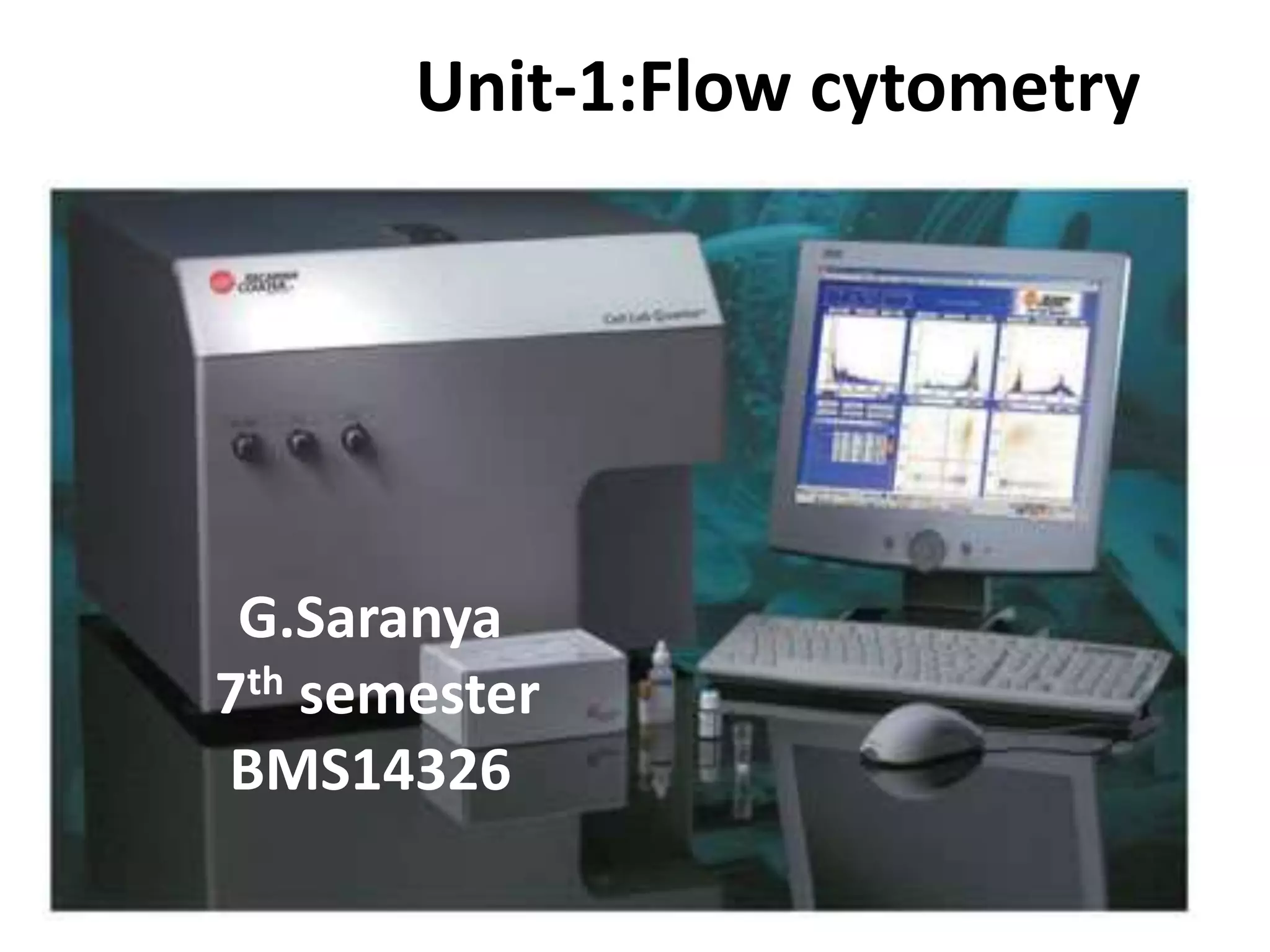
Unit-1:Flow cytometry
G.Saranya
7th semester
BMS14326
 Measuring properties of cell as they flow in a fluid
suspension across an illuminated light path.
Flow cytometric immunophenotyping (FCI) first appeared
in clinical laboratories in the 1980s, in the wake of the AIDS
epidemic.
Initially utilized to assess CD4 T-cells, the technique was
soon applied to lymphoid and eventually myeloid
neoplasms.
INTRODUCTION
 Current flow cytometers have the capability of
simultaneously measuring multiple parameters of
individual cells in a cell suspension.
 In addition, flow cytometry is also highly sensitive and
can detect immunophenotype of cells in a specimen with
thousands of cells.
The parameters analyzed by flow cytometry include
 physical properties of cells; the size, cytoplasmic
granularity, and amount of DNA contents; and
 cell antigens/markers (surface, cytoplasmic, and
nuclear) that can be recognized by specific antibodies.
By using appropriate antibody panels, flow cytometry
can reveal
the cell type (hematopoietic, lymphoid, or
nonhematopoietic),
cell lineage (B- and T cells, natural killer cells, myeloid/
monocytic cells, neuro/ neuroendocrine cells, and
epithelial cells),
cell maturation stage (precursors vs. matured cells)
Flow cytometry involves the analysis of
the optical and fluorescence
characteristics of single particle (e.g.
cells, nuclei, chromosomes) during
their passage within a narrow, precisely
defined liquid stream.
Principle
COMPUTER
SYSTEM
ELECTRONIC
SYSTEM
OPTICAL SYSTEMFLOW SYSTEM
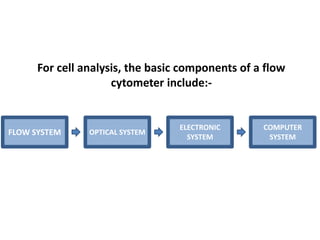
For cell analysis, the basic components of a flow
cytometer include:-
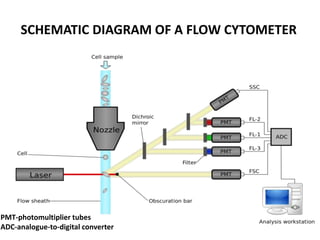
PMT-photomultiplier tubes
ADC-analogue-to-digital converter
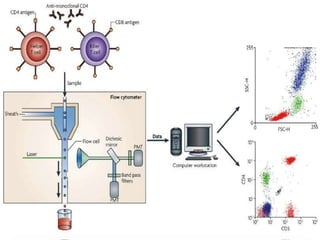
SCHEMATIC DIAGRAM OF A FLOW CYTOMETER
Flow cytometer is composed of three main components:
The Flow system (fluidics)- Cells in suspension are brought
in single file past
The Optical system (light sensing)- a focused laser which
scatter light and emit fluorescence that is filtered and
collected
The Electronic system (signal processing)-emitted light is
converted to digitized values that are stored in a file for
analysis
The Flow System
• One of the fundamentals of flow cytometry is the ability to
measure the properties of individual particles, which is
managed by the fluidics system.
• When a sample is injected into a flow cytometer, it is
ordered into a stream of single particles.
• The fluidic system consists of a FLOW CELL (Quartz
Chamber):
– Central channel/ core - through which the sample is
injected.
– Outer sheath - contains faster flowing fluid k/a Sheath
fluid (0.9% Saline / PBS) , enclosing the central core.
Hydrodynamic Focusing
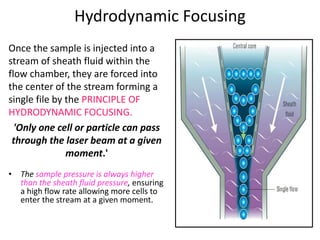
Once the sample is injected into a
stream of sheath fluid within the
flow chamber, they are forced into
the center of the stream forming a
single file by the PRINCIPLE OF
HYDRODYNAMIC FOCUSING.
'Only one cell or particle can pass
through the laser beam at a given
moment.'
• The sample pressure is always higher
than the sheath fluid pressure, ensuring
a high flow rate allowing more cells to
enter the stream at a given moment.
OPTICS
• After the cell delivery system, the need is to excite the cells
using a light source.
• The light source used in a flow cytometer:
• Laser (more commonly)
• Arc lamp
• Why Lasers are more common?
 They are highly coherent and uniform. They can be easily focused on a
very small area (like a sample stream).
 They are monochromatic, emitting single wavelengths of light.
• ARGON Lasers - 488nm wavelength (blue to blue green)
When a light intersects a laser beam at the so called
'interogation point' two events occur:
a) light scattering
b) emission of light (fluorescence )
Fluorescence is light emitted during decay of
excited electron to its basal state.
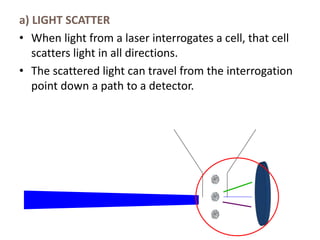
a) LIGHT SCATTER
• When light from a laser interrogates a cell, that cell
scatters light in all directions.
• The scattered light can travel from the interrogation
point down a path to a detector.
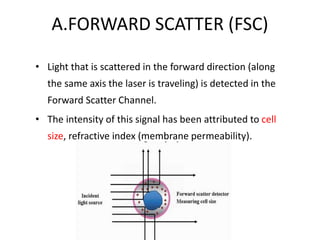
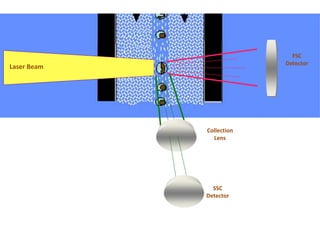
A.FORWARD SCATTER (FSC)
• Light that is scattered in the forward direction (along
the same axis the laser is traveling) is detected in the
Forward Scatter Channel.
• The intensity of this signal has been attributed to cell
size, refractive index (membrane permeability).
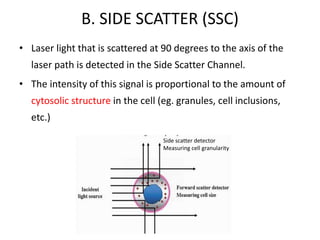
B. SIDE SCATTER (SSC)
• Laser light that is scattered at 90 degrees to the axis of the
laser path is detected in the Side Scatter Channel.
• The intensity of this signal is proportional to the amount of
cytosolic structure in the cell (eg. granules, cell inclusions,
etc.)
Side scatter detector
Measuring cell granularity
FSC
Detector
Collection
Lens
SSC
Detector
Laser Beam
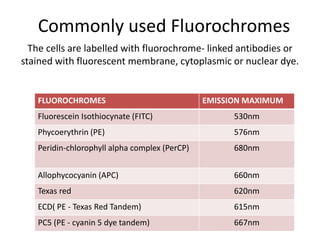
Commonly used Fluorochromes
The cells are labelled with fluorochrome- linked antibodies or
stained with fluorescent membrane, cytoplasmic or nuclear dye.
FLUOROCHROMES EMISSION MAXIMUM
Fluorescein Isothiocynate (FITC) 530nm
Phycoerythrin (PE) 576nm
Peridin-chlorophyll alpha complex (PerCP) 680nm
Allophycocyanin (APC) 660nm
Texas red 620nm
ECD( PE - Texas Red Tandem) 615nm
PC5 (PE - cyanin 5 dye tandem) 667nm
B) EMISSION OF FLUORESCENT LIGHT (FLUORESCENCE)
• As the fluorescent molecule present in or on the particle is
interrogated by the laser light, it will absorb energy from the
laser light and release the absorbed energy at longer wave
length.
• Emitted photons pass through the collection lens and are split
and steered down specific channels with the use of filters.
• Emitted fluorescence intensity is proportional to the amount
of fluorescent compound on the particle.
Optics- Filters
• Different wavelengths of light are scattered simultaneously
from a cell
Need to split the light into its specific wavelengths in order
to measure and quantify them independently. This is done
with filters.
• The system of filters ensures that each photo detector
receives light bands of various wavelengths.
• Optical filters are designed such that they absorb or reflect
some wavelengths of light, while transmitting others.
• Types of filters
1. Long Pass 2. Short Pass
3. Band Pass 4. Dichroic
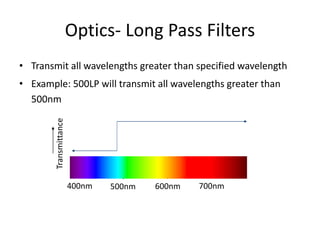
Optics- Long Pass Filters
• Transmit all wavelengths greater than specified wavelength
• Example: 500LP will transmit all wavelengths greater than
500nm
400nm 500nm 600nm 700nm
Transmittance
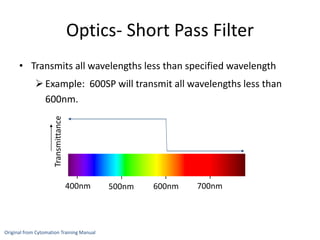
Optics- Short Pass Filter
• Transmits all wavelengths less than specified wavelength
Example: 600SP will transmit all wavelengths less than
600nm.
400nm 500nm 600nm 700nm
Transmittance
Original from Cytomation Training Manual
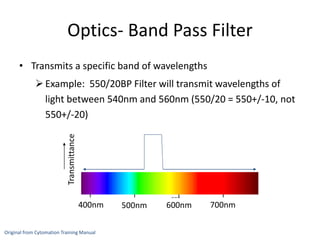
Optics- Band Pass Filter
• Transmits a specific band of wavelengths
Example: 550/20BP Filter will transmit wavelengths of
light between 540nm and 560nm (550/20 = 550+/-10, not
550+/-20)
400nm 500nm 600nm 700nm
Transmittance
Original from Cytomation Training Manual
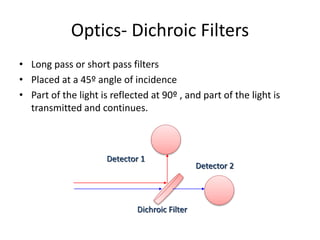
Optics- Dichroic Filters
• Long pass or short pass filters
• Placed at a 45º angle of incidence
• Part of the light is reflected at 90º , and part of the light is
transmitted and continues.
Dichroic Filter
Detector 1
Detector 2
OPTICS - DETECTORS
• The photo detectors convert the photons to electrical
impulses.
• Two common types of detectors used in flow cytometry:
– Photodiode
used for strong signals, when saturation is a potential
problem (eg, forward scatter detector).
– Photomultiplier tube (PMT)
more sensitive than photodiode but can be destroyed by
exposure to too much light.
used for side scatter and fluorescent signals.
ELECTRONICS
• The electronic subsystem converts photons to
photoelectrons.
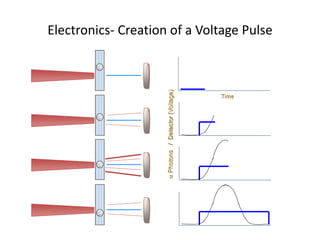
• Measures amplitude, area and width of photoelectron pulse.
• It amplifies pulse either linearly or logarithmically and then
digitalizing the amplified pulse.
Time
Electronics- Creation of a Voltage Pulse
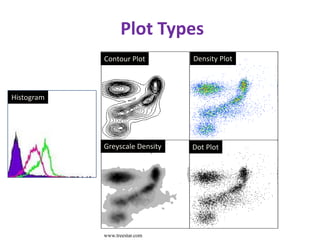
Data Analysis- Plot Types
• There are several plot choices:
Single Color Histogram
 Fluorescence intensity (FI) versus the number of cells
counted.
Two Color Dot Plot
 FI of parameter 1 versus FI of Parameter 2
Two Color Contour Plot
 Concentric rings form around populations. The more
dense the population, the closer the rings are to each
other
Two Color Density Plot
 Areas of higher density will have a different color than
other areas
Plot Types
Contour Plot Density Plot
Greyscale Density Dot Plot
www.treestar.com
Histogram
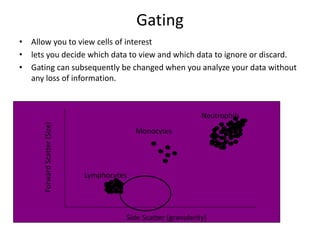
Gating
• Allow you to view cells of interest
• lets you decide which data to view and which data to ignore or discard.
• Gating can subsequently be changed when you analyze your data without
any loss of information.
Side Scatter (granularity)
ForwardScatter(Size)
Neutrophils
Monocytes
Lymphocytes
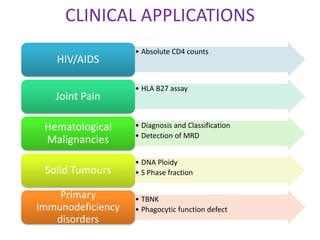
CLINICAL APPLICATIONS
• Absolute CD4 counts
HIV/AIDS
• HLA B27 assay
Joint Pain
• Diagnosis and Classification
• Detection of MRD
Hematological
Malignancies
• DNA Ploidy
• S Phase fractionSolid Tumours
• TBNK
• Phagocytic function defect
Primary
Immunodeficiency
disorders
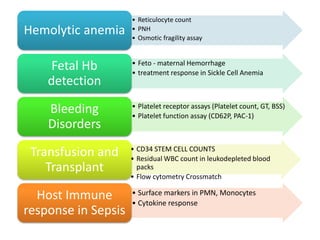
• Reticulocyte count
• PNH
• Osmotic fragility assay
Hemolytic anemia
• Feto - maternal Hemorrhage
• treatment response in Sickle Cell Anemia
Fetal Hb
detection
• Platelet receptor assays (Platelet count, GT, BSS)
• Platelet function assay (CD62P, PAC-1)
Bleeding
Disorders
• CD34 STEM CELL COUNTS
• Residual WBC count in leukodepleted blood
packs
• Flow cytometry Crossmatch
Transfusion and
Transplant
• Surface markers in PMN, Monocytes
• Cytokine response
Host Immune
response in Sepsis
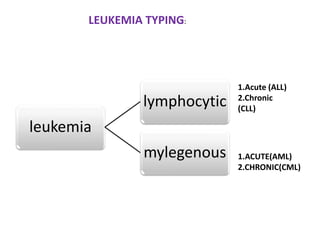
leukemia
lymphocytic
mylegenous
1.Acute (ALL)
2.Chronic
(CLL)
1.ACUTE(AML)
2.CHRONIC(CML)
LEUKEMIA TYPING:
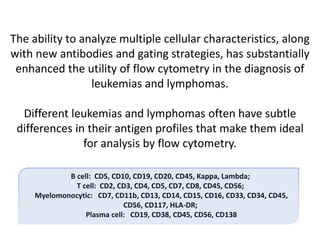
The ability to analyze multiple cellular characteristics, along
with new antibodies and gating strategies, has substantially
enhanced the utility of flow cytometry in the diagnosis of
leukemias and lymphomas.
Different leukemias and lymphomas often have subtle
differences in their antigen profiles that make them ideal
for analysis by flow cytometry.
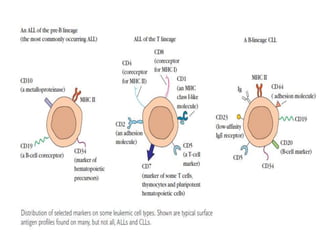
B cell: CD5, CD10, CD19, CD20, CD45, Kappa, Lambda;
T cell: CD2, CD3, CD4, CD5, CD7, CD8, CD45, CD56;
Myelomonocytic: CD7, CD11b, CD13, CD14, CD15, CD16, CD33, CD34, CD45,
CD56, CD117, HLA-DR;
Plasma cell: CD19, CD38, CD45, CD56, CD138
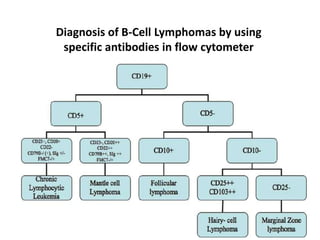
Diagnosis of B-Cell Lymphomas by using
specific antibodies in flow cytometer
IMMUNOPHENOTYPING ANALYSIS
Requires
• Antibodies.
• Fluorochromes.
ANTIBODY
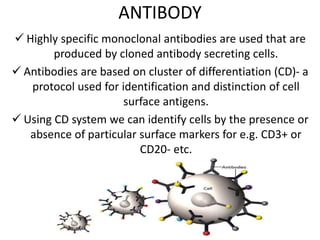
 Highly specific monoclonal antibodies are used that are
produced by cloned antibody secreting cells.
 Antibodies are based on cluster of differentiation (CD)- a
protocol used for identification and distinction of cell
surface antigens.
 Using CD system we can identify cells by the presence or
absence of particular surface markers for e.g. CD3+ or
CD20- etc.
FLUOROCHROMES
Fluorochromes are substances that can be excited by
certain light source (such as laser) and emit a
fluorescent signal at a single wavelength.
Fluorescent dyes can directly bind to certain cellular
content, such as DNA and RNA, and allow us to
perform quantitative analysis on individual cells.
However, in most cases fluorochromes are
conjugated with monoclonal antibodies, which
specifically target cellular antigens/markers.
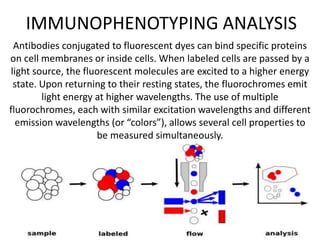
Antibodies conjugated to fluorescent dyes can bind specific proteins
on cell membranes or inside cells. When labeled cells are passed by a
light source, the fluorescent molecules are excited to a higher energy
state. Upon returning to their resting states, the fluorochromes emit
light energy at higher wavelengths. The use of multiple
fluorochromes, each with similar excitation wavelengths and different
emission wavelengths (or “colors”), allows several cell properties to
be measured simultaneously.
IMMUNOPHENOTYPING ANALYSIS
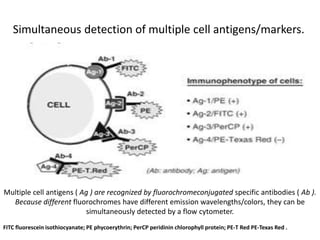
Multiple cell antigens ( Ag ) are recognized by fluorochromeconjugated specific antibodies ( Ab ).
Because different fluorochromes have different emission wavelengths/colors, they can be
simultaneously detected by a flow cytometer.
FITC fluorescein isothiocyanate; PE phycoerythrin; PerCP peridinin chlorophyll protein; PE-T Red PE-Texas Red .
Simultaneous detection of multiple cell antigens/markers.
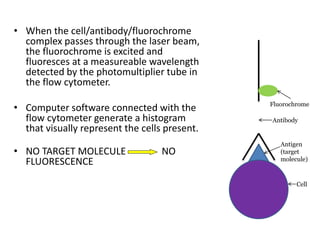
• When the cell/antibody/fluorochrome
complex passes through the laser beam,
the fluorochrome is excited and
fluoresces at a measureable wavelength
detected by the photomultiplier tube in
the flow cytometer.
• Computer software connected with the
flow cytometer generate a histogram
that visually represent the cells present.
• NO TARGET MOLECULE NO
FLUORESCENCE
Antibody
Fluorochrome
Antigen
(target
molecule)
Cell
Thank you

Flow cytometry

  • 1.
  • 2.
     Measuring propertiesof cell as they flow in a fluid suspension across an illuminated light path. Flow cytometric immunophenotyping (FCI) first appeared in clinical laboratories in the 1980s, in the wake of the AIDS epidemic. Initially utilized to assess CD4 T-cells, the technique was soon applied to lymphoid and eventually myeloid neoplasms. INTRODUCTION
  • 3.
     Current flowcytometers have the capability of simultaneously measuring multiple parameters of individual cells in a cell suspension.  In addition, flow cytometry is also highly sensitive and can detect immunophenotype of cells in a specimen with thousands of cells.
  • 4.
    The parameters analyzedby flow cytometry include  physical properties of cells; the size, cytoplasmic granularity, and amount of DNA contents; and  cell antigens/markers (surface, cytoplasmic, and nuclear) that can be recognized by specific antibodies.
  • 5.
    By using appropriateantibody panels, flow cytometry can reveal the cell type (hematopoietic, lymphoid, or nonhematopoietic), cell lineage (B- and T cells, natural killer cells, myeloid/ monocytic cells, neuro/ neuroendocrine cells, and epithelial cells), cell maturation stage (precursors vs. matured cells)
  • 6.
    Flow cytometry involvesthe analysis of the optical and fluorescence characteristics of single particle (e.g. cells, nuclei, chromosomes) during their passage within a narrow, precisely defined liquid stream. Principle
  • 7.
    COMPUTER SYSTEM ELECTRONIC SYSTEM OPTICAL SYSTEMFLOW SYSTEM Forcell analysis, the basic components of a flow cytometer include:-
  • 8.
  • 9.
    Flow cytometer iscomposed of three main components: The Flow system (fluidics)- Cells in suspension are brought in single file past The Optical system (light sensing)- a focused laser which scatter light and emit fluorescence that is filtered and collected The Electronic system (signal processing)-emitted light is converted to digitized values that are stored in a file for analysis
  • 10.
    The Flow System •One of the fundamentals of flow cytometry is the ability to measure the properties of individual particles, which is managed by the fluidics system. • When a sample is injected into a flow cytometer, it is ordered into a stream of single particles. • The fluidic system consists of a FLOW CELL (Quartz Chamber): – Central channel/ core - through which the sample is injected. – Outer sheath - contains faster flowing fluid k/a Sheath fluid (0.9% Saline / PBS) , enclosing the central core.
  • 11.
    Hydrodynamic Focusing Once thesample is injected into a stream of sheath fluid within the flow chamber, they are forced into the center of the stream forming a single file by the PRINCIPLE OF HYDRODYNAMIC FOCUSING. 'Only one cell or particle can pass through the laser beam at a given moment.' • The sample pressure is always higher than the sheath fluid pressure, ensuring a high flow rate allowing more cells to enter the stream at a given moment.
  • 12.
    OPTICS • After thecell delivery system, the need is to excite the cells using a light source. • The light source used in a flow cytometer: • Laser (more commonly) • Arc lamp • Why Lasers are more common?  They are highly coherent and uniform. They can be easily focused on a very small area (like a sample stream).  They are monochromatic, emitting single wavelengths of light. • ARGON Lasers - 488nm wavelength (blue to blue green)
  • 13.
    When a lightintersects a laser beam at the so called 'interogation point' two events occur: a) light scattering b) emission of light (fluorescence ) Fluorescence is light emitted during decay of excited electron to its basal state.
  • 14.
    a) LIGHT SCATTER •When light from a laser interrogates a cell, that cell scatters light in all directions. • The scattered light can travel from the interrogation point down a path to a detector.
  • 15.
    A.FORWARD SCATTER (FSC) •Light that is scattered in the forward direction (along the same axis the laser is traveling) is detected in the Forward Scatter Channel. • The intensity of this signal has been attributed to cell size, refractive index (membrane permeability).
  • 16.
    B. SIDE SCATTER(SSC) • Laser light that is scattered at 90 degrees to the axis of the laser path is detected in the Side Scatter Channel. • The intensity of this signal is proportional to the amount of cytosolic structure in the cell (eg. granules, cell inclusions, etc.) Side scatter detector Measuring cell granularity
  • 17.
  • 18.
    Commonly used Fluorochromes Thecells are labelled with fluorochrome- linked antibodies or stained with fluorescent membrane, cytoplasmic or nuclear dye. FLUOROCHROMES EMISSION MAXIMUM Fluorescein Isothiocynate (FITC) 530nm Phycoerythrin (PE) 576nm Peridin-chlorophyll alpha complex (PerCP) 680nm Allophycocyanin (APC) 660nm Texas red 620nm ECD( PE - Texas Red Tandem) 615nm PC5 (PE - cyanin 5 dye tandem) 667nm
  • 19.
    B) EMISSION OFFLUORESCENT LIGHT (FLUORESCENCE) • As the fluorescent molecule present in or on the particle is interrogated by the laser light, it will absorb energy from the laser light and release the absorbed energy at longer wave length. • Emitted photons pass through the collection lens and are split and steered down specific channels with the use of filters. • Emitted fluorescence intensity is proportional to the amount of fluorescent compound on the particle.
  • 20.
    Optics- Filters • Differentwavelengths of light are scattered simultaneously from a cell Need to split the light into its specific wavelengths in order to measure and quantify them independently. This is done with filters. • The system of filters ensures that each photo detector receives light bands of various wavelengths. • Optical filters are designed such that they absorb or reflect some wavelengths of light, while transmitting others. • Types of filters 1. Long Pass 2. Short Pass 3. Band Pass 4. Dichroic
  • 21.
    Optics- Long PassFilters • Transmit all wavelengths greater than specified wavelength • Example: 500LP will transmit all wavelengths greater than 500nm 400nm 500nm 600nm 700nm Transmittance
  • 22.
    Optics- Short PassFilter • Transmits all wavelengths less than specified wavelength Example: 600SP will transmit all wavelengths less than 600nm. 400nm 500nm 600nm 700nm Transmittance Original from Cytomation Training Manual
  • 23.
    Optics- Band PassFilter • Transmits a specific band of wavelengths Example: 550/20BP Filter will transmit wavelengths of light between 540nm and 560nm (550/20 = 550+/-10, not 550+/-20) 400nm 500nm 600nm 700nm Transmittance Original from Cytomation Training Manual
  • 24.
    Optics- Dichroic Filters •Long pass or short pass filters • Placed at a 45º angle of incidence • Part of the light is reflected at 90º , and part of the light is transmitted and continues. Dichroic Filter Detector 1 Detector 2
  • 25.
    OPTICS - DETECTORS •The photo detectors convert the photons to electrical impulses. • Two common types of detectors used in flow cytometry: – Photodiode used for strong signals, when saturation is a potential problem (eg, forward scatter detector). – Photomultiplier tube (PMT) more sensitive than photodiode but can be destroyed by exposure to too much light. used for side scatter and fluorescent signals.
  • 26.
    ELECTRONICS • The electronicsubsystem converts photons to photoelectrons. • Measures amplitude, area and width of photoelectron pulse. • It amplifies pulse either linearly or logarithmically and then digitalizing the amplified pulse.
  • 27.
  • 28.
    Data Analysis- PlotTypes • There are several plot choices: Single Color Histogram  Fluorescence intensity (FI) versus the number of cells counted. Two Color Dot Plot  FI of parameter 1 versus FI of Parameter 2 Two Color Contour Plot  Concentric rings form around populations. The more dense the population, the closer the rings are to each other Two Color Density Plot  Areas of higher density will have a different color than other areas
  • 29.
    Plot Types Contour PlotDensity Plot Greyscale Density Dot Plot www.treestar.com Histogram
  • 30.
    Gating • Allow youto view cells of interest • lets you decide which data to view and which data to ignore or discard. • Gating can subsequently be changed when you analyze your data without any loss of information. Side Scatter (granularity) ForwardScatter(Size) Neutrophils Monocytes Lymphocytes
  • 31.
    CLINICAL APPLICATIONS • AbsoluteCD4 counts HIV/AIDS • HLA B27 assay Joint Pain • Diagnosis and Classification • Detection of MRD Hematological Malignancies • DNA Ploidy • S Phase fractionSolid Tumours • TBNK • Phagocytic function defect Primary Immunodeficiency disorders
  • 32.
    • Reticulocyte count •PNH • Osmotic fragility assay Hemolytic anemia • Feto - maternal Hemorrhage • treatment response in Sickle Cell Anemia Fetal Hb detection • Platelet receptor assays (Platelet count, GT, BSS) • Platelet function assay (CD62P, PAC-1) Bleeding Disorders • CD34 STEM CELL COUNTS • Residual WBC count in leukodepleted blood packs • Flow cytometry Crossmatch Transfusion and Transplant • Surface markers in PMN, Monocytes • Cytokine response Host Immune response in Sepsis
  • 33.
  • 35.
    The ability toanalyze multiple cellular characteristics, along with new antibodies and gating strategies, has substantially enhanced the utility of flow cytometry in the diagnosis of leukemias and lymphomas. Different leukemias and lymphomas often have subtle differences in their antigen profiles that make them ideal for analysis by flow cytometry. B cell: CD5, CD10, CD19, CD20, CD45, Kappa, Lambda; T cell: CD2, CD3, CD4, CD5, CD7, CD8, CD45, CD56; Myelomonocytic: CD7, CD11b, CD13, CD14, CD15, CD16, CD33, CD34, CD45, CD56, CD117, HLA-DR; Plasma cell: CD19, CD38, CD45, CD56, CD138
  • 36.
    Diagnosis of B-CellLymphomas by using specific antibodies in flow cytometer
  • 37.
  • 38.
    ANTIBODY  Highly specificmonoclonal antibodies are used that are produced by cloned antibody secreting cells.  Antibodies are based on cluster of differentiation (CD)- a protocol used for identification and distinction of cell surface antigens.  Using CD system we can identify cells by the presence or absence of particular surface markers for e.g. CD3+ or CD20- etc.
  • 39.
    FLUOROCHROMES Fluorochromes are substancesthat can be excited by certain light source (such as laser) and emit a fluorescent signal at a single wavelength. Fluorescent dyes can directly bind to certain cellular content, such as DNA and RNA, and allow us to perform quantitative analysis on individual cells. However, in most cases fluorochromes are conjugated with monoclonal antibodies, which specifically target cellular antigens/markers.
  • 40.
    Antibodies conjugated tofluorescent dyes can bind specific proteins on cell membranes or inside cells. When labeled cells are passed by a light source, the fluorescent molecules are excited to a higher energy state. Upon returning to their resting states, the fluorochromes emit light energy at higher wavelengths. The use of multiple fluorochromes, each with similar excitation wavelengths and different emission wavelengths (or “colors”), allows several cell properties to be measured simultaneously. IMMUNOPHENOTYPING ANALYSIS
  • 41.
    Multiple cell antigens( Ag ) are recognized by fluorochromeconjugated specific antibodies ( Ab ). Because different fluorochromes have different emission wavelengths/colors, they can be simultaneously detected by a flow cytometer. FITC fluorescein isothiocyanate; PE phycoerythrin; PerCP peridinin chlorophyll protein; PE-T Red PE-Texas Red . Simultaneous detection of multiple cell antigens/markers.
  • 43.
    • When thecell/antibody/fluorochrome complex passes through the laser beam, the fluorochrome is excited and fluoresces at a measureable wavelength detected by the photomultiplier tube in the flow cytometer. • Computer software connected with the flow cytometer generate a histogram that visually represent the cells present. • NO TARGET MOLECULE NO FLUORESCENCE Antibody Fluorochrome Antigen (target molecule) Cell
  • 44.