Flow Cytometry
Principles and clinical
applications
Dr. Ankit Raiyani
Hematology Department
Sahyadri Specialty Hospital
• Flow cytometry (FCM)
• Immunohistochemistry (IHC)
• Immunofluroscence (IF)
Flow cytometry
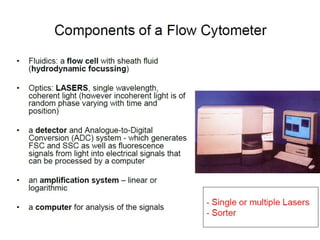
• Flow cytometry is the measurement of
cells in a flow system, which delivers the
cells singly, past a point of measurement
• In practice, the name refers to instruments
in which light is focused at the point of
measurement.
• Typically, light scatter at two different
angles and from one to six or more
fluorescence will be measured.
Disadvantages of FCM
• Need for liquid cell suspension. Therefore
lack of correlation with histomorphologic
features ( tissue architecture)
• Requires viable, fresh (unfixed) material
• Requires 1,00,000 events acquired by
tubes, which often limits its use in CSF,
paucicellular lesions.
History
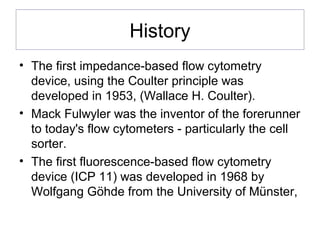
• The first impedance-based flow cytometry
device, using the Coulter principle was
developed in 1953, (Wallace H. Coulter).
• Mack Fulwyler was the inventor of the forerunner
to today's flow cytometers - particularly the cell
sorter.
• The first fluorescence-based flow cytometry
device (ICP 11) was developed in 1968 by
Wolfgang Göhde from the University of Münster,
• The original name of the fluorescence-based
flow cytometry technology was "pulse
cytophotometry“
• "flow cytometry", as a term was accepted in
1976
• Earlier flow cytometers were conceptualized as
cell sorters. Later on ability to sort cells was
removed as it was deemed unnecessary in
routine work
• But still name FACS (Fluorescence-activated
cell sorting) is used in BD flow cytometers.
Principle
Hydrodynamic focusing
Sample preparation
• Types of specimens suitable for flow
cytometry:
– Blood, bone marrow aspirate, fine needle
aspirates, body fluids.
– Solid tissue biopsy like spleen, thymus has to
be processed to form a cell suspension.
Sample preparation
• In clinical samples, if nucleated cells are
being studied, the red blood cells are
usually lysed either by a brief exposure to
distilled water, incubation with an
ammonium chloride solution or with a
weak detergent.
• If surface antigens are to be stained, fresh
unfixed cells are reacted with the labelled
antibodies.
• Take sample (100μl) in each tube
• Add monoclonal antibodies and vortex
• Incubate at room temperature in dark for 20 min
• Add RBC lysing solution (1 ml)
• Centrifuge for 5 min
• Discard supernatant
• PBS wash, discard supernatant
• Add PBS (0.5 ml) to WBC pellet.
• For cytoplasmic or nuclear antigens, the cells
must be fixed and permeabilised to give the
antibody access to the antigen.
• There is no standard procedure for staining intra-
cellular antigens.
• Many antigens are adversely affected by some
fixatives and consequently the optimum procedure
has to be determined for each protein under study.
• Several manufacturers sell reagents which are
mostly based on permeabilisation in detergent,
usually saponin, and fixation in formaldehyde.
IntraPrep
• Reagent 1:
– Fixation agent
– Formaldehide
• Reagent 2:
– Permeability agent
– Saponine
Fluorochromes used with
monoclonal antibodies
• Argon laser (488 nm)
• Fluorochromes: Are Molecules That Emit
Fluorescence Upon Excitation With Light
• In our set up:
– FITC (fluorescein isothiocyanate)
– PE (Phytoerythrin)
– ECD (phycoerythrin-Texas Red conjugate /energy
coupled dye )
– PC5 (phycoerythrin-cyanine5 conjugate)
– PC7 (phycoerythrin-cyanine7 conjugate)
Fluorochromes used with
monoclonal antibodies
• Others:
– PerCP (peridinin chlorophyll-A protein)
– 7-AAD (7-actinomycin D)
– PI (propidium iodide)
– TOT-1 (thiazole orange)
Gating strategy
• Can be used in single parameter and two
parameter charts.
• Commonly used gates in two parameter
scatter plots.
– FSC Vs SSC
– CD45 Vs SSC
– CD19 Vs SSC
Single
parameter
histogram
Single parameter gating
Two parameters scatter plot
Two parameters scatter plots with
gate A as source
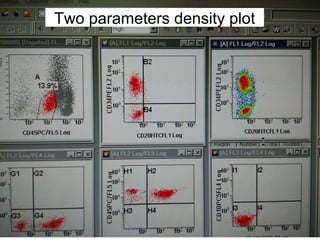
Two parameters density plot
SSC
• High SSC: PMN (including precursors),
granular blasts
• Intermediate SSC: Monocytes, blasts,
Hairy cell leukemia cells
• Low SSC: Lymphocytes, blasts,
hematogones.
FSC
• High FSC: monoblasts and monocytic
cells,
• Intermediate FSC: Myeloblasts, Large
lymphoma cells (DLBCL, ALCL, etc)
• Low FSC: Lymphoblasts, lymphocytes
CD 45 Vs SSC
• Bright CD 45 + Low SSC: lymphocytes, mature
lymphoproliferative disorder
• Bright CD45 + High SSC: Monocytes, neoplastic
monocytes (CMML, Acute Myeloid Leukemia
M4/5), HCL, PMN in Myelodysplastic Syndrome.
• Moderate CD45 + High SSC: PMN, maturing
myeloid cells, hypergranular APML,
• Moderate CD45 + slightly increased SSC:
lymphoblasts
CD 45 Vs SSC
• Dim CD45 + Low SSC: hematogones,
lymphoblasts
• CD45 negative + Low SSC: plasma cells,
RBC precursors.
• CD45 negative + High SSC: extrinsic
elements (metastatic cells)
CD138 Vs SSC gating
CD19 Vs SSC
How to obtain absolute cell count
by flow cytometer
• While flow cytometry generally gives the
percentage of a particular sub-set of cells, some
flow cytometers precisely record the the volume
of sample analysed or deliver a fixed volume of
sample. A percentage count of a sub-population
of cells can be directly converted to an absolute
count.
• In instruments without this facility, two
approaches are used to measure the absolute
count, referred to as two platform or one
platform methods.
Two platform approach
• Concentration of all the cells in a sample is determined
by another method.
• e.g. for blood leucocytes, TLC is calculated by coulter
counter.
• The flow cytometer is then used to determine the
percentage of cells in a particular sub-set so that the cell
concentration of the sub-set can be calculated.
• The disadvantage of the two platform method is that
errors in the two instruments are compounded and that
two instruments are required.
• E.g.: CD4/CD8/CD25 count.
One platform approach
• Fixed volume of sample is spiked with a known number
of fluorescent beads.
• The brightness and light scatter of the beads is different
to that of cells so that beads and cells can be easily
distinguished in the flow cytometer.
• Counting the number of beads in the portion of the
sample analyzed allows the volume analyzed to be
calculated and hence the concentration of cells.
• The disadvantage of this method is that beads can stick
to each other and to the walls of the tube leading to an
underestimation of the bead count.
• E.g.: CD4/CD8 count, CD34 count
CD4/CD8
count
CD34 count
Typical Problems/Challenges
– Some markers are highly expressed, others are
expressed at low levels.
– Some dyes are much brighter than others.
– Significant emission spill over from non-primary
fluorescent reagents contributes to optical
background, which can often diminish the resolution
of dim markers (due to spread after compensation).
– Some markers may be available only in certain
colors.
– New fluorochromes are not as bright or stable as
the original ones.
Colour compensation
• The emission spectra of fluorescent dyes
are broad.
• For example, while fluorescein
fluorescence looks, and is, predominately
green, the spectrum contains a range of
colours from green to red.
• While the peak emission is clearly
separated for each dye, there is
considerable overlap between the dyes.
Spectral overlap
Ccells labelled
with FITC will
appear to have
some
phycoerythrin
fluorescence.
Compensation
• First the PMT (photomultiplier) voltages on
all the fluorescence channels in use are
set to display the data as required;
generally to give a good separation
between negative and positive cells.
• Cells labelled singly with each of the
fluorochromes are run and the compensation
set by inputting the percentage of the one
fluorescence signal that needs to be
subtracted from another.
• Software is available to carry out this
procedure automatically, once the data from
each fluorochrome has been recorded.
• Color compensation is carried out by
software and can be applied off-line after the
data has been recorded
• Flow-Check Fluorospheres
– Fluorospheres used to check the stability of the optical and
fluidic systems.
• Flow-Set Fluorospheres
– Fluorospheres used to standardize light scatter and
fluorescence intensity for human leukocyte applications.
• QuickCOMP 2 Kit:-
– Two single-color antibody reagents (FITC and PE) that can
be used to adjust color compensation on a flow cytometer.
• QuickCOMP 4 Kit:-
– Four single-color antibody reagents (FITC, PE, ECD, and
PC5) that can be used to adjust color compensation on a
flow cytometer.
• Thank You!

Flow Cytometry - basics, principles and applications

  • 1.
    Flow Cytometry Principles andclinical applications Dr. Ankit Raiyani Hematology Department Sahyadri Specialty Hospital
  • 5.
    • Flow cytometry(FCM) • Immunohistochemistry (IHC) • Immunofluroscence (IF)
  • 7.
    Flow cytometry • Flowcytometry is the measurement of cells in a flow system, which delivers the cells singly, past a point of measurement • In practice, the name refers to instruments in which light is focused at the point of measurement. • Typically, light scatter at two different angles and from one to six or more fluorescence will be measured.
  • 9.
    Disadvantages of FCM •Need for liquid cell suspension. Therefore lack of correlation with histomorphologic features ( tissue architecture) • Requires viable, fresh (unfixed) material • Requires 1,00,000 events acquired by tubes, which often limits its use in CSF, paucicellular lesions.
  • 10.
    History • The firstimpedance-based flow cytometry device, using the Coulter principle was developed in 1953, (Wallace H. Coulter). • Mack Fulwyler was the inventor of the forerunner to today's flow cytometers - particularly the cell sorter. • The first fluorescence-based flow cytometry device (ICP 11) was developed in 1968 by Wolfgang Göhde from the University of Münster,
  • 11.
    • The originalname of the fluorescence-based flow cytometry technology was "pulse cytophotometry“ • "flow cytometry", as a term was accepted in 1976 • Earlier flow cytometers were conceptualized as cell sorters. Later on ability to sort cells was removed as it was deemed unnecessary in routine work • But still name FACS (Fluorescence-activated cell sorting) is used in BD flow cytometers.
  • 13.
  • 16.
  • 20.
    Sample preparation • Typesof specimens suitable for flow cytometry: – Blood, bone marrow aspirate, fine needle aspirates, body fluids. – Solid tissue biopsy like spleen, thymus has to be processed to form a cell suspension.
  • 21.
    Sample preparation • Inclinical samples, if nucleated cells are being studied, the red blood cells are usually lysed either by a brief exposure to distilled water, incubation with an ammonium chloride solution or with a weak detergent. • If surface antigens are to be stained, fresh unfixed cells are reacted with the labelled antibodies.
  • 22.
    • Take sample(100μl) in each tube • Add monoclonal antibodies and vortex • Incubate at room temperature in dark for 20 min • Add RBC lysing solution (1 ml) • Centrifuge for 5 min • Discard supernatant • PBS wash, discard supernatant • Add PBS (0.5 ml) to WBC pellet.
  • 23.
    • For cytoplasmicor nuclear antigens, the cells must be fixed and permeabilised to give the antibody access to the antigen. • There is no standard procedure for staining intra- cellular antigens. • Many antigens are adversely affected by some fixatives and consequently the optimum procedure has to be determined for each protein under study. • Several manufacturers sell reagents which are mostly based on permeabilisation in detergent, usually saponin, and fixation in formaldehyde.
  • 25.
    IntraPrep • Reagent 1: –Fixation agent – Formaldehide • Reagent 2: – Permeability agent – Saponine
  • 26.
    Fluorochromes used with monoclonalantibodies • Argon laser (488 nm) • Fluorochromes: Are Molecules That Emit Fluorescence Upon Excitation With Light • In our set up: – FITC (fluorescein isothiocyanate) – PE (Phytoerythrin) – ECD (phycoerythrin-Texas Red conjugate /energy coupled dye ) – PC5 (phycoerythrin-cyanine5 conjugate) – PC7 (phycoerythrin-cyanine7 conjugate)
  • 27.
    Fluorochromes used with monoclonalantibodies • Others: – PerCP (peridinin chlorophyll-A protein) – 7-AAD (7-actinomycin D) – PI (propidium iodide) – TOT-1 (thiazole orange)
  • 29.
    Gating strategy • Canbe used in single parameter and two parameter charts. • Commonly used gates in two parameter scatter plots. – FSC Vs SSC – CD45 Vs SSC – CD19 Vs SSC
  • 30.
  • 31.
  • 32.
  • 33.
    Two parameters scatterplots with gate A as source
  • 34.
  • 36.
    SSC • High SSC:PMN (including precursors), granular blasts • Intermediate SSC: Monocytes, blasts, Hairy cell leukemia cells • Low SSC: Lymphocytes, blasts, hematogones.
  • 37.
    FSC • High FSC:monoblasts and monocytic cells, • Intermediate FSC: Myeloblasts, Large lymphoma cells (DLBCL, ALCL, etc) • Low FSC: Lymphoblasts, lymphocytes
  • 38.
    CD 45 VsSSC • Bright CD 45 + Low SSC: lymphocytes, mature lymphoproliferative disorder • Bright CD45 + High SSC: Monocytes, neoplastic monocytes (CMML, Acute Myeloid Leukemia M4/5), HCL, PMN in Myelodysplastic Syndrome. • Moderate CD45 + High SSC: PMN, maturing myeloid cells, hypergranular APML, • Moderate CD45 + slightly increased SSC: lymphoblasts
  • 39.
    CD 45 VsSSC • Dim CD45 + Low SSC: hematogones, lymphoblasts • CD45 negative + Low SSC: plasma cells, RBC precursors. • CD45 negative + High SSC: extrinsic elements (metastatic cells)
  • 40.
  • 41.
  • 42.
    How to obtainabsolute cell count by flow cytometer • While flow cytometry generally gives the percentage of a particular sub-set of cells, some flow cytometers precisely record the the volume of sample analysed or deliver a fixed volume of sample. A percentage count of a sub-population of cells can be directly converted to an absolute count. • In instruments without this facility, two approaches are used to measure the absolute count, referred to as two platform or one platform methods.
  • 43.
    Two platform approach •Concentration of all the cells in a sample is determined by another method. • e.g. for blood leucocytes, TLC is calculated by coulter counter. • The flow cytometer is then used to determine the percentage of cells in a particular sub-set so that the cell concentration of the sub-set can be calculated. • The disadvantage of the two platform method is that errors in the two instruments are compounded and that two instruments are required. • E.g.: CD4/CD8/CD25 count.
  • 44.
    One platform approach •Fixed volume of sample is spiked with a known number of fluorescent beads. • The brightness and light scatter of the beads is different to that of cells so that beads and cells can be easily distinguished in the flow cytometer. • Counting the number of beads in the portion of the sample analyzed allows the volume analyzed to be calculated and hence the concentration of cells. • The disadvantage of this method is that beads can stick to each other and to the walls of the tube leading to an underestimation of the bead count. • E.g.: CD4/CD8 count, CD34 count
  • 45.
  • 46.
  • 47.
    Typical Problems/Challenges – Somemarkers are highly expressed, others are expressed at low levels. – Some dyes are much brighter than others. – Significant emission spill over from non-primary fluorescent reagents contributes to optical background, which can often diminish the resolution of dim markers (due to spread after compensation). – Some markers may be available only in certain colors. – New fluorochromes are not as bright or stable as the original ones.
  • 48.
    Colour compensation • Theemission spectra of fluorescent dyes are broad. • For example, while fluorescein fluorescence looks, and is, predominately green, the spectrum contains a range of colours from green to red. • While the peak emission is clearly separated for each dye, there is considerable overlap between the dyes.
  • 50.
    Spectral overlap Ccells labelled withFITC will appear to have some phycoerythrin fluorescence.
  • 51.
    Compensation • First thePMT (photomultiplier) voltages on all the fluorescence channels in use are set to display the data as required; generally to give a good separation between negative and positive cells. • Cells labelled singly with each of the fluorochromes are run and the compensation set by inputting the percentage of the one fluorescence signal that needs to be subtracted from another.
  • 52.
    • Software isavailable to carry out this procedure automatically, once the data from each fluorochrome has been recorded. • Color compensation is carried out by software and can be applied off-line after the data has been recorded
  • 53.
    • Flow-Check Fluorospheres –Fluorospheres used to check the stability of the optical and fluidic systems. • Flow-Set Fluorospheres – Fluorospheres used to standardize light scatter and fluorescence intensity for human leukocyte applications. • QuickCOMP 2 Kit:- – Two single-color antibody reagents (FITC and PE) that can be used to adjust color compensation on a flow cytometer. • QuickCOMP 4 Kit:- – Four single-color antibody reagents (FITC, PE, ECD, and PC5) that can be used to adjust color compensation on a flow cytometer.
  • 56.