
FLOW CYTOMETRY; Mechanism &
Applications
PRESENTED BY;
ALTAMAS ALI
Flow Cytometry
Definition:
‘Flow Cytometry’ as the name suggests is a technique for cell counting
and measurement of different properties of the cell (‘cyto’= cell;
‘metry’=count/measurement).
It is a laser based technology that measures and analyses different
physical and chemical properties of the cells/particles flowing in a
stream of fluid through a beam of light
A Flow Cytometer
Mechanism
Biological sample
Label it with a fluorescent marker
Cells move in a linear stream through a focused light source (laser beam)
Fluorescent molecule gets activated and emits light that is filtered and detected by
sensitive light detectors (usually a photomultiplier tube)
Conversion of analog fluorescent signals to digital signals
Flow Cytometry
 This method allows the quantitative and qualitative analysis of several properties
of cell populations from virtually any type of fresh unfixed tissue or body fluid.
 The properties measured include a particle’s related size, relative granularity or
internal complexity, and relative fluorescence intensity
Most commonly analyzed materials are:
 blood,
 bone marrow aspirate and
 lymph node suspensions.
Principle of Flow Cytometry
 Flow cytometer is composed of three main components:
 The Flow system (fluidics)
Cells in suspension are brought in single file past
 The Optical system (light sensing)
a focused laser which scatter light and emit fluorescence that is filtered and
collected
 The Electronic system (signal processing)
emitted light is converted to digitized values that are stored in a file for analysis
The Flow System
 One of the fundamentals of flow cytometry is the ability to measure
the properties of individual particles, which is managed by the
fluidics system.
 When a sample is injected into a flow cytometer, it is ordered into a
stream of single particles.
 The fluidic system consists of a FLOW CELL (Quartz Chamber):
 Central channel/ core - through which the sample is injected.
 Outer sheath - contains faster flowing fluid k/a Sheath fluid (0.9% Saline / PBS) ,
enclosing the central core.
Hydrodynamic Focusing
Once the sample is injected into a stream of
sheath fluid within the flow chamber, they
are forced into the center of the stream
forming a single file by the PRINCIPLE
OF HYDRODYNAMIC FOCUSING.
Optics
 After the cell delivery system, the need is to excite the cells using a light source.
 The light source used in a flow cytometer:
Laser (more commonly)
Arc lamp
 Why Lasers are more common?
 They are highly coherent and uniform. They can be easily focused on a very
small area (like a sample stream).
 They are monochromatic, emitting single wavelengths of light.
 ARGON Lasers - 488nm wavelength (blue to blue green)
.
When a light intersects a laser beam at the so called
'interogation point' two events occur:
a) light scattering
b) emission of light (fluorescence )
Fluorescence is light emitted during decay of excited electron
to its basal state.
Optics
A) Light Scatter
 When light from a laser interrogates a cell, that cell scatters light in
all directions.
 The scattered light can travel from the interrogation point down a
path to a detector.
Optics - Forward Scatter (FSC)
 Light that is scattered in the
forward direction (along the same
axis the laser is traveling) is
detected in the Forward Scatter
Channel.
 The intensity of this signal has
been attributed to cell size,
refractive index (membrane
permeability).
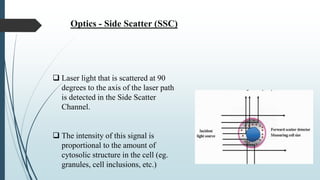
Optics - Side Scatter (SSC)
 Laser light that is scattered at 90
degrees to the axis of the laser path
is detected in the Side Scatter
Channel.
 The intensity of this signal is
proportional to the amount of
cytosolic structure in the cell (eg.
granules, cell inclusions, etc.)
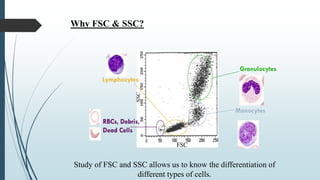
Why FSC & SSC?
Study of FSC and SSC allows us to know the differentiation of
different types of cells.
Optics
B) Emission Of Fluorescent Light (Fluorescence)
 As the fluorescent molecule present in or on the particle is interrogated
by the laser light, it will absorb energy from the laser light and
release the absorbed energy at longer wave length.
 Emitted photons pass through the collection lens and are split and
steered down specific channels with the use of filters.
 Emitted fluorescence intensity is proportional to the amount of
fluorescent compound on the particle.
Optics - Detectors
 The photo detectors convert the photons to electrical impulses.
 Two common types of detectors used in flow cytometry:
 Photodiode
 used for strong signals, when saturation is a potential problem (e.g., forward scatter
detector).
 Photomultiplier tube (PMT)
 more sensitive than photodiode but can be destroyed by exposure to too much
light.
 used for side scatter and fluorescent signals.
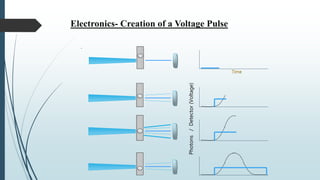
Electronics
 The electronic subsystem converts photons to photoelectrons.
 Measures amplitude, area and width of photoelectron pulse.
 It amplifies pulse either linearly or logarithmically and then
digitalizing the amplified pulse.
Electronics- Creation of a Voltage Pulse
.
Time
Photons/Detector(Voltage)
Data Analysis
 Gating is in essence electronic window that sets upper and lower
limits on the type and amount of material that passes through.
 Selection of only a certain population of cells for analysis on a
plot.
 Allows the ability to look at parameters specific to only that subset.
Interpretation of Graphs
 An important tool for evaluating data is the dot plot.
 The instrument detects each cell as a point on an X-Y graph. This
form of data presentation looks at two parameters of the sample at
the same time.
What Is Unique In Flow cytometry?
 Multi parametric .
 Rapid analysis of large number of cells.
 Information at a single cell level.
 Detection of rare cell populations.
 Allows physical isolation of cells of interest.
Applications
 Analysis
 Immunophenotyping
 Dyes that bind to nucleic acids (DNA, RNA)
 Functional assays
 Cell Counting
 Cell Sorting

Flow cytometry

  • 1.
    FLOW CYTOMETRY; Mechanism& Applications PRESENTED BY; ALTAMAS ALI
  • 2.
    Flow Cytometry Definition: ‘Flow Cytometry’as the name suggests is a technique for cell counting and measurement of different properties of the cell (‘cyto’= cell; ‘metry’=count/measurement). It is a laser based technology that measures and analyses different physical and chemical properties of the cells/particles flowing in a stream of fluid through a beam of light
  • 3.
  • 4.
    Mechanism Biological sample Label itwith a fluorescent marker Cells move in a linear stream through a focused light source (laser beam) Fluorescent molecule gets activated and emits light that is filtered and detected by sensitive light detectors (usually a photomultiplier tube) Conversion of analog fluorescent signals to digital signals
  • 5.
    Flow Cytometry  Thismethod allows the quantitative and qualitative analysis of several properties of cell populations from virtually any type of fresh unfixed tissue or body fluid.  The properties measured include a particle’s related size, relative granularity or internal complexity, and relative fluorescence intensity Most commonly analyzed materials are:  blood,  bone marrow aspirate and  lymph node suspensions.
  • 6.
    Principle of FlowCytometry  Flow cytometer is composed of three main components:  The Flow system (fluidics) Cells in suspension are brought in single file past  The Optical system (light sensing) a focused laser which scatter light and emit fluorescence that is filtered and collected  The Electronic system (signal processing) emitted light is converted to digitized values that are stored in a file for analysis
  • 8.
    The Flow System One of the fundamentals of flow cytometry is the ability to measure the properties of individual particles, which is managed by the fluidics system.  When a sample is injected into a flow cytometer, it is ordered into a stream of single particles.  The fluidic system consists of a FLOW CELL (Quartz Chamber):  Central channel/ core - through which the sample is injected.  Outer sheath - contains faster flowing fluid k/a Sheath fluid (0.9% Saline / PBS) , enclosing the central core.
  • 9.
    Hydrodynamic Focusing Once thesample is injected into a stream of sheath fluid within the flow chamber, they are forced into the center of the stream forming a single file by the PRINCIPLE OF HYDRODYNAMIC FOCUSING.
  • 10.
    Optics  After thecell delivery system, the need is to excite the cells using a light source.  The light source used in a flow cytometer: Laser (more commonly) Arc lamp  Why Lasers are more common?  They are highly coherent and uniform. They can be easily focused on a very small area (like a sample stream).  They are monochromatic, emitting single wavelengths of light.  ARGON Lasers - 488nm wavelength (blue to blue green)
  • 11.
    . When a lightintersects a laser beam at the so called 'interogation point' two events occur: a) light scattering b) emission of light (fluorescence ) Fluorescence is light emitted during decay of excited electron to its basal state.
  • 12.
    Optics A) Light Scatter When light from a laser interrogates a cell, that cell scatters light in all directions.  The scattered light can travel from the interrogation point down a path to a detector.
  • 13.
    Optics - ForwardScatter (FSC)  Light that is scattered in the forward direction (along the same axis the laser is traveling) is detected in the Forward Scatter Channel.  The intensity of this signal has been attributed to cell size, refractive index (membrane permeability).
  • 14.
    Optics - SideScatter (SSC)  Laser light that is scattered at 90 degrees to the axis of the laser path is detected in the Side Scatter Channel.  The intensity of this signal is proportional to the amount of cytosolic structure in the cell (eg. granules, cell inclusions, etc.)
  • 16.
    Why FSC &SSC? Study of FSC and SSC allows us to know the differentiation of different types of cells.
  • 17.
    Optics B) Emission OfFluorescent Light (Fluorescence)  As the fluorescent molecule present in or on the particle is interrogated by the laser light, it will absorb energy from the laser light and release the absorbed energy at longer wave length.  Emitted photons pass through the collection lens and are split and steered down specific channels with the use of filters.  Emitted fluorescence intensity is proportional to the amount of fluorescent compound on the particle.
  • 18.
    Optics - Detectors The photo detectors convert the photons to electrical impulses.  Two common types of detectors used in flow cytometry:  Photodiode  used for strong signals, when saturation is a potential problem (e.g., forward scatter detector).  Photomultiplier tube (PMT)  more sensitive than photodiode but can be destroyed by exposure to too much light.  used for side scatter and fluorescent signals.
  • 19.
    Electronics  The electronicsubsystem converts photons to photoelectrons.  Measures amplitude, area and width of photoelectron pulse.  It amplifies pulse either linearly or logarithmically and then digitalizing the amplified pulse.
  • 20.
    Electronics- Creation ofa Voltage Pulse . Time Photons/Detector(Voltage)
  • 21.
    Data Analysis  Gatingis in essence electronic window that sets upper and lower limits on the type and amount of material that passes through.  Selection of only a certain population of cells for analysis on a plot.  Allows the ability to look at parameters specific to only that subset.
  • 22.
    Interpretation of Graphs An important tool for evaluating data is the dot plot.  The instrument detects each cell as a point on an X-Y graph. This form of data presentation looks at two parameters of the sample at the same time.
  • 23.
    What Is UniqueIn Flow cytometry?  Multi parametric .  Rapid analysis of large number of cells.  Information at a single cell level.  Detection of rare cell populations.  Allows physical isolation of cells of interest.
  • 24.
    Applications  Analysis  Immunophenotyping Dyes that bind to nucleic acids (DNA, RNA)  Functional assays  Cell Counting  Cell Sorting