MLC Flow Cytometry Facility


 Introduction To Flow
 Cytometry


   Rob Salomon
   Garvan Institute of Medical Research
   Darlinghurst NSW


                                          Flow Cytometry
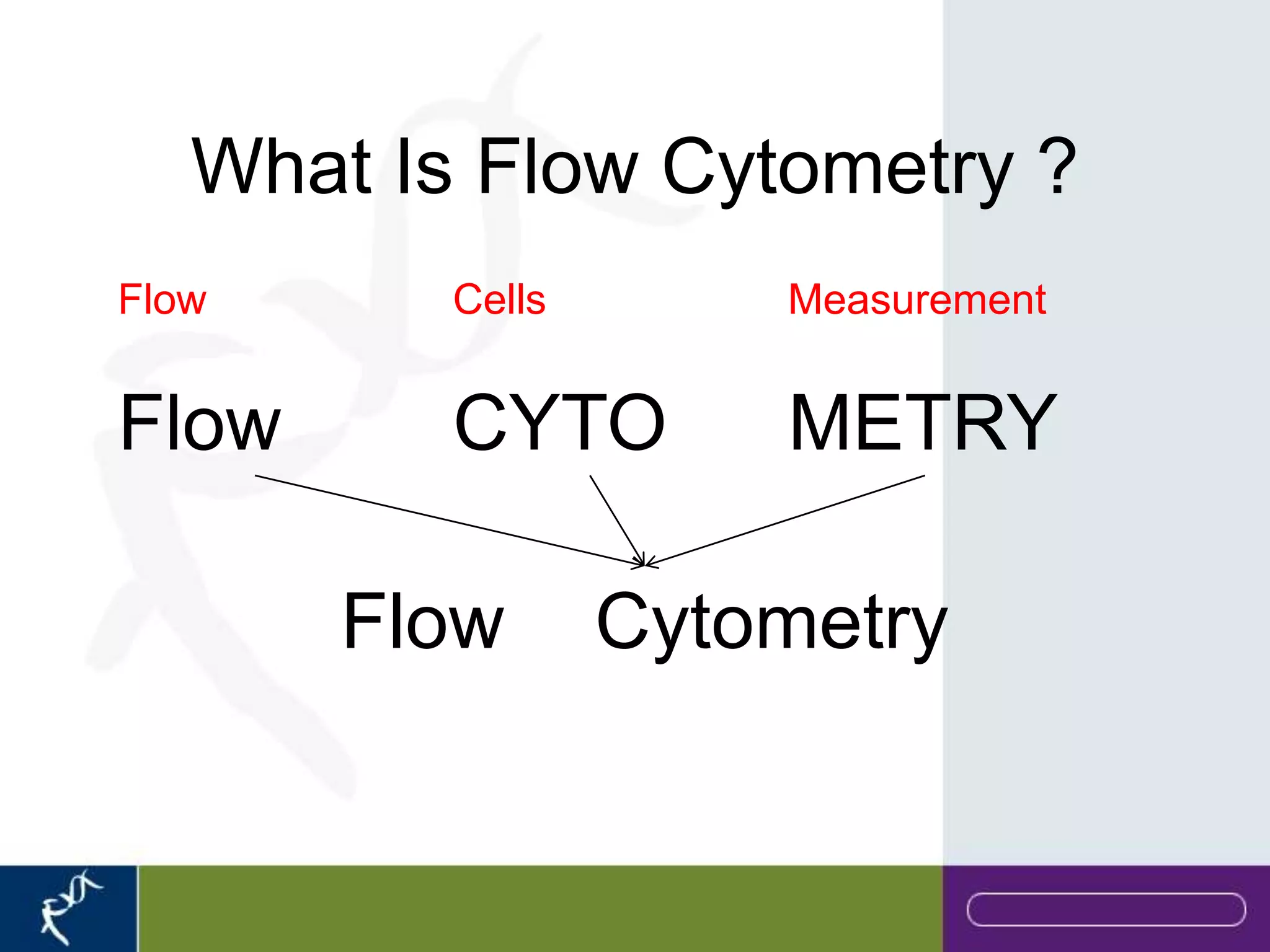
What Is Flow Cytometry ?
                Measurement


                METRY
What Is Flow Cytometry ?
       Cells    Measurement


       CYTO     METRY
What Is Flow Cytometry ?
Flow      Cells    Measurement


Flow      CYTO     METRY
What Is Flow Cytometry ?
Flow      Cells       Measurement


Flow      CYTO        METRY

       Flow       Cytometry
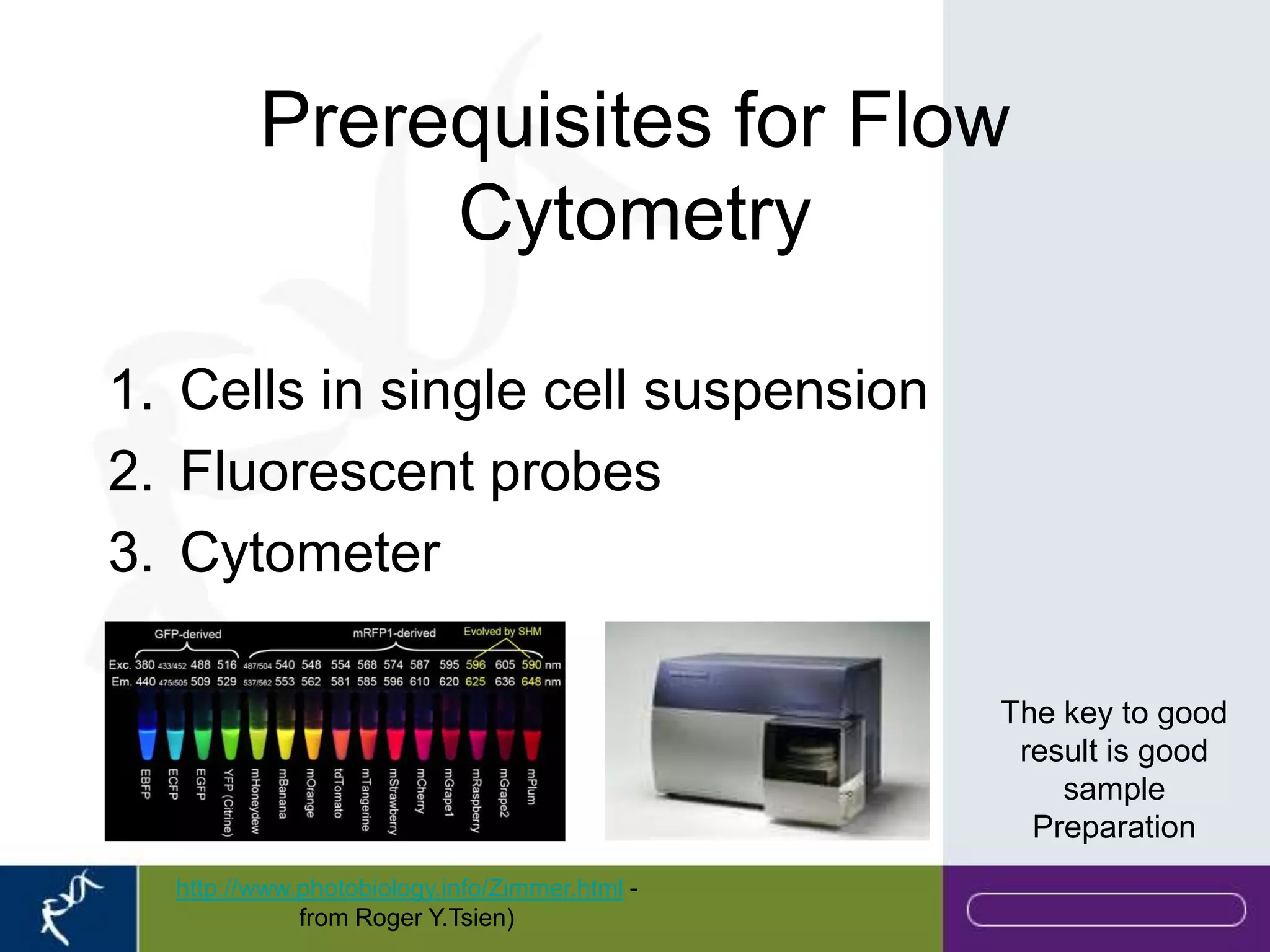
Prerequisites for Flow
              Cytometry

1. Cells in single cell suspension
2. Fluorescent probes
3. Cytometer

                                               The key to good
                                                result is good
                                                   sample
                                                 Preparation
  http://www.photobiology.info/Zimmer.html -
             from Roger Y.Tsien)
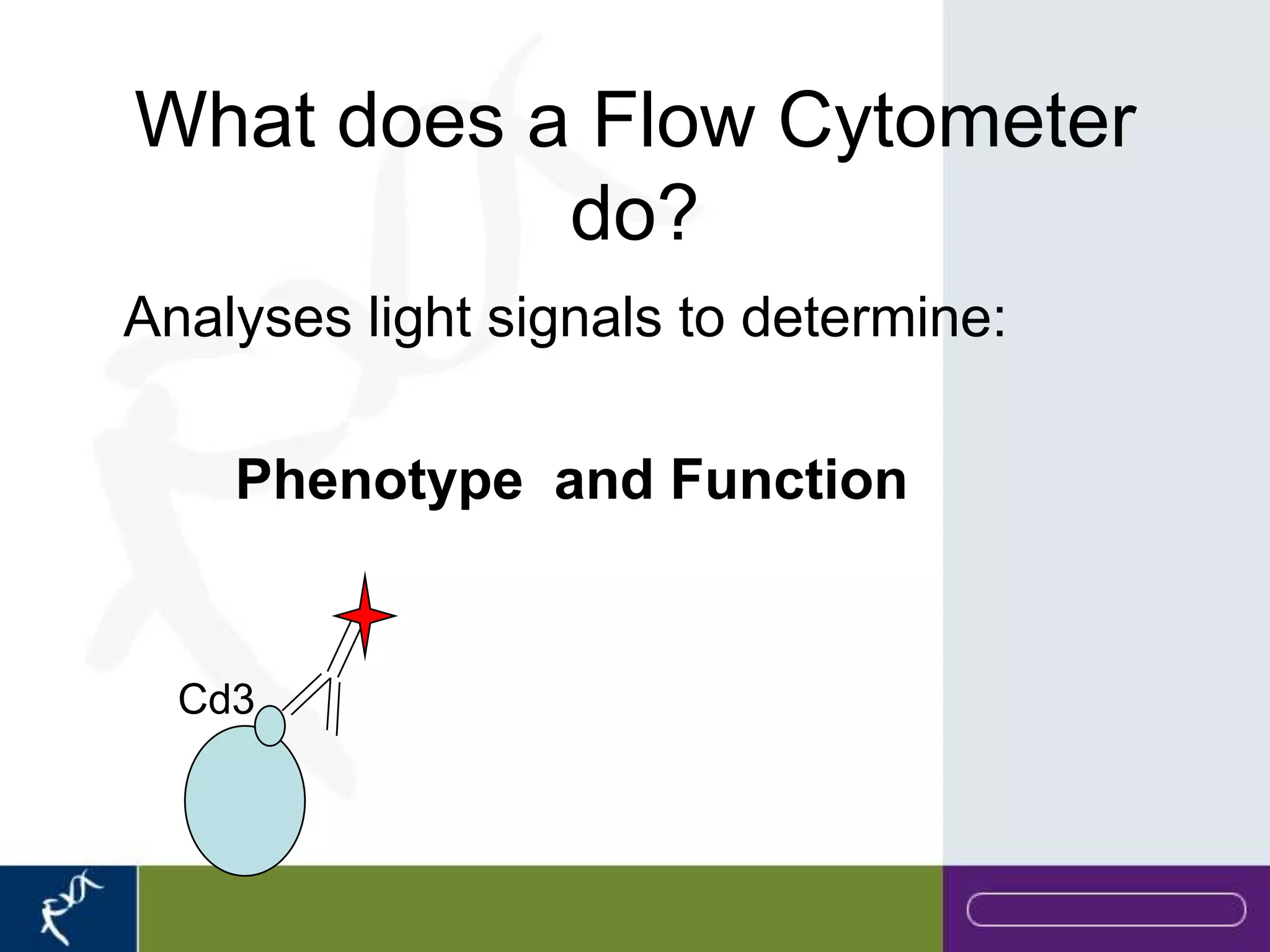
What does a Flow Cytometer
           do?
Analyses light signals to determine:

    Phenotype and Function


  Cd3
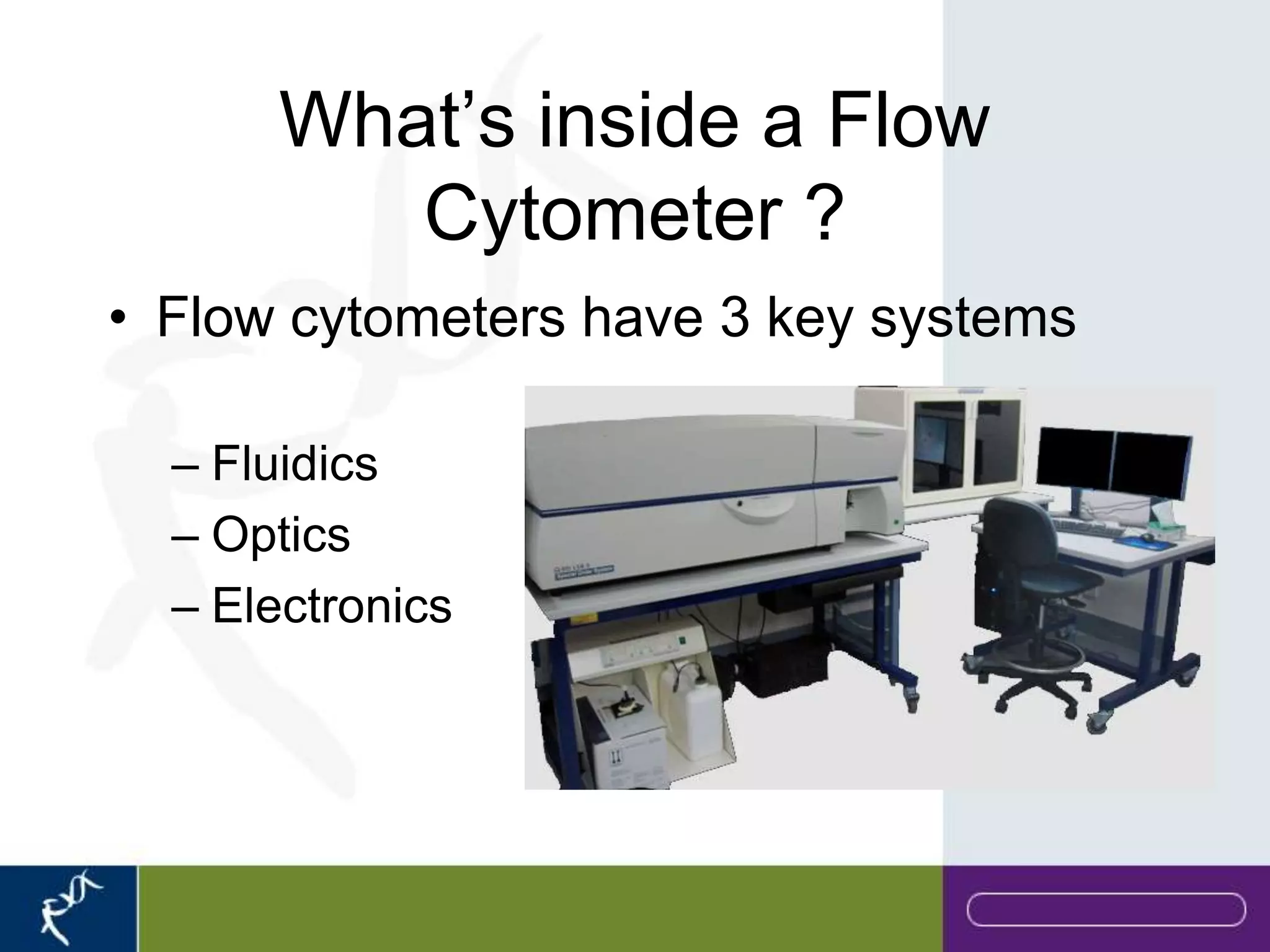
What’s inside a Flow
         Cytometer ?
• Flow cytometers have 3 key systems

  – Fluidics
  – Optics
  – Electronics
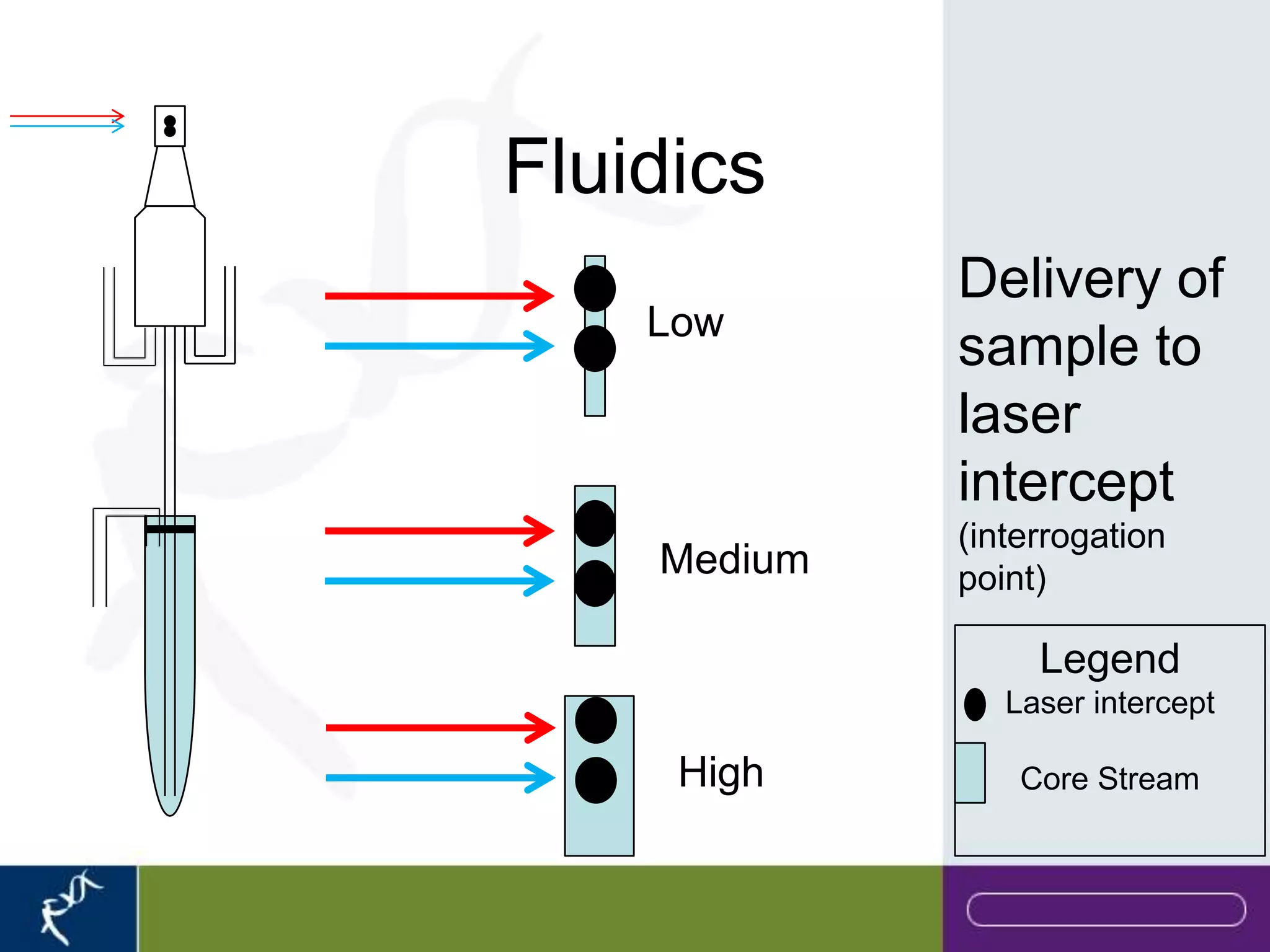
Fluidics
             Delivery of
    Low
             sample to
             laser
             intercept
             (interrogation
    Medium   point)

                  Legend
                Laser intercept

     High        Core Stream
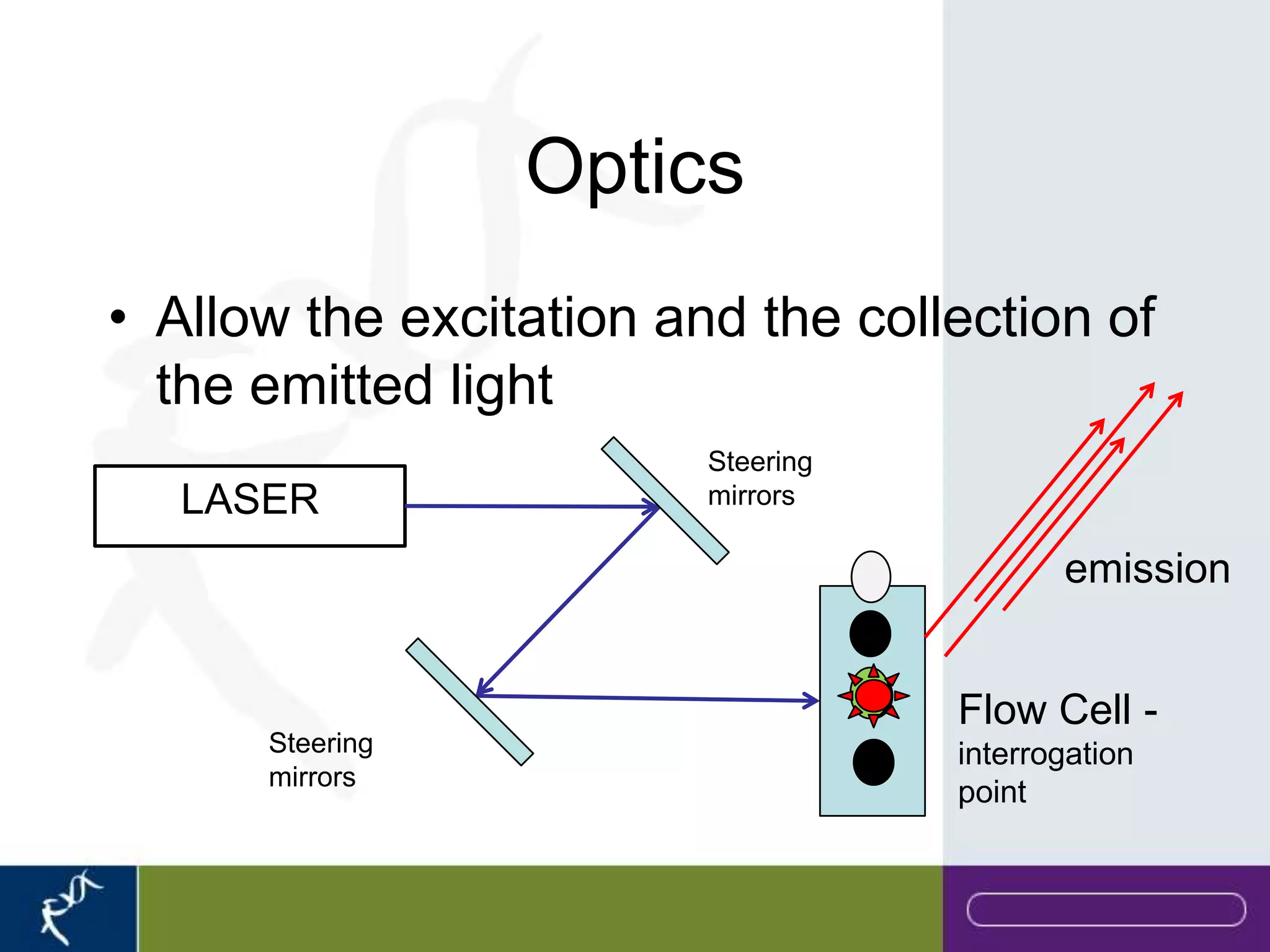
Optics
• Allow the excitation and the collection of
  the emitted light
                         Steering
   LASER                 mirrors

                                           emission


                                    Flow Cell -
      Steering                      interrogation
      mirrors
                                    point
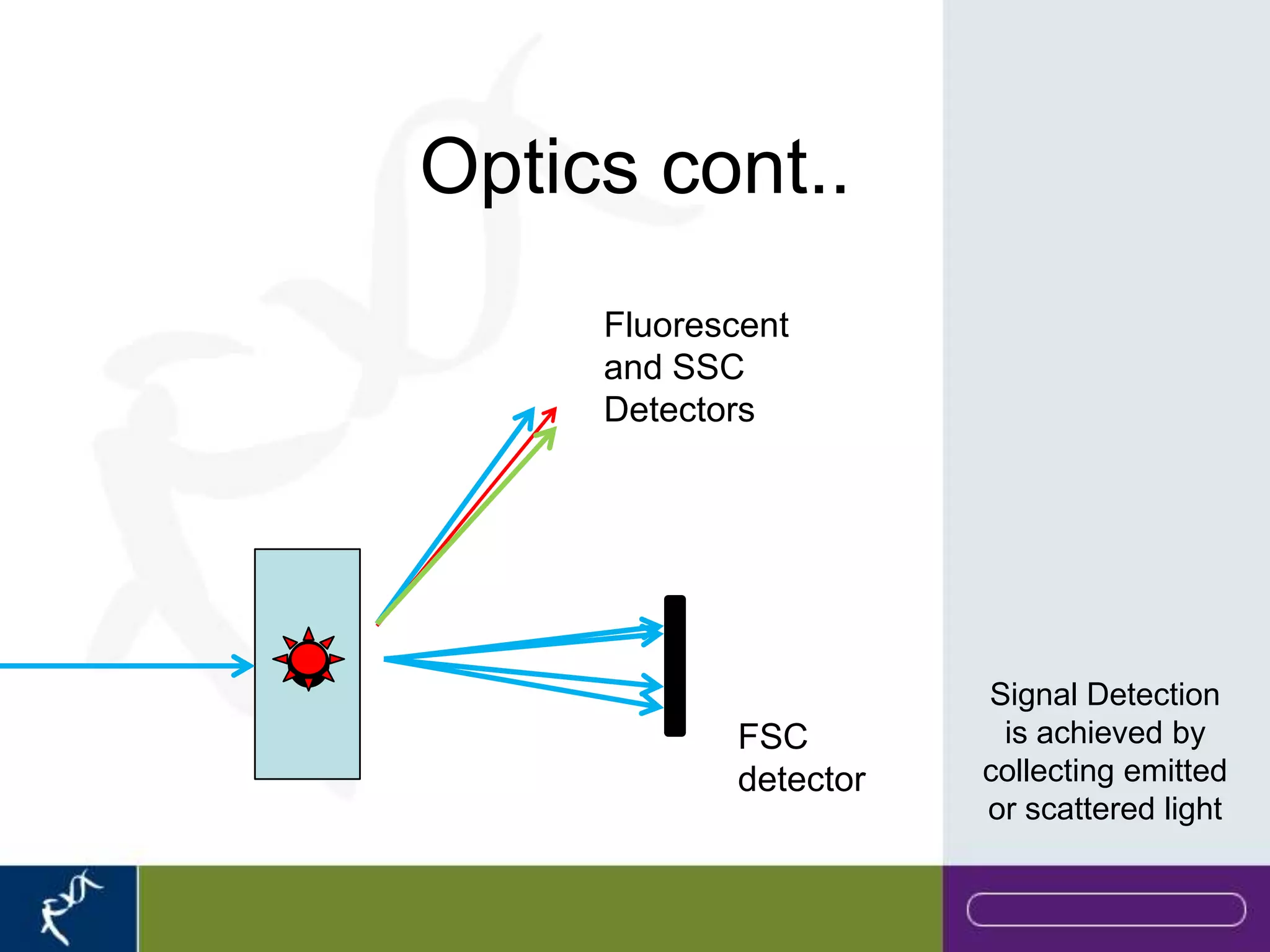
Optics cont..
     Fluorescent
     and SSC
     Detectors


                       Signal Detection
            FSC         is achieved by
            detector   collecting emitted
                       or scattered light
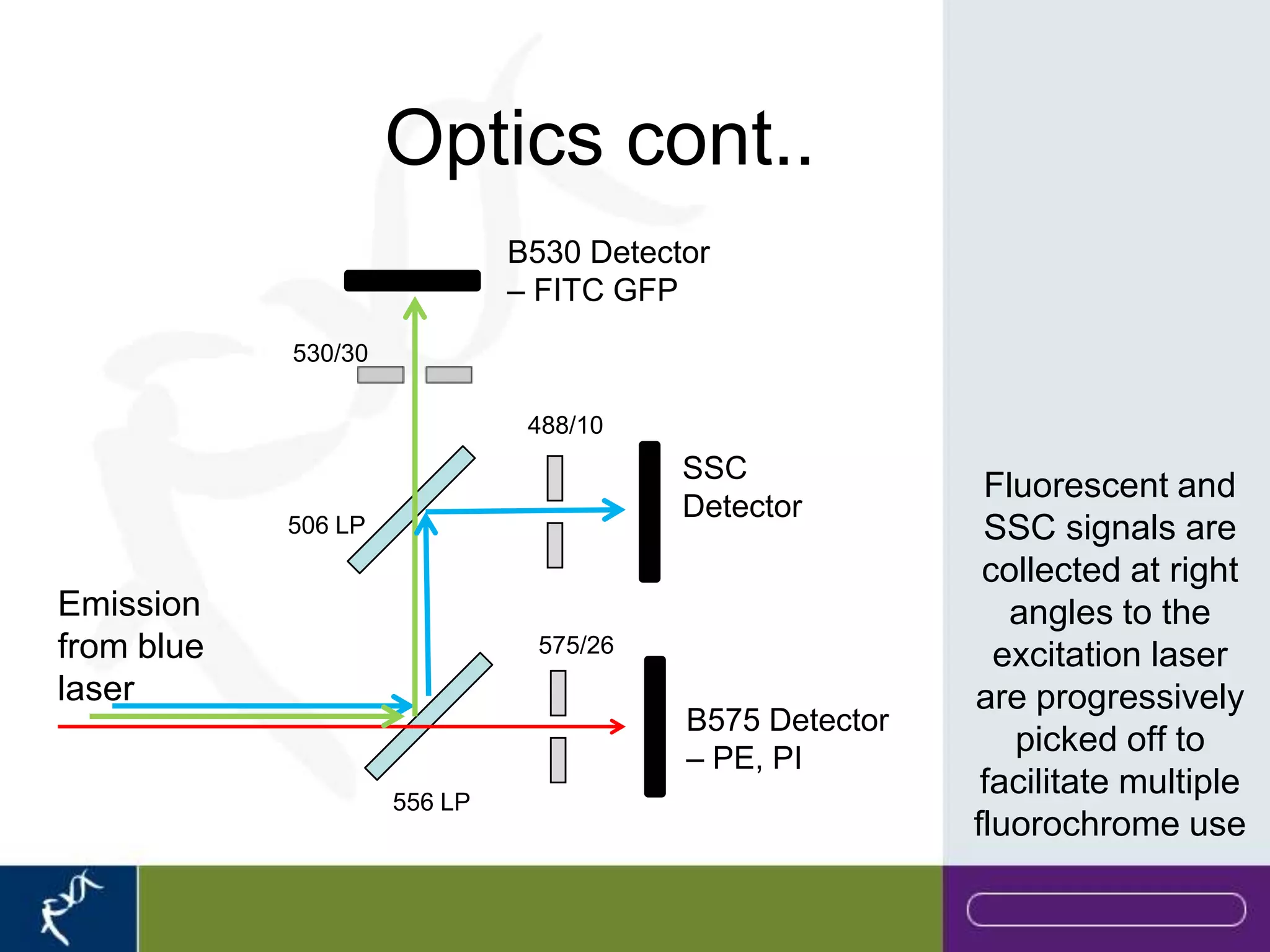
Optics cont..
                              B530 Detector
                              – FITC GFP
            530/30

                               488/10
                                         SSC
                                                          Fluorescent and
                                         Detector
            506 LP                                        SSC signals are
                                                          collected at right
Emission                                                    angles to the
from blue                      575/26
                                                           excitation laser
laser                                                    are progressively
                                         B575 Detector
                                                            picked off to
                                         – PE, PI
                     556 LP
                                                          facilitate multiple
                                                         fluorochrome use
Electronics

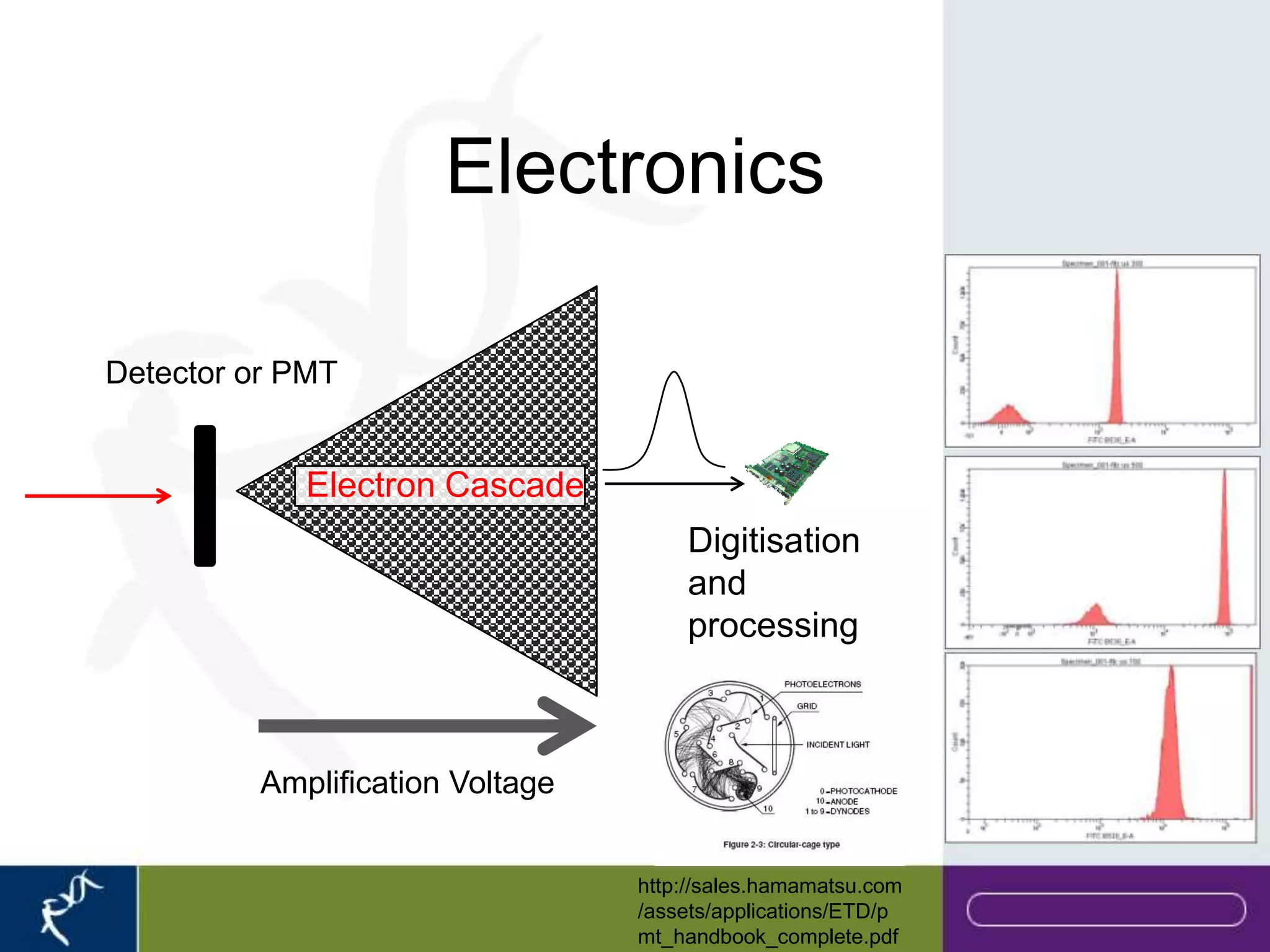
Detector or PMT


            Electron Cascade
                                     Digitisation
                                     and
                                     processing


         Amplification Voltage


                                 http://sales.hamamatsu.com
                                 /assets/applications/ETD/p
                                 mt_handbook_complete.pdf
What type of signals do we
       see with Flow ?
• Scatter
  – Forward Scatter (FSC)
     • parallel or Perpendicular FSC
  – Side scatter (SSC)
• Fluorescence
  – FITC , PE, APC, GFP, DAPI (plus lots lots more)
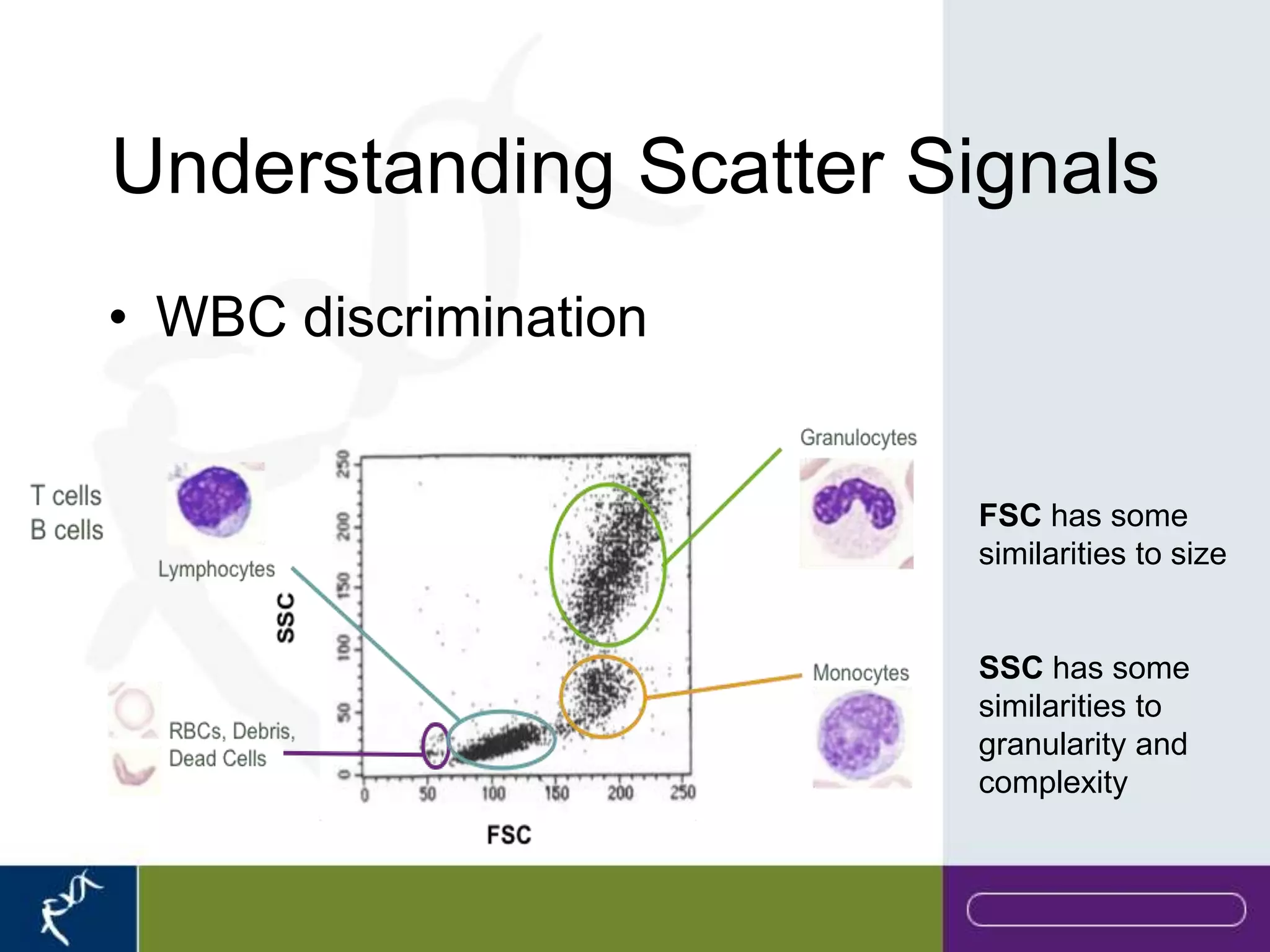
Understanding Scatter Signals
• WBC discrimination


                       FSC has some
                       similarities to size


                       SSC has some
                       similarities to
                       granularity and
                       complexity
Fluorescent Signals
• Fluorescence may be used in the
  detection of :
  –   Protein, RNA and DNA
  –   DNA synthesis
  –   Dye efflux
  –   Organelle Activity
                                    A cytometer can
  –   Change in pH                 detected light from
  –   Protein interactions          any system you
                                    can design that
  –   Cell movement and division
                                         utilises
  –   etc                             fluorescence
Examples of fluorescent probe
                                    use           10
                                                       5
Fluorescence 2 (CD4)
                       <B670L_B-A>: CD8-PerCP55


                                                  104


                                                       3
                                                  10


                                                   0


                                                           0            103      104     105
                                                               <R780_A-A>: bTCR-APCAF750
                                                           Fluorescence 1 (βTCR)
Understanding Fluoroscence

                                              The fluorescent
Excited
                                           molecule is excited
                     e-
                                             by the excitation
  state


                          e-               source (laser). This
                                            imparts energy to
                                 e-
                                              electrons in the
                                      e-
                                            molecule which in
Resting      e-
                                             then released as
                  Mechanism of                 the molecule
                                               relaxes. The
                  Fluorscence              energy is released
                                                  as light.
How do I choose my
          Fluorochromes ?
•   Antibody availability
•   Function – i.e. Mcherry Vs GFP
•   Fluorochrome brightness
•   Excitation source
•   Emission filters
•   Other fluorochromes/ Signals present in my
    sample (spectral overlap)
Fluorochrome Brightness
Probe                            QY
AF488                           0.92
R-Pe                            0.82
AF546                           0.79
AF594                           0.66
                                             Quantum yield :
APC                             0.68
                                            Is a measure of the
A647                            0.33       relative brightness of
eGFP                             0.6       the fluorochrome. IT
                                              is measured as:
Azumi Green                     0.74
ZS Green 1                      0.91

http://en.wikipedia.org/wiki/Fluorophore
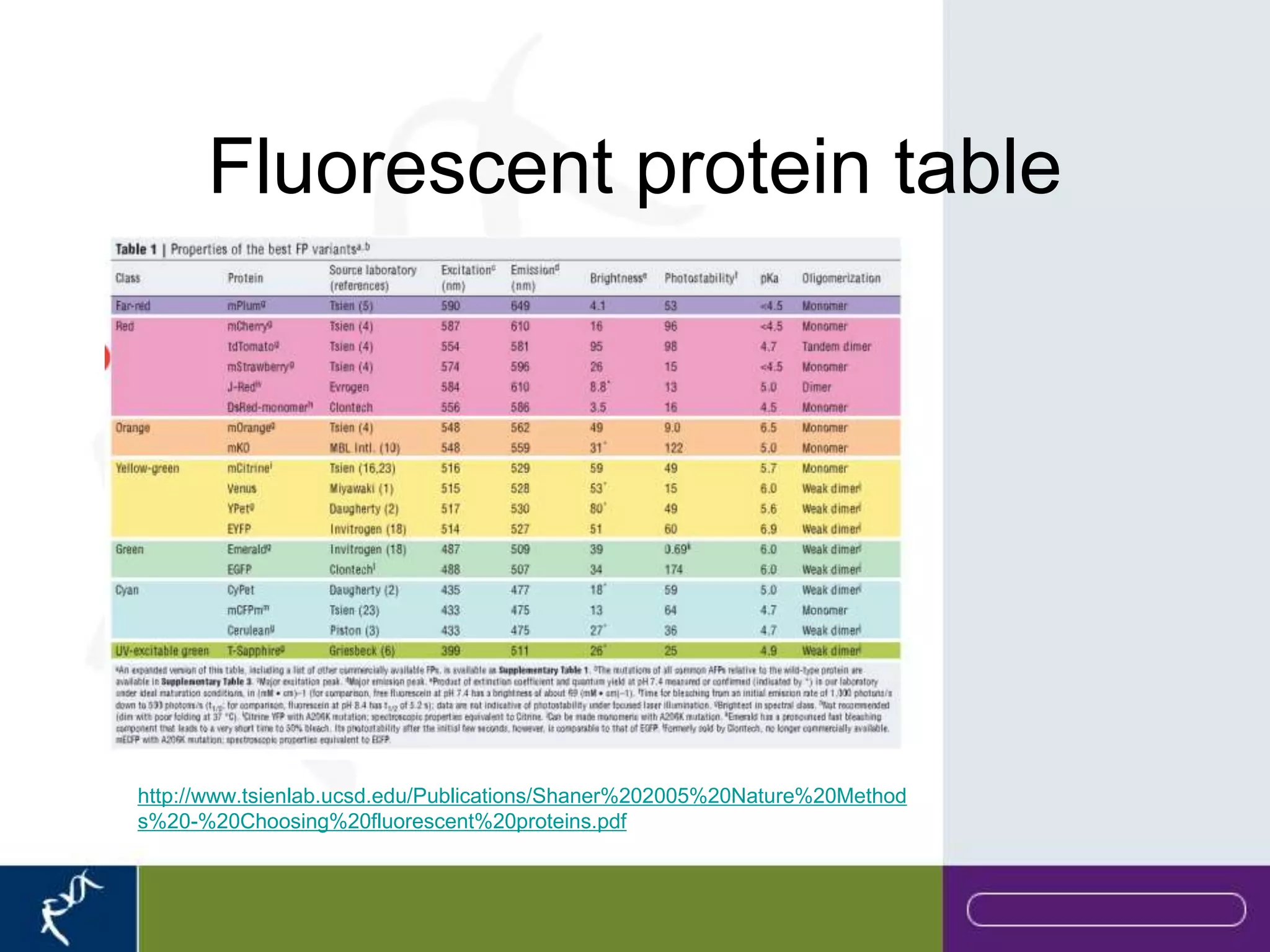
Fluorescent protein table


http://www.tsienlab.ucsd.edu/Publications/Shaner%202005%20Nature%20Method
s%20-%20Choosing%20fluorescent%20proteins.pdf
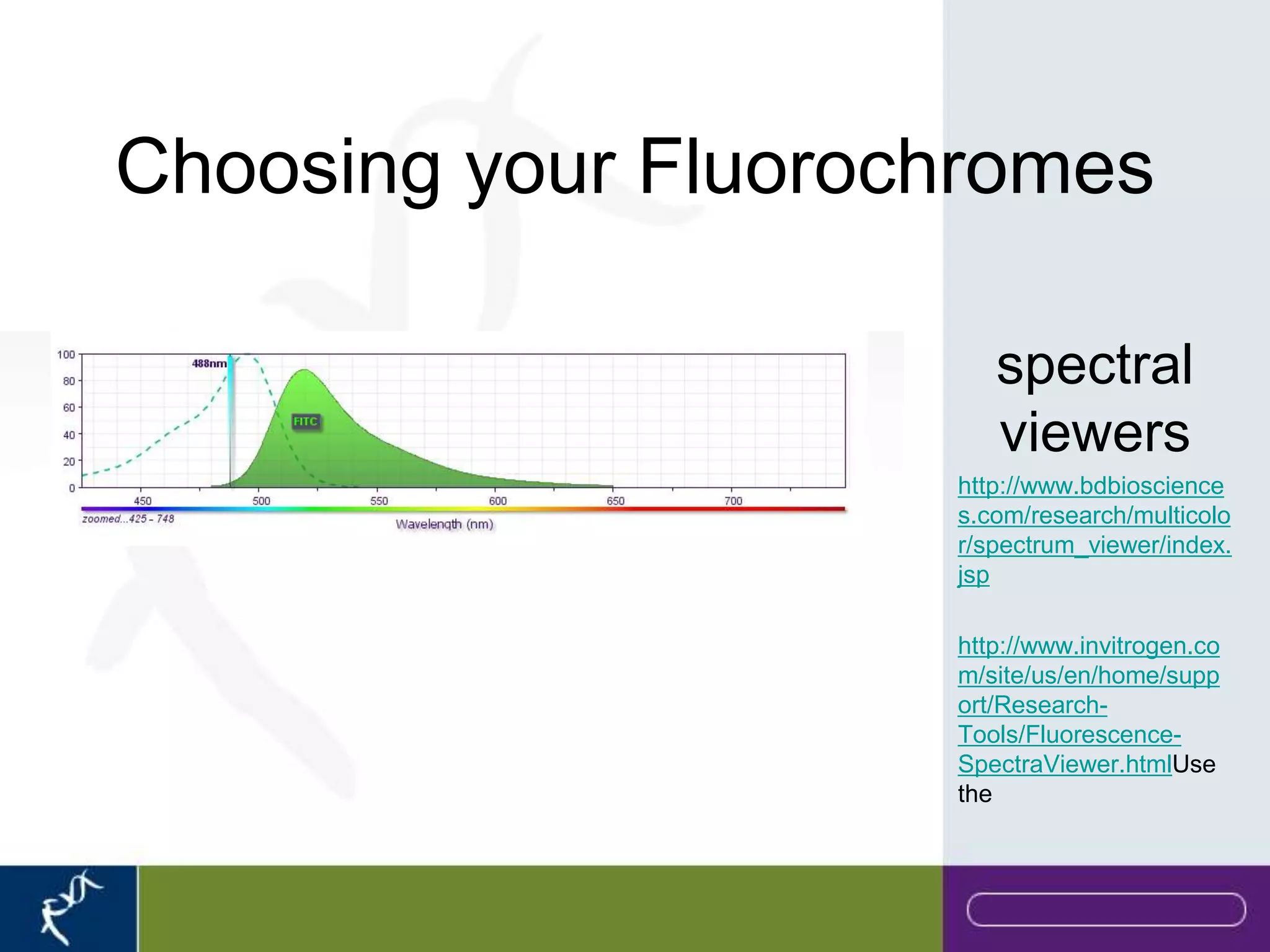
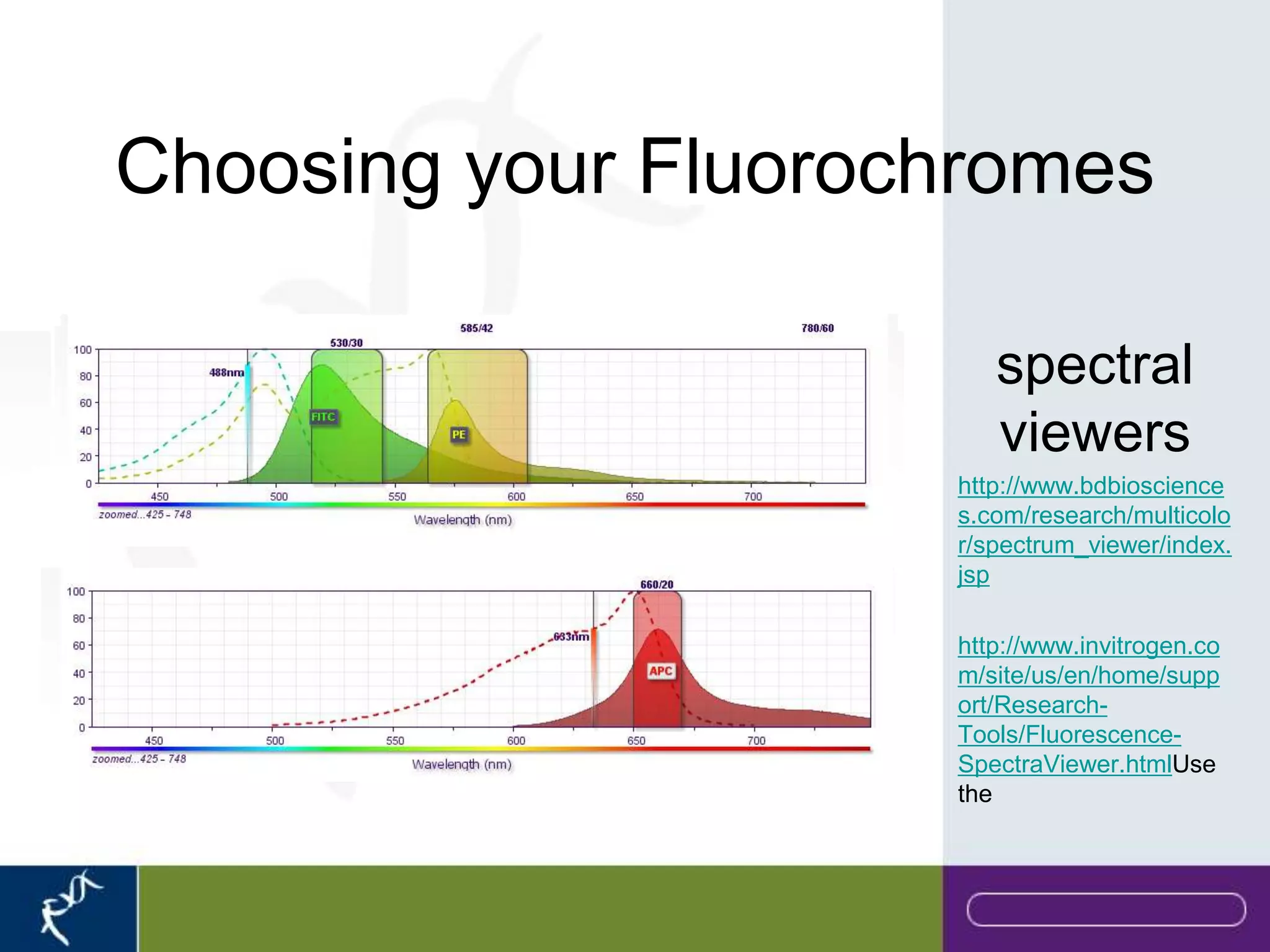
Choosing your Fluorochromes

                        spectral
                        viewers
                     http://www.bdbioscience
                     s.com/research/multicolo
                     r/spectrum_viewer/index.
                     jsp

                     http://www.invitrogen.co
                     m/site/us/en/home/supp
                     ort/Research-
                     Tools/Fluorescence-
                     SpectraViewer.htmlUse
                     the
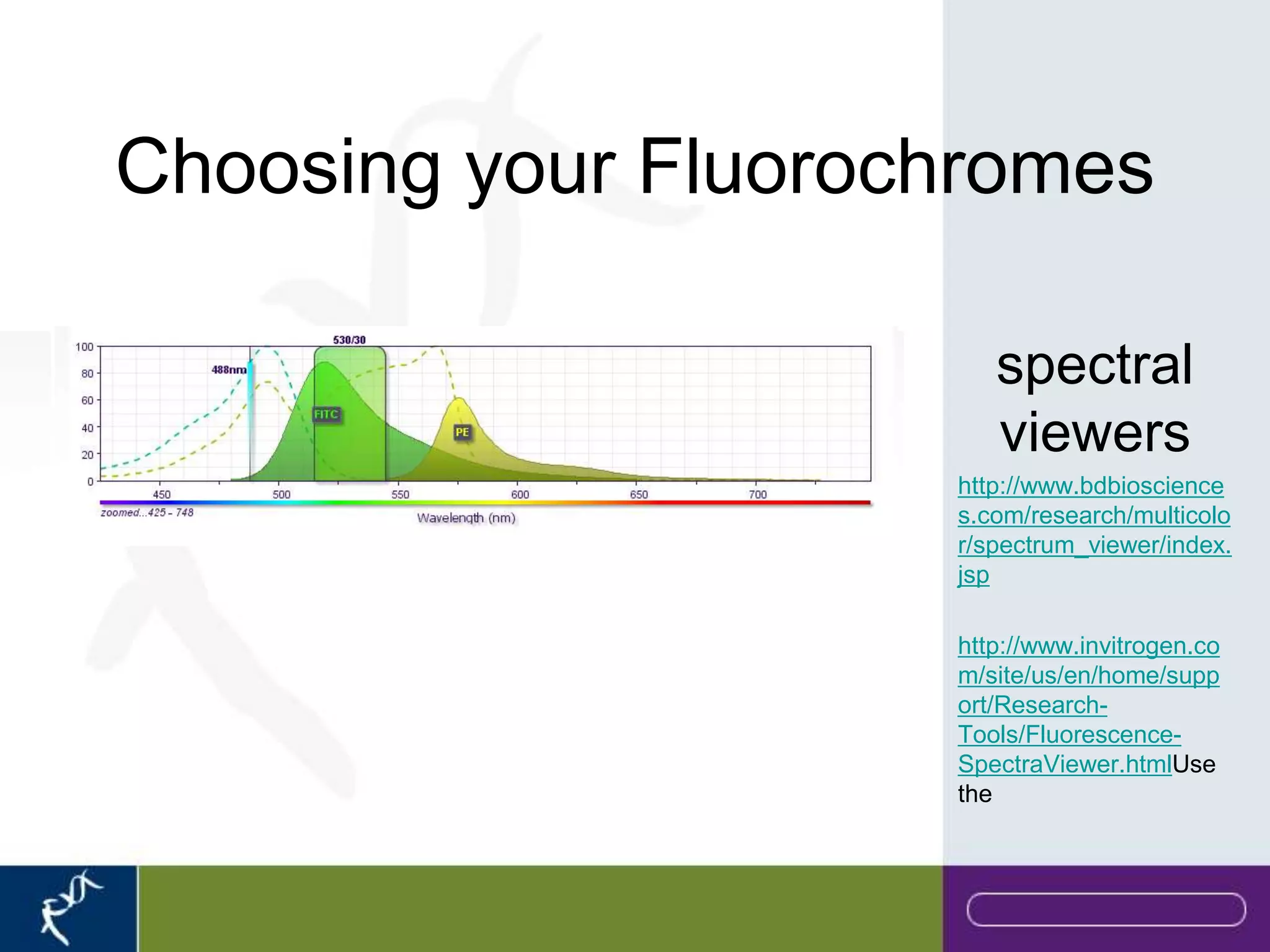
Choosing your Fluorochromes

                        spectral
                        viewers
                     http://www.bdbioscience
                     s.com/research/multicolo
                     r/spectrum_viewer/index.
                     jsp

                     http://www.invitrogen.co
                     m/site/us/en/home/supp
                     ort/Research-
                     Tools/Fluorescence-
                     SpectraViewer.htmlUse
                     the
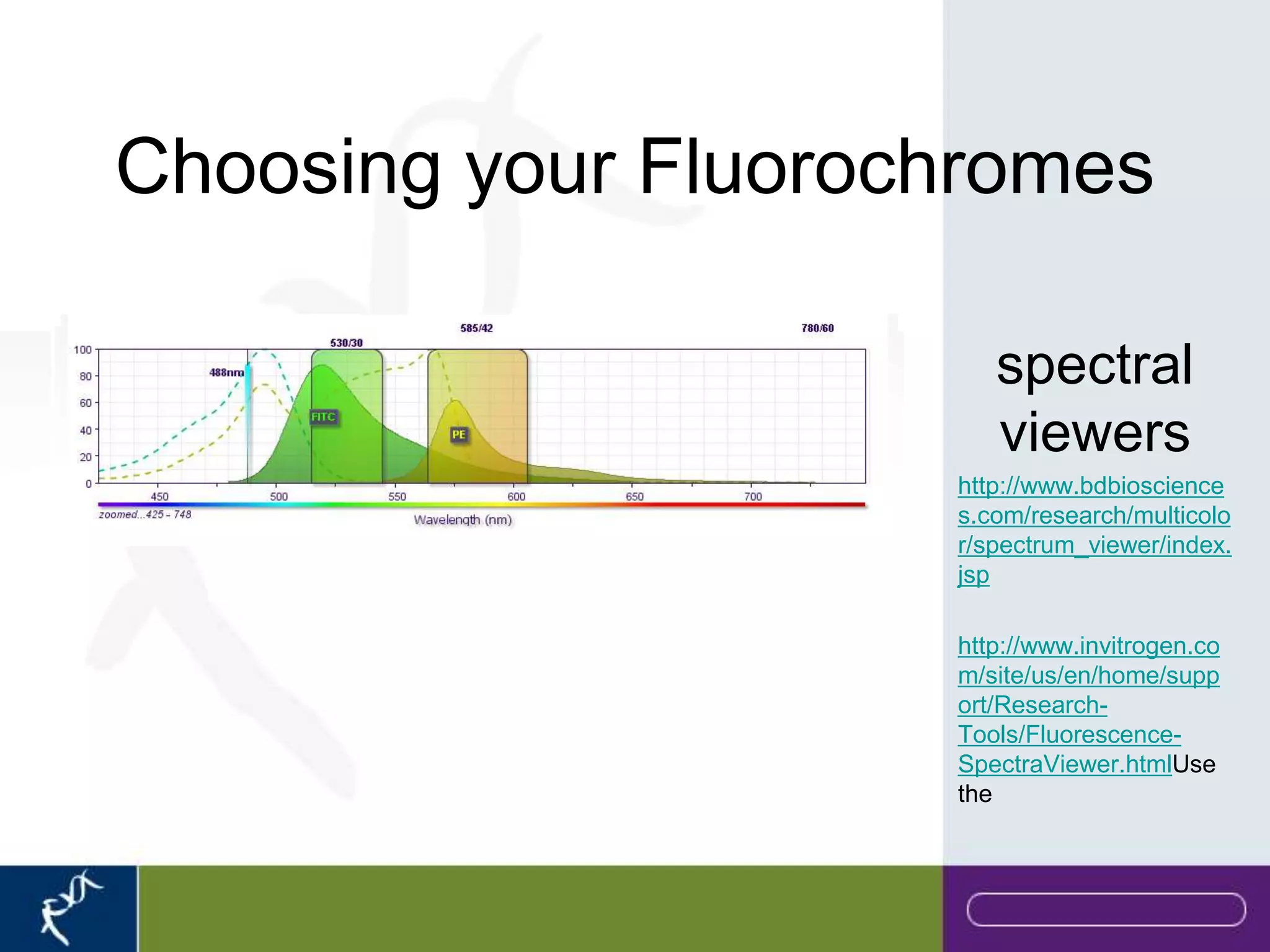
Choosing your Fluorochromes

                        spectral
                        viewers
                     http://www.bdbioscience
                     s.com/research/multicolo
                     r/spectrum_viewer/index.
                     jsp

                     http://www.invitrogen.co
                     m/site/us/en/home/supp
                     ort/Research-
                     Tools/Fluorescence-
                     SpectraViewer.htmlUse
                     the
Choosing your Fluorochromes

                        spectral
                        viewers
                     http://www.bdbioscience
                     s.com/research/multicolo
                     r/spectrum_viewer/index.
                     jsp

                     http://www.invitrogen.co
                     m/site/us/en/home/supp
                     ort/Research-
                     Tools/Fluorescence-
                     SpectraViewer.htmlUse
                     the
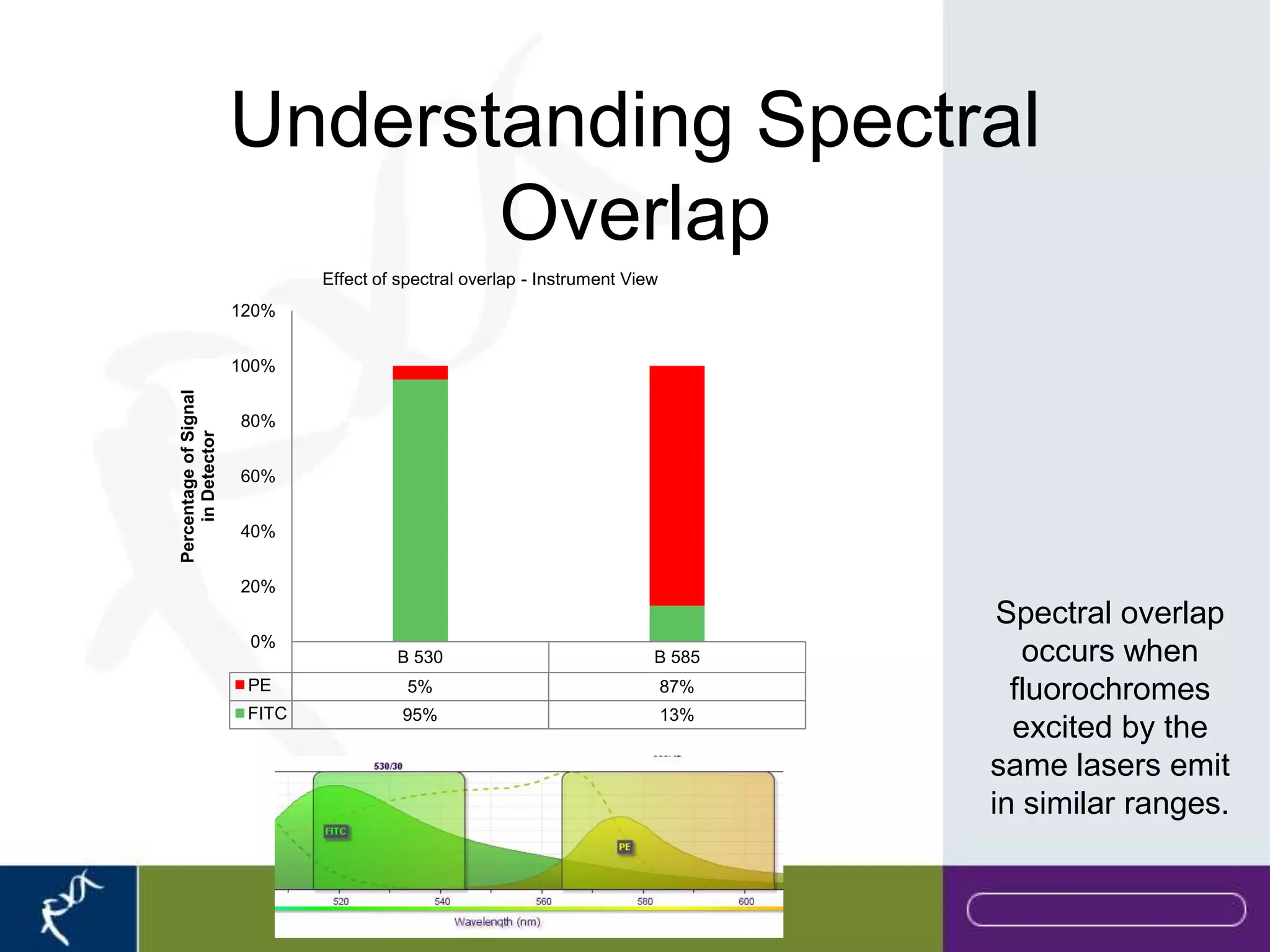
Understanding Spectral
                              Overlap
                               Effect of spectral overlap - Instrument View
                       120%


                       100%
Percentage of Signal


                       80%
    in Detector


                       60%


                       40%


                       20%
                                                                                     Spectral overlap
                        0%
                                        B 530                             B 585        occurs when
                        PE                5%                                  87%     fluorochromes
                        FITC             95%                                  13%
                                                                                      excited by the
                                                                                    same lasers emit
                                                                                    in similar ranges.
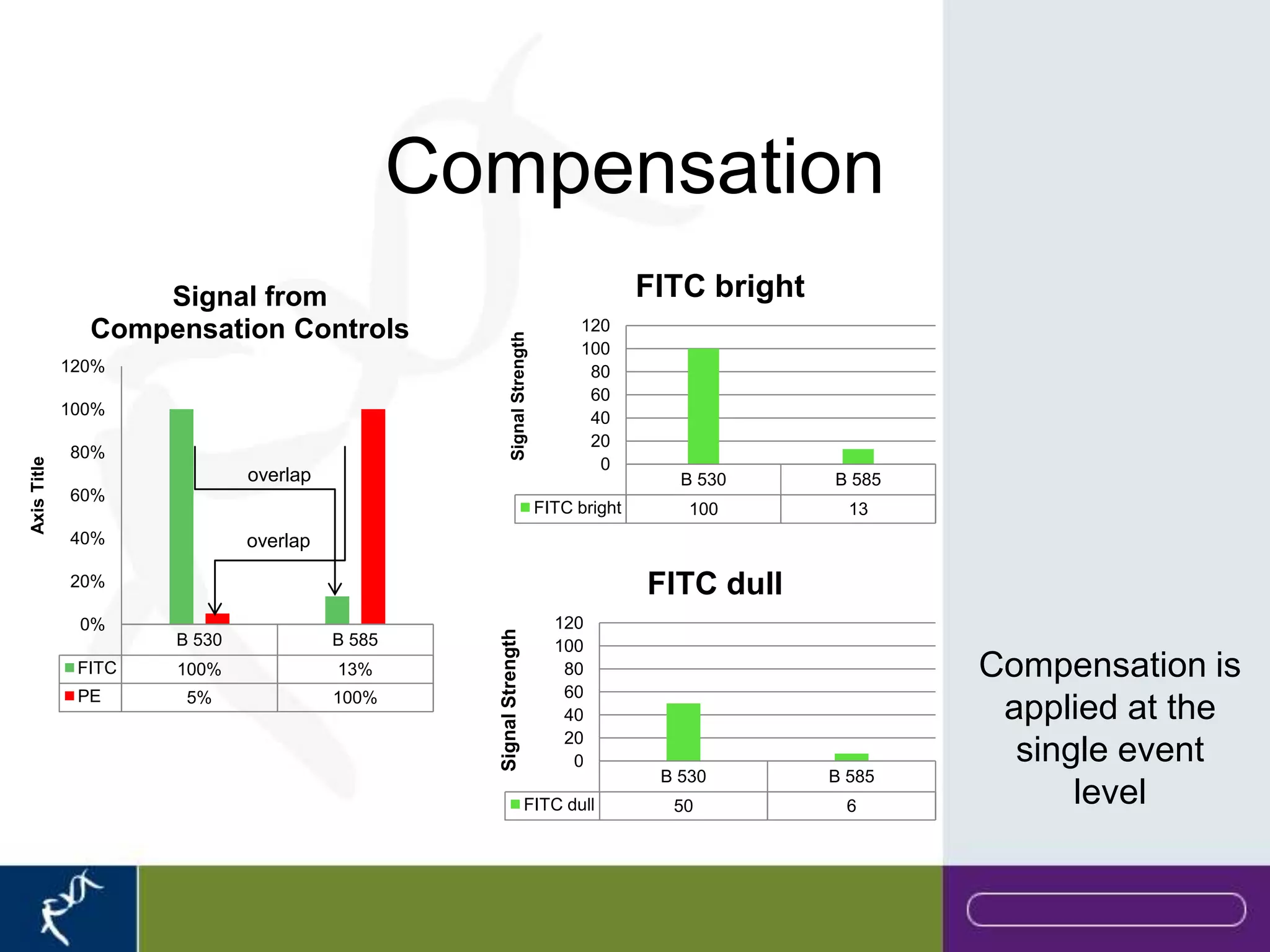
Compensation
                   Signal from                                                           FITC bright
               Compensation Controls                                            120


                                                         Signal Strength
                                                                                100
             120%                                                                80
                                                                                 60
             100%                                                                40
                                                                                 20
             80%
Axis Title


                                                                                  0
                             overlap                                                        B 530      B 585
             60%
                                                                           FITC bright       100         13
             40%             overlap

             20%                                                                         FITC dull
              0%                                                             120
                                                 Signal Strength


                     B 530             B 585                                 100
              FITC   100%              13%                                    80                               Compensation is
              PE      5%               100%                                   60
                                                                              40                                applied at the
                                                                              20
                                                                               0                                 single event
                                                                                          B 530        B 585
                                                                    FITC dull              50           6            level
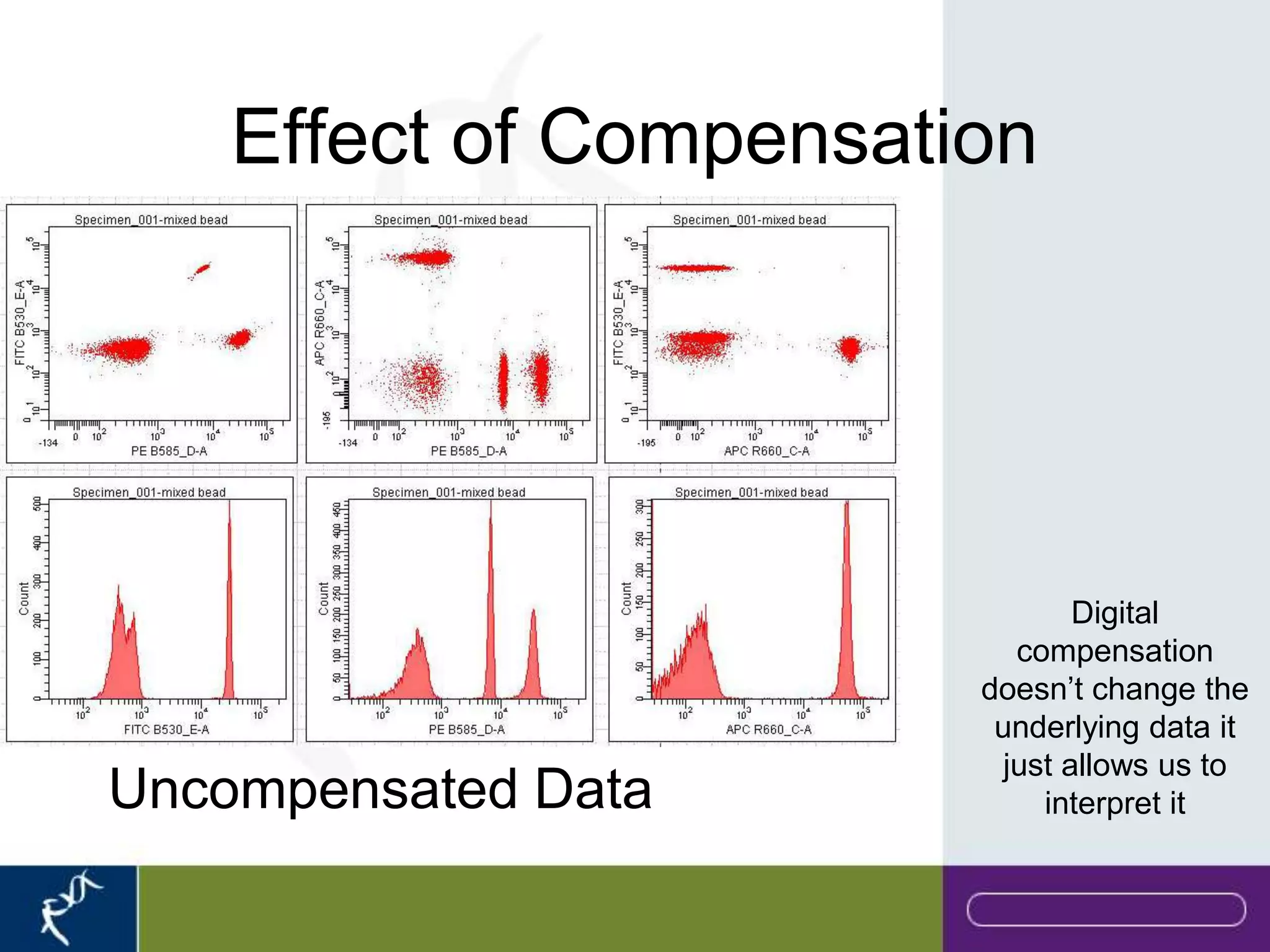
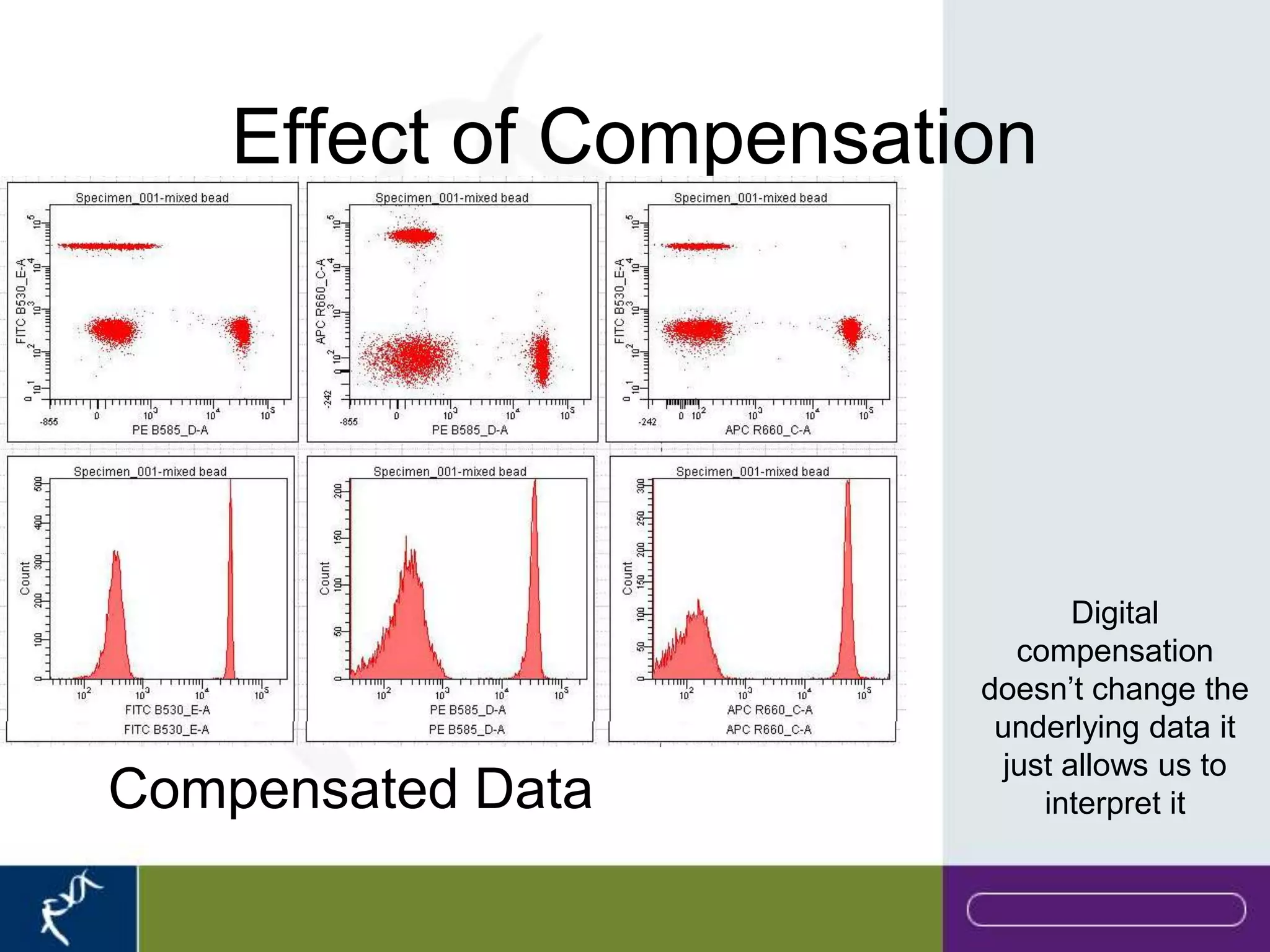
Effect of Compensation


                                Digital
                           compensation
                        doesn’t change the
                         underlying data it
                          just allows us to
Uncompensated Data           interpret it
Effect of Compensation


                                Digital
                           compensation
                        doesn’t change the
                         underlying data it
                          just allows us to
Compensated Data             interpret it
How many Fluorochromes can
         I use ?
• Most flow = 1- 3 fluorochromes
• Basic phenotyping panel = 6-8
  fluorochromes
• Complicated panels = 11-12
  flourochromes
• High end = 17 fluorochromes
Seventeen-colour flow cytometry: unravelling the immune system
Stephen P. Perfetto, Pratip K. Chattopadhyay & Mario Roederer
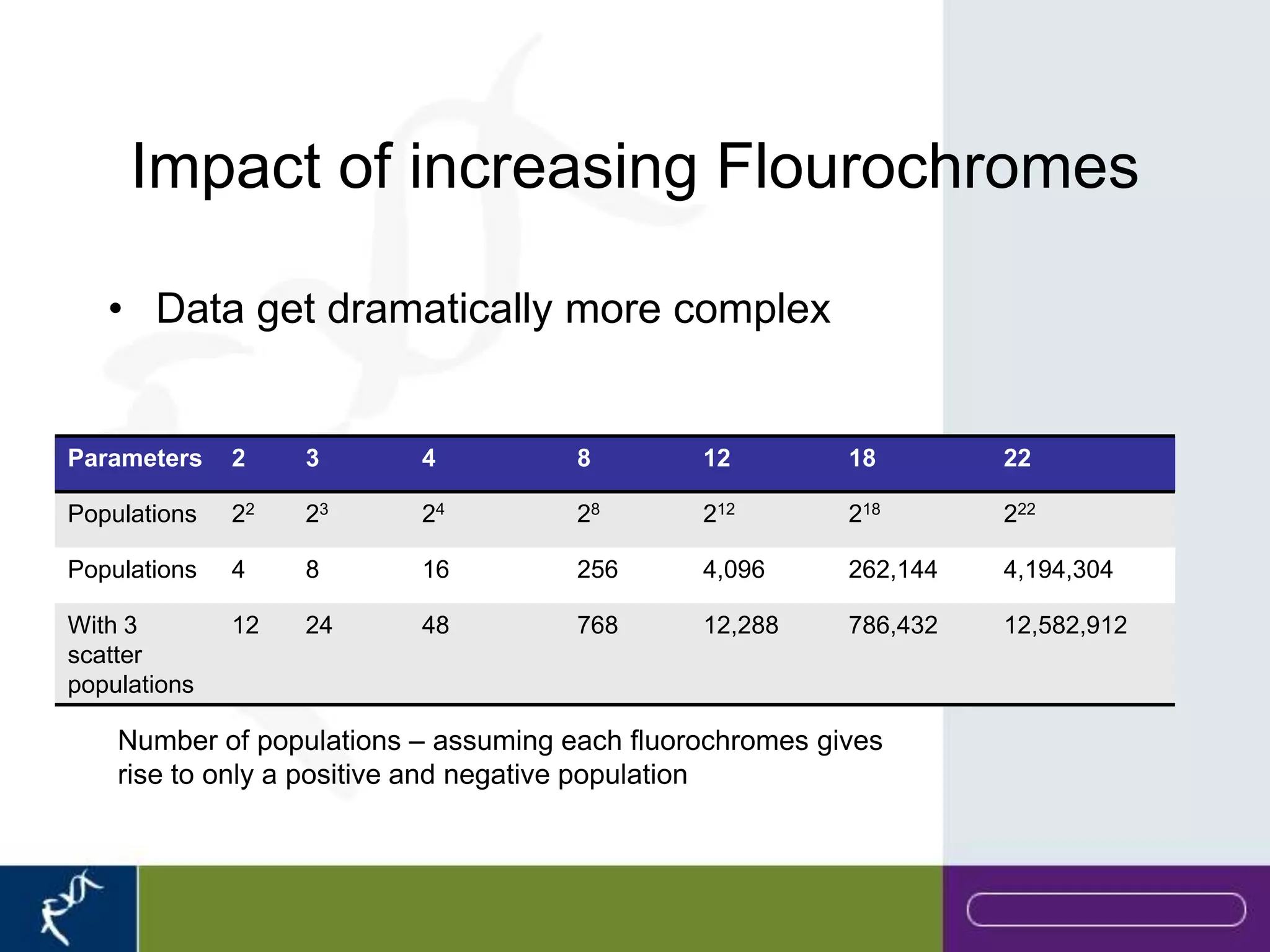
Impact of increasing Flourochromes

   • Data get dramatically more complex


Parameters    2    3      4           8        12         18        22

Populations   22   23     24          28       212        218       222

Populations   4    8      16          256      4,096      262,144   4,194,304

With 3        12   24     48          768      12,288     786,432   12,582,912
scatter
populations

    Number of populations – assuming each fluorochromes gives
    rise to only a positive and negative population
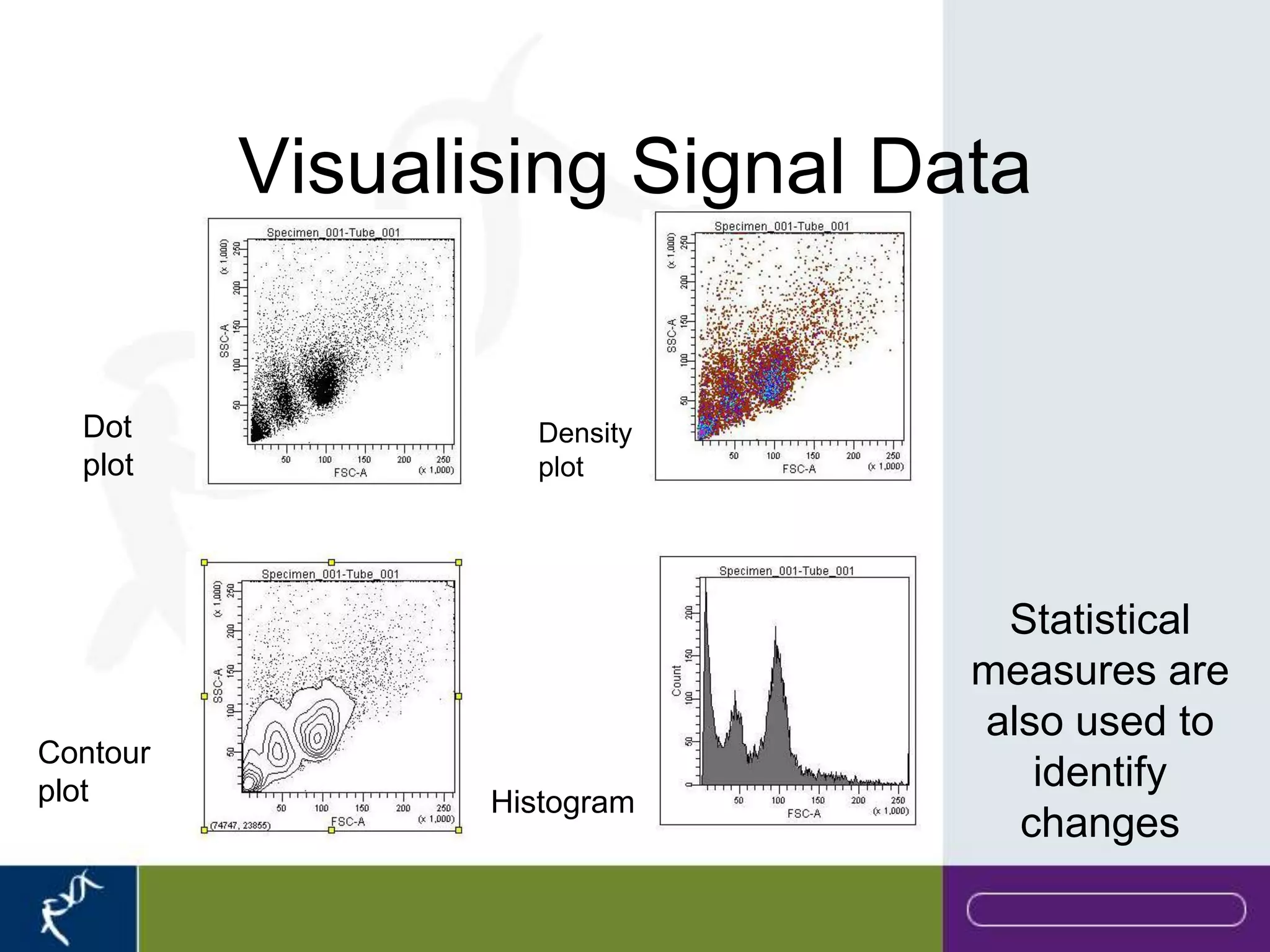
Visualising Signal Data


  Dot              Density
  plot             plot


                                Statistical
                               measures are
                               also used to
Contour
plot                              identify
                 Histogram
                                 changes
Basics uses of Flow
                  Cytometry ?
•   Phenotyping
•   Apoptosis and cell death
•   Cell cycle, cell divising and DNA synthesis
•   Transduction/transfection confirmation
•   Cell tracking
•   Small particle analysis
•   Functional analysis – calcium flux, gene expression, dye
    efflux, mitochondrial activity

• Marine and microorganism identification
Why use Flow Cytometry ?
• Rapid analysis ( 3k- 200k events/second)

• Individual event analysis

• Quantifiable results

• Multiple parameter analysis

• Statistical relevance
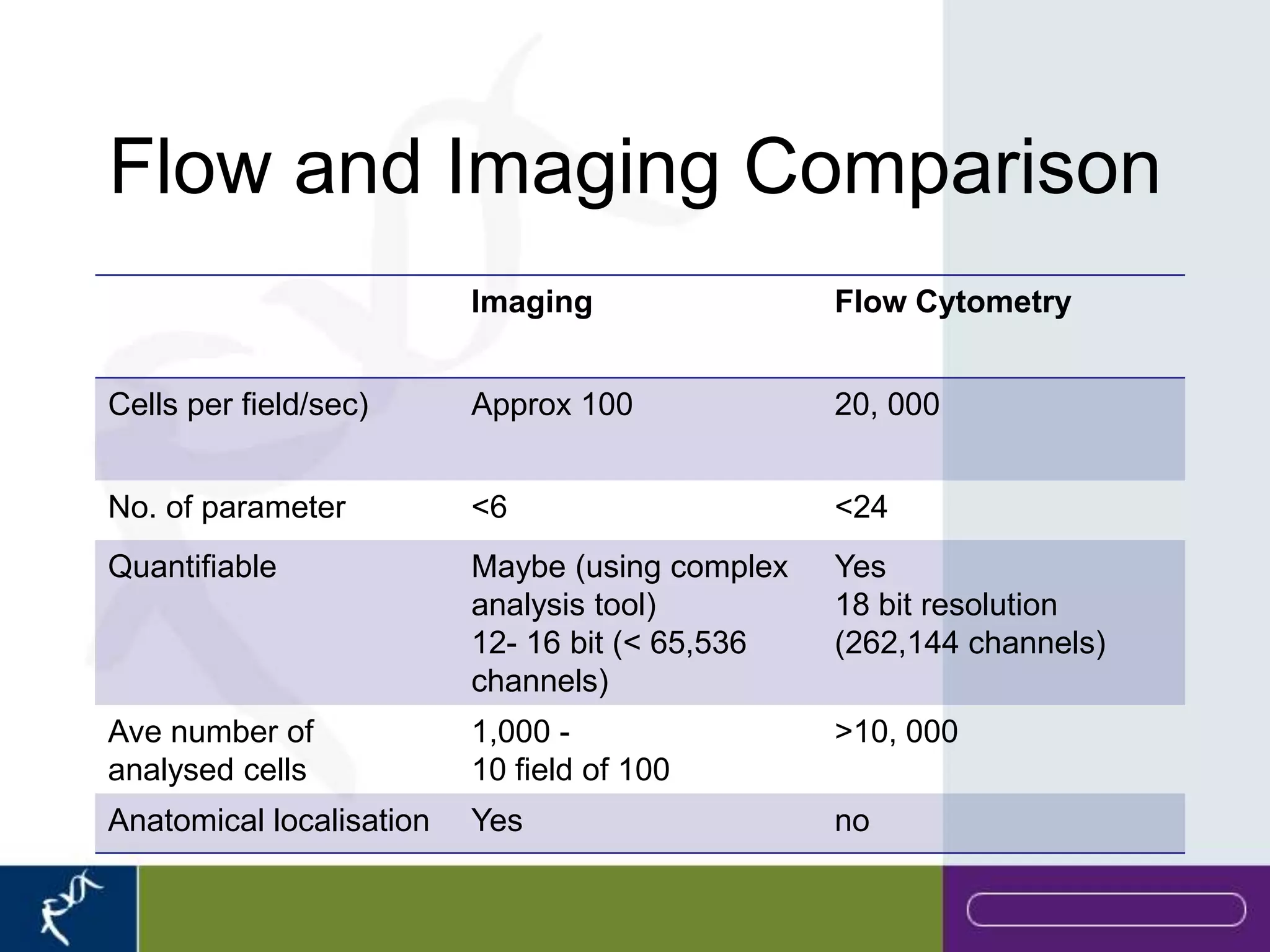
Flow and Imaging Comparison
                          Imaging                Flow Cytometry


Cells per field/sec)      Approx 100             20, 000


No. of parameter          <6                     <24
Quantifiable              Maybe (using complex   Yes
                          analysis tool)         18 bit resolution
                          12- 16 bit (< 65,536   (262,144 channels)
                          channels)
Ave number of             1,000 -                >10, 000
analysed cells            10 field of 100
Anatomical localisation   Yes                    no
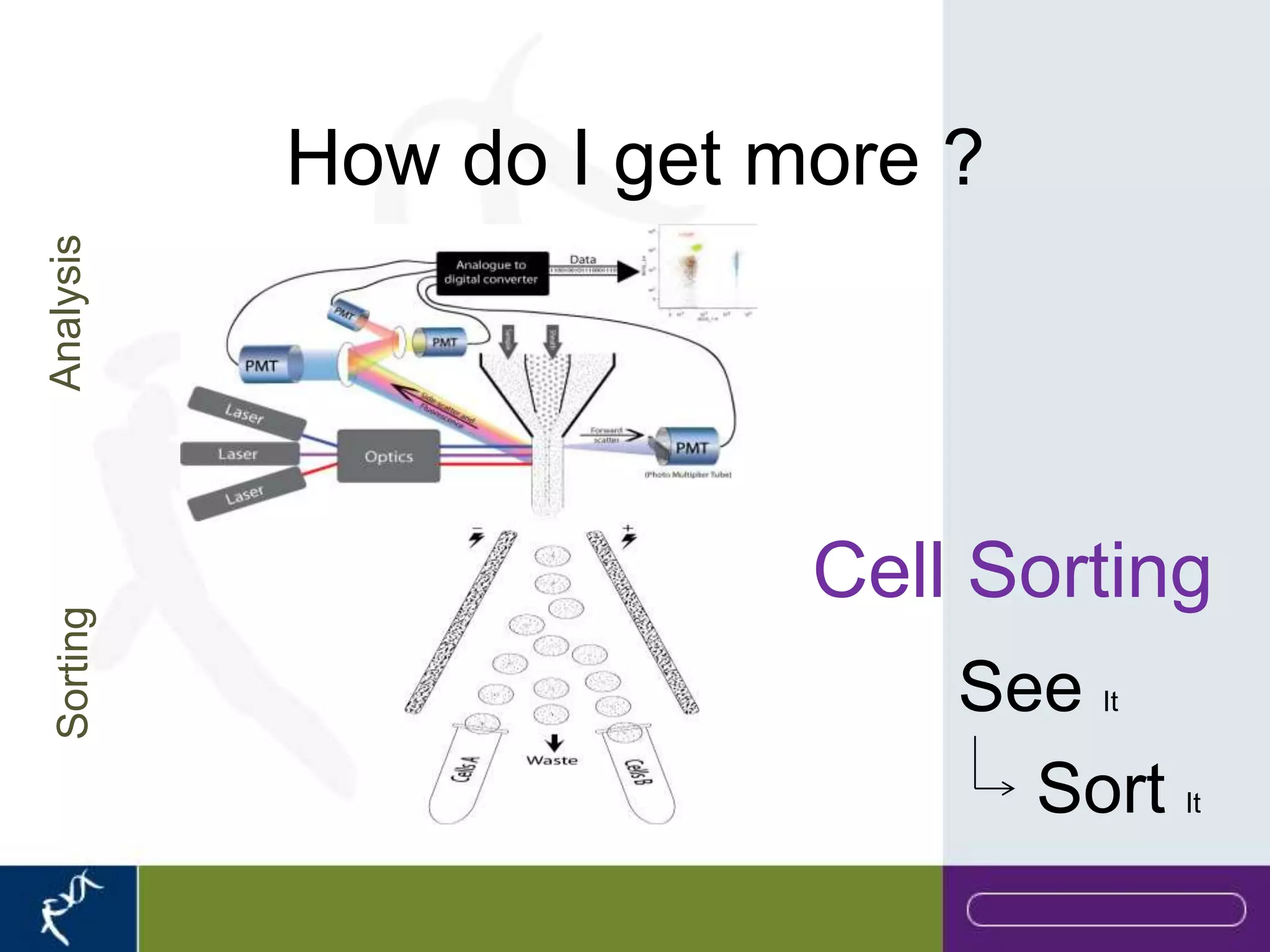
How do I get more ?
Analysis


                         Cell Sorting
 Sorting


                             See It


                               Sort   It
Contact Details
• Rob Salomon
   – r.salomon@garvan.org.au
   – (02) 9295 8431

• Bookings (Nikki and David)
   – Flow@garvan.org.au
   – (02) 9295 8432

• http://linkage.garvan.unsw.edu.au/Flow/index.html

Introduction to Flow Cytometry

  • 1.
    MLC Flow CytometryFacility Introduction To Flow Cytometry Rob Salomon Garvan Institute of Medical Research Darlinghurst NSW Flow Cytometry
  • 2.
    What Is FlowCytometry ?
  • 3.
    What Is FlowCytometry ? Measurement METRY
  • 4.
    What Is FlowCytometry ? Cells Measurement CYTO METRY
  • 5.
    What Is FlowCytometry ? Flow Cells Measurement Flow CYTO METRY
  • 6.
    What Is FlowCytometry ? Flow Cells Measurement Flow CYTO METRY Flow Cytometry
  • 7.
    Prerequisites for Flow Cytometry 1. Cells in single cell suspension 2. Fluorescent probes 3. Cytometer The key to good result is good sample Preparation http://www.photobiology.info/Zimmer.html - from Roger Y.Tsien)
  • 8.
    What does aFlow Cytometer do? Analyses light signals to determine: Phenotype and Function Cd3
  • 9.
    What’s inside aFlow Cytometer ? • Flow cytometers have 3 key systems – Fluidics – Optics – Electronics
  • 10.
    Fluidics Delivery of Low sample to laser intercept (interrogation Medium point) Legend Laser intercept High Core Stream
  • 11.
    Optics • Allow theexcitation and the collection of the emitted light Steering LASER mirrors emission Flow Cell - Steering interrogation mirrors point
  • 12.
    Optics cont.. Fluorescent and SSC Detectors Signal Detection FSC is achieved by detector collecting emitted or scattered light
  • 13.
    Optics cont.. B530 Detector – FITC GFP 530/30 488/10 SSC Fluorescent and Detector 506 LP SSC signals are collected at right Emission angles to the from blue 575/26 excitation laser laser are progressively B575 Detector picked off to – PE, PI 556 LP facilitate multiple fluorochrome use
  • 14.
    Electronics Detector or PMT Electron Cascade Digitisation and processing Amplification Voltage http://sales.hamamatsu.com /assets/applications/ETD/p mt_handbook_complete.pdf
  • 15.
    What type ofsignals do we see with Flow ? • Scatter – Forward Scatter (FSC) • parallel or Perpendicular FSC – Side scatter (SSC) • Fluorescence – FITC , PE, APC, GFP, DAPI (plus lots lots more)
  • 16.
    Understanding Scatter Signals •WBC discrimination FSC has some similarities to size SSC has some similarities to granularity and complexity
  • 17.
    Fluorescent Signals • Fluorescencemay be used in the detection of : – Protein, RNA and DNA – DNA synthesis – Dye efflux – Organelle Activity A cytometer can – Change in pH detected light from – Protein interactions any system you can design that – Cell movement and division utilises – etc fluorescence
  • 18.
    Examples of fluorescentprobe use 10 5 Fluorescence 2 (CD4) <B670L_B-A>: CD8-PerCP55 104 3 10 0 0 103 104 105 <R780_A-A>: bTCR-APCAF750 Fluorescence 1 (βTCR)
  • 19.
    Understanding Fluoroscence The fluorescent Excited molecule is excited e- by the excitation state e- source (laser). This imparts energy to e- electrons in the e- molecule which in Resting e- then released as Mechanism of the molecule relaxes. The Fluorscence energy is released as light.
  • 20.
    How do Ichoose my Fluorochromes ? • Antibody availability • Function – i.e. Mcherry Vs GFP • Fluorochrome brightness • Excitation source • Emission filters • Other fluorochromes/ Signals present in my sample (spectral overlap)
  • 21.
    Fluorochrome Brightness Probe QY AF488 0.92 R-Pe 0.82 AF546 0.79 AF594 0.66 Quantum yield : APC 0.68 Is a measure of the A647 0.33 relative brightness of eGFP 0.6 the fluorochrome. IT is measured as: Azumi Green 0.74 ZS Green 1 0.91 http://en.wikipedia.org/wiki/Fluorophore
  • 22.
  • 23.
    Choosing your Fluorochromes spectral viewers http://www.bdbioscience s.com/research/multicolo r/spectrum_viewer/index. jsp http://www.invitrogen.co m/site/us/en/home/supp ort/Research- Tools/Fluorescence- SpectraViewer.htmlUse the
  • 24.
    Choosing your Fluorochromes spectral viewers http://www.bdbioscience s.com/research/multicolo r/spectrum_viewer/index. jsp http://www.invitrogen.co m/site/us/en/home/supp ort/Research- Tools/Fluorescence- SpectraViewer.htmlUse the
  • 25.
    Choosing your Fluorochromes spectral viewers http://www.bdbioscience s.com/research/multicolo r/spectrum_viewer/index. jsp http://www.invitrogen.co m/site/us/en/home/supp ort/Research- Tools/Fluorescence- SpectraViewer.htmlUse the
  • 26.
    Choosing your Fluorochromes spectral viewers http://www.bdbioscience s.com/research/multicolo r/spectrum_viewer/index. jsp http://www.invitrogen.co m/site/us/en/home/supp ort/Research- Tools/Fluorescence- SpectraViewer.htmlUse the
  • 27.
    Understanding Spectral Overlap Effect of spectral overlap - Instrument View 120% 100% Percentage of Signal 80% in Detector 60% 40% 20% Spectral overlap 0% B 530 B 585 occurs when PE 5% 87% fluorochromes FITC 95% 13% excited by the same lasers emit in similar ranges.
  • 28.
    Compensation Signal from FITC bright Compensation Controls 120 Signal Strength 100 120% 80 60 100% 40 20 80% Axis Title 0 overlap B 530 B 585 60% FITC bright 100 13 40% overlap 20% FITC dull 0% 120 Signal Strength B 530 B 585 100 FITC 100% 13% 80 Compensation is PE 5% 100% 60 40 applied at the 20 0 single event B 530 B 585 FITC dull 50 6 level
  • 29.
    Effect of Compensation Digital compensation doesn’t change the underlying data it just allows us to Uncompensated Data interpret it
  • 30.
    Effect of Compensation Digital compensation doesn’t change the underlying data it just allows us to Compensated Data interpret it
  • 31.
    How many Fluorochromescan I use ? • Most flow = 1- 3 fluorochromes • Basic phenotyping panel = 6-8 fluorochromes • Complicated panels = 11-12 flourochromes • High end = 17 fluorochromes Seventeen-colour flow cytometry: unravelling the immune system Stephen P. Perfetto, Pratip K. Chattopadhyay & Mario Roederer
  • 32.
    Impact of increasingFlourochromes • Data get dramatically more complex Parameters 2 3 4 8 12 18 22 Populations 22 23 24 28 212 218 222 Populations 4 8 16 256 4,096 262,144 4,194,304 With 3 12 24 48 768 12,288 786,432 12,582,912 scatter populations Number of populations – assuming each fluorochromes gives rise to only a positive and negative population
  • 33.
    Visualising Signal Data Dot Density plot plot Statistical measures are also used to Contour plot identify Histogram changes
  • 34.
    Basics uses ofFlow Cytometry ? • Phenotyping • Apoptosis and cell death • Cell cycle, cell divising and DNA synthesis • Transduction/transfection confirmation • Cell tracking • Small particle analysis • Functional analysis – calcium flux, gene expression, dye efflux, mitochondrial activity • Marine and microorganism identification
  • 35.
    Why use FlowCytometry ? • Rapid analysis ( 3k- 200k events/second) • Individual event analysis • Quantifiable results • Multiple parameter analysis • Statistical relevance
  • 36.
    Flow and ImagingComparison Imaging Flow Cytometry Cells per field/sec) Approx 100 20, 000 No. of parameter <6 <24 Quantifiable Maybe (using complex Yes analysis tool) 18 bit resolution 12- 16 bit (< 65,536 (262,144 channels) channels) Ave number of 1,000 - >10, 000 analysed cells 10 field of 100 Anatomical localisation Yes no
  • 37.
    How do Iget more ? Analysis Cell Sorting Sorting See It Sort It
  • 38.
    Contact Details • RobSalomon – r.salomon@garvan.org.au – (02) 9295 8431 • Bookings (Nikki and David) – Flow@garvan.org.au – (02) 9295 8432 • http://linkage.garvan.unsw.edu.au/Flow/index.html