

Dedicated to:
From:
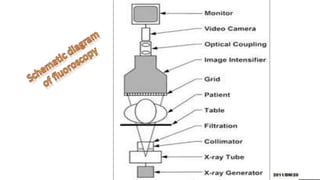
Fluoroscopy
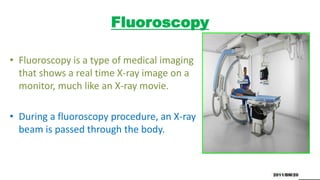
• Fluoroscopy is a type of medical imaging
that shows a real time X-ray image on a
monitor, much like an X-ray movie.
• During a fluoroscopy procedure, an X-ray
beam is passed through the body.
Image intensifier:
• The image-intensifier tube is a complex electronic device that
receives the image-forming x-ray beam and converts it into a
visible-light image of high intensity.
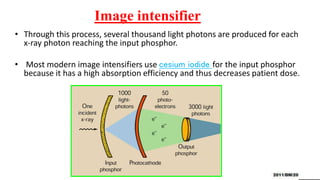
• Within an image intensifier, the input phosphor converts the
x-ray photons to light photons, which are then converted to
photoelectrons within the photocathode
Image intensifier
• Through this process, several thousand light photons are produced for each
x-ray photon reaching the input phosphor.
• Most modern image intensifiers use cesium iodide for the input phosphor
because it has a high absorption efficiency and thus decreases patient dose.
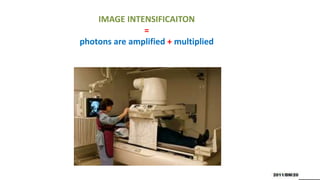
IMAGE INTENSIFICAITON
=
photons are amplified + multiplied
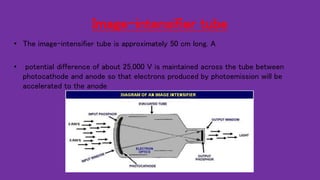
Image-intensifier tube
• The image-intensifier tube is approximately 50 cm long. A
• potential difference of about 25,000 V is maintained across the tube between
photocathode and anode so that electrons produced by photoemission will be
accelerated to the anode
Photocathode
• The photocathode emits electrons when illuminated by the input
phosphor.
ANODE:
• The anode is a circular plate with a hole in the middle through which
electrons pass to the output phosphor, which is just the other side of
the anode .
Advantage of Image intensifier
• The principal advantage of image-intensified fluoroscopy over earlier types of
fluoroscopy is increased image brightness. this requires high levels of image
brightness.
• The image intensifier was developed principally to replace the conventional
fluorescent screen, which had to be viewed in a darkened room.
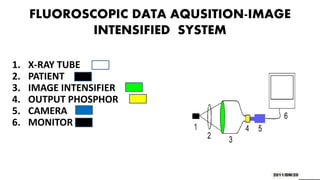
FLUOROSCOPIC DATA AQUSITION-IMAGE
INTENSIFIED SYSTEM
1. X-RAY TUBE
2. PATIENT
3. IMAGE INTENSIFIER
4. OUTPUT PHOSPHOR
5. CAMERA
6. MONITOR
IMAGE
The solid state charge-
coupled device (CCD).
• Two methods are used to electronically convert the
visible image on the output phosphor of the image
intensifier into an electronic signal:
Thermionic television
camera tube
Applications
Fluoroscopy is used in many types of examinations and procedures such as
• cardiac catheterization
• Arthrography (visualization of a joint or joints)
• lumbar puncture,
• placement of intravenous (IV) catheters (hollow tubes inserted into veins or
arteries)
Thank you

Flouroscopy

  • 2.
  • 3.
    Fluoroscopy • Fluoroscopy isa type of medical imaging that shows a real time X-ray image on a monitor, much like an X-ray movie. • During a fluoroscopy procedure, an X-ray beam is passed through the body.
  • 4.
    Image intensifier: • Theimage-intensifier tube is a complex electronic device that receives the image-forming x-ray beam and converts it into a visible-light image of high intensity. • Within an image intensifier, the input phosphor converts the x-ray photons to light photons, which are then converted to photoelectrons within the photocathode
  • 5.
    Image intensifier • Throughthis process, several thousand light photons are produced for each x-ray photon reaching the input phosphor. • Most modern image intensifiers use cesium iodide for the input phosphor because it has a high absorption efficiency and thus decreases patient dose.
  • 6.
  • 7.
    Image-intensifier tube • Theimage-intensifier tube is approximately 50 cm long. A • potential difference of about 25,000 V is maintained across the tube between photocathode and anode so that electrons produced by photoemission will be accelerated to the anode
  • 8.
    Photocathode • The photocathodeemits electrons when illuminated by the input phosphor. ANODE: • The anode is a circular plate with a hole in the middle through which electrons pass to the output phosphor, which is just the other side of the anode .
  • 9.
    Advantage of Imageintensifier • The principal advantage of image-intensified fluoroscopy over earlier types of fluoroscopy is increased image brightness. this requires high levels of image brightness. • The image intensifier was developed principally to replace the conventional fluorescent screen, which had to be viewed in a darkened room.
  • 11.
    FLUOROSCOPIC DATA AQUSITION-IMAGE INTENSIFIEDSYSTEM 1. X-RAY TUBE 2. PATIENT 3. IMAGE INTENSIFIER 4. OUTPUT PHOSPHOR 5. CAMERA 6. MONITOR
  • 12.
    IMAGE The solid statecharge- coupled device (CCD). • Two methods are used to electronically convert the visible image on the output phosphor of the image intensifier into an electronic signal: Thermionic television camera tube
  • 13.
    Applications Fluoroscopy is usedin many types of examinations and procedures such as • cardiac catheterization • Arthrography (visualization of a joint or joints) • lumbar puncture, • placement of intravenous (IV) catheters (hollow tubes inserted into veins or arteries)
  • 14.