Fluoroscopy
Presenter: Sujan Karki
B.Sc. MIT 2nd year
National Academy of Medical Sciences, Bir Hospital
Topics Included
•History
•IITV system
•Digital Fluroscopy
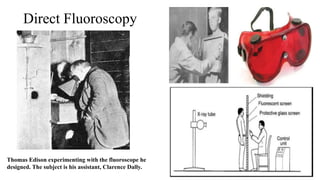
Direct Fluoroscopy
Thomas Edison experimenting with the fluoroscope he
designed. The subject is his assistant, Clarence Dally.
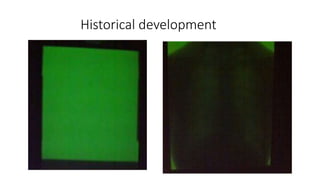
Historical development
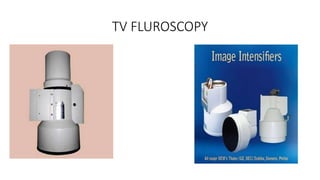
TV FLUROSCOPY
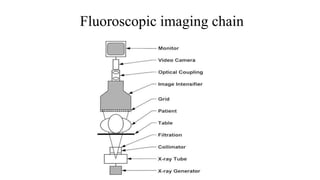
Fluoroscopic imaging chain
X-ray Generator
• Selection of KVP and MA that is delivered to x-ray tube.
• similar design as of radiography with added circuitry for automatic brightness
control and low continuous tube current or rapid pulsed exposure.
• Methods used to energize xray tube in fluoroscopy:
1) Pulsed Exposure
2) Continuous Exposure
X-ray Tube
• X-ray tubes are produced with anode angle ranges of 7°–20°.
• For radiography and fluoroscopy systems, bi-focus tubes are common.
• A small focal spot (0.3–0.6 mm) is used for fluoroscopy, and either the
small or the large focal spot (1.0–1.2 mm) can be used for image
recording when high tube currents are needed.
• small focal spot may be essential for sharp images of fine vasculature or
guide wires
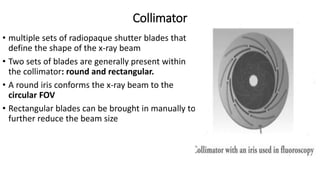
Collimator
• multiple sets of radiopaque shutter blades that
define the shape of the x-ray beam
• Two sets of blades are generally present within
the collimator: round and rectangular.
• A round iris conforms the x-ray beam to the
circular FOV
• Rectangular blades can be brought in manually to
further reduce the beam size
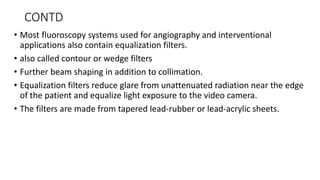
CONTD
• Most fluoroscopy systems used for angiography and interventional
applications also contain equalization filters.
• also called contour or wedge filters
• Further beam shaping in addition to collimation.
• Equalization filters reduce glare from unattenuated radiation near the edge
of the patient and equalize light exposure to the video camera.
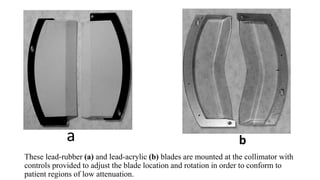
• The filters are made from tapered lead-rubber or lead-acrylic sheets.
Filter
• The penetrating ability of an x-ray beam is determined by measuring the
half-value layer (HVL), where the HVL is the thickness of some attenuating
material that reduces the beam intensity by one-half at a specified kilovolt
peak.
• Federal regulations require that the minimum HVL for both radiography and
fluoroscopy be 2.3 mm Al at 80 kVp.
• However, it is recommended that the minimum HVL be increased to 3.0 mm
Al at 80 kVp to reduce patient dose, particularly for fluoroscopy.
• Aluminum is the most common added filtration material. Copper can also be
used for improved low-energy x-ray filtering
• The use of copper filtration material has become more prevalent in
fluoroscopy systems used for high-dose procedures such as angiography and
interventional applications.
These lead-rubber (a) and lead-acrylic (b) blades are mounted at the collimator with
controls provided to adjust the blade location and rotation in order to conform to
patient regions of low attenuation.
a b
Grid
• Anti-scatter grids are used to improve image contrast by reducing the scattered
x rays that reach the image receptor
• The grid ratios for fluoroscopy range from 6:1 to 10:1, which is generally lower
than common radiographic grid ratios (8:1 to 16:1).
• Image contrast loss will be minimal when the FOV is reduced or the patient or
body part examined is small
• a grid is not needed if a large air gap between the patient and the image
intensifier is required for geometric magnification, access to the patient, or
access to interventional devices.
• With the grid removed, patient exposure can be reduced by about 50%.
• Although some fluoroscopy systems allow for easy grid removal, exchanging the
grid can be cumbersome or impossible on others.
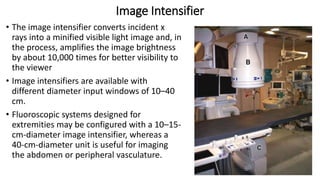
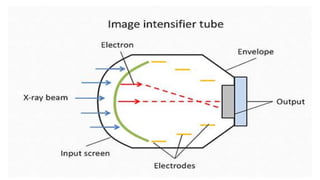
Image Intensifier
• The image intensifier converts incident x
rays into a minified visible light image and, in
the process, amplifies the image brightness
by about 10,000 times for better visibility to
the viewer
• Image intensifiers are available with
different diameter input windows of 10–40
cm.
• Fluoroscopic systems designed for
extremities may be configured with a 10–15-
cm-diameter image intensifier, whereas a
40-cm-diameter unit is useful for imaging
the abdomen or peripheral vasculature.
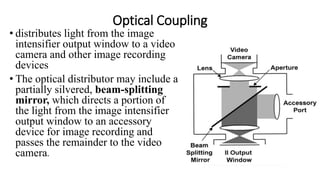
Optical Coupling
• distributes light from the image
intensifier output window to a video
camera and other image recording
devices
• The optical distributor may include a
partially silvered, beam-splitting
mirror, which directs a portion of
the light from the image intensifier
output window to an accessory
device for image recording and
passes the remainder to the video
camera.
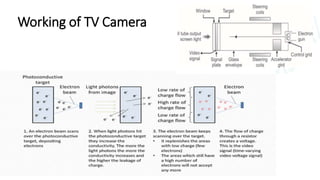
Television System
• A closed-circuit television system is used to view the image
intensifier output image.
• The television system consists of a video camera that converts the
image to a voltage signal and a monitor that receives the signal and
forms the image display.
• Advantages of TV monitor are:
 Brightness can be adjusted
 Multiple obserber can see the display at the same time
 Image storage at the electronic format
Working of TV Camera
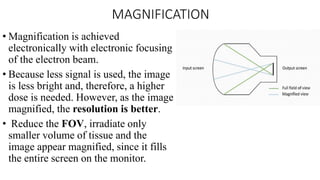
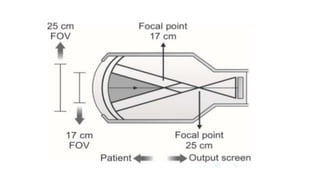
MAGNIFICATION
• Magnification is achieved
electronically with electronic focusing
of the electron beam.
• Because less signal is used, the image
is less bright and, therefore, a higher
dose is needed. However, as the image
magnified, the resolution is better.
• Reduce the FOV, irradiate only
smaller volume of tissue and the
image appear magnified, since it fills
the entire screen on the monitor.
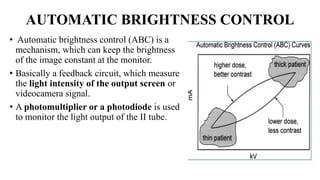
AUTOMATIC BRIGHTNESS CONTROL
• Automatic brightness control (ABC) is a
mechanism, which can keep the brightness
of the image constant at the monitor.
• Basically a feedback circuit, which measure
the light intensity of the output screen or
videocamera signal.
• A photomultiplier or a photodiode is used
to monitor the light output of the II tube.
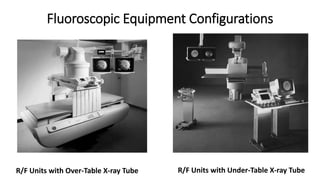
Fluoroscopic Equipment Configurations
R/F Units with Over-Table X-ray Tube R/F Units with Under-Table X-ray Tube
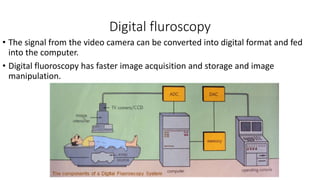
Digital fluroscopy
• The signal from the video camera can be converted into digital format and fed
into the computer.
• Digital fluoroscopy has faster image acquisition and storage and image
manipulation.
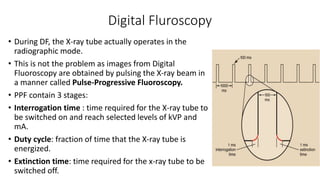
Digital Fluroscopy
• During DF, the X-ray tube actually operates in the
radiographic mode.
• This is not the problem as images from Digital
Fluoroscopy are obtained by pulsing the X-ray beam in
a manner called Pulse-Progressive Fluoroscopy.
• PPF contain 3 stages:
• Interrogation time : time required for the X-ray tube to
be switched on and reach selected levels of kVP and
mA.
• Duty cycle: fraction of time that the X-ray tube is
energized.
• Extinction time: time required for the x-ray tube to be
switched off.
contd
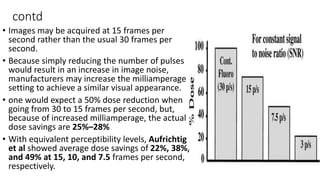
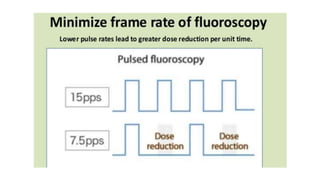
• Images may be acquired at 15 frames per
second rather than the usual 30 frames per
second.
• Because simply reducing the number of pulses
would result in an increase in image noise,
manufacturers may increase the milliamperage
setting to achieve a similar visual appearance.
• one would expect a 50% dose reduction when
going from 30 to 15 frames per second, but,
because of increased milliamperage, the actual
dose savings are 25%–28%
• With equivalent perceptibility levels, Aufrichtig
et al showed average dose savings of 22%, 38%,
and 49% at 15, 10, and 7.5 frames per second,
respectively.
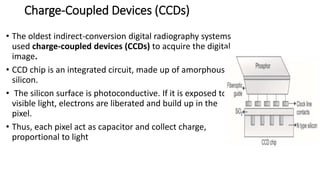
Charge-Coupled Devices (CCDs)
• The oldest indirect-conversion digital radiography systems
used charge-coupled devices (CCDs) to acquire the digital
image.
• CCD chip is an integrated circuit, made up of amorphous
silicon.
• The silicon surface is photoconductive. If it is exposed to
visible light, electrons are liberated and build up in the
pixel.
• Thus, each pixel act as capacitor and collect charge,
proportional to light
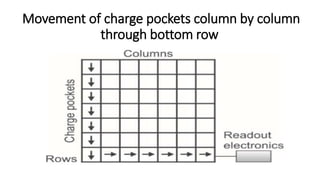
Movement of charge pockets column by column
through bottom row
ADVANTAGES OF CCD
•High spatial resolution
•High signal to noise ratio
•High quantum detective efficiency
•No lag or blooming
•No spatial distortion
•Unlimited life
•Linear response
•Low patient dose
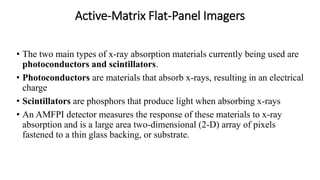
Active-Matrix Flat-Panel Imagers
• The two main types of x-ray absorption materials currently being used are
photoconductors and scintillators.
• Photoconductors are materials that absorb x-rays, resulting in an electrical
charge
• Scintillators are phosphors that produce light when absorbing x-rays
• An AMFPI detector measures the response of these materials to x-ray
absorption and is a large area two-dimensional (2-D) array of pixels
fastened to a thin glass backing, or substrate.
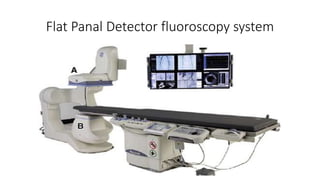
Flat Panal Detector fluoroscopy system
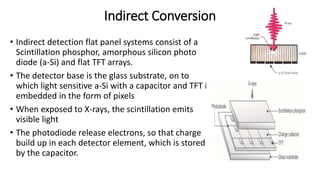
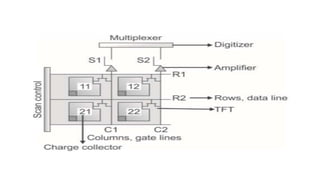
Indirect Conversion
• Indirect detection flat panel systems consist of a
Scintillation phosphor, amorphous silicon photo
diode (a-Si) and flat TFT arrays.
• The detector base is the glass substrate, on to
which light sensitive a-Si with a capacitor and TFT is
embedded in the form of pixels
• When exposed to X-rays, the scintillation emits
visible light
• The photodiode release electrons, so that charge
build up in each detector element, which is stored
by the capacitor.
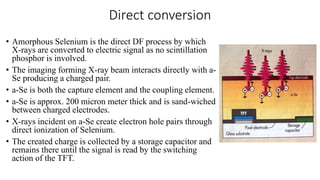
Direct conversion
• Amorphous Selenium is the direct DF process by which
X-rays are converted to electric signal as no scintillation
phosphor is involved.
• The imaging forming X-ray beam interacts directly with a-
Se producing a charged pair.
• a-Se is both the capture element and the coupling element.
• a-Se is approx. 200 micron meter thick and is sand-wiched
between charged electrodes.
• X-rays incident on a-Se create electron hole pairs through
direct ionization of Selenium.
• The created charge is collected by a storage capacitor and
remains there until the signal is read by the switching
action of the TFT.
Artefacts
• Artefacts in fluoroscopic imaging usually stem from image distortions
caused by components of the image chain
• XRII suffer from several common image distortions including:
1)Veiling Glare
2)Vignetting
3)Blooming
4)Pincushion Distortion
5)S Distortion
• Flat Panel image receptors are generally freefrom image distortions
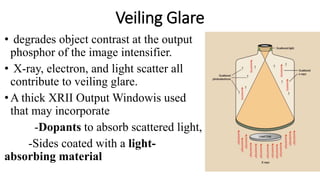
Veiling Glare
• degrades object contrast at the output
phosphor of the image intensifier.
• X-ray, electron, and light scatter all
contribute to veiling glare.
•A thick XRII Output Windowis used
that may incorporate
-Dopants to absorb scattered light,
-Sides coated with a light-
absorbing material
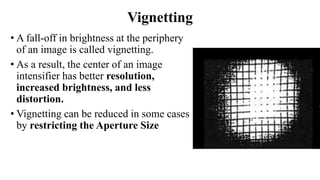
Vignetting
• A fall-off in brightness at the periphery
of an image is called vignetting.
• As a result, the center of an image
intensifier has better resolution,
increased brightness, and less
distortion.
• Vignetting can be reduced in some cases
by restricting the Aperture Size
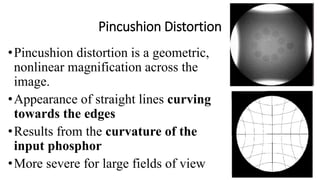
Pincushion Distortion
•Pincushion distortion is a geometric,
nonlinear magnification across the
image.
•Appearance of straight lines curving
towards the edges
•Results from the curvature of the
input phosphor
•More severe for large fields of view
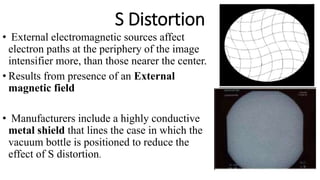
S Distortion
• External electromagnetic sources affect
electron paths at the periphery of the image
intensifier more, than those nearer the center.
• Results from presence of an External
magnetic field
• Manufacturers include a highly conductive
metal shield that lines the case in which the
vacuum bottle is positioned to reduce the
effect of S distortion.
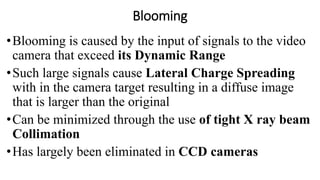
Blooming
•Blooming is caused by the input of signals to the video
camera that exceed its Dynamic Range
•Such large signals cause Lateral Charge Spreading
with in the camera target resulting in a diffuse image
that is larger than the original
•Can be minimized through the use of tight X ray beam
Collimation
•Has largely been eliminated in CCD cameras
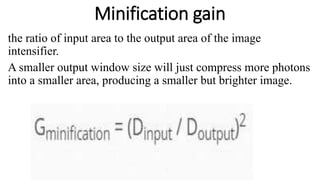
Minification gain
the ratio of input area to the output area of the image
intensifier.
A smaller output window size will just compress more photons
into a smaller area, producing a smaller but brighter image.
Flux gain
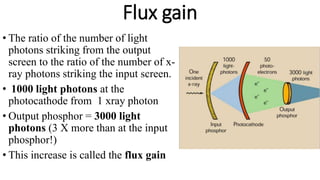
• The ratio of the number of light
photons striking from the output
screen to the ratio of the number of x-
ray photons striking the input screen.
• 1000 light photons at the
photocathode from 1 xray photon
• Output phosphor = 3000 light
photons (3 X more than at the input
phosphor!)
• This increase is called the flux gain
Brightness Gain and Conversion Factor
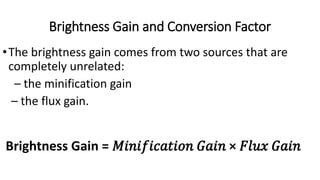
•The brightness gain comes from two sources that are
completely unrelated:
– the minification gain
– the flux gain.
Brightness Gain = 𝑀𝑖𝑛𝑖𝑓𝑖𝑐𝑎𝑡𝑖𝑜𝑛 𝐺𝑎𝑖𝑛 × 𝐹𝑙𝑢𝑥 𝐺𝑎𝑖𝑛
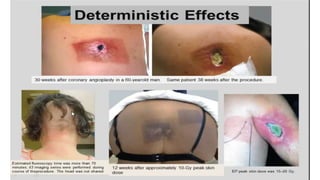
PATIENT RADIATION DOSE
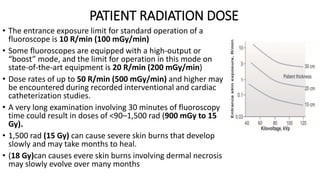
• The entrance exposure limit for standard operation of a
fluoroscope is 10 R/min (100 mGy/min)
• Some fluoroscopes are equipped with a high-output or
“boost” mode, and the limit for operation in this mode on
state-of-the-art equipment is 20 R/min (200 mGy/min)
• Dose rates of up to 50 R/min (500 mGy/min) and higher may
be encountered during recorded interventional and cardiac
catheterization studies.
• A very long examination involving 30 minutes of fluoroscopy
time could result in doses of <90–1,500 rad (900 mGy to 15
Gy).
• 1,500 rad (15 Gy) can cause severe skin burns that develop
slowly and may take months to heal.
• (18 Gy)can causes evere skin burns involving dermal necrosis
may slowly evolve over many months
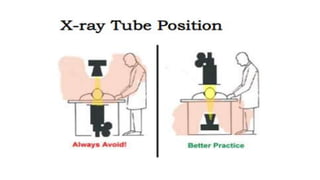
WHAT TO DO DURING FLUROSCOPY
Intermittent Fluoroscopy
• keeping the x rays on only a few seconds at a time, long enough to
view the current catheter position.
• View and save images with last-image-hold
• Fluoroscopy units are also equipped with last-image-hold. This
allows for storing and reviewing of the last image without re-
exposing the patient to more radiation.
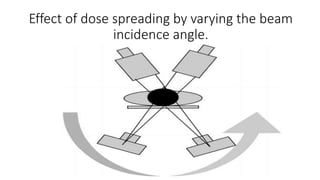
Effect of dose spreading by varying the beam
incidence angle.
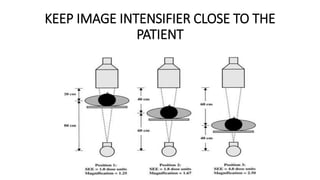
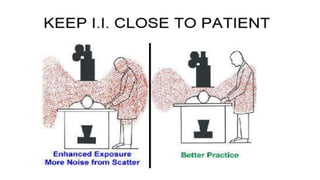
KEEP IMAGE INTENSIFIER CLOSE TO THE
PATIENT
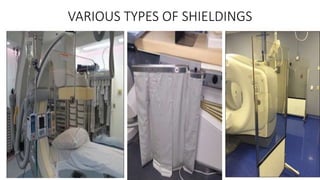
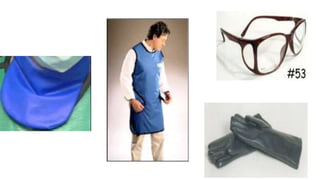
VARIOUS TYPES OF SHIELDINGS
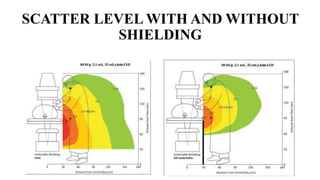
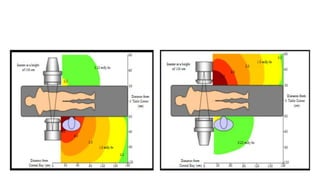
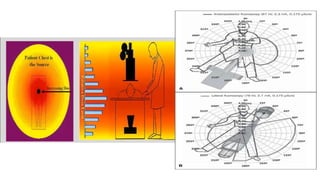
SCATTER LEVEL WITH AND WITHOUT
SHIELDING
References
• Fluoroscopy: Patient Radiation Exposure Issues,Mahadevappa Mahesh
• The AAPM/RSNA Physics Tutorial for Residents General Overview of Fluoroscopic
Imaging,Beth A. Schueler
• The AAPM/RSNA Physics Tutorial for Residents Fluoroscopy: Patient Radiation
Exposure Issues1,Mahadevappa Mahesh, PhD
• Radiography and fluoroscopy, 1920 to the present,J S Krohmer
• Study of scattered radiation during fluoroscopy in hip surgery,Oksana Lesyuk1
• Survey of Modern Fluoroscopy Imaging: Flat-Panel Detectors versus Image Intensifiers and
More,Edward Lee Nickolof
• Radiology key
• Radiology café
• IAEA FLUROSCOPY
• THE PHYSICS OF RADIOLOGYAND IMAGING(K THALAYAN)
• RADIOLOGIC SCIENCE FOR TECHNOLOGIST (STEWART CARLYLE BUSHONG)
• The AAPM/RSNA Physics Tutorial for ResidentsTypical Patient Radiation Doses in Diagnostic
Radiology1Robert A. Parry, Sharon A. Glaze, Benjamin R. Archer
QUESTIONS
• WHAT DO YOU UNDERSTAND BY PULSED FLUROSCOPY ?
• WHAT ARE THE PARTS OF IMAGE INTENSIFIER TUBE?
• WHAT DO YOU UNDERSTAND BY MAGNIFICATION IN
FLUROSCOPY?
• WHAT ARE THE TYPES OF ARTIFACTS SEEN IN
FLUROSCOPY?

Fluoroscopy

  • 1.
    Fluoroscopy Presenter: Sujan Karki B.Sc.MIT 2nd year National Academy of Medical Sciences, Bir Hospital
  • 2.
  • 3.
    Direct Fluoroscopy Thomas Edisonexperimenting with the fluoroscope he designed. The subject is his assistant, Clarence Dally.
  • 4.
  • 5.
  • 6.
  • 7.
    X-ray Generator • Selectionof KVP and MA that is delivered to x-ray tube. • similar design as of radiography with added circuitry for automatic brightness control and low continuous tube current or rapid pulsed exposure. • Methods used to energize xray tube in fluoroscopy: 1) Pulsed Exposure 2) Continuous Exposure
  • 8.
    X-ray Tube • X-raytubes are produced with anode angle ranges of 7°–20°. • For radiography and fluoroscopy systems, bi-focus tubes are common. • A small focal spot (0.3–0.6 mm) is used for fluoroscopy, and either the small or the large focal spot (1.0–1.2 mm) can be used for image recording when high tube currents are needed. • small focal spot may be essential for sharp images of fine vasculature or guide wires
  • 9.
    Collimator • multiple setsof radiopaque shutter blades that define the shape of the x-ray beam • Two sets of blades are generally present within the collimator: round and rectangular. • A round iris conforms the x-ray beam to the circular FOV • Rectangular blades can be brought in manually to further reduce the beam size
  • 10.
    CONTD • Most fluoroscopysystems used for angiography and interventional applications also contain equalization filters. • also called contour or wedge filters • Further beam shaping in addition to collimation. • Equalization filters reduce glare from unattenuated radiation near the edge of the patient and equalize light exposure to the video camera. • The filters are made from tapered lead-rubber or lead-acrylic sheets.
  • 11.
    Filter • The penetratingability of an x-ray beam is determined by measuring the half-value layer (HVL), where the HVL is the thickness of some attenuating material that reduces the beam intensity by one-half at a specified kilovolt peak. • Federal regulations require that the minimum HVL for both radiography and fluoroscopy be 2.3 mm Al at 80 kVp. • However, it is recommended that the minimum HVL be increased to 3.0 mm Al at 80 kVp to reduce patient dose, particularly for fluoroscopy. • Aluminum is the most common added filtration material. Copper can also be used for improved low-energy x-ray filtering • The use of copper filtration material has become more prevalent in fluoroscopy systems used for high-dose procedures such as angiography and interventional applications.
  • 12.
    These lead-rubber (a)and lead-acrylic (b) blades are mounted at the collimator with controls provided to adjust the blade location and rotation in order to conform to patient regions of low attenuation. a b
  • 13.
    Grid • Anti-scatter gridsare used to improve image contrast by reducing the scattered x rays that reach the image receptor • The grid ratios for fluoroscopy range from 6:1 to 10:1, which is generally lower than common radiographic grid ratios (8:1 to 16:1). • Image contrast loss will be minimal when the FOV is reduced or the patient or body part examined is small • a grid is not needed if a large air gap between the patient and the image intensifier is required for geometric magnification, access to the patient, or access to interventional devices. • With the grid removed, patient exposure can be reduced by about 50%. • Although some fluoroscopy systems allow for easy grid removal, exchanging the grid can be cumbersome or impossible on others.
  • 14.
    Image Intensifier • Theimage intensifier converts incident x rays into a minified visible light image and, in the process, amplifies the image brightness by about 10,000 times for better visibility to the viewer • Image intensifiers are available with different diameter input windows of 10–40 cm. • Fluoroscopic systems designed for extremities may be configured with a 10–15- cm-diameter image intensifier, whereas a 40-cm-diameter unit is useful for imaging the abdomen or peripheral vasculature.
  • 16.
    Optical Coupling • distributeslight from the image intensifier output window to a video camera and other image recording devices • The optical distributor may include a partially silvered, beam-splitting mirror, which directs a portion of the light from the image intensifier output window to an accessory device for image recording and passes the remainder to the video camera.
  • 17.
    Television System • Aclosed-circuit television system is used to view the image intensifier output image. • The television system consists of a video camera that converts the image to a voltage signal and a monitor that receives the signal and forms the image display. • Advantages of TV monitor are:  Brightness can be adjusted  Multiple obserber can see the display at the same time  Image storage at the electronic format
  • 18.
  • 19.
    MAGNIFICATION • Magnification isachieved electronically with electronic focusing of the electron beam. • Because less signal is used, the image is less bright and, therefore, a higher dose is needed. However, as the image magnified, the resolution is better. • Reduce the FOV, irradiate only smaller volume of tissue and the image appear magnified, since it fills the entire screen on the monitor.
  • 21.
    AUTOMATIC BRIGHTNESS CONTROL •Automatic brightness control (ABC) is a mechanism, which can keep the brightness of the image constant at the monitor. • Basically a feedback circuit, which measure the light intensity of the output screen or videocamera signal. • A photomultiplier or a photodiode is used to monitor the light output of the II tube.
  • 22.
    Fluoroscopic Equipment Configurations R/FUnits with Over-Table X-ray Tube R/F Units with Under-Table X-ray Tube
  • 23.
    Digital fluroscopy • Thesignal from the video camera can be converted into digital format and fed into the computer. • Digital fluoroscopy has faster image acquisition and storage and image manipulation.
  • 24.
    Digital Fluroscopy • DuringDF, the X-ray tube actually operates in the radiographic mode. • This is not the problem as images from Digital Fluoroscopy are obtained by pulsing the X-ray beam in a manner called Pulse-Progressive Fluoroscopy. • PPF contain 3 stages: • Interrogation time : time required for the X-ray tube to be switched on and reach selected levels of kVP and mA. • Duty cycle: fraction of time that the X-ray tube is energized. • Extinction time: time required for the x-ray tube to be switched off.
  • 25.
    contd • Images maybe acquired at 15 frames per second rather than the usual 30 frames per second. • Because simply reducing the number of pulses would result in an increase in image noise, manufacturers may increase the milliamperage setting to achieve a similar visual appearance. • one would expect a 50% dose reduction when going from 30 to 15 frames per second, but, because of increased milliamperage, the actual dose savings are 25%–28% • With equivalent perceptibility levels, Aufrichtig et al showed average dose savings of 22%, 38%, and 49% at 15, 10, and 7.5 frames per second, respectively.
  • 27.
    Charge-Coupled Devices (CCDs) •The oldest indirect-conversion digital radiography systems used charge-coupled devices (CCDs) to acquire the digital image. • CCD chip is an integrated circuit, made up of amorphous silicon. • The silicon surface is photoconductive. If it is exposed to visible light, electrons are liberated and build up in the pixel. • Thus, each pixel act as capacitor and collect charge, proportional to light
  • 28.
    Movement of chargepockets column by column through bottom row
  • 29.
    ADVANTAGES OF CCD •Highspatial resolution •High signal to noise ratio •High quantum detective efficiency •No lag or blooming •No spatial distortion •Unlimited life •Linear response •Low patient dose
  • 30.
    Active-Matrix Flat-Panel Imagers •The two main types of x-ray absorption materials currently being used are photoconductors and scintillators. • Photoconductors are materials that absorb x-rays, resulting in an electrical charge • Scintillators are phosphors that produce light when absorbing x-rays • An AMFPI detector measures the response of these materials to x-ray absorption and is a large area two-dimensional (2-D) array of pixels fastened to a thin glass backing, or substrate.
  • 31.
    Flat Panal Detectorfluoroscopy system
  • 32.
    Indirect Conversion • Indirectdetection flat panel systems consist of a Scintillation phosphor, amorphous silicon photo diode (a-Si) and flat TFT arrays. • The detector base is the glass substrate, on to which light sensitive a-Si with a capacitor and TFT is embedded in the form of pixels • When exposed to X-rays, the scintillation emits visible light • The photodiode release electrons, so that charge build up in each detector element, which is stored by the capacitor.
  • 34.
    Direct conversion • AmorphousSelenium is the direct DF process by which X-rays are converted to electric signal as no scintillation phosphor is involved. • The imaging forming X-ray beam interacts directly with a- Se producing a charged pair. • a-Se is both the capture element and the coupling element. • a-Se is approx. 200 micron meter thick and is sand-wiched between charged electrodes. • X-rays incident on a-Se create electron hole pairs through direct ionization of Selenium. • The created charge is collected by a storage capacitor and remains there until the signal is read by the switching action of the TFT.
  • 36.
    Artefacts • Artefacts influoroscopic imaging usually stem from image distortions caused by components of the image chain • XRII suffer from several common image distortions including: 1)Veiling Glare 2)Vignetting 3)Blooming 4)Pincushion Distortion 5)S Distortion • Flat Panel image receptors are generally freefrom image distortions
  • 37.
    Veiling Glare • degradesobject contrast at the output phosphor of the image intensifier. • X-ray, electron, and light scatter all contribute to veiling glare. •A thick XRII Output Windowis used that may incorporate -Dopants to absorb scattered light, -Sides coated with a light- absorbing material
  • 38.
    Vignetting • A fall-offin brightness at the periphery of an image is called vignetting. • As a result, the center of an image intensifier has better resolution, increased brightness, and less distortion. • Vignetting can be reduced in some cases by restricting the Aperture Size
  • 39.
    Pincushion Distortion •Pincushion distortionis a geometric, nonlinear magnification across the image. •Appearance of straight lines curving towards the edges •Results from the curvature of the input phosphor •More severe for large fields of view
  • 40.
    S Distortion • Externalelectromagnetic sources affect electron paths at the periphery of the image intensifier more, than those nearer the center. • Results from presence of an External magnetic field • Manufacturers include a highly conductive metal shield that lines the case in which the vacuum bottle is positioned to reduce the effect of S distortion.
  • 41.
    Blooming •Blooming is causedby the input of signals to the video camera that exceed its Dynamic Range •Such large signals cause Lateral Charge Spreading with in the camera target resulting in a diffuse image that is larger than the original •Can be minimized through the use of tight X ray beam Collimation •Has largely been eliminated in CCD cameras
  • 42.
    Minification gain the ratioof input area to the output area of the image intensifier. A smaller output window size will just compress more photons into a smaller area, producing a smaller but brighter image.
  • 43.
    Flux gain • Theratio of the number of light photons striking from the output screen to the ratio of the number of x- ray photons striking the input screen. • 1000 light photons at the photocathode from 1 xray photon • Output phosphor = 3000 light photons (3 X more than at the input phosphor!) • This increase is called the flux gain
  • 44.
    Brightness Gain andConversion Factor •The brightness gain comes from two sources that are completely unrelated: – the minification gain – the flux gain. Brightness Gain = 𝑀𝑖𝑛𝑖𝑓𝑖𝑐𝑎𝑡𝑖𝑜𝑛 𝐺𝑎𝑖𝑛 × 𝐹𝑙𝑢𝑥 𝐺𝑎𝑖𝑛
  • 45.
    PATIENT RADIATION DOSE •The entrance exposure limit for standard operation of a fluoroscope is 10 R/min (100 mGy/min) • Some fluoroscopes are equipped with a high-output or “boost” mode, and the limit for operation in this mode on state-of-the-art equipment is 20 R/min (200 mGy/min) • Dose rates of up to 50 R/min (500 mGy/min) and higher may be encountered during recorded interventional and cardiac catheterization studies. • A very long examination involving 30 minutes of fluoroscopy time could result in doses of <90–1,500 rad (900 mGy to 15 Gy). • 1,500 rad (15 Gy) can cause severe skin burns that develop slowly and may take months to heal. • (18 Gy)can causes evere skin burns involving dermal necrosis may slowly evolve over many months
  • 46.
    WHAT TO DODURING FLUROSCOPY
  • 47.
    Intermittent Fluoroscopy • keepingthe x rays on only a few seconds at a time, long enough to view the current catheter position. • View and save images with last-image-hold • Fluoroscopy units are also equipped with last-image-hold. This allows for storing and reviewing of the last image without re- exposing the patient to more radiation.
  • 48.
    Effect of dosespreading by varying the beam incidence angle.
  • 49.
    KEEP IMAGE INTENSIFIERCLOSE TO THE PATIENT
  • 52.
    VARIOUS TYPES OFSHIELDINGS
  • 54.
    SCATTER LEVEL WITHAND WITHOUT SHIELDING
  • 58.
    References • Fluoroscopy: PatientRadiation Exposure Issues,Mahadevappa Mahesh • The AAPM/RSNA Physics Tutorial for Residents General Overview of Fluoroscopic Imaging,Beth A. Schueler • The AAPM/RSNA Physics Tutorial for Residents Fluoroscopy: Patient Radiation Exposure Issues1,Mahadevappa Mahesh, PhD • Radiography and fluoroscopy, 1920 to the present,J S Krohmer • Study of scattered radiation during fluoroscopy in hip surgery,Oksana Lesyuk1 • Survey of Modern Fluoroscopy Imaging: Flat-Panel Detectors versus Image Intensifiers and More,Edward Lee Nickolof • Radiology key • Radiology café • IAEA FLUROSCOPY • THE PHYSICS OF RADIOLOGYAND IMAGING(K THALAYAN) • RADIOLOGIC SCIENCE FOR TECHNOLOGIST (STEWART CARLYLE BUSHONG) • The AAPM/RSNA Physics Tutorial for ResidentsTypical Patient Radiation Doses in Diagnostic Radiology1Robert A. Parry, Sharon A. Glaze, Benjamin R. Archer
  • 60.
    QUESTIONS • WHAT DOYOU UNDERSTAND BY PULSED FLUROSCOPY ? • WHAT ARE THE PARTS OF IMAGE INTENSIFIER TUBE? • WHAT DO YOU UNDERSTAND BY MAGNIFICATION IN FLUROSCOPY? • WHAT ARE THE TYPES OF ARTIFACTS SEEN IN FLUROSCOPY?

Editor's Notes

  • #4 Zinc cadmium sulfide red goggles for dark adaptation
  • #15 Developed in 1948 • Is designed to amplify the brightness of an image • New II are capable of increasing image brightness 500-8000
  • #16 The K-edges of cesium (36 keV) and iodine (33 keV) falls under the bremsstrahlung spectrum of fluoroscopy X-rays, which increases its absorption efficiency (60%). Input screen aluminium window withstand air pressure FOCUSSING ELECTRODES
  • #17 Rapid sequence cut film, cine fluoroscopy ,videotape,digital recording
  • #19 A TV camera tube uses an electron beam that scans across, line by line. The scanning direction is determined by focusing and deflection coils arranged around the outside of the tube.  photo-conductive layer of antimony trisulfide, and act as a target
  • #22  change of kV at constant mA, (ii) change of mA at constant kV, and (iii) change of both kV and mA.
  • #24 (i) image storage facility, (ii) image processing such as noise reduction, and edge enhancement, (iii) black and white reversal, i.e. display of – and + images, (iv) geometrical inversion, i.e. left to right and top to bottom, (v) dose reduction, (vi) wide dynamic range, (vii) dynamic imaging, (viii) filmless imaging
  • #25 DF system must incorporate high frequency generators with very rapid switching on and off with interrogation time and extinction times of less than 1ms.
  • #34 During the X-ray exposure, negative voltage is applied to the gate and all the transistor switches are in OFF position GATE SOURCE AND DRAIN
  • #35 A bias voltage applied to the depth of the selenium layer draw the electrons and holes to corresponding electrodes; the generated current is thus proportional to the intensity of the irradiation. Signal is then read out using underlying readout electronics, typically by a thin-film transistor (TFT) array
  • #45 Brightness of the output phosphor i.e. Conversion factor :brightness of the output phosphor/Input exposure rate
  • #46  Higher the kVp and lesser the patient thickness, lesser the radiation dose to the patient Fluoroscopy imaging time is higher and it may vary from 1–3 minutes for a examination to 15 minutes for a interventional procedure. The skin entrance dose should not exceed 50 mGy/min to the patient. It will vary with kVp and patient thickness. A typical fluoroscopy examination may give a dose of 10–30 mGy/min. This is defined as the exposure in (R) at the skin surface of the patient excluding the backscatter contribution from the measurement in popular because entrance skin exposure is easy to measure, but unfortunately the entrance skin exposure is poorly suited for specifying the radiation received by patients understanding radiographic examination. The entrance skin exposure does not take into account the radio sensitivity of individual organs or tissues, the area of an X-rays beam, or the beam’s penetrating power, therefore, entrance skin exposure is poor indicator of the total energy imparted to patient (James etal , 2006). Where ( OP) is the output in mGy/ (mAs) of the X-ray tube measured at distance of 100 cm from the tube focus along the beam axis at 80 kVp , peak tube voltage (kVp), ( mAs) is the product of the tube current (in mA) and the exposure time in (S), 20 (FSD) the focus-to-skin distance (in cm) and (BSF) the backscatter factor Unit is gray (Gy) (IAEA, 2007). (Jaypee et al, 2001). Or ESD =C (Kvp FSD)2( mAS mmAL) Where ESD is Entrance skin dose, C is constant=0.2775 , FSD is focus to skin distance , mAS is is the product of the tube current (in mA) and the exposure time in (S)kVp , peak tube voltage, AL is aluminum filtration . (Tung etal , 1999)
  • #48 LAST HOLD TECHNIQUE
  • #50 Removal of Grid For mobile C-arm type fluoroscopy units, maximize distance from the radiation source
  • #55 Table skirt