Dedicated to:
From:
 Developed by Hal Anger at Berkeley in 1957
therefore also called Anger camera.
 An electronic device that detects gamma rays emitted
by radio pharmaceutical (e.g. technetium 99m (Tc-
99m) that have been introduced into the body as
tracers.
 The position of the source of the radioactivity can be
plotted and displayed on a TV monitor or
photographic film.
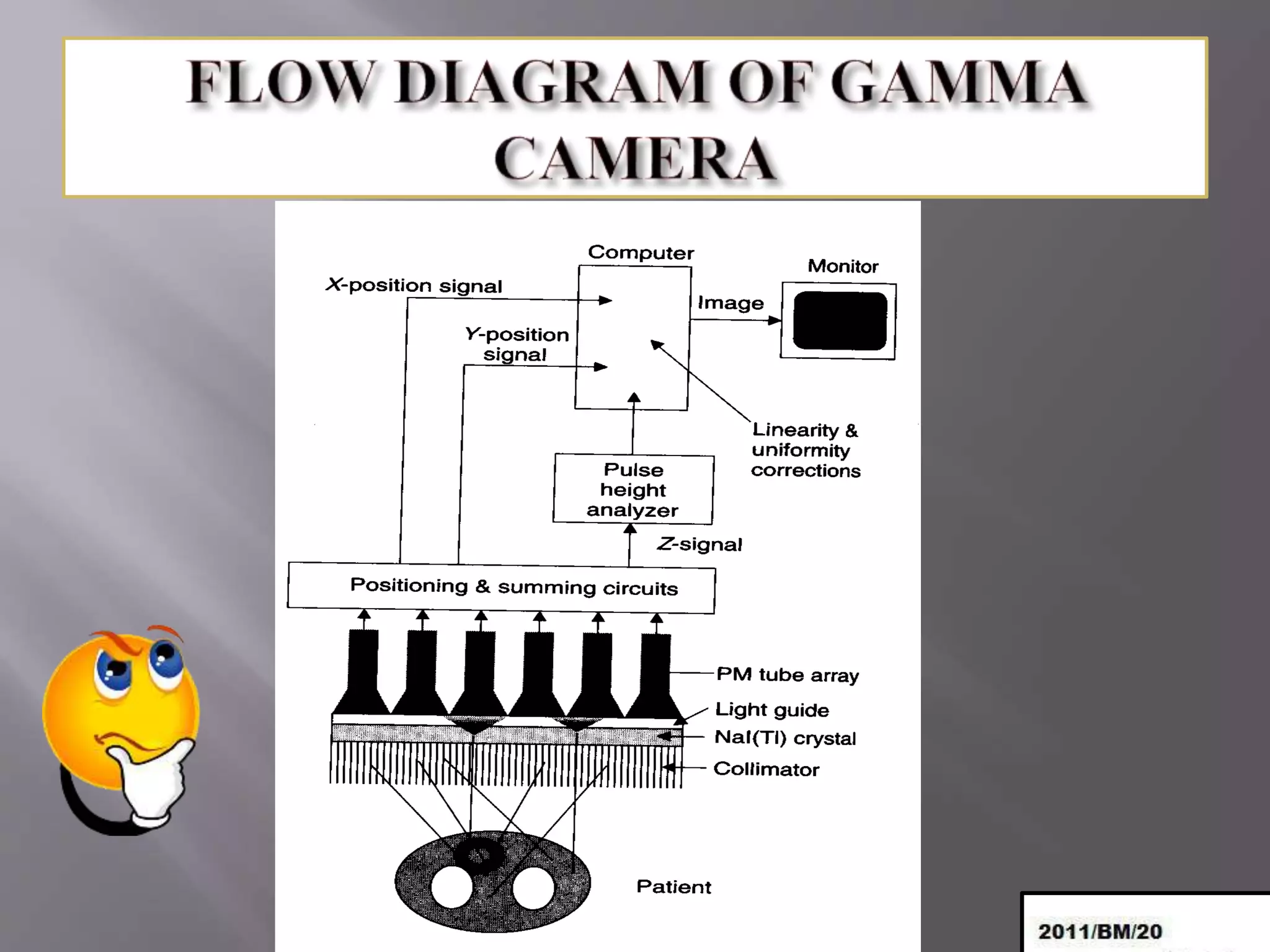
 Collimator
 NaI(Tl) crystal or Detector crystal.
 Photomultiplier Tubes(PMT)
 Pre-amplifier
 Position logic circuits
 Correction circuit
 Computer
 Display (Cathode Ray Tube etc).
 Storage
 Collimator is made from lead.
 Maintains the quality of image
 Spaces between holes known as septa.
 Collimator consisting of a series of holes in a lead plate can
be used to select the direction of the rays falling on the
crystal. There are 4 types of collimator.
 Parallel-hole collimator
 Pin-hole collimator
 Diverging
 Converging
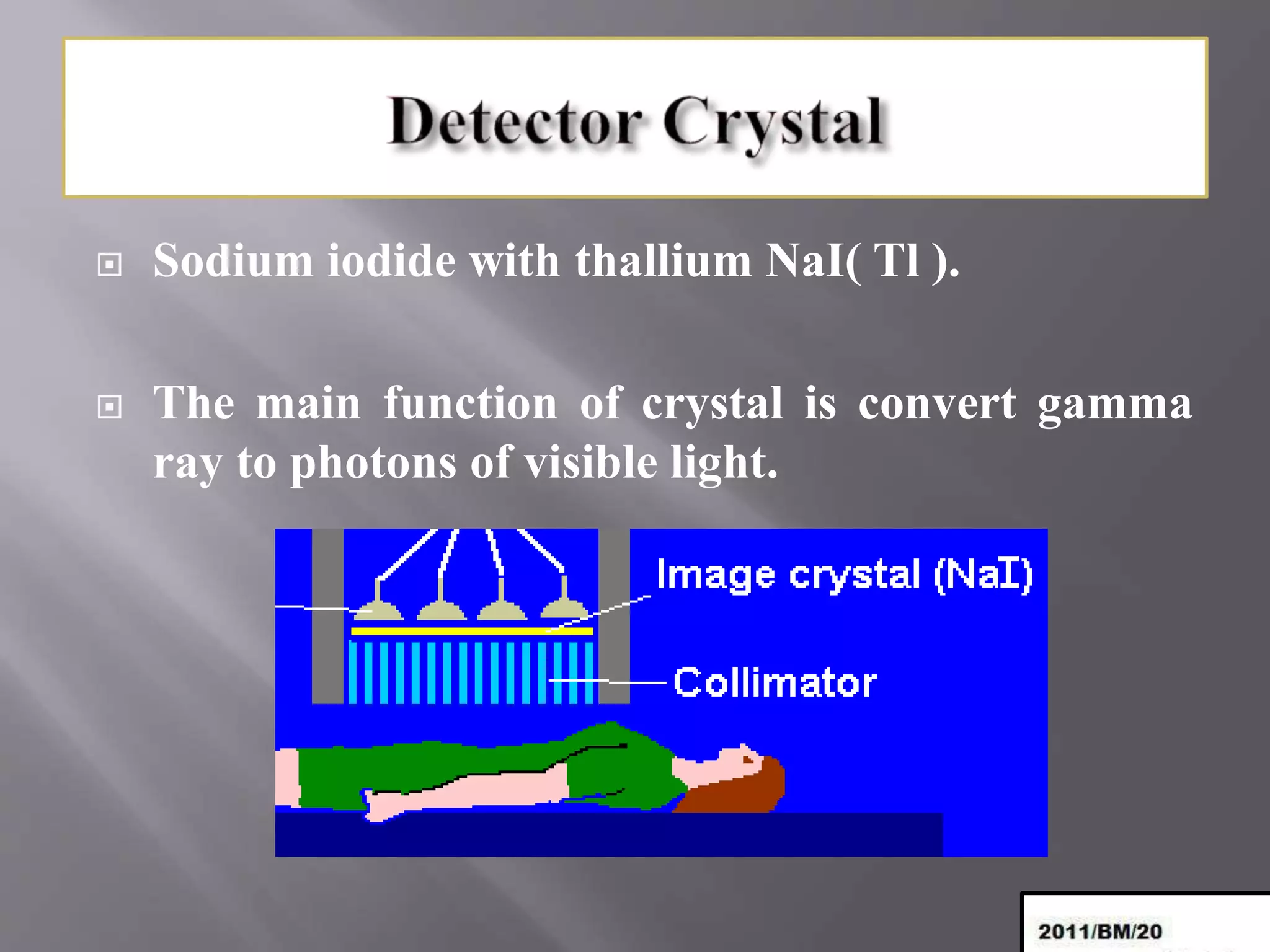
 Sodium iodide with thallium NaI( Tl ).
 The main function of crystal is convert gamma
ray to photons of visible light.
• The photomultiplier tube (PMT) is an instrument
that converts light to electrical signals.
• Gamma Camera contains 37 -91 PMT.
• It detects and amplifies the electrons that are
produced by the photocathode. The photocathode,
when stimulated by light photons, ejects electrons.
The PMT is attached to the back of the crystal.
.
 Preamps attach above
the PMT.
 The amount of charge
given by PMT is very
small.
 A very sensitive
amplifier is therefore
needed to amplify this
signal.
Position circuitary receive the electrical impulses from
pre-amplifiers.
This allows the position circuits to determine where
each scintillation event occurred in the detector crystal.
 Peak height analyzer and a computer convert the
light into a useful anatomical image
Finally, a processing computer is used to deal with the
incoming projection data and processes it into a
readable image .
The computer may use various methods to
reconstruct an image, such as filtered back projection
or iterative reconstruction.
The scan of whole body.
Thank youThank you

Gamma Camera

  • 2.
  • 3.
     Developed byHal Anger at Berkeley in 1957 therefore also called Anger camera.  An electronic device that detects gamma rays emitted by radio pharmaceutical (e.g. technetium 99m (Tc- 99m) that have been introduced into the body as tracers.  The position of the source of the radioactivity can be plotted and displayed on a TV monitor or photographic film.
  • 5.
     Collimator  NaI(Tl)crystal or Detector crystal.  Photomultiplier Tubes(PMT)  Pre-amplifier  Position logic circuits  Correction circuit  Computer  Display (Cathode Ray Tube etc).  Storage
  • 7.
     Collimator ismade from lead.  Maintains the quality of image  Spaces between holes known as septa.  Collimator consisting of a series of holes in a lead plate can be used to select the direction of the rays falling on the crystal. There are 4 types of collimator.  Parallel-hole collimator  Pin-hole collimator  Diverging  Converging
  • 9.
     Sodium iodidewith thallium NaI( Tl ).  The main function of crystal is convert gamma ray to photons of visible light.
  • 10.
    • The photomultipliertube (PMT) is an instrument that converts light to electrical signals. • Gamma Camera contains 37 -91 PMT. • It detects and amplifies the electrons that are produced by the photocathode. The photocathode, when stimulated by light photons, ejects electrons. The PMT is attached to the back of the crystal.
  • 11.
  • 12.
     Preamps attachabove the PMT.  The amount of charge given by PMT is very small.  A very sensitive amplifier is therefore needed to amplify this signal.
  • 13.
    Position circuitary receivethe electrical impulses from pre-amplifiers. This allows the position circuits to determine where each scintillation event occurred in the detector crystal.  Peak height analyzer and a computer convert the light into a useful anatomical image
  • 14.
    Finally, a processingcomputer is used to deal with the incoming projection data and processes it into a readable image . The computer may use various methods to reconstruct an image, such as filtered back projection or iterative reconstruction.
  • 15.
    The scan ofwhole body.
  • 17.