RADIATION PROTECTION IN DIAGNOSTIC AND INTERVENTIONAL RADIOLOGY L16.1: Optimization of protection in fluoroscopy
Introduction Subject matter : fluoroscopy equipment and accessories Different electronic component contribute to the image formation in fluoroscopy. Good knowledge of their respective role and consistent Quality Control policy are the essential tools for an appropriate use of such an equipment.
Topics Example of fluoroscopy systems Image intensifier component and parameters Image intensifier and TV system
Overview To become familiar with the component of the fluoroscopy system (design, technical parameters that affect the fluoroscopic image quality and Quality Control).
Part 16.1: Optimization of protection in fluoroscopy Topic 1:  Example of fluoroscopy systems IAEA Training Material on Radiation Protection in Diagnostic and Interventional Radiology
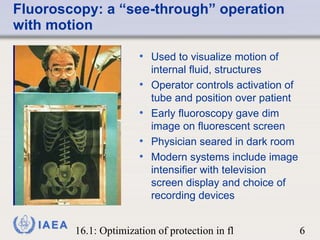
Fluoroscopy: a “see-through” operation with motion Used to visualize motion of internal fluid, structures Operator controls activation of tube and position over patient Early fluoroscopy gave dim image on fluorescent screen  Physician seared in dark room Modern systems include image intensifier with television screen display and choice of recording devices
Fluoroscopy X-ray transmitted trough patient The photographic plate replaced by fluorescent screen Screen fluoresces under irradiation and gives a life picture Older systems direct viewing of screen Nowadays screen part of an Image Intensifier system Coupled to a television camera Radiologist can watch the images “live” on TV-monitor; images can be recorded Fluoroscopy often used to observe digestive tract Upper GI series, Barium Swallow Lower GI series Barium Enema
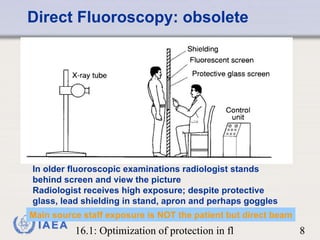
Direct Fluoroscopy: obsolete In older fluoroscopic examinations radiologist stands behind screen and view the picture Radiologist receives high exposure; despite protective glass, lead shielding in stand, apron and perhaps goggles Main source staff exposure is NOT the patient but direct beam
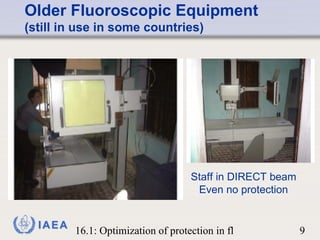
Older Fluoroscopic Equipment (still in use in some countries) Staff in DIRECT beam Even no protection
Direct fluoroscopy AVOID USE OF DIRECT FLUOROSCOPY Directive 97/43Euratom Art 8.4. In the case of fluoroscopy, examinations without an image intensification or equivalent techniques are not justified and shall therefore be  prohibited . Direct fluoroscopy will not comply with BSS App.II.25  “…  performance of diagnostic radiography and fluoroscopy equipment and of nuclear medicine equipment should be assessed on the basis of comparison with the guidance levels
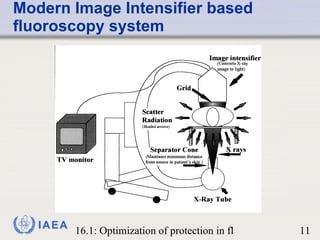
Modern Image Intensifier based fluoroscopy system
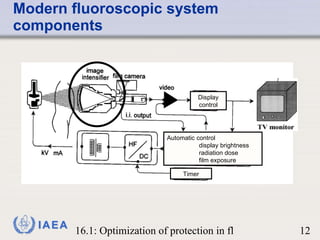
Modern fluoroscopic system components Automatic control display brightness radiation dose film exposure Timer Display control
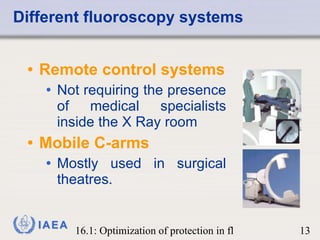
Different fluoroscopy systems Remote control systems Not requiring the presence of medical specialists inside the X Ray room Mobile C-arms Mostly used in surgical theatres.
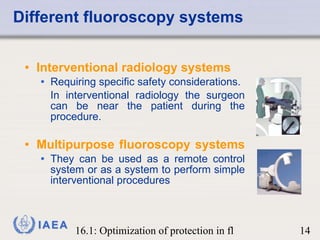
Different fluoroscopy systems Interventional radiology systems Requiring specific safety considerations. In interventional radiology the surgeon can be near the patient during the procedure. Multipurpose fluoroscopy systems   They can be used as a remote control system or as a system to perform simple interventional procedures
Part 16.1: Optimization of protection in fluoroscopy Topic 2: Image Intensifier component and parameters IAEA Training Material on Radiation Protection in Diagnostic and Interventional Radiology
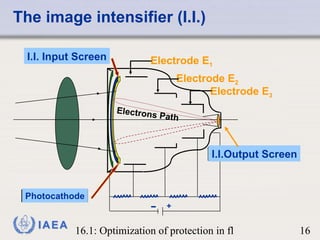
The image intensifier (I.I.) + I.I. Input Screen I.I.Output Screen Photocathode Electrode E 1 Electrode E 3 Electrode E 2 Electrons Path
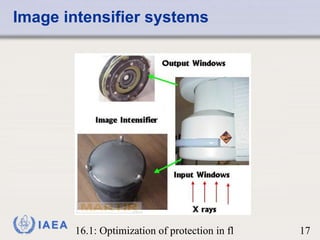
Image intensifier systems
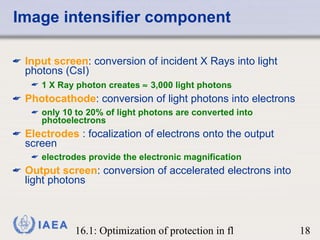
Image intensifier component Input screen : conversion of incident X Rays into light photons (CsI) 1 X Ray photon creates    3,000 light photons Photocathode : conversion of light photons into electrons only 10 to 20% of light photons are converted   into photoelectrons Electrodes  : focalization of electrons onto the output screen electrodes provide the electronic magnification Output screen : conversion of accelerated electrons into light photons
Image intensifier parameters (I) Conversion coefficient  ( Gx ): the ratio of the output screen brightness to the input screen dose rate  [ cd.m -2  Gys -1 ] Gx depends on the quality of the incident beam ( IEC  publication 573  recommends  HVL of 7    0.2 mm Al) Gx depends on :  the applied tube potential the diameter  (  )  of the input screen I.I. input screen  (  )  of 22 cm    Gx = 200 I.I. input screen  (  )  of 16 cm    Gx = 200 x (16/22) 2  = 105 I.I. input screen  (  )  of 11 cm    Gx = 200 x (11/22) 2  = 50
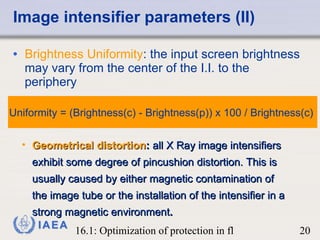
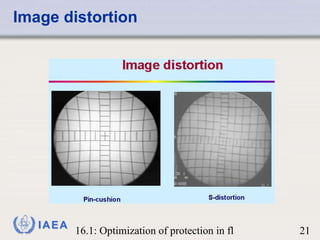
Image intensifier parameters (II) Brightness Uniformity : the input screen brightness may vary from the center of the I.I. to the periphery  Geometrical distortion :  all X Ray image intensifiers exhibit some degree of pincushion distortion. This is usually caused by either magnetic contamination of the image tube or the installation of the intensifier in a strong magnetic environment . Uniformity = (Brightness(c) - Brightness(p)) x 100 / Brightness(c)
Image distortion
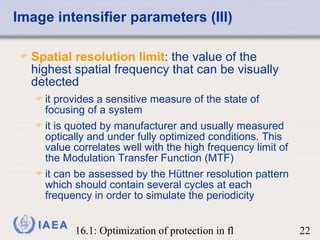
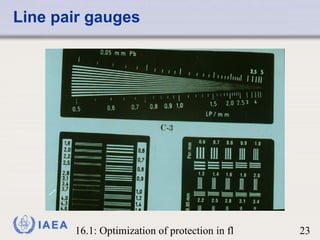
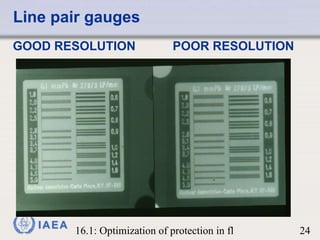
Image intensifier parameters (III) Spatial resolution limit : the value of the highest spatial frequency that can be visually detected it provides a sensitive measure of the state of focusing of a system it is quoted by manufacturer and usually measured optically and under fully optimized conditions. This value correlates well with the high frequency limit of the Modulation Transfer Function (MTF) it can be assessed by the Hüttner resolution pattern which should contain several cycles at each frequency in order to simulate the periodicity
Line pair gauges
Line pair gauges GOOD RESOLUTION POOR RESOLUTION
Image intensifier parameters  (IV) Overall image quality - threshold contrast-detail detection   X Ray, electrons and light scatter process in an I.I. can result in a significant loss of contrast of radiological detail. The degree of contrast exhibited by an I.I. is defined by the design of the image tube and coupling optics. Spurious sources of contrast loss are: accumulation of dust and dirt on the various optical surfaces reduction in the quality of the vacuum aging process (destruction of phosphor screen) Sources of noise are: X Ray   quantum mottle photo-conversion processes, film granularity, film processing
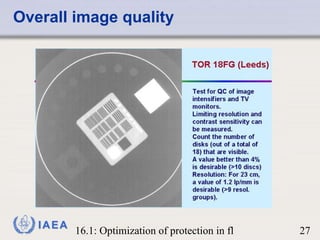
Image intensifier parameters  (V) Overall image quality can be assessed using a suitable threshold contrast-detail detectability test object which comprises an array of disc-shaped metal details and gives a range of diameters and X Ray transmission Sources of image degradation such as contrast loss, noise and unsharpness limit the number of details that are visible. If performance is regularly monitored using this test, any sudden or gradual deterioration in image quality can be detected as a reduction in the number of low contrast and/or small details.
Overall image quality
Part 16.1: Optimization of protection in fluoroscopy Topic 3: Image Intensifier and TV system IAEA Training Material on Radiation Protection in Diagnostic and Interventional Radiology
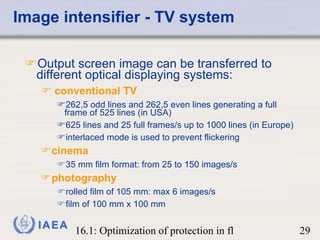
Image intensifier - TV system Output screen image can be transferred to different optical displaying systems: conventional TV   262,5 odd lines and 262,5 even lines generating a full frame of 525 lines (in USA)  625 lines and 25 full frames/s up to 1000 lines (in Europe) interlaced mode is used to prevent flickering cinema 35 mm film format: from 25 to 150 images/s photography rolled film of 105 mm: max 6 images/s film of 100 mm x 100 mm
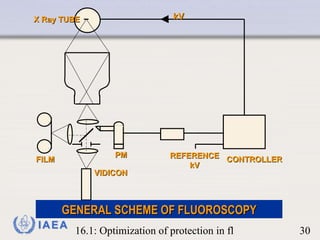
VIDICON FILM PM REFERENCE kV CONTROLLER X Ray TUBE kV GENERAL SCHEME OF FLUOROSCOPY
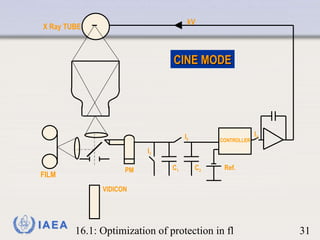
VIDICON FILM PM CONTROLLER X Ray TUBE kV CINE MODE I 2 Ref. I 3 C 1 I 1 C 2
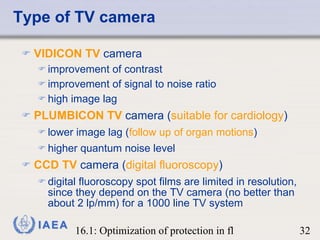
Type of TV camera VIDICON TV  camera improvement of contrast improvement of signal to noise ratio  high image lag PLUMBICON TV  camera ( suitable for cardiology ) lower image lag ( follow up of organ motions ) higher quantum noise level CCD TV  camera ( digital fluoroscopy ) digital fluoroscopy spot films are limited in resolution, since they depend on the TV camera (no better than about 2 lp/mm) for a 1000 line TV system
TV camera and video signal (I) The output phosphor of the image intensifier is optically coupled to a television camera system.  A pair of lenses focuses the output image onto the input surface of the television camera.  Often a beam splitting mirror is interposed between the two lenses.  The purpose of this mirror is to reflect part of the light produced by the image intensifier onto a 100 mm camera or cine camera. Typically, the mirror will reflect 90% of the incident light and transmit 10% onto the television camera.
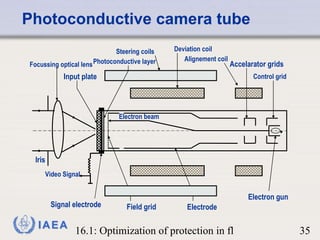
TV camera and video signal (II) Older fluoroscopy equipment will have a television system using a camera tube.  The camera tube has a glass envelope containing a thin conductive layer coated onto the inside surface of the glass envelope.  In a PLUMBICON tube, this material is made out of lead oxide, whereas antimony trisulphide is used in a VIDICON tube.
Photoconductive camera tube Focussing optical lens Input plate Steering coils Deviation coil Alignement coil Accelarator grids Control grid Electron beam Video Signal Signal electrode Field grid Electrode Electron gun Iris Photoconductive layer
TV camera and video signal (III) The surface of the photoconductor is scanned with an electron beam and the amount of current flowing is related to the amount of light falling on the television camera input surface. The scanning electron beam is produced by a heated photocathode.  Electrons are emitted into the vacuum and accelerated across the television camera tube by applying a voltage.  The electron beam is focussed by a set of focussing coils.
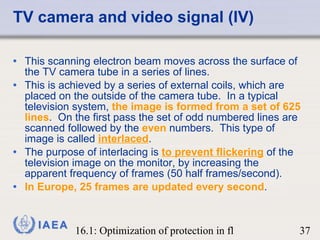
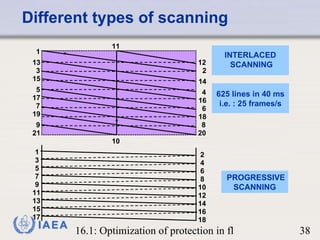
TV camera and video signal (IV) This scanning electron beam moves across the surface of the TV camera tube in a series of lines.  This is achieved by a series of external coils, which are placed on the outside of the camera tube.  In a typical television system,  the image is formed from a set of 625 lines .  On the first pass the set of odd numbered lines are scanned followed by the  even  numbers.  This type of image is called  interlaced . The purpose of interlacing is  to prevent flickering  of the television image on the monitor, by increasing the apparent frequency of frames (50 half frames/second).  In Europe, 25 frames are updated every second .
Different types of scanning INTERLACED  SCANNING PROGRESSIVE SCANNING 12 2 14 4 16 18 6 1 8 20 13 15 17 10 11 3 21 19 5 7 9 3 5 18 16 14 12 10 8 6 4 2 7 9 11 13 15 17 1 625 lines in 40 ms i.e. : 25 frames/s
TV camera and video signal (V) On most fluoroscopy units, the  resolution  of the system  is governed  by the  number of lines  of the television system.  Thus, it is possible to improve the high contrast resolution by increasing the number of television lines.  Some systems have 1,000 lines and prototype systems with 2,000 lines are being developed.
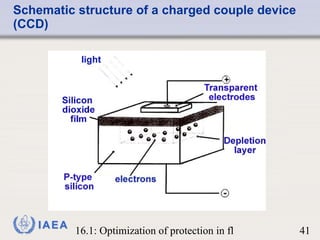
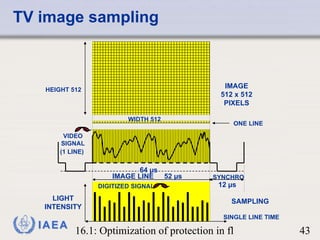
TV camera and video signal (VI) Many modern fluoroscopy systems used CCD (charge coupled devices) TV cameras.  The front surface is a  mosaic of detectors  from which a signal is derived.  The video signal comprises a set of  repetitive synchronizing pulses . In between there is a signal that is produced by the light falling on the camera surface.  The synchronizing voltage is used to trigger the TV system to begin sweeping across a raster line. Another voltage pulse is used to trigger the system to start rescanning the television field.
Schematic structure of a charged couple device (CCD)
TV camera and video signal (VII) A series of electronic circuits move the scanning beams of the TV camera and monitor in synchronism.  This is achieved by the synchronizing voltage pulses.  The current, which flows down the scanning beam in the TV monitor, is related to that in the TV camera. Consequently, the brightness of  the image on the TV monitor is proportional to the amount of light  falling on the corresponding position on the TV camera.
TV image  sampling SYNCHRO 12 µs LIGHT INTENSITY SAMPLING 64 µs VIDEO SIGNAL (1 LINE)   52 µs IMAGE LINE  SINGLE LINE TIME DIGITIZED SIGNAL ONE LINE IMAGE 512 x 512 PIXELS WIDTH 512 HEIGHT 512
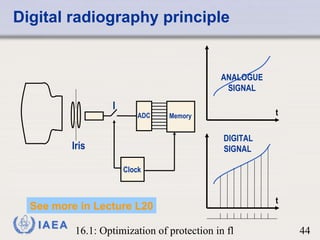
Digital radiography principle Clock Memory ADC I Iris t t ANALOGUE SIGNAL DIGITAL SIGNAL   See more in Lecture L20
Digital Image recording In newer fluoroscopic systems film recording replaced with digital image recording.  Digital photospots acquired by recording a digitized video signal and storing it in computer memory.  Operation fast, convenient. Image quality can be enhanced by application of various image processing techniques, including window-level, frame averaging, and edge enhancement.  But, the spatial resolution of digital photospots is less than that of film images.
It is possible to adjust the brightness and contrast settings of the TV monitor to improve the quality of the displayed image.  This can be performed using a suitable test object or electronic pattern generator. TV camera and video signal (VIII)
Summary The main components of the fluoroscopy imaging chain and their role are explained: Image Intensifier Associated image TV system
Where to Get More Information Physics of diagnostic radiology, Curry et al, Lea & Febiger, 1990 Imaging systems in medical diagnostics, Krestel ed., Siemens, 1990 The physics of diagnostic imaging, Dowsett et al, Chapman&Hall, 1998

Fluoroscopy systems

  • 1.
    RADIATION PROTECTION INDIAGNOSTIC AND INTERVENTIONAL RADIOLOGY L16.1: Optimization of protection in fluoroscopy
  • 2.
    Introduction Subject matter: fluoroscopy equipment and accessories Different electronic component contribute to the image formation in fluoroscopy. Good knowledge of their respective role and consistent Quality Control policy are the essential tools for an appropriate use of such an equipment.
  • 3.
    Topics Example offluoroscopy systems Image intensifier component and parameters Image intensifier and TV system
  • 4.
    Overview To becomefamiliar with the component of the fluoroscopy system (design, technical parameters that affect the fluoroscopic image quality and Quality Control).
  • 5.
    Part 16.1: Optimizationof protection in fluoroscopy Topic 1: Example of fluoroscopy systems IAEA Training Material on Radiation Protection in Diagnostic and Interventional Radiology
  • 6.
    Fluoroscopy: a “see-through”operation with motion Used to visualize motion of internal fluid, structures Operator controls activation of tube and position over patient Early fluoroscopy gave dim image on fluorescent screen Physician seared in dark room Modern systems include image intensifier with television screen display and choice of recording devices
  • 7.
    Fluoroscopy X-ray transmittedtrough patient The photographic plate replaced by fluorescent screen Screen fluoresces under irradiation and gives a life picture Older systems direct viewing of screen Nowadays screen part of an Image Intensifier system Coupled to a television camera Radiologist can watch the images “live” on TV-monitor; images can be recorded Fluoroscopy often used to observe digestive tract Upper GI series, Barium Swallow Lower GI series Barium Enema
  • 8.
    Direct Fluoroscopy: obsoleteIn older fluoroscopic examinations radiologist stands behind screen and view the picture Radiologist receives high exposure; despite protective glass, lead shielding in stand, apron and perhaps goggles Main source staff exposure is NOT the patient but direct beam
  • 9.
    Older Fluoroscopic Equipment(still in use in some countries) Staff in DIRECT beam Even no protection
  • 10.
    Direct fluoroscopy AVOIDUSE OF DIRECT FLUOROSCOPY Directive 97/43Euratom Art 8.4. In the case of fluoroscopy, examinations without an image intensification or equivalent techniques are not justified and shall therefore be prohibited . Direct fluoroscopy will not comply with BSS App.II.25 “… performance of diagnostic radiography and fluoroscopy equipment and of nuclear medicine equipment should be assessed on the basis of comparison with the guidance levels
  • 11.
    Modern Image Intensifierbased fluoroscopy system
  • 12.
    Modern fluoroscopic systemcomponents Automatic control display brightness radiation dose film exposure Timer Display control
  • 13.
    Different fluoroscopy systemsRemote control systems Not requiring the presence of medical specialists inside the X Ray room Mobile C-arms Mostly used in surgical theatres.
  • 14.
    Different fluoroscopy systemsInterventional radiology systems Requiring specific safety considerations. In interventional radiology the surgeon can be near the patient during the procedure. Multipurpose fluoroscopy systems They can be used as a remote control system or as a system to perform simple interventional procedures
  • 15.
    Part 16.1: Optimizationof protection in fluoroscopy Topic 2: Image Intensifier component and parameters IAEA Training Material on Radiation Protection in Diagnostic and Interventional Radiology
  • 16.
    The image intensifier(I.I.) + I.I. Input Screen I.I.Output Screen Photocathode Electrode E 1 Electrode E 3 Electrode E 2 Electrons Path
  • 17.
  • 18.
    Image intensifier componentInput screen : conversion of incident X Rays into light photons (CsI) 1 X Ray photon creates  3,000 light photons Photocathode : conversion of light photons into electrons only 10 to 20% of light photons are converted into photoelectrons Electrodes : focalization of electrons onto the output screen electrodes provide the electronic magnification Output screen : conversion of accelerated electrons into light photons
  • 19.
    Image intensifier parameters(I) Conversion coefficient ( Gx ): the ratio of the output screen brightness to the input screen dose rate [ cd.m -2  Gys -1 ] Gx depends on the quality of the incident beam ( IEC publication 573 recommends HVL of 7  0.2 mm Al) Gx depends on : the applied tube potential the diameter (  ) of the input screen I.I. input screen (  ) of 22 cm  Gx = 200 I.I. input screen (  ) of 16 cm  Gx = 200 x (16/22) 2 = 105 I.I. input screen (  ) of 11 cm  Gx = 200 x (11/22) 2 = 50
  • 20.
    Image intensifier parameters(II) Brightness Uniformity : the input screen brightness may vary from the center of the I.I. to the periphery Geometrical distortion : all X Ray image intensifiers exhibit some degree of pincushion distortion. This is usually caused by either magnetic contamination of the image tube or the installation of the intensifier in a strong magnetic environment . Uniformity = (Brightness(c) - Brightness(p)) x 100 / Brightness(c)
  • 21.
  • 22.
    Image intensifier parameters(III) Spatial resolution limit : the value of the highest spatial frequency that can be visually detected it provides a sensitive measure of the state of focusing of a system it is quoted by manufacturer and usually measured optically and under fully optimized conditions. This value correlates well with the high frequency limit of the Modulation Transfer Function (MTF) it can be assessed by the Hüttner resolution pattern which should contain several cycles at each frequency in order to simulate the periodicity
  • 23.
  • 24.
    Line pair gaugesGOOD RESOLUTION POOR RESOLUTION
  • 25.
    Image intensifier parameters (IV) Overall image quality - threshold contrast-detail detection X Ray, electrons and light scatter process in an I.I. can result in a significant loss of contrast of radiological detail. The degree of contrast exhibited by an I.I. is defined by the design of the image tube and coupling optics. Spurious sources of contrast loss are: accumulation of dust and dirt on the various optical surfaces reduction in the quality of the vacuum aging process (destruction of phosphor screen) Sources of noise are: X Ray quantum mottle photo-conversion processes, film granularity, film processing
  • 26.
    Image intensifier parameters (V) Overall image quality can be assessed using a suitable threshold contrast-detail detectability test object which comprises an array of disc-shaped metal details and gives a range of diameters and X Ray transmission Sources of image degradation such as contrast loss, noise and unsharpness limit the number of details that are visible. If performance is regularly monitored using this test, any sudden or gradual deterioration in image quality can be detected as a reduction in the number of low contrast and/or small details.
  • 27.
  • 28.
    Part 16.1: Optimizationof protection in fluoroscopy Topic 3: Image Intensifier and TV system IAEA Training Material on Radiation Protection in Diagnostic and Interventional Radiology
  • 29.
    Image intensifier -TV system Output screen image can be transferred to different optical displaying systems: conventional TV 262,5 odd lines and 262,5 even lines generating a full frame of 525 lines (in USA) 625 lines and 25 full frames/s up to 1000 lines (in Europe) interlaced mode is used to prevent flickering cinema 35 mm film format: from 25 to 150 images/s photography rolled film of 105 mm: max 6 images/s film of 100 mm x 100 mm
  • 30.
    VIDICON FILM PMREFERENCE kV CONTROLLER X Ray TUBE kV GENERAL SCHEME OF FLUOROSCOPY
  • 31.
    VIDICON FILM PMCONTROLLER X Ray TUBE kV CINE MODE I 2 Ref. I 3 C 1 I 1 C 2
  • 32.
    Type of TVcamera VIDICON TV camera improvement of contrast improvement of signal to noise ratio high image lag PLUMBICON TV camera ( suitable for cardiology ) lower image lag ( follow up of organ motions ) higher quantum noise level CCD TV camera ( digital fluoroscopy ) digital fluoroscopy spot films are limited in resolution, since they depend on the TV camera (no better than about 2 lp/mm) for a 1000 line TV system
  • 33.
    TV camera andvideo signal (I) The output phosphor of the image intensifier is optically coupled to a television camera system. A pair of lenses focuses the output image onto the input surface of the television camera. Often a beam splitting mirror is interposed between the two lenses. The purpose of this mirror is to reflect part of the light produced by the image intensifier onto a 100 mm camera or cine camera. Typically, the mirror will reflect 90% of the incident light and transmit 10% onto the television camera.
  • 34.
    TV camera andvideo signal (II) Older fluoroscopy equipment will have a television system using a camera tube. The camera tube has a glass envelope containing a thin conductive layer coated onto the inside surface of the glass envelope. In a PLUMBICON tube, this material is made out of lead oxide, whereas antimony trisulphide is used in a VIDICON tube.
  • 35.
    Photoconductive camera tubeFocussing optical lens Input plate Steering coils Deviation coil Alignement coil Accelarator grids Control grid Electron beam Video Signal Signal electrode Field grid Electrode Electron gun Iris Photoconductive layer
  • 36.
    TV camera andvideo signal (III) The surface of the photoconductor is scanned with an electron beam and the amount of current flowing is related to the amount of light falling on the television camera input surface. The scanning electron beam is produced by a heated photocathode. Electrons are emitted into the vacuum and accelerated across the television camera tube by applying a voltage. The electron beam is focussed by a set of focussing coils.
  • 37.
    TV camera andvideo signal (IV) This scanning electron beam moves across the surface of the TV camera tube in a series of lines. This is achieved by a series of external coils, which are placed on the outside of the camera tube. In a typical television system, the image is formed from a set of 625 lines . On the first pass the set of odd numbered lines are scanned followed by the even numbers. This type of image is called interlaced . The purpose of interlacing is to prevent flickering of the television image on the monitor, by increasing the apparent frequency of frames (50 half frames/second). In Europe, 25 frames are updated every second .
  • 38.
    Different types ofscanning INTERLACED SCANNING PROGRESSIVE SCANNING 12 2 14 4 16 18 6 1 8 20 13 15 17 10 11 3 21 19 5 7 9 3 5 18 16 14 12 10 8 6 4 2 7 9 11 13 15 17 1 625 lines in 40 ms i.e. : 25 frames/s
  • 39.
    TV camera andvideo signal (V) On most fluoroscopy units, the resolution of the system is governed by the number of lines of the television system. Thus, it is possible to improve the high contrast resolution by increasing the number of television lines. Some systems have 1,000 lines and prototype systems with 2,000 lines are being developed.
  • 40.
    TV camera andvideo signal (VI) Many modern fluoroscopy systems used CCD (charge coupled devices) TV cameras. The front surface is a mosaic of detectors from which a signal is derived. The video signal comprises a set of repetitive synchronizing pulses . In between there is a signal that is produced by the light falling on the camera surface. The synchronizing voltage is used to trigger the TV system to begin sweeping across a raster line. Another voltage pulse is used to trigger the system to start rescanning the television field.
  • 41.
    Schematic structure ofa charged couple device (CCD)
  • 42.
    TV camera andvideo signal (VII) A series of electronic circuits move the scanning beams of the TV camera and monitor in synchronism. This is achieved by the synchronizing voltage pulses. The current, which flows down the scanning beam in the TV monitor, is related to that in the TV camera. Consequently, the brightness of the image on the TV monitor is proportional to the amount of light falling on the corresponding position on the TV camera.
  • 43.
    TV image sampling SYNCHRO 12 µs LIGHT INTENSITY SAMPLING 64 µs VIDEO SIGNAL (1 LINE) 52 µs IMAGE LINE SINGLE LINE TIME DIGITIZED SIGNAL ONE LINE IMAGE 512 x 512 PIXELS WIDTH 512 HEIGHT 512
  • 44.
    Digital radiography principleClock Memory ADC I Iris t t ANALOGUE SIGNAL DIGITAL SIGNAL See more in Lecture L20
  • 45.
    Digital Image recordingIn newer fluoroscopic systems film recording replaced with digital image recording. Digital photospots acquired by recording a digitized video signal and storing it in computer memory. Operation fast, convenient. Image quality can be enhanced by application of various image processing techniques, including window-level, frame averaging, and edge enhancement. But, the spatial resolution of digital photospots is less than that of film images.
  • 46.
    It is possibleto adjust the brightness and contrast settings of the TV monitor to improve the quality of the displayed image. This can be performed using a suitable test object or electronic pattern generator. TV camera and video signal (VIII)
  • 47.
    Summary The maincomponents of the fluoroscopy imaging chain and their role are explained: Image Intensifier Associated image TV system
  • 48.
    Where to GetMore Information Physics of diagnostic radiology, Curry et al, Lea & Febiger, 1990 Imaging systems in medical diagnostics, Krestel ed., Siemens, 1990 The physics of diagnostic imaging, Dowsett et al, Chapman&Hall, 1998

Editor's Notes

  • #2 Part …: ( Add part number and title) Module…: ( Add module number and title) Lesson …: ( Add session number and title) Learning objectives: Upon completion of this lesson, the students will be able to: … . (Add a list of what the students are expected to learn or be able to do upon completion of the session) Activity: ( Add the method used for presenting or conducting the lesson – lecture, demonstration, exercise, laboratory exercise, case study, simulation, etc.) Duration: ( Add presentation time or duration of the session – hrs) Materials and equipment needed: (List materials and equipment needed to conduct the session, if appropriate) References: (List the references for the session)
  • #3 Explanation or/and additional information Instructions for the lecturer/trainer
  • #4 Explanation or/and additional information Instructions for the lecturer/trainer
  • #5 Lecture notes: ( about 100 words) Instructions for the lecturer/trainer
  • #6 Part …: ( Add part number and title) Module…: ( Add module number and title) Lesson …: ( Add session number and title) Learning objectives: Upon completion of this lesson, the students will be able to: … . (Add a list of what the students are expected to learn or be able to do upon completion of the session) Activity: ( Add the method used for presenting or conducting the lesson – lecture, demonstration, exercise, laboratory exercise, case study, simulation, etc.) Duration: ( Add presentation time or duration of the session – hrs) Materials and equipment needed: (List materials and equipment needed to conduct the session, if appropriate) References: (List the references for the session)
  • #16 Part …: ( Add part number and title) Module…: ( Add module number and title) Lesson …: ( Add session number and title) Learning objectives: Upon completion of this lesson, the students will be able to: … . (Add a list of what the students are expected to learn or be able to do upon completion of the session) Activity: ( Add the method used for presenting or conducting the lesson – lecture, demonstration, exercise, laboratory exercise, case study, simulation, etc.) Duration: ( Add presentation time or duration of the session – hrs) Materials and equipment needed: (List materials and equipment needed to conduct the session, if appropriate) References: (List the references for the session)
  • #29 Part …: ( Add part number and title) Module…: ( Add module number and title) Lesson …: ( Add session number and title) Learning objectives: Upon completion of this lesson, the students will be able to: … . (Add a list of what the students are expected to learn or be able to do upon completion of the session) Activity: ( Add the method used for presenting or conducting the lesson – lecture, demonstration, exercise, laboratory exercise, case study, simulation, etc.) Duration: ( Add presentation time or duration of the session – hrs) Materials and equipment needed: (List materials and equipment needed to conduct the session, if appropriate) References: (List the references for the session)
  • #48 Let’s summarize the main subjects we did cover in this session. (List the main subjects covered and stress again the important features of the session)