Dedicated to:
From:
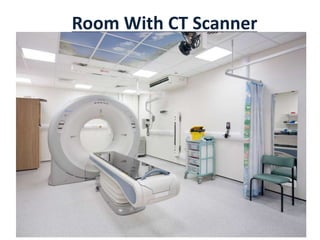
Room With CT Scanner
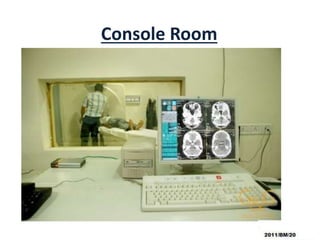
Console Room
Introduction
• Tomography is from the Greek word "tomos"
meaning "slice" and “graph” meaning "describing".
• .
• CT was invented in 1972 by British engineer
Godfrey Hounsfield of EMI Laboratories.
• The first clinical CT scanners were installed
between 1974 and 1976.
• It combines the use of a digital computer together with a
rotating x-ray device to create detailed cross sectional
images or "slices" of the different organs and body parts
such as the lungs, liver, kidneys, pancreas, pelvis, etc.
• CT Scan has the unique ability to image a combination of
soft tissue, bone, and blood vessels.
• For example, conventional x-ray imaging of the head can
only show the dense bone structures of the skull .
Diagram showing
relationship of x-ray tube,
patient, detector, and
image reconstruction
computer and display
monitor
Generations Of CT Scanner
• First Generation
• Second Generation
• Third Generation
• Fourth Generation
• Fifth Generation
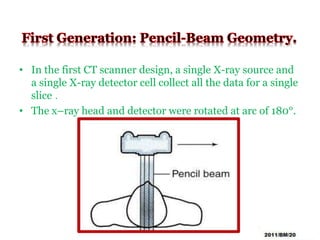
• In the first CT scanner design, a single X-ray source and
a single X-ray detector cell collect all the data for a single
slice .
• The x–ray head and detector were rotated at arc of 180°.
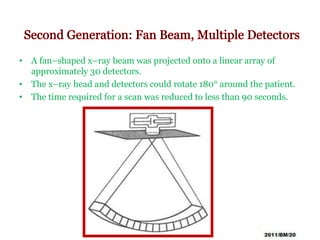
• A fan–shaped x–ray beam was projected onto a linear array of
approximately 30 detectors.
• The x–ray head and detectors could rotate 180° around the patient.
• The time required for a scan was reduced to less than 90 seconds.
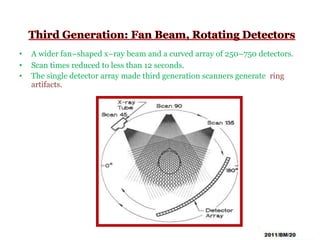
• A wider fan–shaped x–ray beam and a curved array of 250–750 detectors.
• Scan times reduced to less than 12 seconds.
• The single detector array made third generation scanners generate ring
artifacts.
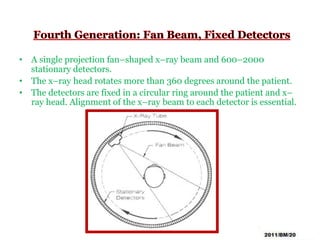
• A single projection fan–shaped x–ray beam and 600–2000
stationary detectors.
• The x–ray head rotates more than 360 degrees around the patient.
• The detectors are fixed in a circular ring around the patient and x–
ray head. Alignment of the x–ray beam to each detector is essential.
• Fifth-generation scanners are unique in that the x-ray source
becomes an integral part of the system design.
• The detector array remains stationary, while a high-energy electron
beams is electronically swept along a semicircular tungsten strip
anode.
• This machine is a research prototype and is not available
commercially.
• Volume CT images can be produced in as little as 10 ms.
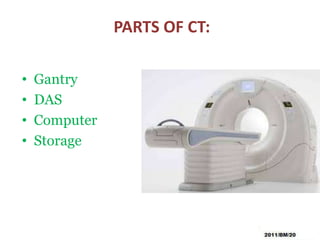
PARTS OF CT:
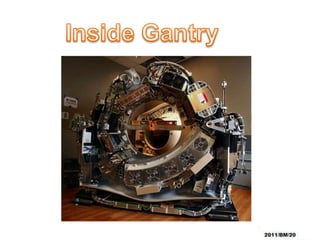
• Gantry
• DAS
• Computer
• Storage
Gantry
• The Gantry includes the:
– The X-ray tube
– The Detector Array
– The High-Voltage generator
– The patient Support Couch
DAS (data acquizition system)
• DETECTORS
• CURRENT TO VOLTAGE CONVERTERS
• PRE AMPLIFIER
• INTEGRATOR
• ADC
• To computer world
• COMPUTER:
It involve processing
• STORAGE:
It can be film, CD, Hard Disk, etc.
• CT imaging is used for studying the chest, abdomen and pelvis
because it provides detailed, cross-sectional views of all types of
tissue.
• CT imaging detect many different cancers, including lung, liver and
pancreatic cancer and the tumors of brain and head.
• Since the image allows a physician to confirm the presence of a
tumor and measure its size, precise location and the extent of the
tumor's involvement with other nearby tissue.
• CT scanning is painless, noninvasive and accurate.
• A major advantage of CT is its ability to image bone, soft
tissue and blood vessels all at the same time.
• Unlike conventional x-rays, CT scanning provides very
detailed images of many types of tissue as well as the
lungs, bones, and blood vessels.
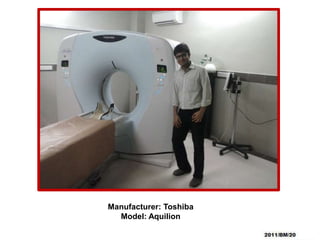
Manufacturer: Toshiba
Model: Aquilion
Thank you

CT scanner

  • 2.
  • 3.
    Room With CTScanner
  • 4.
  • 5.
    Introduction • Tomography isfrom the Greek word "tomos" meaning "slice" and “graph” meaning "describing". • . • CT was invented in 1972 by British engineer Godfrey Hounsfield of EMI Laboratories. • The first clinical CT scanners were installed between 1974 and 1976.
  • 6.
    • It combinesthe use of a digital computer together with a rotating x-ray device to create detailed cross sectional images or "slices" of the different organs and body parts such as the lungs, liver, kidneys, pancreas, pelvis, etc. • CT Scan has the unique ability to image a combination of soft tissue, bone, and blood vessels. • For example, conventional x-ray imaging of the head can only show the dense bone structures of the skull .
  • 7.
    Diagram showing relationship ofx-ray tube, patient, detector, and image reconstruction computer and display monitor
  • 8.
    Generations Of CTScanner • First Generation • Second Generation • Third Generation • Fourth Generation • Fifth Generation
  • 9.
    • In thefirst CT scanner design, a single X-ray source and a single X-ray detector cell collect all the data for a single slice . • The x–ray head and detector were rotated at arc of 180°.
  • 10.
    • A fan–shapedx–ray beam was projected onto a linear array of approximately 30 detectors. • The x–ray head and detectors could rotate 180° around the patient. • The time required for a scan was reduced to less than 90 seconds.
  • 11.
    • A widerfan–shaped x–ray beam and a curved array of 250–750 detectors. • Scan times reduced to less than 12 seconds. • The single detector array made third generation scanners generate ring artifacts.
  • 12.
    • A singleprojection fan–shaped x–ray beam and 600–2000 stationary detectors. • The x–ray head rotates more than 360 degrees around the patient. • The detectors are fixed in a circular ring around the patient and x– ray head. Alignment of the x–ray beam to each detector is essential.
  • 13.
    • Fifth-generation scannersare unique in that the x-ray source becomes an integral part of the system design. • The detector array remains stationary, while a high-energy electron beams is electronically swept along a semicircular tungsten strip anode. • This machine is a research prototype and is not available commercially. • Volume CT images can be produced in as little as 10 ms.
  • 14.
    PARTS OF CT: •Gantry • DAS • Computer • Storage
  • 15.
    Gantry • The Gantryincludes the: – The X-ray tube – The Detector Array – The High-Voltage generator – The patient Support Couch
  • 16.
    DAS (data acquizitionsystem) • DETECTORS • CURRENT TO VOLTAGE CONVERTERS • PRE AMPLIFIER • INTEGRATOR • ADC • To computer world
  • 17.
    • COMPUTER: It involveprocessing • STORAGE: It can be film, CD, Hard Disk, etc.
  • 18.
    • CT imagingis used for studying the chest, abdomen and pelvis because it provides detailed, cross-sectional views of all types of tissue. • CT imaging detect many different cancers, including lung, liver and pancreatic cancer and the tumors of brain and head. • Since the image allows a physician to confirm the presence of a tumor and measure its size, precise location and the extent of the tumor's involvement with other nearby tissue.
  • 19.
    • CT scanningis painless, noninvasive and accurate. • A major advantage of CT is its ability to image bone, soft tissue and blood vessels all at the same time. • Unlike conventional x-rays, CT scanning provides very detailed images of many types of tissue as well as the lungs, bones, and blood vessels.
  • 21.
  • 22.