CONVENTIONAL
FLUOROSCOPY, IMAGE
INTENSIFIER TUBE
Presentor: Anjan Dangal
B.Sc.MIT 2nd year
National Academy of Medical Sciences
INTRODUCTION
• Imaging Technique , Uses : X rays
• Production of Dynamic radiographic image, in effects, moving pictures.
• Obtained in Real time
• Allows visualization of internal structure and functions
• Term Fluorescence, describes the material that immediately emits the
Visible light , in response to some stimulus
HISTORY
• “ On a New kind of Ray” By Roentgen in 1895
• Interest in X rays Around the scientific world.
• Thomas Edison Jumped to Interest.
• 4 months, later exposed over 8000, substances to x rays
• Calcium tungstate , fluoresced most brightly
• Used this substance to create Edison vitascope,, device for recreational fluroscopy
HISTORY
• By, Thomas Alba Edison, in 1896
• Device was light tight, hand held metal cone
• Early fluoroscopes were simply cardboard funnels, open at narrow end for the
eyes of the observer, while the wide end was closed with a thin cardboard piece
that had been coated on the inside with a layer of fluorescent metal salt
• Thomas Edison examines Clarence
Dally's, his assistant, hand thru a
fluoroscope of his own design.
• Credit: Science Source / Photo
Researchers (Crosby, 38) After his
assistant's death (which was
radiation related) years later,
Edison swore off x-ray research
and never touched it again.
• WWI, 1917; Operation on a
wounded soldier with the
surgeon using a fluoroscope to
locate the bullets. Although
the surgeon is wearing gloves,
little protection against
radiation appears to be used.
From A. M. Jungmann, "X-rays:
Samaritans of war" in
Waldemar Kaempffert, Ed
SHOE FITTING
• Limited light produced from the
fluroscent screen
• Fluroscopic Image was faint
• early radiologists were required to
sit in a darkened room, in which the
procedure was to be performed,
accustomizing their eyes to the dark
and thereby increasing their
sensitivity to the light.
• Red adaptation googles were
developed by William Tredelenberg
to address the problem of dark
adaptation of the eyes.
• The resulting red light from the
goggles' filtration correctly
sensitized the physician's eyes prior
to the procedure, while still allowing
him to receive enough light to
function normally.
LIMIATATION OF 1ST FLUROSCOPE
• Extremely dim : to maximize dark room : 10 min. later red goggles glass
• High Radiation dose both to the patient and observer
• In 1941, William Chamberlain’s studies on poor illumination from the fluoroscopic
screens resulted in the development of the image intensifier in the 1953.
EXPOSURE
• Exposure rate rather lower than General radiography.
• 80 Kvp, 600mA, 0.1 sec = Skin Entrance exposure-1.0 R
• If 80 Kvp, 600mA, 10 min = Skin Entrance Exposure- 5900 R
• Serious Radiation Injury.
• Actually only 3 mA, 10 min = 30 R
• Exposure rate is much less but Total X ray exposure is usually higher.
• Radiography Image= 600 time more photons/sec
ELECTRONIC IMAGE INTENSIFICATION TUBE
• By Russel H. Morgan in 1940s.
• Improved image visibility, lower radiation dose, record permanent image
MODERN FLUROSCOPIC IMAGING
X RAY GENERATOR
• Selection of KVP and MA
• Added circuitry for fluoroscopic operation, including either low continuous tube
current or rapid pulsed exposure and Automatic Brightness control.
• High Frequency generators are commonly used.
TWO METHODS USED TO ENERGISE X RAY TUBE
FOR FLUROSCOPY
1. Continuous Fluroscopy: where generators provide a steady tube current while
the fluoroscope is activated. Image Acquired at a rate of 30 frames/sec,
resulting in Acquisition time of 33msec per image.
2. Pulsed Fluroscopy: exposure delivered in short pulses , 3- 10 msec in length ,
pulse rate of 30 pulses per second is used with some unit allowing lower pulse
rate of 15 or 7.5 pulses/sec.
Adv: Improved in Temporal resolution, motion blurres occurring within each
image is reduced because of shorter acquisition time
• Another important feature of a fluoroscopic xray generator is ABC, which acts to
keep the overall image brightness seen on the monitor at a constant level as the
image intensifier is panned over body parts of differing thickness and attenuation.
• Constant brightness is achieved by automatically adjusting the kVp and mA
settings as needed to maintain the x-ray exposure level at the entrance to the
image intensifier.
X RAY TUBE
• Small focal spot desired to reduce geometric unsharpness
• Small focal spot of 0.3 – 0.6mm used
• Large focal spot of 1.0- 1.2 mm used
• To improve heat dissipation, high-speed anode rotation may be used (over
10,000 rpm).
• In addition, a circulating water or oil heat exchanger with cooling fans is
commonly installed.
• grid-controlled pulsing to produce very short (millisecond) exposures for cine
image recording or pulsed fluoroscopy.
COLLIMATORS
A round iris conforms the x-ray beam to the
circular FOV.
The collimator automatically limits the x-ray
beam to no larger than the FOV
Most fluoroscopy systems used for
angiography and interventional applications
also contain equalization filters.
These filters, also called contour or wedge
filters, are partially radiolucent blades used to
provide further beam shaping in addition to
collimation
FILTERS
• HVL for both radiography and fluoroscopy be 2.3 mm Al at 80 kVp.
• However, it is recommended that the minimum HVL be increased to 3.0 mm Al at
80 kVp to reduce patient dose, particularly for fluoroscopy
• Aluminum is the most common added filtration material.
GRID
• Reduces scattered radiation that reaches the IR
• The grid ratios for fluoroscopy range from 6:1 to 10:1, which is generally lower
than common radiographic grid ratios (8:1 to 16:1)
• removal of the grid may be desirable to reduce patient dose when the amount of
scatter produced is low
• With the grid removed, patient exposure can be reduced by about 50%.
IMAGE INTENSIFIER TUBE
• The image intensifier converts incident x rays into a minified visible light image and, in the
process, amplifies the image brightness by about 10,000 times for better visibility to the viewer.
• Vaccum Tube consisting of 5 basic parts:
1. Input layer
2. Photocathode
3. Electrostatic lenses
4. Accelerating Anode
5. Output layer
• Input Diameter = 6,9,12 or 16 inch Increased Resolution
• Output Diameter= 1 inch
• Results, Image Bright at
Output x 1ooo times
INPUT LAYER
• The input layer is made up of four different components:
1. the input window,
2. substrate,
3. input phosphor,
4. and photocathode
• First, x rays strike the input window, which is made of a curved, thin layer of metal
or glass.
• Next, they pass through the 0.5-mm-thick aluminum substrate layer and input
phosphor layer, where they are converted into light photons.
INPUT PHOSPHOR
• Microscopic Needles of Cesium Iodide
• Columnar Shaped- prevents light dispersion- preserves resolution
• Radiation Light, yellow – green wavelength
• The fluorescent material in early screens was barium platinocyanide, which was
subsequently replaced by cadmium tungstate and later zinc-cadmium sulfide
WHY CSI: NA
• It has a high atomic number from
Cs ( Z= 55) and I 9Z=53) which
also results in higher x ray
absorption.
• Csi screens absorbs 2/3 of the
incident beam as compared to less
than 1/3 for the cadmium sulfide.
• K edge energies in Csi is in the
diagnostic range 36KeV for Cs and
33 KeV for I
PHOTOCATHODE
• Photoemissive metal: Antimony + Cesium Compunds
• Receives light from Input Screen
• Free Up Electrons
• Single X ray Photons= Many Light Photons
• Ex: 60 kv x ray photons , 200 photoelectrons being emited
• Milllions of Electrons
• To maximize conversion efficiency from the light photon to the photoelectron, light
emitted from the input phosphor should match the sensitivity spectrum of the
photocathode
ELECTROSTATIC FOCUSING LENS
• Series of bands or rings of Metal
• Have varying positive voltage, through which circular electron beam must pass
• Capacity of pulling the electron towards output phosphor
• Focusing rings: increasing degree of positive charge as becomes narrower
towards anode
• Arranged as the electrons focused on much smaller area
• Process of focusing the electrons onto small output phosphors: Minification
ACCELERATING ANODE
• Location: Neck of IIT, Small ring of metal
• Function: Attract and accelerate electrons towards output phosphors.
• + Charge of 25000V to 30000V
• Electrons energy 50 to 75 times more than they left Input phosphors
• Transformed to light
• The Ratio of the numbers of light photons emitted by output phosphors to the
number of X ray striking the input phosphor is called flux gain .
OUTPUT PHOSPHOR
• Zinc cadmium sulphide : Silver ( Zn CDs: Ag)
• Electrons converted to light
• Typically only 1 inch in diameter.
• Light emitted is concentrated and bright
• Light passes to Television camera tube or CCD.
WORKING OF II TUBE
• First, x rays strike the input window, which is made of a curved, thin layer of metal
or glass. Next, they pass through the 0.5-mm-thick aluminum substrate layer and
input phosphor layer, where they are converted into light photons
• The light photons emitted from the input phosphor are then absorbed in the
photocathode and converted into electrons
• The electrons emerging from the photocathode are focused and accelerated
through the vacuum to the output layer by the electron optics system
• At the output phosphor, the electrons are converted into visible light photons.
These photons are then transmitted out of the image intensifier through a glass
output window.
OPTICAL COUPLING
• system distributes light from the image intensifier output window to a video
camera and other image recording devices
• The optical distributor may include a partially silvered, beam-splitting mirror,
which directs a portion of the light from the image intensifier output window to
an accessory device for image recording and passes the remainder to the video
camera.
• A circular aperture is also included to set the proper light level required by the
video camera.
• The aperture setting affects the appearance of noise in the fluoroscopic image.
TELEVISION SYSTEM
• closed-circuit television system is used to view the image intensifier output
image.
• consists of a video camera that converts the image to a voltage signal and a
monitor that receives the signal and forms the image display.
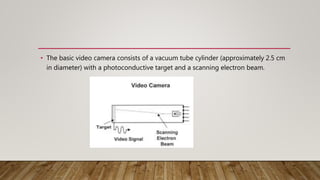
• The basic video camera consists of a vacuum tube cylinder (approximately 2.5 cm
in diameter) with a photoconductive target and a scanning electron beam.
• The optical coupling lens focuses the image intensifier output image onto the
target, forming a latent charge image from the charge carriers within the
photoconductive layer.
• This latent image is read out by the electron beam, which scans across the target
in a series of horizontal raster lines.
• As the scanning electron beam moves across the target, a current signal is
produced that represents the two-dimensional image as a continuous series of
raster lines with varying voltage levels.
• a new type of camera has been developed to replace the traditional vacuum tube
design.
• Charge coupled device (CCD) cameras consist of a solid-state array of light
sensors, which store the image as pixels
• s, CCD cameras are smaller, are more rugged, require less power, and have a
longer lifetime
MONITOR
• The voltage signal produced by the video camera is converted into a visible
image by the monitor.
• The monitor consists of a vacuum chamber with a phosphor screen and scanning
electron beam.
• The electron beam moves across the phosphor screen in horizontal raster scan
lines with the intensity variation controlled by the camera voltage signal, thus
reproducing the image from the video camera target.
IMAGE RECORDING
• include additional devices to record images during an examination.
• Recording methods include
1. spot film devices,
2. film changers,
3. photospot cameras,
4. cine cameras, and
5. digital photospots
SPOT FILM DEVICES
• used to acquire a radiographic image with a screen-film cassette that is moved
into position in front of the image intensifier.
• Collimation can be automatically varied to produce multiple image formats (for
example, four images on one film).
• Clinical applications of spot film devices include gastrointestinal imaging,
genitourinary imaging, arthrography, and myelography
FILM CHANGERS
• also acquire a radiographic film either in front of the image intensifier or with it
moved out of position.
• Film changers are known by many different names (rapid film changer, serial film
changer, cut-film changer, Puck [Elema Schonander] film changer, BCM [B. C.
Medical] long cassette changer); however, the basic operation for each is similar.
• Films are moved rapidly into position from a supply magazine at a selectable rate
up to four films per second and then transferred to a take-up magazine for
manual transport to a film processor.
• The primary clinical application of film changers is dynamic vascular imaging with
iodinated contrast material
PHOTOSPOT CAMERAS
• Photospot cameras record the image intensifier output on rolled or cut film to
produce images about 10 cm in diameter.
• The photospot camera is mounted on the optical distributor accessory device
port to record images rapidly during the fluoroscopic examination.
• Photofluorography is generally used for the same clinical examinations as spot
film devices.
CINE CAMERA
• A cine camera may also be mounted as an accessory image recording device to
acquire images on 35-mm film.
• Cinefluorography is typically used for cardiac catheterization procedures to
record rapid rate images of the beating heart.
DIGITAL IMAGE RECORDING
• Digital photo spots are acquired by recording a digitized video signal and storing
it in computer memory.
• The operation is fast and convenient, plus image quality can be enhanced by the
application of various image processing techniques, including window-level,
frame averaging, and edge enhancement.
FLUROSCOPIC IMAGE QUALITY
• The number of x-ray photons absorbed by the image intensifier determines the
statistical quality of a fluoroscopic image.
• The image quality of an image intensification system is defined by its
1. scintillation,
2. contrast and
3. distortion.
SCINTILLATION
• scintillation is often used to generally indicate the emission of light, its more precise meaning is to
“twinkle” or give off varying amounts of light
• quantum noise is the variation of intensity distribution within an x-ray beam.
• result of quantum noise is quantum mottle in the image.
• The noise pattern, since it is random in nature, has the tendency to appear to be moving,
giving rise to the expression of “crawling ants” or “snow.”
• This effect occurs when an insufficient number of x-rays per unit of time are absorbed at
the input screen of the I.I.
• Therefore, the ususal method employed to eliminate quantum noise is
• to raise the x-ray tube current (mA) to generate more x-ray quanta in a given period of
• time. Once this threshold is reached, the noise may disappear,
CONTRAST
• Image intensifier not good at preservation of Image contrast.
• Any x-ray photon incident on the input screen of the image intensifier, which is
not absorbed by the input phosphor, may pass through the intensifier tube and, if
close to the intensifier tube axis, will strike the output phosphor screen.
• any light emitted at the output phosphor screen moving backward through the
tube axis
• Contrast tends to deteriorate as an image intensifier ages.
• The deterioration rate can be as high as 10 percent per year.
DISTORTION
• Various types of distortion can occur in the fluoroscopically intensified image,
including
1. pincushion distortion,
2. veiling glare, and
3. vignetting.
PINCUSHION
• Pincushion distortion results in slightly higher magnification of the input
image toward the edge of the image.
• Because of pincushion distortion, the central region of the input phosphor
produces better spatial resolution than the periphery.
• This means that operation in magnification mode also yields a sharper
overall image.
• Another kind of spatial distortion that can occur with the image from an
intensifier tube is s-distortion, which can be caused by strong external
magnetic or electrical fields in close proximity to the image intensifier tube.
VEILING GLARE
• the consequence of light scatter from the output screen window of
the image intensifier.
• The scattered light, just like scattered radiation, adds to the
background signal and degrades the contrast in the fluoroscopic
image.
• The scattering of x-rays up through the image intensifier tube, and of
electrons from the beam within the tube, also both contribute to
veiling glare.
• Any brightness in the middle area of the disc image, which should be
dark, is indicative of veiling glare from scattered light, x-rays and
electrons.
VIGNETTING
• The brightness measured at the output phosphor will vary from the center to the
periphery of the image, even if a homogeneous x-ray field was incident upon the
image intensifier.
• The brightness will be greatest toward the center of the image and will fall off at the
edges.
• One source of vignetting is a consequence of pincushion distortion.
• With pincushion distortion the image is magnified to a greater extent toward the
periphery.
• This means the minifying, electron-concentrating effect of the electronic optics is
reduced at the periphery, causing less brightness there.
• Vignetting also occurs in the optical coupling between the image intensifier tube and
any recording device, because of scattered light effects.
DIGITAL FLUROSCOPY
• Dynamic flat panel detectors
1. Image Intensifier tubes are being replaced by flat-panel digital detectors
Two types of dynamic FPDs are available:
An indirect detector using a cesium iodide phosphor couled to an active matrix
array of amorphous silicon TFts
Direct detector using AMA of amorphous selenium TFTs.
• In fluoroscopic applications, the challenge for FPDs has been the requirement of
low dose per image frame, meaning that the inherent electronic noise of the
detector must be extremely low, and the required dynamic range is high.
• It has proven to be quite difficult to manufacture FPDs with electronic noise
characteristics low enough to achieve good signal-to-noise ratio (SNR) under low
exposure conditions, yet such devices do now exist.
WORKING MECHANISM
• In a dynamic FPD, a light-emitting diode (LED) array is located below the detector
which has a function similar to the “erase” cycle of a CR processor—it produces a
bright microsecond flash of light to erase images after each frame is taken in
order to eliminate any ghost images.
• The LED array “refreshes” the detector panel between each frame
ADVANTAGE OF FPDS
• Flat panel detectors are more physically compact than XRII/video systems, allowing
more flexibility in movement and patient positioning.
• However, the most important benefit of the FPD is that it does not suffer from the
many inherent limitations of the XRII, including geometric “pin-cushion” distortion, “S”
distortion, veiling glare (glare extending from very bright areas) and vignetting (loss of
brightness at periphery). Other advantages of dynamic flat-panel detectors over
convention fluoroscopy
• include their contrast enhancement of low subject-contrast anatomical structures,
high DQE and dynamic range across all levels of exposure, and their rectangular shape
which corresponds with a rectangular display screen.
DIFFERENCE BETWEEN DYNAMIC FPDS AND STATIC
FPDS
• Dynamic FPDs have large dimensions compared to static FPDs
• Pixel sizes of 200–300 microns are used digital fluoroscopy detectors, larger than
those for digital radiography detectors (100–150 microns)
• Dynamic flat-panel detectors can operate in either continuous or pulsed x-ray
modes.
SUMMARY
• Fluoroscopy is one of the few modalities that provide live imaging of the patient. In
addition to real-time diagnosis, it is useful for positioning of the patient and
performing interventional procedures.
• Early fluoroscopic imaging required direct viewing of a fluorescent screen. Since the
image brightness of this system was insufficient, it was necessary for the operator to
become dark-adapted before performing the examination. Modern fluoroscopic
imaging uses an image intensifier to amplify image brightness and a television
system for image viewing.
• Fluoroscopic units utilizing a flat-panel detector instead of an image intensifier and
video camera are new technology.
REFRENCES
• RSNA Physics tutorial for Residents, General Overview of Fluroscopic Imaging
• www.imagewisely.og/ Modern Fluroscopy Imaging System
• www.Wikipedia.com/ Fluroscopy
• www.slideshare.com/ fluoroscopy
• Radiography in Digital Age, Quinn B carol
• Physics for Radiologic Technologist, Bushong
1.WHY IS LOW EXPOSURE RATE USED IN
FLUROSCOPY?
2. FUNCTION OF OPTICAL COUPLING SYSTEM?
WHAT IS PINCUSHION DISTORTION?
WHAT IS FLUX GAIN?
MAJOR DIFFERENCE BETWEEN CONTINUOUS
FLUOROSCOPY AND PULSED FLUROSCOPY
TYPES OF IMAGE RECORDING METHOD USED IN
FLUOROSCOPY?
HOW IS FLAT PANEL DETECTORS DIFFERENT FROM
IMAGE INTENSIFIER TUBE USED IN FLUROSCOPY

Fluroscopy

  • 1.
    CONVENTIONAL FLUOROSCOPY, IMAGE INTENSIFIER TUBE Presentor:Anjan Dangal B.Sc.MIT 2nd year National Academy of Medical Sciences
  • 2.
    INTRODUCTION • Imaging Technique, Uses : X rays • Production of Dynamic radiographic image, in effects, moving pictures. • Obtained in Real time • Allows visualization of internal structure and functions • Term Fluorescence, describes the material that immediately emits the Visible light , in response to some stimulus
  • 3.
    HISTORY • “ Ona New kind of Ray” By Roentgen in 1895 • Interest in X rays Around the scientific world. • Thomas Edison Jumped to Interest. • 4 months, later exposed over 8000, substances to x rays • Calcium tungstate , fluoresced most brightly • Used this substance to create Edison vitascope,, device for recreational fluroscopy
  • 4.
    HISTORY • By, ThomasAlba Edison, in 1896 • Device was light tight, hand held metal cone
  • 5.
    • Early fluoroscopeswere simply cardboard funnels, open at narrow end for the eyes of the observer, while the wide end was closed with a thin cardboard piece that had been coated on the inside with a layer of fluorescent metal salt
  • 6.
    • Thomas Edisonexamines Clarence Dally's, his assistant, hand thru a fluoroscope of his own design. • Credit: Science Source / Photo Researchers (Crosby, 38) After his assistant's death (which was radiation related) years later, Edison swore off x-ray research and never touched it again.
  • 7.
    • WWI, 1917;Operation on a wounded soldier with the surgeon using a fluoroscope to locate the bullets. Although the surgeon is wearing gloves, little protection against radiation appears to be used. From A. M. Jungmann, "X-rays: Samaritans of war" in Waldemar Kaempffert, Ed
  • 8.
  • 9.
    • Limited lightproduced from the fluroscent screen • Fluroscopic Image was faint • early radiologists were required to sit in a darkened room, in which the procedure was to be performed, accustomizing their eyes to the dark and thereby increasing their sensitivity to the light.
  • 10.
    • Red adaptationgoogles were developed by William Tredelenberg to address the problem of dark adaptation of the eyes. • The resulting red light from the goggles' filtration correctly sensitized the physician's eyes prior to the procedure, while still allowing him to receive enough light to function normally.
  • 11.
    LIMIATATION OF 1STFLUROSCOPE • Extremely dim : to maximize dark room : 10 min. later red goggles glass • High Radiation dose both to the patient and observer
  • 12.
    • In 1941,William Chamberlain’s studies on poor illumination from the fluoroscopic screens resulted in the development of the image intensifier in the 1953.
  • 13.
    EXPOSURE • Exposure raterather lower than General radiography. • 80 Kvp, 600mA, 0.1 sec = Skin Entrance exposure-1.0 R • If 80 Kvp, 600mA, 10 min = Skin Entrance Exposure- 5900 R • Serious Radiation Injury. • Actually only 3 mA, 10 min = 30 R • Exposure rate is much less but Total X ray exposure is usually higher. • Radiography Image= 600 time more photons/sec
  • 14.
    ELECTRONIC IMAGE INTENSIFICATIONTUBE • By Russel H. Morgan in 1940s. • Improved image visibility, lower radiation dose, record permanent image
  • 15.
  • 16.
    X RAY GENERATOR •Selection of KVP and MA • Added circuitry for fluoroscopic operation, including either low continuous tube current or rapid pulsed exposure and Automatic Brightness control. • High Frequency generators are commonly used.
  • 17.
    TWO METHODS USEDTO ENERGISE X RAY TUBE FOR FLUROSCOPY 1. Continuous Fluroscopy: where generators provide a steady tube current while the fluoroscope is activated. Image Acquired at a rate of 30 frames/sec, resulting in Acquisition time of 33msec per image. 2. Pulsed Fluroscopy: exposure delivered in short pulses , 3- 10 msec in length , pulse rate of 30 pulses per second is used with some unit allowing lower pulse rate of 15 or 7.5 pulses/sec. Adv: Improved in Temporal resolution, motion blurres occurring within each image is reduced because of shorter acquisition time
  • 18.
    • Another importantfeature of a fluoroscopic xray generator is ABC, which acts to keep the overall image brightness seen on the monitor at a constant level as the image intensifier is panned over body parts of differing thickness and attenuation. • Constant brightness is achieved by automatically adjusting the kVp and mA settings as needed to maintain the x-ray exposure level at the entrance to the image intensifier.
  • 19.
    X RAY TUBE •Small focal spot desired to reduce geometric unsharpness • Small focal spot of 0.3 – 0.6mm used • Large focal spot of 1.0- 1.2 mm used • To improve heat dissipation, high-speed anode rotation may be used (over 10,000 rpm). • In addition, a circulating water or oil heat exchanger with cooling fans is commonly installed. • grid-controlled pulsing to produce very short (millisecond) exposures for cine image recording or pulsed fluoroscopy.
  • 20.
    COLLIMATORS A round irisconforms the x-ray beam to the circular FOV. The collimator automatically limits the x-ray beam to no larger than the FOV Most fluoroscopy systems used for angiography and interventional applications also contain equalization filters. These filters, also called contour or wedge filters, are partially radiolucent blades used to provide further beam shaping in addition to collimation
  • 21.
    FILTERS • HVL forboth radiography and fluoroscopy be 2.3 mm Al at 80 kVp. • However, it is recommended that the minimum HVL be increased to 3.0 mm Al at 80 kVp to reduce patient dose, particularly for fluoroscopy • Aluminum is the most common added filtration material.
  • 22.
    GRID • Reduces scatteredradiation that reaches the IR • The grid ratios for fluoroscopy range from 6:1 to 10:1, which is generally lower than common radiographic grid ratios (8:1 to 16:1) • removal of the grid may be desirable to reduce patient dose when the amount of scatter produced is low • With the grid removed, patient exposure can be reduced by about 50%.
  • 23.
    IMAGE INTENSIFIER TUBE •The image intensifier converts incident x rays into a minified visible light image and, in the process, amplifies the image brightness by about 10,000 times for better visibility to the viewer. • Vaccum Tube consisting of 5 basic parts: 1. Input layer 2. Photocathode 3. Electrostatic lenses 4. Accelerating Anode 5. Output layer
  • 24.
    • Input Diameter= 6,9,12 or 16 inch Increased Resolution • Output Diameter= 1 inch • Results, Image Bright at Output x 1ooo times
  • 25.
    INPUT LAYER • Theinput layer is made up of four different components: 1. the input window, 2. substrate, 3. input phosphor, 4. and photocathode
  • 26.
    • First, xrays strike the input window, which is made of a curved, thin layer of metal or glass. • Next, they pass through the 0.5-mm-thick aluminum substrate layer and input phosphor layer, where they are converted into light photons.
  • 27.
    INPUT PHOSPHOR • MicroscopicNeedles of Cesium Iodide • Columnar Shaped- prevents light dispersion- preserves resolution • Radiation Light, yellow – green wavelength • The fluorescent material in early screens was barium platinocyanide, which was subsequently replaced by cadmium tungstate and later zinc-cadmium sulfide
  • 28.
    WHY CSI: NA •It has a high atomic number from Cs ( Z= 55) and I 9Z=53) which also results in higher x ray absorption. • Csi screens absorbs 2/3 of the incident beam as compared to less than 1/3 for the cadmium sulfide. • K edge energies in Csi is in the diagnostic range 36KeV for Cs and 33 KeV for I
  • 29.
    PHOTOCATHODE • Photoemissive metal:Antimony + Cesium Compunds • Receives light from Input Screen • Free Up Electrons • Single X ray Photons= Many Light Photons • Ex: 60 kv x ray photons , 200 photoelectrons being emited • Milllions of Electrons • To maximize conversion efficiency from the light photon to the photoelectron, light emitted from the input phosphor should match the sensitivity spectrum of the photocathode
  • 31.
    ELECTROSTATIC FOCUSING LENS •Series of bands or rings of Metal • Have varying positive voltage, through which circular electron beam must pass • Capacity of pulling the electron towards output phosphor • Focusing rings: increasing degree of positive charge as becomes narrower towards anode • Arranged as the electrons focused on much smaller area • Process of focusing the electrons onto small output phosphors: Minification
  • 32.
    ACCELERATING ANODE • Location:Neck of IIT, Small ring of metal • Function: Attract and accelerate electrons towards output phosphors. • + Charge of 25000V to 30000V • Electrons energy 50 to 75 times more than they left Input phosphors • Transformed to light • The Ratio of the numbers of light photons emitted by output phosphors to the number of X ray striking the input phosphor is called flux gain .
  • 33.
    OUTPUT PHOSPHOR • Zinccadmium sulphide : Silver ( Zn CDs: Ag) • Electrons converted to light • Typically only 1 inch in diameter. • Light emitted is concentrated and bright • Light passes to Television camera tube or CCD.
  • 35.
    WORKING OF IITUBE • First, x rays strike the input window, which is made of a curved, thin layer of metal or glass. Next, they pass through the 0.5-mm-thick aluminum substrate layer and input phosphor layer, where they are converted into light photons • The light photons emitted from the input phosphor are then absorbed in the photocathode and converted into electrons • The electrons emerging from the photocathode are focused and accelerated through the vacuum to the output layer by the electron optics system • At the output phosphor, the electrons are converted into visible light photons. These photons are then transmitted out of the image intensifier through a glass output window.
  • 36.
    OPTICAL COUPLING • systemdistributes light from the image intensifier output window to a video camera and other image recording devices
  • 37.
    • The opticaldistributor may include a partially silvered, beam-splitting mirror, which directs a portion of the light from the image intensifier output window to an accessory device for image recording and passes the remainder to the video camera. • A circular aperture is also included to set the proper light level required by the video camera. • The aperture setting affects the appearance of noise in the fluoroscopic image.
  • 38.
    TELEVISION SYSTEM • closed-circuittelevision system is used to view the image intensifier output image. • consists of a video camera that converts the image to a voltage signal and a monitor that receives the signal and forms the image display.
  • 39.
    • The basicvideo camera consists of a vacuum tube cylinder (approximately 2.5 cm in diameter) with a photoconductive target and a scanning electron beam.
  • 40.
    • The opticalcoupling lens focuses the image intensifier output image onto the target, forming a latent charge image from the charge carriers within the photoconductive layer. • This latent image is read out by the electron beam, which scans across the target in a series of horizontal raster lines. • As the scanning electron beam moves across the target, a current signal is produced that represents the two-dimensional image as a continuous series of raster lines with varying voltage levels.
  • 41.
    • a newtype of camera has been developed to replace the traditional vacuum tube design. • Charge coupled device (CCD) cameras consist of a solid-state array of light sensors, which store the image as pixels • s, CCD cameras are smaller, are more rugged, require less power, and have a longer lifetime
  • 42.
    MONITOR • The voltagesignal produced by the video camera is converted into a visible image by the monitor. • The monitor consists of a vacuum chamber with a phosphor screen and scanning electron beam. • The electron beam moves across the phosphor screen in horizontal raster scan lines with the intensity variation controlled by the camera voltage signal, thus reproducing the image from the video camera target.
  • 43.
    IMAGE RECORDING • includeadditional devices to record images during an examination. • Recording methods include 1. spot film devices, 2. film changers, 3. photospot cameras, 4. cine cameras, and 5. digital photospots
  • 45.
    SPOT FILM DEVICES •used to acquire a radiographic image with a screen-film cassette that is moved into position in front of the image intensifier. • Collimation can be automatically varied to produce multiple image formats (for example, four images on one film). • Clinical applications of spot film devices include gastrointestinal imaging, genitourinary imaging, arthrography, and myelography
  • 46.
    FILM CHANGERS • alsoacquire a radiographic film either in front of the image intensifier or with it moved out of position. • Film changers are known by many different names (rapid film changer, serial film changer, cut-film changer, Puck [Elema Schonander] film changer, BCM [B. C. Medical] long cassette changer); however, the basic operation for each is similar. • Films are moved rapidly into position from a supply magazine at a selectable rate up to four films per second and then transferred to a take-up magazine for manual transport to a film processor. • The primary clinical application of film changers is dynamic vascular imaging with iodinated contrast material
  • 47.
    PHOTOSPOT CAMERAS • Photospotcameras record the image intensifier output on rolled or cut film to produce images about 10 cm in diameter. • The photospot camera is mounted on the optical distributor accessory device port to record images rapidly during the fluoroscopic examination. • Photofluorography is generally used for the same clinical examinations as spot film devices.
  • 48.
    CINE CAMERA • Acine camera may also be mounted as an accessory image recording device to acquire images on 35-mm film. • Cinefluorography is typically used for cardiac catheterization procedures to record rapid rate images of the beating heart.
  • 49.
    DIGITAL IMAGE RECORDING •Digital photo spots are acquired by recording a digitized video signal and storing it in computer memory. • The operation is fast and convenient, plus image quality can be enhanced by the application of various image processing techniques, including window-level, frame averaging, and edge enhancement.
  • 58.
    FLUROSCOPIC IMAGE QUALITY •The number of x-ray photons absorbed by the image intensifier determines the statistical quality of a fluoroscopic image. • The image quality of an image intensification system is defined by its 1. scintillation, 2. contrast and 3. distortion.
  • 59.
    SCINTILLATION • scintillation isoften used to generally indicate the emission of light, its more precise meaning is to “twinkle” or give off varying amounts of light • quantum noise is the variation of intensity distribution within an x-ray beam. • result of quantum noise is quantum mottle in the image. • The noise pattern, since it is random in nature, has the tendency to appear to be moving, giving rise to the expression of “crawling ants” or “snow.” • This effect occurs when an insufficient number of x-rays per unit of time are absorbed at the input screen of the I.I. • Therefore, the ususal method employed to eliminate quantum noise is • to raise the x-ray tube current (mA) to generate more x-ray quanta in a given period of • time. Once this threshold is reached, the noise may disappear,
  • 60.
    CONTRAST • Image intensifiernot good at preservation of Image contrast. • Any x-ray photon incident on the input screen of the image intensifier, which is not absorbed by the input phosphor, may pass through the intensifier tube and, if close to the intensifier tube axis, will strike the output phosphor screen. • any light emitted at the output phosphor screen moving backward through the tube axis • Contrast tends to deteriorate as an image intensifier ages. • The deterioration rate can be as high as 10 percent per year.
  • 61.
    DISTORTION • Various typesof distortion can occur in the fluoroscopically intensified image, including 1. pincushion distortion, 2. veiling glare, and 3. vignetting.
  • 62.
    PINCUSHION • Pincushion distortionresults in slightly higher magnification of the input image toward the edge of the image. • Because of pincushion distortion, the central region of the input phosphor produces better spatial resolution than the periphery. • This means that operation in magnification mode also yields a sharper overall image. • Another kind of spatial distortion that can occur with the image from an intensifier tube is s-distortion, which can be caused by strong external magnetic or electrical fields in close proximity to the image intensifier tube.
  • 63.
    VEILING GLARE • theconsequence of light scatter from the output screen window of the image intensifier. • The scattered light, just like scattered radiation, adds to the background signal and degrades the contrast in the fluoroscopic image. • The scattering of x-rays up through the image intensifier tube, and of electrons from the beam within the tube, also both contribute to veiling glare. • Any brightness in the middle area of the disc image, which should be dark, is indicative of veiling glare from scattered light, x-rays and electrons.
  • 64.
    VIGNETTING • The brightnessmeasured at the output phosphor will vary from the center to the periphery of the image, even if a homogeneous x-ray field was incident upon the image intensifier. • The brightness will be greatest toward the center of the image and will fall off at the edges. • One source of vignetting is a consequence of pincushion distortion. • With pincushion distortion the image is magnified to a greater extent toward the periphery. • This means the minifying, electron-concentrating effect of the electronic optics is reduced at the periphery, causing less brightness there. • Vignetting also occurs in the optical coupling between the image intensifier tube and any recording device, because of scattered light effects.
  • 65.
    DIGITAL FLUROSCOPY • Dynamicflat panel detectors 1. Image Intensifier tubes are being replaced by flat-panel digital detectors Two types of dynamic FPDs are available: An indirect detector using a cesium iodide phosphor couled to an active matrix array of amorphous silicon TFts Direct detector using AMA of amorphous selenium TFTs.
  • 67.
    • In fluoroscopicapplications, the challenge for FPDs has been the requirement of low dose per image frame, meaning that the inherent electronic noise of the detector must be extremely low, and the required dynamic range is high. • It has proven to be quite difficult to manufacture FPDs with electronic noise characteristics low enough to achieve good signal-to-noise ratio (SNR) under low exposure conditions, yet such devices do now exist.
  • 68.
    WORKING MECHANISM • Ina dynamic FPD, a light-emitting diode (LED) array is located below the detector which has a function similar to the “erase” cycle of a CR processor—it produces a bright microsecond flash of light to erase images after each frame is taken in order to eliminate any ghost images. • The LED array “refreshes” the detector panel between each frame
  • 69.
    ADVANTAGE OF FPDS •Flat panel detectors are more physically compact than XRII/video systems, allowing more flexibility in movement and patient positioning. • However, the most important benefit of the FPD is that it does not suffer from the many inherent limitations of the XRII, including geometric “pin-cushion” distortion, “S” distortion, veiling glare (glare extending from very bright areas) and vignetting (loss of brightness at periphery). Other advantages of dynamic flat-panel detectors over convention fluoroscopy • include their contrast enhancement of low subject-contrast anatomical structures, high DQE and dynamic range across all levels of exposure, and their rectangular shape which corresponds with a rectangular display screen.
  • 70.
    DIFFERENCE BETWEEN DYNAMICFPDS AND STATIC FPDS • Dynamic FPDs have large dimensions compared to static FPDs • Pixel sizes of 200–300 microns are used digital fluoroscopy detectors, larger than those for digital radiography detectors (100–150 microns) • Dynamic flat-panel detectors can operate in either continuous or pulsed x-ray modes.
  • 71.
    SUMMARY • Fluoroscopy isone of the few modalities that provide live imaging of the patient. In addition to real-time diagnosis, it is useful for positioning of the patient and performing interventional procedures. • Early fluoroscopic imaging required direct viewing of a fluorescent screen. Since the image brightness of this system was insufficient, it was necessary for the operator to become dark-adapted before performing the examination. Modern fluoroscopic imaging uses an image intensifier to amplify image brightness and a television system for image viewing. • Fluoroscopic units utilizing a flat-panel detector instead of an image intensifier and video camera are new technology.
  • 73.
    REFRENCES • RSNA Physicstutorial for Residents, General Overview of Fluroscopic Imaging • www.imagewisely.og/ Modern Fluroscopy Imaging System • www.Wikipedia.com/ Fluroscopy • www.slideshare.com/ fluoroscopy • Radiography in Digital Age, Quinn B carol • Physics for Radiologic Technologist, Bushong
  • 74.
    1.WHY IS LOWEXPOSURE RATE USED IN FLUROSCOPY?
  • 75.
    2. FUNCTION OFOPTICAL COUPLING SYSTEM?
  • 76.
    WHAT IS PINCUSHIONDISTORTION?
  • 77.
  • 78.
    MAJOR DIFFERENCE BETWEENCONTINUOUS FLUOROSCOPY AND PULSED FLUROSCOPY
  • 79.
    TYPES OF IMAGERECORDING METHOD USED IN FLUOROSCOPY?
  • 80.
    HOW IS FLATPANEL DETECTORS DIFFERENT FROM IMAGE INTENSIFIER TUBE USED IN FLUROSCOPY