Glass
      Flat Glass Products and
     Float Glass Manufacture
              Sept 2007
             Rick Mitson
Advanced Programme Manager –Pilkington
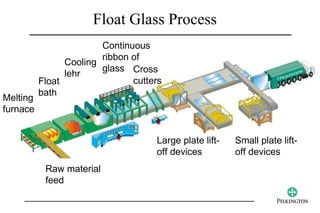
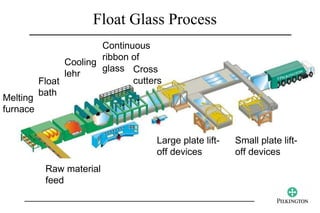
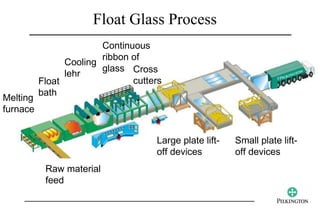
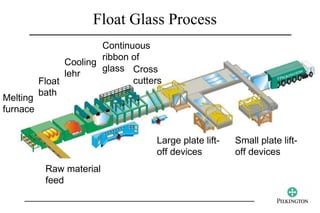
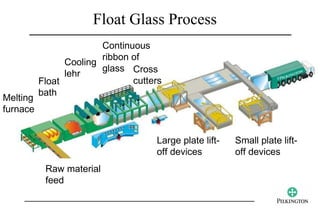
Float Glass Process
                        Continuous
                        ribbon of
                Cooling
                        glass Cross
                lehr
          Float                cutters
          bath
Melting
furnace


                                    Large plate lift-   Small plate lift-
                                    off devices         off devices
           Raw material
           feed
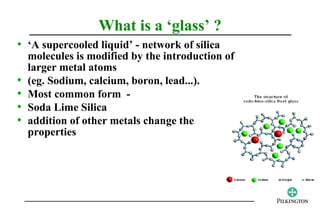
What is a ‘glass’ ?
• ‘A supercooled liquid’ - network of silica
    molecules is modified by the introduction of
    larger metal atoms
•   (eg. Sodium, calcium, boron, lead...).
•   Most common form -
•   Soda Lime Silica
•   addition of other metals change the
    properties
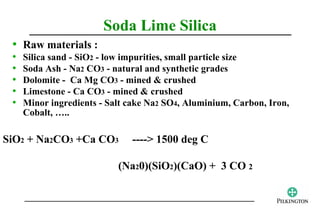
Soda Lime Silica
 • Raw materials :
 •   Silica sand - SiO2 - low impurities, small particle size
 •   Soda Ash - Na2 CO3 - natural and synthetic grades
 •   Dolomite - Ca Mg CO3 - mined & crushed
 •   Limestone - Ca CO3 - mined & crushed
 •   Minor ingredients - Salt cake Na2 SO4, Aluminium, Carbon, Iron,
     Cobalt, …..

SiO2 + Na2CO3 +Ca CO3         ----> 1500 deg C

                           (Na20)(SiO2)(CaO) + 3 CO 2
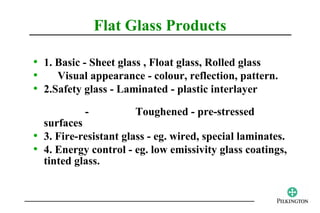
Flat Glass Products

• 1. Basic - Sheet glass , Float glass, Rolled glass
•    Visual appearance - colour, reflection, pattern.
• 2.Safety glass - Laminated - plastic interlayer
           -          Toughened - pre-stressed
  surfaces
• 3. Fire-resistant glass - eg. wired, special laminates.
• 4. Energy control - eg. low emissivity glass coatings,
  tinted glass.
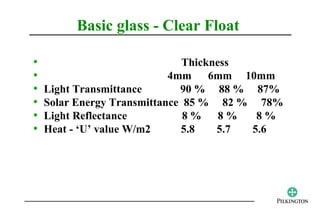
Basic glass - Clear Float

•                              Thickness
•                           4mm 6mm 10mm
•   Light Transmittance       90 % 88 % 87%
•   Solar Energy Transmittance 85 % 82 % 78%
•   Light Reflectance          8% 8%      8%
•   Heat - ‘U’ value W/m2     5.8    5.7 5.6
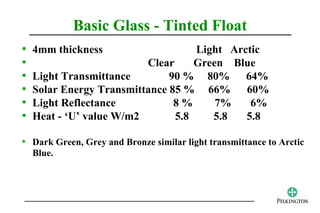
Basic Glass - Tinted Float
•   4mm thickness                   Light Arctic
•                         Clear     Green Blue
•   Light Transmittance        90 % 80% 64%
•   Solar Energy Transmittance 85 % 66% 60%
•   Light Reflectance           8%      7%    6%
•   Heat - ‘U’ value W/m2       5.8    5.8   5.8

• Dark Green, Grey and Bronze similar light transmittance to Arctic
    Blue.
Fire resistant glass

• Wired glass
• On exposure to fire: glass breaks, but held in place by integral wire mesh

• Example: Pilkington Pyroshield Safety
•
• EN references: EN 572-1 (Definitions etc.), -3 (Polished wired), -6
  (Wired patterned), -8 (Supplied and final cut sizes), -9 (Evaluation of
  conformity)
Fire resistant glass

• Special intumescent laminated glass
• On exposure to fire: layers crack but are held together by the inorganic
  intumescent interlayer, which is chemically compatible with glass and
  bonds glass layers together

• Examples: Pilkington Pyrostop, Glaverbel Pyrobel
•
• EN references: EN ISO 12543 series (Laminated glass), prEN 14449
  (Evaluation of conformity)
Low Emissivity Coated Glass
Pilkington Optitherm™ SN is an off-line coated glass for use
in insulating glass units and can be combined with other types of
Pilkington glass.
Pilkington Optitherm™ SN consists of Pilkington Optifloat™
which is provided with a coating on one side. Moreover it is
available as laminated Pilkington Optilam Therm™ and
toughened.
Emissivity of double glazing with low emissivity glass is now
below 1.8 W/ sq.m
Self Cleaning Glass
Pilkington Activ™ - same as conventional glass but with a specially
developed coating on the outside. Once exposed to daylight, the
coating chemically reacts in two ways.
Breaking down organic dirt
Using a "photocatalytic" process, the coating reacts with ultra-violet
rays present in natural daylight to break down and disintegrate
organic dirt.
Washing dirt away
The second part of the process happens when rainwater hits the glass.
The coating is "hydrophilic" which means that instead of forming
droplets, the water spreads evenly over the surface and as it runs off
takes the dirt with it. Compared with conventional glass, the water
also dries off very quickly without leaving unsightly "drying spots".
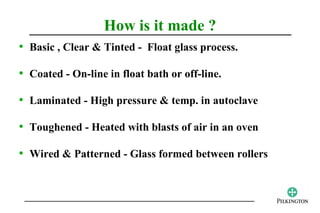
How is it made ?
• Basic , Clear & Tinted - Float glass process.

• Coated - On-line in float bath or off-line.

• Laminated - High pressure & temp. in autoclave

• Toughened - Heated with blasts of air in an oven

• Wired & Patterned - Glass formed between rollers
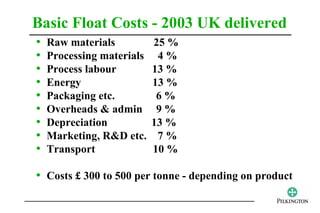
Basic Float Costs - 2003 UK delivered
•   Raw materials          25 %
•   Processing materials    4%
•   Process labour         13 %
•   Energy                 13 %
•   Packaging etc.          6%
•   Overheads & admin       9%
•   Depreciation           13 %
•   Marketing, R&D etc.     7%
•   Transport              10 %

• Costs £ 300 to 500 per tonne - depending on product
Float Glass Process
                        Continuous
                        ribbon of
                Cooling
                        glass Cross
                lehr
          Float                cutters
          bath
Melting
furnace


                                    Large plate lift-   Small plate lift-
                                    off devices         off devices
           Raw material
           feed
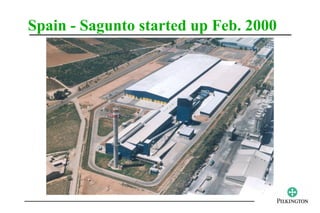
Spain - Sagunto started up Feb. 2000
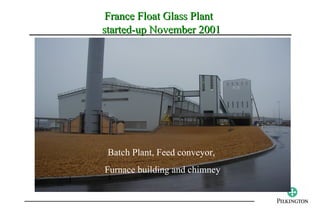
France Float Glass Plant
started-up November 2001


 Batch Plant, Feed conveyor,
Furnace building and chimney
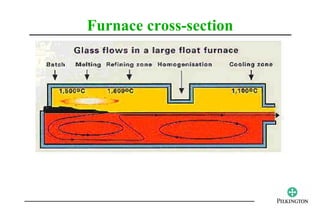
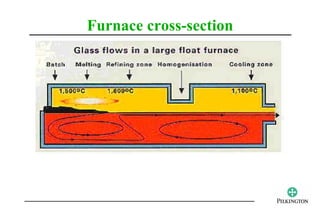
Furnace cross-section
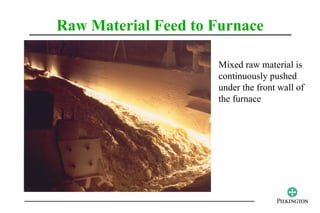
Raw Material Feed to Furnace

                     Mixed raw material is
                     continuously pushed
                     under the front wall of
                     the furnace
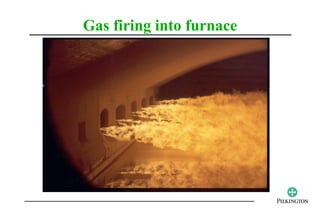
Gas firing into furnace
Furnace cross-section
Float Glass Process
                        Continuous
                        ribbon of
                Cooling
                        glass Cross
                lehr
          Float                cutters
          bath
Melting
furnace


                                    Large plate lift-   Small plate lift-
                                    off devices         off devices
           Raw material
           feed
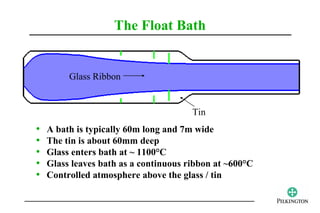
The Float Bath


         Glass Ribbon


                                       Tin
•   A bath is typically 60m long and 7m wide
•   The tin is about 60mm deep
•   Glass enters bath at ~ 1100°C
•   Glass leaves bath as a continuous ribbon at ~600°C
•   Controlled atmosphere above the glass / tin
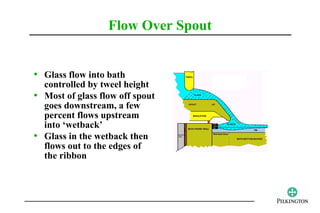
Flow Over Spout


• Glass flow into bath
  controlled by tweel height
• Most of glass flow off spout
  goes downstream, a few
  percent flows upstream
  into ‘wetback’
• Glass in the wetback then
  flows out to the edges of
  the ribbon
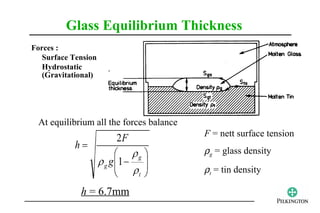
Glass Equilibrium Thickness
Forces :
   Surface Tension
   Hydrostatic
   (Gravitational)


 At equilibrium all the forces balance
                                         F = nett surface tension
                                         ρg = glass density
                                         ρt = tin density

             h = 6.7mm
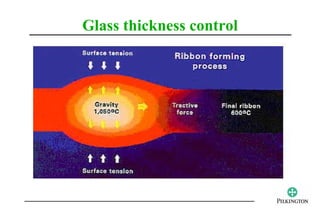
Glass thickness control
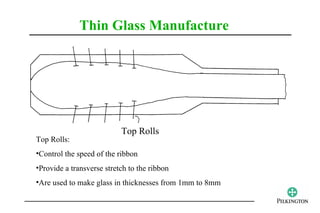
Thin Glass Manufacture


                           Top Rolls
Top Rolls:
•Control the speed of the ribbon
•Provide a transverse stretch to the ribbon
•Are used to make glass in thicknesses from 1mm to 8mm
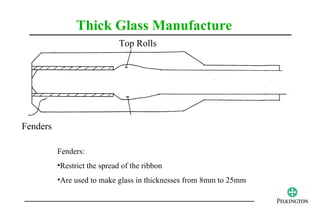
Thick Glass Manufacture
                              Top Rolls


Fenders

          Fenders:
          •Restrict the spread of the ribbon
          •Are used to make glass in thicknesses from 8mm to 25mm
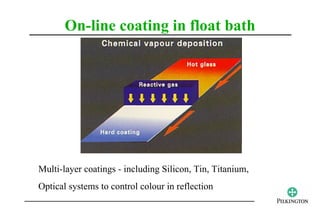
On-line coating in float bath


Multi-layer coatings - including Silicon, Tin, Titanium,
Optical systems to control colour in reflection
Float Glass Process
                        Continuous
                        ribbon of
                Cooling
                        glass Cross
                lehr
          Float                cutters
          bath
Melting
furnace


                                    Large plate lift-   Small plate lift-
                                    off devices         off devices
           Raw material
           feed
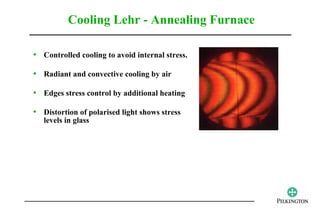
Cooling Lehr - Annealing Furnace

• Controlled cooling to avoid internal stress.

• Radiant and convective cooling by air

• Edges stress control by additional heating

• Distortion of polarised light shows stress
   levels in glass
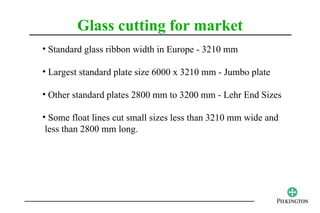
Glass cutting for market
• Standard glass ribbon width in Europe - 3210 mm

• Largest standard plate size 6000 x 3210 mm - Jumbo plate

• Other standard plates 2800 mm to 3200 mm - Lehr End Sizes

• Some float lines cut small sizes less than 3210 mm wide and
 less than 2800 mm long.
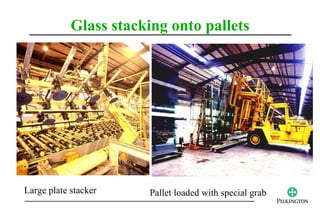
Glass stacking onto pallets


Large plate stacker    Pallet loaded with special grab
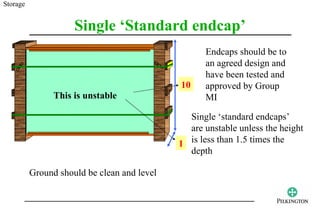
Storage


                     Single ‘Standard endcap’
                                                   Endcaps should be to
                                                   an agreed design and
                                                   have been tested and
                                             10    approved by Group
                This is unstable                   MI

                                               Single ‘standard endcaps’
                                               are unstable unless the height
                                             1 is less than 1.5 times the
                                               depth

          Ground should be clean and level
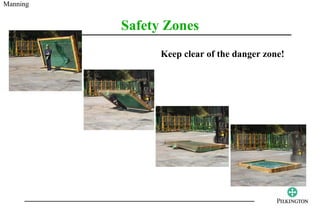
Manning


          Safety Zones
                Keep clear of the danger zone!
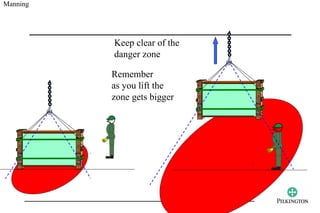
Manning


          Keep clear of the
          danger zone

          Remember
          as you lift the
          zone gets bigger
Glass Transport
• Western Europe - Float lines product mainly
  Jumbos and LES sizes.
• Economic transport distance 200km to 600km.
• Processing plants located closer to final customers.

• UK Float lines: 3 Pilkington, St.Helens, Lancashire
•                 1 St.Gobain, Eggborough, Yorks.
•                 1 Guardian, Hull, Yorks.
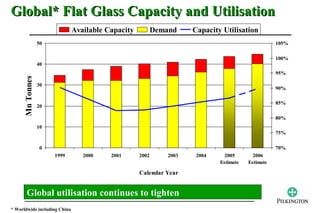
Global* Flat Glass Capacity and Utilisation
                              Available Capacity          Demand     Capacity Utilisation
                 50                                                                                105%

                                                                                                   100%
                 40
                                                                                                   95%
     Mn Tonnes


                 30
                                                                                                   90%

                                                                                                   85%
                 20

                                                                                                   80%
                 10
                                                                                                   75%

                  0                                                                                70%
                      1999       2000    2001      2002       2003    2004     2005       2006
                                                                             Estimate   Estimate

                                                   Calendar Year


       Global utilisation continues to tighten
* Worldwide including China
Float Glass Process
                        Continuous
                        ribbon of
                Cooling
                        glass Cross
                lehr
          Float                cutters
          bath
Melting
furnace


                                    Large plate lift-   Small plate lift-
                                    off devices         off devices
           Raw material
           feed
Glass References
              www.pilkington.com
      Pilkington Technical Advisory Service
Groupement Europeen des Producteurs de Verre Plat -
                 info@gepvp.be

Flat glass products & float manufacture2007

  • 1.
    Glass Flat Glass Products and Float Glass Manufacture Sept 2007 Rick Mitson Advanced Programme Manager –Pilkington
  • 2.
    Float Glass Process Continuous ribbon of Cooling glass Cross lehr Float cutters bath Melting furnace Large plate lift- Small plate lift- off devices off devices Raw material feed
  • 3.
    What is a‘glass’ ? • ‘A supercooled liquid’ - network of silica molecules is modified by the introduction of larger metal atoms • (eg. Sodium, calcium, boron, lead...). • Most common form - • Soda Lime Silica • addition of other metals change the properties
  • 4.
    Soda Lime Silica • Raw materials : • Silica sand - SiO2 - low impurities, small particle size • Soda Ash - Na2 CO3 - natural and synthetic grades • Dolomite - Ca Mg CO3 - mined & crushed • Limestone - Ca CO3 - mined & crushed • Minor ingredients - Salt cake Na2 SO4, Aluminium, Carbon, Iron, Cobalt, ….. SiO2 + Na2CO3 +Ca CO3 ----> 1500 deg C (Na20)(SiO2)(CaO) + 3 CO 2
  • 5.
    Flat Glass Products •1. Basic - Sheet glass , Float glass, Rolled glass • Visual appearance - colour, reflection, pattern. • 2.Safety glass - Laminated - plastic interlayer - Toughened - pre-stressed surfaces • 3. Fire-resistant glass - eg. wired, special laminates. • 4. Energy control - eg. low emissivity glass coatings, tinted glass.
  • 6.
    Basic glass -Clear Float • Thickness • 4mm 6mm 10mm • Light Transmittance 90 % 88 % 87% • Solar Energy Transmittance 85 % 82 % 78% • Light Reflectance 8% 8% 8% • Heat - ‘U’ value W/m2 5.8 5.7 5.6
  • 7.
    Basic Glass -Tinted Float • 4mm thickness Light Arctic • Clear Green Blue • Light Transmittance 90 % 80% 64% • Solar Energy Transmittance 85 % 66% 60% • Light Reflectance 8% 7% 6% • Heat - ‘U’ value W/m2 5.8 5.8 5.8 • Dark Green, Grey and Bronze similar light transmittance to Arctic Blue.
  • 8.
    Fire resistant glass •Wired glass • On exposure to fire: glass breaks, but held in place by integral wire mesh • Example: Pilkington Pyroshield Safety • • EN references: EN 572-1 (Definitions etc.), -3 (Polished wired), -6 (Wired patterned), -8 (Supplied and final cut sizes), -9 (Evaluation of conformity)
  • 9.
    Fire resistant glass •Special intumescent laminated glass • On exposure to fire: layers crack but are held together by the inorganic intumescent interlayer, which is chemically compatible with glass and bonds glass layers together • Examples: Pilkington Pyrostop, Glaverbel Pyrobel • • EN references: EN ISO 12543 series (Laminated glass), prEN 14449 (Evaluation of conformity)
  • 10.
    Low Emissivity CoatedGlass Pilkington Optitherm™ SN is an off-line coated glass for use in insulating glass units and can be combined with other types of Pilkington glass. Pilkington Optitherm™ SN consists of Pilkington Optifloat™ which is provided with a coating on one side. Moreover it is available as laminated Pilkington Optilam Therm™ and toughened. Emissivity of double glazing with low emissivity glass is now below 1.8 W/ sq.m
  • 11.
    Self Cleaning Glass PilkingtonActiv™ - same as conventional glass but with a specially developed coating on the outside. Once exposed to daylight, the coating chemically reacts in two ways. Breaking down organic dirt Using a "photocatalytic" process, the coating reacts with ultra-violet rays present in natural daylight to break down and disintegrate organic dirt. Washing dirt away The second part of the process happens when rainwater hits the glass. The coating is "hydrophilic" which means that instead of forming droplets, the water spreads evenly over the surface and as it runs off takes the dirt with it. Compared with conventional glass, the water also dries off very quickly without leaving unsightly "drying spots".
  • 12.
    How is itmade ? • Basic , Clear & Tinted - Float glass process. • Coated - On-line in float bath or off-line. • Laminated - High pressure & temp. in autoclave • Toughened - Heated with blasts of air in an oven • Wired & Patterned - Glass formed between rollers
  • 13.
    Basic Float Costs- 2003 UK delivered • Raw materials 25 % • Processing materials 4% • Process labour 13 % • Energy 13 % • Packaging etc. 6% • Overheads & admin 9% • Depreciation 13 % • Marketing, R&D etc. 7% • Transport 10 % • Costs £ 300 to 500 per tonne - depending on product
  • 14.
    Float Glass Process Continuous ribbon of Cooling glass Cross lehr Float cutters bath Melting furnace Large plate lift- Small plate lift- off devices off devices Raw material feed
  • 15.
    Spain - Saguntostarted up Feb. 2000
  • 16.
    France Float GlassPlant started-up November 2001 Batch Plant, Feed conveyor, Furnace building and chimney
  • 17.
  • 18.
    Raw Material Feedto Furnace Mixed raw material is continuously pushed under the front wall of the furnace
  • 19.
  • 20.
  • 21.
    Float Glass Process Continuous ribbon of Cooling glass Cross lehr Float cutters bath Melting furnace Large plate lift- Small plate lift- off devices off devices Raw material feed
  • 22.
    The Float Bath Glass Ribbon Tin • A bath is typically 60m long and 7m wide • The tin is about 60mm deep • Glass enters bath at ~ 1100°C • Glass leaves bath as a continuous ribbon at ~600°C • Controlled atmosphere above the glass / tin
  • 23.
    Flow Over Spout •Glass flow into bath controlled by tweel height • Most of glass flow off spout goes downstream, a few percent flows upstream into ‘wetback’ • Glass in the wetback then flows out to the edges of the ribbon
  • 24.
    Glass Equilibrium Thickness Forces: Surface Tension Hydrostatic (Gravitational) At equilibrium all the forces balance F = nett surface tension ρg = glass density ρt = tin density h = 6.7mm
  • 25.
  • 26.
    Thin Glass Manufacture Top Rolls Top Rolls: •Control the speed of the ribbon •Provide a transverse stretch to the ribbon •Are used to make glass in thicknesses from 1mm to 8mm
  • 27.
    Thick Glass Manufacture Top Rolls Fenders Fenders: •Restrict the spread of the ribbon •Are used to make glass in thicknesses from 8mm to 25mm
  • 28.
    On-line coating infloat bath Multi-layer coatings - including Silicon, Tin, Titanium, Optical systems to control colour in reflection
  • 29.
    Float Glass Process Continuous ribbon of Cooling glass Cross lehr Float cutters bath Melting furnace Large plate lift- Small plate lift- off devices off devices Raw material feed
  • 30.
    Cooling Lehr -Annealing Furnace • Controlled cooling to avoid internal stress. • Radiant and convective cooling by air • Edges stress control by additional heating • Distortion of polarised light shows stress levels in glass
  • 31.
    Glass cutting formarket • Standard glass ribbon width in Europe - 3210 mm • Largest standard plate size 6000 x 3210 mm - Jumbo plate • Other standard plates 2800 mm to 3200 mm - Lehr End Sizes • Some float lines cut small sizes less than 3210 mm wide and less than 2800 mm long.
  • 32.
    Glass stacking ontopallets Large plate stacker Pallet loaded with special grab
  • 33.
    Storage Single ‘Standard endcap’ Endcaps should be to an agreed design and have been tested and 10 approved by Group This is unstable MI Single ‘standard endcaps’ are unstable unless the height 1 is less than 1.5 times the depth Ground should be clean and level
  • 34.
    Manning Safety Zones Keep clear of the danger zone!
  • 35.
    Manning Keep clear of the danger zone Remember as you lift the zone gets bigger
  • 36.
    Glass Transport • WesternEurope - Float lines product mainly Jumbos and LES sizes. • Economic transport distance 200km to 600km. • Processing plants located closer to final customers. • UK Float lines: 3 Pilkington, St.Helens, Lancashire • 1 St.Gobain, Eggborough, Yorks. • 1 Guardian, Hull, Yorks.
  • 37.
    Global* Flat GlassCapacity and Utilisation Available Capacity Demand Capacity Utilisation 50 105% 100% 40 95% Mn Tonnes 30 90% 85% 20 80% 10 75% 0 70% 1999 2000 2001 2002 2003 2004 2005 2006 Estimate Estimate Calendar Year Global utilisation continues to tighten * Worldwide including China
  • 38.
    Float Glass Process Continuous ribbon of Cooling glass Cross lehr Float cutters bath Melting furnace Large plate lift- Small plate lift- off devices off devices Raw material feed
  • 39.
    Glass References www.pilkington.com Pilkington Technical Advisory Service Groupement Europeen des Producteurs de Verre Plat - info@gepvp.be

Editor's Notes