ENGINEERING CERAMICS
MET 203
Maxwell Owusu
[BSc., MSc.]
Maxwell.owusu@stu.edu.gh/ +233-261-268565
PROCESSING OF CERAMICS
1. Processing of Traditional Ceramics
2.Processing of New Ceramics
Types of Ceramics and Their Processing
• Ceramic materials divide into three categories:
1. Traditional ceramics – particulate processing
2. New ceramics – particulate processing
3. Glasses – solidification processing
• Particulate processes for traditional and new ceramics as well
as certain composite materials are covered in this slide set
Ceramics Processing Overview
• Traditional ceramics are made from minerals occurring in
nature
• Products: pottery, porcelain, bricks, and cement
• New ceramics are made from synthetically produced raw
materials
• Products: cutting tools, artificial bones, nuclear fuels, substrates for
electronic circuits
• Starting material for these products is powder
Ceramics Processing Overview
• For traditional ceramics
• Powders are mixed with water to bind them together and achieve
proper consistency for shaping
• For new ceramics
• Substances other than water are used as binders during shaping
• After shaping, green part is fired (sintered)
• Function is the same as in PM - to effect a solid state reaction that
bonds the particles into a hard ma
Processing Overview for Traditional
Ceramics
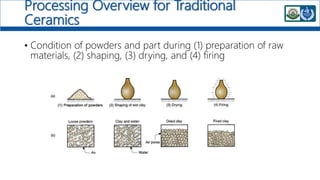
• Condition of powders and part during (1) preparation of raw
materials, (2) shaping, (3) drying, and (4) firing
Preparation of Raw Materials in Traditional
Ceramics Processing
• Most shaping processes for traditional ceramics require the starting
material to be a plastic paste
• This paste is comprised of fine ceramic powders mixed with water
• The starting raw ceramic material usually occurs in nature as rocky
lumps
• Purpose of the preparation step is to reduce the rocky lumps to powder
Comminution
• Reducing particle size in ceramics processing by using mechanical
energy in various forms such as impact, compression, and attrition
• Comminution techniques are most effective on brittle materials such as
cement and metallic ores
• Two general types of comminution operations:
• Crushing
• Grinding
Crushing
• Reduction of large lumps from the mine to smaller sizes for
subsequent further reduction
• Several stages may be required (e.g., primary crushing, secondary crushing)
• Reduction ratio in each stage is 3 to 6 times
• Crushing of minerals is accomplished by
• Compression against rigid surfaces or
• Impact against surfaces
Grinding
• In the context of comminution, grinding refers to the reduction of
small pieces after crushing to fine powder
• Accomplished by abrasion, impact, and/or compaction by hard media such
as balls or rolls
• Examples of grinding include:
• Ball mill
• Roller mill
• Impact grinding
Ingredients of Ceramic Paste
Main
1. Clay
• Chemistry = hydrous aluminum silicates
• Usually the main ingredient because of ideal forming characteristics when mixed with
water
2. Water
• Creates clay-water mixture with good plasticity for shaping
Additional Ingredients of Ceramic Paste
3. Non-plastic raw materials
• Such as alumina and silica
• Purpose is to reduce shrinkage in drying and firing but also reduces plasticity during
forming
4. Other ingredients
• Such as fluxes that melt (vitrify) during firing and promote sintering
• Wetting agents to improve mixing of ingredients
Shaping Processes
• Slip casting
• The clay-water mixture is a slurry
• Plastic forming methods
• The clay is plastic
• Semi-dry pressing
• The clay is moist but has low plasticity
• Dry pressing
• The clay is basically dry (less than 5% water) and has no plasticity
Slip Casting
• Suspension of ceramic powders in water, called a slip, is poured into
porous plaster of mold
• Water from the mix is absorbed into the plaster to form a firm layer of clay
at the mold surface
• Slip composition is 25% to 40% water
• Two principal variations:
• Drain casting - mold is inverted to drain excess slip after semi-solid layer has formed
• Solid casting - enough time is allowed for full body to become firm
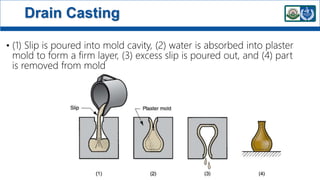
Drain Casting
• (1) Slip is poured into mold cavity, (2) water is absorbed into plaster
mold to form a firm layer, (3) excess slip is poured out, and (4) part
is removed from mold
Overview of Plastic Forming
• Starting mixture must have a plastic consistency
• Composition 15% to 25% water
• Variety of manual and mechanized methods
• Manual methods use clay with more water because it is more easily formed
• Mechanized methods generally use clay with less water so starting clay is
tough
• Plastic Forming Methods
1. Hand modeling (manual method)
2. Jiggering (mechanized method)
3. Plastic pressing (mechanized method)
4. Extrusion (mechanized method)
Dry Pressing
• Process sequence similar to semi-dry pressing
• Except water content of starting mix is < 5%
• Dies made of hardened tool steel or cemented carbide to reduce
wear due to abrasive dry clay
• No drying shrinkage occurs
• Drying time is eliminated and good accuracy is achieved in final product
• Products: bathroom tile, electrical insulators, refractory brick, and
other simple geometries
Clay Volume vs. Water Content
• Water plays an important role in most of the traditional ceramics
shaping processes
• Thereafter, it has no purpose and must be removed from the clay piece
before firing
• Shrinkage is a problem during drying because water contributes
volume to the piece, and the volume is reduced when it is removed
Drying
• Drying process occurs in two stages
• Stage 1 - Drying rate is rapid as water evaporates from surface into
surrounding air and interior water migrates by capillary action to surface to
replace it
• This is when volumetric shrinkage occurs, with the risk of warping and cracking
• Stage 2 - Moisture content has been reduced to where the ceramic grains
are in contact
• Little or no further volumetric shrinkage
Firing of Traditional Ceramics
• Heat treatment process to sinter the ceramic material
• Performed in a furnace called a kiln
• Bonds are developed between ceramic grains
• This is accompanied by densification and reduction of porosity
• Additional shrinkage occurs in the polycrystalline material in addition to that which has
already occurred in drying
• In firing of traditional ceramics, a glassy phase forms among the crystals
that acts as a binder
Glazing
• Application of a ceramic surface coating to make the piece more
impervious to water and enhance its appearance
• Usual processing sequence with glazed ware:
1. Fire the piece once before glazing to harden the body of the piece
2. Apply glaze
3. Fire the piece a second time to harden glaze
Processing of New Ceramics
• Manufacturing sequence for new ceramics can be summarized in
the following steps:
1. Preparation of starting materials
2. Shaping
3. Sintering
4. Finishing
• While the sequence is nearly the same as for the traditional
ceramics, the details are often quite different
Preparation of Starting Materials
• Strength requirements are usually much greater for new ceramics
than for traditional ceramics
• Starting powders must be smaller and more uniform in size and
composition, since the strength of the resulting ceramic product is
inversely related to grain size
• Greater control over the starting powders is required
• Powder preparation includes mechanical and chemical methods
Shaping of New Ceramics
• Many of the shaping processes are borrowed from powder
metallurgy (PM) and traditional ceramics
• PM press and sinter methods have been adapted to the new ceramic
materials
• And some of the traditional ceramics forming techniques are used
to shape the new ceramics
• Slip casting
• Extrusion
• Dry pressing
Hot Pressing
• Similar to dry pressing
• Except it is carried out at elevated temperatures so sintering of the product
is accomplished simultaneously with pressing
• Eliminates the need for a separate firing step
• Higher densities and finer grain size are obtained
• But die life is reduced by the hot abrasive particles against the die surfaces
Isostatic Pressing
• Uses hydrostatic pressure to compact the ceramic powders from all
directions
• Avoids the problem of non-uniform density in the final product that is
often observed in conventional uniaxial pressing
• Same process used in powder metallurgy
SINTERING OF CERAMICS
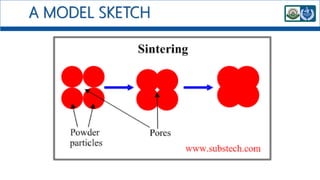
• DEFINITION
• Sintering commonly refers to processes involved in the heat
treatment of powder compacts at elevated temperatures, where
diffusional mass transport is appreciable.
• Successful sintering usually results in a dense polycrystalline solid.
However, sintering can proceed only locally (i.e. at contact point of
grains), without any appreciable change in the average overall
density of a powder compact
A MODEL SKETCH
WHY CERAMICS HAVE TO BE SINTERED?
• Ceramic materials are sintered because
1. Ceramics melt at high temperatures.
2. As-solidified microstructures can not be modified through additional
plastic deformation and recrystallisation due to brittleness of ceramics.
3. The resulting coarse grains would act as fracture initiation sites.
4. Low thermal conductivities of ceramics (<30-50 W/mK), in contrast to
high thermal conductivity of metals (in the range 50-300 W/mK) cause
large temperature gradients, and thus thermal stress and shock in
melting-solidification of ceramics.
WHAT HAPPENS DURING SINTERING
• Increase of interparticle contact area with time
• Rounding-off of sharp angles and points of contact
• In most cases, the approach of particle centres and overall
densification
• Decrease in volume of interconnected pores
• Continuing isolation of pores
• Grain growth and decrease in volume of isolated pores
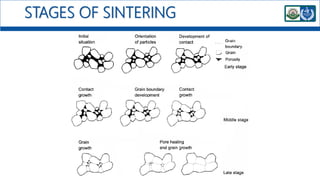
SINTERING STAGES
• There are three stages of sintering. These are
1. The initial stage
2. The intermediate stage
3. The final stage
• Various changes occur during each stage and the ceramic part becomes
more dense with each stage.
INITIAL STAGE OF SINTERING
During this stage various changes occur some of which are
• There is a local point of contact formation without any shrinkage
which is accompanied by smoothing of the free surface of particles
• There is also neck formation at the contact point
• There is an increase in the relative density of the ceramic product to
about 70% of the theoretical density.
THE INTERMEDIATE STAGE OF SINTERING
• There is neck growth at this stage
• Pores at this stage form arrays of interconnected cylindrical channels
• The centres of the particles approach one another with a resulting
compact shrinkage
• At this stage shrinkage normally results in a densification to about
95% of the theoretical density.
THE FINAL STAGE OF SINTERING
At this stage of sintering there is
• Isolation of pores with the density exceeding 93%
• Porosity is eliminated
• There is grain growth
STAGES OF SINTERING
SINTERING CATEGORIES
• Solid state sintering occurs when the powder compact is densified
wholly in a solid state at the sintering temperature.
• Whereas liquid phase sintering occurs when a liquid phase is
present in the powder compact during sintering.
• Transient liquid phase sintering is a combination of liquid phase
sintering and solid state sintering. In this sintering technique a liquid
phase forms in the compact at an early stage of sintering, but the
liquid disappears as sintering proceeds and densification is
completed in the solid state.
SINTERING VARIABLES
• The microstructure of a powder compact and its sinterability is
dependent on certain variables. These variables can be categorized
into two:
1. Material variables
2. Process variables
MATERIAL VARIABLES
• These include
1. Chemical composition of the powder compact
2. Powder size
3. Powder shape
4. Powder size distribution
5. Degree of powder agglomeration
• The sinterability and compressibility of the powder compact are
influenced by these variables
PROCESS VARIABLES
• These are mostly thermodynamic variables. These include
1. Temperature
2. Time
3. Pressure
4. Heating and cooling rate
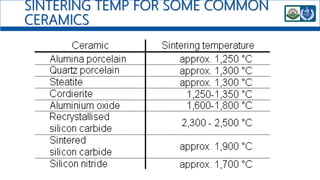
SINTERING TEMP FOR SOME COMMON
CERAMICS
ADVANTAGES OF SINTERING
• The parts produced have an excellent surface finish, and good
dimensional accuracy.
• The porosity inherent in sintered components is useful for
specialized application such as filters and bearings.
• Refractory materials which are impossible to shape using other
methods can be fabricated by sintering with metals of lower
melting points.
• A wide range of parts with special electrical and magnetic
properties can be produced
CURRENT TRENDS
• Selective laser sintering (SLS) is a rapid process that allows to
generate complex parts by solidifying successive layers of powder
material on top of each other.
• Solidification is obtained by fusing or sintering selected areas of the
successive powder layers using thermal energy supplied through a laser
beam.
• SPS (spark plasma sintering)
Ceramic processing

Ceramic processing

  • 1.
    ENGINEERING CERAMICS MET 203 MaxwellOwusu [BSc., MSc.] Maxwell.owusu@stu.edu.gh/ +233-261-268565
  • 2.
    PROCESSING OF CERAMICS 1.Processing of Traditional Ceramics 2.Processing of New Ceramics
  • 3.
    Types of Ceramicsand Their Processing • Ceramic materials divide into three categories: 1. Traditional ceramics – particulate processing 2. New ceramics – particulate processing 3. Glasses – solidification processing • Particulate processes for traditional and new ceramics as well as certain composite materials are covered in this slide set
  • 4.
    Ceramics Processing Overview •Traditional ceramics are made from minerals occurring in nature • Products: pottery, porcelain, bricks, and cement • New ceramics are made from synthetically produced raw materials • Products: cutting tools, artificial bones, nuclear fuels, substrates for electronic circuits • Starting material for these products is powder
  • 5.
    Ceramics Processing Overview •For traditional ceramics • Powders are mixed with water to bind them together and achieve proper consistency for shaping • For new ceramics • Substances other than water are used as binders during shaping • After shaping, green part is fired (sintered) • Function is the same as in PM - to effect a solid state reaction that bonds the particles into a hard ma
  • 6.
    Processing Overview forTraditional Ceramics • Condition of powders and part during (1) preparation of raw materials, (2) shaping, (3) drying, and (4) firing
  • 7.
    Preparation of RawMaterials in Traditional Ceramics Processing • Most shaping processes for traditional ceramics require the starting material to be a plastic paste • This paste is comprised of fine ceramic powders mixed with water • The starting raw ceramic material usually occurs in nature as rocky lumps • Purpose of the preparation step is to reduce the rocky lumps to powder
  • 8.
    Comminution • Reducing particlesize in ceramics processing by using mechanical energy in various forms such as impact, compression, and attrition • Comminution techniques are most effective on brittle materials such as cement and metallic ores • Two general types of comminution operations: • Crushing • Grinding
  • 9.
    Crushing • Reduction oflarge lumps from the mine to smaller sizes for subsequent further reduction • Several stages may be required (e.g., primary crushing, secondary crushing) • Reduction ratio in each stage is 3 to 6 times • Crushing of minerals is accomplished by • Compression against rigid surfaces or • Impact against surfaces
  • 10.
    Grinding • In thecontext of comminution, grinding refers to the reduction of small pieces after crushing to fine powder • Accomplished by abrasion, impact, and/or compaction by hard media such as balls or rolls • Examples of grinding include: • Ball mill • Roller mill • Impact grinding
  • 11.
    Ingredients of CeramicPaste Main 1. Clay • Chemistry = hydrous aluminum silicates • Usually the main ingredient because of ideal forming characteristics when mixed with water 2. Water • Creates clay-water mixture with good plasticity for shaping Additional Ingredients of Ceramic Paste 3. Non-plastic raw materials • Such as alumina and silica • Purpose is to reduce shrinkage in drying and firing but also reduces plasticity during forming 4. Other ingredients • Such as fluxes that melt (vitrify) during firing and promote sintering • Wetting agents to improve mixing of ingredients
  • 12.
    Shaping Processes • Slipcasting • The clay-water mixture is a slurry • Plastic forming methods • The clay is plastic • Semi-dry pressing • The clay is moist but has low plasticity • Dry pressing • The clay is basically dry (less than 5% water) and has no plasticity
  • 13.
    Slip Casting • Suspensionof ceramic powders in water, called a slip, is poured into porous plaster of mold • Water from the mix is absorbed into the plaster to form a firm layer of clay at the mold surface • Slip composition is 25% to 40% water • Two principal variations: • Drain casting - mold is inverted to drain excess slip after semi-solid layer has formed • Solid casting - enough time is allowed for full body to become firm
  • 14.
    Drain Casting • (1)Slip is poured into mold cavity, (2) water is absorbed into plaster mold to form a firm layer, (3) excess slip is poured out, and (4) part is removed from mold
  • 15.
    Overview of PlasticForming • Starting mixture must have a plastic consistency • Composition 15% to 25% water • Variety of manual and mechanized methods • Manual methods use clay with more water because it is more easily formed • Mechanized methods generally use clay with less water so starting clay is tough • Plastic Forming Methods 1. Hand modeling (manual method) 2. Jiggering (mechanized method) 3. Plastic pressing (mechanized method) 4. Extrusion (mechanized method)
  • 16.
    Dry Pressing • Processsequence similar to semi-dry pressing • Except water content of starting mix is < 5% • Dies made of hardened tool steel or cemented carbide to reduce wear due to abrasive dry clay • No drying shrinkage occurs • Drying time is eliminated and good accuracy is achieved in final product • Products: bathroom tile, electrical insulators, refractory brick, and other simple geometries
  • 17.
    Clay Volume vs.Water Content • Water plays an important role in most of the traditional ceramics shaping processes • Thereafter, it has no purpose and must be removed from the clay piece before firing • Shrinkage is a problem during drying because water contributes volume to the piece, and the volume is reduced when it is removed
  • 18.
    Drying • Drying processoccurs in two stages • Stage 1 - Drying rate is rapid as water evaporates from surface into surrounding air and interior water migrates by capillary action to surface to replace it • This is when volumetric shrinkage occurs, with the risk of warping and cracking • Stage 2 - Moisture content has been reduced to where the ceramic grains are in contact • Little or no further volumetric shrinkage
  • 19.
    Firing of TraditionalCeramics • Heat treatment process to sinter the ceramic material • Performed in a furnace called a kiln • Bonds are developed between ceramic grains • This is accompanied by densification and reduction of porosity • Additional shrinkage occurs in the polycrystalline material in addition to that which has already occurred in drying • In firing of traditional ceramics, a glassy phase forms among the crystals that acts as a binder
  • 20.
    Glazing • Application ofa ceramic surface coating to make the piece more impervious to water and enhance its appearance • Usual processing sequence with glazed ware: 1. Fire the piece once before glazing to harden the body of the piece 2. Apply glaze 3. Fire the piece a second time to harden glaze
  • 21.
    Processing of NewCeramics • Manufacturing sequence for new ceramics can be summarized in the following steps: 1. Preparation of starting materials 2. Shaping 3. Sintering 4. Finishing • While the sequence is nearly the same as for the traditional ceramics, the details are often quite different
  • 22.
    Preparation of StartingMaterials • Strength requirements are usually much greater for new ceramics than for traditional ceramics • Starting powders must be smaller and more uniform in size and composition, since the strength of the resulting ceramic product is inversely related to grain size • Greater control over the starting powders is required • Powder preparation includes mechanical and chemical methods
  • 23.
    Shaping of NewCeramics • Many of the shaping processes are borrowed from powder metallurgy (PM) and traditional ceramics • PM press and sinter methods have been adapted to the new ceramic materials • And some of the traditional ceramics forming techniques are used to shape the new ceramics • Slip casting • Extrusion • Dry pressing
  • 24.
    Hot Pressing • Similarto dry pressing • Except it is carried out at elevated temperatures so sintering of the product is accomplished simultaneously with pressing • Eliminates the need for a separate firing step • Higher densities and finer grain size are obtained • But die life is reduced by the hot abrasive particles against the die surfaces
  • 25.
    Isostatic Pressing • Useshydrostatic pressure to compact the ceramic powders from all directions • Avoids the problem of non-uniform density in the final product that is often observed in conventional uniaxial pressing • Same process used in powder metallurgy
  • 26.
    SINTERING OF CERAMICS •DEFINITION • Sintering commonly refers to processes involved in the heat treatment of powder compacts at elevated temperatures, where diffusional mass transport is appreciable. • Successful sintering usually results in a dense polycrystalline solid. However, sintering can proceed only locally (i.e. at contact point of grains), without any appreciable change in the average overall density of a powder compact
  • 27.
  • 28.
    WHY CERAMICS HAVETO BE SINTERED? • Ceramic materials are sintered because 1. Ceramics melt at high temperatures. 2. As-solidified microstructures can not be modified through additional plastic deformation and recrystallisation due to brittleness of ceramics. 3. The resulting coarse grains would act as fracture initiation sites. 4. Low thermal conductivities of ceramics (<30-50 W/mK), in contrast to high thermal conductivity of metals (in the range 50-300 W/mK) cause large temperature gradients, and thus thermal stress and shock in melting-solidification of ceramics.
  • 29.
    WHAT HAPPENS DURINGSINTERING • Increase of interparticle contact area with time • Rounding-off of sharp angles and points of contact • In most cases, the approach of particle centres and overall densification • Decrease in volume of interconnected pores • Continuing isolation of pores • Grain growth and decrease in volume of isolated pores
  • 30.
    SINTERING STAGES • Thereare three stages of sintering. These are 1. The initial stage 2. The intermediate stage 3. The final stage • Various changes occur during each stage and the ceramic part becomes more dense with each stage.
  • 31.
    INITIAL STAGE OFSINTERING During this stage various changes occur some of which are • There is a local point of contact formation without any shrinkage which is accompanied by smoothing of the free surface of particles • There is also neck formation at the contact point • There is an increase in the relative density of the ceramic product to about 70% of the theoretical density.
  • 32.
    THE INTERMEDIATE STAGEOF SINTERING • There is neck growth at this stage • Pores at this stage form arrays of interconnected cylindrical channels • The centres of the particles approach one another with a resulting compact shrinkage • At this stage shrinkage normally results in a densification to about 95% of the theoretical density.
  • 33.
    THE FINAL STAGEOF SINTERING At this stage of sintering there is • Isolation of pores with the density exceeding 93% • Porosity is eliminated • There is grain growth
  • 34.
  • 35.
    SINTERING CATEGORIES • Solidstate sintering occurs when the powder compact is densified wholly in a solid state at the sintering temperature. • Whereas liquid phase sintering occurs when a liquid phase is present in the powder compact during sintering. • Transient liquid phase sintering is a combination of liquid phase sintering and solid state sintering. In this sintering technique a liquid phase forms in the compact at an early stage of sintering, but the liquid disappears as sintering proceeds and densification is completed in the solid state.
  • 36.
    SINTERING VARIABLES • Themicrostructure of a powder compact and its sinterability is dependent on certain variables. These variables can be categorized into two: 1. Material variables 2. Process variables
  • 37.
    MATERIAL VARIABLES • Theseinclude 1. Chemical composition of the powder compact 2. Powder size 3. Powder shape 4. Powder size distribution 5. Degree of powder agglomeration • The sinterability and compressibility of the powder compact are influenced by these variables
  • 38.
    PROCESS VARIABLES • Theseare mostly thermodynamic variables. These include 1. Temperature 2. Time 3. Pressure 4. Heating and cooling rate
  • 39.
    SINTERING TEMP FORSOME COMMON CERAMICS
  • 40.
    ADVANTAGES OF SINTERING •The parts produced have an excellent surface finish, and good dimensional accuracy. • The porosity inherent in sintered components is useful for specialized application such as filters and bearings. • Refractory materials which are impossible to shape using other methods can be fabricated by sintering with metals of lower melting points. • A wide range of parts with special electrical and magnetic properties can be produced
  • 41.
    CURRENT TRENDS • Selectivelaser sintering (SLS) is a rapid process that allows to generate complex parts by solidifying successive layers of powder material on top of each other. • Solidification is obtained by fusing or sintering selected areas of the successive powder layers using thermal energy supplied through a laser beam. • SPS (spark plasma sintering)