Slip casting
Vinayak kumar
212314011
History
 This process was introduced into many European
porcelain factories in the eighteenth century, and was
commonly employed for the casting of terracotta
sculpture in the nineteenth century.
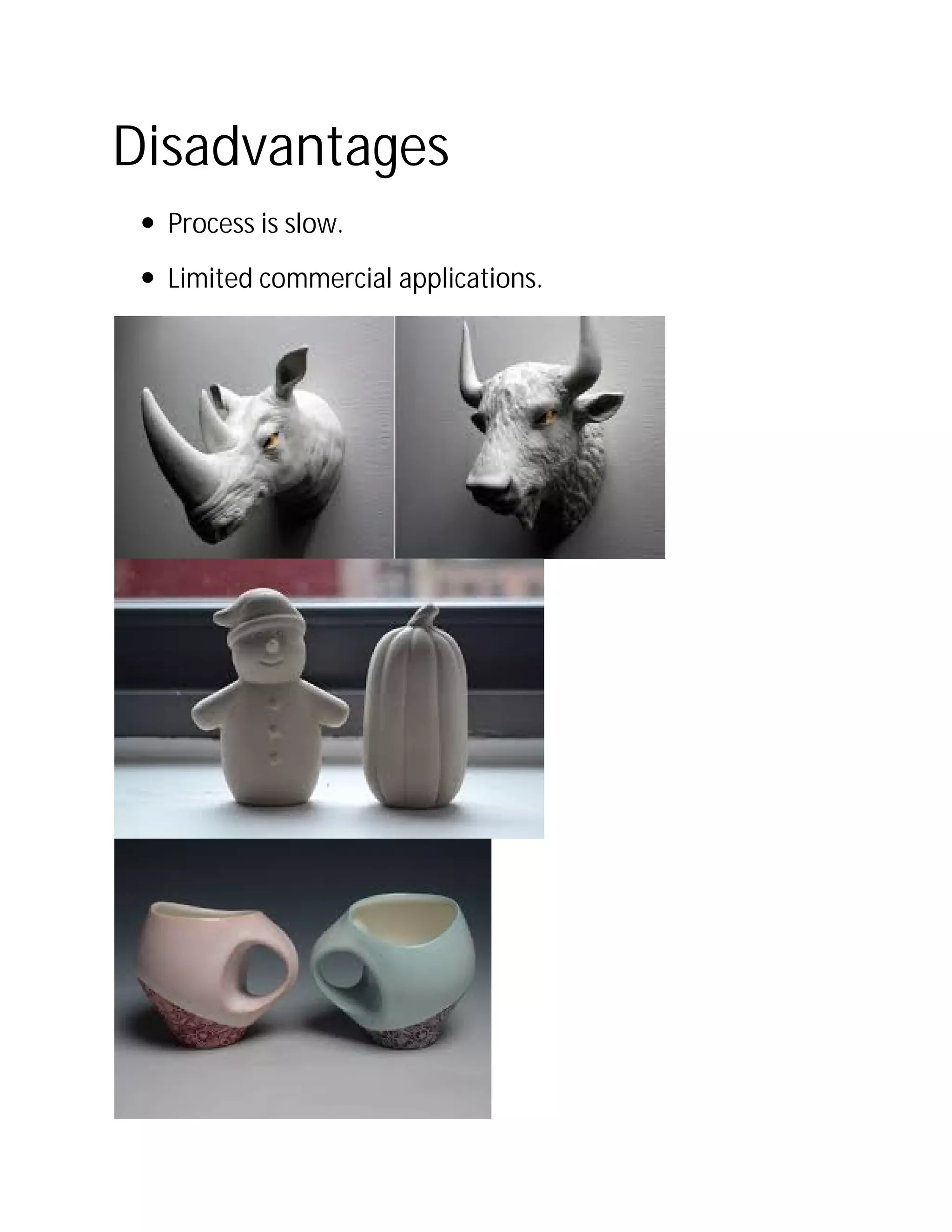
 Today we may find that many common things we have
such as: figurines, doll faces, dishes, flower pots, lamp
bases, toilets etc. are made from this technique of mass
production
Slip casting
 A slip is a suspension of metal or ceramic powder (5µm) in
water or other suitable liquid which is poured into an
absorbent( Plaster of Paris ) mould dried and subsequently
sintered.
 Slip are usually made up of constituent powders, a
dispersing agent to stabilize the powder against colloidal
forces , a solvent to control the slip viscosity and facilitate
casting , a binder for giving green strength to the cast
shape and plasticizer to modify the properties of the
binder.
Two principal variations
Drain casting:
after a semi-solid layer has been formed, thus producing a
hollow product.
Solid casting:
is allowed for entire body to become firm.
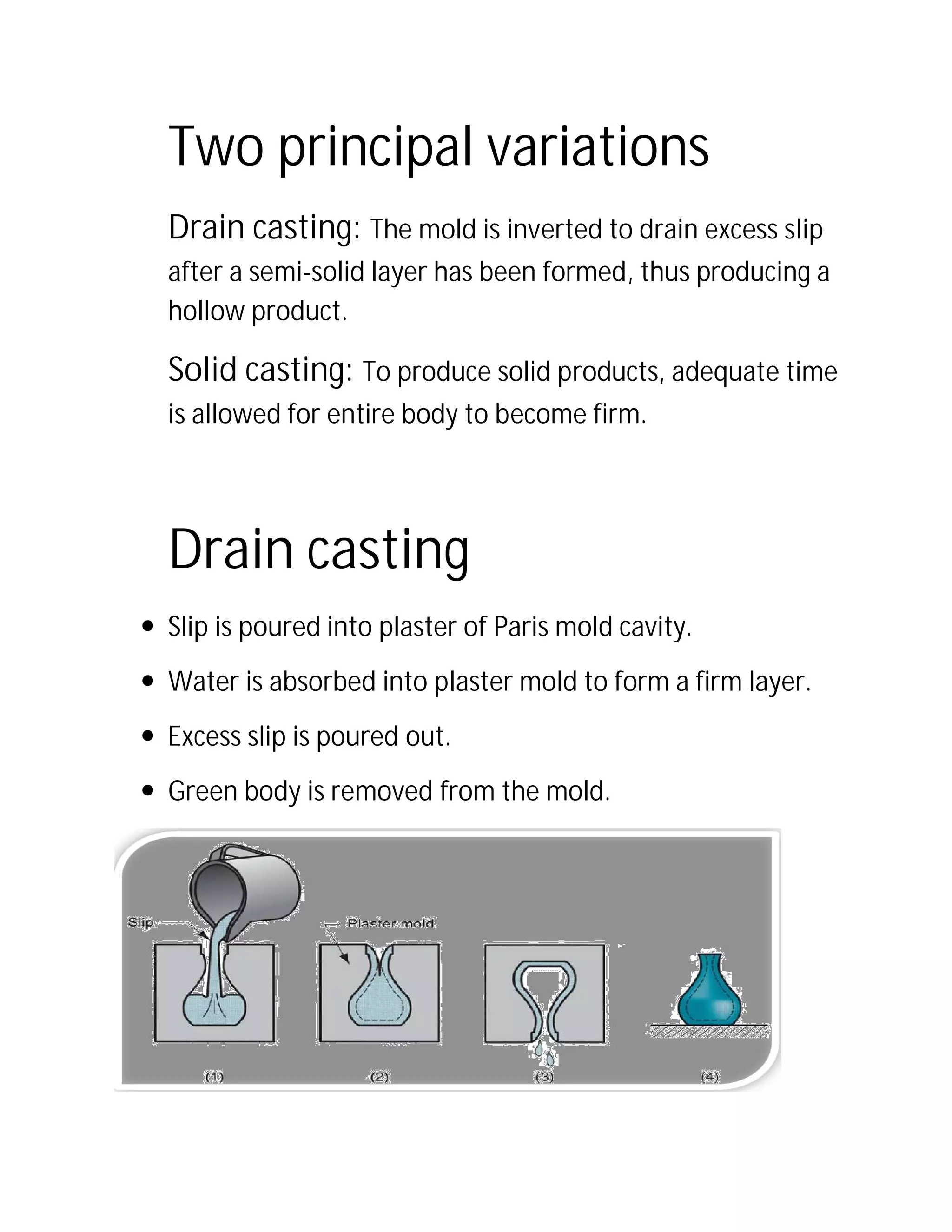
Drain casting
 Slip is poured into plaster of Paris mold cavity.
 Water is absorbed into plaster mold to form a firm layer.
 Excess slip is poured out.
 Green body is removed from the mold.
Two principal variations
Drain casting: The mold is inverted to drain excess slip
solid layer has been formed, thus producing a
To produce solid products, adequate time
is allowed for entire body to become firm.
Drain casting
Slip is poured into plaster of Paris mold cavity.
Water is absorbed into plaster mold to form a firm layer.
Excess slip is poured out.
Green body is removed from the mold.
Two principal variations
d to drain excess slip
solid layer has been formed, thus producing a
To produce solid products, adequate time
Water is absorbed into plaster mold to form a firm layer.
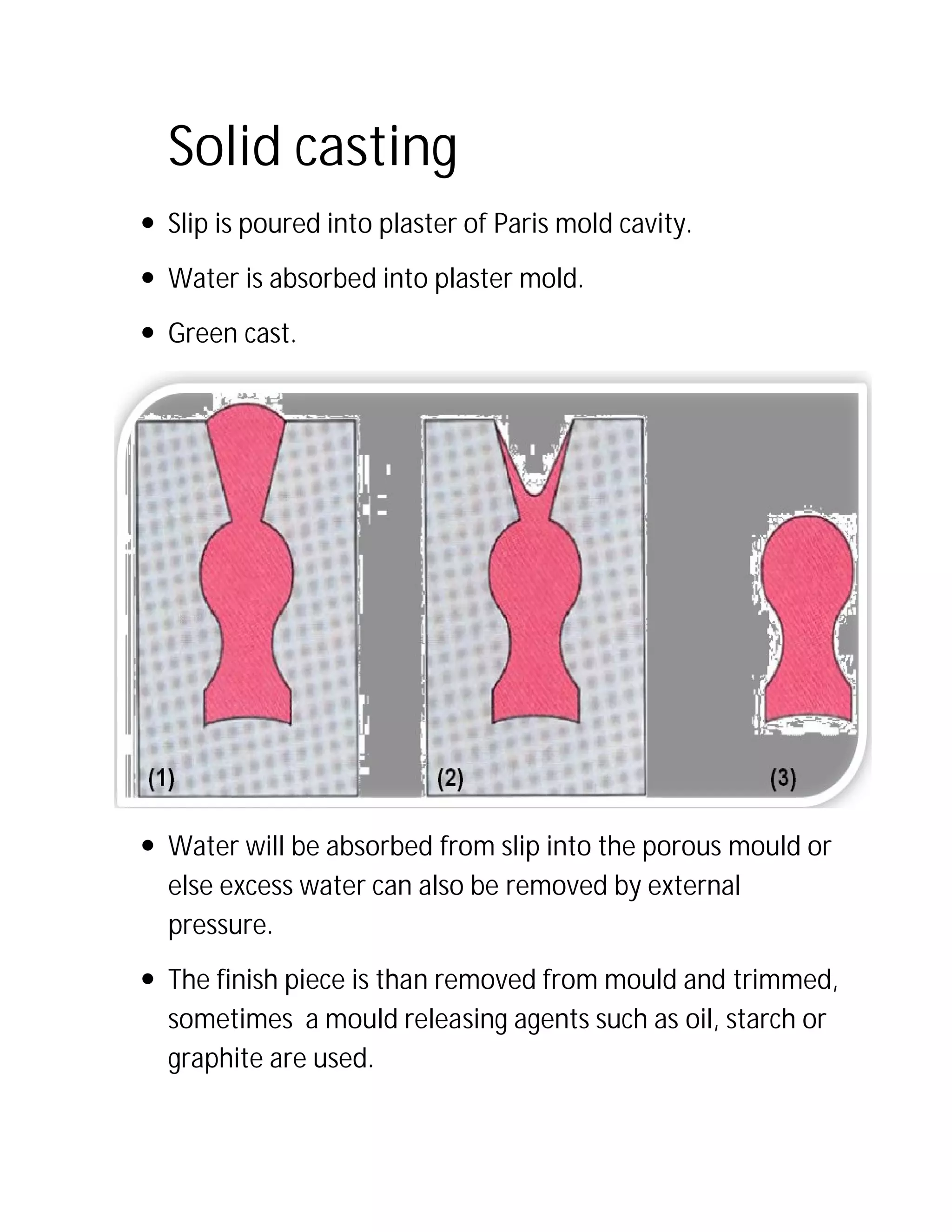
Solid casting
 Slip is poured into plaster of Paris mold cavity.
 Water is absorbe
 Green cast.
 Water will be absorbed from slip into the porous mould or
else excess water can also be removed by external
pressure.
 The finish piece is than removed from mould and trimmed,
sometimes a mould releasing agents such as oi
graphite are used.
Solid casting
Slip is poured into plaster of Paris mold cavity.
is absorbed into plaster mold.
Water will be absorbed from slip into the porous mould or
else excess water can also be removed by external
The finish piece is than removed from mould and trimmed,
sometimes a mould releasing agents such as oil, starch or
graphite are used.
Water will be absorbed from slip into the porous mould or
else excess water can also be removed by external
The finish piece is than removed from mould and trimmed,
l, starch or
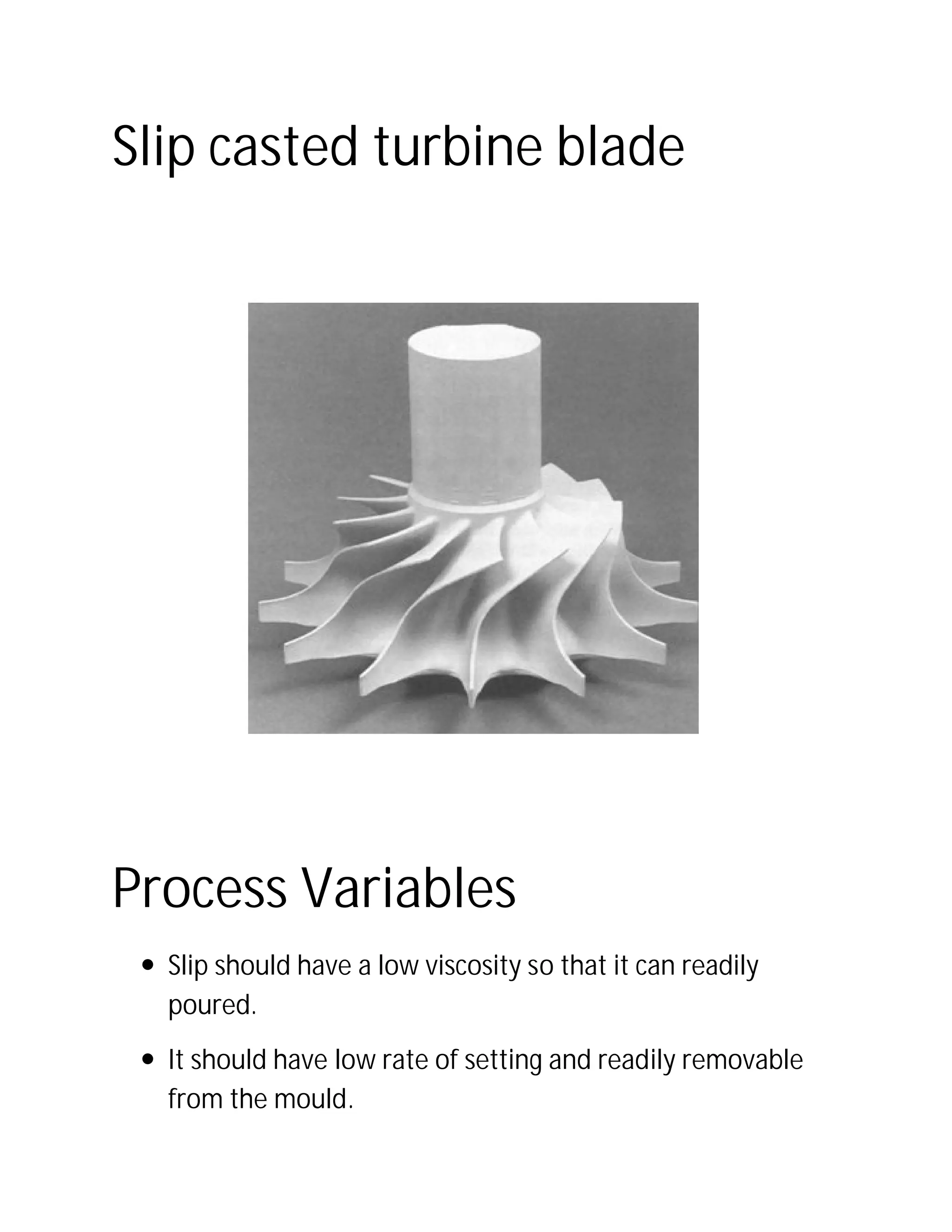
Slip casted turbine blade
Process Variables
 Slip should have a low viscosity so that it can readily
poured.
 It should have low rate of setting and readily removable
from the mould.
Slip casted turbine blade
Process Variables
Slip should have a low viscosity so that it can readily
It should have low rate of setting and readily removable
Slip should have a low viscosity so that it can readily
It should have low rate of setting and readily removable
 Should have low shrinkage on drying and high strength
after drying.
 To achieve these properties we use fine powder particles
less than 5µm and to obtain the optimum viscosity,
deflocculantion and control of pH of slip are necessary.
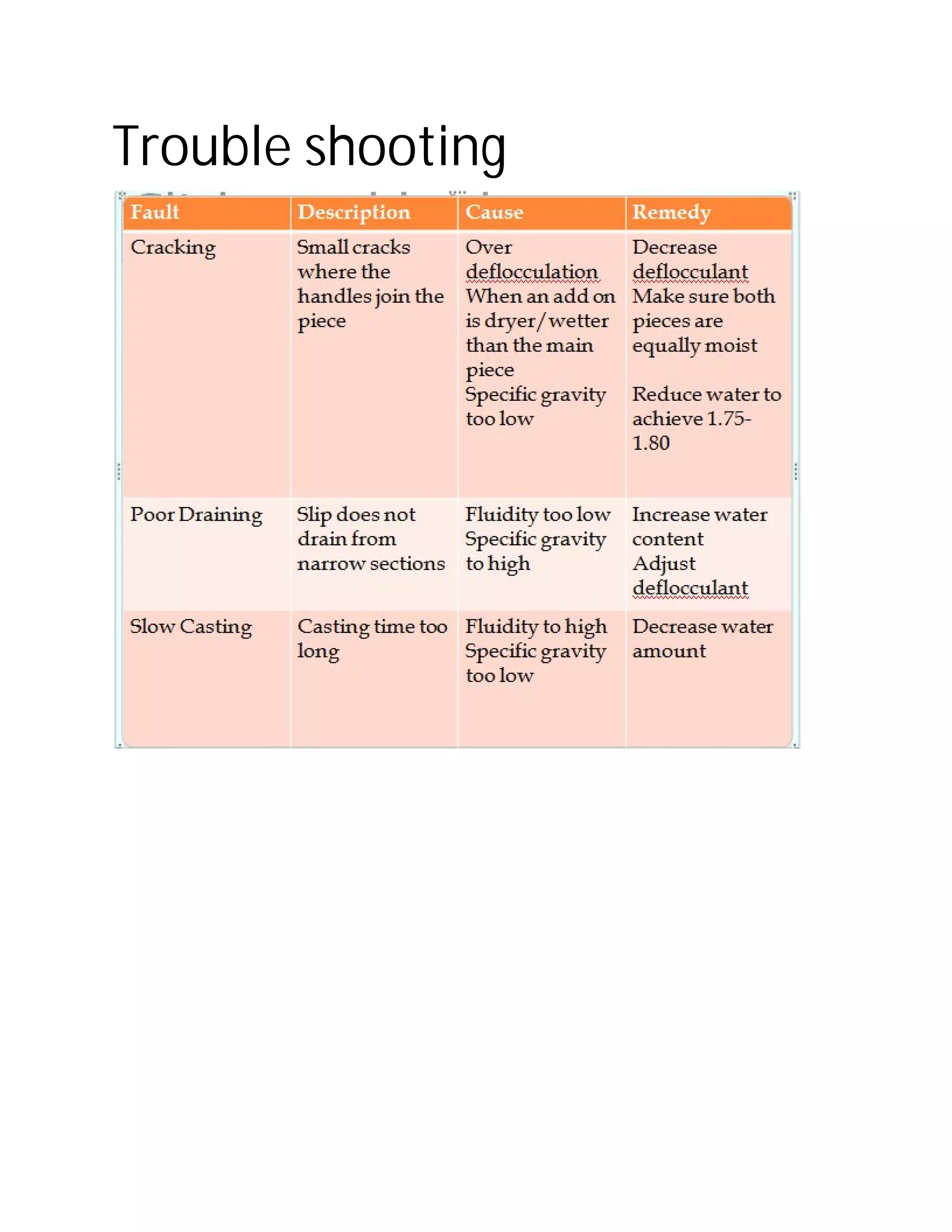
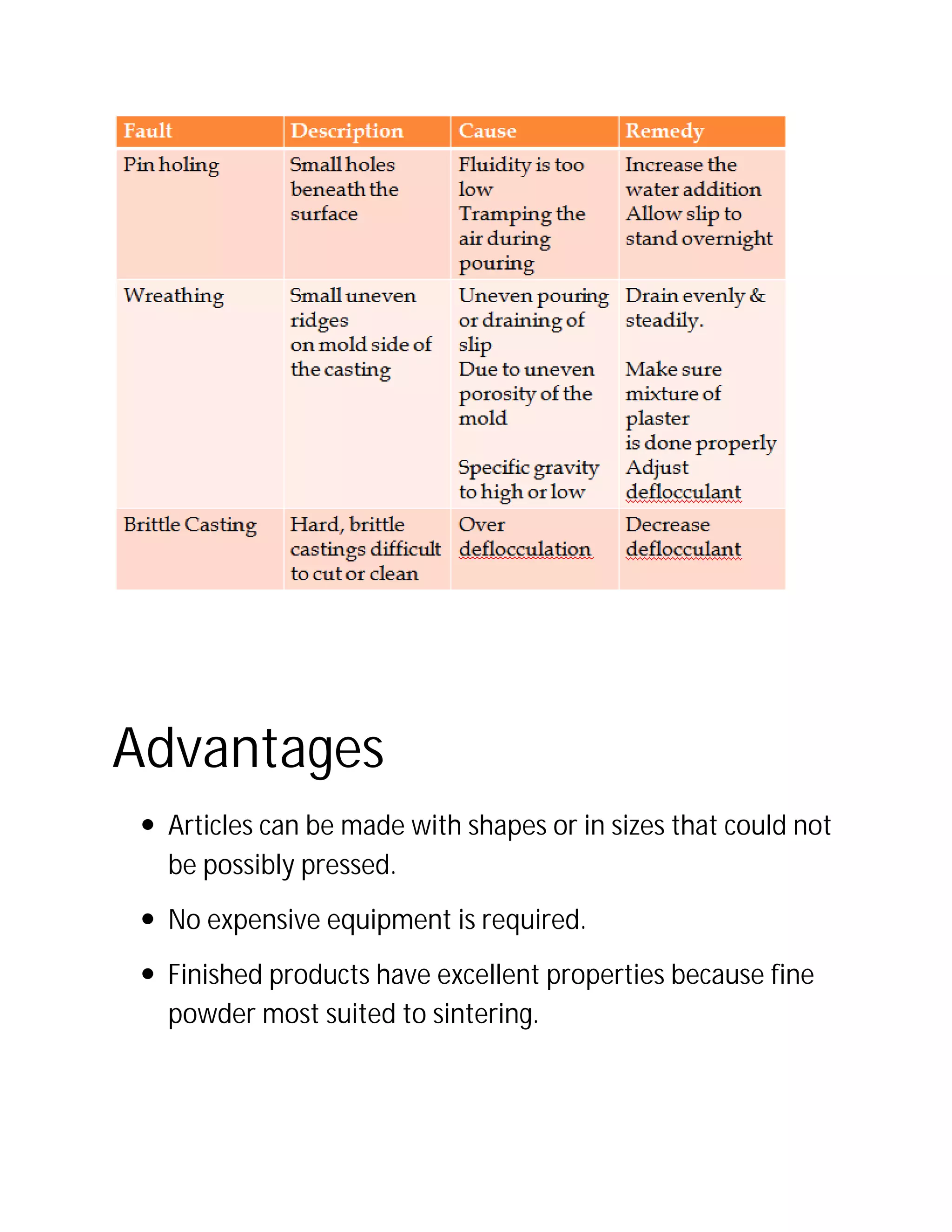
Trouble shooting
Advantages
 Articles can be made with shapes or in sizes that could not
be possibly pressed.
 No expensive equipment is required.
 Finished products have excellent properties because fine
powder most suited to sintering.
Disadvantages
 Process is slow.
 Limited commercial applications.
Slip casting

Slip casting

  • 1.
  • 2.
    History  This processwas introduced into many European porcelain factories in the eighteenth century, and was commonly employed for the casting of terracotta sculpture in the nineteenth century.  Today we may find that many common things we have such as: figurines, doll faces, dishes, flower pots, lamp bases, toilets etc. are made from this technique of mass production Slip casting  A slip is a suspension of metal or ceramic powder (5µm) in water or other suitable liquid which is poured into an absorbent( Plaster of Paris ) mould dried and subsequently sintered.  Slip are usually made up of constituent powders, a dispersing agent to stabilize the powder against colloidal forces , a solvent to control the slip viscosity and facilitate casting , a binder for giving green strength to the cast shape and plasticizer to modify the properties of the binder.
  • 3.
    Two principal variations Draincasting: after a semi-solid layer has been formed, thus producing a hollow product. Solid casting: is allowed for entire body to become firm. Drain casting  Slip is poured into plaster of Paris mold cavity.  Water is absorbed into plaster mold to form a firm layer.  Excess slip is poured out.  Green body is removed from the mold. Two principal variations Drain casting: The mold is inverted to drain excess slip solid layer has been formed, thus producing a To produce solid products, adequate time is allowed for entire body to become firm. Drain casting Slip is poured into plaster of Paris mold cavity. Water is absorbed into plaster mold to form a firm layer. Excess slip is poured out. Green body is removed from the mold. Two principal variations d to drain excess slip solid layer has been formed, thus producing a To produce solid products, adequate time Water is absorbed into plaster mold to form a firm layer.
  • 4.
    Solid casting  Slipis poured into plaster of Paris mold cavity.  Water is absorbe  Green cast.  Water will be absorbed from slip into the porous mould or else excess water can also be removed by external pressure.  The finish piece is than removed from mould and trimmed, sometimes a mould releasing agents such as oi graphite are used. Solid casting Slip is poured into plaster of Paris mold cavity. is absorbed into plaster mold. Water will be absorbed from slip into the porous mould or else excess water can also be removed by external The finish piece is than removed from mould and trimmed, sometimes a mould releasing agents such as oil, starch or graphite are used. Water will be absorbed from slip into the porous mould or else excess water can also be removed by external The finish piece is than removed from mould and trimmed, l, starch or
  • 5.
    Slip casted turbineblade Process Variables  Slip should have a low viscosity so that it can readily poured.  It should have low rate of setting and readily removable from the mould. Slip casted turbine blade Process Variables Slip should have a low viscosity so that it can readily It should have low rate of setting and readily removable Slip should have a low viscosity so that it can readily It should have low rate of setting and readily removable
  • 6.
     Should havelow shrinkage on drying and high strength after drying.  To achieve these properties we use fine powder particles less than 5µm and to obtain the optimum viscosity, deflocculantion and control of pH of slip are necessary.
  • 7.
  • 8.
    Advantages  Articles canbe made with shapes or in sizes that could not be possibly pressed.  No expensive equipment is required.  Finished products have excellent properties because fine powder most suited to sintering.
  • 9.
    Disadvantages  Process isslow.  Limited commercial applications.