CERAMICS
Mr.H.P.Varade
Assistant Professor
Sanjivani College of Engineering
Kopargaon,Dist:Ahmednagar
Ceramics
An inorganic compound consisting of a metal (or semi-metal) and
one or more nonmetals
 Examples:
Silica - silicon dioxide (SiO2), the main ingredient in most glass
products
Alumina - aluminum oxide (Al2O3), used in various applications
from abrasives to artificial bones
More complex compounds such as hydrous aluminum silicate
(Al2Si2O5(OH)4), the main ingredient in most clay products
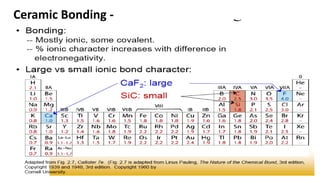
Ceramic Bonding -
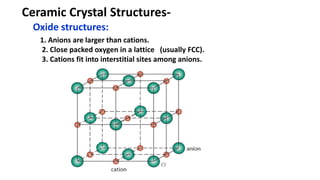
Ceramic Crystal Structures-
Oxide structures:
1. Anions are larger than cations.
2. Close packed oxygen in a lattice (usually FCC).
3. Cations fit into interstitial sites among anions.
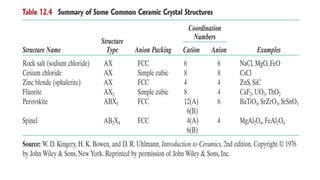
ABX3 Crystal Structures -
6
• Perovskite (calcium titanium
oxide) structure
Ex: complex oxide
Barium Titanate
(BaTiO3)
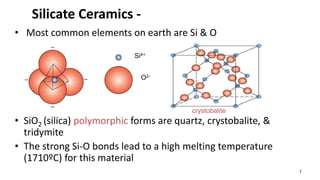
Silicate Ceramics -
• Most common elements on earth are Si & O
• SiO2 (silica) polymorphic forms are quartz, crystobalite, &
tridymite
• The strong Si-O bonds lead to a high melting temperature
(1710ºC) for this material
7
Si4+
O2-
crystobalite
8
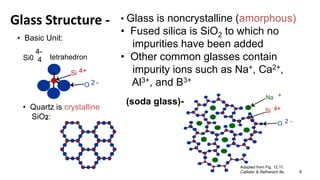
Glass Structure -
• Quartz is crystalline
SiO2:
• Basic Unit:
• Glass is noncrystalline (amorphous)
• Fused silica is SiO2 to which no
impurities have been added
• Other common glasses contain
impurity ions such as Na+, Ca2+,
Al3+, and B3+
(soda glass)-
Adapted from Fig. 12.11,
Callister & Rethwisch 8e.
Si0 4 tetrahedron
4-
Si 4+
O 2 -
Si 4+
Na +
O 2 -
Properties of Ceramic Materials-
Properties of Ceramic Materials
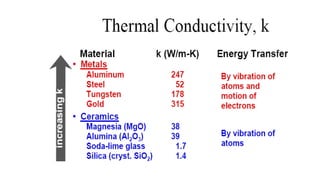
• High hardness, electrical and thermal insulating,
chemical stability, and high melting temperatures
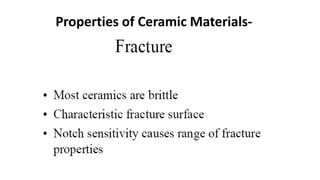
• Brittle, virtually no ductility - can cause problems
in both processing and performance of ceramic
products
Processing of Ceramics-
1.Slip Casting-
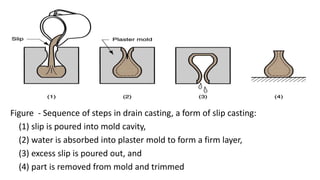
• A suspension of ceramic powders in water, called a slip, is poured into a
porous plaster of paris mold, so that water from the mix is absorbed into
the plaster to form a firm layer of clay at the mold surface .
•The slip composition is 25% to 40% water
Figure - Sequence of steps in drain casting, a form of slip casting:
(1) slip is poured into mold cavity,
(2) water is absorbed into plaster mold to form a firm layer,
(3) excess slip is poured out, and
(4) part is removed from mold and trimmed
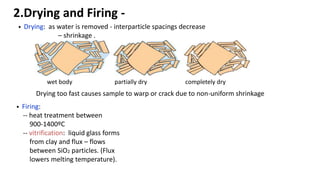
• Drying: as water is removed - interparticle spacings decrease
– shrinkage .
2.Drying and Firing -
Drying too fast causes sample to warp or crack due to non-uniform shrinkage
wet body partially dry completely dry
• Firing:
-- heat treatment between
900-1400ºC
-- vitrification: liquid glass forms
from clay and flux – flows
between SiO2 particles. (Flux
lowers melting temperature).
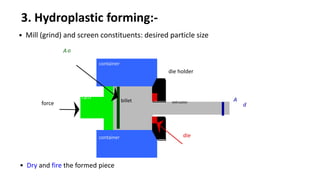
• Mill (grind) and screen constituents: desired particle size
• Dry and fire the formed piece
ram
billet
container
container
force
die holder
die
A o
A
d
extrusion
3. Hydroplastic forming:-
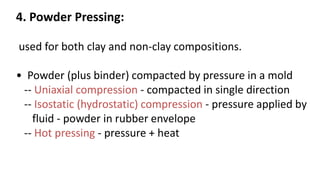
4. Powder Pressing:
used for both clay and non-clay compositions.
• Powder (plus binder) compacted by pressure in a mold
-- Uniaxial compression - compacted in single direction
-- Isostatic (hydrostatic) compression - pressure applied by
fluid - powder in rubber envelope
-- Hot pressing - pressure + heat
Ceramic Products
• Clay construction products - bricks, clay pipe, and building tile ,cement
concrete
• Refractory ceramics - ceramics capable of high temperature applications
such as furnace walls, crucibles, and molds
• White ware products - stoneware, fine china, porcelain, and other
tableware, based on mixtures of clay and other minerals
• Glass - bottles, glasses, lenses, window pane, and light bulbs
• Glass fibers - thermal insulating wool, reinforced plastics (fiberglass), and
fiber optics communications lines
• Abrasives - aluminum oxide and silicon carbide
• Cutting tool materials - tungsten carbide, aluminum oxide, and cubic
boron nitride
• Ceramic insulators - applications include electrical transmission
components, spark plugs, and microelectronic chip substrates
• Magnetic ceramics – example: computer memories
• Nuclear fuels based on uranium oxide (UO2)
• Bioceramics - artificial teeth and bones
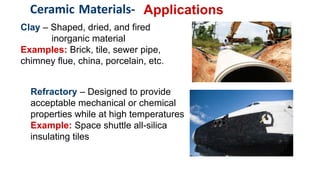
Ceramic Materials- Applications
Clay – Shaped, dried, and fired
inorganic material
Examples: Brick, tile, sewer pipe,
chimney flue, china, porcelain, etc.
Refractory – Designed to provide
acceptable mechanical or chemical
properties while at high temperatures
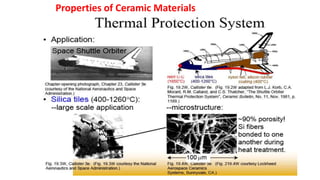
Example: Space shuttle all-silica
insulating tiles
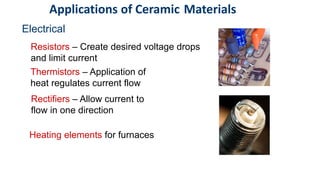
Applications of Ceramic Materials
Rectifiers – Allow current to
flow in one direction
Heating elements for furnaces
Electrical
Resistors – Create desired voltage drops
and limit current
Thermistors – Application of
heat regulates current flow
• Alumina(Al2O3) is used as insulators in spark plug and
electronic packaging, rocket nozzles etc.
• Tungsten carbide and Titanium carbide along with metal
binders like Ni, Co, Cr, Mo are known as cermets which are
used as cutting tool materials.
• Tungsten carbide is used as an abrasive material for grinding
and polishing operations
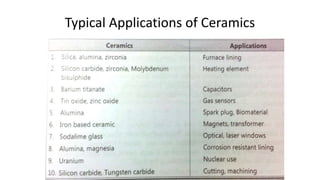
Typical Applications of Ceramics
THANK YOU

CERAMICS

  • 1.
    CERAMICS Mr.H.P.Varade Assistant Professor Sanjivani Collegeof Engineering Kopargaon,Dist:Ahmednagar
  • 2.
    Ceramics An inorganic compoundconsisting of a metal (or semi-metal) and one or more nonmetals  Examples: Silica - silicon dioxide (SiO2), the main ingredient in most glass products Alumina - aluminum oxide (Al2O3), used in various applications from abrasives to artificial bones More complex compounds such as hydrous aluminum silicate (Al2Si2O5(OH)4), the main ingredient in most clay products
  • 3.
  • 4.
    Ceramic Crystal Structures- Oxidestructures: 1. Anions are larger than cations. 2. Close packed oxygen in a lattice (usually FCC). 3. Cations fit into interstitial sites among anions.
  • 6.
    ABX3 Crystal Structures- 6 • Perovskite (calcium titanium oxide) structure Ex: complex oxide Barium Titanate (BaTiO3)
  • 7.
    Silicate Ceramics - •Most common elements on earth are Si & O • SiO2 (silica) polymorphic forms are quartz, crystobalite, & tridymite • The strong Si-O bonds lead to a high melting temperature (1710ºC) for this material 7 Si4+ O2- crystobalite
  • 8.
    8 Glass Structure - •Quartz is crystalline SiO2: • Basic Unit: • Glass is noncrystalline (amorphous) • Fused silica is SiO2 to which no impurities have been added • Other common glasses contain impurity ions such as Na+, Ca2+, Al3+, and B3+ (soda glass)- Adapted from Fig. 12.11, Callister & Rethwisch 8e. Si0 4 tetrahedron 4- Si 4+ O 2 - Si 4+ Na + O 2 -
  • 9.
  • 10.
  • 12.
  • 13.
    Properties of CeramicMaterials • High hardness, electrical and thermal insulating, chemical stability, and high melting temperatures • Brittle, virtually no ductility - can cause problems in both processing and performance of ceramic products
  • 14.
    Processing of Ceramics- 1.SlipCasting- • A suspension of ceramic powders in water, called a slip, is poured into a porous plaster of paris mold, so that water from the mix is absorbed into the plaster to form a firm layer of clay at the mold surface . •The slip composition is 25% to 40% water
  • 15.
    Figure - Sequenceof steps in drain casting, a form of slip casting: (1) slip is poured into mold cavity, (2) water is absorbed into plaster mold to form a firm layer, (3) excess slip is poured out, and (4) part is removed from mold and trimmed
  • 16.
    • Drying: aswater is removed - interparticle spacings decrease – shrinkage . 2.Drying and Firing - Drying too fast causes sample to warp or crack due to non-uniform shrinkage wet body partially dry completely dry • Firing: -- heat treatment between 900-1400ºC -- vitrification: liquid glass forms from clay and flux – flows between SiO2 particles. (Flux lowers melting temperature).
  • 17.
    • Mill (grind)and screen constituents: desired particle size • Dry and fire the formed piece ram billet container container force die holder die A o A d extrusion 3. Hydroplastic forming:-
  • 18.
    4. Powder Pressing: usedfor both clay and non-clay compositions. • Powder (plus binder) compacted by pressure in a mold -- Uniaxial compression - compacted in single direction -- Isostatic (hydrostatic) compression - pressure applied by fluid - powder in rubber envelope -- Hot pressing - pressure + heat
  • 19.
    Ceramic Products • Clayconstruction products - bricks, clay pipe, and building tile ,cement concrete • Refractory ceramics - ceramics capable of high temperature applications such as furnace walls, crucibles, and molds • White ware products - stoneware, fine china, porcelain, and other tableware, based on mixtures of clay and other minerals • Glass - bottles, glasses, lenses, window pane, and light bulbs • Glass fibers - thermal insulating wool, reinforced plastics (fiberglass), and fiber optics communications lines • Abrasives - aluminum oxide and silicon carbide • Cutting tool materials - tungsten carbide, aluminum oxide, and cubic boron nitride
  • 20.
    • Ceramic insulators- applications include electrical transmission components, spark plugs, and microelectronic chip substrates • Magnetic ceramics – example: computer memories • Nuclear fuels based on uranium oxide (UO2) • Bioceramics - artificial teeth and bones
  • 21.
    Ceramic Materials- Applications Clay– Shaped, dried, and fired inorganic material Examples: Brick, tile, sewer pipe, chimney flue, china, porcelain, etc. Refractory – Designed to provide acceptable mechanical or chemical properties while at high temperatures Example: Space shuttle all-silica insulating tiles
  • 22.
    Applications of CeramicMaterials Rectifiers – Allow current to flow in one direction Heating elements for furnaces Electrical Resistors – Create desired voltage drops and limit current Thermistors – Application of heat regulates current flow
  • 23.
    • Alumina(Al2O3) isused as insulators in spark plug and electronic packaging, rocket nozzles etc. • Tungsten carbide and Titanium carbide along with metal binders like Ni, Co, Cr, Mo are known as cermets which are used as cutting tool materials. • Tungsten carbide is used as an abrasive material for grinding and polishing operations
  • 24.
  • 25.