



SERIAL EXTRACTION
INTRODUCTION  HISTORY  RATIONALE  INDICATIONS  CONTRAINDICATIONS  ADVANTAGES  DISADVANTAGES  DIAGNOSITC PROCEDURE  PROBLEMS IN SERIAL EXTRACTION
INTRODUCTION :   Serial Extraction is an interceptive orthodontic procedure  usually initiated in the early mixed dentition.   It is a procedure that includes the planned extraction of certain deciduous teeth & later specific permenent teeth in an orderly sequence & pre-determined pattern to guide the erupting permenent teeth into a more favourable position.
HISTORY:-   Kjellgren  (1929) used the term   “ Serial  extraction”   to describe a procedure where some deciduous teeth followed by permenent teeth were extracted to guide the rest of the teeth into normal occlusion.   Nance   during 1940’s popularized this technique in united states of AMERICA, termed it   “planned & progressive extraction”   & has been called the ‘father’ of  Serial  extraction philosophy in united states.   Hotz   in 1970 called such a procedure   “active supervision”   of teeth by extraction.
Serial  extraction is based on 2 basic principles:-   Physiologic tooth movement   RATIONALE:- Arch Length tooth material discrepancy:   Whenever there is an excess of tooth material as compared to the arch length a selective extraction of some teeth is done so that rest of the teeth can be guided to normal occlusion.   Human dentition shows a physiologic tendency to move towards an extraction space.   Thus by selective  removal of some teeth the rest of the teeth which are in the process of eruption are guided by the natural forces into the extraction spaces .
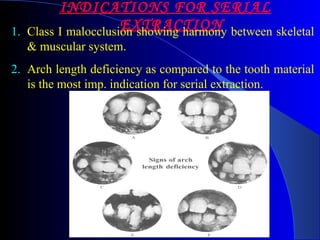
INDICATIONS FOR SERIAL EXTRACTION Class I malocclusion showing harmony between skeletal & muscular system.  Arch length deficiency as compared to the tooth material is the most imp. indication for serial extraction.
Absence of physiologic spacing  Unilateral or bilateral premature loss of deciduous canines with midline shift.  Malpositioned or impacted lateral incisors .  Irregular or crowded upper & lower incisors. Localized gingival recession in the lower ant region Ectopic eruption of teeth.  Mesial migration of buccal segment.  Arch length deficiency is indicated by the presence of  1 or more of the following features:-
Abnormal eruption pattern & sequence. Lower anterior flaring. Ankylosis of 1 or more teeth . Where growth is not enough to overcome the discrepancy between tooth material & basal bone.   Patients with straight profile & pleasing appearance.
Contraindications of Serial Extraction Class II & III malocclusion with skeletal abnormalities.  Space dentition.  Anodontia/ oligodontia.  Open bite & deep bite.  Midline diastema.  Class I malocclusion with minimal space deficiency.  Unerupted malformed teeth. Eg. Dilacerations.  Extensive caries or heavily filled I permenent molars.  Mild disproportion between arch length & tooth material .
Advantages of Serial Extraction: Treatment is more physiologic as it involves guidance of teeth into normal positions.  Psychological trauma associated with malocclusion can be avoided by treatment of the malocclusion at an early stage.  It eliminates the duration of multi-banded fixed treatment. Better oral hygiene is possible thereby reducing the risk of caries.  Health of investing tissue is preserved.  Lesser retention period is indicated at the completion of treatment.  More stable results are achieved as the tooth material & arch length are in harmony.
Disadvantages of Serial Extraction:   It can not be universally applied to all patients. Treatment time is prolonged as the treatment is carried out in stages spread over 2-3 years.  It requires the patient to visit the dentist thus patient co-operation is needed.  As the extraction spaces are created that close gradually the patient has a tendency of developing tongue thrust.
Extraction of buccal teeth can result in deepening of the bite.  If the procedure are not carried out properly there is a risk of arch length reducing by mesial migration of the buccal segment. Ditching or space can exist b/w the canine & 2 nd  premolar.  The axial inclination of teeth at the termination of the serial extraction procedure may require correction.
Procedure There are mainly three methods:- Dewel’s Method  Tweed’s Method  Nance method.
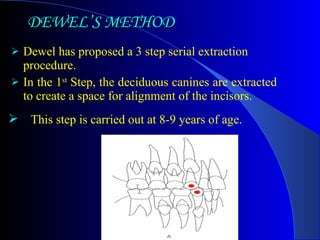
DEWEL’S METHOD Dewel has proposed a 3 step serial extraction  procedure.  In the 1 st  Step, the deciduous canines are extracted to create a space for alignment of the incisors.  This step is carried out at 8-9 years of age.
After 1 years, the deciduous 1st molars are extracted so that the eruption of 1st premolars is accelerated.
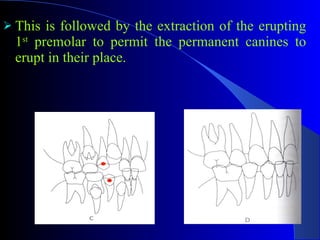
This is followed by the extraction of the erupting 1 st  premolar to permit the permanent canines to erupt in their place.
In some cases, a   Modified Dewel’s Technique   is followed where in the 1 st  premolar are enucleated at the time of extraction of the 1 st   deciduous molars. This is frequently necessary in the mandibular arch where the canines often erupt before the 1 st  PM
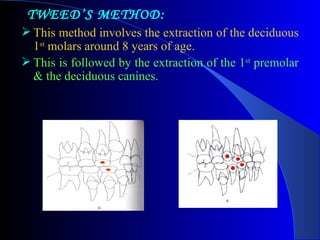
TWEED’S METHOD: This method involves the extraction of the deciduous 1 st  molars around 8 years of age.  This is followed by the extraction of the 1 st  premolar & the deciduous canines.
Nance Method: This is similar to the Tweed’s technique & involves the extraction of the deciduous 1st molars followed by the extraction of the 1st Premolars & the deciduous canines.
Problems in the serial extraction   Ant. crossbites can broadly classified as :-  Dento- alveolar ant. crossbites. Skeletal ant. crossbites  Functional ant. crossbites.  ANTERIOR CROSSBITES
Dento alvealor ant. Crossbites: Ant. crossbite in which  1 or more maxillary teeth are in lingual relation to the mandibular ant. is termed as  “Dentoalveolar ant. Crossbites”. This is manifested as single tooth crossbite & usually occurs due to over retained deciduous teeth.   Functional ant. Crossbites: Also called  “Pseudo Class III Malocclusion”. Occurs as a result of occlusal prematurities .
Skeletal ant. crossbite These are usually a result of skeletal discrepencies in growth of  maxilla or the mandible.  Ant. cross bite can be a result of maxillary retrognathism or hypoplasia or mandibular prognthism.  These are treated by use of myofunctional or orthopadic appliances.
References : Textbook  of  orthodontics : GRABER Textbook  of orthodontics : S.I. BHALAJHI

serial extraction

  • 1.
  • 2.
    INTRODUCTION HISTORY RATIONALE INDICATIONS CONTRAINDICATIONS ADVANTAGES DISADVANTAGES DIAGNOSITC PROCEDURE PROBLEMS IN SERIAL EXTRACTION
  • 3.
    INTRODUCTION : Serial Extraction is an interceptive orthodontic procedure usually initiated in the early mixed dentition. It is a procedure that includes the planned extraction of certain deciduous teeth & later specific permenent teeth in an orderly sequence & pre-determined pattern to guide the erupting permenent teeth into a more favourable position.
  • 4.
    HISTORY:- Kjellgren (1929) used the term “ Serial extraction” to describe a procedure where some deciduous teeth followed by permenent teeth were extracted to guide the rest of the teeth into normal occlusion. Nance during 1940’s popularized this technique in united states of AMERICA, termed it “planned & progressive extraction” & has been called the ‘father’ of Serial extraction philosophy in united states. Hotz in 1970 called such a procedure “active supervision” of teeth by extraction.
  • 5.
    Serial extractionis based on 2 basic principles:- Physiologic tooth movement RATIONALE:- Arch Length tooth material discrepancy: Whenever there is an excess of tooth material as compared to the arch length a selective extraction of some teeth is done so that rest of the teeth can be guided to normal occlusion. Human dentition shows a physiologic tendency to move towards an extraction space. Thus by selective removal of some teeth the rest of the teeth which are in the process of eruption are guided by the natural forces into the extraction spaces .
  • 6.
    INDICATIONS FOR SERIALEXTRACTION Class I malocclusion showing harmony between skeletal & muscular system. Arch length deficiency as compared to the tooth material is the most imp. indication for serial extraction.
  • 7.
    Absence of physiologicspacing Unilateral or bilateral premature loss of deciduous canines with midline shift. Malpositioned or impacted lateral incisors . Irregular or crowded upper & lower incisors. Localized gingival recession in the lower ant region Ectopic eruption of teeth. Mesial migration of buccal segment. Arch length deficiency is indicated by the presence of 1 or more of the following features:-
  • 8.
    Abnormal eruption pattern& sequence. Lower anterior flaring. Ankylosis of 1 or more teeth . Where growth is not enough to overcome the discrepancy between tooth material & basal bone. Patients with straight profile & pleasing appearance.
  • 9.
    Contraindications of SerialExtraction Class II & III malocclusion with skeletal abnormalities. Space dentition. Anodontia/ oligodontia. Open bite & deep bite. Midline diastema. Class I malocclusion with minimal space deficiency. Unerupted malformed teeth. Eg. Dilacerations. Extensive caries or heavily filled I permenent molars. Mild disproportion between arch length & tooth material .
  • 10.
    Advantages of SerialExtraction: Treatment is more physiologic as it involves guidance of teeth into normal positions. Psychological trauma associated with malocclusion can be avoided by treatment of the malocclusion at an early stage. It eliminates the duration of multi-banded fixed treatment. Better oral hygiene is possible thereby reducing the risk of caries. Health of investing tissue is preserved. Lesser retention period is indicated at the completion of treatment. More stable results are achieved as the tooth material & arch length are in harmony.
  • 11.
    Disadvantages of SerialExtraction: It can not be universally applied to all patients. Treatment time is prolonged as the treatment is carried out in stages spread over 2-3 years. It requires the patient to visit the dentist thus patient co-operation is needed. As the extraction spaces are created that close gradually the patient has a tendency of developing tongue thrust.
  • 12.
    Extraction of buccalteeth can result in deepening of the bite. If the procedure are not carried out properly there is a risk of arch length reducing by mesial migration of the buccal segment. Ditching or space can exist b/w the canine & 2 nd premolar. The axial inclination of teeth at the termination of the serial extraction procedure may require correction.
  • 13.
    Procedure There aremainly three methods:- Dewel’s Method Tweed’s Method Nance method.
  • 14.
    DEWEL’S METHOD Dewelhas proposed a 3 step serial extraction procedure. In the 1 st Step, the deciduous canines are extracted to create a space for alignment of the incisors. This step is carried out at 8-9 years of age.
  • 15.
    After 1 years,the deciduous 1st molars are extracted so that the eruption of 1st premolars is accelerated.
  • 16.
    This is followedby the extraction of the erupting 1 st premolar to permit the permanent canines to erupt in their place.
  • 17.
    In some cases,a Modified Dewel’s Technique is followed where in the 1 st premolar are enucleated at the time of extraction of the 1 st deciduous molars. This is frequently necessary in the mandibular arch where the canines often erupt before the 1 st PM
  • 18.
    TWEED’S METHOD: Thismethod involves the extraction of the deciduous 1 st molars around 8 years of age. This is followed by the extraction of the 1 st premolar & the deciduous canines.
  • 19.
    Nance Method: Thisis similar to the Tweed’s technique & involves the extraction of the deciduous 1st molars followed by the extraction of the 1st Premolars & the deciduous canines.
  • 20.
    Problems in theserial extraction Ant. crossbites can broadly classified as :- Dento- alveolar ant. crossbites. Skeletal ant. crossbites Functional ant. crossbites. ANTERIOR CROSSBITES
  • 21.
    Dento alvealor ant.Crossbites: Ant. crossbite in which 1 or more maxillary teeth are in lingual relation to the mandibular ant. is termed as “Dentoalveolar ant. Crossbites”. This is manifested as single tooth crossbite & usually occurs due to over retained deciduous teeth. Functional ant. Crossbites: Also called “Pseudo Class III Malocclusion”. Occurs as a result of occlusal prematurities .
  • 22.
    Skeletal ant. crossbiteThese are usually a result of skeletal discrepencies in growth of maxilla or the mandible. Ant. cross bite can be a result of maxillary retrognathism or hypoplasia or mandibular prognthism. These are treated by use of myofunctional or orthopadic appliances.
  • 23.
    References : Textbook of orthodontics : GRABER Textbook of orthodontics : S.I. BHALAJHI