COMPLICATED EXTRACTION & ODONTECTOMY  Presenter: R1  鄭瑋之 Instructor: VS  陳靜容醫師 Date: 2012/2/17
Outlines
Indications  for Surgical Extraction Erupted teeth Excessive forced may cause a fracture of bone/tooth Heavy or dense bone (aging, bruxism) Root condition: hyper-cementosis (aging), divergent (maxillary 1 st  molars) Maxillary sinus Extensive caries or large restorations Retained roots
Impacted teeth Pericoronitis prevention/treatment (25~30%) Prevention of dental disease Caries (15%) Periodontal disease (5%) Orthodontic Considerations Crowding of mandibular Incisors (controversial) Interference of orthodontic treatment/orthognathic surgery Root resorption of adjacent teeth: about 7% Indications  for Surgical Extraction
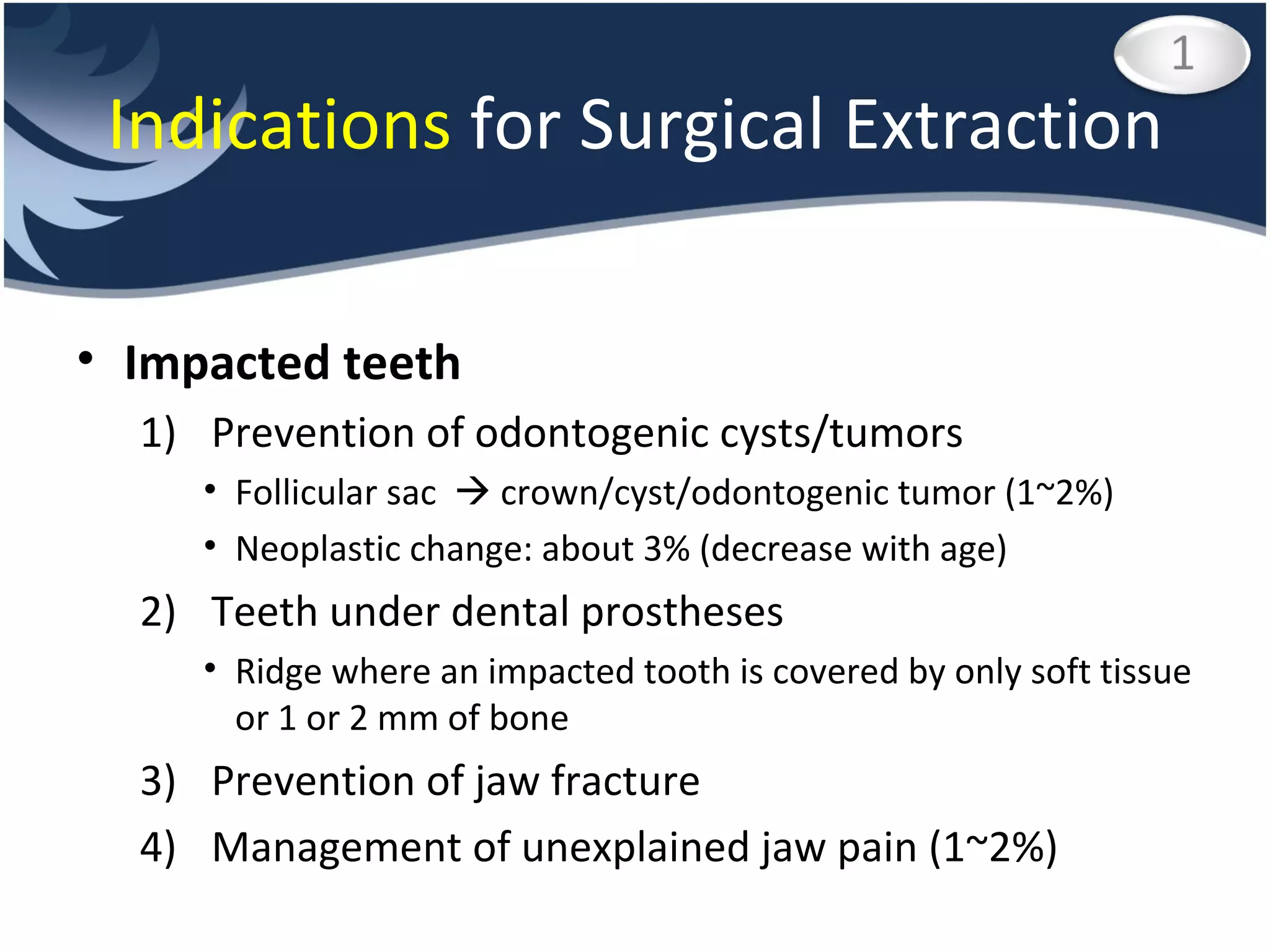
Impacted teeth Prevention of odontogenic cysts/tumors Follicular sac    crown/cyst/odontogenic tumor (1~2%) Neoplastic change: about 3% (decrease with age) Teeth under dental prostheses Ridge where an impacted tooth is covered by only soft tissue or 1 or 2 mm of bone Prevention of jaw fracture Management of unexplained jaw pain (1~2%) Indications  for Surgical Extraction
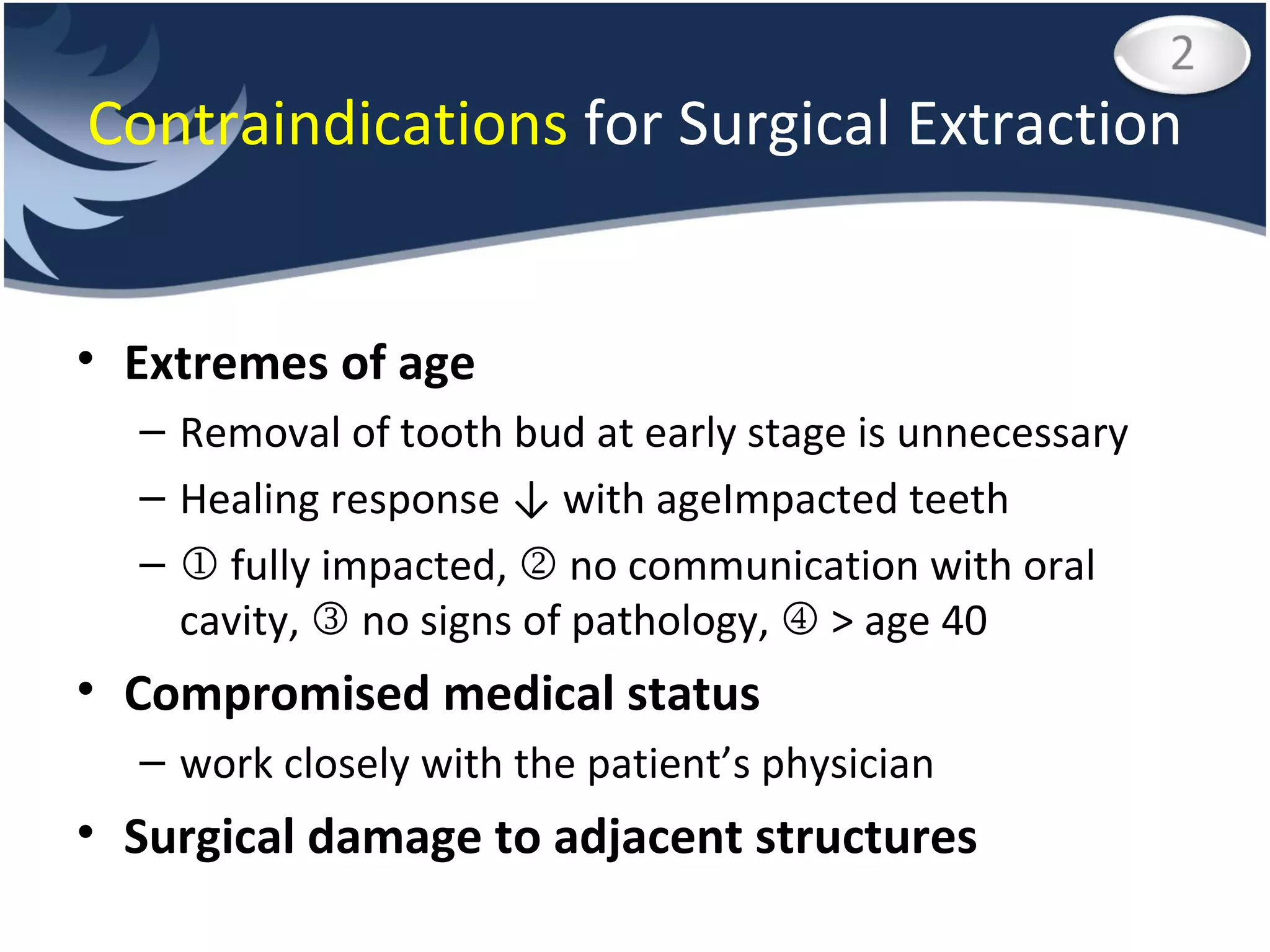
Contraindications  for Surgical Extraction Extremes of age Removal of tooth bud at early stage is unnecessary Healing response ↓ with ageImpacted teeth    fully impacted,    no communication with oral cavity,    no signs of pathology,    > age 40 Compromised medical status work closely with the patient’s physician Surgical damage to adjacent structures
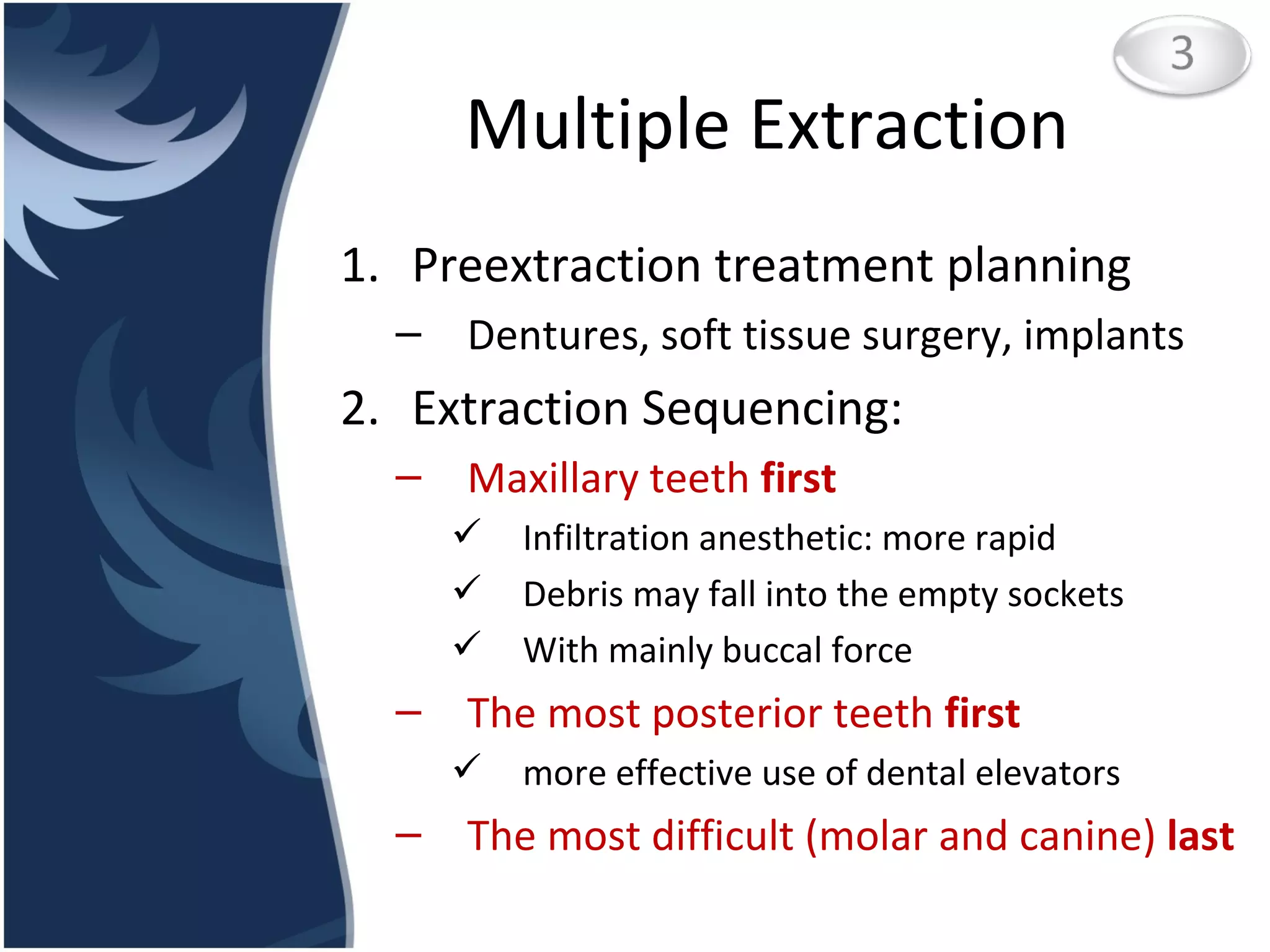
Multiple Extraction Preextraction treatment planning Dentures, soft tissue surgery, implants Extraction Sequencing: Maxillary teeth   first Infiltration anesthetic: more rapid Debris may fall into the empty sockets With mainly buccal force The most posterior teeth  first more effective use of dental elevators The most difficult (molar and canine)  last
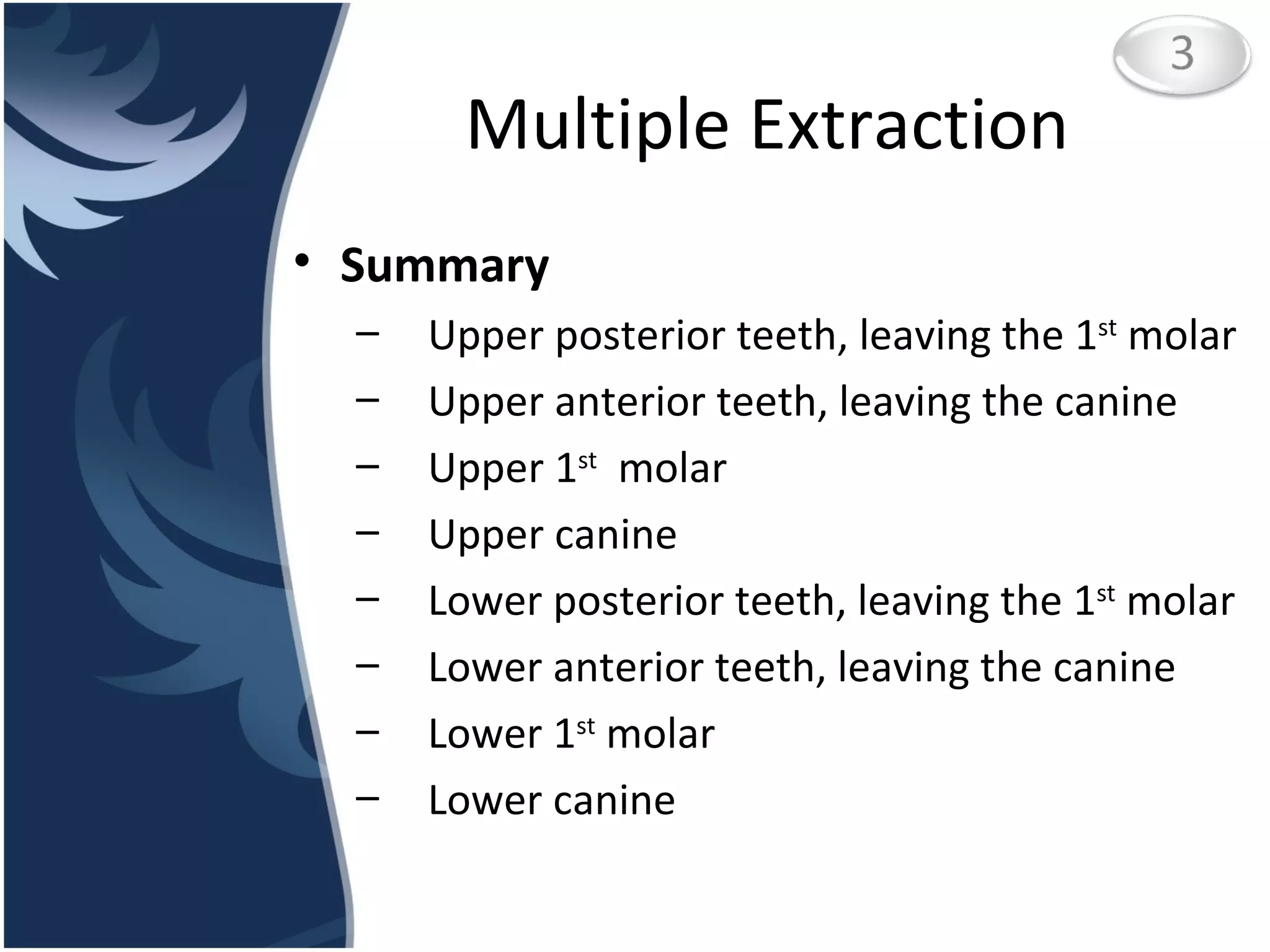
Multiple Extraction Summary Upper posterior teeth, leaving the 1 st  molar Upper anterior teeth, leaving the canine Upper 1 st   molar Upper canine Lower posterior teeth, leaving the 1 st  molar Lower anterior teeth, leaving the canine Lower 1 st  molar Lower canine
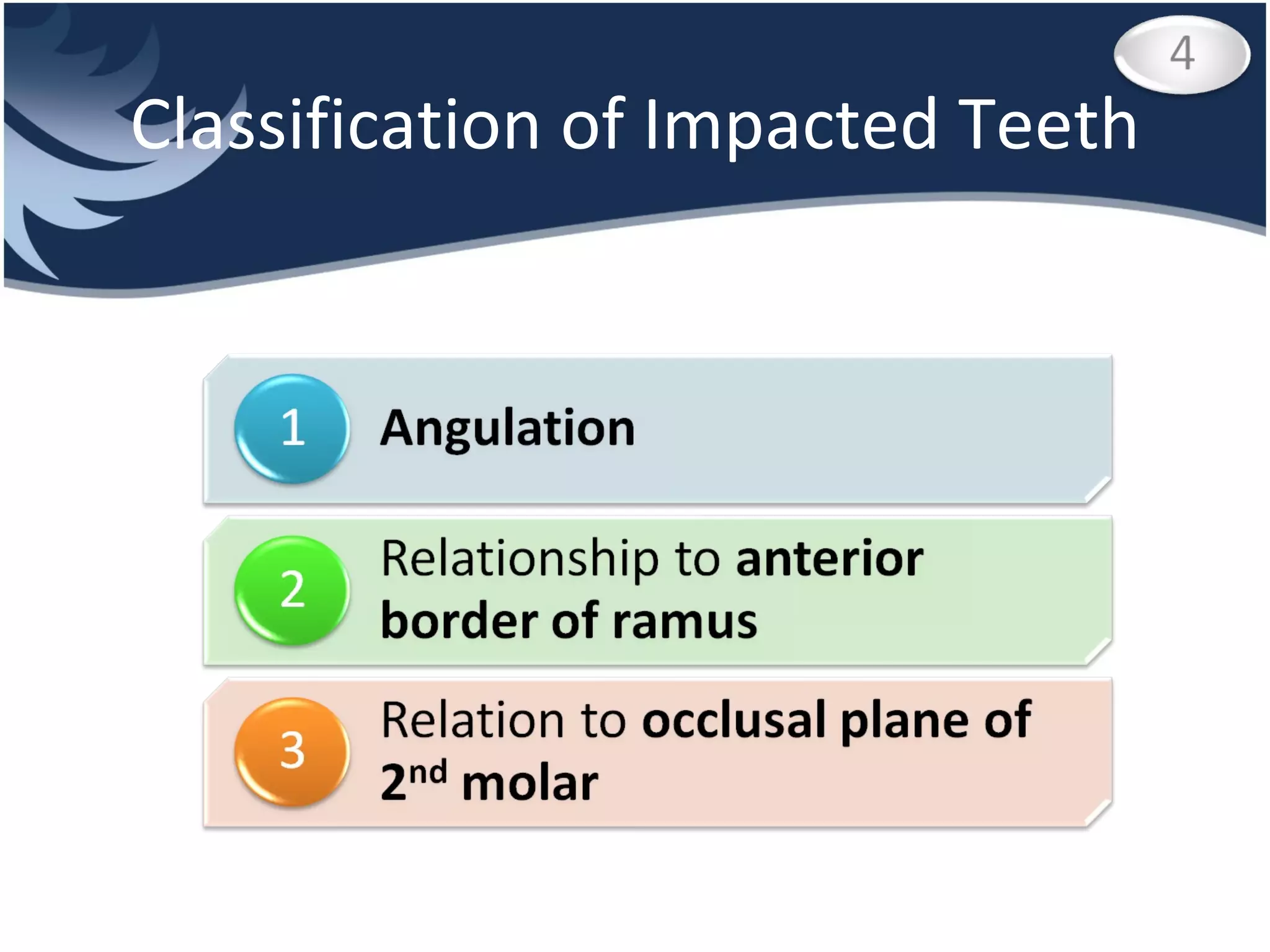
Classification of Impacted Teeth
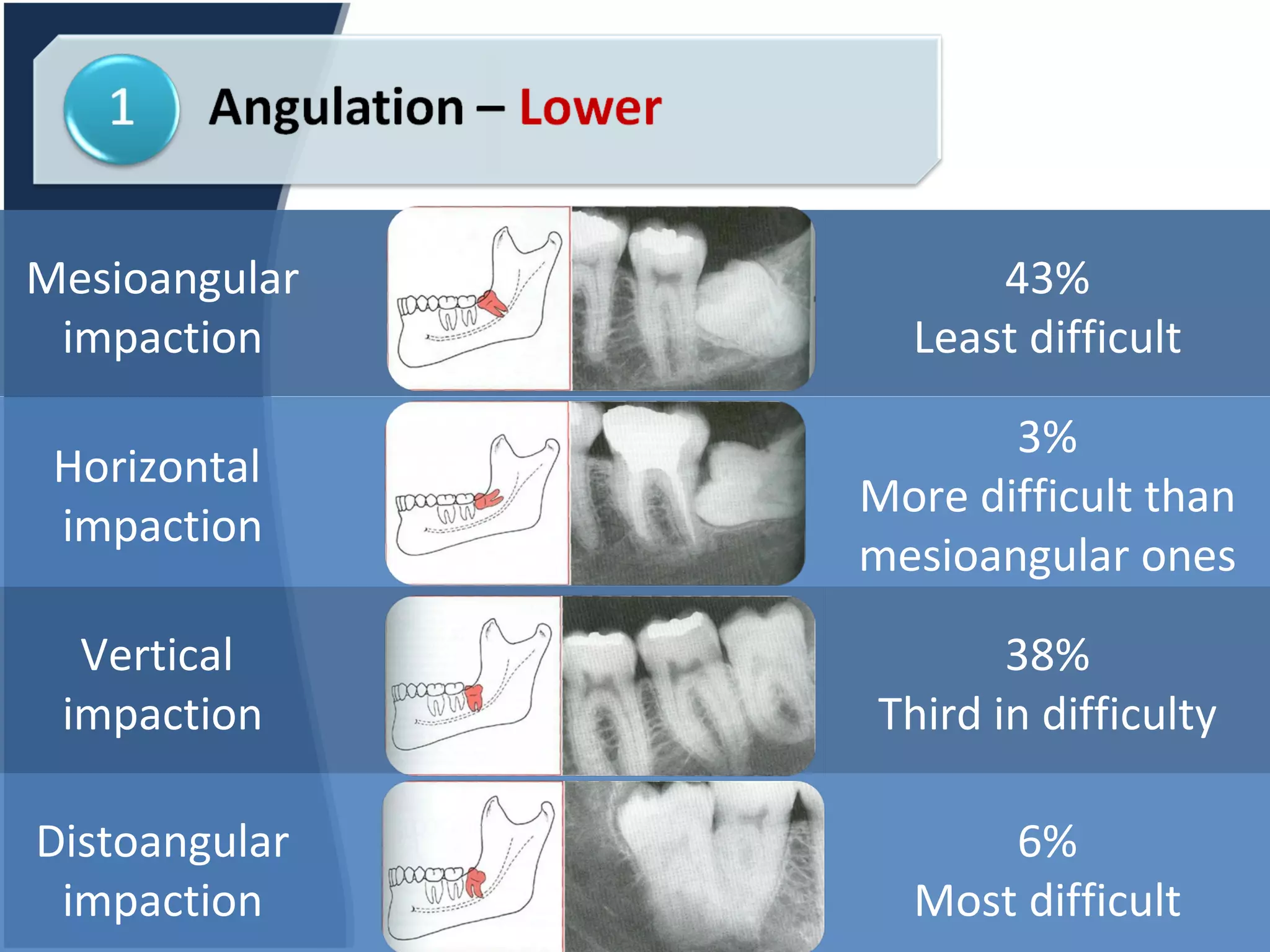
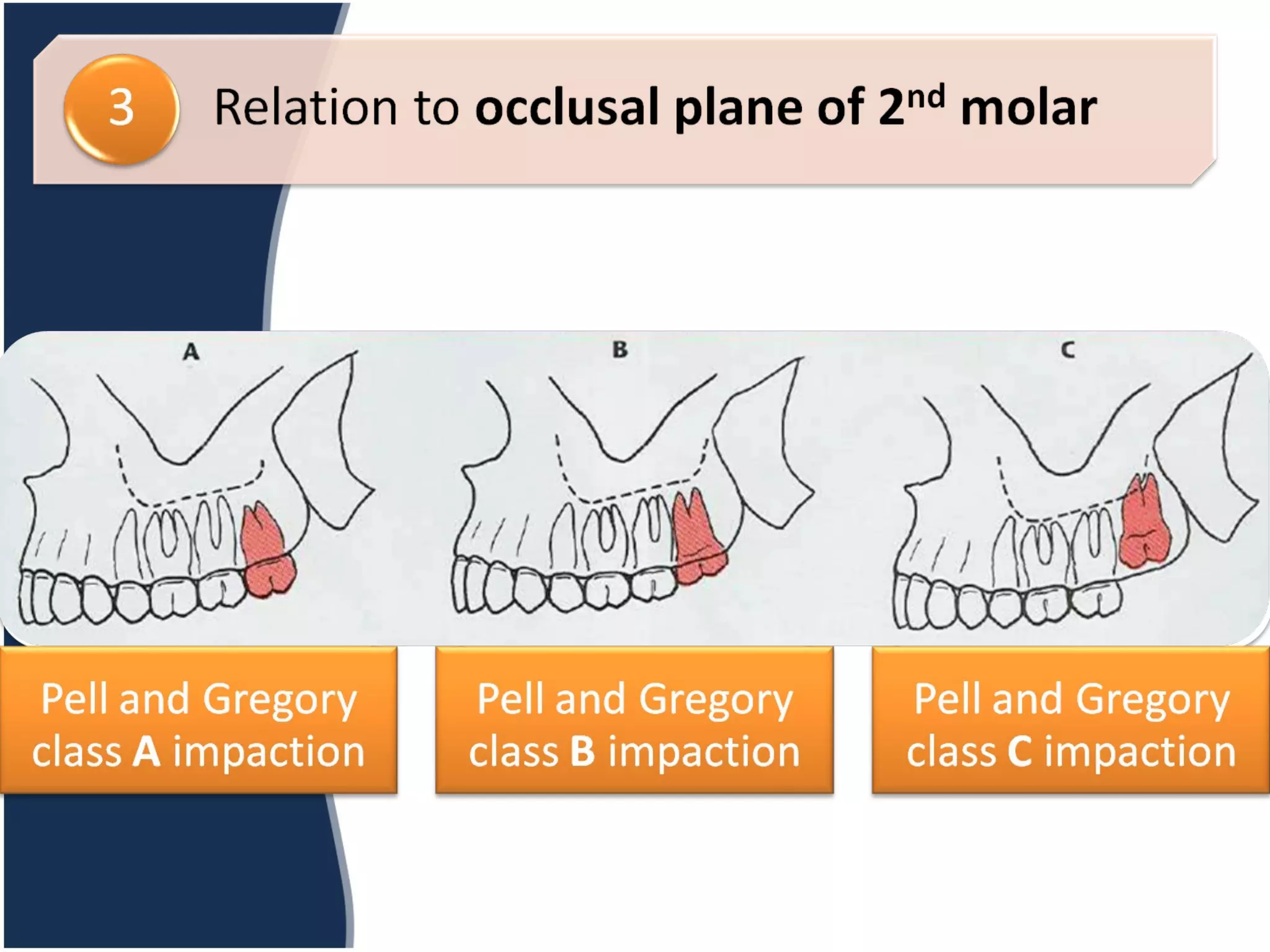
Mesioangular impaction 43% Least difficult Horizontal  impaction 3% More difficult than mesioangular ones Vertical  impaction 38% Third in difficulty Distoangular impaction 6% Most difficult
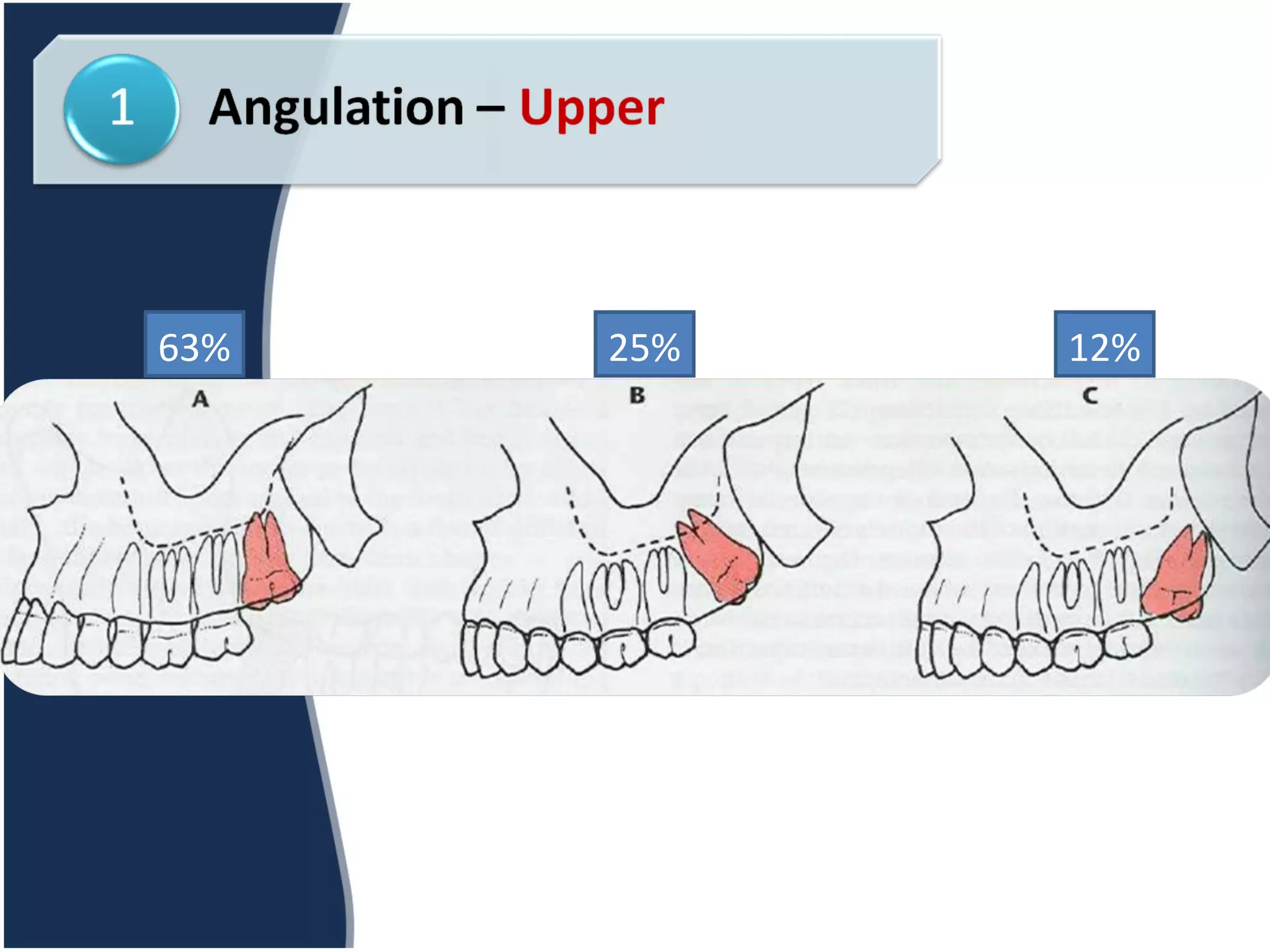
63% 25% 12%
 
 
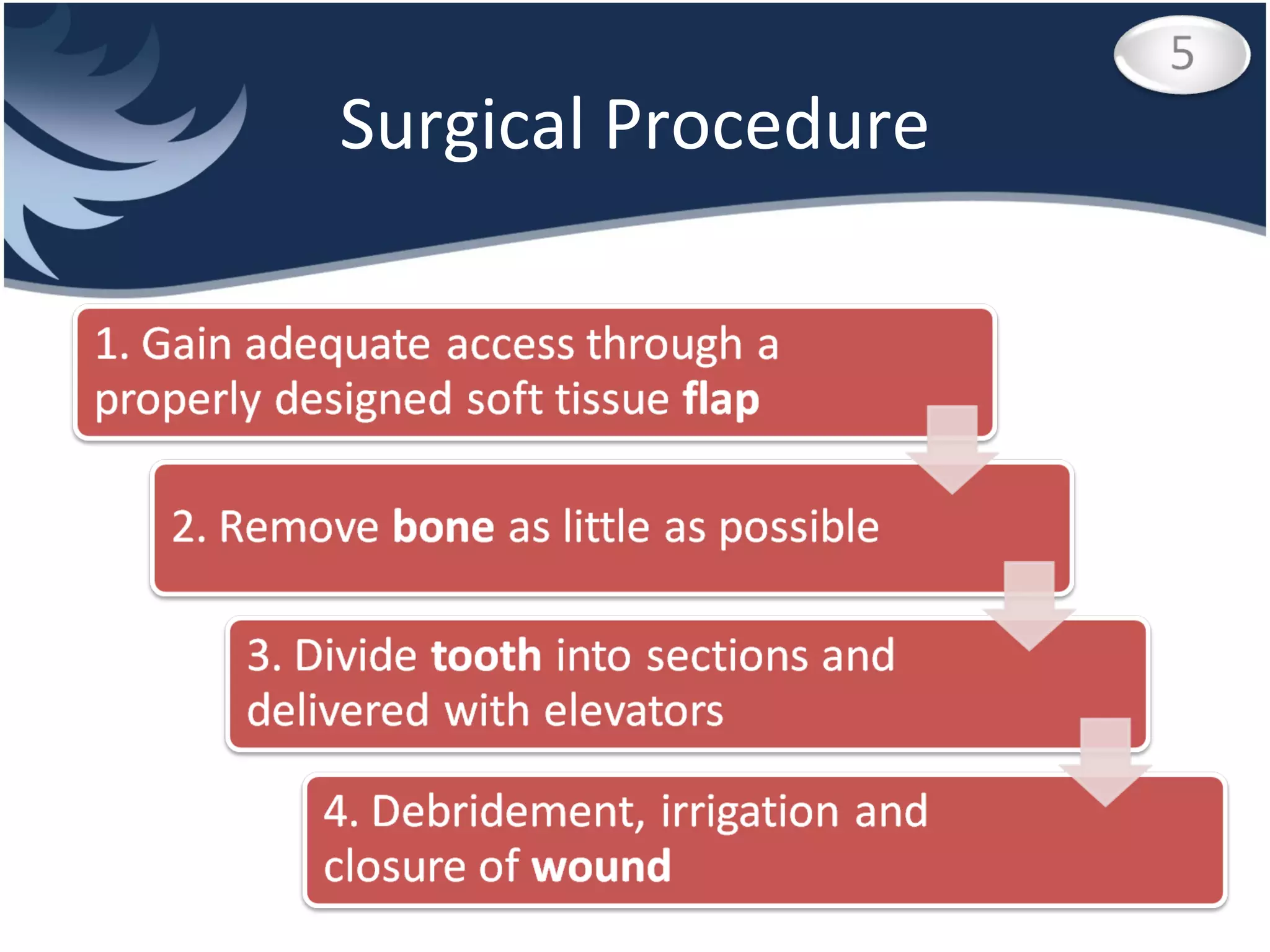
Surgical Procedure
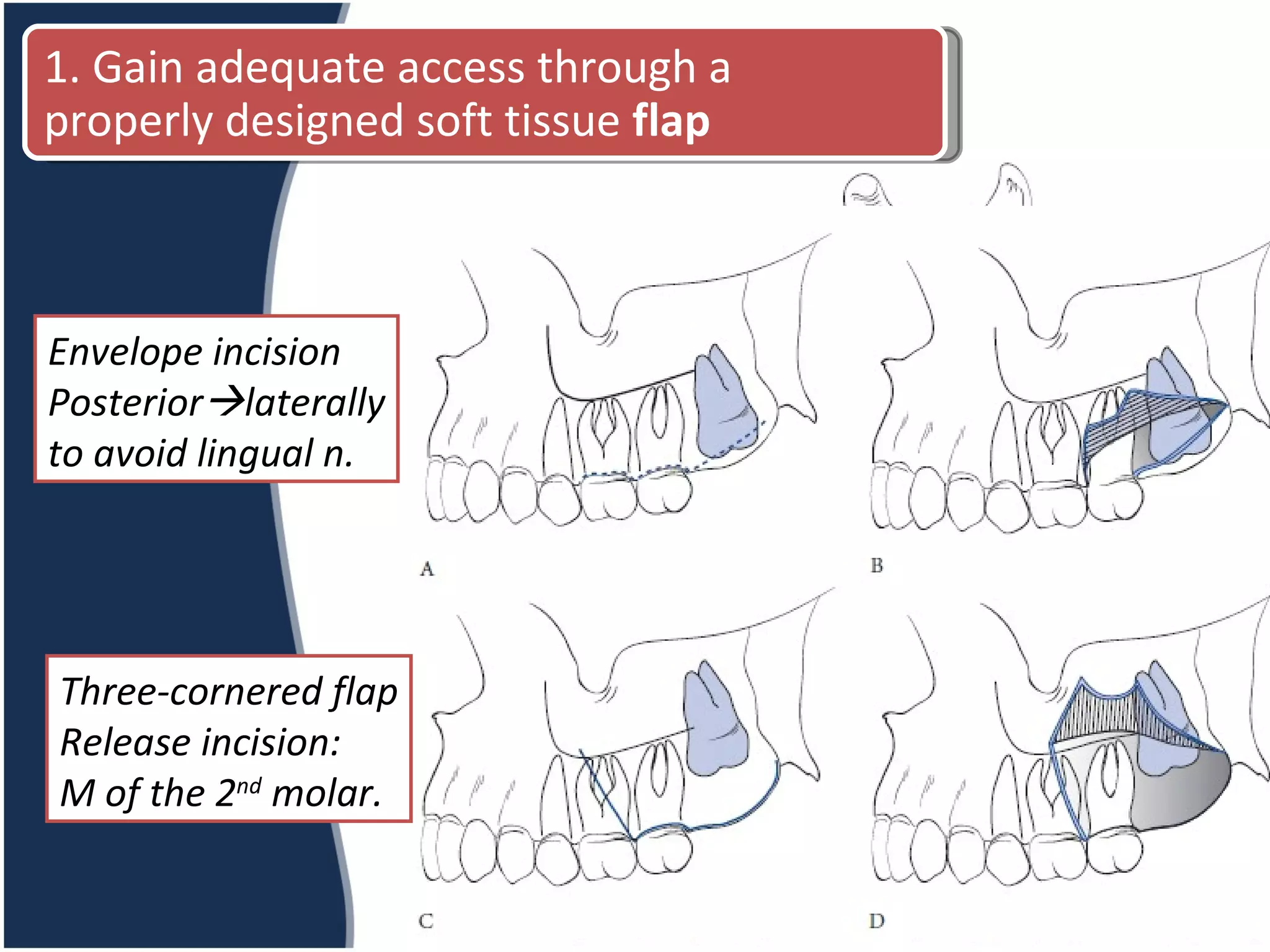
Envelope incision Posterior  laterally to avoid lingual n. Three-cornered flap Release incision: M of the 2 nd  molar. 1. Gain adequate access through a properly designed soft tissue  flap
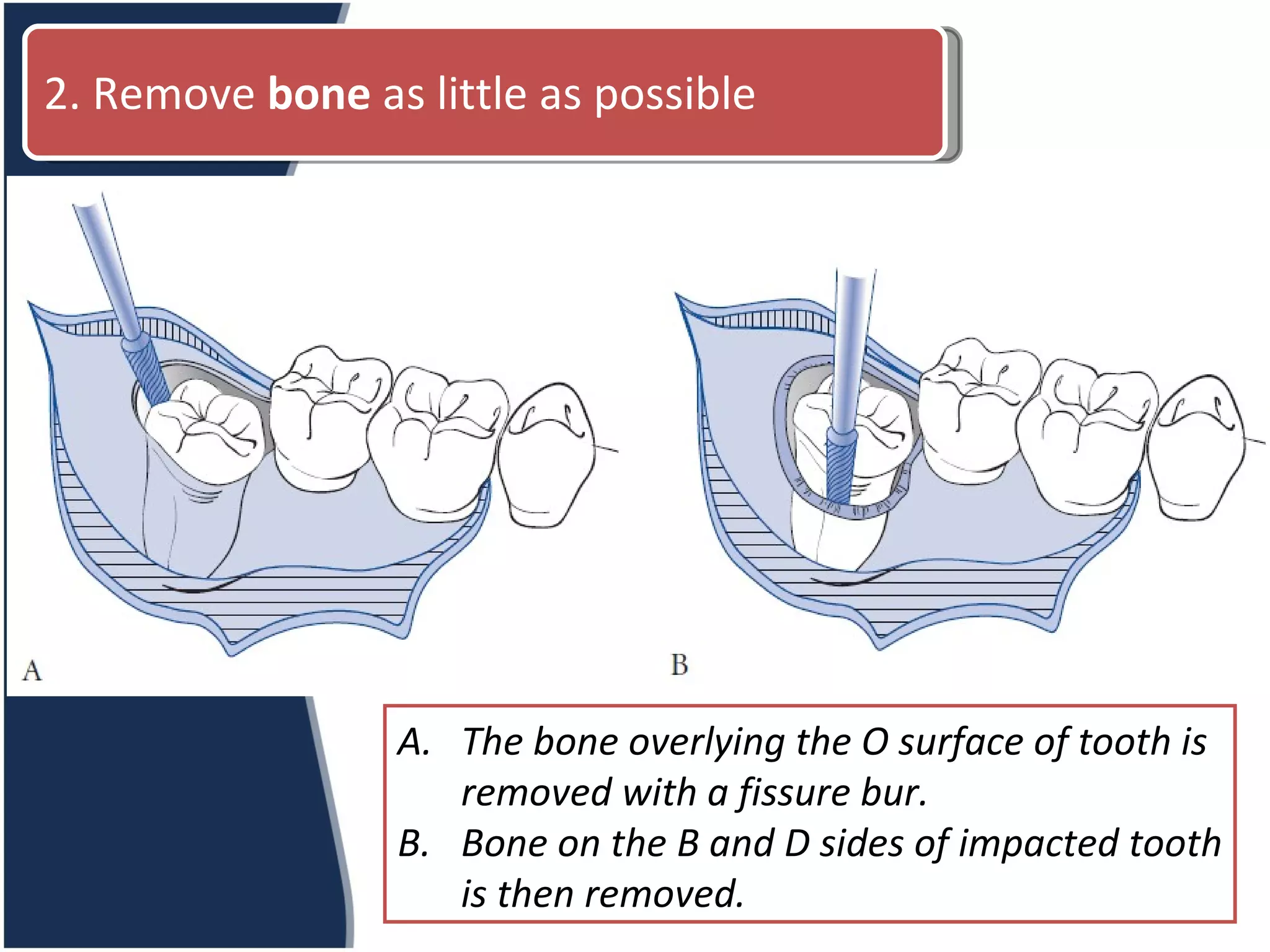
The bone overlying the O surface of tooth is removed with a fissure bur. Bone on the B and D sides of impacted tooth is then removed. 2. Remove  bone  as little as possible
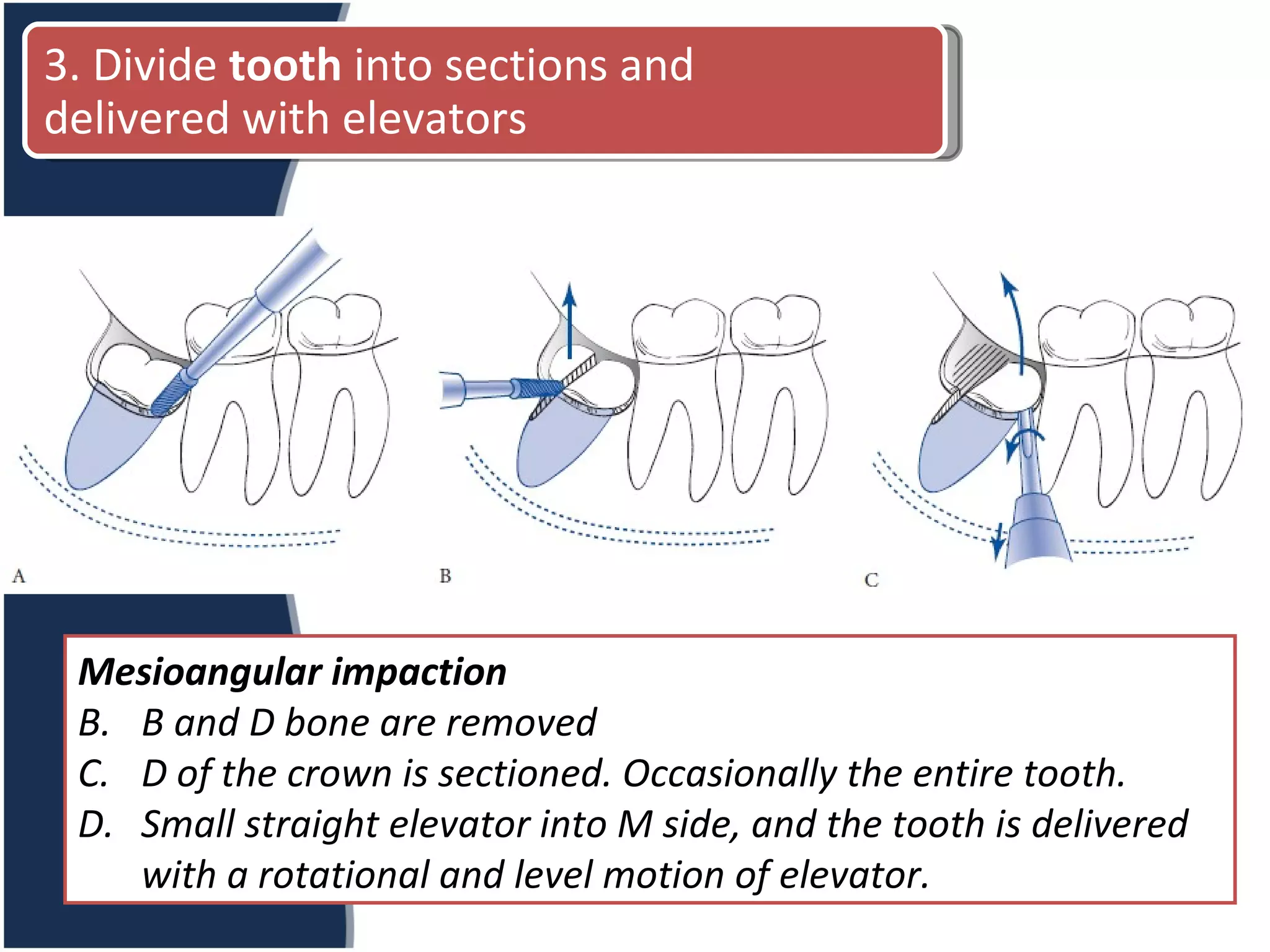
Mesioangular impaction B and D bone are removed D of the crown is sectioned. Occasionally the entire tooth. Small straight elevator into M side, and the tooth is delivered with a rotational and level motion of elevator. 3. Divide  tooth  into sections and delivered with elevators
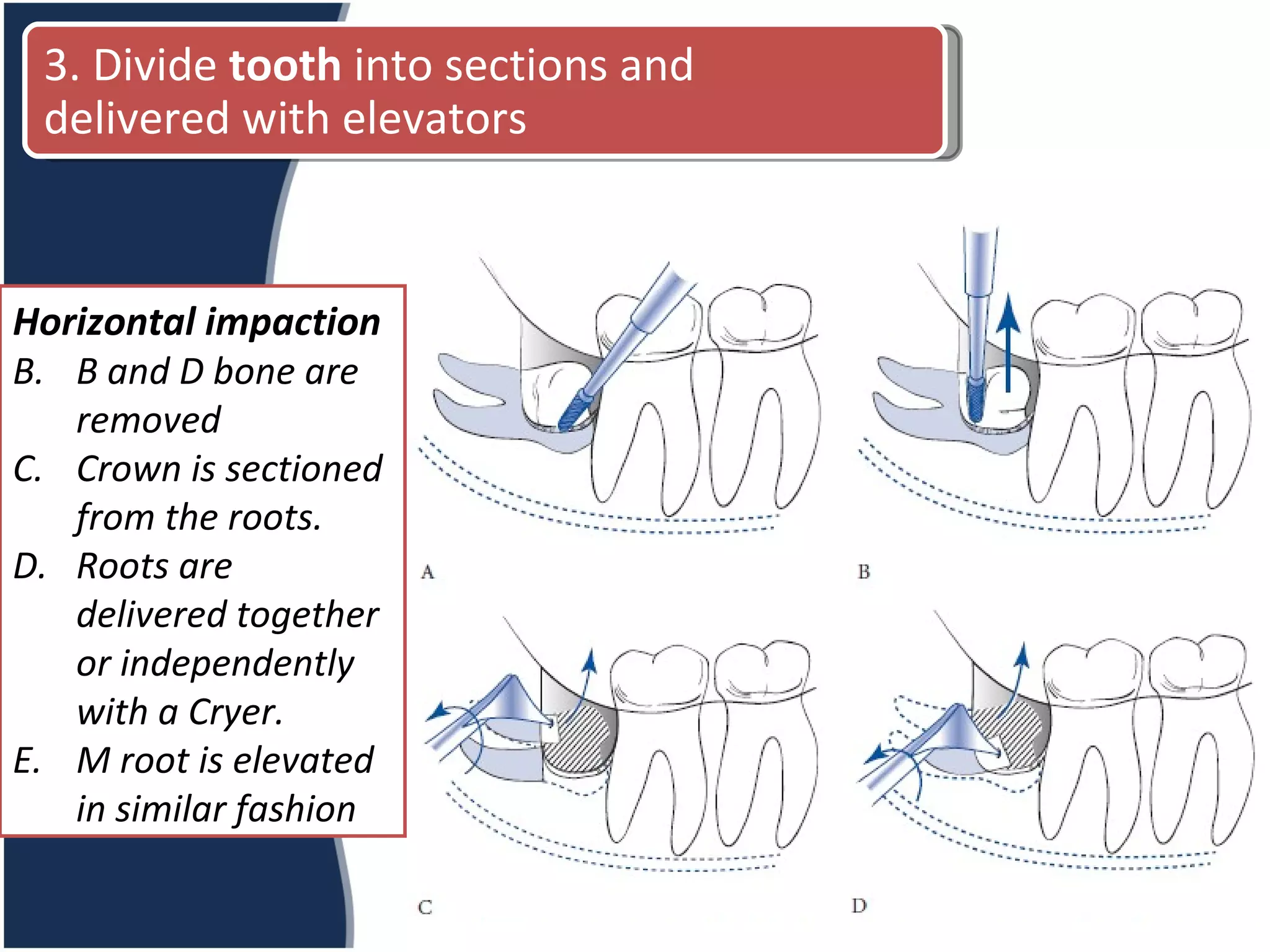
Horizontal impaction B and D bone are removed Crown is sectioned from the roots. Roots are delivered together or independently with a Cryer.  M root is elevated in similar fashion 3. Divide  tooth  into sections and delivered with elevators
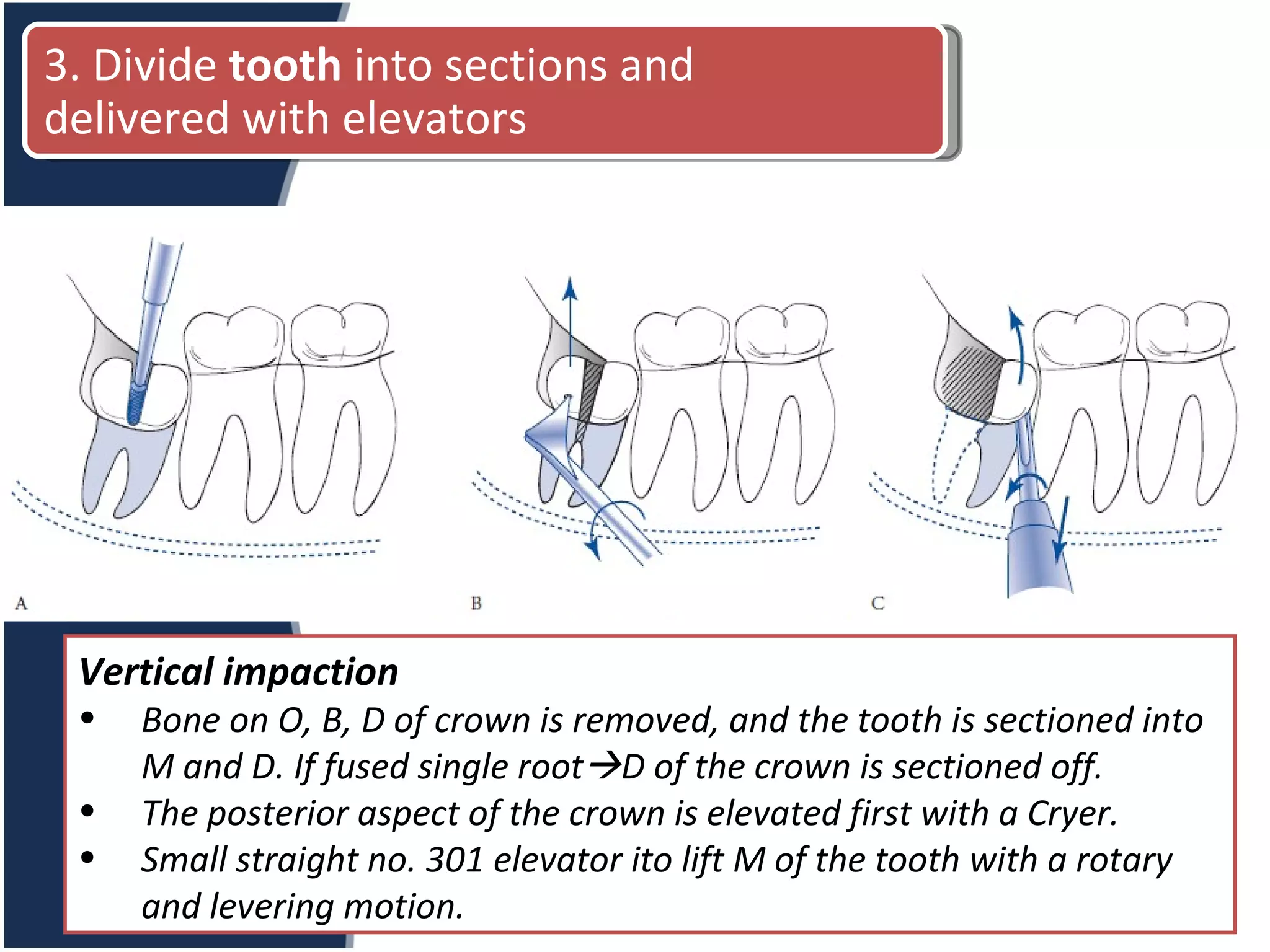
Vertical impaction Bone on O, B, D of crown is removed, and the tooth is sectioned into M and D. If fused single root  D of the crown is sectioned off. The posterior aspect of the crown is elevated first with a Cryer. Small straight no. 301 elevator ito lift M of the tooth with a rotary and levering motion. 3. Divide  tooth  into sections and delivered with elevators
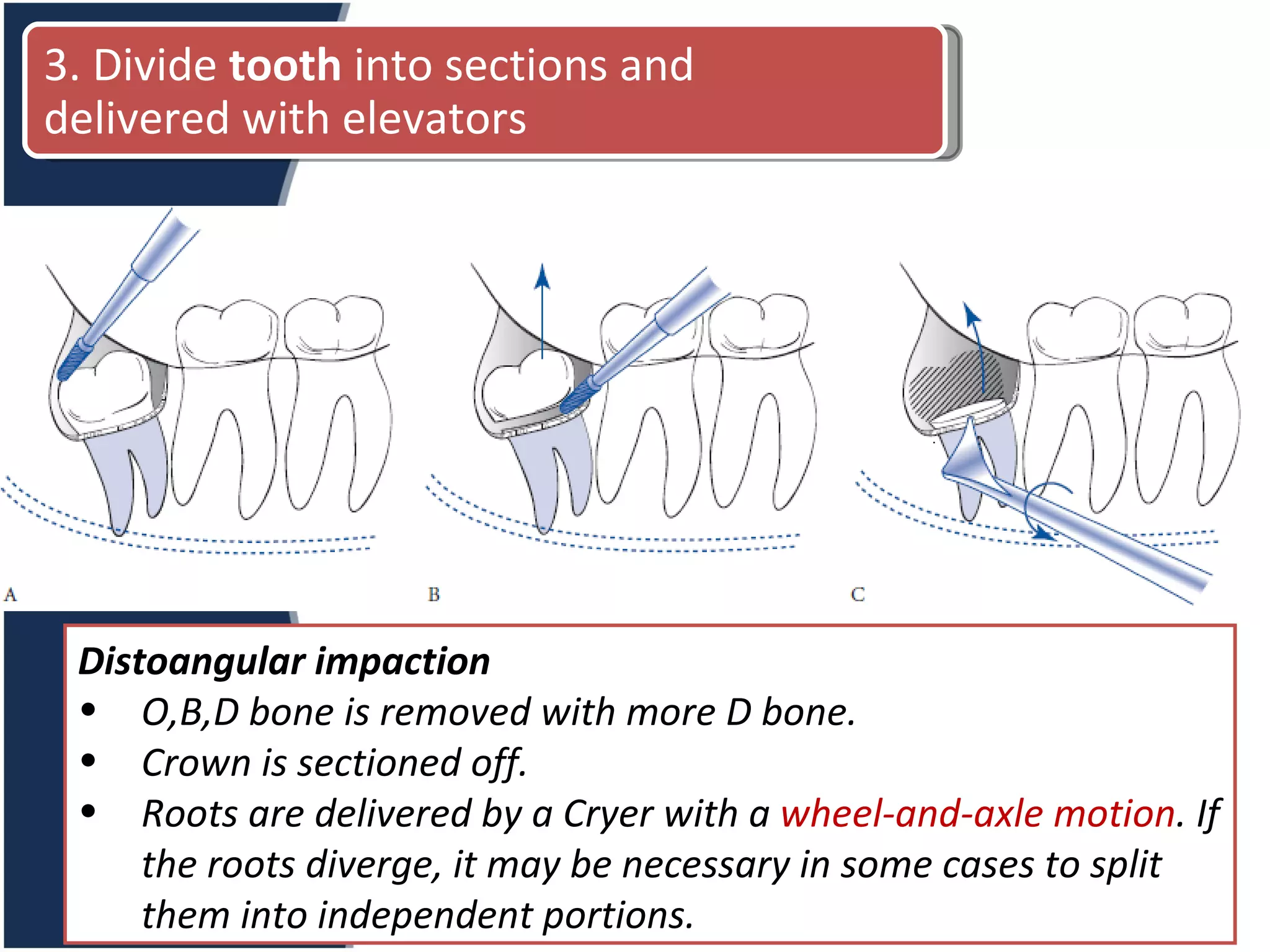
Distoangular impaction O,B,D bone is removed with more D bone. Crown is sectioned off. Roots are delivered by a Cryer with a  wheel-and-axle motion . If the roots diverge, it may be necessary in some cases to split them into independent portions. 3. Divide  tooth  into sections and delivered with elevators
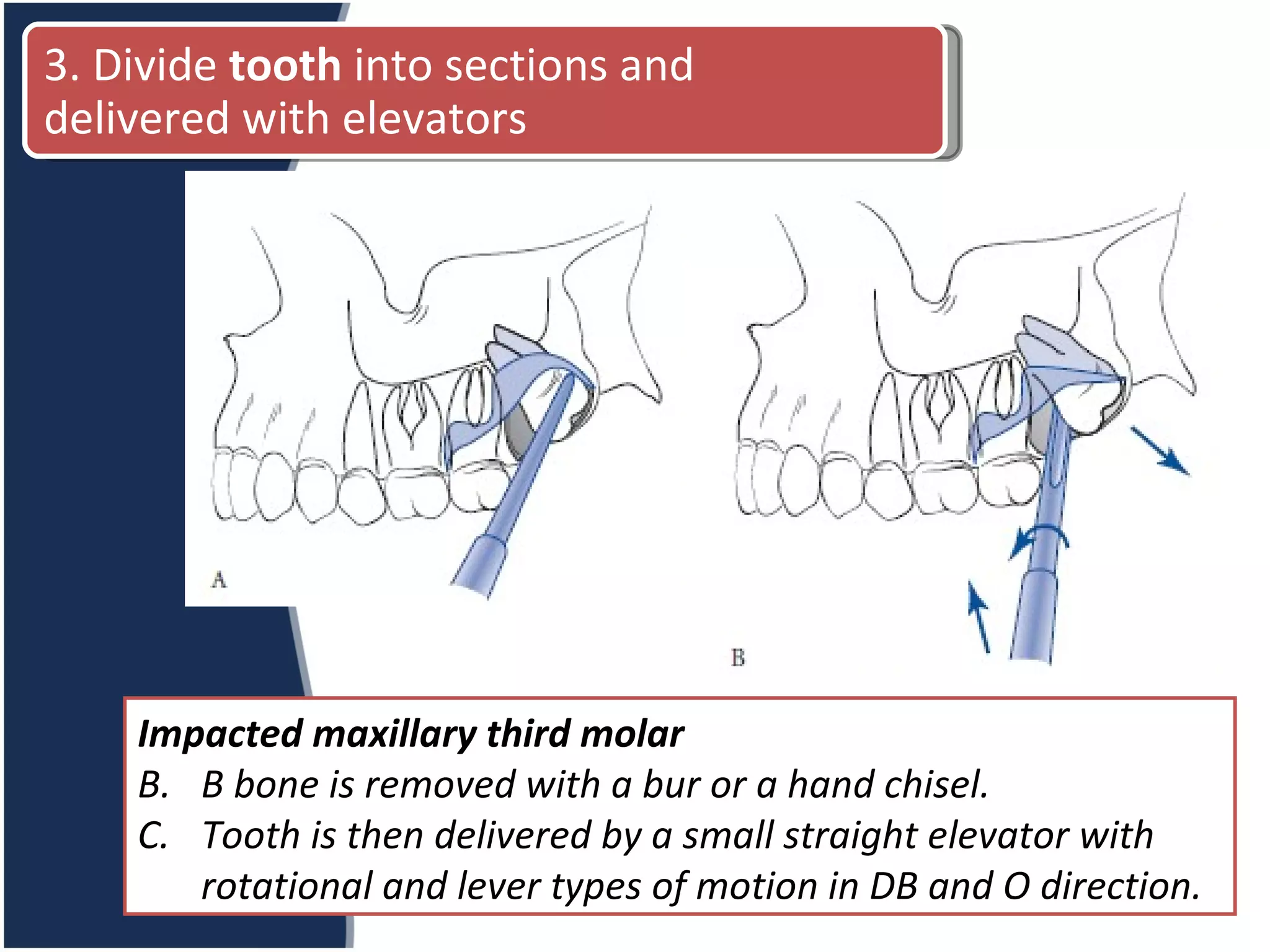
Impacted maxillary third molar  B bone is removed with a bur or a hand chisel. Tooth is then delivered by a small straight elevator with rotational and lever types of motion in DB and O direction. 3. Divide  tooth  into sections and delivered with elevators
Debride  the wound of all debris after with  periapical curettes Smooth  the sharp, rough edges of bone with  bone files . Remove remnants of  dental follicle  with  mosquitos and hemostats . Final irrigation  with  saline  and thorough inspection Check for adequate hemostasis Closure of the wound 4. Debridement, irrigation and closure of  wound
Postoperative Management Analgesics During the first 24 hours, analgesics are prescribed routinely; after this time, they are used only when required. Combination of  codeine  and  aspirin/acetaminophen  or  NSAID  might be suggested. Antibiotics Preexisting pericoronitis    antibiotics for a few days No preexisting infection    antibiotics is not indicated Anti-inflammatory medication Steroid  or  aspirin  might be considered.
Trismus Reaches its peak on the  second day  and resolves by the end of the first week. Bleeding Moist gauze pack ing with pressure Socket packed with oxidized cellulose Swelling/edema Corticosteroids Ice packing has no effect on edema Reaches its peak by the end of the second day Infection (1.7~2.7%) Debris left under the mucoperiosteal flap Post-OP Complications
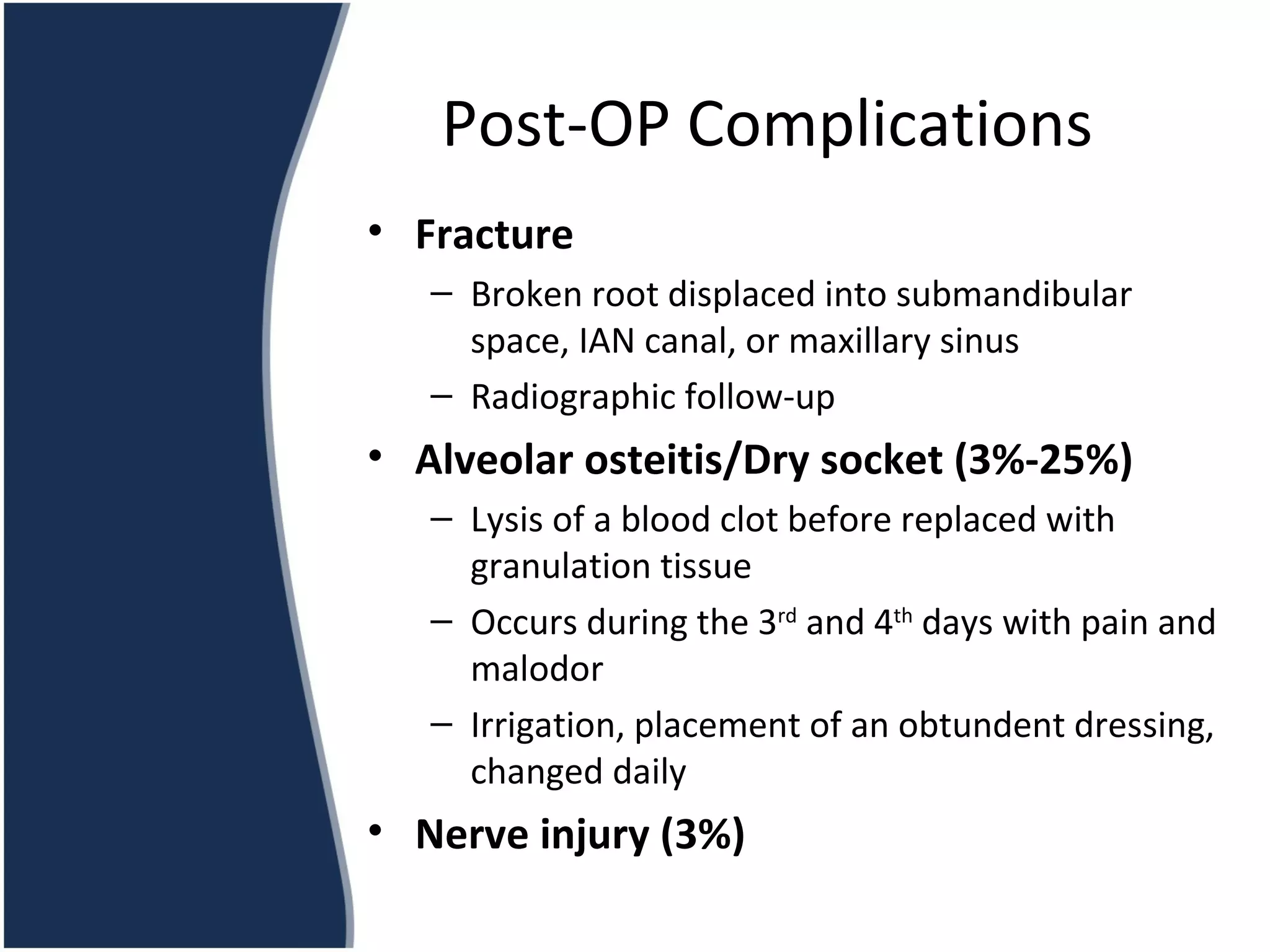
Fracture Broken root displaced into submandibular space, IAN canal, or maxillary sinus Radiographic follow-up Alveolar osteitis/Dry socket (3%-25%) Lysis of a blood clot before replaced with granulation tissue Occurs during the 3 rd  and 4 th  days with pain and malodor Irrigation, placement of an obtundent dressing, changed daily Nerve injury (3%) Post-OP Complications
 

Complicated Extraction and Odontectomy

  • 1.
    COMPLICATED EXTRACTION &ODONTECTOMY Presenter: R1 鄭瑋之 Instructor: VS 陳靜容醫師 Date: 2012/2/17
  • 2.
  • 3.
    Indications forSurgical Extraction Erupted teeth Excessive forced may cause a fracture of bone/tooth Heavy or dense bone (aging, bruxism) Root condition: hyper-cementosis (aging), divergent (maxillary 1 st molars) Maxillary sinus Extensive caries or large restorations Retained roots
  • 4.
    Impacted teeth Pericoronitisprevention/treatment (25~30%) Prevention of dental disease Caries (15%) Periodontal disease (5%) Orthodontic Considerations Crowding of mandibular Incisors (controversial) Interference of orthodontic treatment/orthognathic surgery Root resorption of adjacent teeth: about 7% Indications for Surgical Extraction
  • 5.
    Impacted teeth Preventionof odontogenic cysts/tumors Follicular sac  crown/cyst/odontogenic tumor (1~2%) Neoplastic change: about 3% (decrease with age) Teeth under dental prostheses Ridge where an impacted tooth is covered by only soft tissue or 1 or 2 mm of bone Prevention of jaw fracture Management of unexplained jaw pain (1~2%) Indications for Surgical Extraction
  • 6.
    Contraindications forSurgical Extraction Extremes of age Removal of tooth bud at early stage is unnecessary Healing response ↓ with ageImpacted teeth  fully impacted,  no communication with oral cavity,  no signs of pathology,  > age 40 Compromised medical status work closely with the patient’s physician Surgical damage to adjacent structures
  • 7.
    Multiple Extraction Preextractiontreatment planning Dentures, soft tissue surgery, implants Extraction Sequencing: Maxillary teeth first Infiltration anesthetic: more rapid Debris may fall into the empty sockets With mainly buccal force The most posterior teeth first more effective use of dental elevators The most difficult (molar and canine) last
  • 8.
    Multiple Extraction SummaryUpper posterior teeth, leaving the 1 st molar Upper anterior teeth, leaving the canine Upper 1 st molar Upper canine Lower posterior teeth, leaving the 1 st molar Lower anterior teeth, leaving the canine Lower 1 st molar Lower canine
  • 9.
  • 10.
    Mesioangular impaction 43%Least difficult Horizontal impaction 3% More difficult than mesioangular ones Vertical impaction 38% Third in difficulty Distoangular impaction 6% Most difficult
  • 11.
  • 12.
  • 13.
  • 14.
  • 15.
    Envelope incision Posterior laterally to avoid lingual n. Three-cornered flap Release incision: M of the 2 nd molar. 1. Gain adequate access through a properly designed soft tissue flap
  • 16.
    The bone overlyingthe O surface of tooth is removed with a fissure bur. Bone on the B and D sides of impacted tooth is then removed. 2. Remove bone as little as possible
  • 17.
    Mesioangular impaction Band D bone are removed D of the crown is sectioned. Occasionally the entire tooth. Small straight elevator into M side, and the tooth is delivered with a rotational and level motion of elevator. 3. Divide tooth into sections and delivered with elevators
  • 18.
    Horizontal impaction Band D bone are removed Crown is sectioned from the roots. Roots are delivered together or independently with a Cryer. M root is elevated in similar fashion 3. Divide tooth into sections and delivered with elevators
  • 19.
    Vertical impaction Boneon O, B, D of crown is removed, and the tooth is sectioned into M and D. If fused single root  D of the crown is sectioned off. The posterior aspect of the crown is elevated first with a Cryer. Small straight no. 301 elevator ito lift M of the tooth with a rotary and levering motion. 3. Divide tooth into sections and delivered with elevators
  • 20.
    Distoangular impaction O,B,Dbone is removed with more D bone. Crown is sectioned off. Roots are delivered by a Cryer with a wheel-and-axle motion . If the roots diverge, it may be necessary in some cases to split them into independent portions. 3. Divide tooth into sections and delivered with elevators
  • 21.
    Impacted maxillary thirdmolar B bone is removed with a bur or a hand chisel. Tooth is then delivered by a small straight elevator with rotational and lever types of motion in DB and O direction. 3. Divide tooth into sections and delivered with elevators
  • 22.
    Debride thewound of all debris after with periapical curettes Smooth the sharp, rough edges of bone with bone files . Remove remnants of dental follicle with mosquitos and hemostats . Final irrigation with saline and thorough inspection Check for adequate hemostasis Closure of the wound 4. Debridement, irrigation and closure of wound
  • 23.
    Postoperative Management AnalgesicsDuring the first 24 hours, analgesics are prescribed routinely; after this time, they are used only when required. Combination of codeine and aspirin/acetaminophen or NSAID might be suggested. Antibiotics Preexisting pericoronitis  antibiotics for a few days No preexisting infection  antibiotics is not indicated Anti-inflammatory medication Steroid or aspirin might be considered.
  • 24.
    Trismus Reaches itspeak on the second day and resolves by the end of the first week. Bleeding Moist gauze pack ing with pressure Socket packed with oxidized cellulose Swelling/edema Corticosteroids Ice packing has no effect on edema Reaches its peak by the end of the second day Infection (1.7~2.7%) Debris left under the mucoperiosteal flap Post-OP Complications
  • 25.
    Fracture Broken rootdisplaced into submandibular space, IAN canal, or maxillary sinus Radiographic follow-up Alveolar osteitis/Dry socket (3%-25%) Lysis of a blood clot before replaced with granulation tissue Occurs during the 3 rd and 4 th days with pain and malodor Irrigation, placement of an obtundent dressing, changed daily Nerve injury (3%) Post-OP Complications
  • 26.