Pre R/T Dental Management
  Presenter: R1 鄭瑋之
  Instructor: VS 陳靜容醫師
  Date: 2012/3/16
Oral Assessment before R/T
• Acute effects of RT: mucositis, altered salivary
  gland function and risk of mucosal infection.
• Long-term effects of RT: hypovascularity,
  hypocellularity and hypoxia of the tissues, damage
  to the salivary glands and increased collagen
  synthesis resulting in fibrosis. The affected bone
  and soft tissue have a reduced capacity to remodel.
• A consultation with a dental teamshould be
  completed before the start of therapy.
Oral Assessment before R/T

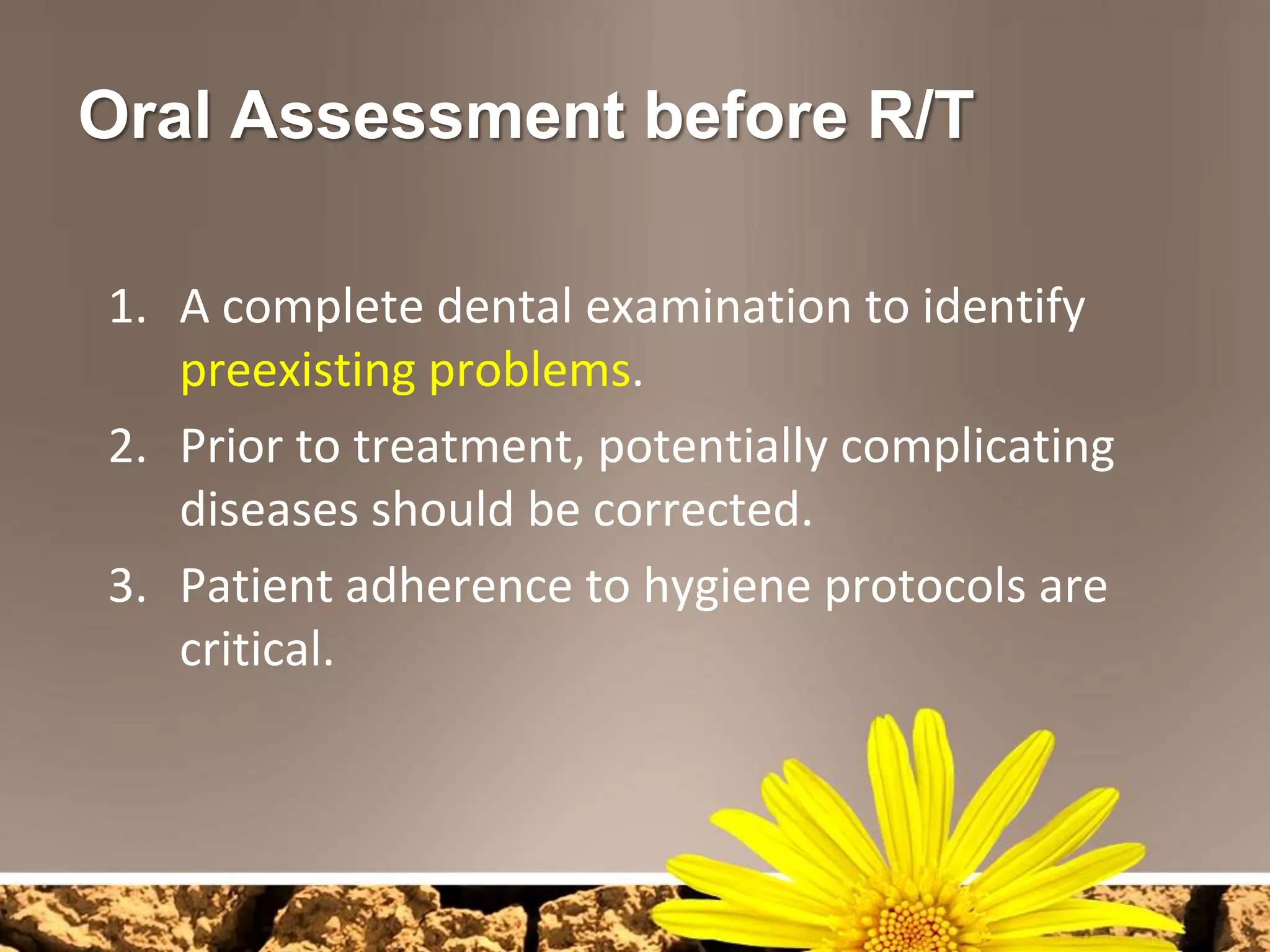
1. A complete dental examination to identify
   preexisting problems.
2. Prior to treatment, potentially complicating
   diseases should be corrected.
3. Patient adherence to hygiene protocols are
   critical.
Strategies
Before R/T
Medical history                  Prior cancer history, risk factors
Definitive diagnosis              Tumour size and type
Dental knowledge                 Past and current dental care
Oral hygiene                     Current practices
Complete dental examination Mucosa, dentition, periodontium, TMJ
Radiographic examination         Panoramic, selected periapical, bitewing
                                 Resting (> 0.1 mL/minute),
Whole salivary flow rates
                                 stimulated (> 1.0 mL/minute)
                                 Pulp tests, specific cultures (fungal, viral,
Adjunctive tests as indicated
                                 bacterial)
Prognosis (cure or palliation)
Proposed radiation therapy       Timing, dose, fields
Oral Assessment before R/T
• All teeth, but especially those located within the
  radiation fields, should be closely evaluated.
• Only 11.2% of patients required no dental
  treatment before RT.
• The criteria for extractions before R/T are not
  universally accepted and are subject to clinical
  judgement.
Criteria for pre R/T extractions

• Teeth in the high-dose radiation field and
   – Caries (nonrestorable)
   – Active periapical disease (symptomatic teeth)
   – Moderate to severe periodontal disease
   – Lack of opposing teeth, compromised hygiene
   – Partial impactions or incomplete eruption
   – Extensive periapical lesions (if not chronic or well
     localized
• A more aggressive dental management strategy
  should be considered for patients with limited
  previous dental care, poor oral hygiene and past
  dental or periodontal disease
Guidelines for extractions
• At least 2 weeks, ideally 3 weeks, before R/T.
• Trim bone at wound margins to eliminate sharp
  edges.
• Primary closure should be done.
• Intra alveolar hemostatic packing agents should be
  avoided that can serve as a nidus of microbeal
  growth.
• If the platelets count is < 50000/mm3 than
  transfusion is mandatory.
• Delay the extraction if the WBC < 2000/mm3 or
  absolute neutrophil is < 1000/mm3. Prophylatic
  antibiotics .
During R/T
• Monitoring of the oral cavity
• Systematically applied oral hygiene protocols may
  reduce the incidence, severity and duration of oral
  complications.
• Frequent brushing with a soft-bristled toothbrush
  and fluoride toothpaste or gel to help prevent
  plaque accumulation and demineralization or
  caries of the teeth.
Strategies
During R/T
                                        Brushing 2 to 4 times daily with
Maintenance of good oral hygiene
                                        soft-bristled brush; flossing daily
                                        Custom trays, brush-on
Daily topical fluoride
                                        prescription-strength fluoride
Frequent saline rinses
Lip moisturizer (non-petroleum based)
Passive jaw-opening exercises to
reduce trismus
Side Effects of R/T
• Directly affects the salivary glands, the mucosal
  membranes, the jaw muscles and bone.
1. Dry mouth (xerostomia): loss of saliva  periodontal
   disease, rampant caries, and oral fungal and bacterial
   infections.
2. Oral Infection (Candida)
3. Oral Mucositis: by the 3rd week of treatment
4. Fibrosis around the mastication m.  trismus
5. Bone: blood flow↓, loss of osteocytes  limited
   remodelling of bone and limited healing potential
If >40Gy , permanent
  Xerostomia             dysfunction of the salivary
                         glands should be expected.
  • Sialagogues

 residual function


Sjogren’s disease

  • No optimal substitute for saliva: without
    rheologic and antimicrobial factors
  • Sugarless gum or lozenges, ice cubes or ice
    water, eating foods high in ascorbic acid, malic
    acid or citric acid, but not recommended in
    dentate patients
Xerostomia
• For the prevention of rampant caries 
  1. Apply 1.1% neutral sodium fluoride gel daily
     (for at least 5 minutes) with a custom fitted
     vinyl tray.
  2. Started on the first day of R/T and
     continued daily as long as salivary flow rates
     are low.
  3. High-potency fluoride brush-on gels and
     dentifrices in those who are unable or
     unwilling to comply with the use of fluoride
     trays.
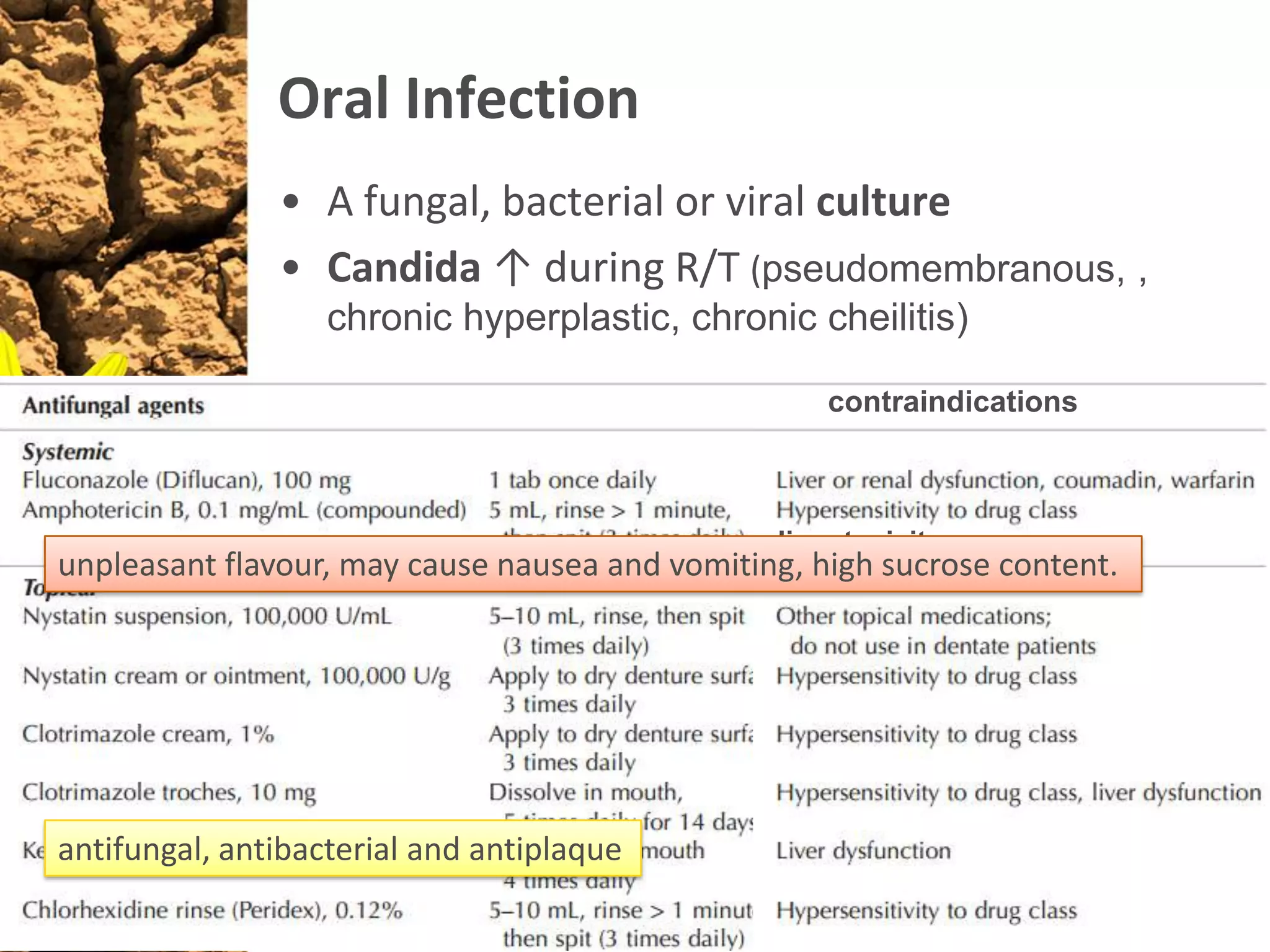
Oral Infection
               • A fungal, bacterial or viral culture
               • Candida ↑ during R/T (pseudomembranous, ,
                   chronic hyperplastic, chronic cheilitis)

                                                    contraindications


                                                liver toxicity
unpleasant flavour, may cause nausea and vomiting, high sucrose content.


antifungal, antibacterial and antiplaque
Oral Infection

• If CHX is used, it is important to note that
  nystatin and CHX should not be used
  concurrently, because chlorhexidine binds to
  nystatin, rendering both ineffective.
• CHX should be used at least 30 minutes
  before or after the use of any other topical
  agents with which it may bind.
• Viral infections, such as Herpes simplex 1 
  acyclovir or penciclovir (newer, with
  increased tissue penetration)
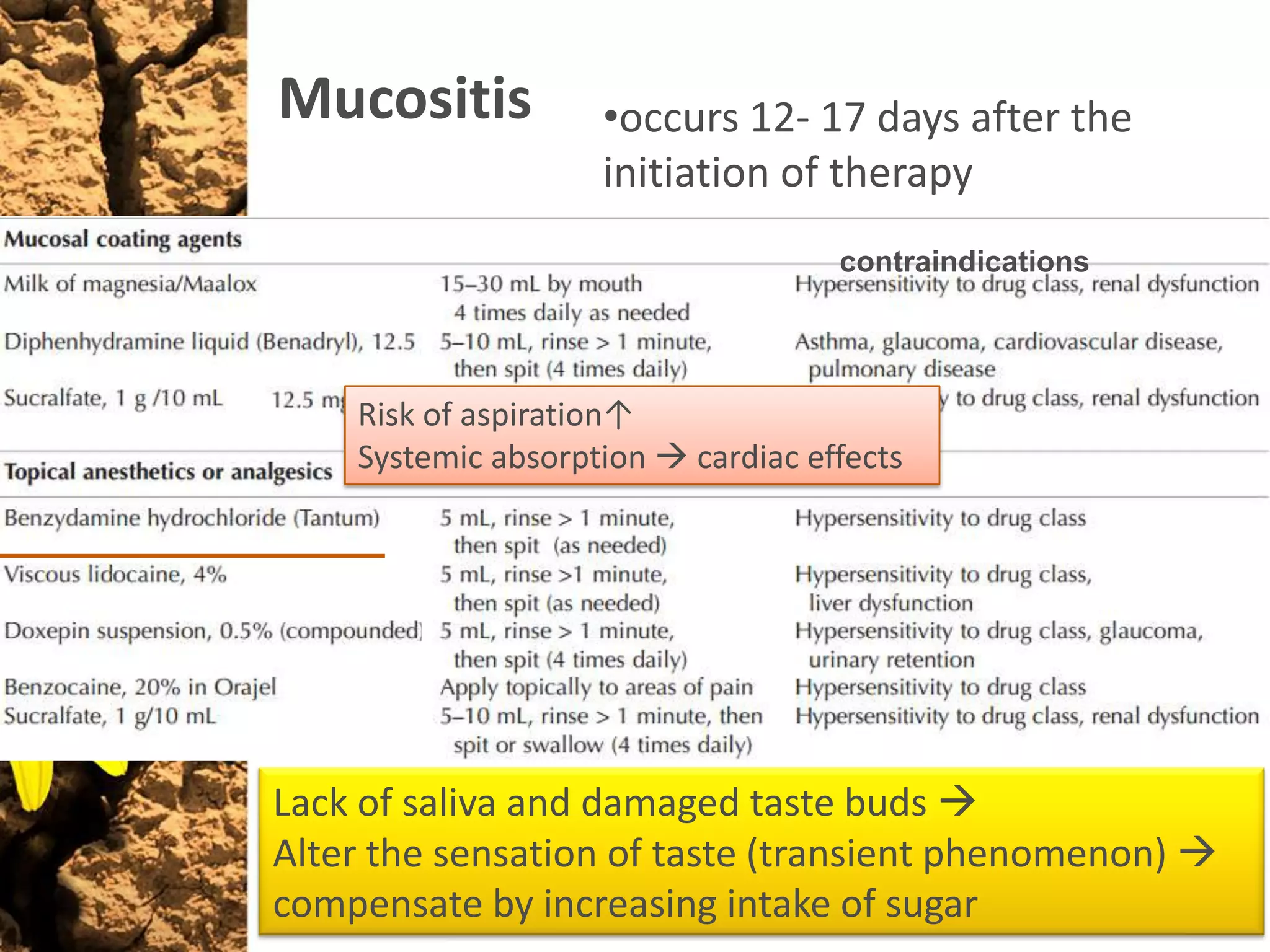
Mucositis

• Combinations of rinses: interfere  dilution
• Isotonic saline/sodium bicarbonate
• Prophylactic rinses with CHX  Candida
  counts↓ but has no effect on mucositis.
• Cheapest and easiest: a teaspoon (10 mL) of salt
  + a teaspoon (10 mL) of baking soda (sodium
  bicarbonate) in 8 ounces (250 mL) of water.
• Oral rinses should be discontinued because of
  their drying and irritating effects.
• The discomfort can be reduced with coating
  agents, topical anesthetics and analgesics.
Mucositis           •occurs 12- 17 days after the
                    initiation of therapy
                                    contraindications


    Risk of aspiration↑
    Systemic absorption  cardiac effects


Lack of saliva and damaged taste buds 
Alter the sensation of taste (transient phenomenon) 
compensate by increasing intake of sugar
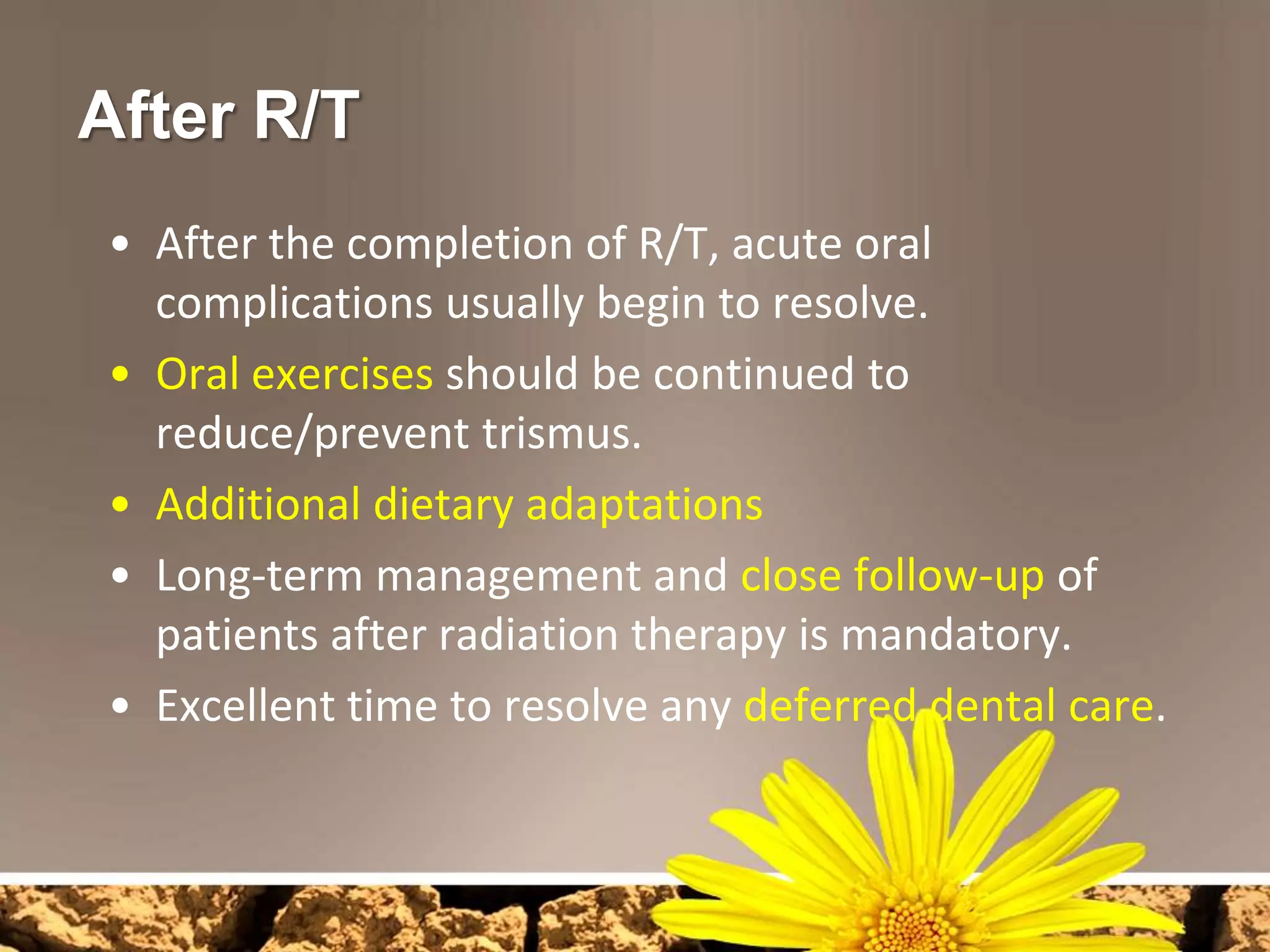
After R/T
• After the completion of R/T, acute oral
  complications usually begin to resolve.
• Oral exercises should be continued to
  reduce/prevent trismus.
• Additional dietary adaptations
• Long-term management and close follow-up of
  patients after radiation therapy is mandatory.
• Excellent time to resolve any deferred dental care.
Strategies

After R/T
Complete dental work that was
deferred during radiotherapy
Maintain integrity of teeth       Especially those in radiation fields
                                  Check for oral hygiene, xerostomia,
                                  decalcification, decay, ORN,
Frequent follow-up appointments
                                  metastatic disease, recurrent disease,
                                  new malignant disease
Osteoradionecrosis
• Irreversible, progressive devitalization of irradiated
  bone
• Most in the mandible, where vascularization is poor
  and bone density is high.
• Symptoms: pain, orofacial fistulas, exposed necrotic
  bone, pathologic fracture and suppuration
• One-third of cases occur spontaneously.
• The majority result from extraction of teeth.
• Incidence: dentate = edentulous*2
• Poor oral hygiene and continued use of alcohol and
  tobacco may also lead to rapid onset of ORN.
• Hyperbaric oxygen therapy in conjunction with
  surgery has better success rates.
Conclusion
• The complications of radiotherapy must be
  considered thoroughly so that every effort is
  undertaken to minimize the oral morbidity of
  these patients before, during and after cancer
  treatment and throughout the patient’s
  lifetime.
Referrence
1. Pamela J. Hancock, BSc, DMD, Joel B.
   Epstein, DMD, MSD, FRCD(C), Georgia Robins
   Sadler, BSN, MBA, PhD. Oral and Dental Management Related
   to Radiation Therapy for Head and Neck Cancer. J Can Dent
   Assoc 2003; 69(9):585–90.
2. Jay Lucas, DMD, MD, David Rombach, DMD, MD, Joel
   Goldwein, MD. Effects of Radiotherapy on the Oral Cavity.
   November 1, 2001.
3. Virendra Singh M.D.S., Sunita Malik M.D.S. Oral Care Of Patients
   Undergoing Chemotherapy And Radiotherapy: A Review Of
   Clinical Approach. The Internet Journal of Radiology ISSN: 1528-
   8404.

Pre Radiotherapy Dental Management

  • 1.
    Pre R/T DentalManagement Presenter: R1 鄭瑋之 Instructor: VS 陳靜容醫師 Date: 2012/3/16
  • 2.
    Oral Assessment beforeR/T • Acute effects of RT: mucositis, altered salivary gland function and risk of mucosal infection. • Long-term effects of RT: hypovascularity, hypocellularity and hypoxia of the tissues, damage to the salivary glands and increased collagen synthesis resulting in fibrosis. The affected bone and soft tissue have a reduced capacity to remodel. • A consultation with a dental teamshould be completed before the start of therapy.
  • 3.
    Oral Assessment beforeR/T 1. A complete dental examination to identify preexisting problems. 2. Prior to treatment, potentially complicating diseases should be corrected. 3. Patient adherence to hygiene protocols are critical.
  • 4.
    Strategies Before R/T Medical history Prior cancer history, risk factors Definitive diagnosis Tumour size and type Dental knowledge Past and current dental care Oral hygiene Current practices Complete dental examination Mucosa, dentition, periodontium, TMJ Radiographic examination Panoramic, selected periapical, bitewing Resting (> 0.1 mL/minute), Whole salivary flow rates stimulated (> 1.0 mL/minute) Pulp tests, specific cultures (fungal, viral, Adjunctive tests as indicated bacterial) Prognosis (cure or palliation) Proposed radiation therapy Timing, dose, fields
  • 5.
    Oral Assessment beforeR/T • All teeth, but especially those located within the radiation fields, should be closely evaluated. • Only 11.2% of patients required no dental treatment before RT. • The criteria for extractions before R/T are not universally accepted and are subject to clinical judgement.
  • 6.
    Criteria for preR/T extractions • Teeth in the high-dose radiation field and – Caries (nonrestorable) – Active periapical disease (symptomatic teeth) – Moderate to severe periodontal disease – Lack of opposing teeth, compromised hygiene – Partial impactions or incomplete eruption – Extensive periapical lesions (if not chronic or well localized • A more aggressive dental management strategy should be considered for patients with limited previous dental care, poor oral hygiene and past dental or periodontal disease
  • 7.
    Guidelines for extractions •At least 2 weeks, ideally 3 weeks, before R/T. • Trim bone at wound margins to eliminate sharp edges. • Primary closure should be done. • Intra alveolar hemostatic packing agents should be avoided that can serve as a nidus of microbeal growth. • If the platelets count is < 50000/mm3 than transfusion is mandatory. • Delay the extraction if the WBC < 2000/mm3 or absolute neutrophil is < 1000/mm3. Prophylatic antibiotics .
  • 8.
    During R/T • Monitoringof the oral cavity • Systematically applied oral hygiene protocols may reduce the incidence, severity and duration of oral complications. • Frequent brushing with a soft-bristled toothbrush and fluoride toothpaste or gel to help prevent plaque accumulation and demineralization or caries of the teeth.
  • 9.
    Strategies During R/T Brushing 2 to 4 times daily with Maintenance of good oral hygiene soft-bristled brush; flossing daily Custom trays, brush-on Daily topical fluoride prescription-strength fluoride Frequent saline rinses Lip moisturizer (non-petroleum based) Passive jaw-opening exercises to reduce trismus
  • 10.
    Side Effects ofR/T • Directly affects the salivary glands, the mucosal membranes, the jaw muscles and bone. 1. Dry mouth (xerostomia): loss of saliva  periodontal disease, rampant caries, and oral fungal and bacterial infections. 2. Oral Infection (Candida) 3. Oral Mucositis: by the 3rd week of treatment 4. Fibrosis around the mastication m.  trismus 5. Bone: blood flow↓, loss of osteocytes  limited remodelling of bone and limited healing potential
  • 11.
    If >40Gy ,permanent Xerostomia dysfunction of the salivary glands should be expected. • Sialagogues residual function Sjogren’s disease • No optimal substitute for saliva: without rheologic and antimicrobial factors • Sugarless gum or lozenges, ice cubes or ice water, eating foods high in ascorbic acid, malic acid or citric acid, but not recommended in dentate patients
  • 12.
    Xerostomia • For theprevention of rampant caries  1. Apply 1.1% neutral sodium fluoride gel daily (for at least 5 minutes) with a custom fitted vinyl tray. 2. Started on the first day of R/T and continued daily as long as salivary flow rates are low. 3. High-potency fluoride brush-on gels and dentifrices in those who are unable or unwilling to comply with the use of fluoride trays.
  • 13.
    Oral Infection • A fungal, bacterial or viral culture • Candida ↑ during R/T (pseudomembranous, , chronic hyperplastic, chronic cheilitis) contraindications liver toxicity unpleasant flavour, may cause nausea and vomiting, high sucrose content. antifungal, antibacterial and antiplaque
  • 14.
    Oral Infection • IfCHX is used, it is important to note that nystatin and CHX should not be used concurrently, because chlorhexidine binds to nystatin, rendering both ineffective. • CHX should be used at least 30 minutes before or after the use of any other topical agents with which it may bind. • Viral infections, such as Herpes simplex 1  acyclovir or penciclovir (newer, with increased tissue penetration)
  • 15.
    Mucositis • Combinations ofrinses: interfere  dilution • Isotonic saline/sodium bicarbonate • Prophylactic rinses with CHX  Candida counts↓ but has no effect on mucositis. • Cheapest and easiest: a teaspoon (10 mL) of salt + a teaspoon (10 mL) of baking soda (sodium bicarbonate) in 8 ounces (250 mL) of water. • Oral rinses should be discontinued because of their drying and irritating effects. • The discomfort can be reduced with coating agents, topical anesthetics and analgesics.
  • 16.
    Mucositis •occurs 12- 17 days after the initiation of therapy contraindications Risk of aspiration↑ Systemic absorption  cardiac effects Lack of saliva and damaged taste buds  Alter the sensation of taste (transient phenomenon)  compensate by increasing intake of sugar
  • 17.
    After R/T • Afterthe completion of R/T, acute oral complications usually begin to resolve. • Oral exercises should be continued to reduce/prevent trismus. • Additional dietary adaptations • Long-term management and close follow-up of patients after radiation therapy is mandatory. • Excellent time to resolve any deferred dental care.
  • 18.
    Strategies After R/T Complete dentalwork that was deferred during radiotherapy Maintain integrity of teeth Especially those in radiation fields Check for oral hygiene, xerostomia, decalcification, decay, ORN, Frequent follow-up appointments metastatic disease, recurrent disease, new malignant disease
  • 19.
    Osteoradionecrosis • Irreversible, progressivedevitalization of irradiated bone • Most in the mandible, where vascularization is poor and bone density is high. • Symptoms: pain, orofacial fistulas, exposed necrotic bone, pathologic fracture and suppuration • One-third of cases occur spontaneously. • The majority result from extraction of teeth. • Incidence: dentate = edentulous*2 • Poor oral hygiene and continued use of alcohol and tobacco may also lead to rapid onset of ORN. • Hyperbaric oxygen therapy in conjunction with surgery has better success rates.
  • 20.
    Conclusion • The complicationsof radiotherapy must be considered thoroughly so that every effort is undertaken to minimize the oral morbidity of these patients before, during and after cancer treatment and throughout the patient’s lifetime.
  • 21.
    Referrence 1. Pamela J.Hancock, BSc, DMD, Joel B. Epstein, DMD, MSD, FRCD(C), Georgia Robins Sadler, BSN, MBA, PhD. Oral and Dental Management Related to Radiation Therapy for Head and Neck Cancer. J Can Dent Assoc 2003; 69(9):585–90. 2. Jay Lucas, DMD, MD, David Rombach, DMD, MD, Joel Goldwein, MD. Effects of Radiotherapy on the Oral Cavity. November 1, 2001. 3. Virendra Singh M.D.S., Sunita Malik M.D.S. Oral Care Of Patients Undergoing Chemotherapy And Radiotherapy: A Review Of Clinical Approach. The Internet Journal of Radiology ISSN: 1528- 8404.