Instrumentation in Maxillofacial Surgery
Presenter – Dr. Kamini Dadsena.
Moderator – Dr. Rohit Chandra.
Department OF PLASTIC SURGERY
Max Hospital Patparganj
Instruments
A. Instrument for gaining surgical
asepsis and art preparation
1. Cheatle’s forcep
2. Swab holder
3. Towel clip
B. Instrument for gaining surgical
access -
1. Scalpel (Blade handle, Blade)
2. Dissecting scissors
C. Instrument for reflection of
mucoperiosteum flap –
1. Periosteal elevator/ strippers
2. Cleft palate Rasparatory
D. Instrument for Retraction –
1. Langenbeck Retractor
2. C shaped retractor
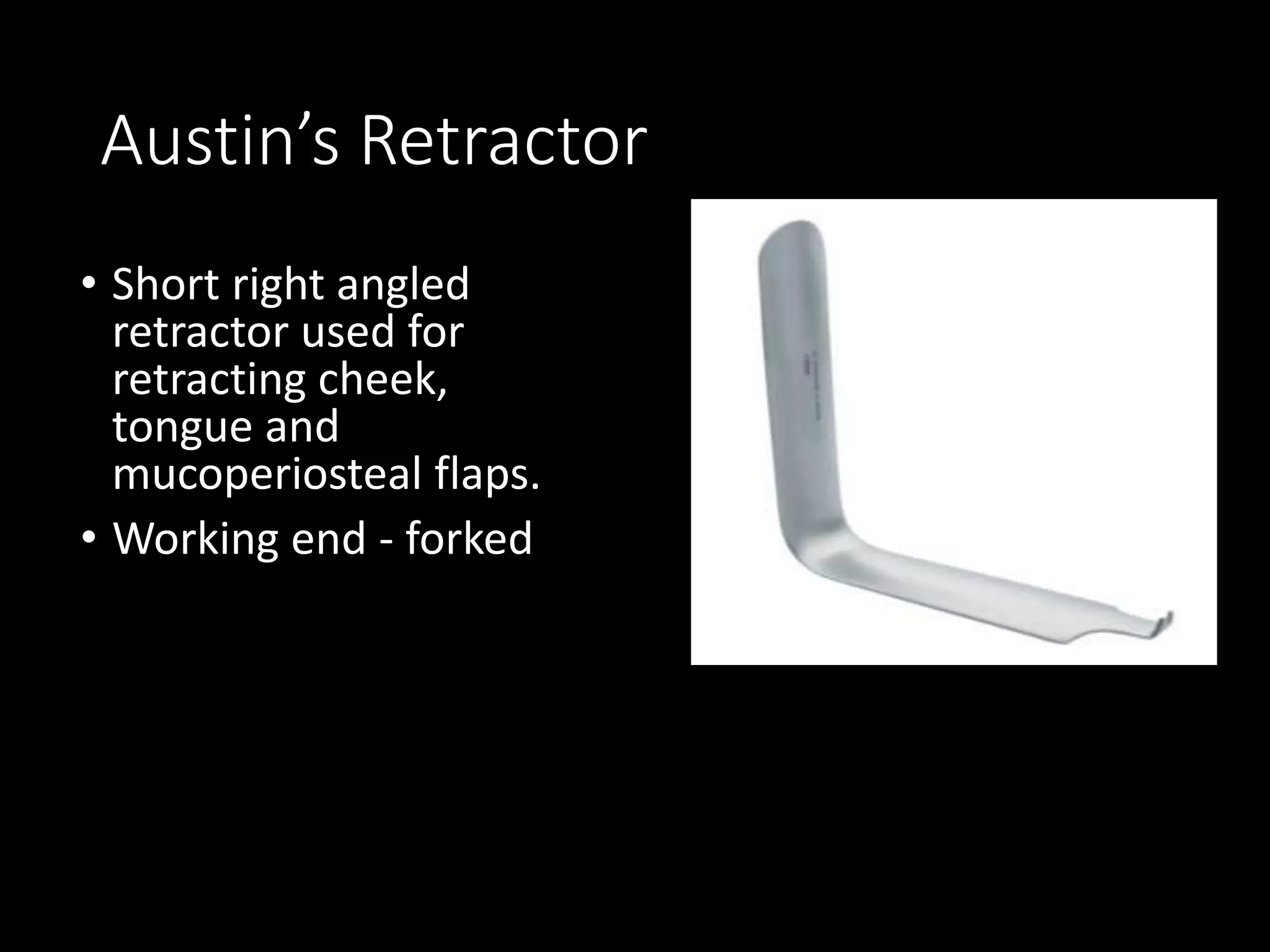
3. Austin retractor
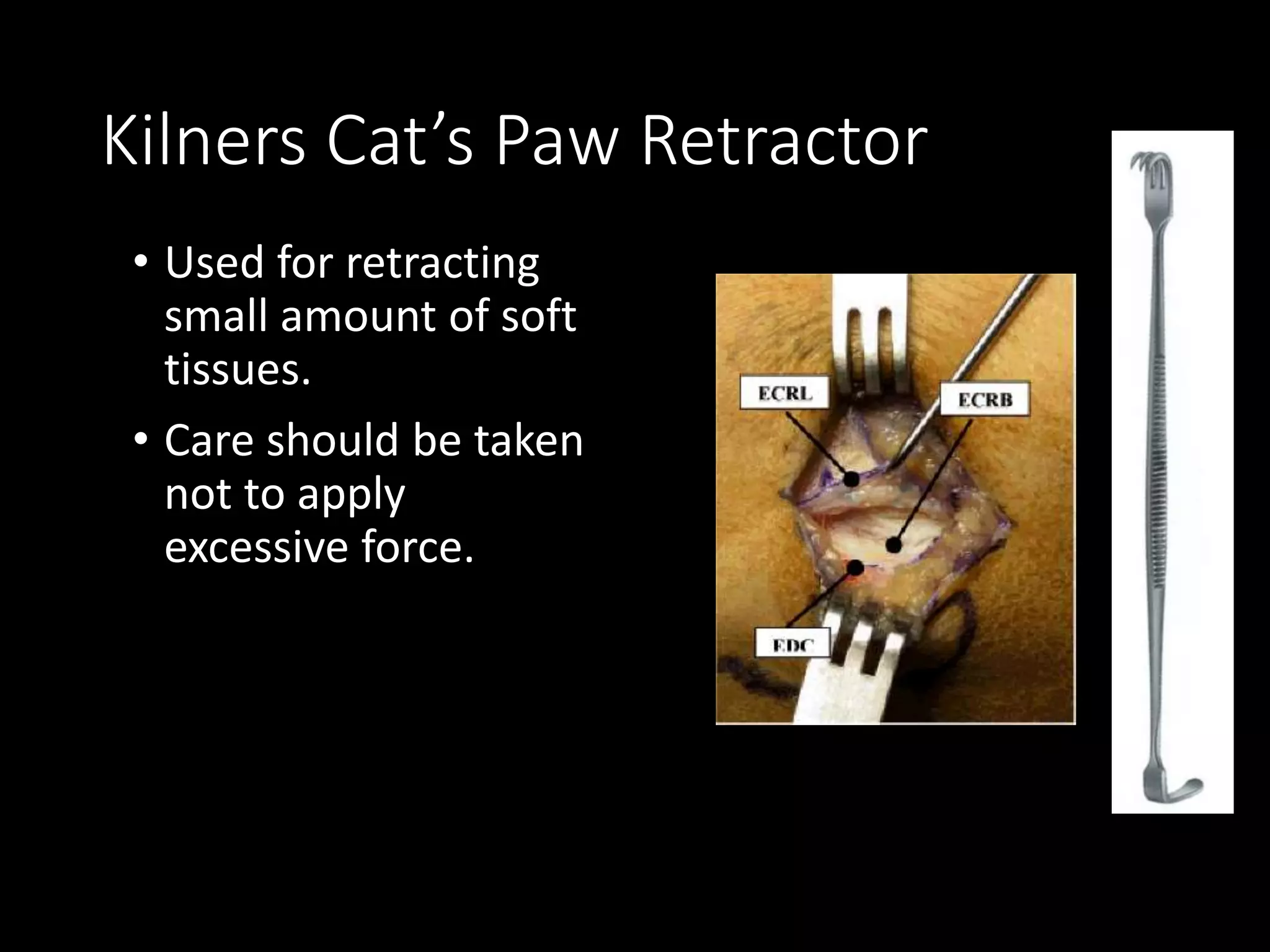
4. Cat’s paw retractor
5. Seldin’s retractor
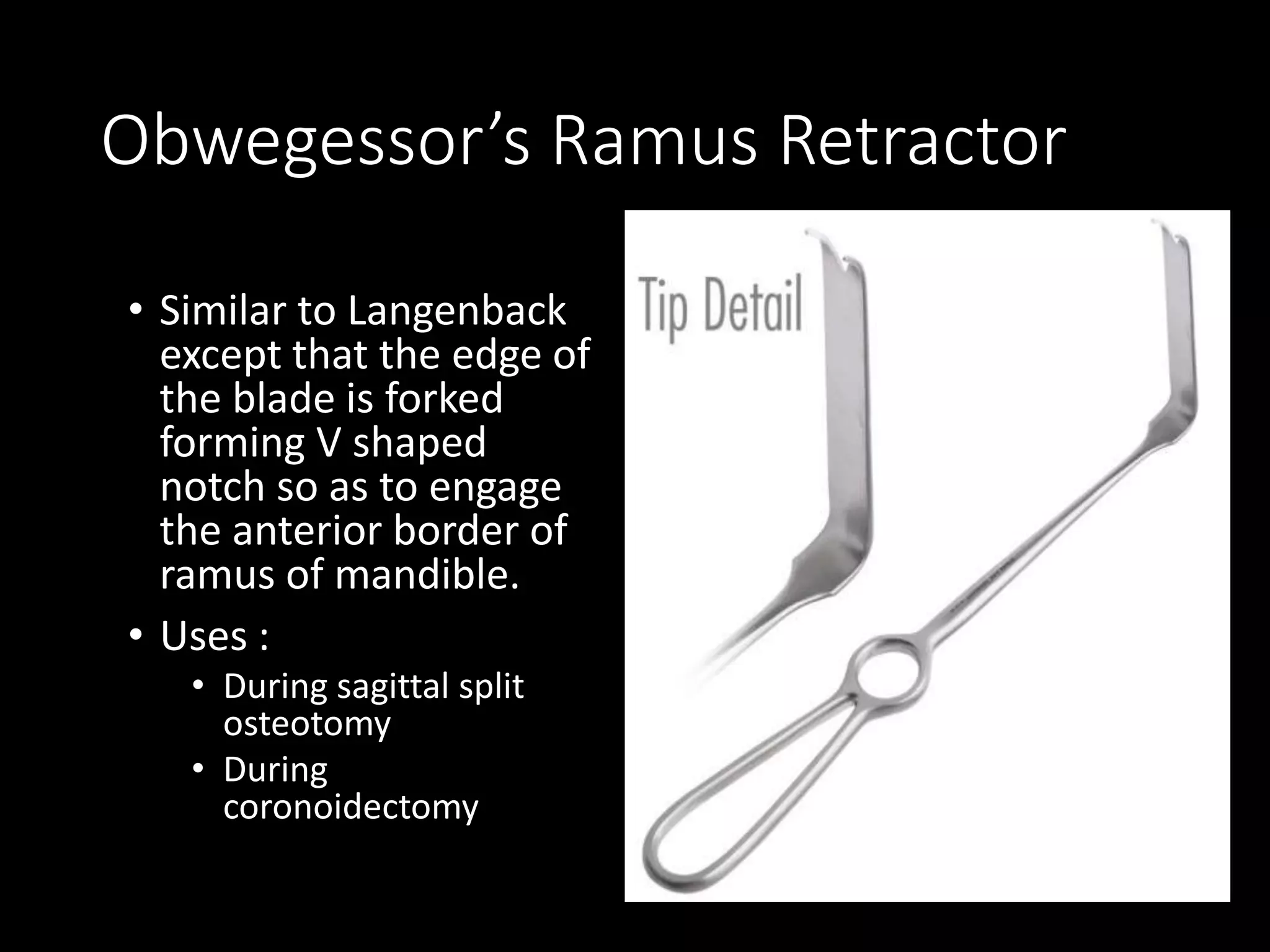
6. Obwegessor’s retractor
7. Skin hook
8. Tongue depressor
9. Cheek retractors
Instruments
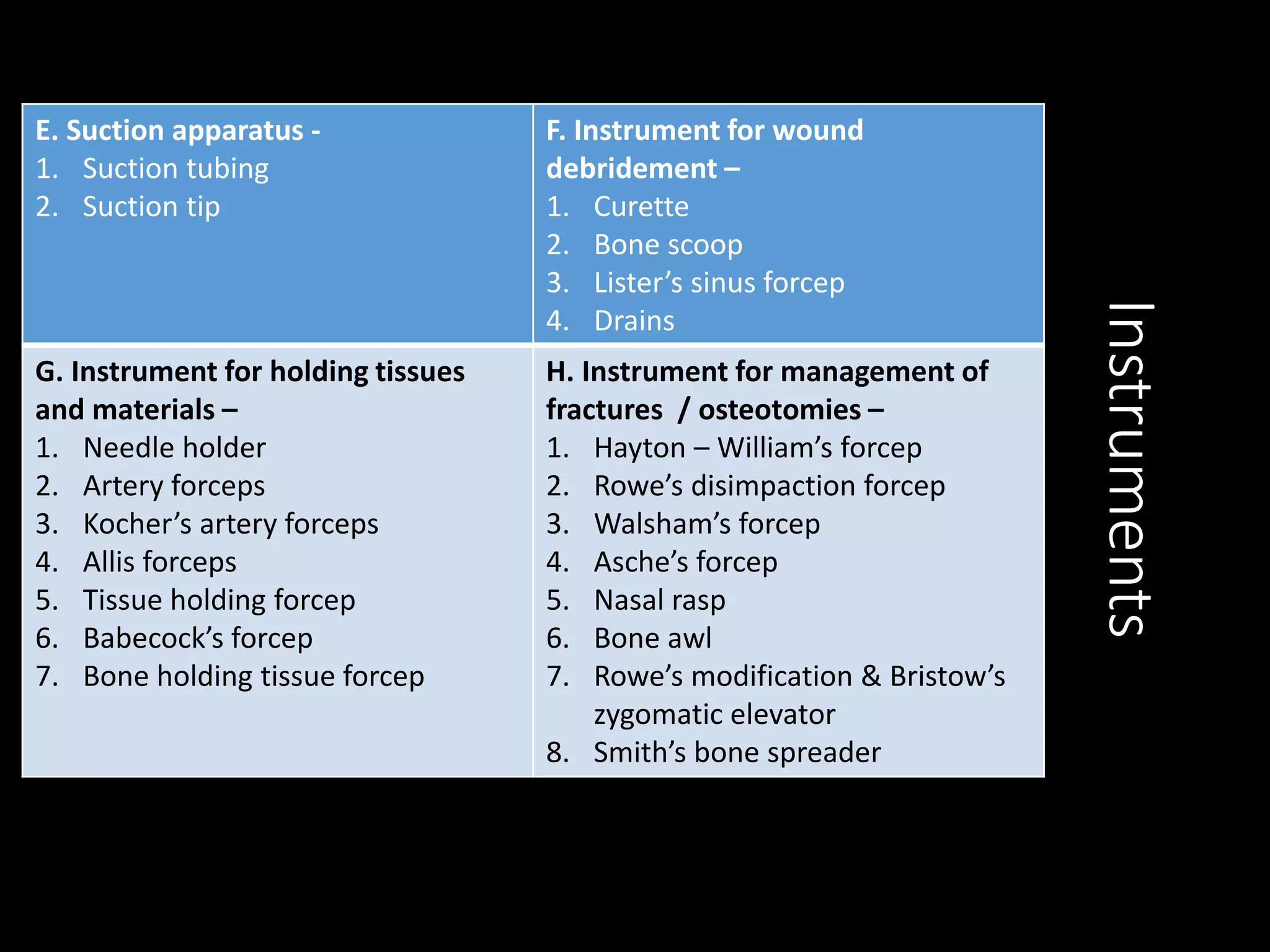
E. Suction apparatus -
1. Suction tubing
2. Suction tip
F. Instrument for wound
debridement –
1. Curette
2. Bone scoop
3. Lister’s sinus forcep
4. Drains
G. Instrument for holding tissues
and materials –
1. Needle holder
2. Artery forceps
3. Kocher’s artery forceps
4. Allis forceps
5. Tissue holding forcep
6. Babecock’s forcep
7. Bone holding tissue forcep
H. Instrument for management of
fractures / osteotomies –
1. Hayton – William’s forcep
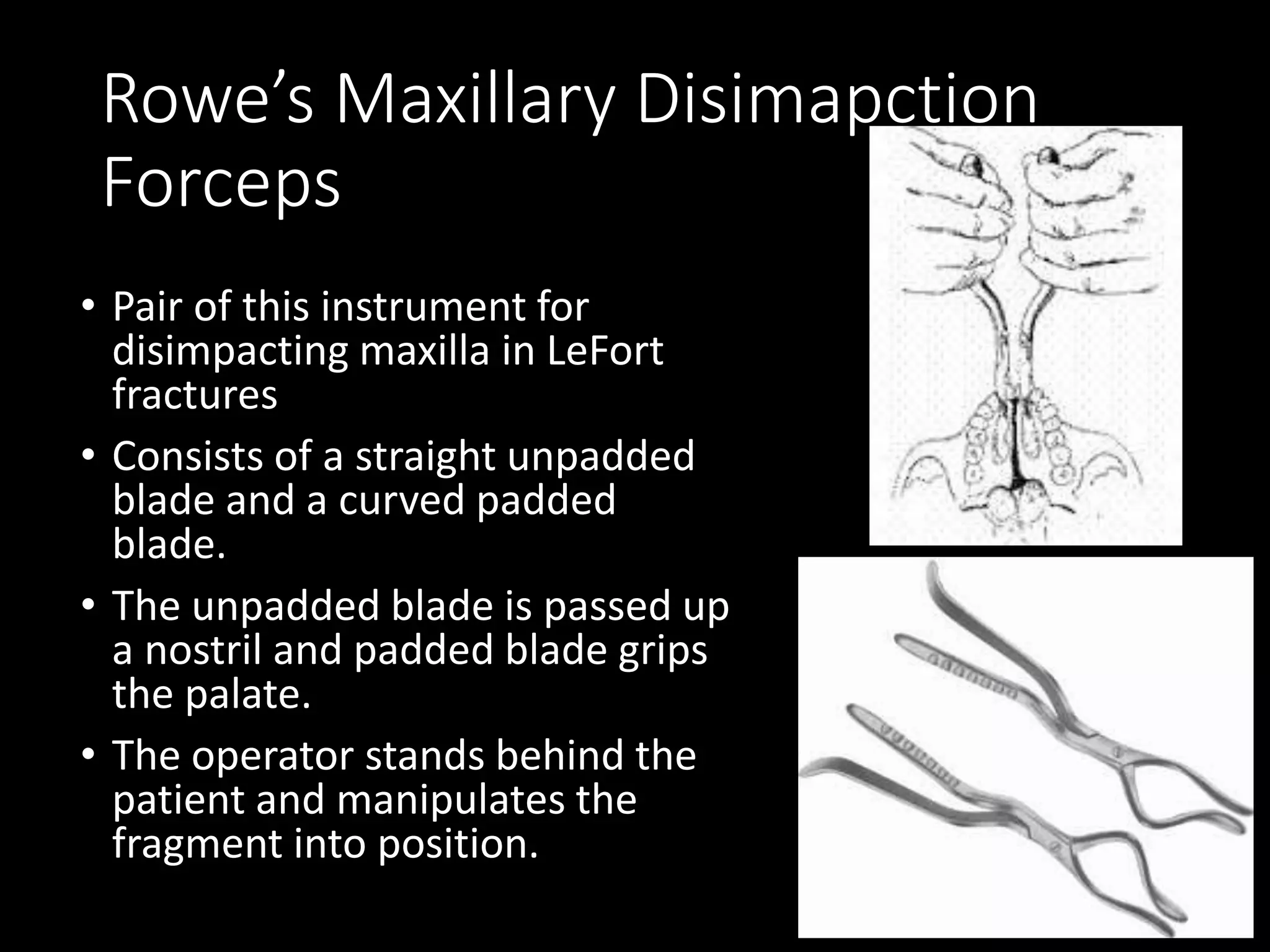
2. Rowe’s disimpaction forcep
3. Walsham’s forcep
4. Asche’s forcep
5. Nasal rasp
6. Bone awl
7. Rowe’s modification & Bristow’s
zygomatic elevator
8. Smith’s bone spreader
Instruments
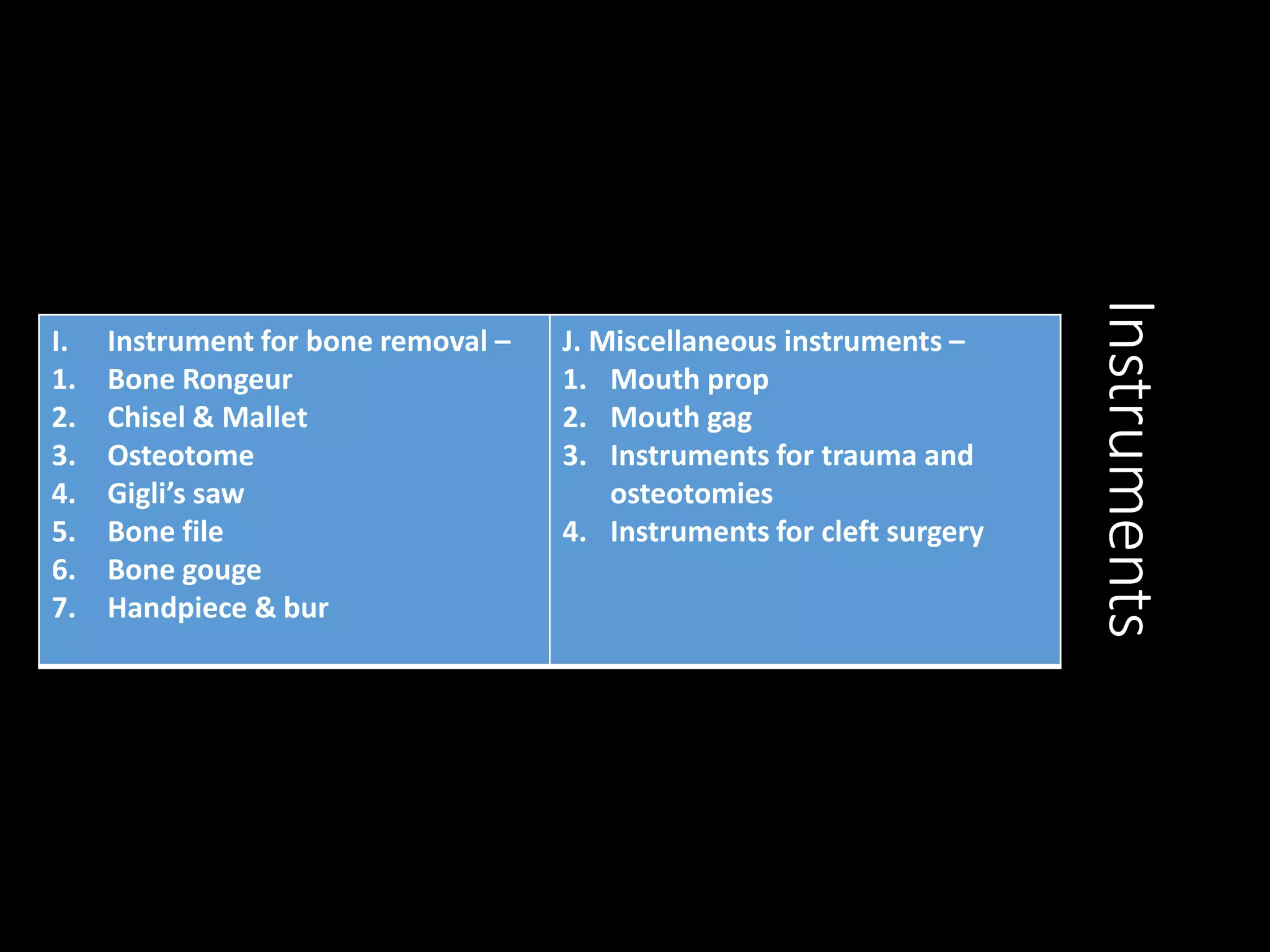
I. Instrument for bone removal –
1. Bone Rongeur
2. Chisel & Mallet
3. Osteotome
4. Gigli’s saw
5. Bone file
6. Bone gouge
7. Handpiece & bur
J. Miscellaneous instruments –
1. Mouth prop
2. Mouth gag
3. Instruments for trauma and
osteotomies
4. Instruments for cleft surgery
Instrument for gaining
surgical asepsis
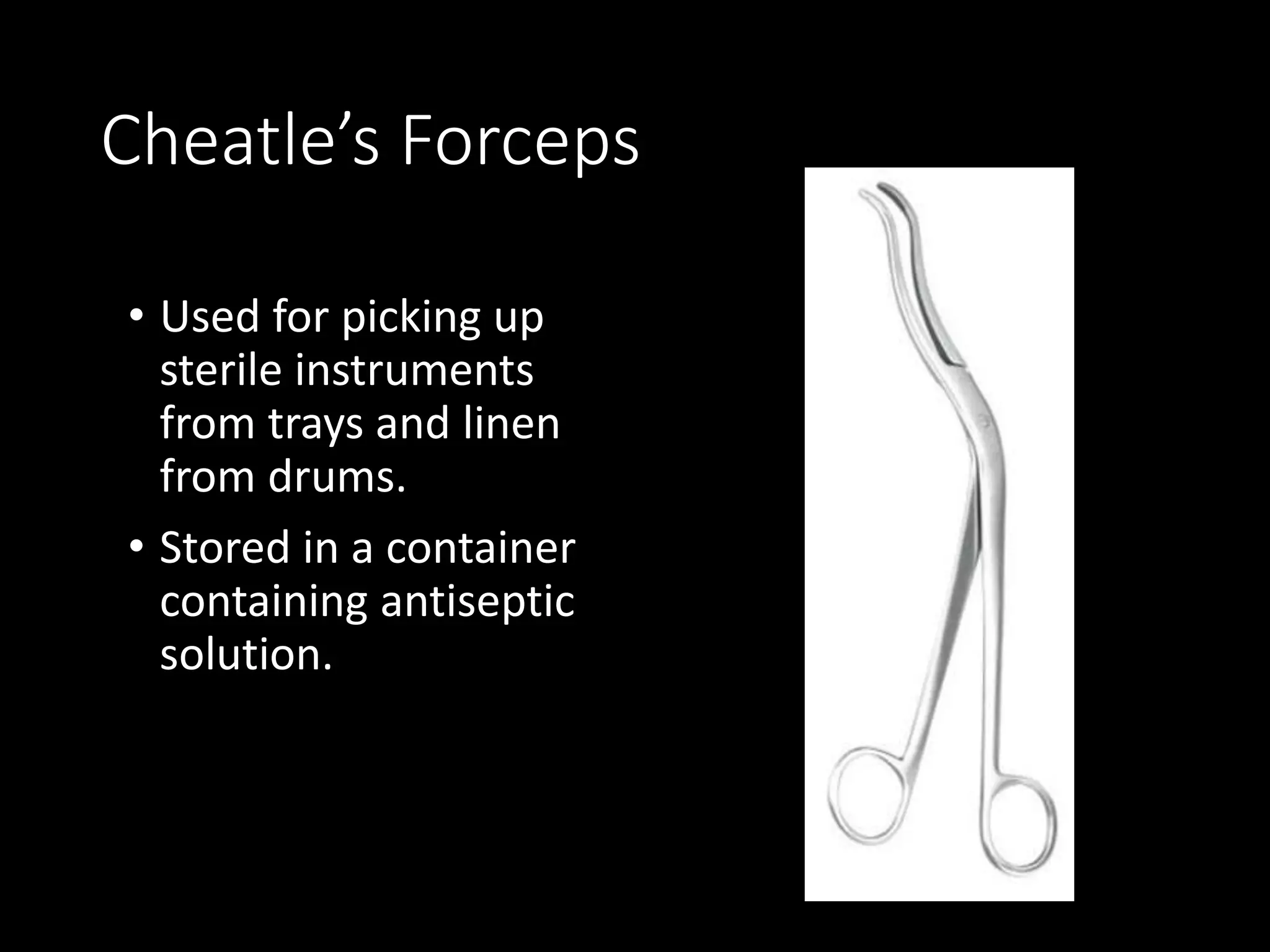
Cheatle’s Forceps
• Used for picking up
sterile instruments
from trays and linen
from drums.
• Stored in a container
containing antiseptic
solution.
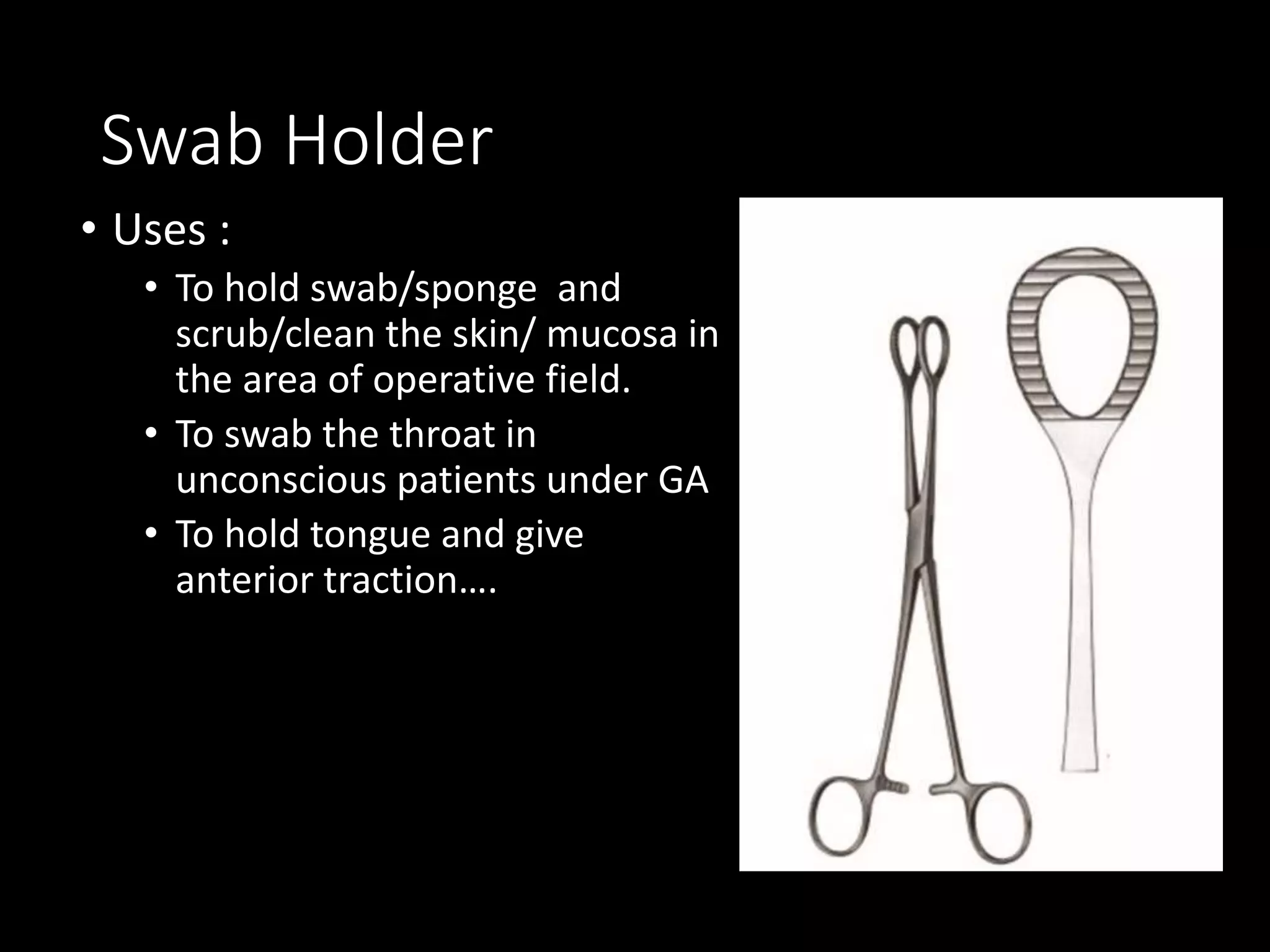
Swab Holder
• Uses :
• To hold swab/sponge and
scrub/clean the skin/ mucosa in
the area of operative field.
• To swab the throat in
unconscious patients under GA
• To hold tongue and give
anterior traction….
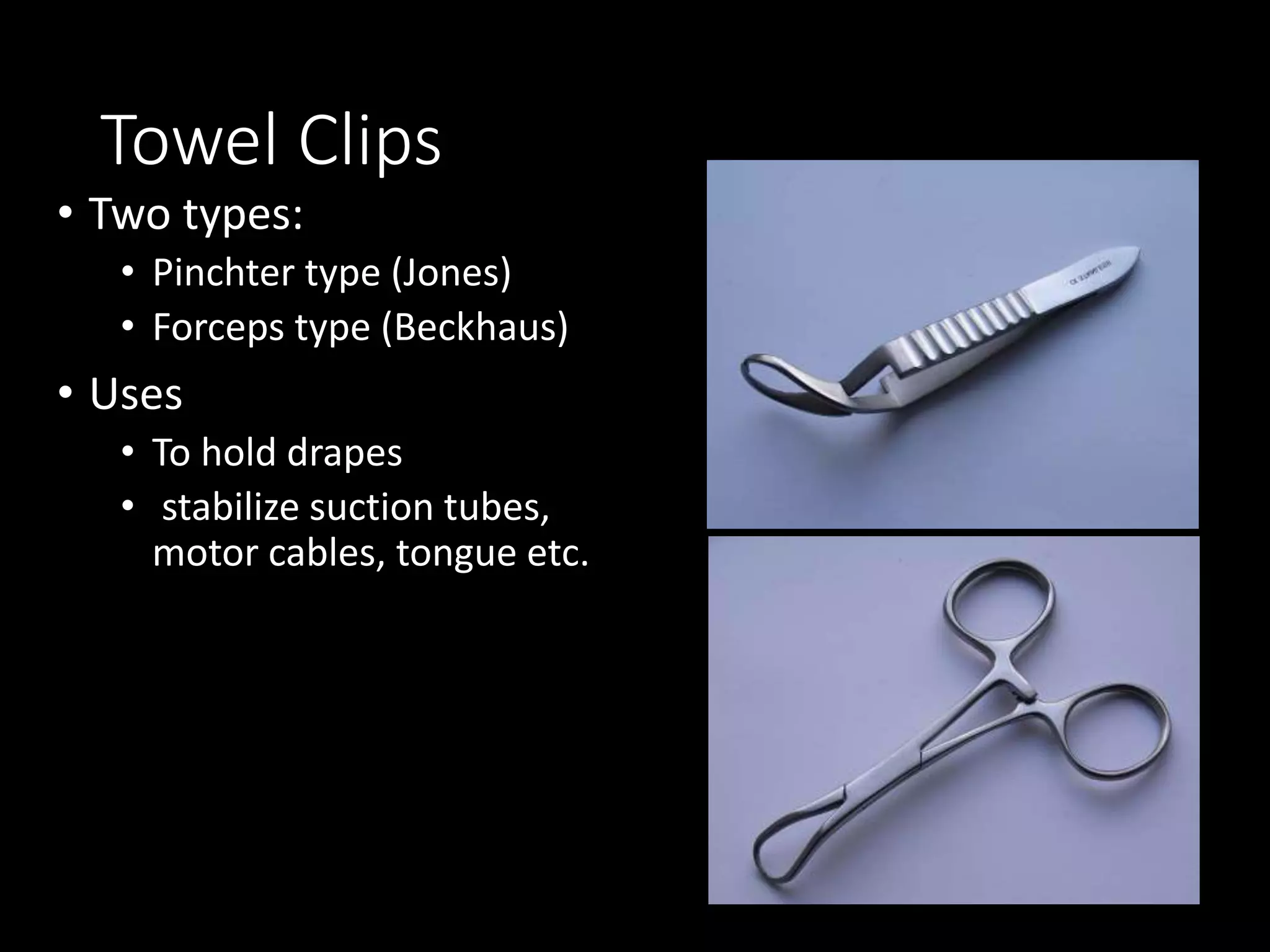
Towel Clips
• Two types:
• Pinchter type (Jones)
• Forceps type (Beckhaus)
• Uses
• To hold drapes
• stabilize suction tubes,
motor cables, tongue etc.
Instrument for gaining surgical access
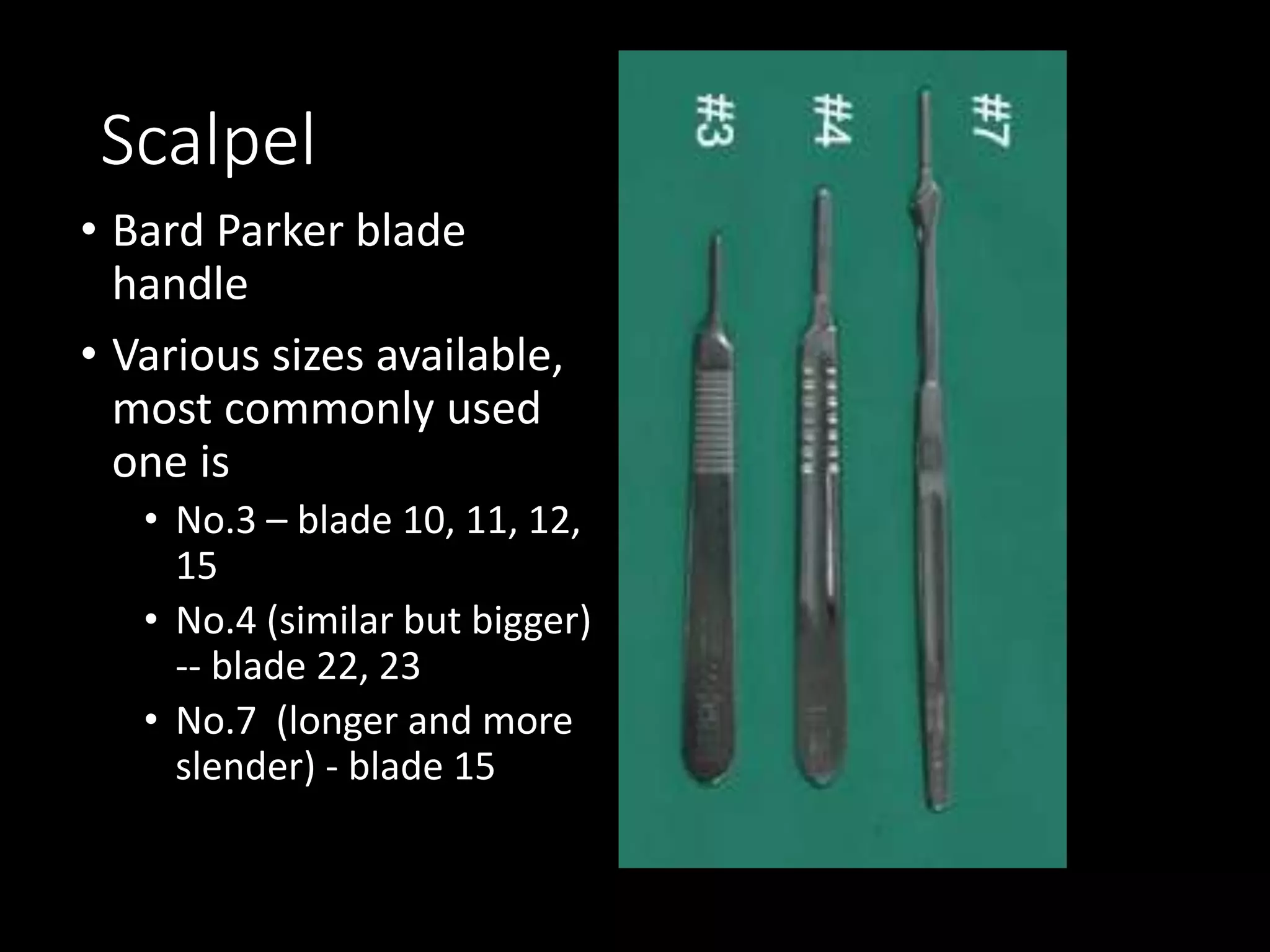
Scalpel
• Bard Parker blade
handle
• Various sizes available,
most commonly used
one is
• No.3 – blade 10, 11, 12,
15
• No.4 (similar but bigger)
-- blade 22, 23
• No.7 (longer and more
slender) - blade 15
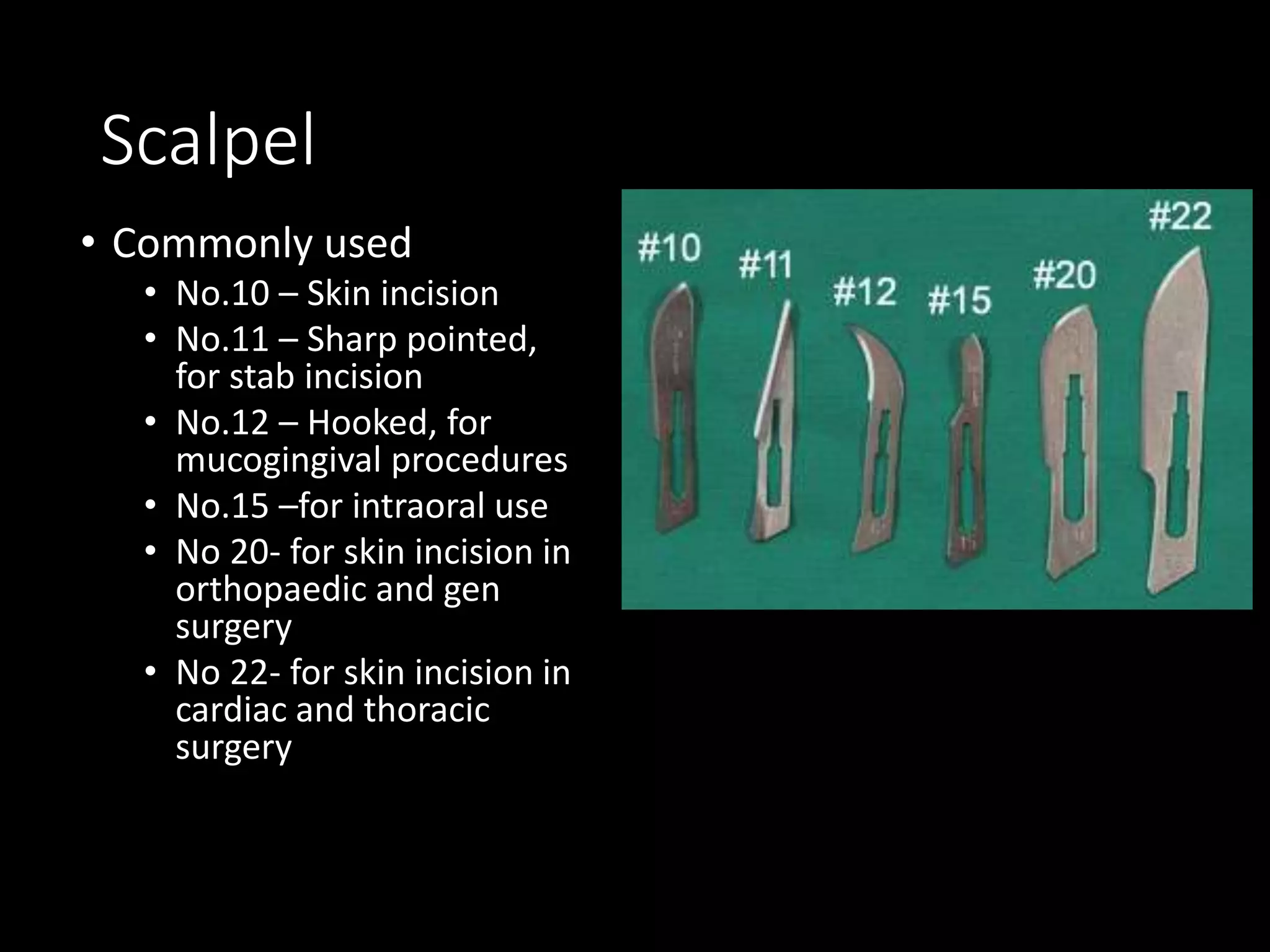
Scalpel
• Commonly used
• No.10 – Skin incision
• No.11 – Sharp pointed,
for stab incision
• No.12 – Hooked, for
mucogingival procedures
• No.15 –for intraoral use
• No 20- for skin incision in
orthopaedic and gen
surgery
• No 22- for skin incision in
cardiac and thoracic
surgery
Dissecting Scissors
• Iris scissor- fine work
• Metzenbaum scissor
• Mayo curved heavy duty
dissecting scissors
Dissecting Scissors
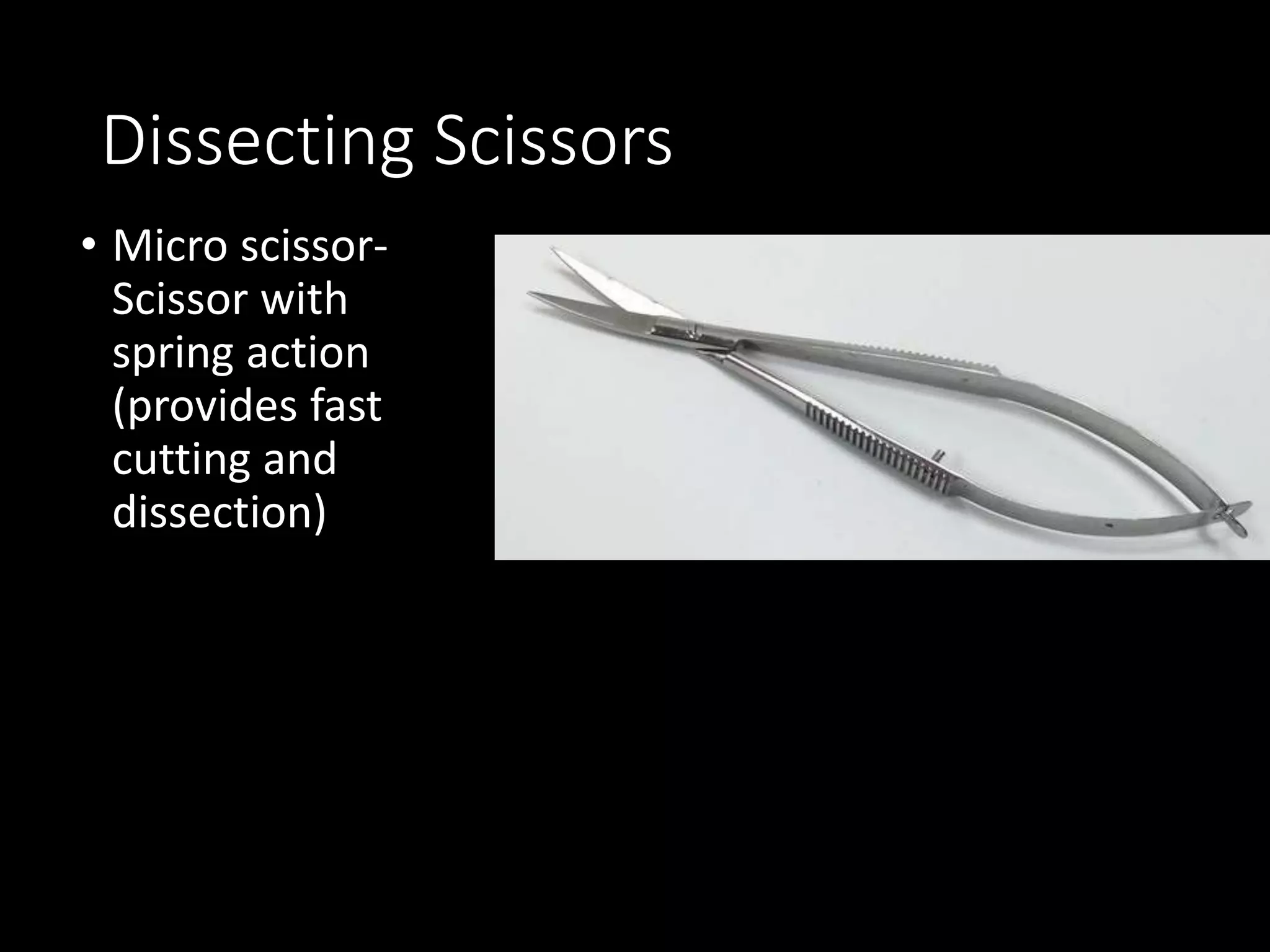
• Micro scissor-
Scissor with
spring action
(provides fast
cutting and
dissection)
Suture Cutting Scissors
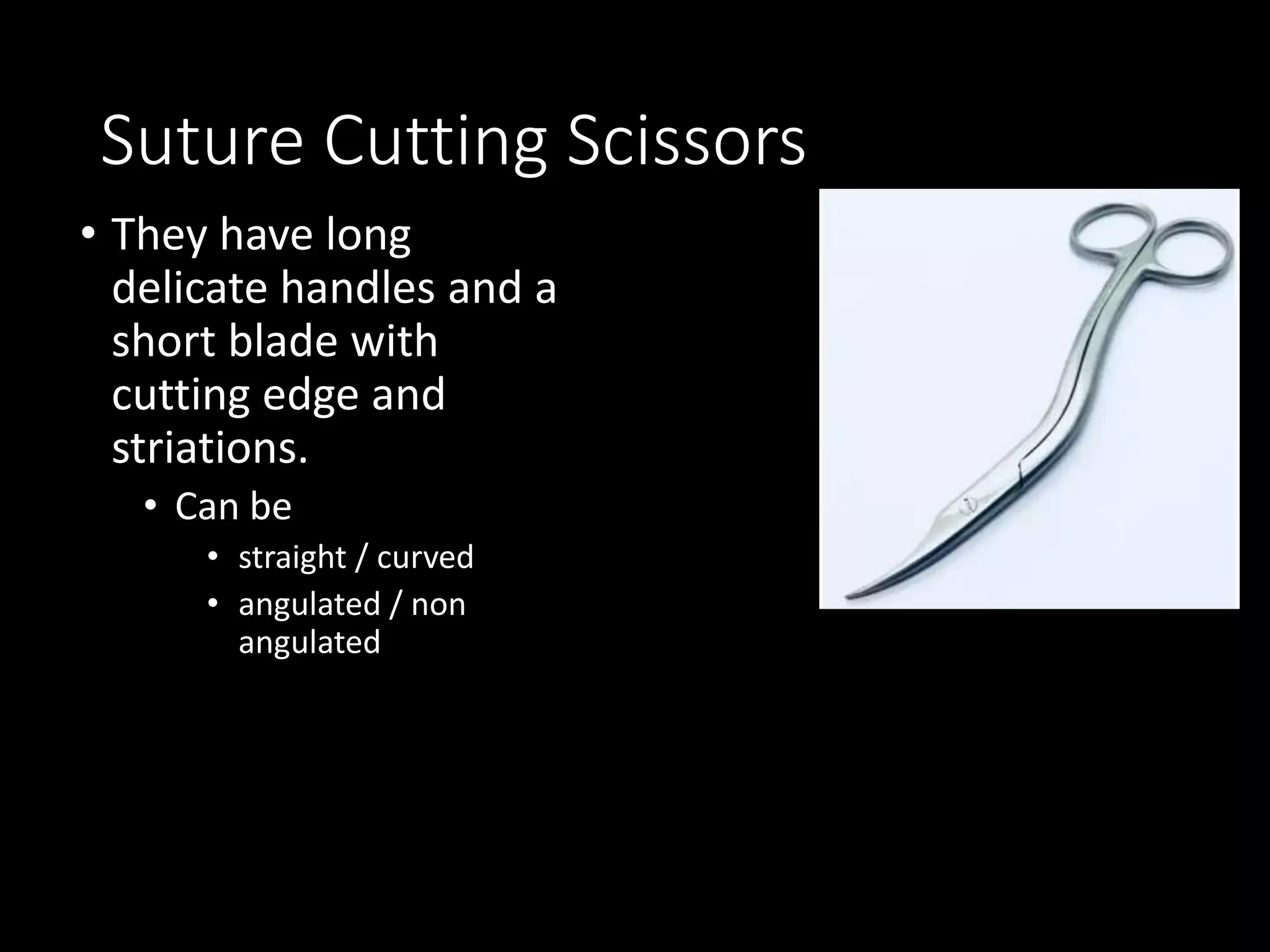
• They have long
delicate handles and a
short blade with
cutting edge and
striations.
• Can be
• straight / curved
• angulated / non
angulated
Heath’s suture
cutting scissor
Instrument for reflection of
mucoperiosteum flap
Periosteal Elevators
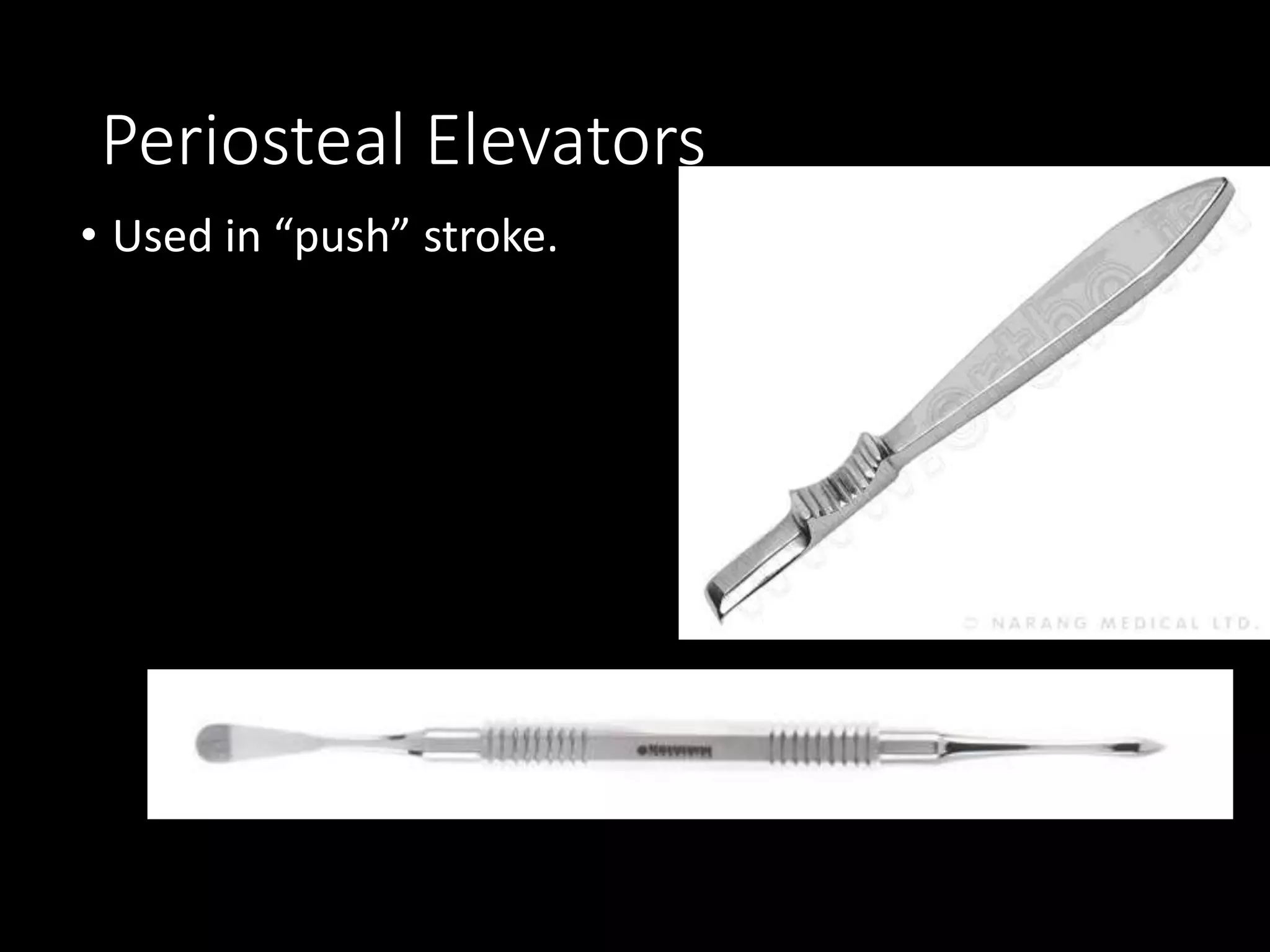
• Used in “push” stroke.
Molt’s No. 9 Periosteal Elevator
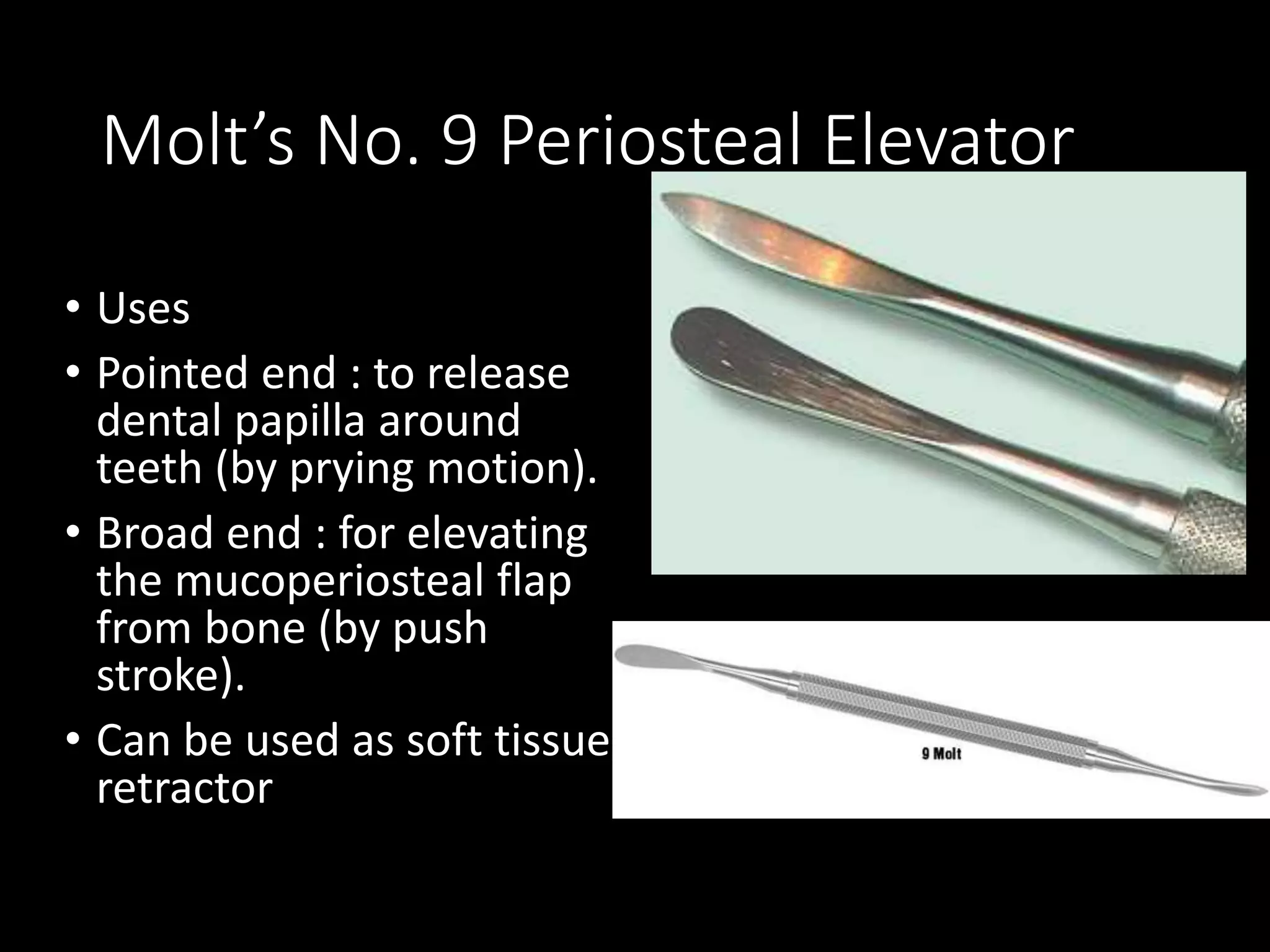
• Uses
• Pointed end : to release
dental papilla around
teeth (by prying motion).
• Broad end : for elevating
the mucoperiosteal flap
from bone (by push
stroke).
• Can be used as soft tissue
retractor
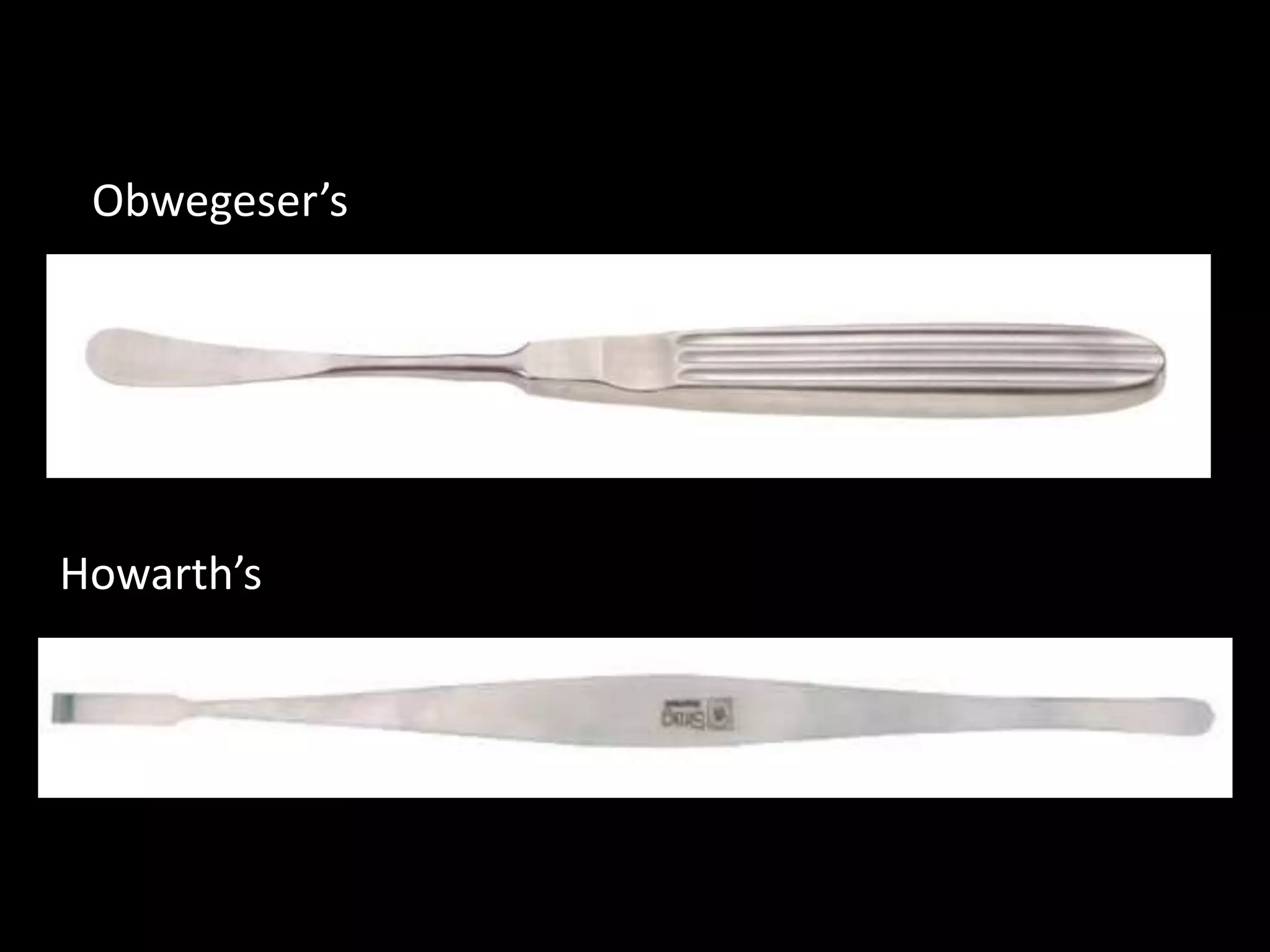
Obwegeser’s
Howarth’s
Joseph periosteal elevator
19
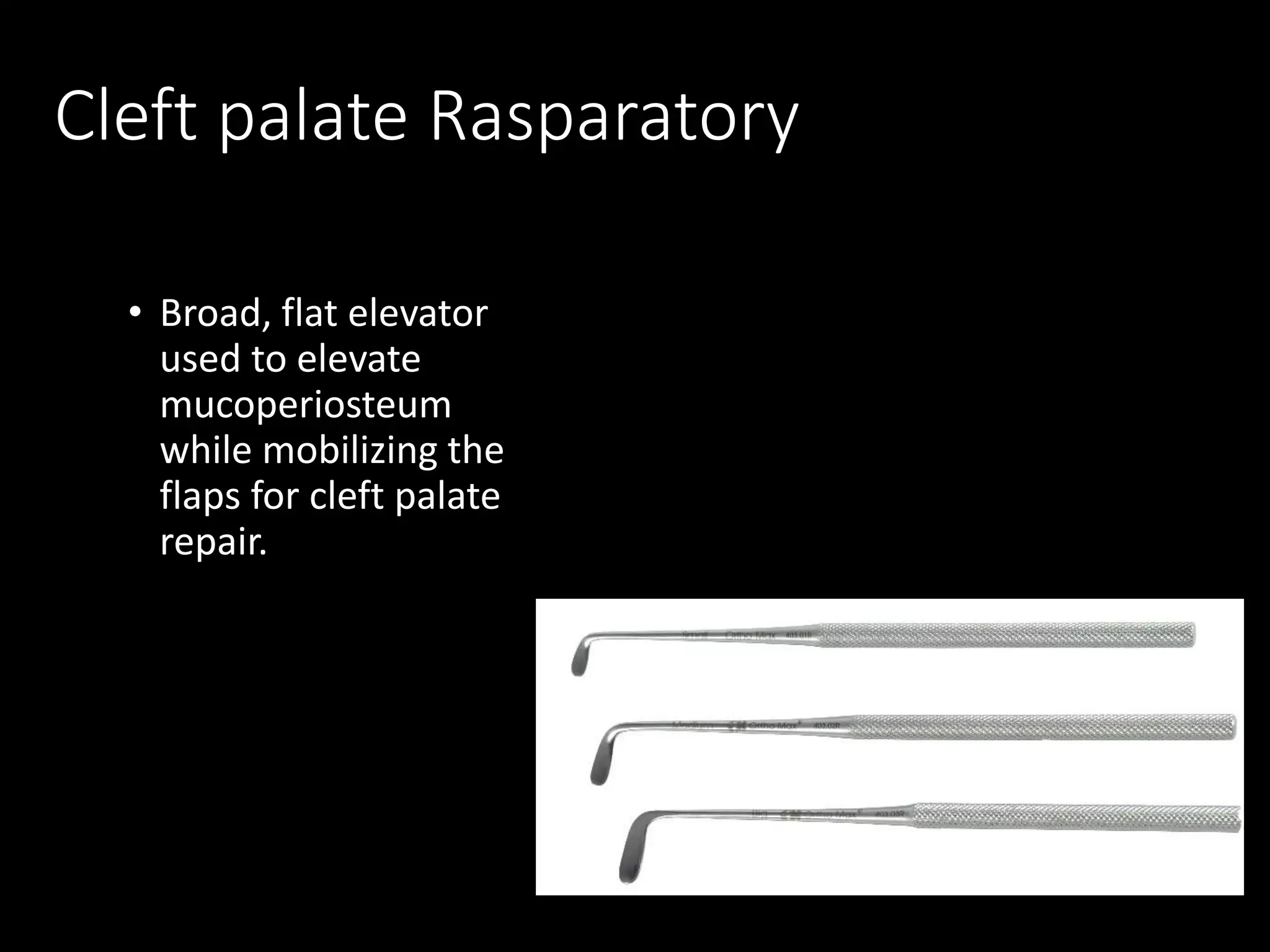
Cleft palate Rasparatory
• Broad, flat elevator
used to elevate
mucoperiosteum
while mobilizing the
flaps for cleft palate
repair.
Instruments for Retraction
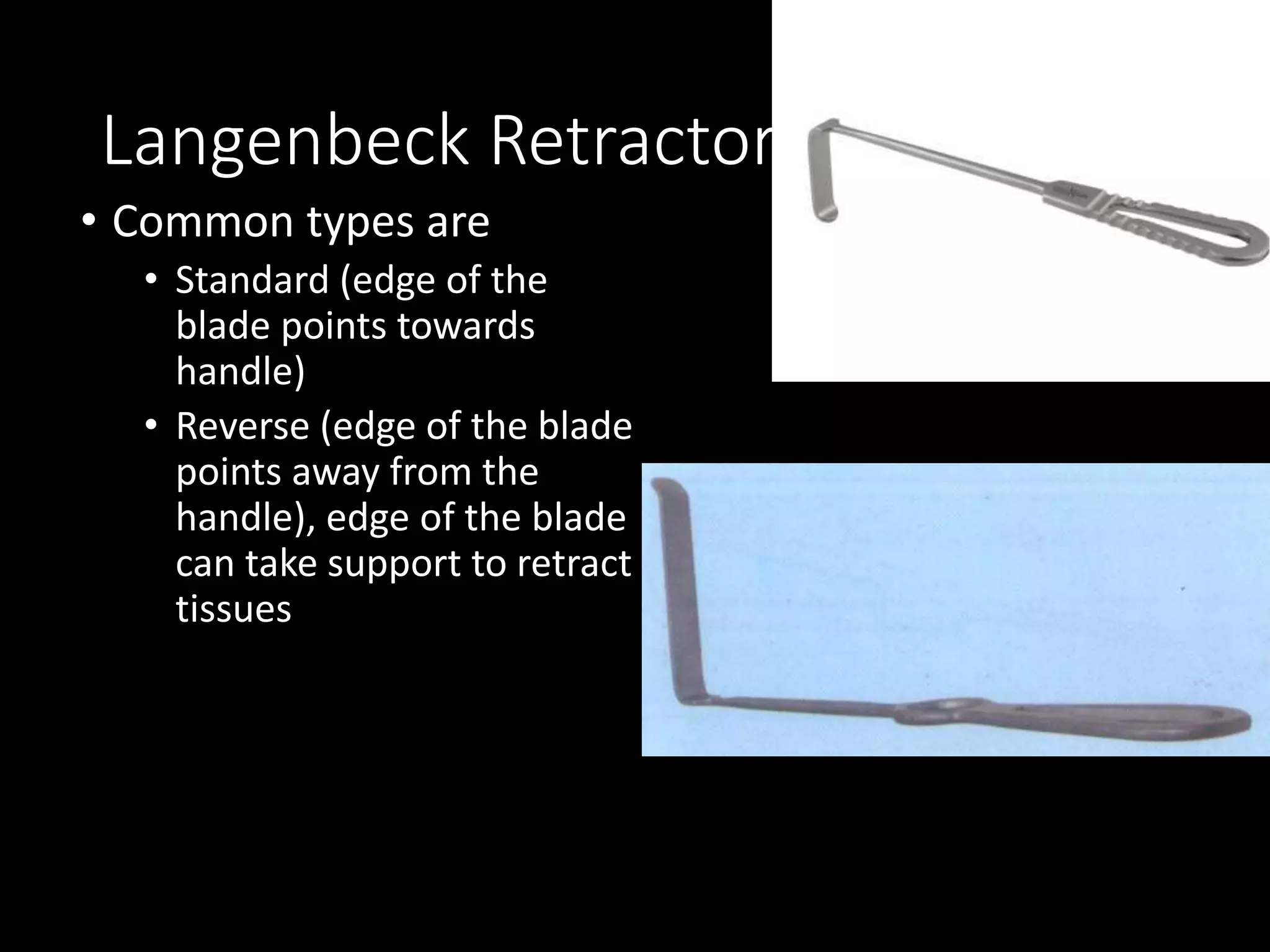
Langenbeck Retractor
• Common types are
• Standard (edge of the
blade points towards
handle)
• Reverse (edge of the blade
points away from the
handle), edge of the blade
can take support to retract
tissues
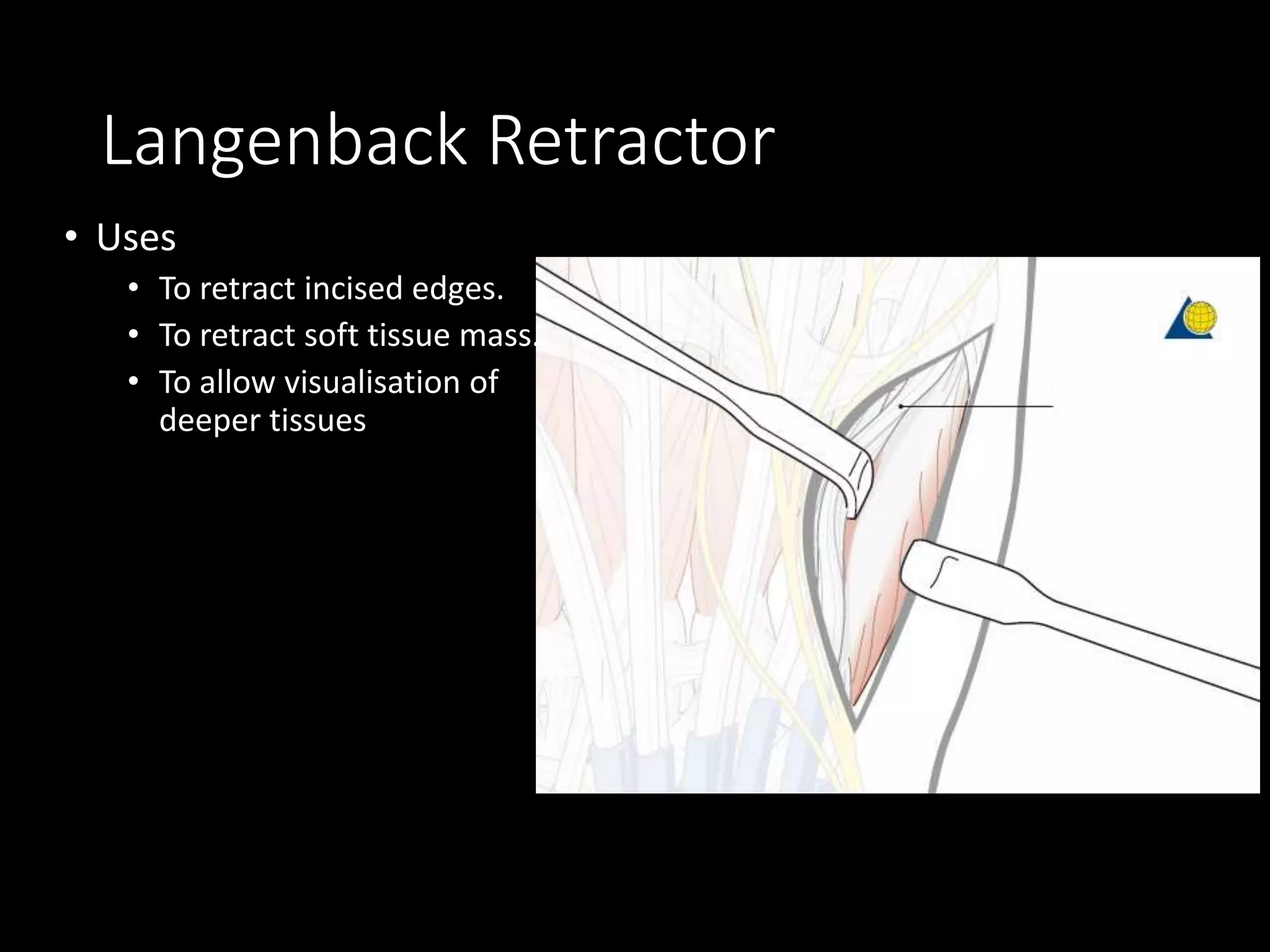
Langenback Retractor
• Uses
• To retract incised edges.
• To retract soft tissue mass.
• To allow visualisation of
deeper tissues
C - Shaped Retractor
• Mostly used in abdominal surgeries.
Deaver retractor
25
• Used to hold abdominal wall during abdominal and
thoracic surgery.
Austin’s Retractor
• Short right angled
retractor used for
retracting cheek,
tongue and
mucoperiosteal flaps.
• Working end - forked
Kilners Cat’s Paw Retractor
• Used for retracting
small amount of soft
tissues.
• Care should be taken
not to apply
excessive force.
Obwegessor’s Ramus Retractor
• Similar to Langenback
except that the edge of
the blade is forked
forming V shaped
notch so as to engage
the anterior border of
ramus of mandible.
• Uses :
• During sagittal split
osteotomy
• During
coronoidectomy
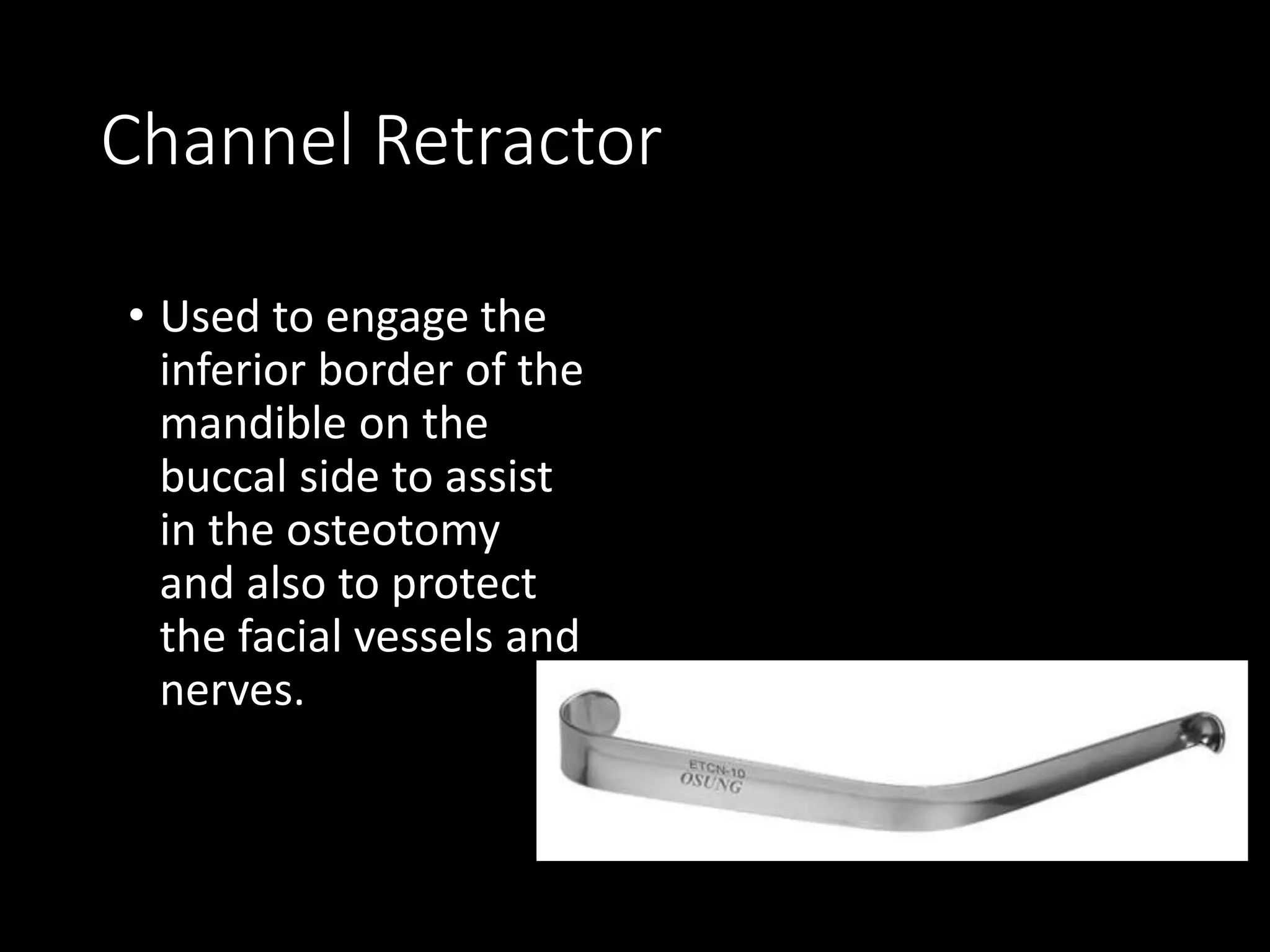
Channel Retractor
• Used to engage the
inferior border of the
mandible on the
buccal side to assist
in the osteotomy
and also to protect
the facial vessels and
nerves.
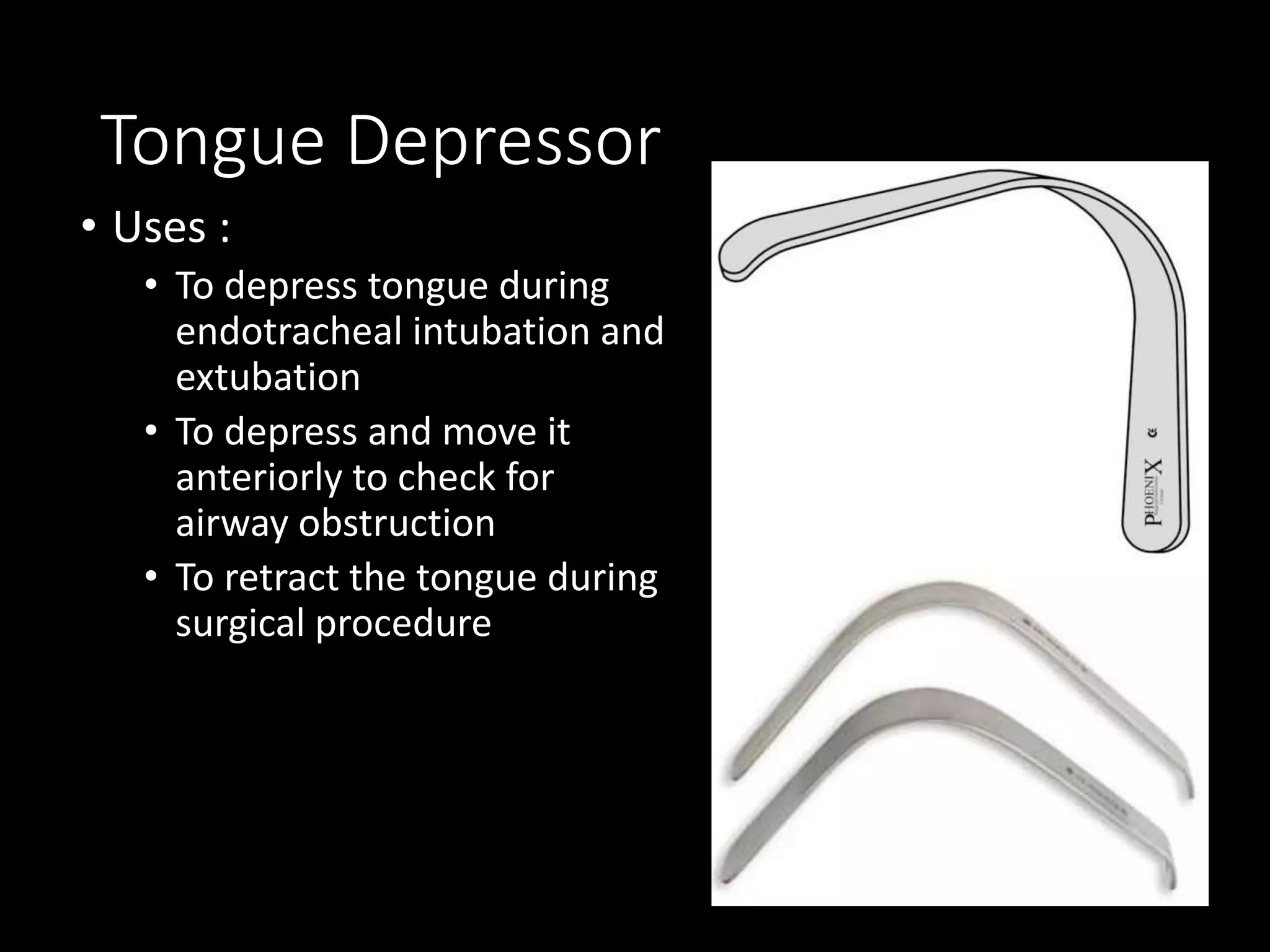
Tongue Depressor
• Uses :
• To depress tongue during
endotracheal intubation and
extubation
• To depress and move it
anteriorly to check for
airway obstruction
• To retract the tongue during
surgical procedure
Skin Hook
• Types
• Single prong – Gillies
• Double prong - Kilner
• Uses –
• To hold and retract skin
edges during cutting,
dissection and suturing.
• To retract small amount of
soft tissues
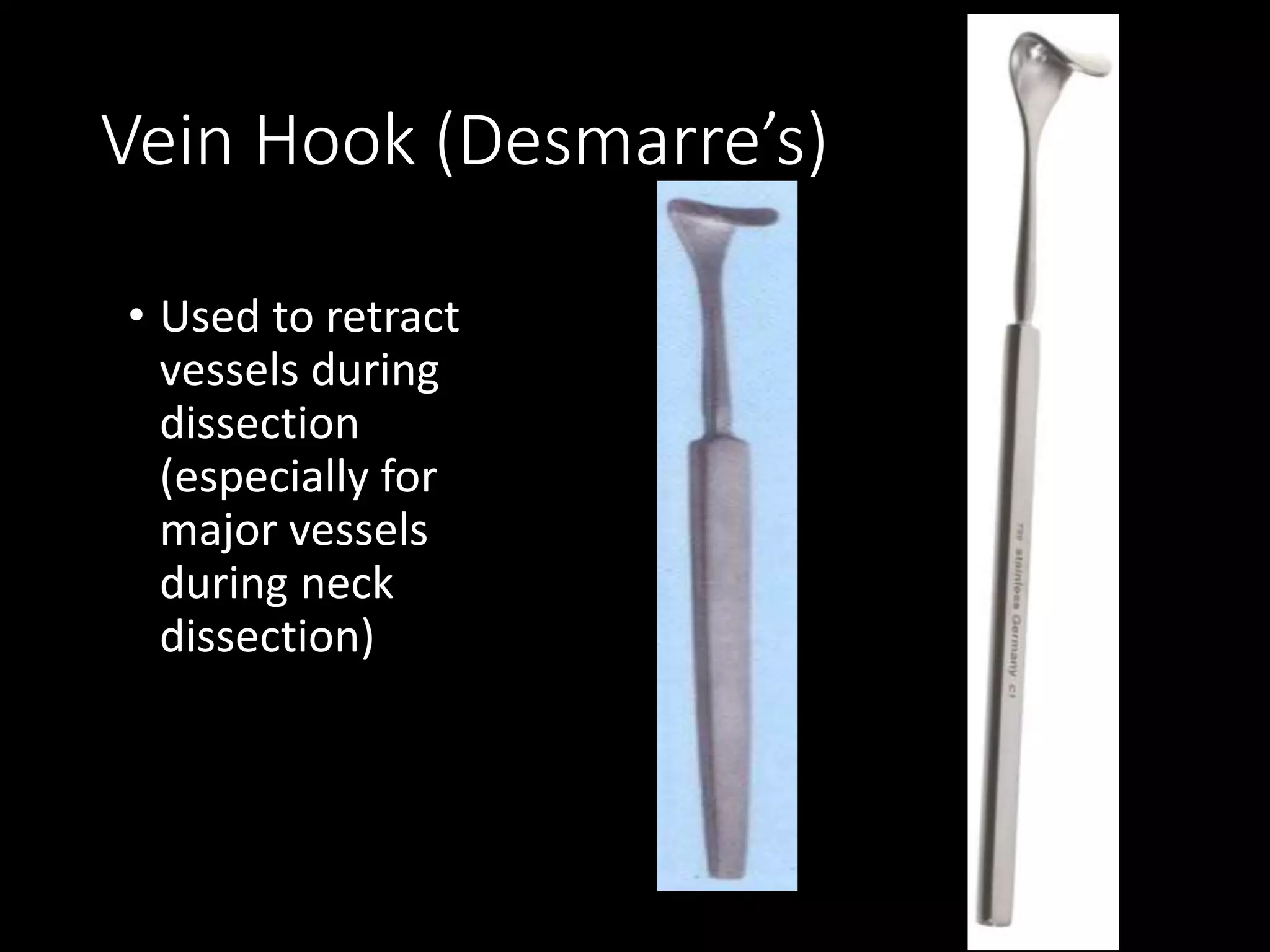
Vein Hook (Desmarre’s)
• Used to retract
vessels during
dissection
(especially for
major vessels
during neck
dissection)
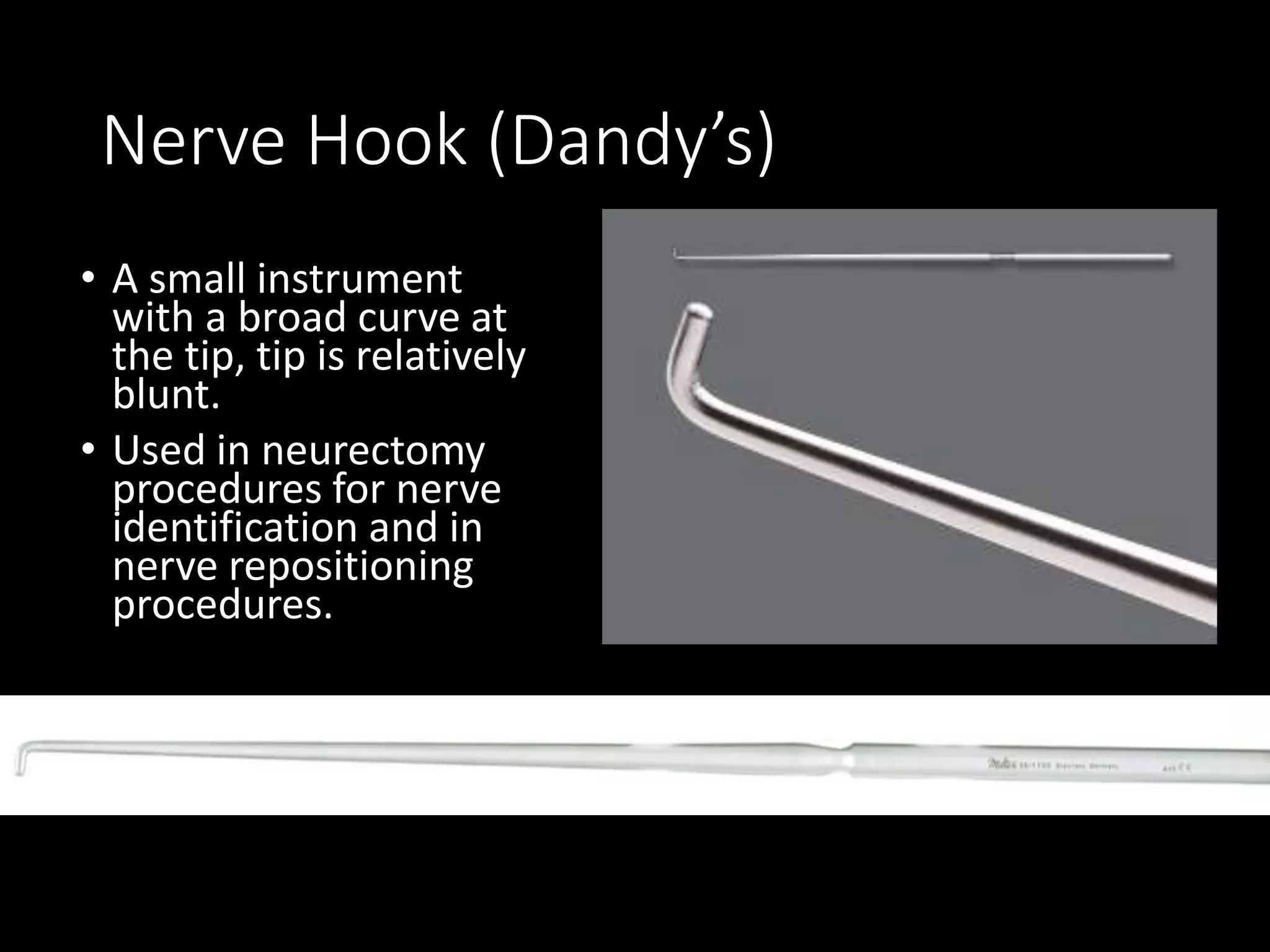
Nerve Hook (Dandy’s)
• A small instrument
with a broad curve at
the tip, tip is relatively
blunt.
• Used in neurectomy
procedures for nerve
identification and in
nerve repositioning
procedures.
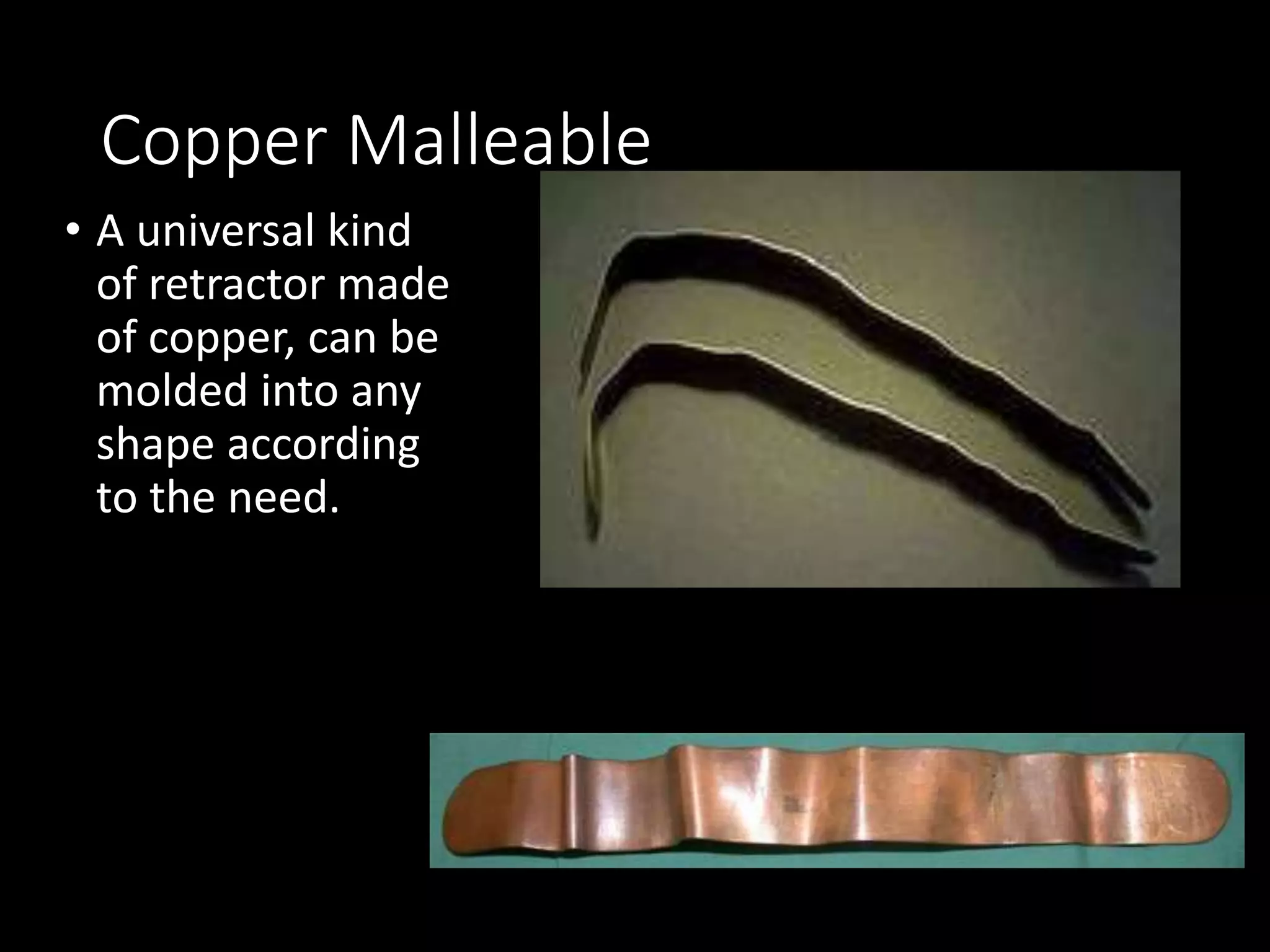
Copper Malleable
• A universal kind
of retractor made
of copper, can be
molded into any
shape according
to the need.
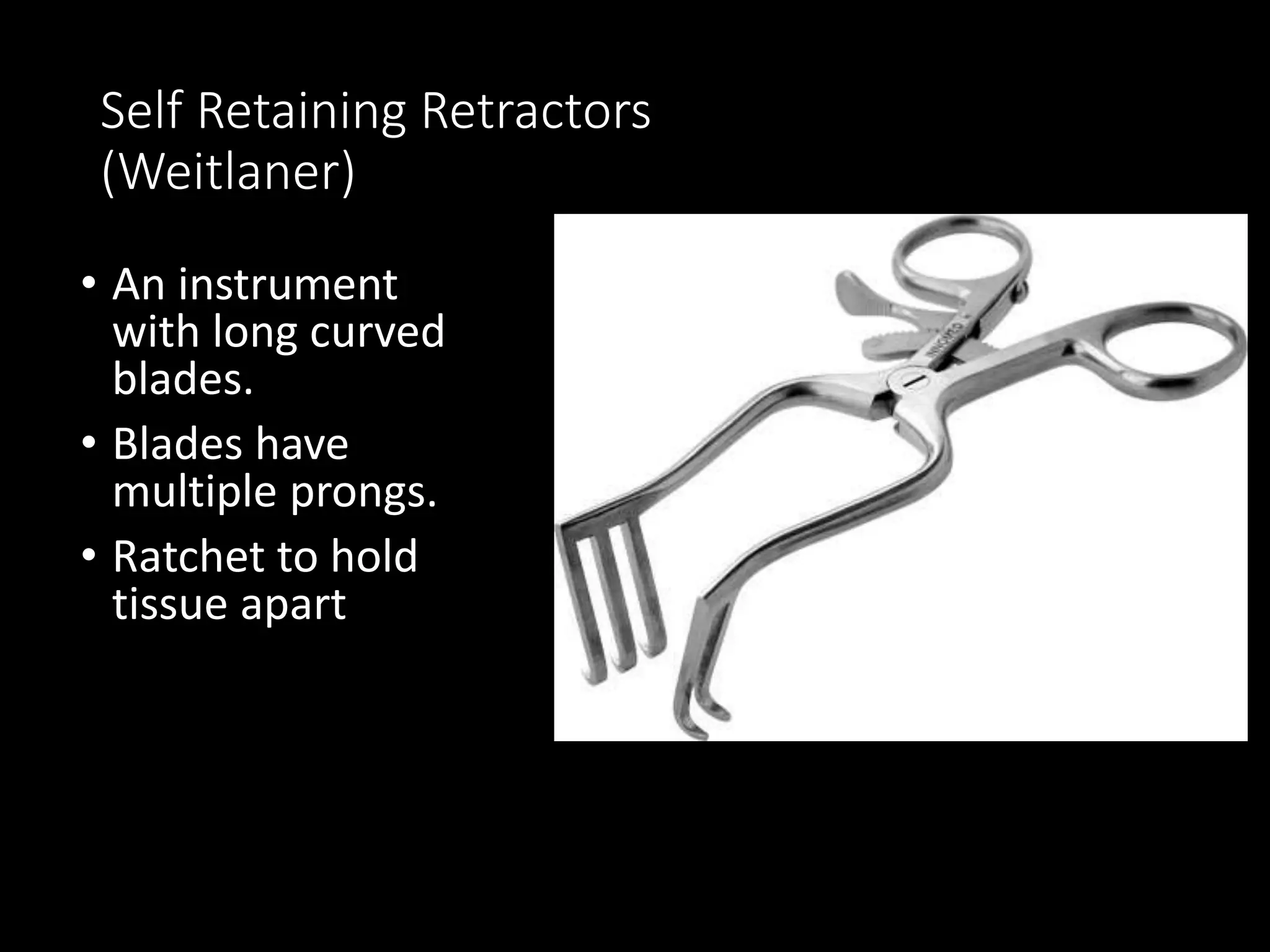
Self Retaining Retractors
(Weitlaner)
• An instrument
with long curved
blades.
• Blades have
multiple prongs.
• Ratchet to hold
tissue apart
Suction apparatus
Suction Tip (Fraizer, Yankauer)
• To maintain a clean field
by sucking away blood,
flushing solutions, debris,
cystic fluid, pus and
secretions.
• No 3 and 4 are commonly
used
• Yankauer – rigid hollow
tube made up of metal or
disposable plastic with a
curve at the distal end to
facilitate removal of thick
pharyngeal secretions
38
Instrument for suturing
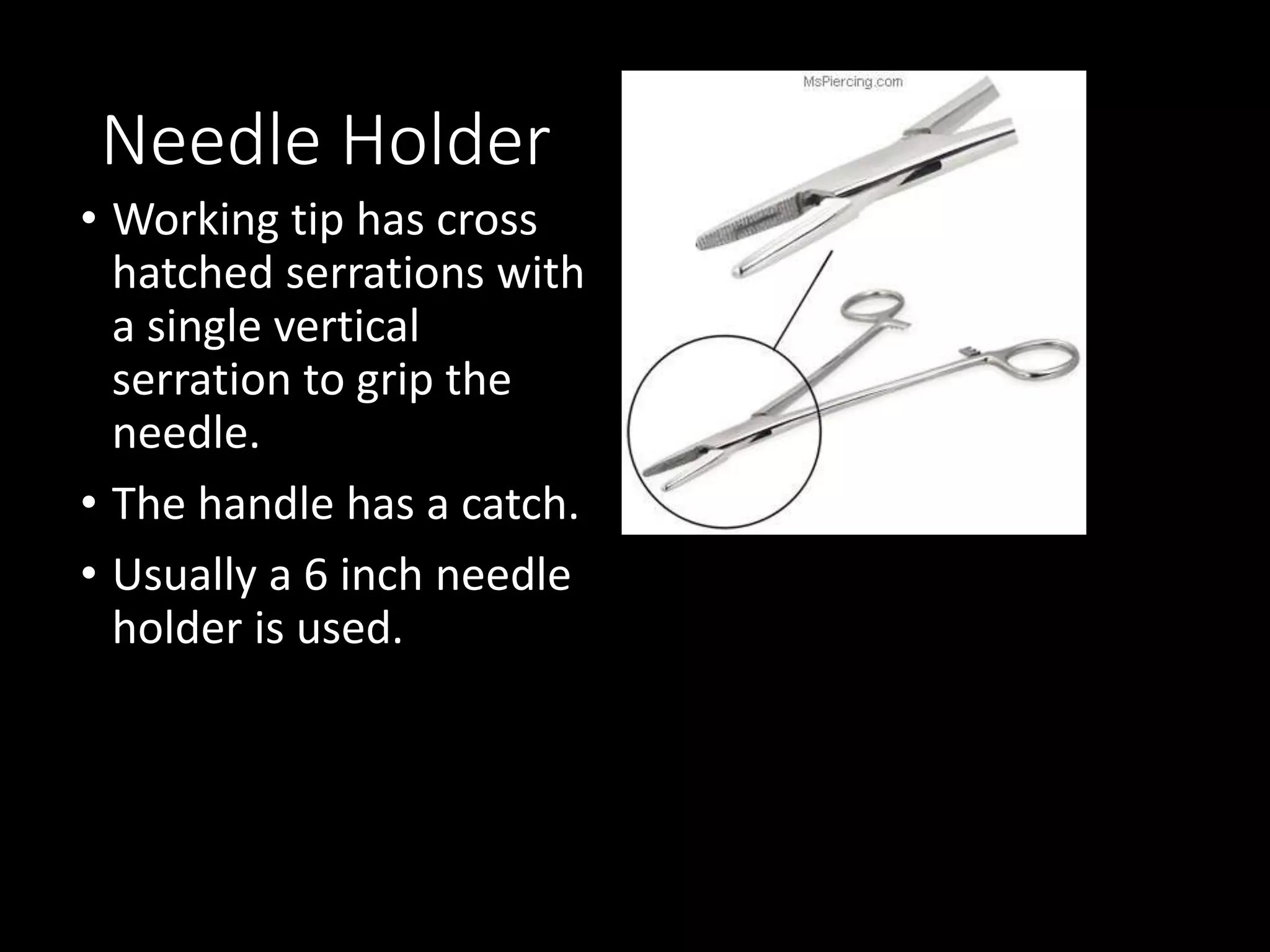
Needle Holder
• Working tip has cross
hatched serrations with
a single vertical
serration to grip the
needle.
• The handle has a catch.
• Usually a 6 inch needle
holder is used.
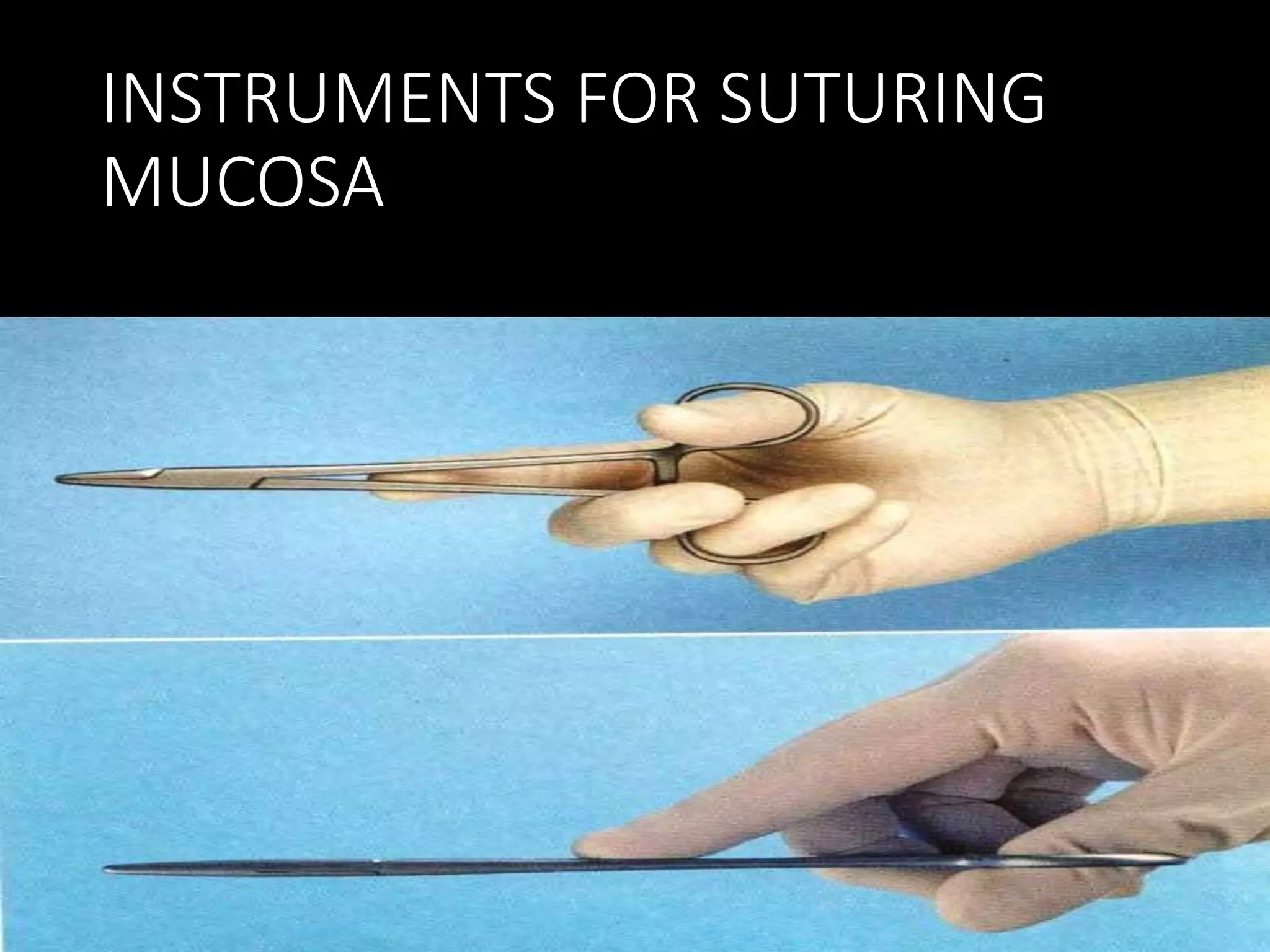
INSTRUMENTS FOR SUTURING
MUCOSA
Instruments for haemostasis
42
Artery Forceps
• Can be
• straight / curved
• large / medium / small
• Mosquito are small
curved artery forceps
which have smaller finer
tips
44
Artery Forceps
• Uses
• To achieve hemostasis by catching blood vessels
(by crushing / ligating / cauterizing)
• To drain an abscess ( by Hilton’s method).
• As tissue forceps for holding subcutaneous tissue
and aponeurosis (but not skin or nerves).
• To pick up necrotic tissues, granulation tissues,
foreign bodies, bone fragments
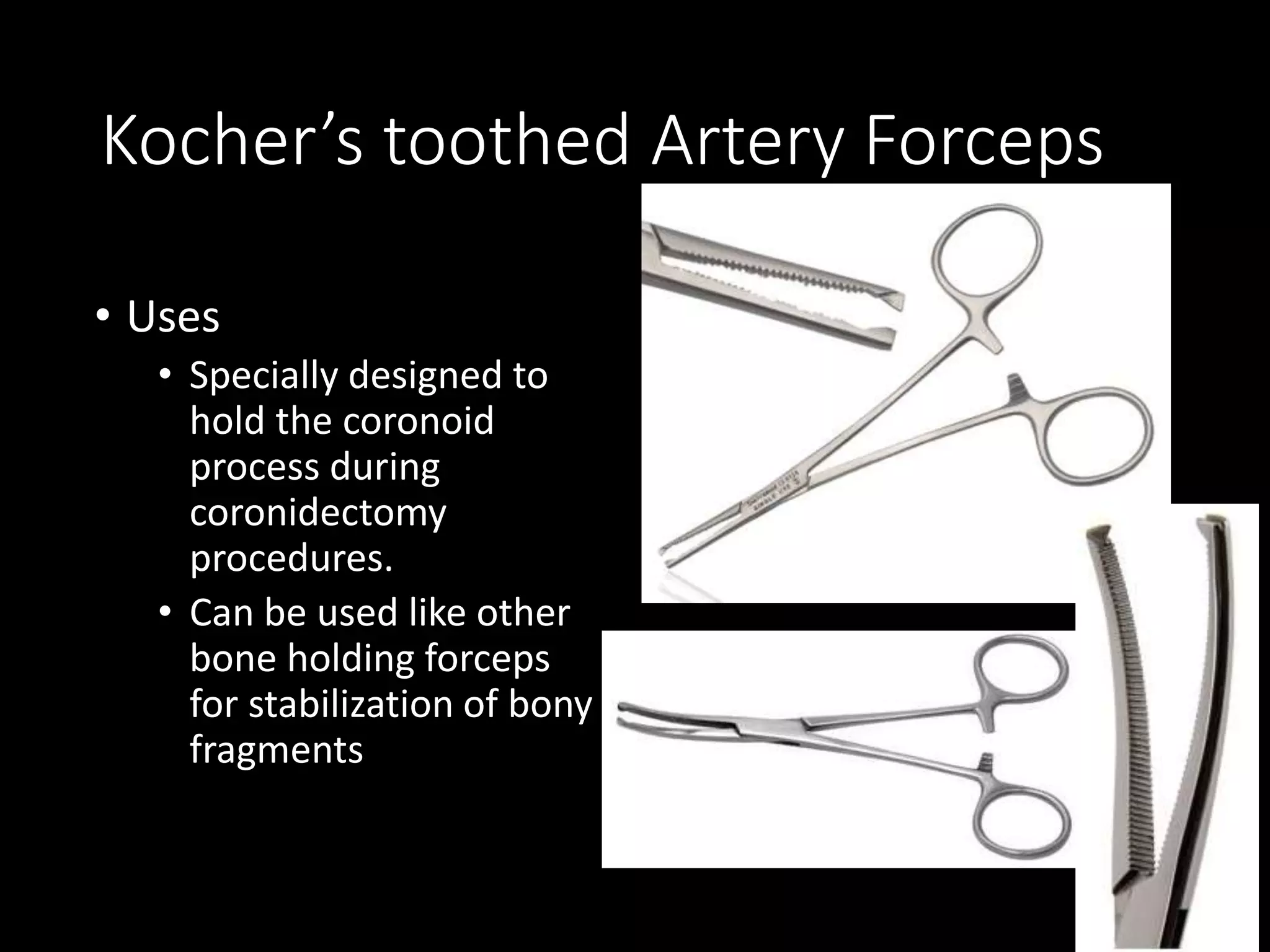
Kocher’s toothed Artery Forceps
• Uses
• Specially designed to
hold the coronoid
process during
coronidectomy
procedures.
• Can be used like other
bone holding forceps
for stabilization of bony
fragments
Instruments for holding tissues
47
Adson’s Tissue Forceps
• Delicate forceps, used to
hold tissues during
process of dissection /
suturing.
• Two types
• Plain / non toothed-, used
to hold delicate structures
• Toothed –to hold tough
structures like skin, coarse
muscle and fascia
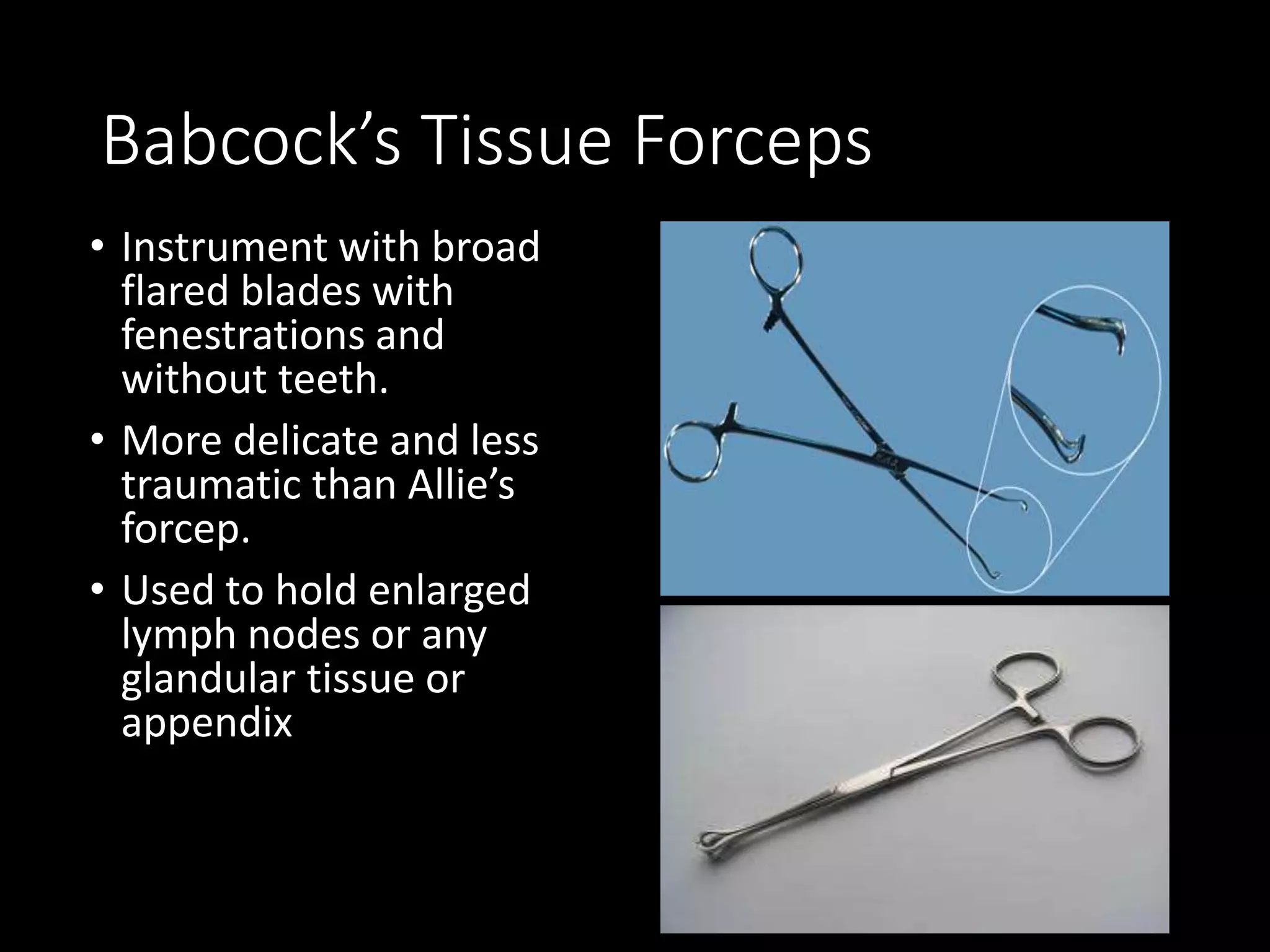
Babcock’s Tissue Forceps
• Instrument with broad
flared blades with
fenestrations and
without teeth.
• More delicate and less
traumatic than Allie’s
forcep.
• Used to hold enlarged
lymph nodes or any
glandular tissue or
appendix
Allis Tissue Forcep
• A forceps with locking
handle, blades have
delicate teeth.
• Uses
• To hold and retract tissues
(generally for tissues that
will be excised).
• To provide tension during
tissue dissection.
• Should never be used to
hold the skin directly.
Crocodile Bone Holding Forcep
• Used to hold the bony
fragments during manipulation
(fracture reduction and fixation
/ osteotomy / resection
procedures).
• When it comes without catch
in the handle, called as
Sequestrum holding forcep,
used to hold sequestrum
Instrument for bone removal
Bone Rongeur Forcep
• This forcep has curved
handles with spring
action.
• The tip of the blade is
angulated forward
towards the handle and
has a concave inner
surface.
• The beaks are sharp.
• They can be
• Both side and end cutting
• Only side cutting
(Blumenthal)
Bone Cutter
• shape of the blade is
different and have a side
cutting action only.
• Uses
• To cut sharp bony margins
following surgical
procedures.
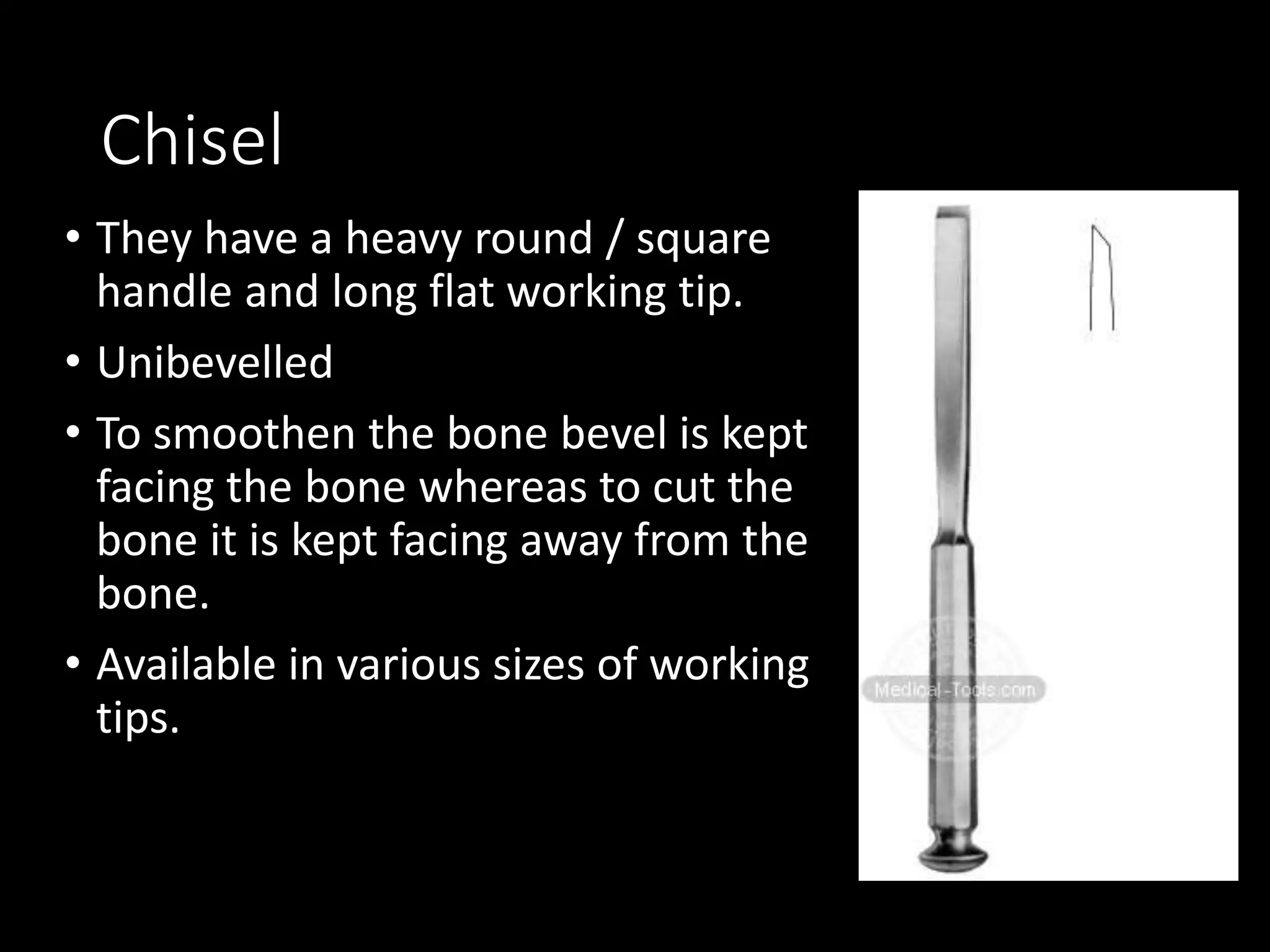
Chisel
• They have a heavy round / square
handle and long flat working tip.
• Unibevelled
• To smoothen the bone bevel is kept
facing the bone whereas to cut the
bone it is kept facing away from the
bone.
• Available in various sizes of working
tips.
Osteotome
• Similar to chisel but ---
bibeveled.
• It splits bone rather
than cutting or chipping
it.
• Uses
• Various osteotomy
procedures.
• Removal / Recontouring
of bone.
• Biopsy of bony lesions
Pterygoid Osteotome
• It is designed in completing
osteotomy between the maxillary
tuberosity and pterygoid plates in
LeFort I osteotomy procedures.
• Curved end
• Placed between tuberosity and
pterygoid plates of sphenoid bone
• Advantages
• Narrow tip to minimize encroachment
upon BFP
• Narrow shank to minimize threat of
tearing mucoperiosteal flap
• Sharp edge with reverse bevel to aid
better seating of osteotome
Pterygoid Osteotome
Mallet
• Similar to hammer, made up of steel / lead /
wood.
• Used for giving controlled taps on the chisel /
osteotome.
• To be effective the mallet should be used
with a loose free swinging movements of the
wrist.
Bone Gouge
• It has a round handle and a
blade that has sharp working
tip that is concave on inner
side.
• Working tip is half round and
has a long working area.
• Uses
• To make a window in anterior
border of maxillary sinus.(in
Caldwell Luc)
• To remove cancellous bone
graft material / irregular
pieces of bone.
Gigli’s Wire Saw
• It has 2 components
1. Wire saw
• It is made by twisting a
few pieces of wire
together so that it
acquires a sharp barbed
cutting edge.
2. Handles
• At the end of the wire
there is a ring to which
the hook of the handles
can be fitted.
Handpiece & Bur
• It is a quicker method of bone removal.
• Micromotor straight Handpiece
• The handpiece should have relatively high speed (35-
40000 rpm) and torque which allows rapid bone
removal.
• Burs
• stainless steel / carbide and available in different shapes
and length.
Surgical Saw
• In handpieces speed of 10,000
– 1 lakh cpm can be achieved.
• Different kinds of saws
available for various type of
osteotomy.
• Sagittal saw moves side to side
(5 - 6° arc), used for wedge /
transverse osteotomy.
• Oscillating saw oscillates (5 - 6°
arc), used for curved / straight
osteotomy.
• Reciprocating saw moves to and
fro (2.4mm), used for short /
long osteotomy.
Instrument for wound debridement
Curette (Lucas)
• An exploratory instrument with
spoon shaped working tip, used
to scrape soft tissues from bony
defects.
• The working end may be in the
plain as the shank or at an
angulation for adequate access.
• It can be single / double ended.
• Always held in “thumb and palm”
grasp and used in “pull (scrape)”
stroke.
• Uses
• To enucleate cyst /granulomas /
intra osseous tumours / cystic
neoplasms.
Volkmann’s Bone Scoop
• Similar to curette but concavity
of the working edge is more
pronounced.
• Uses
• To collect the contents from sinus
tract / fistula / chronic abscess
cavity.
• To scrape bony cavities due to
cystic / tumorous / osteomyelitic
lesions.
• To scoop out cancellous bone for
grafting procedures.
• To introduce graft material or
antiseptic powder into the surgical
area.
Lister’s Sinus Forcep
• It has long narrow blades
which are serrated
transversely for only ½ an
inch at the tip.
• Tip is rounded and bulbous.
• Instrument does not have a
catch.
• Uses
• To open an abscess by Hilton’s
method.
• To dissect out sinus / fistulous
tract in soft tissues.
• To hold a small piece of gauze
between blades to clean a
cavity.
Instruments For Mangament Of
Fractures / Osteotomies
Hayton Williams Forceps
• 2 widely divergent curved beaks that
engage the maxilla behind the tuberosity.
• Used for mid – palatal fractures.
Rowe’s Maxillary Disimapction
Forceps
• Pair of this instrument for
disimpacting maxilla in LeFort
fractures
• Consists of a straight unpadded
blade and a curved padded
blade.
• The unpadded blade is passed up
a nostril and padded blade grips
the palate.
• The operator stands behind the
patient and manipulates the
fragment into position.
Asche’s Nasal Septum Forcep
• Used to reduce
and align
fractures of the
nasal septum.
• Blades are
passed on either
side of the
septum and
vomer and
perpendicular
plate of ethmoid
bone.
Walsham’s Nasal Bone Forcep
• For reduction of nasal fractures
• It has 2 blades – small blade is inserted into
the nose and larger is applied externally to grip
the side of the nose up to the medial canthus
and parallel to frontal process of maxilla.
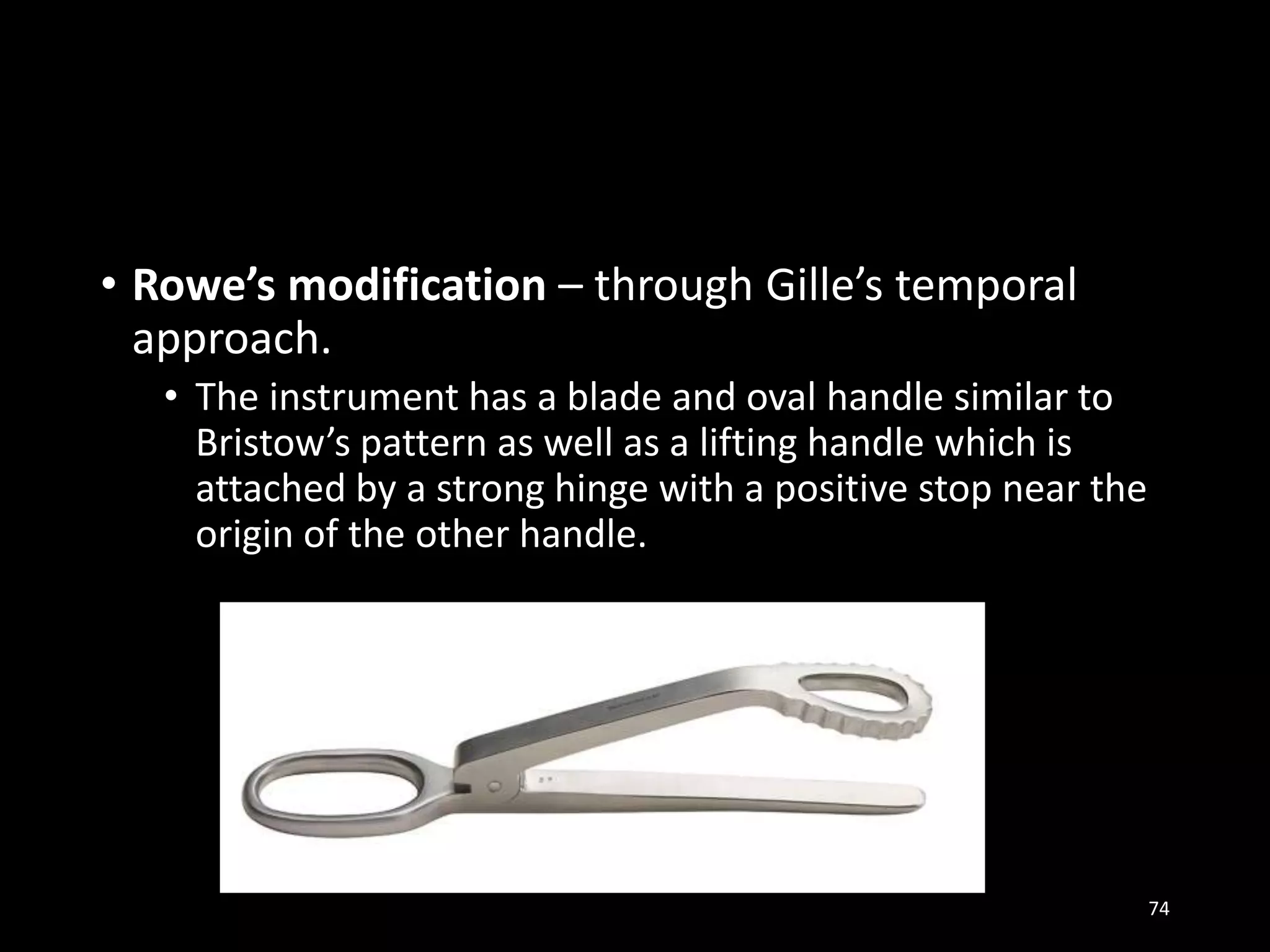
Zygomatic Elevator
• Bristow’s elevator – flat
instrument of sufficient
rigidity and inserted into the
same plane to reduce
zygomatic arch fracture.
• Rowe’s modification – through Gille’s temporal
approach.
• The instrument has a blade and oval handle similar to
Bristow’s pattern as well as a lifting handle which is
attached by a strong hinge with a positive stop near the
origin of the other handle.
74
Stacey zygomatic bone hook
75
Trocar
• It is a sharp, pointed instrument with a sleeve or cannula.
• Used to gain entry into the surgical site through
percutaneous approach to avoid skin incision and scar.
• Example – transbuccal approach to ramus of mandible.
Nasal Septum Osteotome
• It is used to fracture the anterior nasal
spine and separate the nasal septum from
maxilla during LeFort I or premaxillary
osteotomy procedures.
Smith Spreader
• It has 3 blades that are separated by spring
action when the handles are compressed.
• Used to separate bony fragments after
completion of the osteotomy cuts mainly used
to check separation of fragments during
downward fracture of maxilla / SSO procedure.
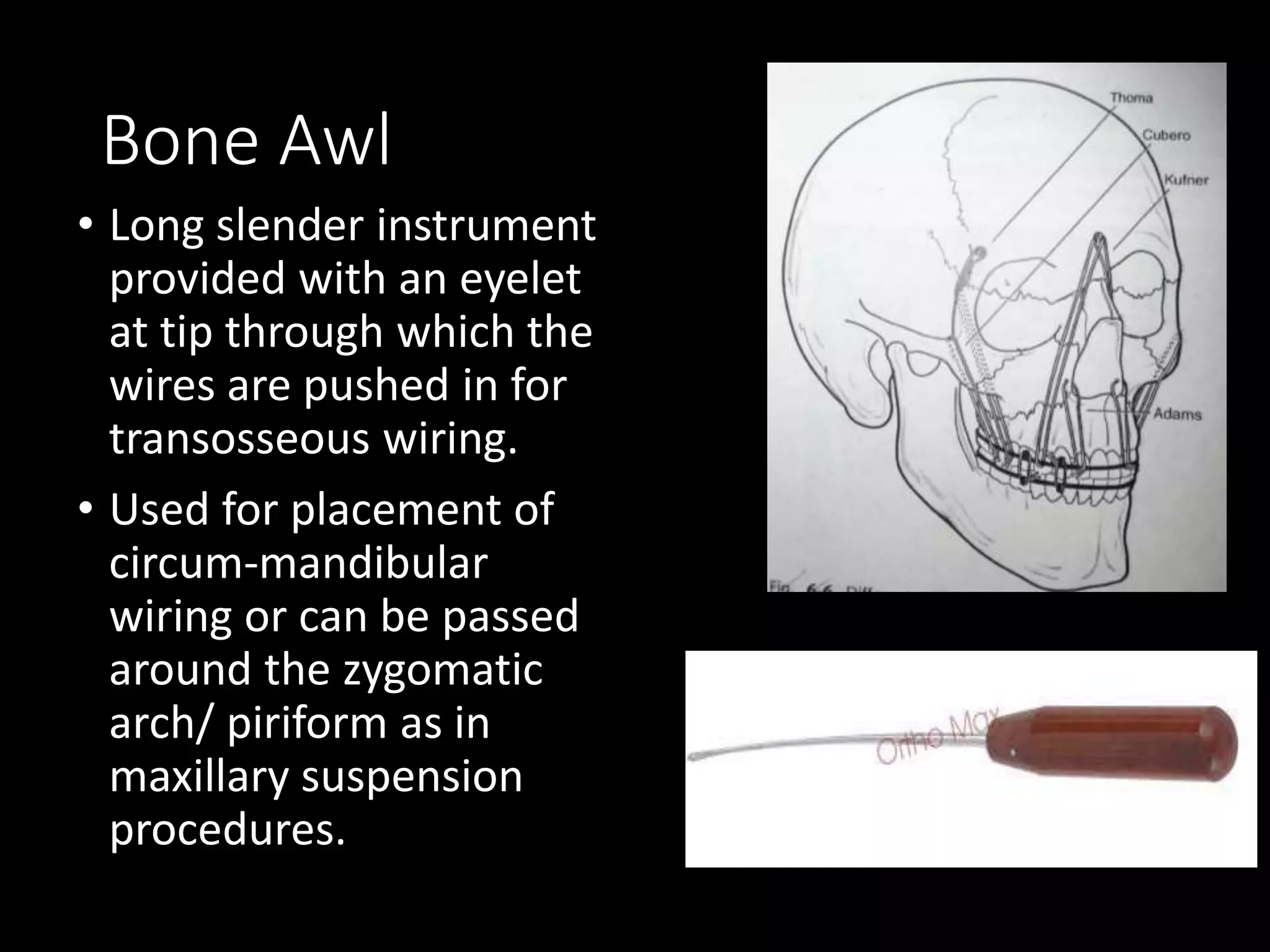
Bone Awl
• Long slender instrument
provided with an eyelet
at tip through which the
wires are pushed in for
transosseous wiring.
• Used for placement of
circum-mandibular
wiring or can be passed
around the zygomatic
arch/ piriform as in
maxillary suspension
procedures.
Instruments for cleft palate
80
Dingman’s Retractor
82
83
84
85
86
87
88
89
90
Instruments for skin grafting
91
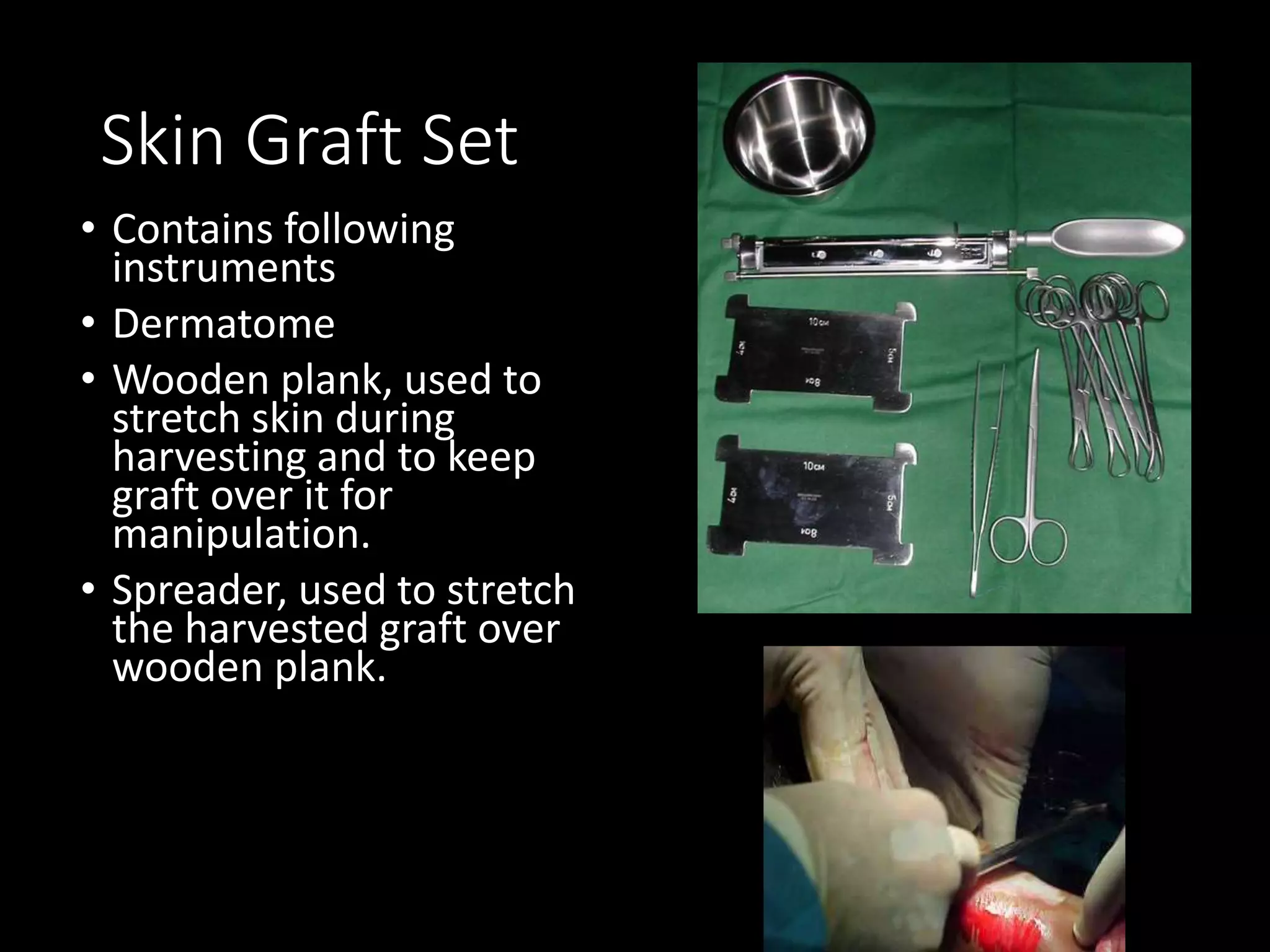
Skin Graft Set
• Contains following
instruments
• Dermatome
• Wooden plank, used to
stretch skin during
harvesting and to keep
graft over it for
manipulation.
• Spreader, used to stretch
the harvested graft over
wooden plank.
Dermatome
• It is a surgical instrument
used to produce thin slices
of skin from the donor site.
• Manual / electrical
• Manual – hand held knives
(Humby’s; Modified Watson
knife) possess adjustment
facility.
• Electrical dermatome –
operated by air pressure
(Brown / Zimmer
dermatome)
Instruments For Bone Grafting
• BONE TREPHINE
• Specially designed
instrument used to
obtain small diameter
trephines of bone for
grafting
• Has 3 parts
• Barrel with stands.
• Piston (working tip has
saw)
• Stylet
Instruments for opening mouth
95
INSTRUMENTS FOR HOLDING THE
MOUTH OPEN
• Soft, rubberlike block- patient rests teeth
• Patient opens to comfortably wide position- block
inserted: holds in the position
• Protects patient’s TMJ, while mandibular teeth
Heister’s Jaw Stretcher &
Fergusson’s Mouth Prop
• Used to forcibly open the mouth
• Indications:
• Trismus due to infection, muscle spasm,
hemarthrosis of TMJ following surgery
• Post operative active jaw physiotherapy after
TMJ ankylosis, OSMF.
References
• Textbook of oral and maxillofacial surgery –
Neelima A Malik
• Peterson’s Contemporary Oral & Maxillofacial
surgery – James Hupp, Edward Ellis
• Rowe & William’s Maxillofacial injuries
• Textbook of Oral and Maxillofacial Surgery – Daniel
M Laskin
• Internet
99

Instruments in major oral and maxillofacial surgery

  • 1.
    Instrumentation in MaxillofacialSurgery Presenter – Dr. Kamini Dadsena. Moderator – Dr. Rohit Chandra. Department OF PLASTIC SURGERY Max Hospital Patparganj
  • 2.
    Instruments A. Instrument forgaining surgical asepsis and art preparation 1. Cheatle’s forcep 2. Swab holder 3. Towel clip B. Instrument for gaining surgical access - 1. Scalpel (Blade handle, Blade) 2. Dissecting scissors C. Instrument for reflection of mucoperiosteum flap – 1. Periosteal elevator/ strippers 2. Cleft palate Rasparatory D. Instrument for Retraction – 1. Langenbeck Retractor 2. C shaped retractor 3. Austin retractor 4. Cat’s paw retractor 5. Seldin’s retractor 6. Obwegessor’s retractor 7. Skin hook 8. Tongue depressor 9. Cheek retractors
  • 3.
    Instruments E. Suction apparatus- 1. Suction tubing 2. Suction tip F. Instrument for wound debridement – 1. Curette 2. Bone scoop 3. Lister’s sinus forcep 4. Drains G. Instrument for holding tissues and materials – 1. Needle holder 2. Artery forceps 3. Kocher’s artery forceps 4. Allis forceps 5. Tissue holding forcep 6. Babecock’s forcep 7. Bone holding tissue forcep H. Instrument for management of fractures / osteotomies – 1. Hayton – William’s forcep 2. Rowe’s disimpaction forcep 3. Walsham’s forcep 4. Asche’s forcep 5. Nasal rasp 6. Bone awl 7. Rowe’s modification & Bristow’s zygomatic elevator 8. Smith’s bone spreader
  • 4.
    Instruments I. Instrument forbone removal – 1. Bone Rongeur 2. Chisel & Mallet 3. Osteotome 4. Gigli’s saw 5. Bone file 6. Bone gouge 7. Handpiece & bur J. Miscellaneous instruments – 1. Mouth prop 2. Mouth gag 3. Instruments for trauma and osteotomies 4. Instruments for cleft surgery
  • 5.
  • 6.
    Cheatle’s Forceps • Usedfor picking up sterile instruments from trays and linen from drums. • Stored in a container containing antiseptic solution.
  • 7.
    Swab Holder • Uses: • To hold swab/sponge and scrub/clean the skin/ mucosa in the area of operative field. • To swab the throat in unconscious patients under GA • To hold tongue and give anterior traction….
  • 8.
    Towel Clips • Twotypes: • Pinchter type (Jones) • Forceps type (Beckhaus) • Uses • To hold drapes • stabilize suction tubes, motor cables, tongue etc.
  • 9.
    Instrument for gainingsurgical access
  • 10.
    Scalpel • Bard Parkerblade handle • Various sizes available, most commonly used one is • No.3 – blade 10, 11, 12, 15 • No.4 (similar but bigger) -- blade 22, 23 • No.7 (longer and more slender) - blade 15
  • 11.
    Scalpel • Commonly used •No.10 – Skin incision • No.11 – Sharp pointed, for stab incision • No.12 – Hooked, for mucogingival procedures • No.15 –for intraoral use • No 20- for skin incision in orthopaedic and gen surgery • No 22- for skin incision in cardiac and thoracic surgery
  • 12.
    Dissecting Scissors • Irisscissor- fine work • Metzenbaum scissor • Mayo curved heavy duty dissecting scissors
  • 13.
    Dissecting Scissors • Microscissor- Scissor with spring action (provides fast cutting and dissection)
  • 14.
    Suture Cutting Scissors •They have long delicate handles and a short blade with cutting edge and striations. • Can be • straight / curved • angulated / non angulated Heath’s suture cutting scissor
  • 15.
    Instrument for reflectionof mucoperiosteum flap
  • 16.
    Periosteal Elevators • Usedin “push” stroke.
  • 17.
    Molt’s No. 9Periosteal Elevator • Uses • Pointed end : to release dental papilla around teeth (by prying motion). • Broad end : for elevating the mucoperiosteal flap from bone (by push stroke). • Can be used as soft tissue retractor
  • 18.
  • 19.
  • 20.
    Cleft palate Rasparatory •Broad, flat elevator used to elevate mucoperiosteum while mobilizing the flaps for cleft palate repair.
  • 21.
  • 22.
    Langenbeck Retractor • Commontypes are • Standard (edge of the blade points towards handle) • Reverse (edge of the blade points away from the handle), edge of the blade can take support to retract tissues
  • 23.
    Langenback Retractor • Uses •To retract incised edges. • To retract soft tissue mass. • To allow visualisation of deeper tissues
  • 24.
    C - ShapedRetractor • Mostly used in abdominal surgeries.
  • 25.
    Deaver retractor 25 • Usedto hold abdominal wall during abdominal and thoracic surgery.
  • 26.
    Austin’s Retractor • Shortright angled retractor used for retracting cheek, tongue and mucoperiosteal flaps. • Working end - forked
  • 27.
    Kilners Cat’s PawRetractor • Used for retracting small amount of soft tissues. • Care should be taken not to apply excessive force.
  • 28.
    Obwegessor’s Ramus Retractor •Similar to Langenback except that the edge of the blade is forked forming V shaped notch so as to engage the anterior border of ramus of mandible. • Uses : • During sagittal split osteotomy • During coronoidectomy
  • 29.
    Channel Retractor • Usedto engage the inferior border of the mandible on the buccal side to assist in the osteotomy and also to protect the facial vessels and nerves.
  • 30.
    Tongue Depressor • Uses: • To depress tongue during endotracheal intubation and extubation • To depress and move it anteriorly to check for airway obstruction • To retract the tongue during surgical procedure
  • 31.
    Skin Hook • Types •Single prong – Gillies • Double prong - Kilner • Uses – • To hold and retract skin edges during cutting, dissection and suturing. • To retract small amount of soft tissues
  • 32.
    Vein Hook (Desmarre’s) •Used to retract vessels during dissection (especially for major vessels during neck dissection)
  • 33.
    Nerve Hook (Dandy’s) •A small instrument with a broad curve at the tip, tip is relatively blunt. • Used in neurectomy procedures for nerve identification and in nerve repositioning procedures.
  • 34.
    Copper Malleable • Auniversal kind of retractor made of copper, can be molded into any shape according to the need.
  • 35.
    Self Retaining Retractors (Weitlaner) •An instrument with long curved blades. • Blades have multiple prongs. • Ratchet to hold tissue apart
  • 36.
  • 37.
    Suction Tip (Fraizer,Yankauer) • To maintain a clean field by sucking away blood, flushing solutions, debris, cystic fluid, pus and secretions. • No 3 and 4 are commonly used • Yankauer – rigid hollow tube made up of metal or disposable plastic with a curve at the distal end to facilitate removal of thick pharyngeal secretions
  • 38.
  • 39.
  • 40.
    Needle Holder • Workingtip has cross hatched serrations with a single vertical serration to grip the needle. • The handle has a catch. • Usually a 6 inch needle holder is used.
  • 41.
  • 42.
  • 43.
    Artery Forceps • Canbe • straight / curved • large / medium / small • Mosquito are small curved artery forceps which have smaller finer tips
  • 44.
  • 45.
    Artery Forceps • Uses •To achieve hemostasis by catching blood vessels (by crushing / ligating / cauterizing) • To drain an abscess ( by Hilton’s method). • As tissue forceps for holding subcutaneous tissue and aponeurosis (but not skin or nerves). • To pick up necrotic tissues, granulation tissues, foreign bodies, bone fragments
  • 46.
    Kocher’s toothed ArteryForceps • Uses • Specially designed to hold the coronoid process during coronidectomy procedures. • Can be used like other bone holding forceps for stabilization of bony fragments
  • 47.
  • 48.
    Adson’s Tissue Forceps •Delicate forceps, used to hold tissues during process of dissection / suturing. • Two types • Plain / non toothed-, used to hold delicate structures • Toothed –to hold tough structures like skin, coarse muscle and fascia
  • 49.
    Babcock’s Tissue Forceps •Instrument with broad flared blades with fenestrations and without teeth. • More delicate and less traumatic than Allie’s forcep. • Used to hold enlarged lymph nodes or any glandular tissue or appendix
  • 50.
    Allis Tissue Forcep •A forceps with locking handle, blades have delicate teeth. • Uses • To hold and retract tissues (generally for tissues that will be excised). • To provide tension during tissue dissection. • Should never be used to hold the skin directly.
  • 51.
    Crocodile Bone HoldingForcep • Used to hold the bony fragments during manipulation (fracture reduction and fixation / osteotomy / resection procedures). • When it comes without catch in the handle, called as Sequestrum holding forcep, used to hold sequestrum
  • 52.
  • 53.
    Bone Rongeur Forcep •This forcep has curved handles with spring action. • The tip of the blade is angulated forward towards the handle and has a concave inner surface. • The beaks are sharp. • They can be • Both side and end cutting • Only side cutting (Blumenthal)
  • 54.
    Bone Cutter • shapeof the blade is different and have a side cutting action only. • Uses • To cut sharp bony margins following surgical procedures.
  • 55.
    Chisel • They havea heavy round / square handle and long flat working tip. • Unibevelled • To smoothen the bone bevel is kept facing the bone whereas to cut the bone it is kept facing away from the bone. • Available in various sizes of working tips.
  • 56.
    Osteotome • Similar tochisel but --- bibeveled. • It splits bone rather than cutting or chipping it. • Uses • Various osteotomy procedures. • Removal / Recontouring of bone. • Biopsy of bony lesions
  • 57.
    Pterygoid Osteotome • Itis designed in completing osteotomy between the maxillary tuberosity and pterygoid plates in LeFort I osteotomy procedures. • Curved end • Placed between tuberosity and pterygoid plates of sphenoid bone • Advantages • Narrow tip to minimize encroachment upon BFP • Narrow shank to minimize threat of tearing mucoperiosteal flap • Sharp edge with reverse bevel to aid better seating of osteotome
  • 58.
  • 59.
    Mallet • Similar tohammer, made up of steel / lead / wood. • Used for giving controlled taps on the chisel / osteotome. • To be effective the mallet should be used with a loose free swinging movements of the wrist.
  • 60.
    Bone Gouge • Ithas a round handle and a blade that has sharp working tip that is concave on inner side. • Working tip is half round and has a long working area. • Uses • To make a window in anterior border of maxillary sinus.(in Caldwell Luc) • To remove cancellous bone graft material / irregular pieces of bone.
  • 61.
    Gigli’s Wire Saw •It has 2 components 1. Wire saw • It is made by twisting a few pieces of wire together so that it acquires a sharp barbed cutting edge. 2. Handles • At the end of the wire there is a ring to which the hook of the handles can be fitted.
  • 62.
    Handpiece & Bur •It is a quicker method of bone removal. • Micromotor straight Handpiece • The handpiece should have relatively high speed (35- 40000 rpm) and torque which allows rapid bone removal. • Burs • stainless steel / carbide and available in different shapes and length.
  • 63.
    Surgical Saw • Inhandpieces speed of 10,000 – 1 lakh cpm can be achieved. • Different kinds of saws available for various type of osteotomy. • Sagittal saw moves side to side (5 - 6° arc), used for wedge / transverse osteotomy. • Oscillating saw oscillates (5 - 6° arc), used for curved / straight osteotomy. • Reciprocating saw moves to and fro (2.4mm), used for short / long osteotomy.
  • 64.
  • 65.
    Curette (Lucas) • Anexploratory instrument with spoon shaped working tip, used to scrape soft tissues from bony defects. • The working end may be in the plain as the shank or at an angulation for adequate access. • It can be single / double ended. • Always held in “thumb and palm” grasp and used in “pull (scrape)” stroke. • Uses • To enucleate cyst /granulomas / intra osseous tumours / cystic neoplasms.
  • 66.
    Volkmann’s Bone Scoop •Similar to curette but concavity of the working edge is more pronounced. • Uses • To collect the contents from sinus tract / fistula / chronic abscess cavity. • To scrape bony cavities due to cystic / tumorous / osteomyelitic lesions. • To scoop out cancellous bone for grafting procedures. • To introduce graft material or antiseptic powder into the surgical area.
  • 67.
    Lister’s Sinus Forcep •It has long narrow blades which are serrated transversely for only ½ an inch at the tip. • Tip is rounded and bulbous. • Instrument does not have a catch. • Uses • To open an abscess by Hilton’s method. • To dissect out sinus / fistulous tract in soft tissues. • To hold a small piece of gauze between blades to clean a cavity.
  • 68.
    Instruments For MangamentOf Fractures / Osteotomies
  • 69.
    Hayton Williams Forceps •2 widely divergent curved beaks that engage the maxilla behind the tuberosity. • Used for mid – palatal fractures.
  • 70.
    Rowe’s Maxillary Disimapction Forceps •Pair of this instrument for disimpacting maxilla in LeFort fractures • Consists of a straight unpadded blade and a curved padded blade. • The unpadded blade is passed up a nostril and padded blade grips the palate. • The operator stands behind the patient and manipulates the fragment into position.
  • 71.
    Asche’s Nasal SeptumForcep • Used to reduce and align fractures of the nasal septum. • Blades are passed on either side of the septum and vomer and perpendicular plate of ethmoid bone.
  • 72.
    Walsham’s Nasal BoneForcep • For reduction of nasal fractures • It has 2 blades – small blade is inserted into the nose and larger is applied externally to grip the side of the nose up to the medial canthus and parallel to frontal process of maxilla.
  • 73.
    Zygomatic Elevator • Bristow’selevator – flat instrument of sufficient rigidity and inserted into the same plane to reduce zygomatic arch fracture.
  • 74.
    • Rowe’s modification– through Gille’s temporal approach. • The instrument has a blade and oval handle similar to Bristow’s pattern as well as a lifting handle which is attached by a strong hinge with a positive stop near the origin of the other handle. 74
  • 75.
  • 76.
    Trocar • It isa sharp, pointed instrument with a sleeve or cannula. • Used to gain entry into the surgical site through percutaneous approach to avoid skin incision and scar. • Example – transbuccal approach to ramus of mandible.
  • 77.
    Nasal Septum Osteotome •It is used to fracture the anterior nasal spine and separate the nasal septum from maxilla during LeFort I or premaxillary osteotomy procedures.
  • 78.
    Smith Spreader • Ithas 3 blades that are separated by spring action when the handles are compressed. • Used to separate bony fragments after completion of the osteotomy cuts mainly used to check separation of fragments during downward fracture of maxilla / SSO procedure.
  • 79.
    Bone Awl • Longslender instrument provided with an eyelet at tip through which the wires are pushed in for transosseous wiring. • Used for placement of circum-mandibular wiring or can be passed around the zygomatic arch/ piriform as in maxillary suspension procedures.
  • 80.
  • 81.
  • 82.
  • 83.
  • 84.
  • 85.
  • 86.
  • 87.
  • 88.
  • 89.
  • 90.
  • 91.
  • 92.
    Skin Graft Set •Contains following instruments • Dermatome • Wooden plank, used to stretch skin during harvesting and to keep graft over it for manipulation. • Spreader, used to stretch the harvested graft over wooden plank.
  • 93.
    Dermatome • It isa surgical instrument used to produce thin slices of skin from the donor site. • Manual / electrical • Manual – hand held knives (Humby’s; Modified Watson knife) possess adjustment facility. • Electrical dermatome – operated by air pressure (Brown / Zimmer dermatome)
  • 94.
    Instruments For BoneGrafting • BONE TREPHINE • Specially designed instrument used to obtain small diameter trephines of bone for grafting • Has 3 parts • Barrel with stands. • Piston (working tip has saw) • Stylet
  • 95.
  • 96.
    INSTRUMENTS FOR HOLDINGTHE MOUTH OPEN • Soft, rubberlike block- patient rests teeth • Patient opens to comfortably wide position- block inserted: holds in the position • Protects patient’s TMJ, while mandibular teeth
  • 97.
    Heister’s Jaw Stretcher& Fergusson’s Mouth Prop • Used to forcibly open the mouth • Indications: • Trismus due to infection, muscle spasm, hemarthrosis of TMJ following surgery • Post operative active jaw physiotherapy after TMJ ankylosis, OSMF.
  • 98.
    References • Textbook oforal and maxillofacial surgery – Neelima A Malik • Peterson’s Contemporary Oral & Maxillofacial surgery – James Hupp, Edward Ellis • Rowe & William’s Maxillofacial injuries • Textbook of Oral and Maxillofacial Surgery – Daniel M Laskin • Internet
  • 99.

Editor's Notes

  • #3 A surgical instrument is a specially designed tool or device for performing specific actions and carrying out desired effects during surgery or operations.
  • #5 Foley’s self retaining catheter Ryle’s tube Trocar
  • #7 Long angulated instrument with angulated heavy jaws. Savlon or gluteraldehyde Must be changed every day
  • #8 An instrument with long blades expanded at ends forming an oblong tip. Blades have central fenestrations & transverse serrations.
  • #9 Jones type has spring joint whereas Beckhaus has locking handles. Tip of both instruments curves towards each other, pointed and overlaps each other which penetrate drapes. To elevate #ed segments of mandible.
  • #11 Has two parts -- blade and handle
  • #12 Always held in pen grasp
  • #13 Iris scissor- delicate fine work Mayo curved heavy duty dissecting scissors- deep tough tissue and raising skin flap by sharp dissection Metzenbaum scissor=soft and delicate tissue and connective tissue plane Micro scissor Used to perform soft tissue dissection in deeper layers. Can be straight / curved sharp (Iris) or blunt (Metzenbaum) Iris scissor – small, sharp pointed, delicate (for fine work). Metzenbaum – longer, blunt nosed, larger handle to blade ratio (for undermining).
  • #14 Tungsten carbide coated blade with gold plated handle (provides a durable cutting edge)
  • #17 A straight instrument with a handle and a blade with sharp working tip. Comes in various shapes and sizes of handle and blade. Curve, angle and blade width combine to elevate periosteum in quicker and easier fashion.
  • #18 Double ended - broad flat end on one side and sharp pointed triangular one on the other side.
  • #19 Obwegeser used to separate the periosteum from bone
  • #23 Has a long handle and a L shaped blade. Available in different sizes of handle and blade (width & length) Can be single / double ended.
  • #25 Long handle but blade is C shaped
  • #28 On one side of the instrument blade has prongs which are curved at the tip, on other side there is right angle retractor. May have 3/4 prongs.
  • #31 L shaped instrument with broad smooth blade for depressing or retracting the tongue.
  • #32 A thin long instrument with a delicate pointed curved tip, which engages tissue
  • #33 Broad curved blade (concave from inside) with smooth edge, which encircles the vessel.
  • #35 disadvantage is lack of firm retraction as given by others.
  • #38 A stylet is provided to clean the lumen if there is clogging Straight / angulated
  • #41 A straight instrument with short working tip. The blade is shorter and stronger than artery forcep.
  • #42 Thumb & ring finger through the rings Index finger along the length of the holder Second finger- aids in controlling the locking mechanism Index finger through the finger ring: dramatic decrease in control
  • #44 These are hinged (locking) forceps having relatively long delicate beaks and unidirectional transverse serrations on the blades.
  • #45 Rt angle forceps Clamping dissectin, grasping tissue
  • #47 Similar to a long heavy artery forcep but it has toothed tips.
  • #49 no tooth at tips, have serrations on inner aspect of tip to aid in grip
  • #52 Have long handles as compared to beaks. Beaks have toothed margin to allow a good grip on the bone. Has a catch to stabilize the instrument in required position
  • #54 To nibble sharp bony margins following extraction of teeth or surgical procedures. To peel of thinned out bone present over cystic or tumorous pathologies.
  • #55 Similar to Ronger forceps as far as working principle is concerned, but more sturdy than Ronger,
  • #60 Mallet (Mead’s)
  • #62 Introducer When moved to and fro along its long axis, it cuts the bone. Used in mandiblectomy and maxillectomy procedures.
  • #63 To make bony window for access to cystic cavities. To release bony ankylosis. To perform osteotomy cuts. To perform resection of maxilla / mandible
  • #64 It gives ease of cutting bone with precision because of different shape / movements of saw.
  • #78 The instrument has a thin, flat blade with a sharp edge. This edge has a slit that engages the anterior nasal spine.
  • #93 0.2-0.3 0.3-0.45 0.45-0.75