MedentaOral & DentalCare
Flaps Designs
Hedayatullah Ehsan (DMD)
hedayatullahehsan@gmail.com
+93 775816022
What is flap?
Tissue lifted from it’s position in body (donor site)
Moved to another site (recipient)
+ it’s blood supply
(Pedicle Flap)
Reflected to expose bone for
surgery
The purpose of flaps:
*Defect reconstruction
*Surgical exposure (access)
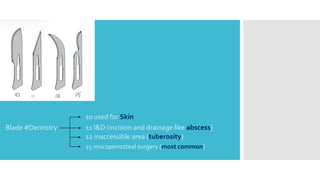
Blade #Dentistry
10 used for Skin
11 I&D (incision and drainage like abscess)
12 inaccessible area (tuberosity)
15 mucoperiosteal surgery (most common)
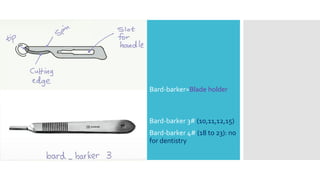
Bard-barker 3# (10,11,12,15)
Bard-barker 4# (18 to 23): no
for dentistry
Bard-barker=Blade holder
Principles:
* Asepsis & Antisepsis:
Asepsis: is the avoidance of pathogenic microorganisms. In practical
terms, ‘aseptic technique’ is one which aims to exclude all
microorganisms. Surgical technique is aseptic in the use of sterile
instruments, clothing, and the ‘no touch” technique.
Antisepsis: is an agent or the application of an agent which inhibits the
growth of microorganisms while in contact with them. Scrubbing up and
preparation of operative sites are examples of antisepsis.
Disinfection: is the inhibition or destruction of pathogens, whereas
sterilization is the destruction or removal of all forms of life. Disinfection
using glutaraldehyde or hypochlorite is second choice, for use where
true sterilization is not feasible.
Principles:
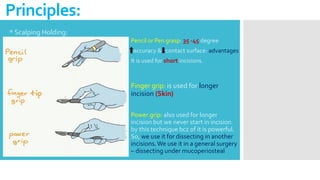
Finger grip: is used for longer
incision (Skin)
Pencil or Pen grasp: 35 -45 degree
accuracy & contact surface: advantages
It is used for short incisions.
* Scalping Holding:
Power grip: also used for longer
incision but we never start in incision
by this technique bcz of it is powerful.
So, we use it for dissecting in another
incisions.We use it in a general surgery
– dissecting under mucoperiosteal
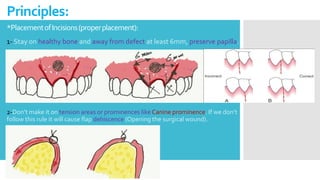
*PlacementofIncisions(properplacement):
1- Stay on healthy bone and away from defect at least 6mm, preserve papilla.
Principles:
2-Don’t make it on tension areas or prominences like Canine prominence. If we don’t
follow this rule it will cause flap dehiscence (Opening the surgical wound).
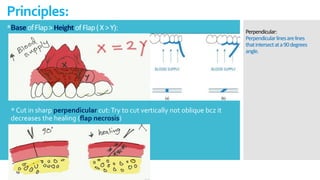
*BaseofFlap˃HeightofFlap(X˃Y):
Principles:
* Cut in sharp perpendicular cut:Try to cut vertically not oblique bcz it
decreases the healing (flap necrosis)
Perpendicular:
Perpendicularlinesarelines
thatintersectata90degrees
angle.
Principles:
*Aim is to avoid the Complications:
1: Flap Tearing
2: Flap Necrosis
3: Flap Opening
Flaps:
Perfect Surgeon must have the heart of the lion and
the hands of a lady, not the claws of a lion and the
heart of a sheep
Flaps:
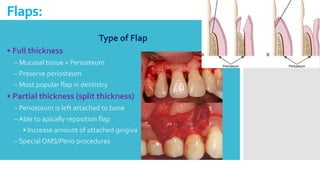
Type of Flap
• Full thickness
– Mucosal tissue + Periosteum
– Preserve periosteum
– Most popular flap in dentistry
• Partial thickness (split thickness)
– Periosteum is left attached to bone
– Able to apically reposition flap
• Increase amount of attached gingiva
– Special OMS/Perio procedures
TypesofMucoperiostealFlaps:
Flaps:
1: Gingival or Envelop Flap
2:Two sided orTriangular Flap (Intrasulcular Flap)
3:Three sided orTrapezoidal Flap (Rectangular Flap)
4: Semilunar Flaps
5: Submarginal Flaps
6: Pedicles Flaps
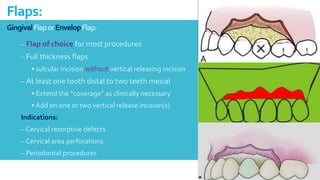
GingivalFlaporEnvelopFlap:
Flaps:
– Flap of choice for most procedures
– Full thickness flaps
• sulcular incision without vertical releasing incision
– At least one tooth distal to two teeth mesial
• Extend the “coverage” as clinically necessary
• Add on one or two vertical release incision(s)
Indications:
– Cervical resorptive defects
– Cervical area perforations
– Periodontal procedures
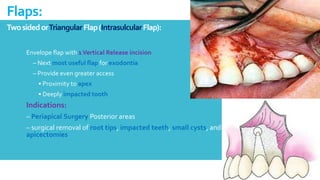
TwosidedorTriangularFlap(IntrasulcularFlap):
Flaps:
Envelope flap with 1Vertical Release incision
– Next most useful flap for exodontia
– Provide even greater access
• Proximity to apex
• Deeply impacted tooth
Indications:
– Periapical Surgery Posterior areas
– surgical removal of root tips, impacted teeth, small cysts, and
apicectomies
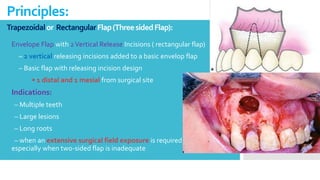
Trapezoidalor RectangularFlap(ThreesidedFlap):
Principles:
Envelope Flap with 2Vertical Release Incisions ( rectangular flap)
– 2 vertical releasing incisions added to a basic envelop flap
– Basic flap with releasing incision design
• 1 distal and 1 mesial from surgical site
Indications:
– Multiple teeth
– Large lesions
– Long roots
– when an extensive surgical field exposure is required
especially when two-sided flap is inadequate
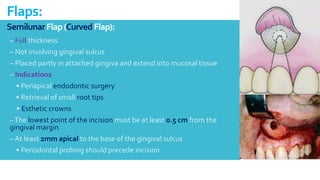
SemilunarFlap(CurvedFlap):
Flaps:
– Full thickness
– Not involving gingival sulcus
– Placed partly in attached gingiva and extend into mucosal tissue
– Indications
• Periapical endodontic surgery
• Retrieval of small root tips
• Esthetic crowns
– The lowest point of the incision must be at least 0.5 cm from the
gingival margin
– At least 2mm apical to the base of the gingival sulcus
• Periodontal probing should precede incision
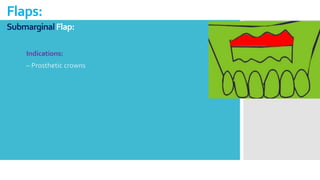
SubmarginalFlap:
Flaps:
Indications:
– Prosthetic crowns
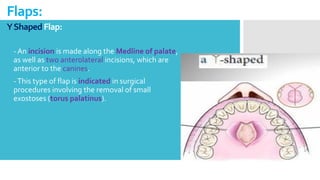
YShapedFlap:
Flaps:
- An incision is made along the Medline of palate,
as well as two anterolateral incisions, which are
anterior to the canines.
-This type of flap is indicated in surgical
procedures involving the removal of small
exostoses (torus palatinus).
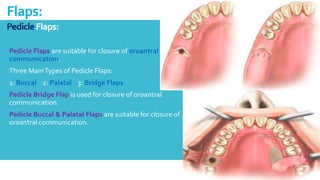
PedicleFlaps:
Flaps:
Pedicle Flaps are suitable for closure of oroantral
communication.
Three MainTypes of Pedicle Flaps:
1: Buccal 2: Palatal 3: Bridge Flaps
Pedicle Bridge Flap is used for closure of oroantral
communication.
Pedicle Buccal & Palatal Flaps are suitable for closure of
oroantral communication.
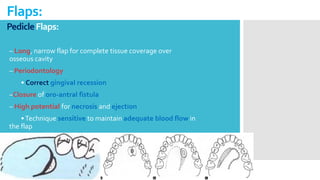
PedicleFlaps:
Flaps:
– Long, narrow flap for complete tissue coverage over
osseous cavity
– Periodontology
• Correct gingival recession
–Closure of oro-antral fistula
– High potential for necrosis and ejection
•Technique sensitive to maintain adequate blood flow in
the flap
Thanks/‫مننه‬
‫باشد‬ ‫مطرح‬ ‫سوال‬
!
Ehsan_wardak

Oral Surgery Flaps Desgning

  • 1.
    MedentaOral & DentalCare FlapsDesigns Hedayatullah Ehsan (DMD) hedayatullahehsan@gmail.com +93 775816022
  • 2.
    What is flap? Tissuelifted from it’s position in body (donor site) Moved to another site (recipient) + it’s blood supply (Pedicle Flap) Reflected to expose bone for surgery The purpose of flaps: *Defect reconstruction *Surgical exposure (access)
  • 3.
    Blade #Dentistry 10 usedfor Skin 11 I&D (incision and drainage like abscess) 12 inaccessible area (tuberosity) 15 mucoperiosteal surgery (most common)
  • 4.
    Bard-barker 3# (10,11,12,15) Bard-barker4# (18 to 23): no for dentistry Bard-barker=Blade holder
  • 5.
    Principles: * Asepsis &Antisepsis: Asepsis: is the avoidance of pathogenic microorganisms. In practical terms, ‘aseptic technique’ is one which aims to exclude all microorganisms. Surgical technique is aseptic in the use of sterile instruments, clothing, and the ‘no touch” technique. Antisepsis: is an agent or the application of an agent which inhibits the growth of microorganisms while in contact with them. Scrubbing up and preparation of operative sites are examples of antisepsis. Disinfection: is the inhibition or destruction of pathogens, whereas sterilization is the destruction or removal of all forms of life. Disinfection using glutaraldehyde or hypochlorite is second choice, for use where true sterilization is not feasible.
  • 6.
    Principles: Finger grip: isused for longer incision (Skin) Pencil or Pen grasp: 35 -45 degree accuracy & contact surface: advantages It is used for short incisions. * Scalping Holding: Power grip: also used for longer incision but we never start in incision by this technique bcz of it is powerful. So, we use it for dissecting in another incisions.We use it in a general surgery – dissecting under mucoperiosteal
  • 7.
    *PlacementofIncisions(properplacement): 1- Stay onhealthy bone and away from defect at least 6mm, preserve papilla. Principles: 2-Don’t make it on tension areas or prominences like Canine prominence. If we don’t follow this rule it will cause flap dehiscence (Opening the surgical wound).
  • 8.
    *BaseofFlap˃HeightofFlap(X˃Y): Principles: * Cut insharp perpendicular cut:Try to cut vertically not oblique bcz it decreases the healing (flap necrosis) Perpendicular: Perpendicularlinesarelines thatintersectata90degrees angle.
  • 9.
    Principles: *Aim is toavoid the Complications: 1: Flap Tearing 2: Flap Necrosis 3: Flap Opening
  • 10.
    Flaps: Perfect Surgeon musthave the heart of the lion and the hands of a lady, not the claws of a lion and the heart of a sheep
  • 11.
    Flaps: Type of Flap •Full thickness – Mucosal tissue + Periosteum – Preserve periosteum – Most popular flap in dentistry • Partial thickness (split thickness) – Periosteum is left attached to bone – Able to apically reposition flap • Increase amount of attached gingiva – Special OMS/Perio procedures
  • 12.
    TypesofMucoperiostealFlaps: Flaps: 1: Gingival orEnvelop Flap 2:Two sided orTriangular Flap (Intrasulcular Flap) 3:Three sided orTrapezoidal Flap (Rectangular Flap) 4: Semilunar Flaps 5: Submarginal Flaps 6: Pedicles Flaps
  • 13.
    GingivalFlaporEnvelopFlap: Flaps: – Flap ofchoice for most procedures – Full thickness flaps • sulcular incision without vertical releasing incision – At least one tooth distal to two teeth mesial • Extend the “coverage” as clinically necessary • Add on one or two vertical release incision(s) Indications: – Cervical resorptive defects – Cervical area perforations – Periodontal procedures
  • 14.
    TwosidedorTriangularFlap(IntrasulcularFlap): Flaps: Envelope flap with1Vertical Release incision – Next most useful flap for exodontia – Provide even greater access • Proximity to apex • Deeply impacted tooth Indications: – Periapical Surgery Posterior areas – surgical removal of root tips, impacted teeth, small cysts, and apicectomies
  • 15.
    Trapezoidalor RectangularFlap(ThreesidedFlap): Principles: Envelope Flapwith 2Vertical Release Incisions ( rectangular flap) – 2 vertical releasing incisions added to a basic envelop flap – Basic flap with releasing incision design • 1 distal and 1 mesial from surgical site Indications: – Multiple teeth – Large lesions – Long roots – when an extensive surgical field exposure is required especially when two-sided flap is inadequate
  • 16.
    SemilunarFlap(CurvedFlap): Flaps: – Full thickness –Not involving gingival sulcus – Placed partly in attached gingiva and extend into mucosal tissue – Indications • Periapical endodontic surgery • Retrieval of small root tips • Esthetic crowns – The lowest point of the incision must be at least 0.5 cm from the gingival margin – At least 2mm apical to the base of the gingival sulcus • Periodontal probing should precede incision
  • 17.
  • 18.
    YShapedFlap: Flaps: - An incisionis made along the Medline of palate, as well as two anterolateral incisions, which are anterior to the canines. -This type of flap is indicated in surgical procedures involving the removal of small exostoses (torus palatinus).
  • 19.
    PedicleFlaps: Flaps: Pedicle Flaps aresuitable for closure of oroantral communication. Three MainTypes of Pedicle Flaps: 1: Buccal 2: Palatal 3: Bridge Flaps Pedicle Bridge Flap is used for closure of oroantral communication. Pedicle Buccal & Palatal Flaps are suitable for closure of oroantral communication.
  • 20.
    PedicleFlaps: Flaps: – Long, narrowflap for complete tissue coverage over osseous cavity – Periodontology • Correct gingival recession –Closure of oro-antral fistula – High potential for necrosis and ejection •Technique sensitive to maintain adequate blood flow in the flap
  • 21.