STM 604 – Differential Equation
Introduction to
Differential Equations
1
STM 604
Differential Equation
ELLVAN M. CAMPOS, MST
Faculty, Institute of Advanced Studies
Introduction to
Differential Equations
Lesson 1: Definition and
Terminologies
2
STM 604
Differential Equation
Introduction to
Differential Equations
Definition
3
STM 604
Differential Equation
Definition
Classification
Solution of an ODE
Examples
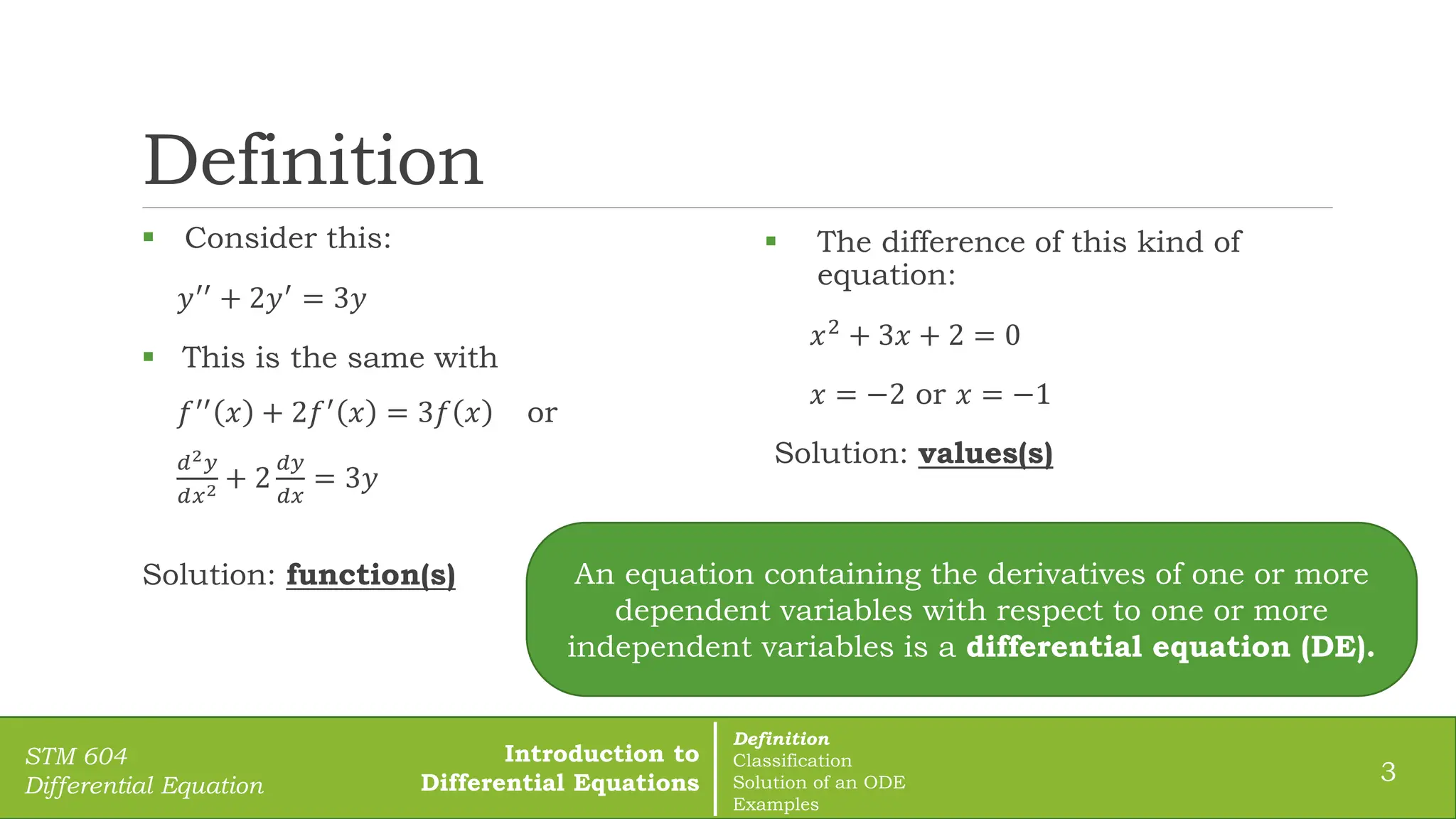
 Consider this:
𝑦′′ + 2𝑦′ = 3𝑦
 This is the same with
𝑓′′ 𝑥 + 2𝑓′ 𝑥 = 3𝑓 𝑥 or
𝑑2𝑦
𝑑𝑥2 + 2
𝑑𝑦
𝑑𝑥
= 3𝑦
Solution: function(s)
Introduction to
Differential Equations
 The difference of this kind of
equation:
𝑥2 + 3𝑥 + 2 = 0
𝑥 = −2 or 𝑥 = −1
Solution: values(s)
An equation containing the derivatives of one or more
dependent variables with respect to one or more
independent variables is a differential equation (DE).
Classification (by Type)
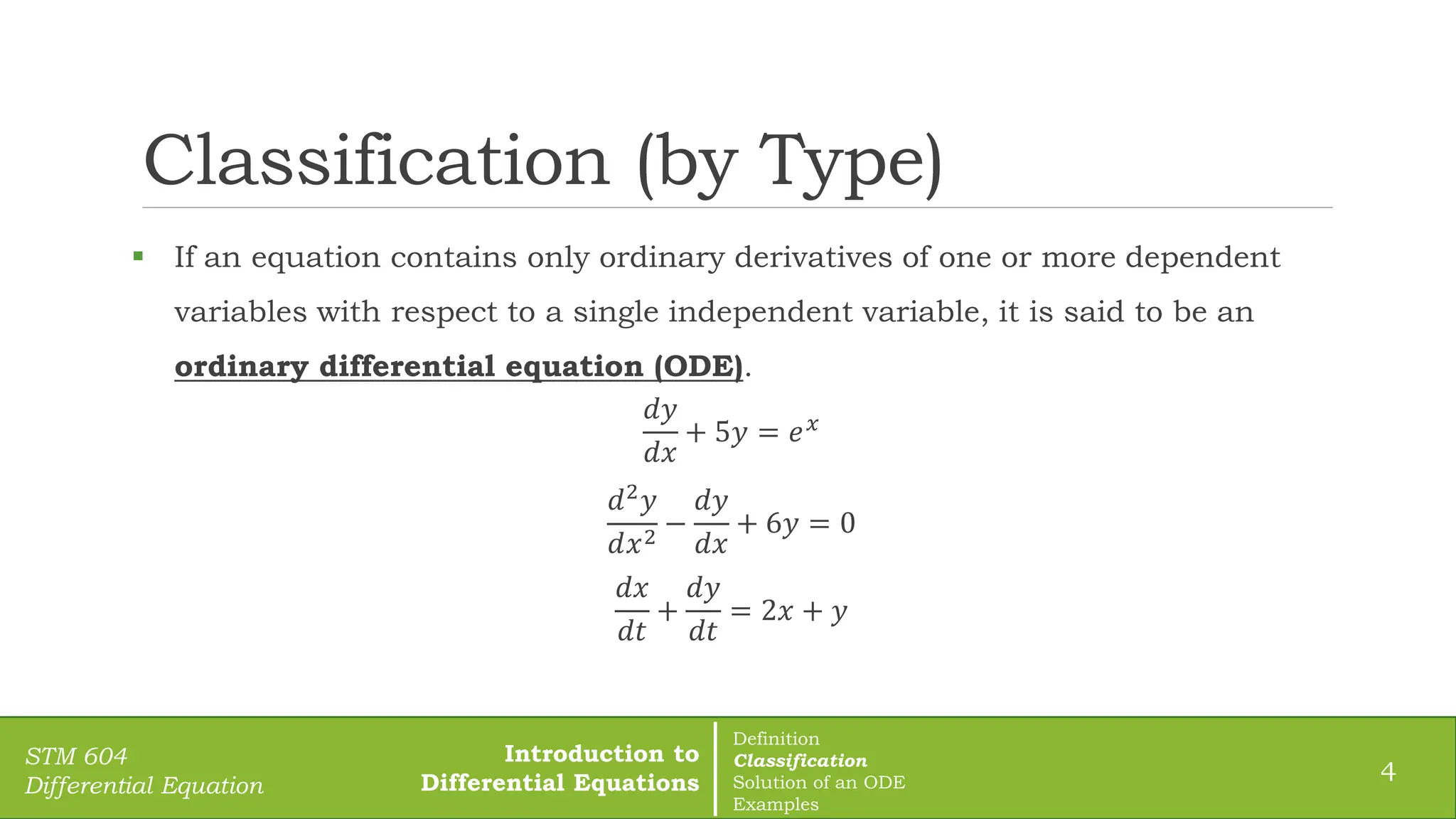
 If an equation contains only ordinary derivatives of one or more dependent
variables with respect to a single independent variable, it is said to be an
ordinary differential equation (ODE).
𝑑𝑦
𝑑𝑥
+ 5𝑦 = 𝑒𝑥
𝑑2𝑦
𝑑𝑥2
−
𝑑𝑦
𝑑𝑥
+ 6𝑦 = 0
𝑑𝑥
𝑑𝑡
+
𝑑𝑦
𝑑𝑡
= 2𝑥 + 𝑦
4
STM 604
Differential Equation
Introduction to
Differential Equations
Definition
Classification
Solution of an ODE
Examples
Classification (by Type)
5
STM 604
Differential Equation
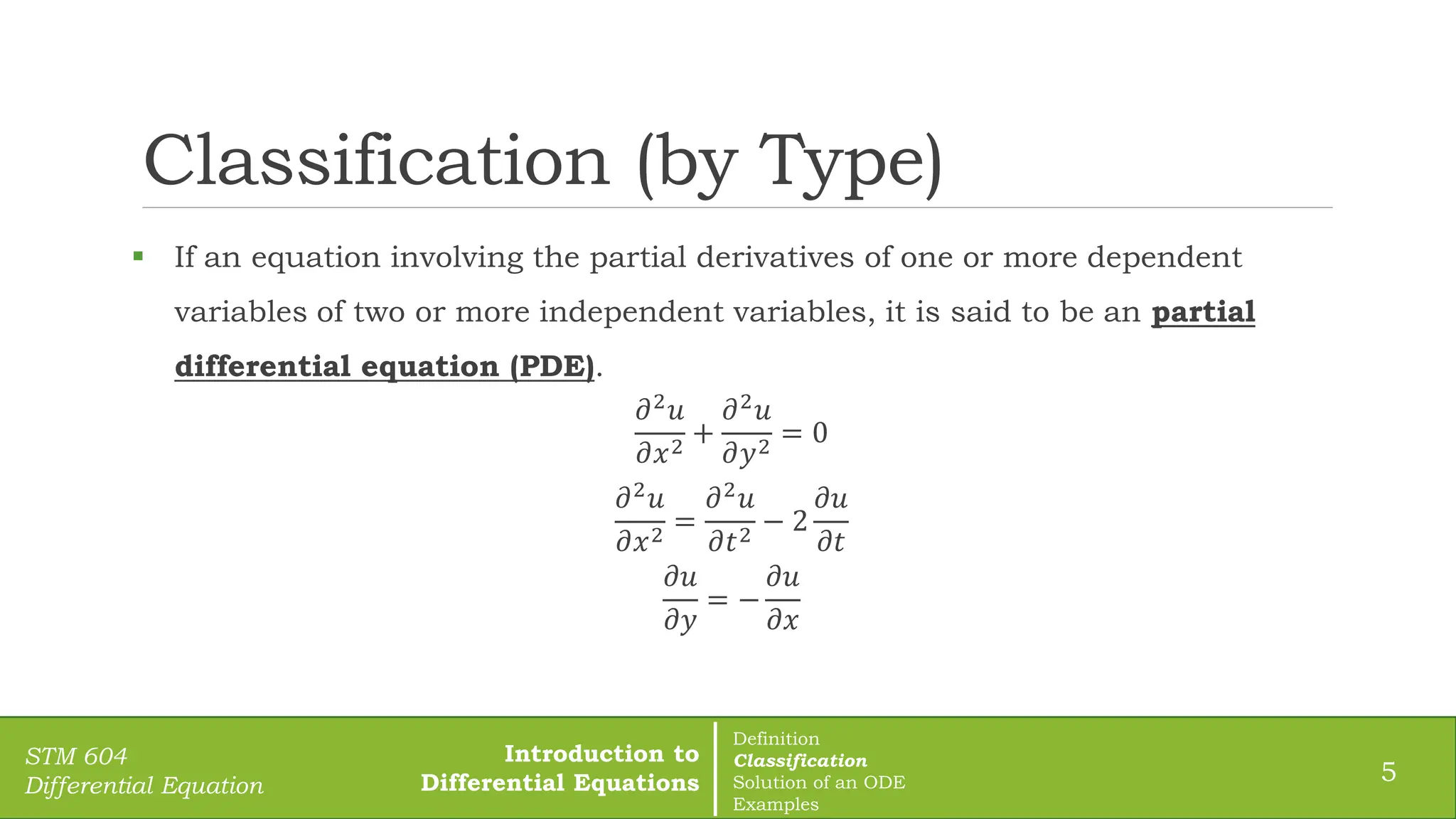
 If an equation involving the partial derivatives of one or more dependent
variables of two or more independent variables, it is said to be an partial
differential equation (PDE).
𝜕2𝑢
𝜕𝑥2
+
𝜕2𝑢
𝜕𝑦2
= 0
𝜕2𝑢
𝜕𝑥2
=
𝜕2𝑢
𝜕𝑡2
− 2
𝜕𝑢
𝜕𝑡
𝜕𝑢
𝜕𝑦
= −
𝜕𝑢
𝜕𝑥
Introduction to
Differential Equations
Definition
Classification
Solution of an ODE
Examples
Classification (by Order)
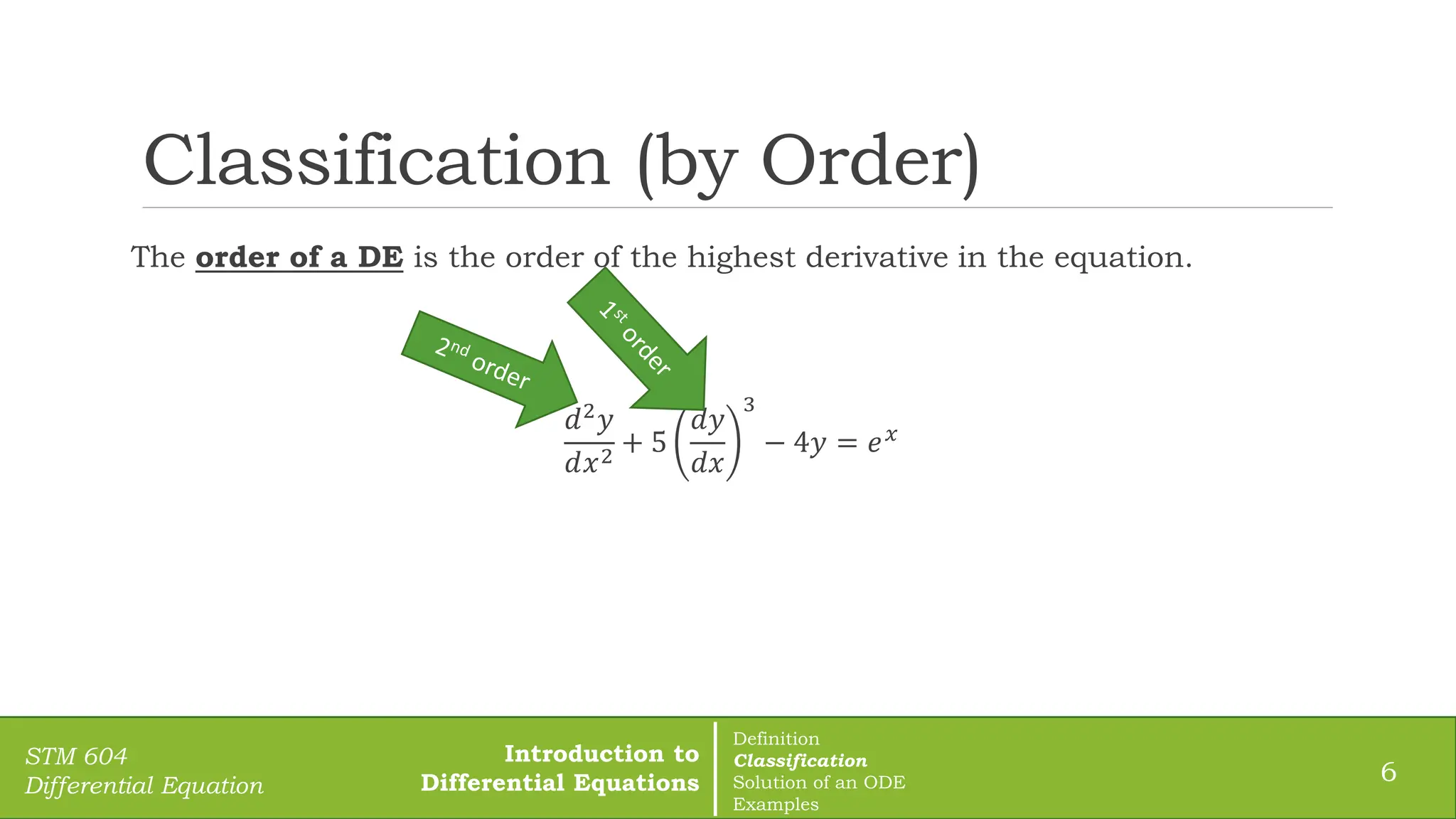
The order of a DE is the order of the highest derivative in the equation.
𝑑2𝑦
𝑑𝑥2
+ 5
𝑑𝑦
𝑑𝑥
3
− 4𝑦 = 𝑒𝑥
6
STM 604
Differential Equation
Introduction to
Differential Equations
Definition
Classification
Solution of an ODE
Examples
Classification (by Linearity)
7
STM 604
Differential Equation
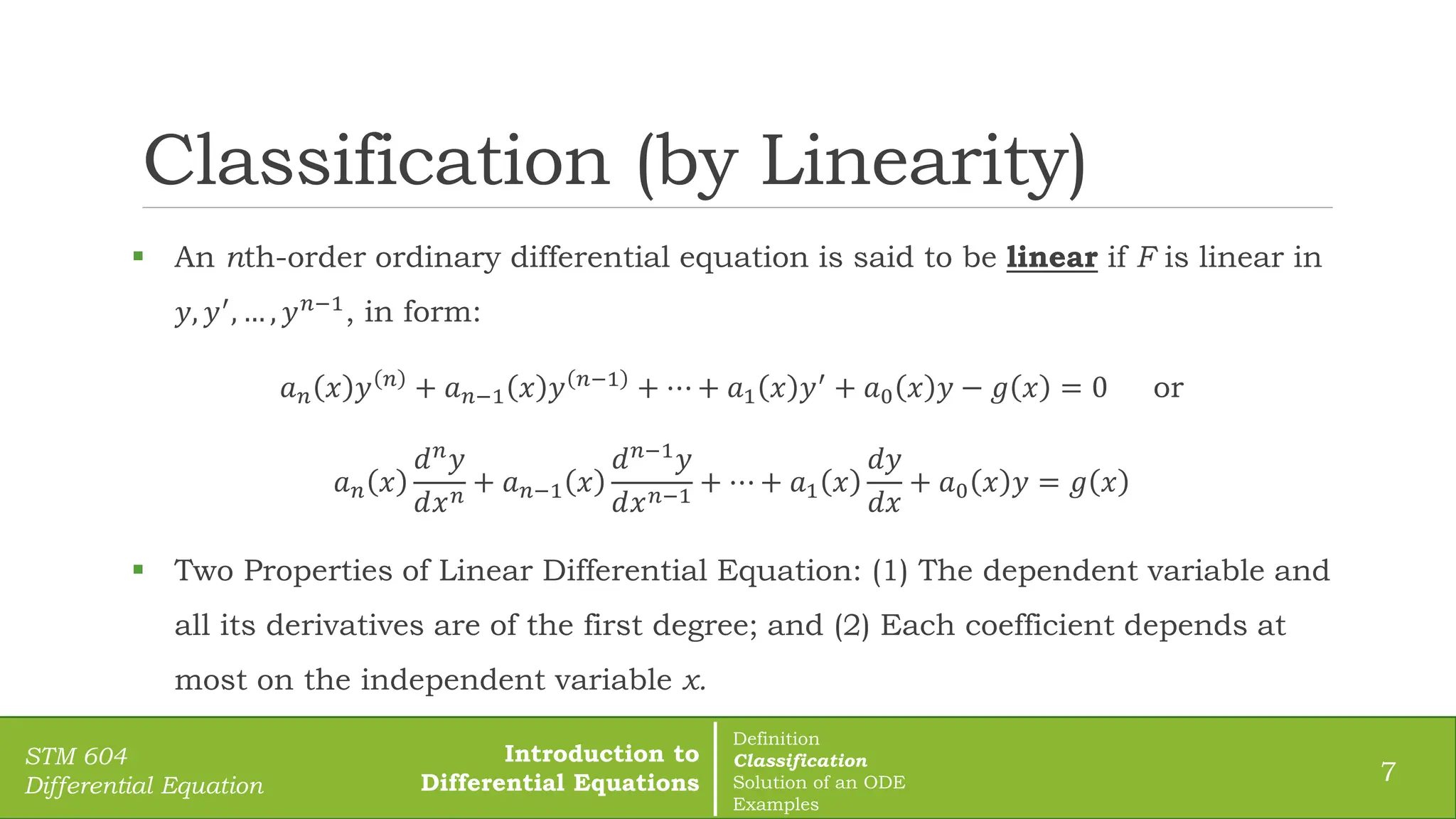
 An nth-order ordinary differential equation is said to be linear if F is linear in
𝑦, 𝑦′
, … , 𝑦𝑛−1
, in form:
𝑎𝑛 𝑥 𝑦 𝑛 + 𝑎𝑛−1 𝑥 𝑦 𝑛−1 + ⋯ + 𝑎1 𝑥 𝑦′ + 𝑎0 𝑥 𝑦 − 𝑔 𝑥 = 0 or
𝑎𝑛 𝑥
𝑑𝑛𝑦
𝑑𝑥𝑛
+ 𝑎𝑛−1 𝑥
𝑑𝑛−1𝑦
𝑑𝑥𝑛−1
+ ⋯ + 𝑎1 𝑥
𝑑𝑦
𝑑𝑥
+ 𝑎0 𝑥 𝑦 = 𝑔 𝑥
 Two Properties of Linear Differential Equation: (1) The dependent variable and
all its derivatives are of the first degree; and (2) Each coefficient depends at
most on the independent variable x.
Introduction to
Differential Equations
Definition
Classification
Solution of an ODE
Examples
Classification (by Linearity)
8
STM 604
Differential Equation
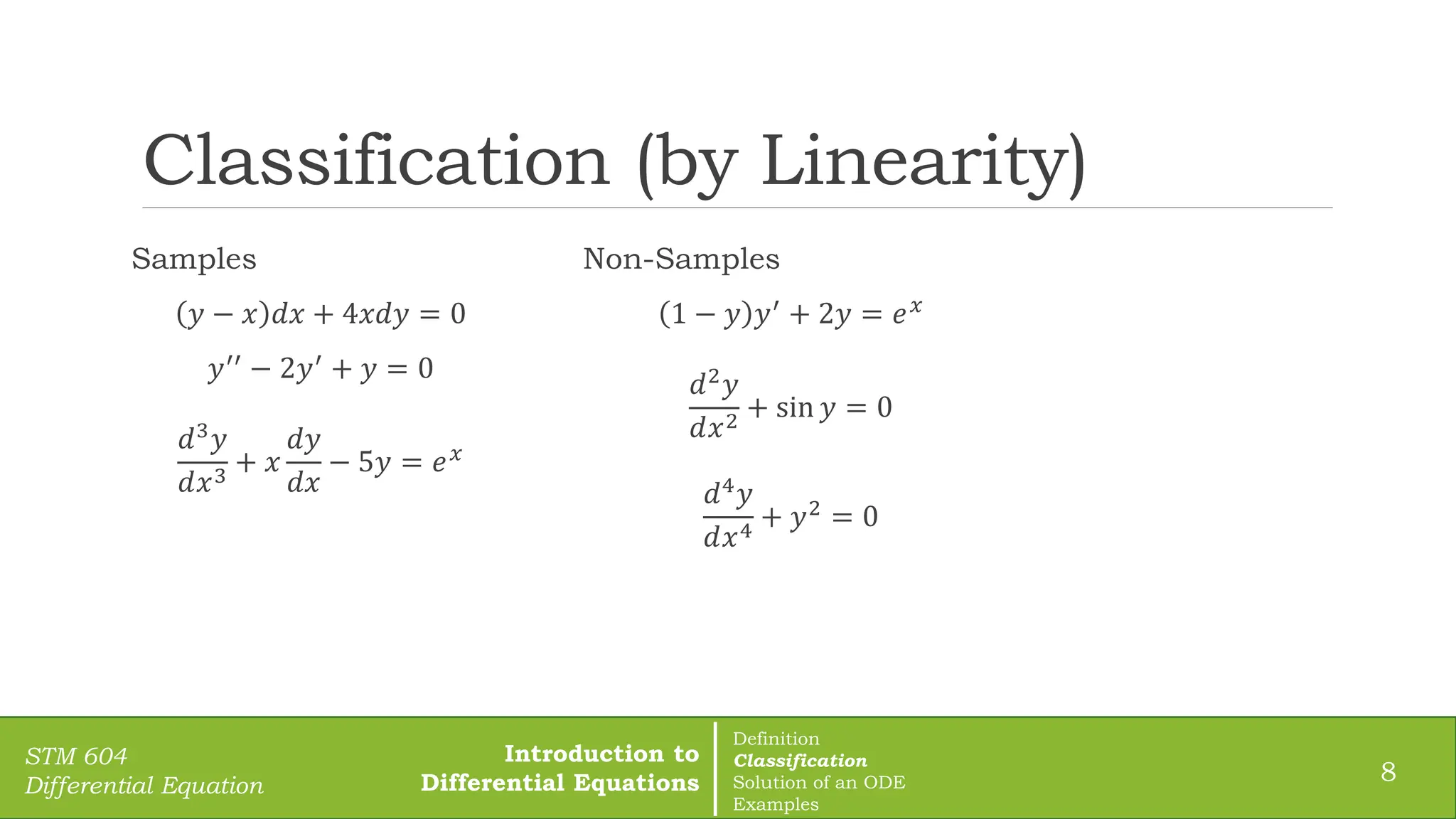
Samples
𝑦 − 𝑥 𝑑𝑥 + 4𝑥𝑑𝑦 = 0
𝑦′′ − 2𝑦′ + 𝑦 = 0
𝑑3𝑦
𝑑𝑥3
+ 𝑥
𝑑𝑦
𝑑𝑥
− 5𝑦 = 𝑒𝑥
Non-Samples
1 − 𝑦 𝑦′ + 2𝑦 = 𝑒𝑥
𝑑2
𝑦
𝑑𝑥2
+ sin 𝑦 = 0
𝑑4𝑦
𝑑𝑥4
+ 𝑦2 = 0
Introduction to
Differential Equations
Definition
Classification
Solution of an ODE
Examples
Solution of an ODE
9
STM 604
Differential Equation
 Any function 𝜙, defined on an interval I and possessing at least n derivatives
that are continuous on I, which when substituted into an nth-order ordinary
differential equation reduces the equation to an identity, is said to be a
solution of the equation on the interval.
 From this definition, the interval I is variously called as interval of definition of
the solution and can be an open interval (𝑎, 𝑏), a closed interval [𝑎, 𝑏], an infinite
interval (𝑎, ∞), and so on.
Introduction to
Differential Equations
Definition
Classification
Solution of an ODE
Examples
Example: Verification of Solution
10
STM 604
Differential Equation
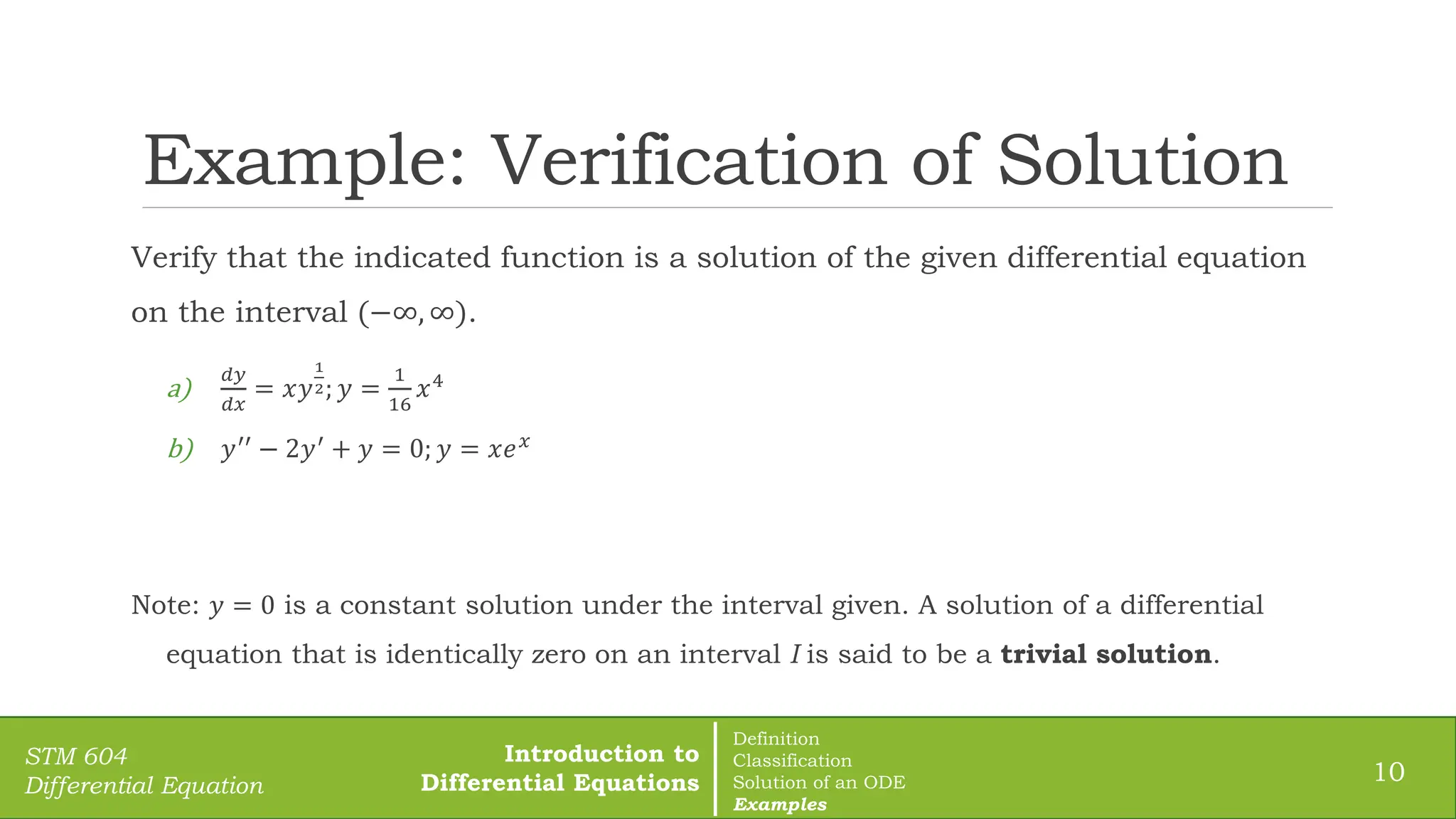
Verify that the indicated function is a solution of the given differential equation
on the interval (−∞, ∞).
a)
𝑑𝑦
𝑑𝑥
= 𝑥𝑦
1
2; 𝑦 =
1
16
𝑥4
b) 𝑦′′
− 2𝑦′
+ 𝑦 = 0; 𝑦 = 𝑥𝑒𝑥
Note: 𝑦 = 0 is a constant solution under the interval given. A solution of a differential
equation that is identically zero on an interval I is said to be a trivial solution.
Introduction to
Differential Equations
Definition
Classification
Solution of an ODE
Examples
Example: Verification of Solution
11
STM 604
Differential Equation
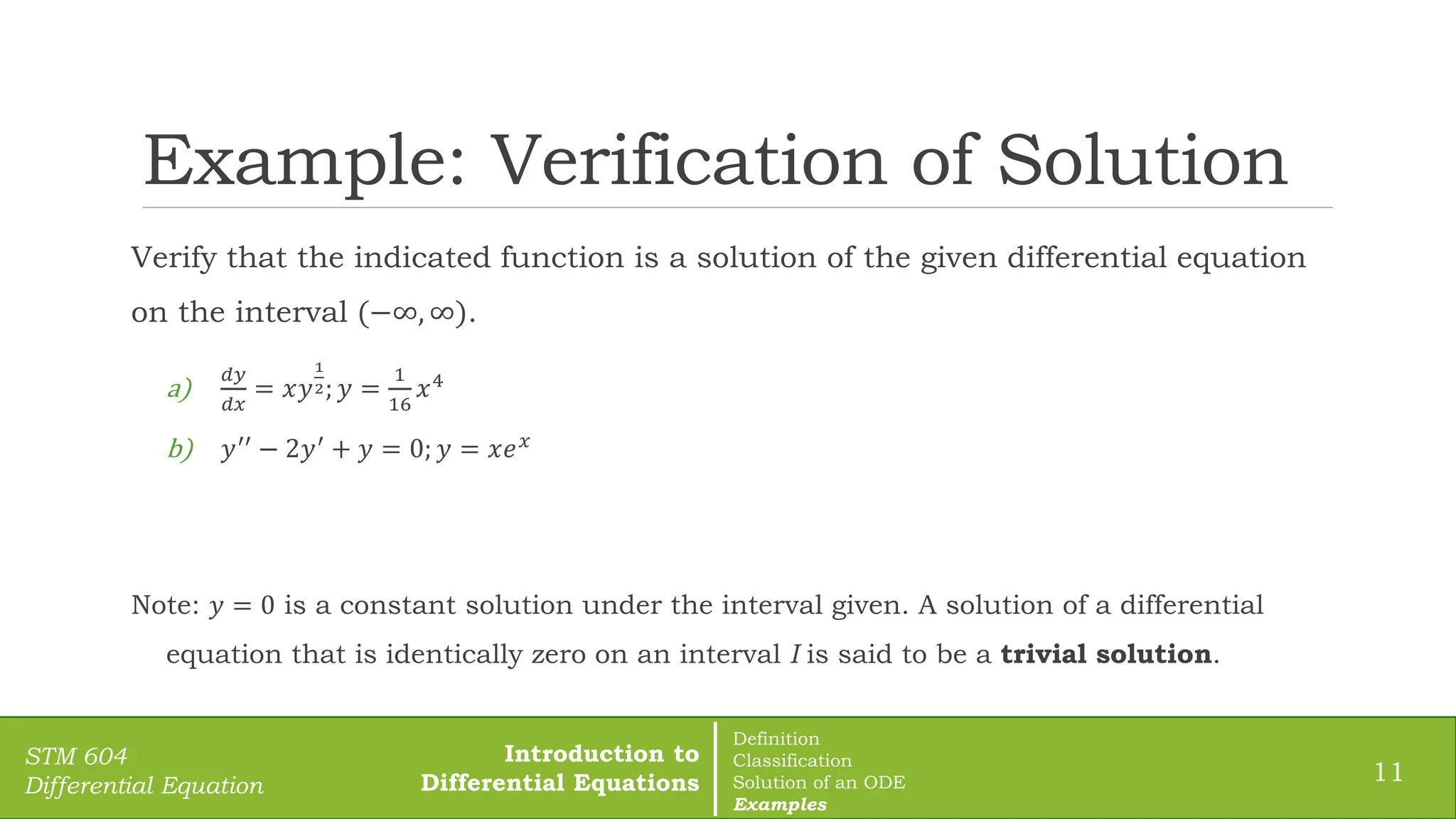
Verify that the indicated function is a solution of the given differential equation
on the interval (−∞, ∞).
a)
𝑑𝑦
𝑑𝑥
= 𝑥𝑦
1
2; 𝑦 =
1
16
𝑥4
b) 𝑦′′
− 2𝑦′
+ 𝑦 = 0; 𝑦 = 𝑥𝑒𝑥
Note: 𝑦 = 0 is a constant solution under the interval given. A solution of a differential
equation that is identically zero on an interval I is said to be a trivial solution.
Introduction to
Differential Equations
Definition
Classification
Solution of an ODE
Examples
Lesson 2: Separable
Variables
12
STM 604
Differential Equation
First-Order Differential
Equations
Definition
13
STM 604
Differential Equation
Definition
Samples
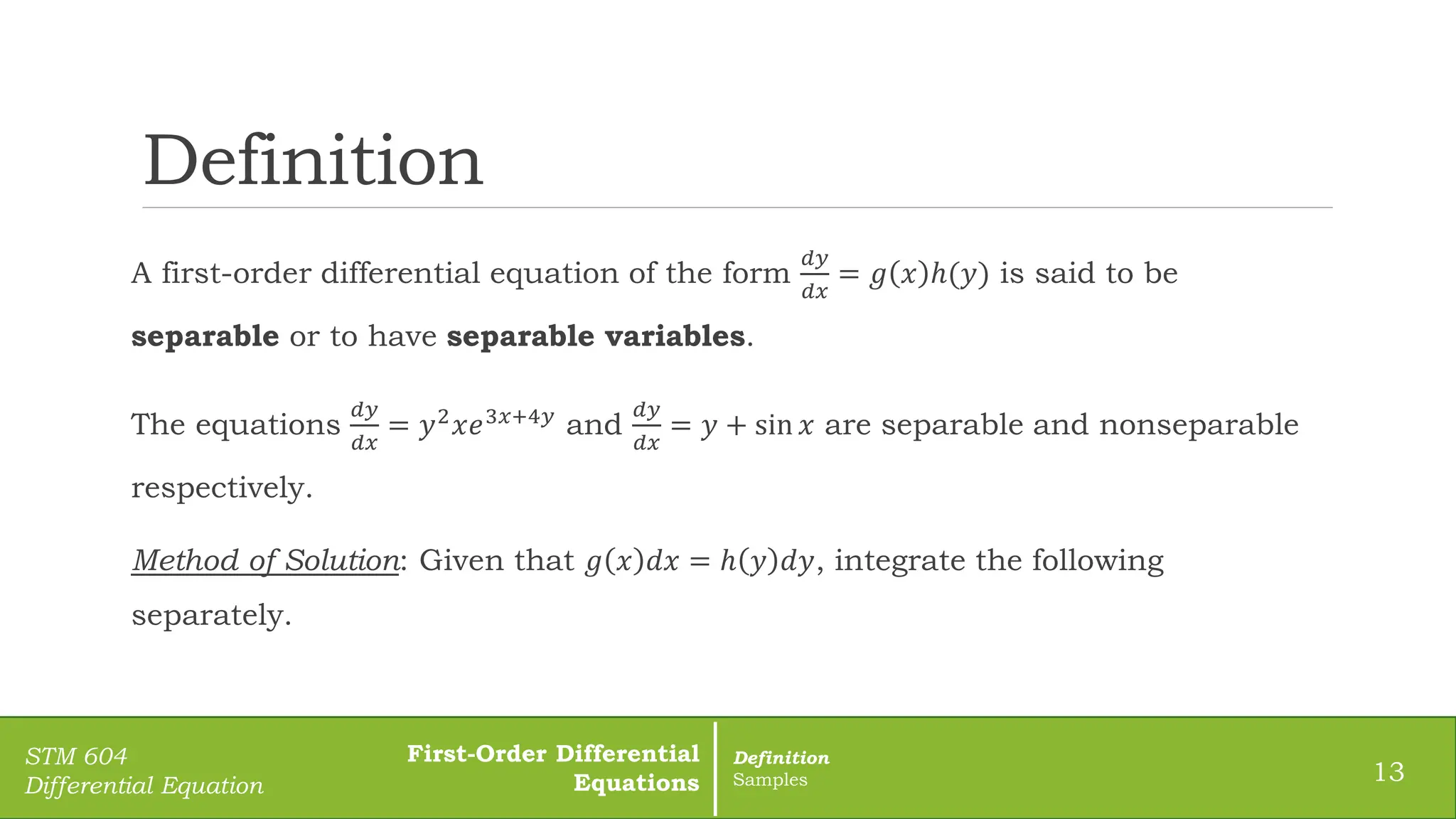
A first-order differential equation of the form
𝑑𝑦
𝑑𝑥
= 𝑔 𝑥 ℎ(𝑦) is said to be
separable or to have separable variables.
The equations
𝑑𝑦
𝑑𝑥
= 𝑦2𝑥𝑒3𝑥+4𝑦 and
𝑑𝑦
𝑑𝑥
= 𝑦 + sin 𝑥 are separable and nonseparable
respectively.
Method of Solution: Given that 𝑔 𝑥 𝑑𝑥 = ℎ 𝑦 𝑑𝑦, integrate the following
separately.
First-Order Differential
Equations
Samples
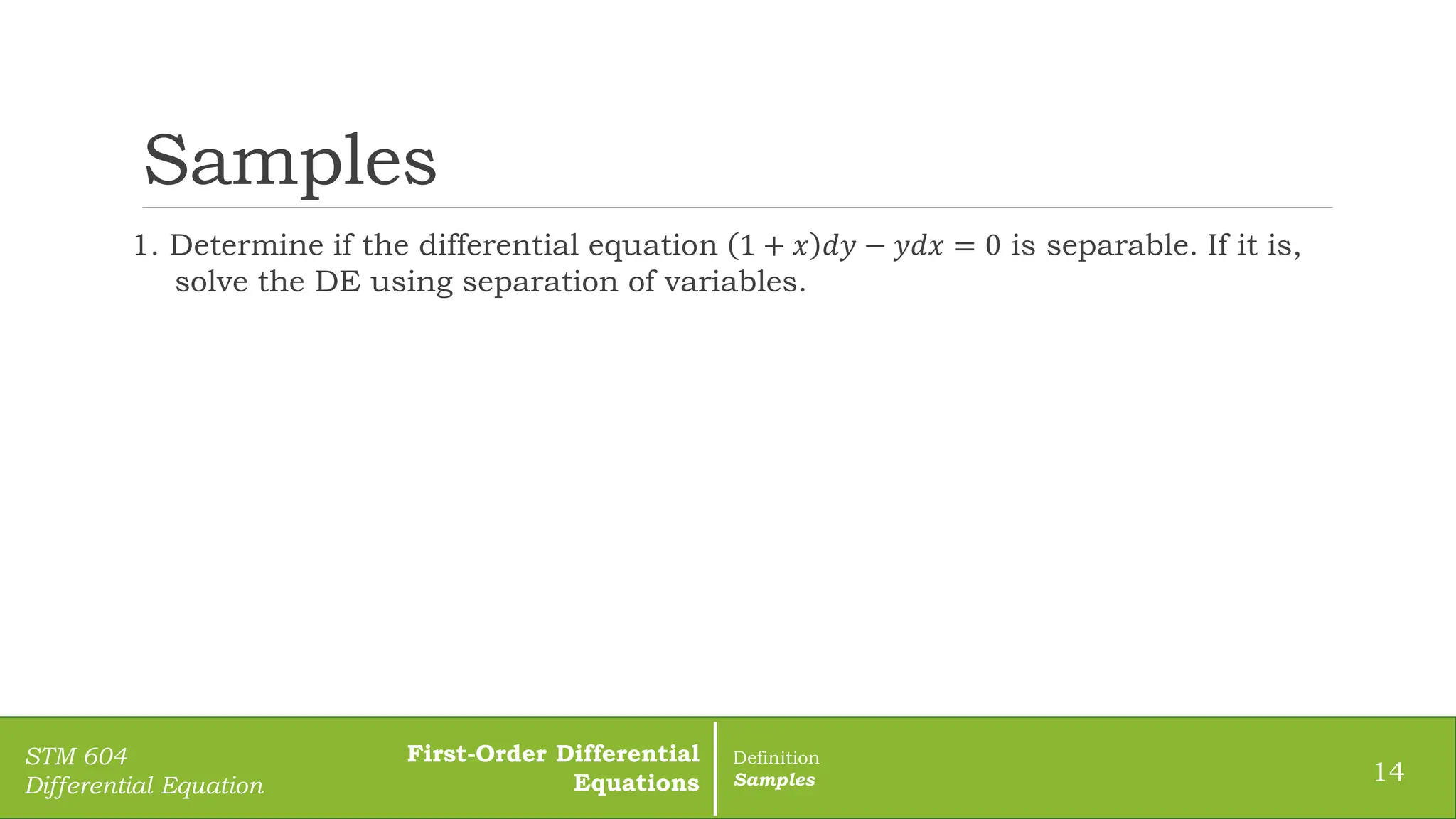
1. Determine if the differential equation 1 + 𝑥 𝑑𝑦 − 𝑦𝑑𝑥 = 0 is separable. If it is,
solve the DE using separation of variables.
14
STM 604
Differential Equation
First-Order Differential
Equations
Definition
Samples
Samples
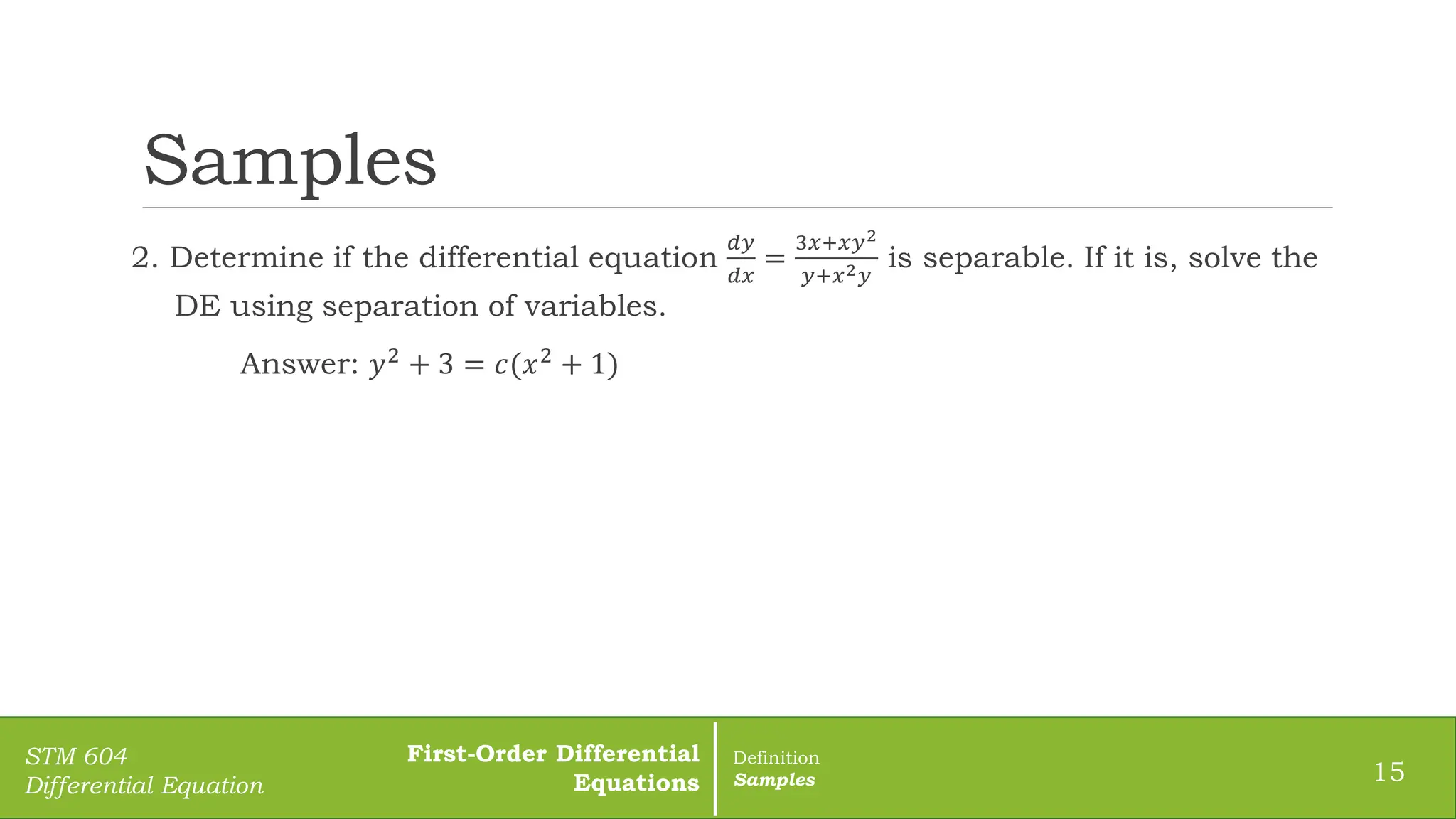
2. Determine if the differential equation
𝑑𝑦
𝑑𝑥
=
3𝑥+𝑥𝑦2
𝑦+𝑥2𝑦
is separable. If it is, solve the
DE using separation of variables.
Answer: 𝑦2 + 3 = 𝑐(𝑥2 + 1)
15
STM 604
Differential Equation
First-Order Differential
Equations
Definition
Samples
Samples
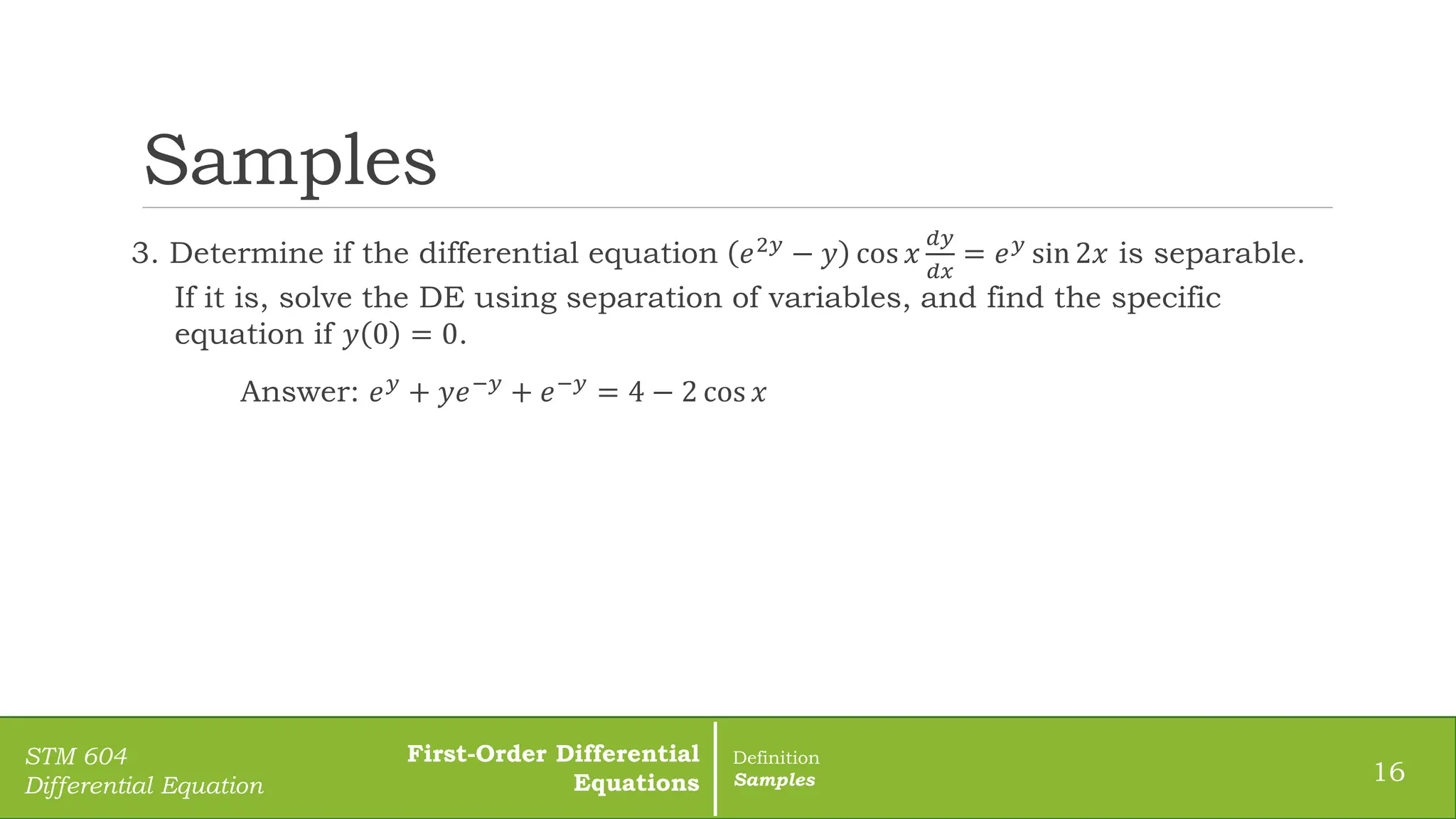
3. Determine if the differential equation 𝑒2𝑦 − 𝑦 cos 𝑥
𝑑𝑦
𝑑𝑥
= 𝑒𝑦 sin 2𝑥 is separable.
If it is, solve the DE using separation of variables, and find the specific
equation if 𝑦 0 = 0.
Answer: 𝑒𝑦
+ 𝑦𝑒−𝑦
+ 𝑒−𝑦
= 4 − 2 cos 𝑥
16
STM 604
Differential Equation
First-Order Differential
Equations
Definition
Samples
Samples
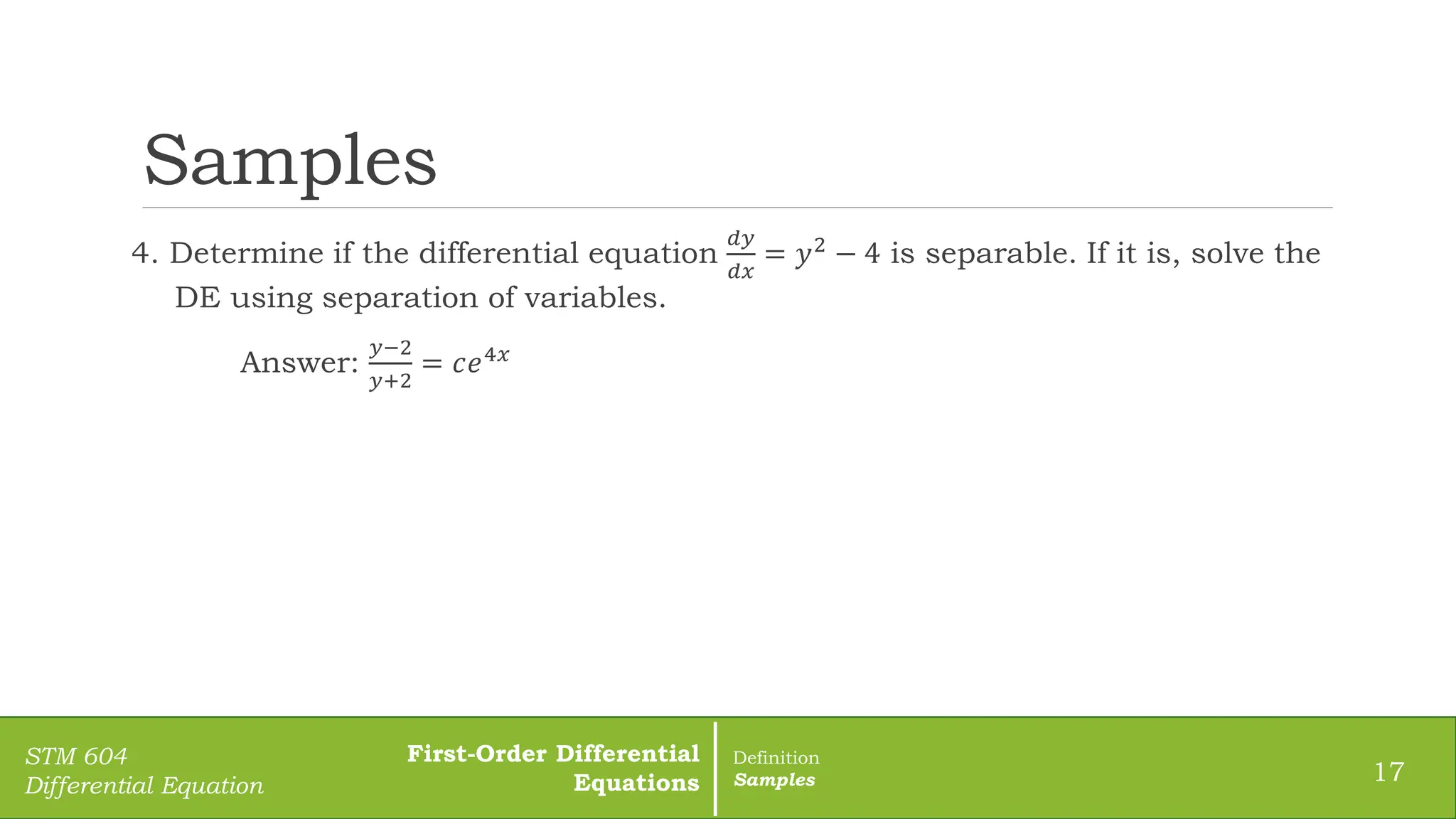
4. Determine if the differential equation
𝑑𝑦
𝑑𝑥
= 𝑦2 − 4 is separable. If it is, solve the
DE using separation of variables.
Answer:
𝑦−2
𝑦+2
= 𝑐𝑒4𝑥
17
STM 604
Differential Equation
First-Order Differential
Equations
Definition
Samples
Lesson 3: Linear
Equations
18
STM 604
Differential Equation
First-Order Differential
Equations
Definition
19
STM 604
Differential Equation
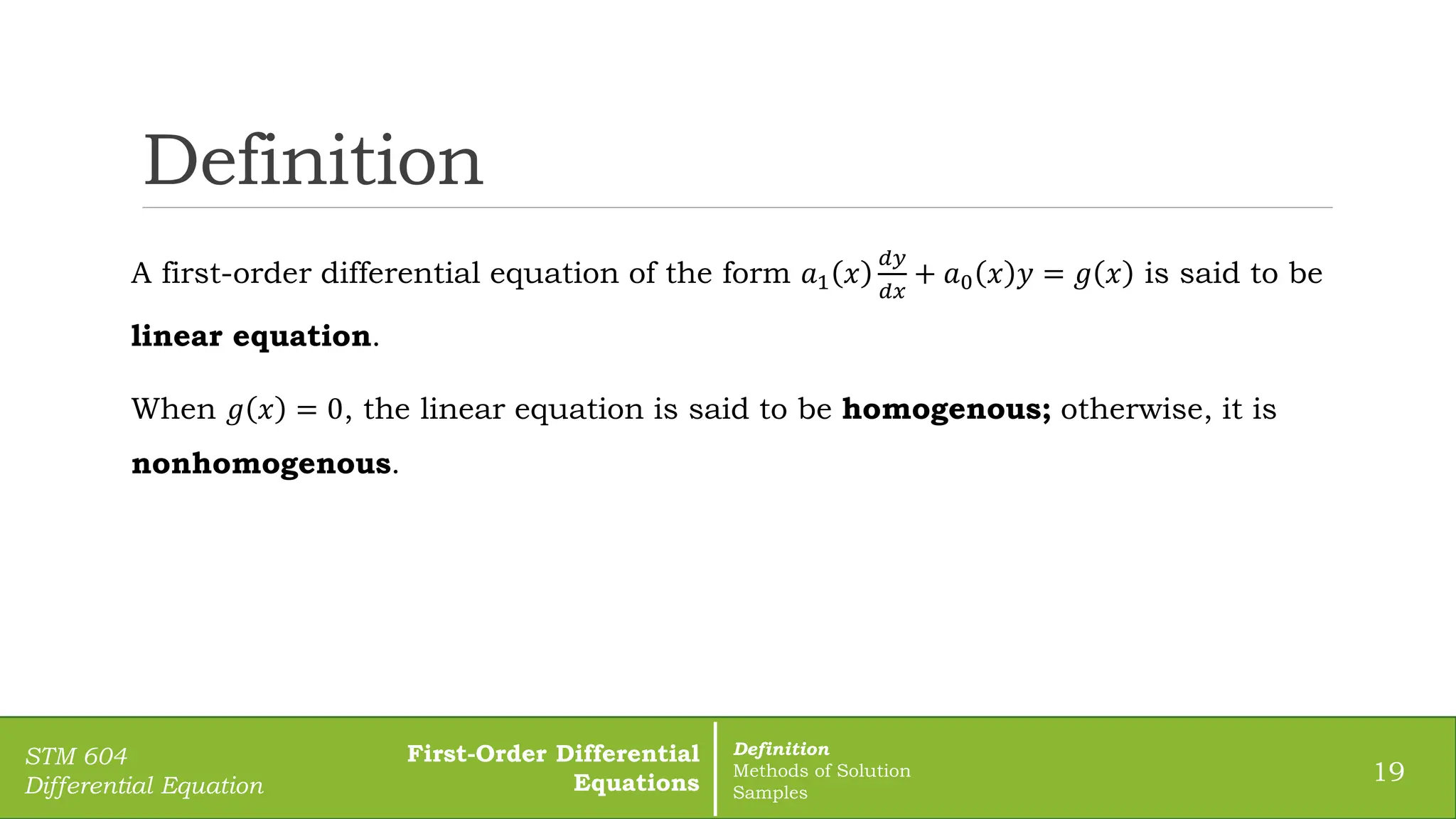
A first-order differential equation of the form 𝑎1 𝑥
𝑑𝑦
𝑑𝑥
+ 𝑎0 𝑥 𝑦 = 𝑔 𝑥 is said to be
linear equation.
When 𝑔 𝑥 = 0, the linear equation is said to be homogenous; otherwise, it is
nonhomogenous.
First-Order Differential
Equations
Definition
Methods of Solution
Samples
Solving a Linear First-Order
Equation
20
STM 604
Differential Equation
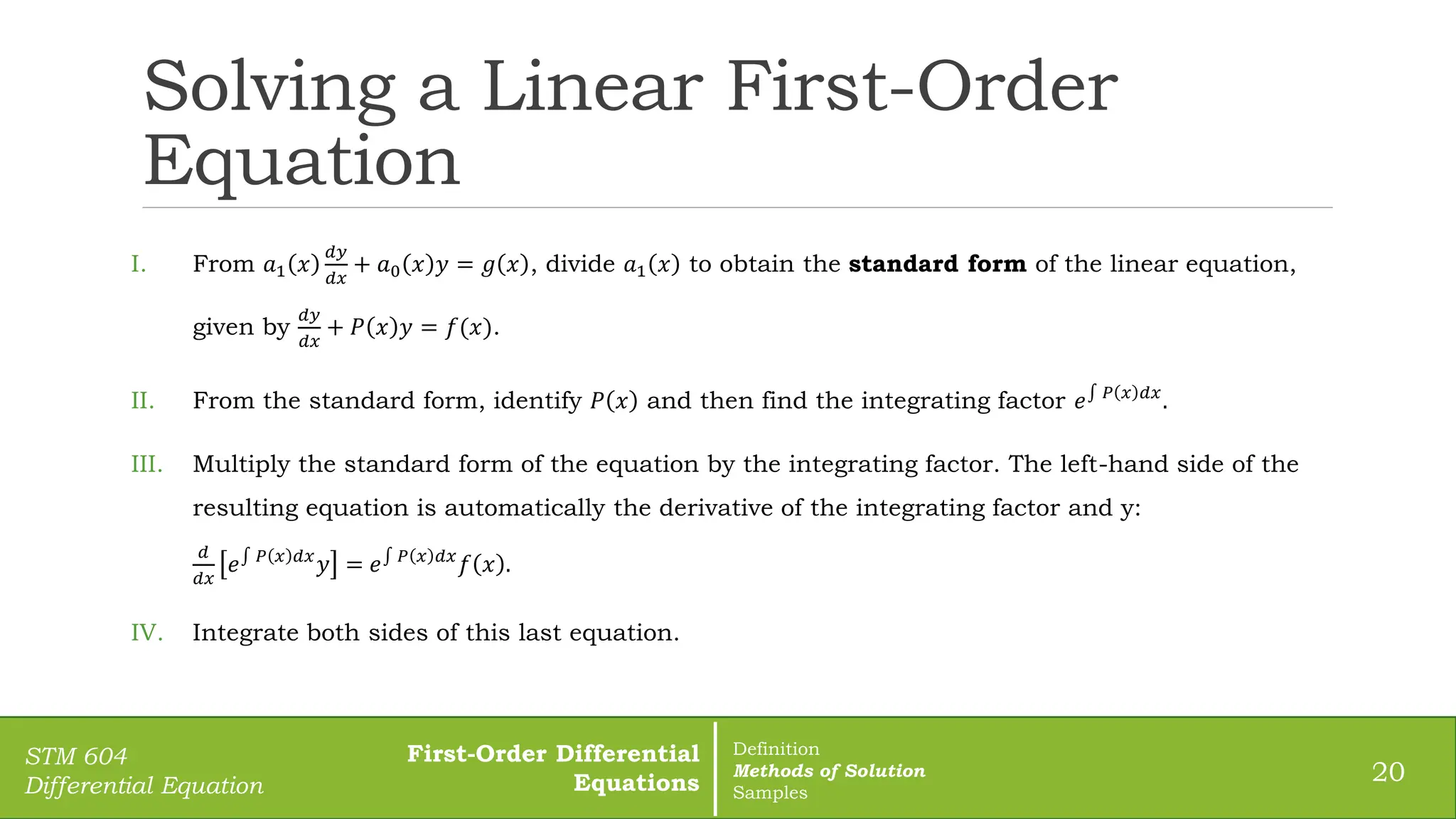
I. From 𝑎1 𝑥
𝑑𝑦
𝑑𝑥
+ 𝑎0 𝑥 𝑦 = 𝑔 𝑥 , divide 𝑎1 𝑥 to obtain the standard form of the linear equation,
given by
𝑑𝑦
𝑑𝑥
+ 𝑃 𝑥 𝑦 = 𝑓(𝑥).
II. From the standard form, identify 𝑃 𝑥 and then find the integrating factor 𝑒 𝑃 𝑥 𝑑𝑥
.
III. Multiply the standard form of the equation by the integrating factor. The left-hand side of the
resulting equation is automatically the derivative of the integrating factor and y:
𝑑
𝑑𝑥
𝑒 𝑃 𝑥 𝑑𝑥
𝑦 = 𝑒 𝑃 𝑥 𝑑𝑥
𝑓 𝑥 .
IV. Integrate both sides of this last equation.
First-Order Differential
Equations
Definition
Methods of Solution
Samples
Samples
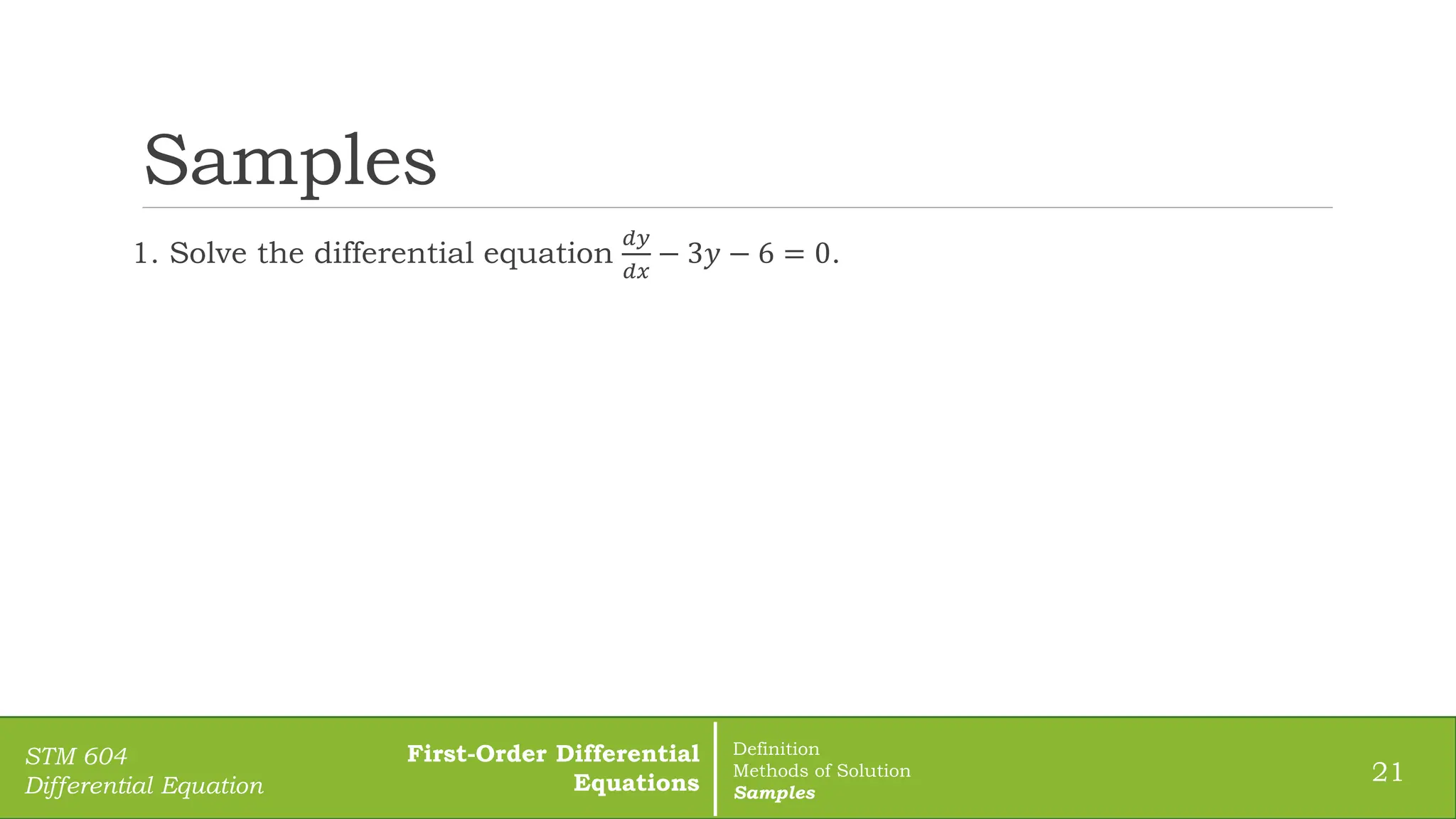
1. Solve the differential equation
𝑑𝑦
𝑑𝑥
− 3𝑦 − 6 = 0.
21
STM 604
Differential Equation
First-Order Differential
Equations
Definition
Methods of Solution
Samples
Samples
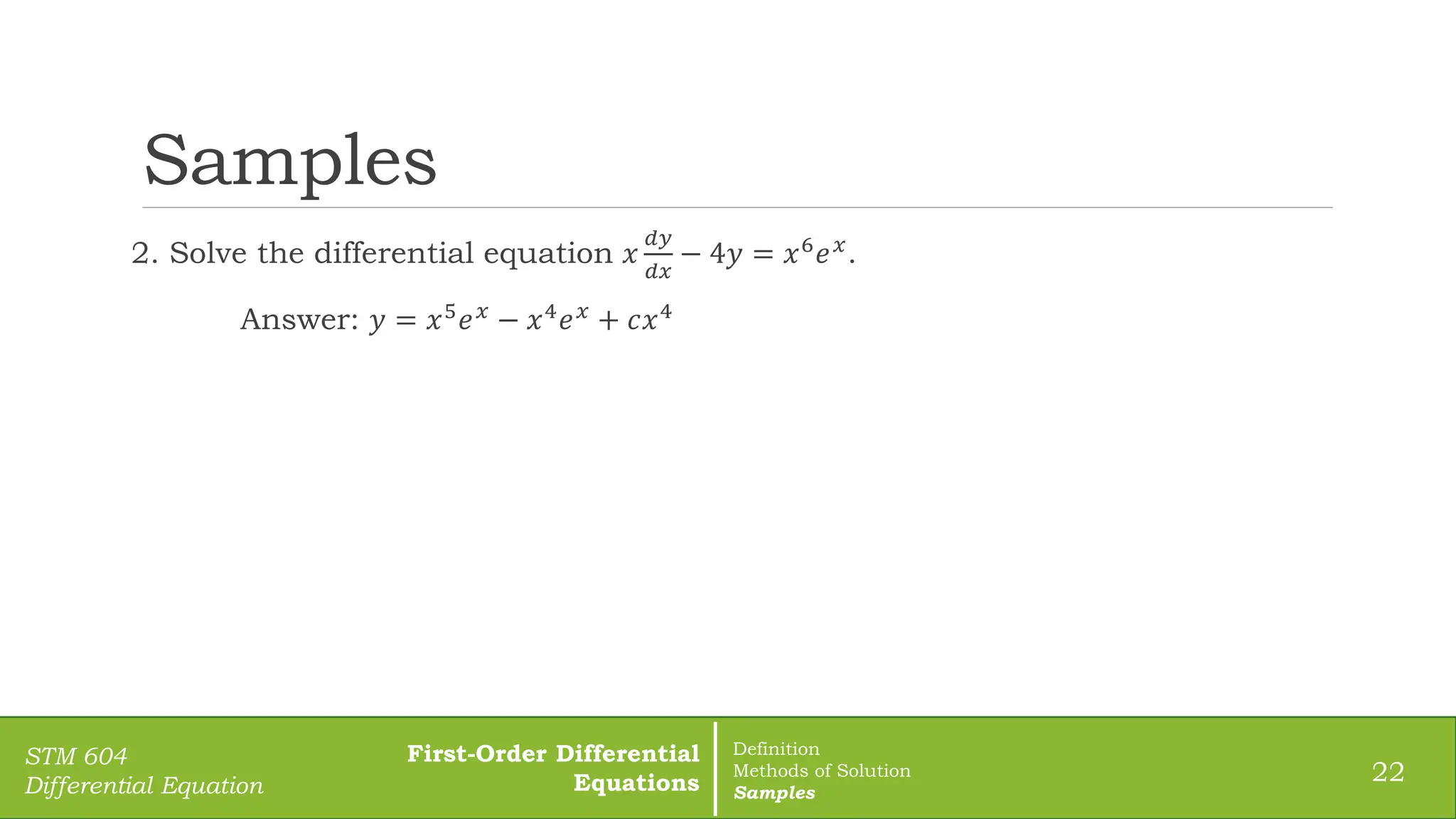
2. Solve the differential equation 𝑥
𝑑𝑦
𝑑𝑥
− 4𝑦 = 𝑥6𝑒𝑥.
Answer: 𝑦 = 𝑥5
𝑒𝑥
− 𝑥4
𝑒𝑥
+ 𝑐𝑥4
22
STM 604
Differential Equation
First-Order Differential
Equations
Definition
Methods of Solution
Samples
Samples
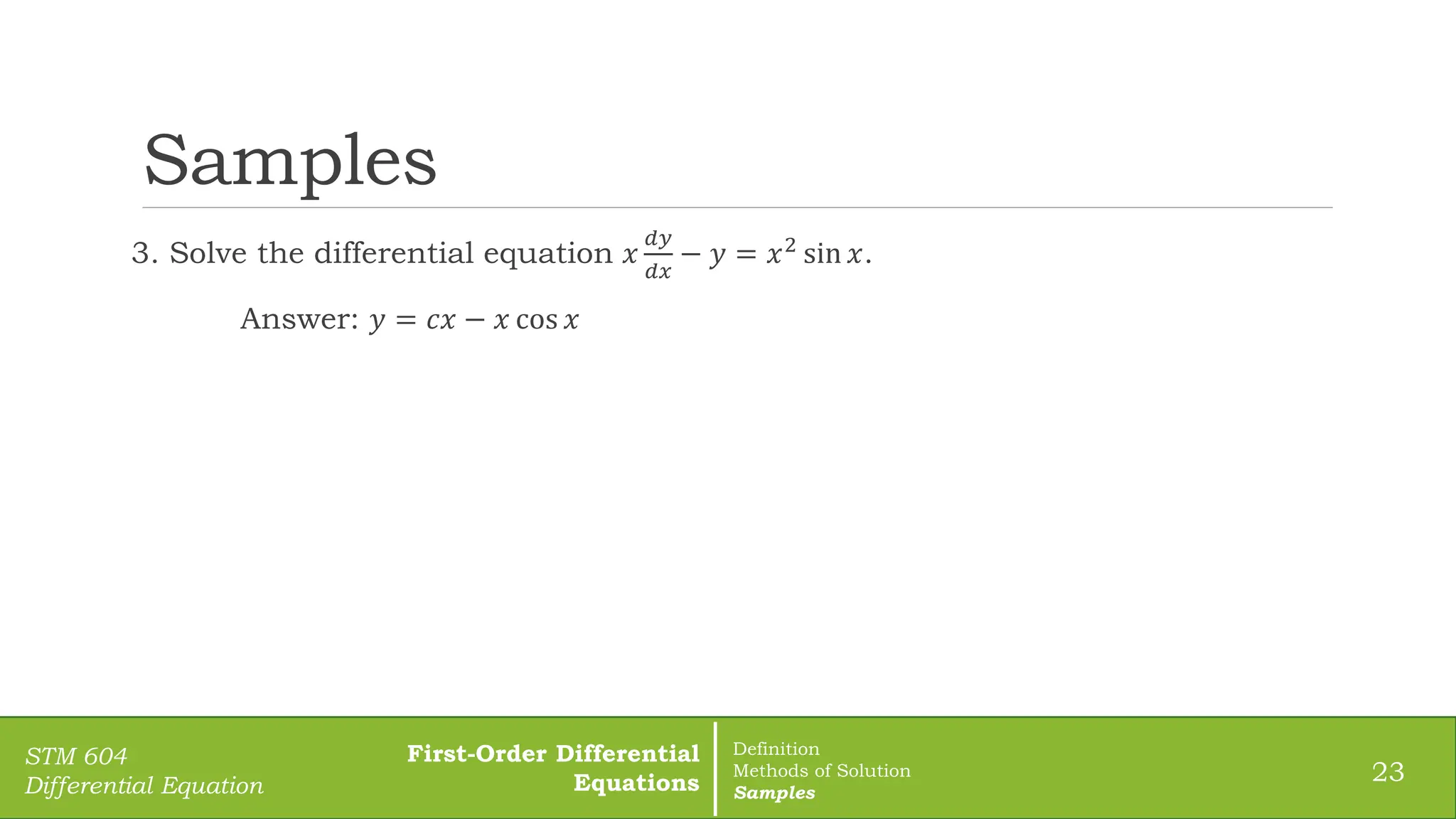
3. Solve the differential equation 𝑥
𝑑𝑦
𝑑𝑥
− 𝑦 = 𝑥2 sin 𝑥.
Answer: 𝑦 = 𝑐𝑥 − 𝑥 cos 𝑥
23
STM 604
Differential Equation
First-Order Differential
Equations
Definition
Methods of Solution
Samples
Lesson 4: Exact
Equations
24
STM 604
Differential Equation
First-Order Differential
Equations
Differential of a Function of Two
Variables
25
STM 604
Differential Equation
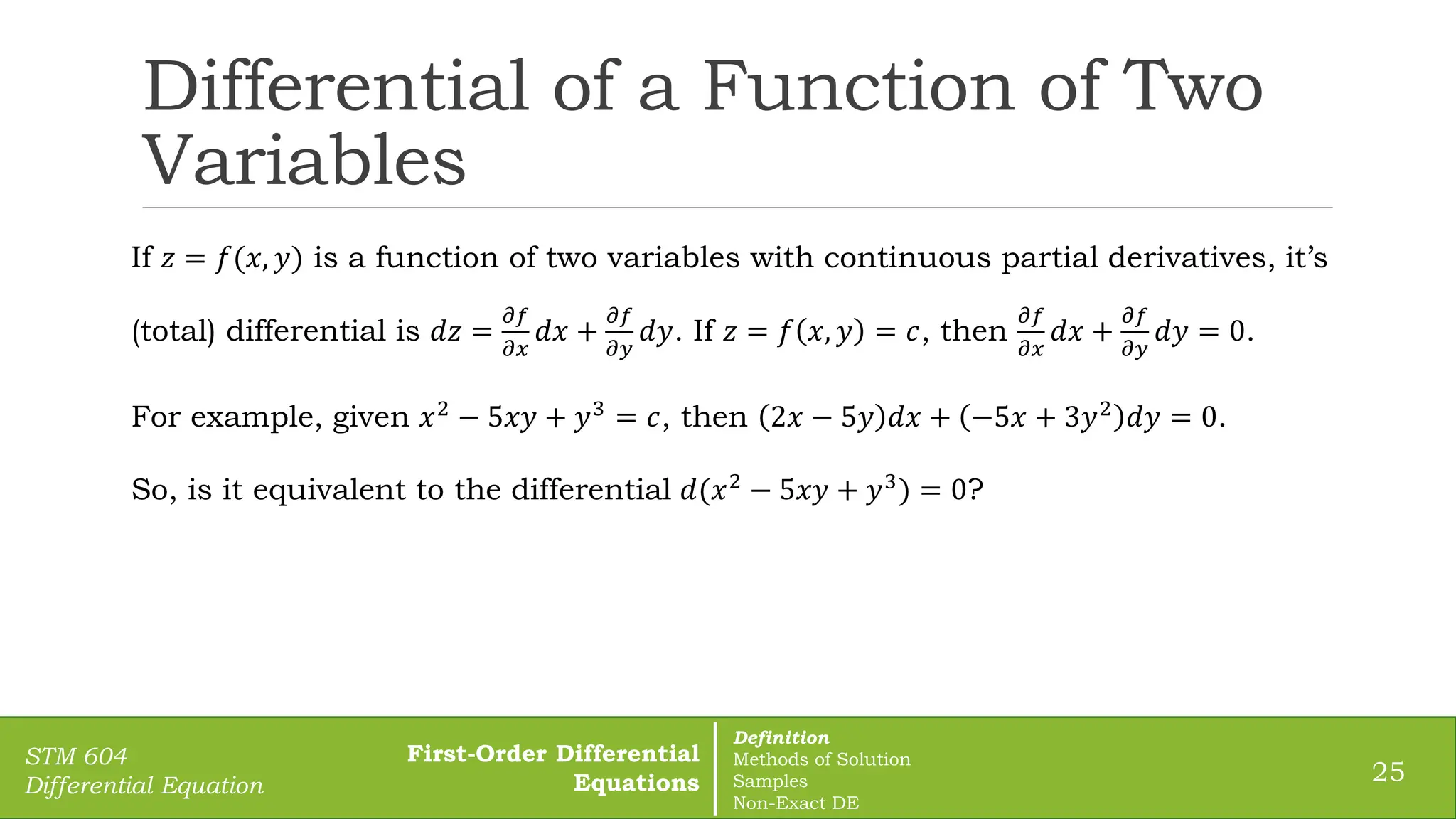
If 𝑧 = 𝑓(𝑥, 𝑦) is a function of two variables with continuous partial derivatives, it’s
(total) differential is 𝑑𝑧 =
𝜕𝑓
𝜕𝑥
𝑑𝑥 +
𝜕𝑓
𝜕𝑦
𝑑𝑦. If 𝑧 = 𝑓 𝑥, 𝑦 = 𝑐, then
𝜕𝑓
𝜕𝑥
𝑑𝑥 +
𝜕𝑓
𝜕𝑦
𝑑𝑦 = 0.
For example, given 𝑥2
− 5𝑥𝑦 + 𝑦3
= 𝑐, then 2𝑥 − 5𝑦 𝑑𝑥 + −5𝑥 + 3𝑦2
𝑑𝑦 = 0.
So, is it equivalent to the differential 𝑑(𝑥2
− 5𝑥𝑦 + 𝑦3
) = 0?
First-Order Differential
Equations
Definition
Methods of Solution
Samples
Non-Exact DE
Definition
26
STM 604
Differential Equation
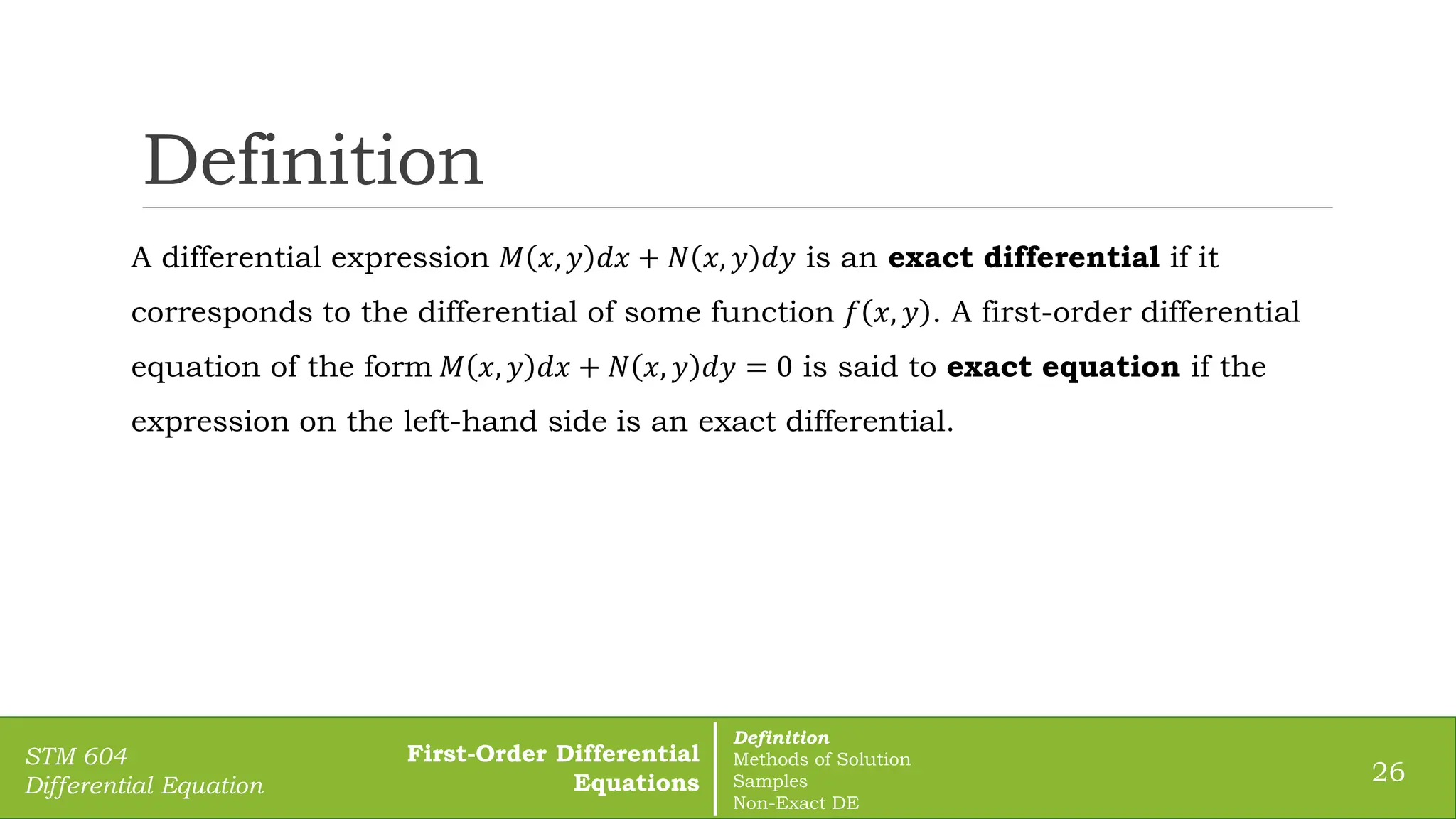
A differential expression 𝑀 𝑥, 𝑦 𝑑𝑥 + 𝑁 𝑥, 𝑦 𝑑𝑦 is an exact differential if it
corresponds to the differential of some function 𝑓 𝑥, 𝑦 . A first-order differential
equation of the form 𝑀 𝑥, 𝑦 𝑑𝑥 + 𝑁 𝑥, 𝑦 𝑑𝑦 = 0 is said to exact equation if the
expression on the left-hand side is an exact differential.
First-Order Differential
Equations
Definition
Methods of Solution
Samples
Non-Exact DE
Theorem
27
STM 604
Differential Equation
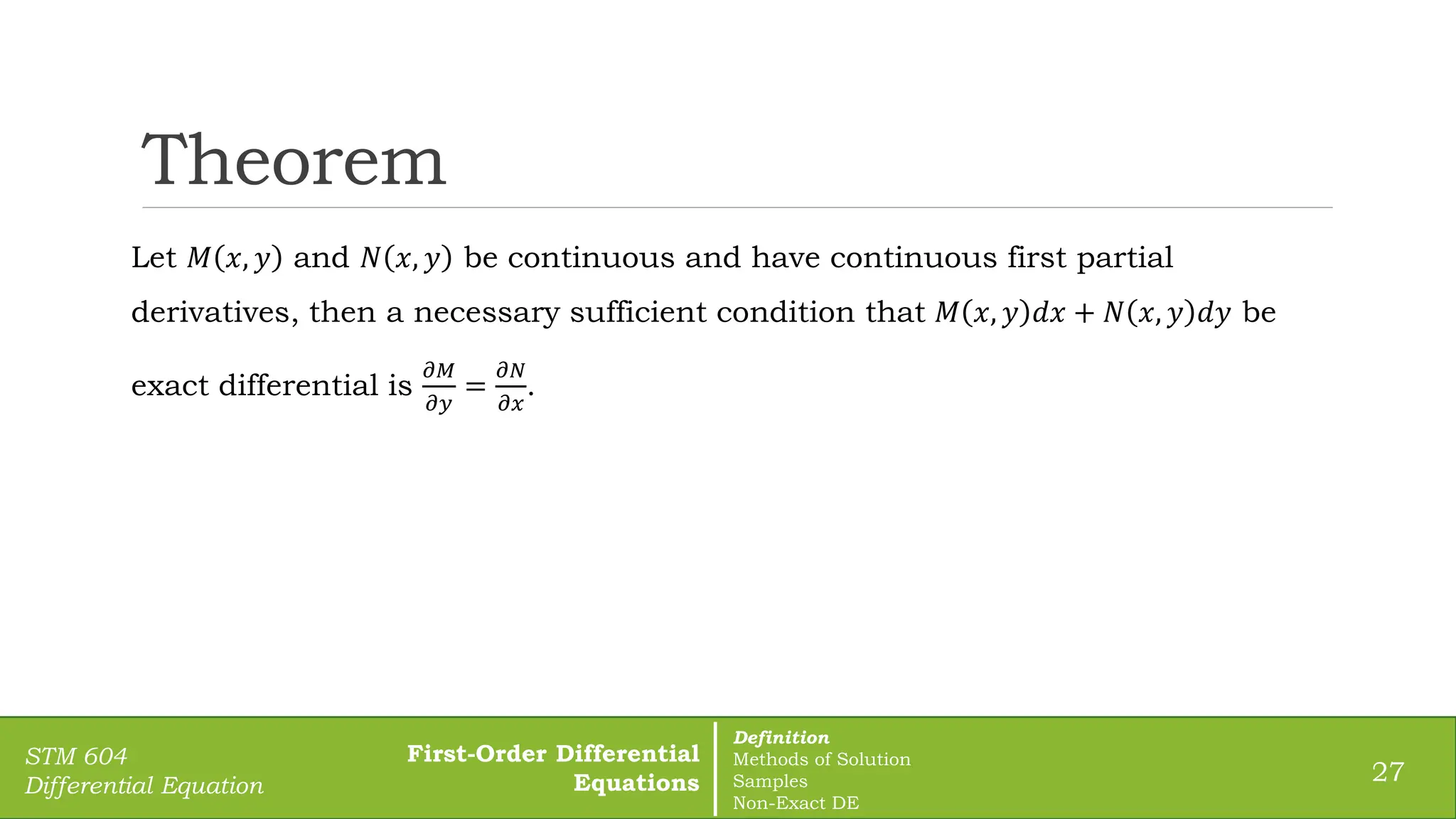
Let 𝑀 𝑥, 𝑦 and 𝑁 𝑥, 𝑦 be continuous and have continuous first partial
derivatives, then a necessary sufficient condition that 𝑀 𝑥, 𝑦 𝑑𝑥 + 𝑁 𝑥, 𝑦 𝑑𝑦 be
exact differential is
𝜕𝑀
𝜕𝑦
=
𝜕𝑁
𝜕𝑥
.
First-Order Differential
Equations
Definition
Methods of Solution
Samples
Non-Exact DE
Method of Solution
28
STM 604
Differential Equation
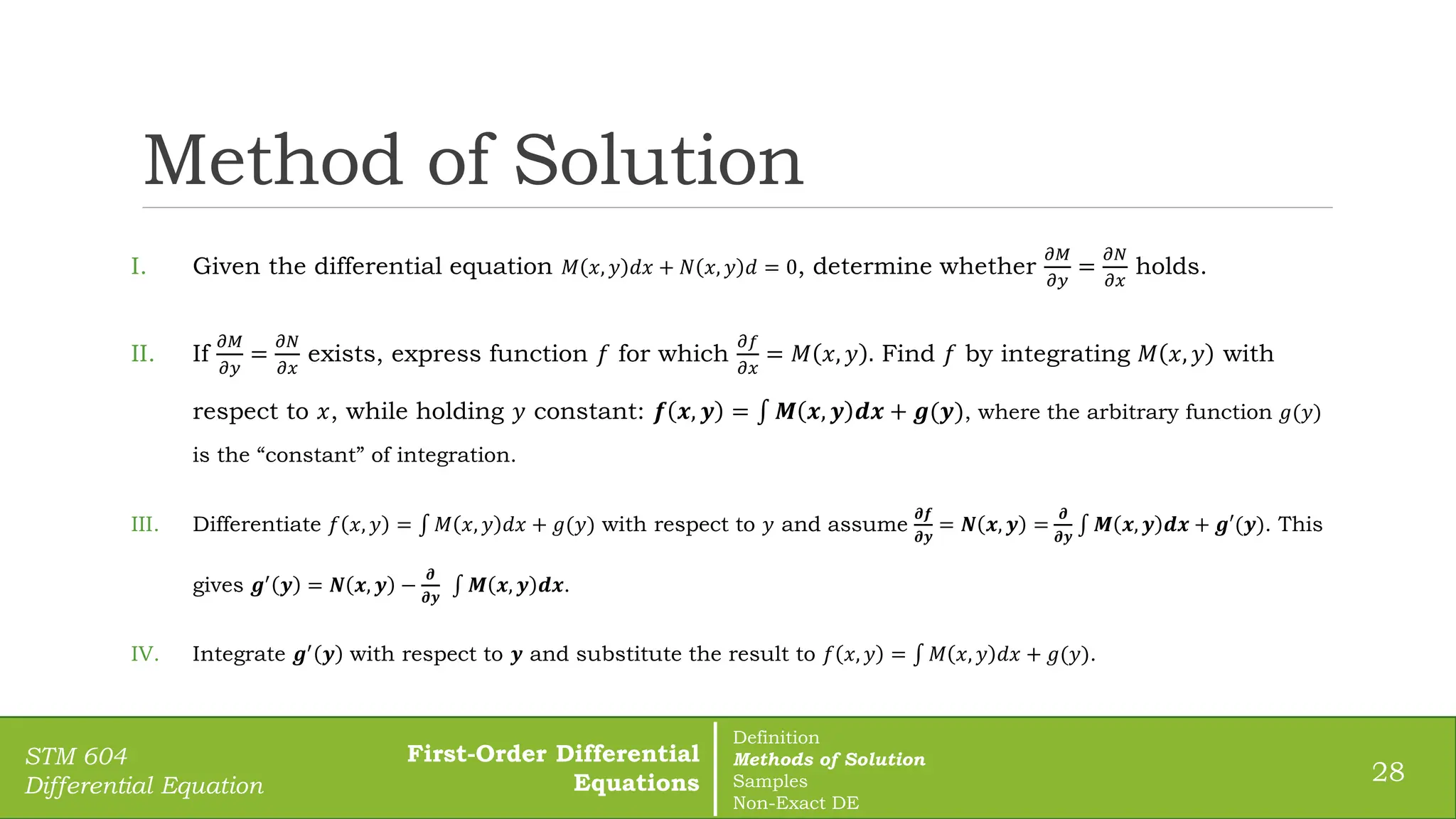
I. Given the differential equation 𝑀 𝑥, 𝑦 𝑑𝑥 + 𝑁 𝑥, 𝑦 𝑑 = 0, determine whether
𝜕𝑀
𝜕𝑦
=
𝜕𝑁
𝜕𝑥
holds.
II. If
𝜕𝑀
𝜕𝑦
=
𝜕𝑁
𝜕𝑥
exists, express function 𝑓 for which
𝜕𝑓
𝜕𝑥
= 𝑀 𝑥, 𝑦 . Find 𝑓 by integrating 𝑀 𝑥, 𝑦 with
respect to 𝑥, while holding 𝑦 constant: 𝒇 𝒙, 𝒚 = 𝑴 𝒙, 𝒚 𝒅𝒙 + 𝒈(𝒚), where the arbitrary function 𝑔(𝑦)
is the “constant” of integration.
III. Differentiate 𝑓 𝑥, 𝑦 = 𝑀 𝑥, 𝑦 𝑑𝑥 + 𝑔(𝑦) with respect to 𝑦 and assume
𝝏𝒇
𝝏𝒚
= 𝑵 𝒙, 𝒚 =
𝝏
𝝏𝒚
𝑴 𝒙, 𝒚 𝒅𝒙 + 𝒈′(𝒚). This
gives 𝒈′
𝒚 = 𝑵 𝒙, 𝒚 −
𝝏
𝝏𝒚
𝑴 𝒙, 𝒚 𝒅𝒙.
IV. Integrate 𝒈′
𝒚 with respect to 𝒚 and substitute the result to 𝑓 𝑥, 𝑦 = 𝑀 𝑥, 𝑦 𝑑𝑥 + 𝑔(𝑦).
First-Order Differential
Equations
Definition
Methods of Solution
Samples
Non-Exact DE
Samples
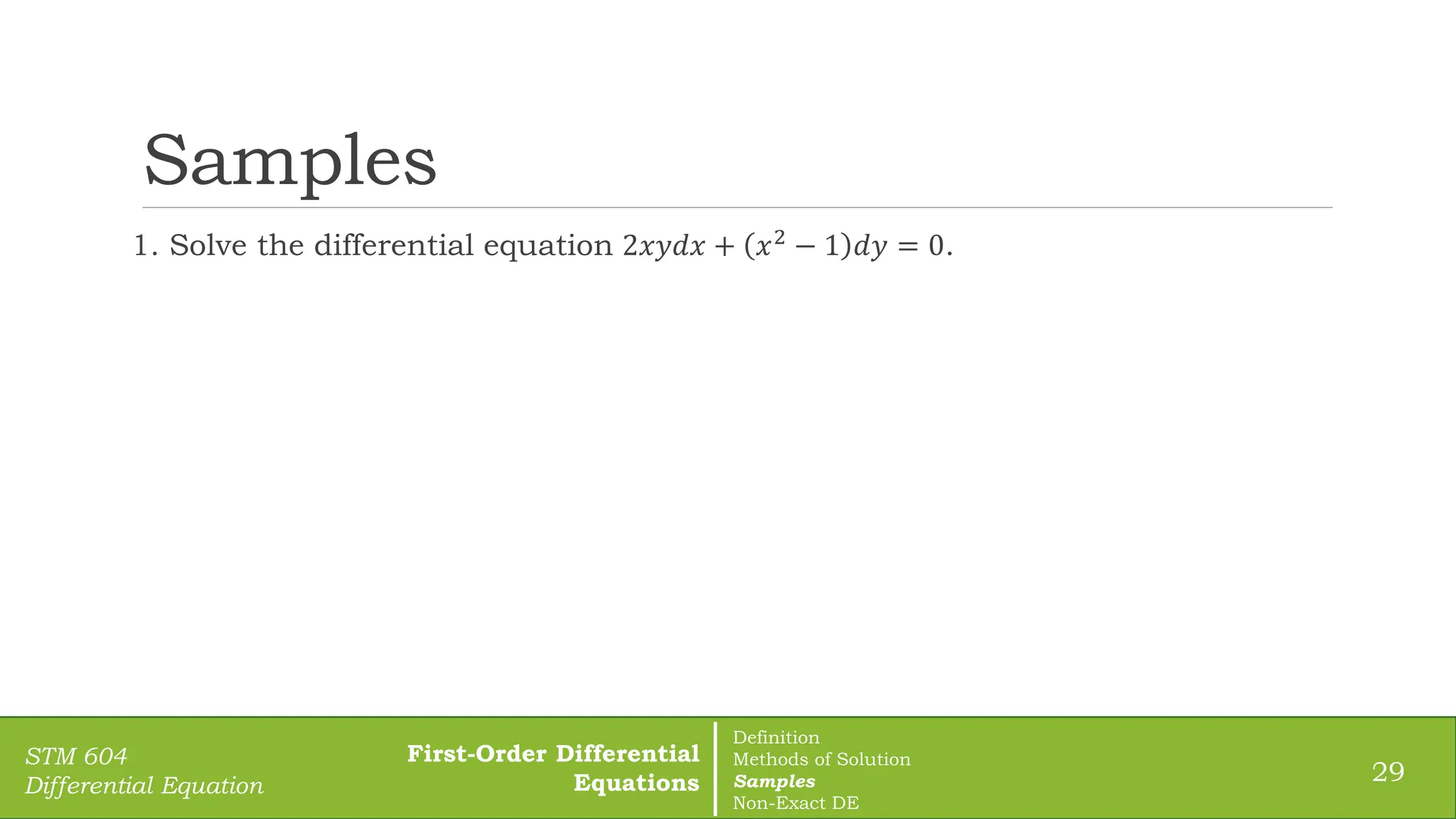
1. Solve the differential equation 2𝑥𝑦𝑑𝑥 + 𝑥2
− 1 𝑑𝑦 = 0.
29
STM 604
Differential Equation
First-Order Differential
Equations
Definition
Methods of Solution
Samples
Non-Exact DE
Samples
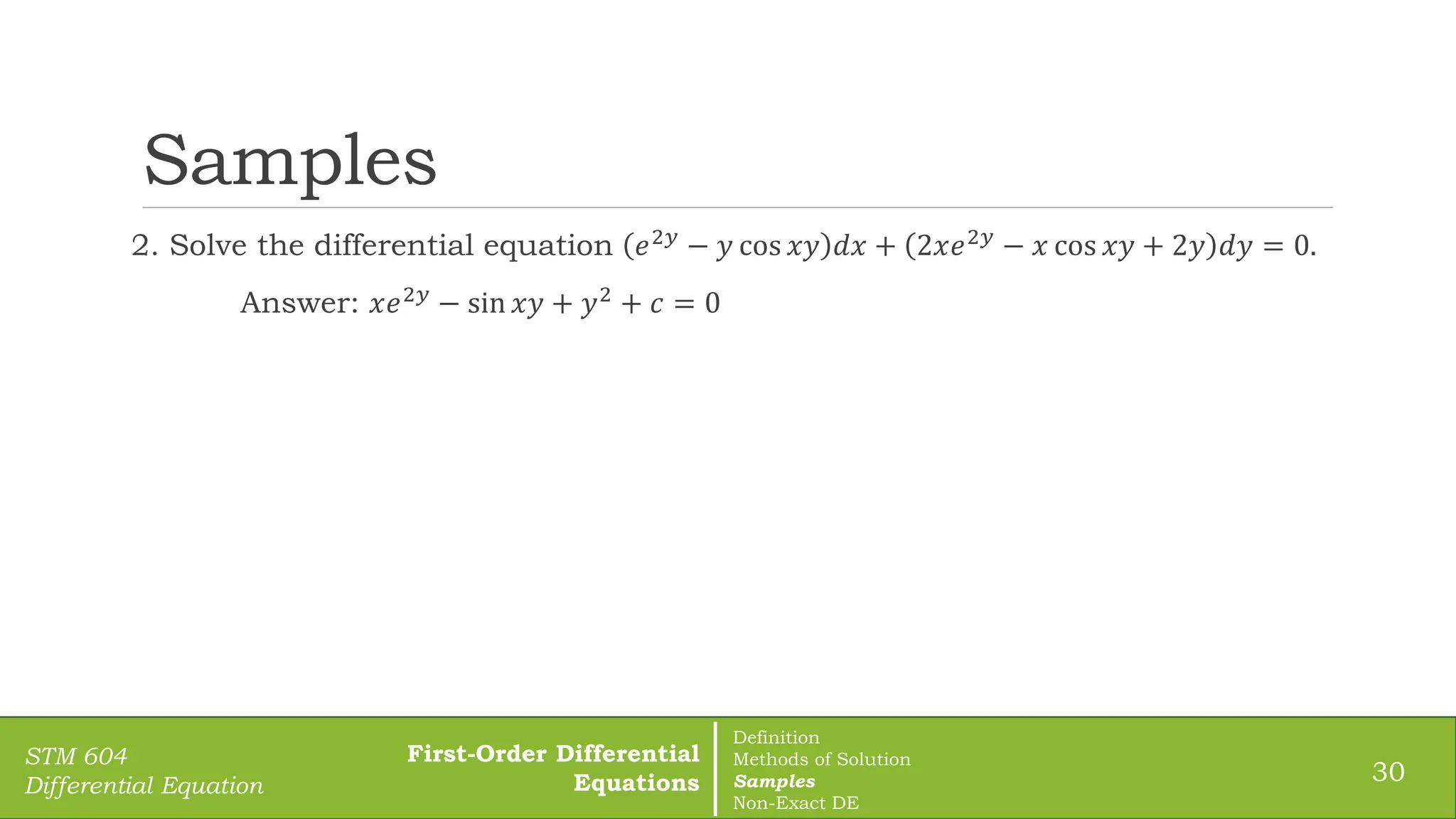
2. Solve the differential equation 𝑒2𝑦
− 𝑦 cos 𝑥𝑦 𝑑𝑥 + 2𝑥𝑒2𝑦
− 𝑥 cos 𝑥𝑦 + 2𝑦 𝑑𝑦 = 0.
Answer: 𝑥𝑒2𝑦 − sin 𝑥𝑦 + 𝑦2 + 𝑐 = 0
30
STM 604
Differential Equation
First-Order Differential
Equations
Definition
Methods of Solution
Samples
Non-Exact DE
Non-Exact Differential Equations
31
STM 604
Differential Equation
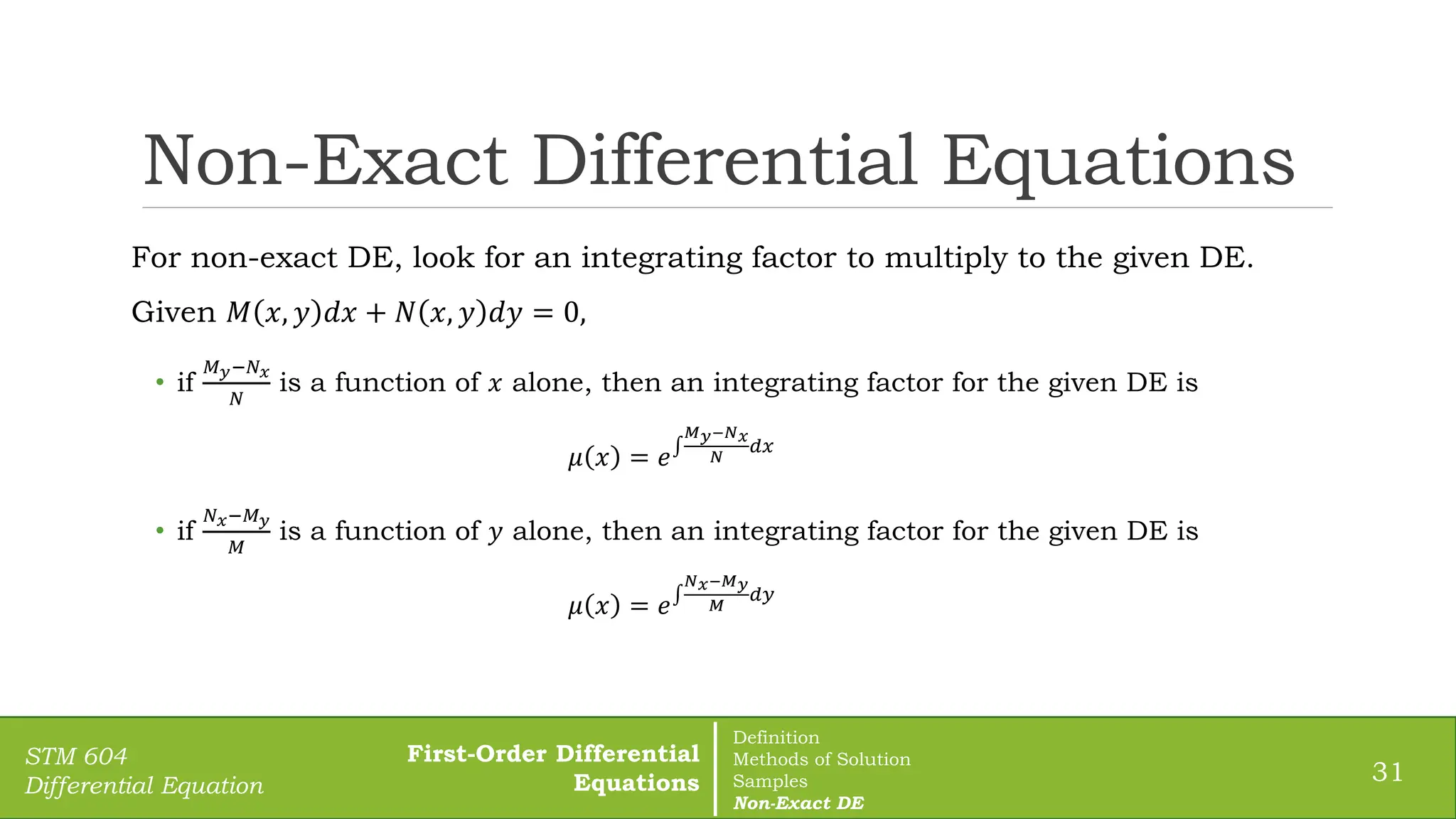
For non-exact DE, look for an integrating factor to multiply to the given DE.
Given 𝑀 𝑥, 𝑦 𝑑𝑥 + 𝑁 𝑥, 𝑦 𝑑𝑦 = 0,
• if
𝑀𝑦−𝑁𝑥
𝑁
is a function of 𝑥 alone, then an integrating factor for the given DE is
𝜇 𝑥 = 𝑒
𝑀𝑦−𝑁𝑥
𝑁
𝑑𝑥
• if
𝑁𝑥−𝑀𝑦
𝑀
is a function of 𝑦 alone, then an integrating factor for the given DE is
𝜇 𝑥 = 𝑒
𝑁𝑥−𝑀𝑦
𝑀
𝑑𝑦
First-Order Differential
Equations
Definition
Methods of Solution
Samples
Non-Exact DE
Samples
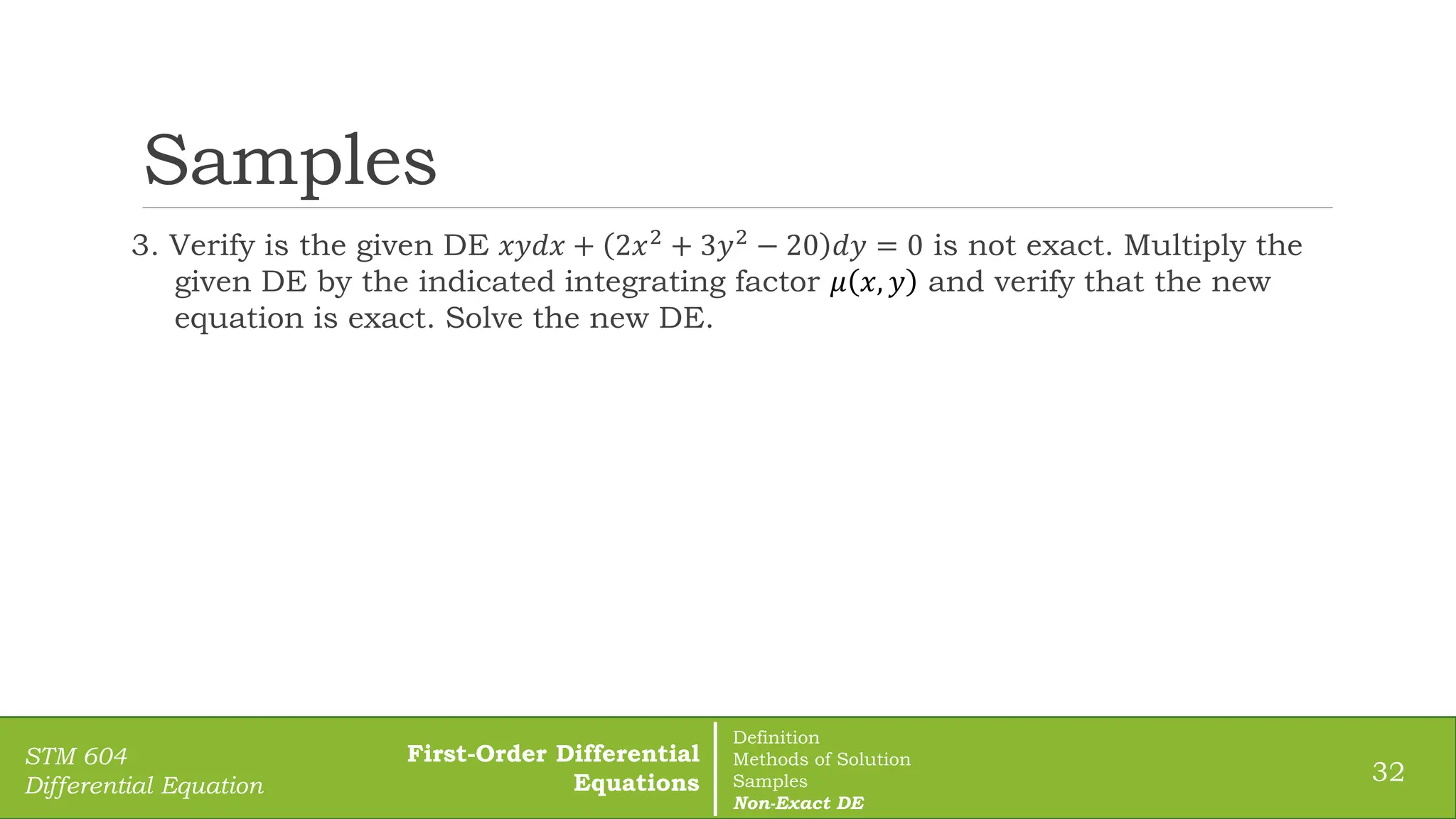
3. Verify is the given DE 𝑥𝑦𝑑𝑥 + 2𝑥2
+ 3𝑦2
− 20 𝑑𝑦 = 0 is not exact. Multiply the
given DE by the indicated integrating factor 𝜇 𝑥, 𝑦 and verify that the new
equation is exact. Solve the new DE.
32
STM 604
Differential Equation
First-Order Differential
Equations
Definition
Methods of Solution
Samples
Non-Exact DE
Lesson 5: Solutions by
Substitution
33
STM 604
Differential Equation
First-Order Differential
Equations
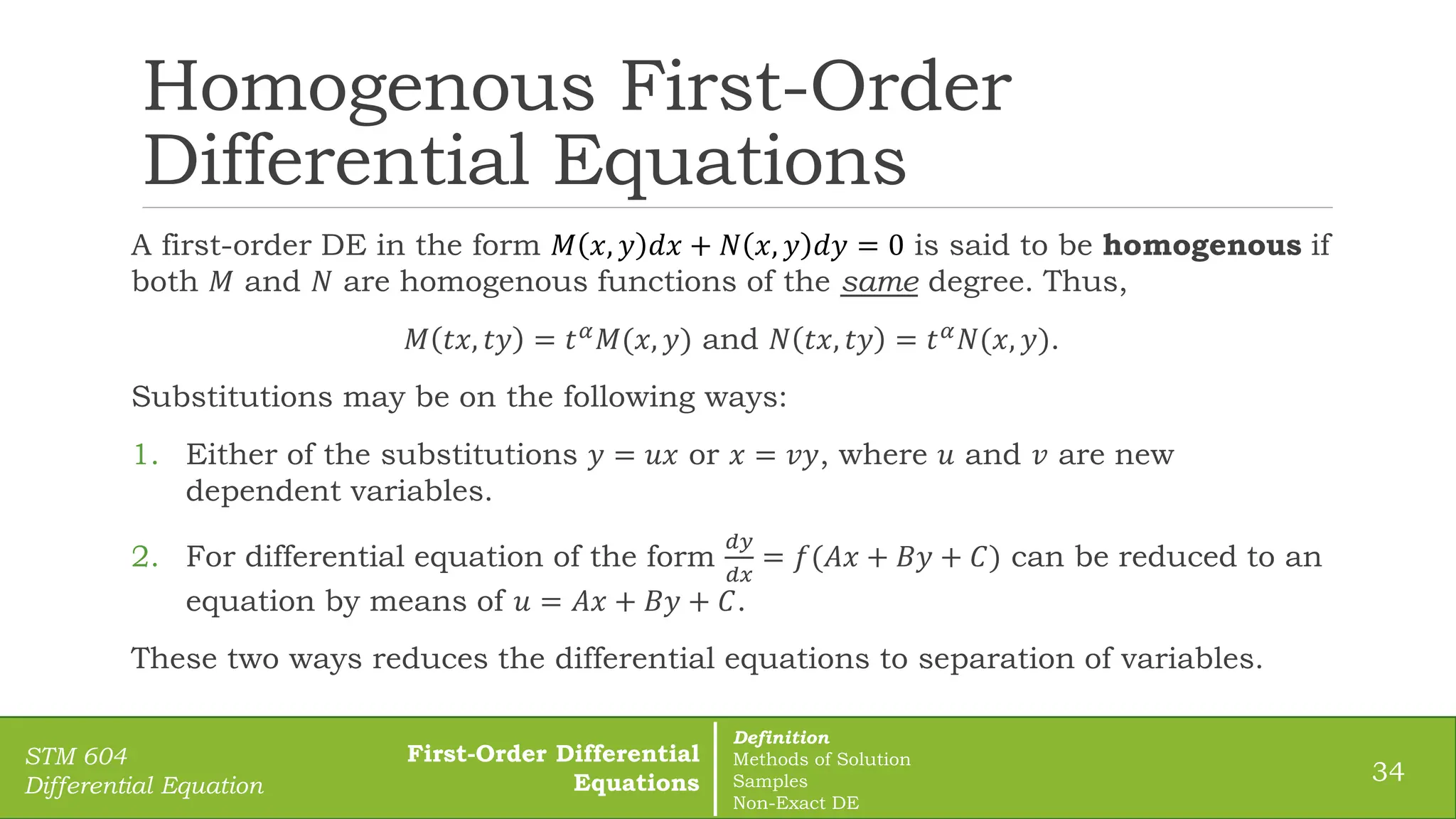
Homogenous First-Order
Differential Equations
A first-order DE in the form 𝑀 𝑥, 𝑦 𝑑𝑥 + 𝑁 𝑥, 𝑦 𝑑𝑦 = 0 is said to be homogenous if
both 𝑀 and 𝑁 are homogenous functions of the same degree. Thus,
𝑀 𝑡𝑥, 𝑡𝑦 = 𝑡𝛼𝑀(𝑥, 𝑦) and 𝑁 𝑡𝑥, 𝑡𝑦 = 𝑡𝛼𝑁(𝑥, 𝑦).
Substitutions may be on the following ways:
1. Either of the substitutions 𝑦 = 𝑢𝑥 or 𝑥 = 𝑣𝑦, where 𝑢 and 𝑣 are new
dependent variables.
2. For differential equation of the form
𝑑𝑦
𝑑𝑥
= 𝑓(𝐴𝑥 + 𝐵𝑦 + 𝐶) can be reduced to an
equation by means of 𝑢 = 𝐴𝑥 + 𝐵𝑦 + 𝐶.
These two ways reduces the differential equations to separation of variables.
34
STM 604
Differential Equation
First-Order Differential
Equations
Definition
Methods of Solution
Samples
Non-Exact DE
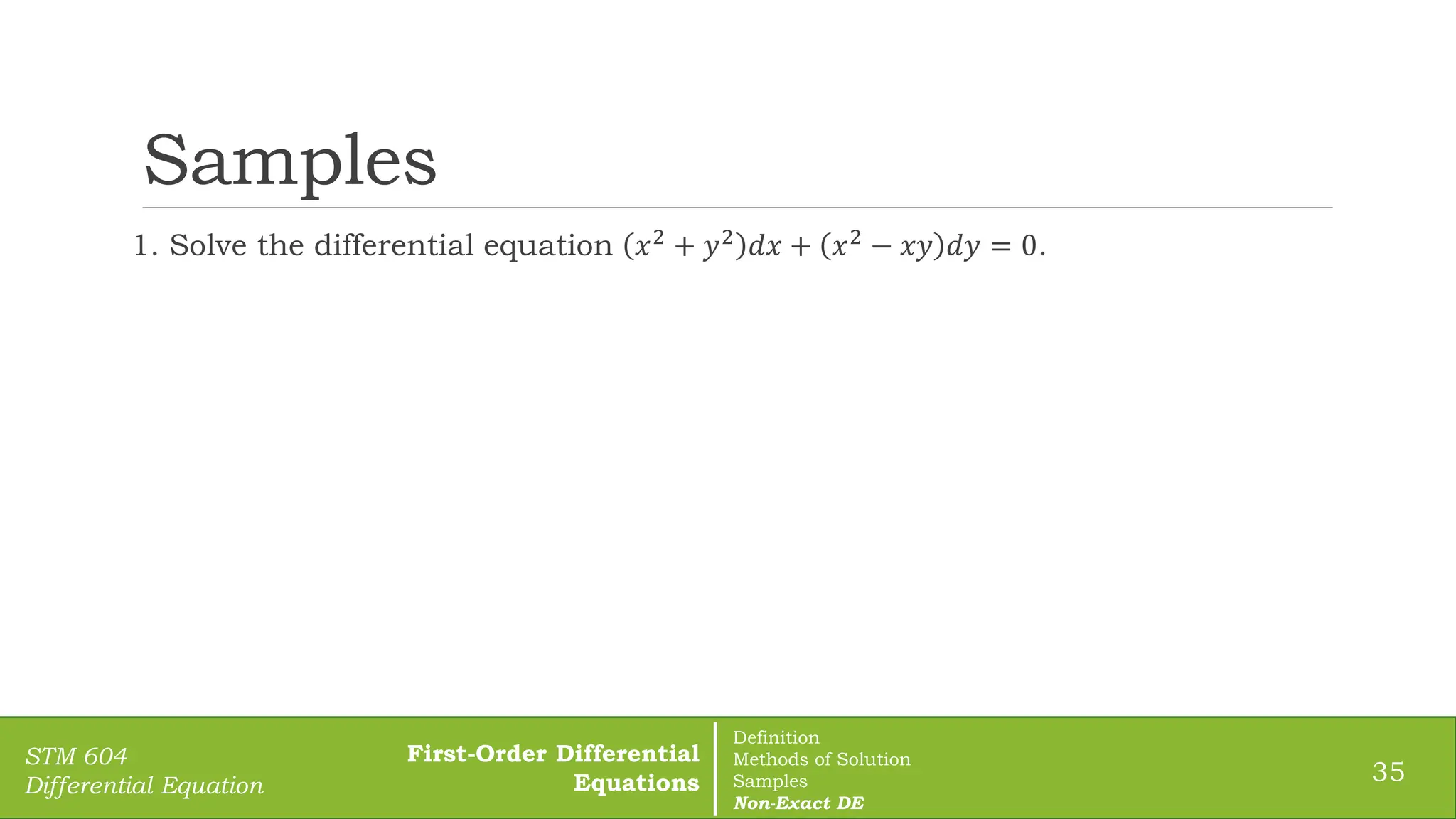
Samples
1. Solve the differential equation 𝑥2
+ 𝑦2
𝑑𝑥 + 𝑥2
− 𝑥𝑦 𝑑𝑦 = 0.
35
STM 604
Differential Equation
First-Order Differential
Equations
Definition
Methods of Solution
Samples
Non-Exact DE
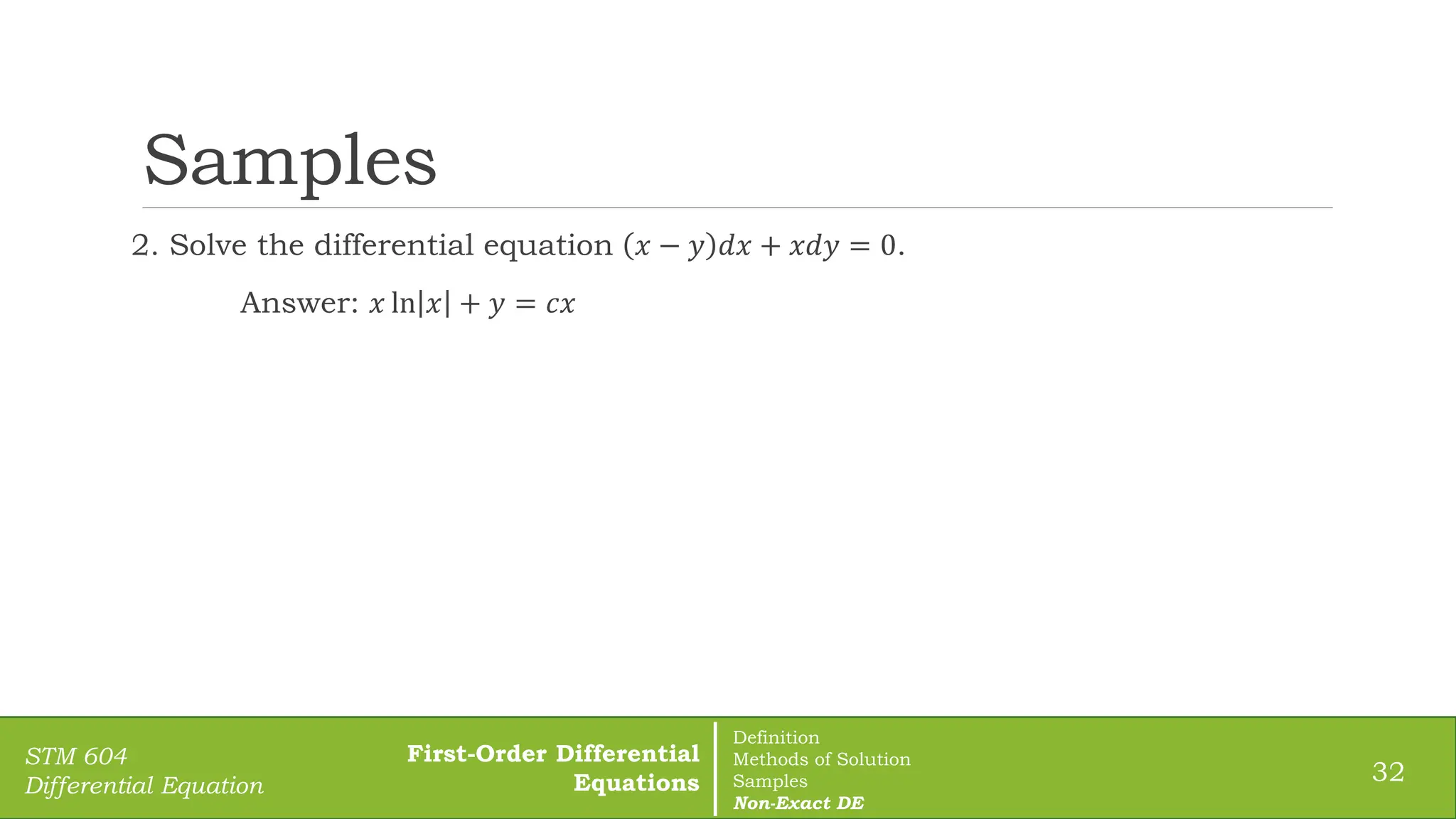
Samples
2. Solve the differential equation 𝑥 − 𝑦 𝑑𝑥 + 𝑥𝑑𝑦 = 0.
Answer: 𝑥 ln 𝑥 + 𝑦 = 𝑐𝑥
32
STM 604
Differential Equation
First-Order Differential
Equations
Definition
Methods of Solution
Samples
Non-Exact DE
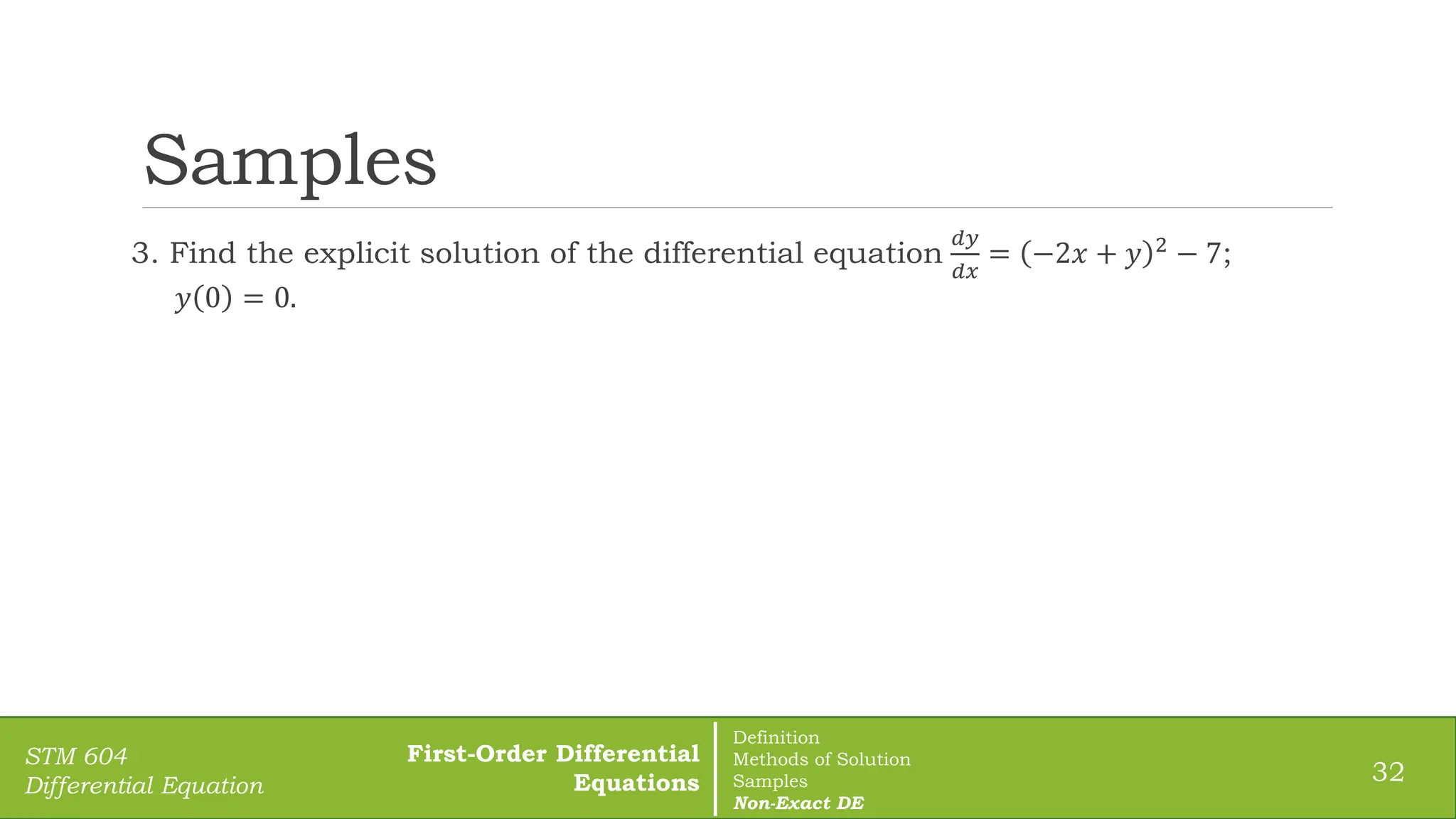
Samples
3. Find the explicit solution of the differential equation
𝑑𝑦
𝑑𝑥
= −2𝑥 + 𝑦 2 − 7;
𝑦 0 = 0.
32
STM 604
Differential Equation
First-Order Differential
Equations
Definition
Methods of Solution
Samples
Non-Exact DE
Samples
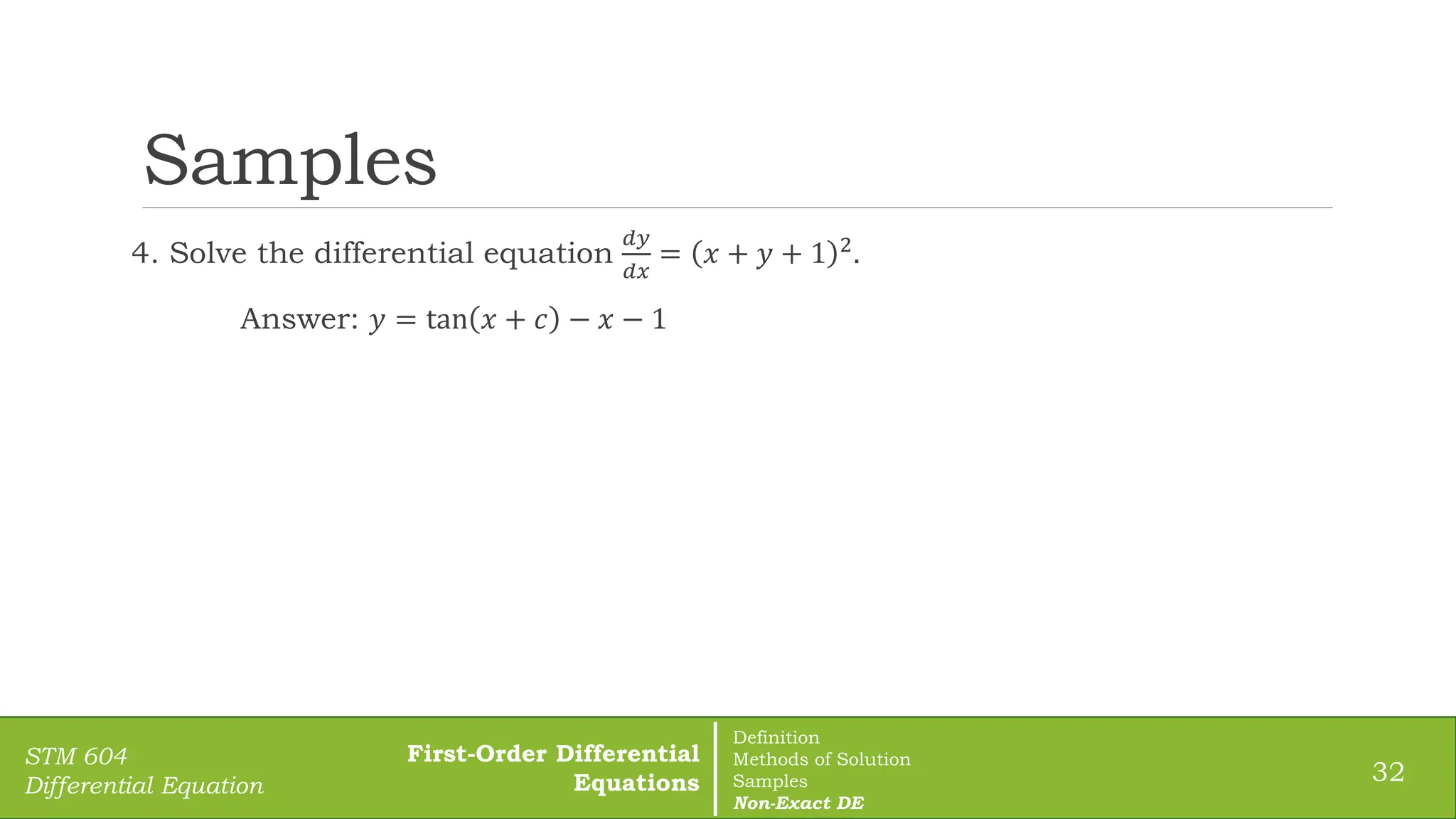
4. Solve the differential equation
𝑑𝑦
𝑑𝑥
= 𝑥 + 𝑦 + 1 2.
Answer: 𝑦 = tan 𝑥 + 𝑐 − 𝑥 − 1
32
STM 604
Differential Equation
First-Order Differential
Equations
Definition
Methods of Solution
Samples
Non-Exact DE
- End 
Thank you!
33
STM 604
Differential Equation

Introduction to Differential Equations and First-Order Differential Equations.pptx

  • 1.
    STM 604 –Differential Equation Introduction to Differential Equations 1 STM 604 Differential Equation ELLVAN M. CAMPOS, MST Faculty, Institute of Advanced Studies Introduction to Differential Equations
  • 2.
    Lesson 1: Definitionand Terminologies 2 STM 604 Differential Equation Introduction to Differential Equations
  • 3.
    Definition 3 STM 604 Differential Equation Definition Classification Solutionof an ODE Examples  Consider this: 𝑦′′ + 2𝑦′ = 3𝑦  This is the same with 𝑓′′ 𝑥 + 2𝑓′ 𝑥 = 3𝑓 𝑥 or 𝑑2𝑦 𝑑𝑥2 + 2 𝑑𝑦 𝑑𝑥 = 3𝑦 Solution: function(s) Introduction to Differential Equations  The difference of this kind of equation: 𝑥2 + 3𝑥 + 2 = 0 𝑥 = −2 or 𝑥 = −1 Solution: values(s) An equation containing the derivatives of one or more dependent variables with respect to one or more independent variables is a differential equation (DE).
  • 4.
    Classification (by Type) If an equation contains only ordinary derivatives of one or more dependent variables with respect to a single independent variable, it is said to be an ordinary differential equation (ODE). 𝑑𝑦 𝑑𝑥 + 5𝑦 = 𝑒𝑥 𝑑2𝑦 𝑑𝑥2 − 𝑑𝑦 𝑑𝑥 + 6𝑦 = 0 𝑑𝑥 𝑑𝑡 + 𝑑𝑦 𝑑𝑡 = 2𝑥 + 𝑦 4 STM 604 Differential Equation Introduction to Differential Equations Definition Classification Solution of an ODE Examples
  • 5.
    Classification (by Type) 5 STM604 Differential Equation  If an equation involving the partial derivatives of one or more dependent variables of two or more independent variables, it is said to be an partial differential equation (PDE). 𝜕2𝑢 𝜕𝑥2 + 𝜕2𝑢 𝜕𝑦2 = 0 𝜕2𝑢 𝜕𝑥2 = 𝜕2𝑢 𝜕𝑡2 − 2 𝜕𝑢 𝜕𝑡 𝜕𝑢 𝜕𝑦 = − 𝜕𝑢 𝜕𝑥 Introduction to Differential Equations Definition Classification Solution of an ODE Examples
  • 6.
    Classification (by Order) Theorder of a DE is the order of the highest derivative in the equation. 𝑑2𝑦 𝑑𝑥2 + 5 𝑑𝑦 𝑑𝑥 3 − 4𝑦 = 𝑒𝑥 6 STM 604 Differential Equation Introduction to Differential Equations Definition Classification Solution of an ODE Examples
  • 7.
    Classification (by Linearity) 7 STM604 Differential Equation  An nth-order ordinary differential equation is said to be linear if F is linear in 𝑦, 𝑦′ , … , 𝑦𝑛−1 , in form: 𝑎𝑛 𝑥 𝑦 𝑛 + 𝑎𝑛−1 𝑥 𝑦 𝑛−1 + ⋯ + 𝑎1 𝑥 𝑦′ + 𝑎0 𝑥 𝑦 − 𝑔 𝑥 = 0 or 𝑎𝑛 𝑥 𝑑𝑛𝑦 𝑑𝑥𝑛 + 𝑎𝑛−1 𝑥 𝑑𝑛−1𝑦 𝑑𝑥𝑛−1 + ⋯ + 𝑎1 𝑥 𝑑𝑦 𝑑𝑥 + 𝑎0 𝑥 𝑦 = 𝑔 𝑥  Two Properties of Linear Differential Equation: (1) The dependent variable and all its derivatives are of the first degree; and (2) Each coefficient depends at most on the independent variable x. Introduction to Differential Equations Definition Classification Solution of an ODE Examples
  • 8.
    Classification (by Linearity) 8 STM604 Differential Equation Samples 𝑦 − 𝑥 𝑑𝑥 + 4𝑥𝑑𝑦 = 0 𝑦′′ − 2𝑦′ + 𝑦 = 0 𝑑3𝑦 𝑑𝑥3 + 𝑥 𝑑𝑦 𝑑𝑥 − 5𝑦 = 𝑒𝑥 Non-Samples 1 − 𝑦 𝑦′ + 2𝑦 = 𝑒𝑥 𝑑2 𝑦 𝑑𝑥2 + sin 𝑦 = 0 𝑑4𝑦 𝑑𝑥4 + 𝑦2 = 0 Introduction to Differential Equations Definition Classification Solution of an ODE Examples
  • 9.
    Solution of anODE 9 STM 604 Differential Equation  Any function 𝜙, defined on an interval I and possessing at least n derivatives that are continuous on I, which when substituted into an nth-order ordinary differential equation reduces the equation to an identity, is said to be a solution of the equation on the interval.  From this definition, the interval I is variously called as interval of definition of the solution and can be an open interval (𝑎, 𝑏), a closed interval [𝑎, 𝑏], an infinite interval (𝑎, ∞), and so on. Introduction to Differential Equations Definition Classification Solution of an ODE Examples
  • 10.
    Example: Verification ofSolution 10 STM 604 Differential Equation Verify that the indicated function is a solution of the given differential equation on the interval (−∞, ∞). a) 𝑑𝑦 𝑑𝑥 = 𝑥𝑦 1 2; 𝑦 = 1 16 𝑥4 b) 𝑦′′ − 2𝑦′ + 𝑦 = 0; 𝑦 = 𝑥𝑒𝑥 Note: 𝑦 = 0 is a constant solution under the interval given. A solution of a differential equation that is identically zero on an interval I is said to be a trivial solution. Introduction to Differential Equations Definition Classification Solution of an ODE Examples
  • 11.
    Example: Verification ofSolution 11 STM 604 Differential Equation Verify that the indicated function is a solution of the given differential equation on the interval (−∞, ∞). a) 𝑑𝑦 𝑑𝑥 = 𝑥𝑦 1 2; 𝑦 = 1 16 𝑥4 b) 𝑦′′ − 2𝑦′ + 𝑦 = 0; 𝑦 = 𝑥𝑒𝑥 Note: 𝑦 = 0 is a constant solution under the interval given. A solution of a differential equation that is identically zero on an interval I is said to be a trivial solution. Introduction to Differential Equations Definition Classification Solution of an ODE Examples
  • 12.
    Lesson 2: Separable Variables 12 STM604 Differential Equation First-Order Differential Equations
  • 13.
    Definition 13 STM 604 Differential Equation Definition Samples Afirst-order differential equation of the form 𝑑𝑦 𝑑𝑥 = 𝑔 𝑥 ℎ(𝑦) is said to be separable or to have separable variables. The equations 𝑑𝑦 𝑑𝑥 = 𝑦2𝑥𝑒3𝑥+4𝑦 and 𝑑𝑦 𝑑𝑥 = 𝑦 + sin 𝑥 are separable and nonseparable respectively. Method of Solution: Given that 𝑔 𝑥 𝑑𝑥 = ℎ 𝑦 𝑑𝑦, integrate the following separately. First-Order Differential Equations
  • 14.
    Samples 1. Determine ifthe differential equation 1 + 𝑥 𝑑𝑦 − 𝑦𝑑𝑥 = 0 is separable. If it is, solve the DE using separation of variables. 14 STM 604 Differential Equation First-Order Differential Equations Definition Samples
  • 15.
    Samples 2. Determine ifthe differential equation 𝑑𝑦 𝑑𝑥 = 3𝑥+𝑥𝑦2 𝑦+𝑥2𝑦 is separable. If it is, solve the DE using separation of variables. Answer: 𝑦2 + 3 = 𝑐(𝑥2 + 1) 15 STM 604 Differential Equation First-Order Differential Equations Definition Samples
  • 16.
    Samples 3. Determine ifthe differential equation 𝑒2𝑦 − 𝑦 cos 𝑥 𝑑𝑦 𝑑𝑥 = 𝑒𝑦 sin 2𝑥 is separable. If it is, solve the DE using separation of variables, and find the specific equation if 𝑦 0 = 0. Answer: 𝑒𝑦 + 𝑦𝑒−𝑦 + 𝑒−𝑦 = 4 − 2 cos 𝑥 16 STM 604 Differential Equation First-Order Differential Equations Definition Samples
  • 17.
    Samples 4. Determine ifthe differential equation 𝑑𝑦 𝑑𝑥 = 𝑦2 − 4 is separable. If it is, solve the DE using separation of variables. Answer: 𝑦−2 𝑦+2 = 𝑐𝑒4𝑥 17 STM 604 Differential Equation First-Order Differential Equations Definition Samples
  • 18.
    Lesson 3: Linear Equations 18 STM604 Differential Equation First-Order Differential Equations
  • 19.
    Definition 19 STM 604 Differential Equation Afirst-order differential equation of the form 𝑎1 𝑥 𝑑𝑦 𝑑𝑥 + 𝑎0 𝑥 𝑦 = 𝑔 𝑥 is said to be linear equation. When 𝑔 𝑥 = 0, the linear equation is said to be homogenous; otherwise, it is nonhomogenous. First-Order Differential Equations Definition Methods of Solution Samples
  • 20.
    Solving a LinearFirst-Order Equation 20 STM 604 Differential Equation I. From 𝑎1 𝑥 𝑑𝑦 𝑑𝑥 + 𝑎0 𝑥 𝑦 = 𝑔 𝑥 , divide 𝑎1 𝑥 to obtain the standard form of the linear equation, given by 𝑑𝑦 𝑑𝑥 + 𝑃 𝑥 𝑦 = 𝑓(𝑥). II. From the standard form, identify 𝑃 𝑥 and then find the integrating factor 𝑒 𝑃 𝑥 𝑑𝑥 . III. Multiply the standard form of the equation by the integrating factor. The left-hand side of the resulting equation is automatically the derivative of the integrating factor and y: 𝑑 𝑑𝑥 𝑒 𝑃 𝑥 𝑑𝑥 𝑦 = 𝑒 𝑃 𝑥 𝑑𝑥 𝑓 𝑥 . IV. Integrate both sides of this last equation. First-Order Differential Equations Definition Methods of Solution Samples
  • 21.
    Samples 1. Solve thedifferential equation 𝑑𝑦 𝑑𝑥 − 3𝑦 − 6 = 0. 21 STM 604 Differential Equation First-Order Differential Equations Definition Methods of Solution Samples
  • 22.
    Samples 2. Solve thedifferential equation 𝑥 𝑑𝑦 𝑑𝑥 − 4𝑦 = 𝑥6𝑒𝑥. Answer: 𝑦 = 𝑥5 𝑒𝑥 − 𝑥4 𝑒𝑥 + 𝑐𝑥4 22 STM 604 Differential Equation First-Order Differential Equations Definition Methods of Solution Samples
  • 23.
    Samples 3. Solve thedifferential equation 𝑥 𝑑𝑦 𝑑𝑥 − 𝑦 = 𝑥2 sin 𝑥. Answer: 𝑦 = 𝑐𝑥 − 𝑥 cos 𝑥 23 STM 604 Differential Equation First-Order Differential Equations Definition Methods of Solution Samples
  • 24.
    Lesson 4: Exact Equations 24 STM604 Differential Equation First-Order Differential Equations
  • 25.
    Differential of aFunction of Two Variables 25 STM 604 Differential Equation If 𝑧 = 𝑓(𝑥, 𝑦) is a function of two variables with continuous partial derivatives, it’s (total) differential is 𝑑𝑧 = 𝜕𝑓 𝜕𝑥 𝑑𝑥 + 𝜕𝑓 𝜕𝑦 𝑑𝑦. If 𝑧 = 𝑓 𝑥, 𝑦 = 𝑐, then 𝜕𝑓 𝜕𝑥 𝑑𝑥 + 𝜕𝑓 𝜕𝑦 𝑑𝑦 = 0. For example, given 𝑥2 − 5𝑥𝑦 + 𝑦3 = 𝑐, then 2𝑥 − 5𝑦 𝑑𝑥 + −5𝑥 + 3𝑦2 𝑑𝑦 = 0. So, is it equivalent to the differential 𝑑(𝑥2 − 5𝑥𝑦 + 𝑦3 ) = 0? First-Order Differential Equations Definition Methods of Solution Samples Non-Exact DE
  • 26.
    Definition 26 STM 604 Differential Equation Adifferential expression 𝑀 𝑥, 𝑦 𝑑𝑥 + 𝑁 𝑥, 𝑦 𝑑𝑦 is an exact differential if it corresponds to the differential of some function 𝑓 𝑥, 𝑦 . A first-order differential equation of the form 𝑀 𝑥, 𝑦 𝑑𝑥 + 𝑁 𝑥, 𝑦 𝑑𝑦 = 0 is said to exact equation if the expression on the left-hand side is an exact differential. First-Order Differential Equations Definition Methods of Solution Samples Non-Exact DE
  • 27.
    Theorem 27 STM 604 Differential Equation Let𝑀 𝑥, 𝑦 and 𝑁 𝑥, 𝑦 be continuous and have continuous first partial derivatives, then a necessary sufficient condition that 𝑀 𝑥, 𝑦 𝑑𝑥 + 𝑁 𝑥, 𝑦 𝑑𝑦 be exact differential is 𝜕𝑀 𝜕𝑦 = 𝜕𝑁 𝜕𝑥 . First-Order Differential Equations Definition Methods of Solution Samples Non-Exact DE
  • 28.
    Method of Solution 28 STM604 Differential Equation I. Given the differential equation 𝑀 𝑥, 𝑦 𝑑𝑥 + 𝑁 𝑥, 𝑦 𝑑 = 0, determine whether 𝜕𝑀 𝜕𝑦 = 𝜕𝑁 𝜕𝑥 holds. II. If 𝜕𝑀 𝜕𝑦 = 𝜕𝑁 𝜕𝑥 exists, express function 𝑓 for which 𝜕𝑓 𝜕𝑥 = 𝑀 𝑥, 𝑦 . Find 𝑓 by integrating 𝑀 𝑥, 𝑦 with respect to 𝑥, while holding 𝑦 constant: 𝒇 𝒙, 𝒚 = 𝑴 𝒙, 𝒚 𝒅𝒙 + 𝒈(𝒚), where the arbitrary function 𝑔(𝑦) is the “constant” of integration. III. Differentiate 𝑓 𝑥, 𝑦 = 𝑀 𝑥, 𝑦 𝑑𝑥 + 𝑔(𝑦) with respect to 𝑦 and assume 𝝏𝒇 𝝏𝒚 = 𝑵 𝒙, 𝒚 = 𝝏 𝝏𝒚 𝑴 𝒙, 𝒚 𝒅𝒙 + 𝒈′(𝒚). This gives 𝒈′ 𝒚 = 𝑵 𝒙, 𝒚 − 𝝏 𝝏𝒚 𝑴 𝒙, 𝒚 𝒅𝒙. IV. Integrate 𝒈′ 𝒚 with respect to 𝒚 and substitute the result to 𝑓 𝑥, 𝑦 = 𝑀 𝑥, 𝑦 𝑑𝑥 + 𝑔(𝑦). First-Order Differential Equations Definition Methods of Solution Samples Non-Exact DE
  • 29.
    Samples 1. Solve thedifferential equation 2𝑥𝑦𝑑𝑥 + 𝑥2 − 1 𝑑𝑦 = 0. 29 STM 604 Differential Equation First-Order Differential Equations Definition Methods of Solution Samples Non-Exact DE
  • 30.
    Samples 2. Solve thedifferential equation 𝑒2𝑦 − 𝑦 cos 𝑥𝑦 𝑑𝑥 + 2𝑥𝑒2𝑦 − 𝑥 cos 𝑥𝑦 + 2𝑦 𝑑𝑦 = 0. Answer: 𝑥𝑒2𝑦 − sin 𝑥𝑦 + 𝑦2 + 𝑐 = 0 30 STM 604 Differential Equation First-Order Differential Equations Definition Methods of Solution Samples Non-Exact DE
  • 31.
    Non-Exact Differential Equations 31 STM604 Differential Equation For non-exact DE, look for an integrating factor to multiply to the given DE. Given 𝑀 𝑥, 𝑦 𝑑𝑥 + 𝑁 𝑥, 𝑦 𝑑𝑦 = 0, • if 𝑀𝑦−𝑁𝑥 𝑁 is a function of 𝑥 alone, then an integrating factor for the given DE is 𝜇 𝑥 = 𝑒 𝑀𝑦−𝑁𝑥 𝑁 𝑑𝑥 • if 𝑁𝑥−𝑀𝑦 𝑀 is a function of 𝑦 alone, then an integrating factor for the given DE is 𝜇 𝑥 = 𝑒 𝑁𝑥−𝑀𝑦 𝑀 𝑑𝑦 First-Order Differential Equations Definition Methods of Solution Samples Non-Exact DE
  • 32.
    Samples 3. Verify isthe given DE 𝑥𝑦𝑑𝑥 + 2𝑥2 + 3𝑦2 − 20 𝑑𝑦 = 0 is not exact. Multiply the given DE by the indicated integrating factor 𝜇 𝑥, 𝑦 and verify that the new equation is exact. Solve the new DE. 32 STM 604 Differential Equation First-Order Differential Equations Definition Methods of Solution Samples Non-Exact DE
  • 33.
    Lesson 5: Solutionsby Substitution 33 STM 604 Differential Equation First-Order Differential Equations
  • 34.
    Homogenous First-Order Differential Equations Afirst-order DE in the form 𝑀 𝑥, 𝑦 𝑑𝑥 + 𝑁 𝑥, 𝑦 𝑑𝑦 = 0 is said to be homogenous if both 𝑀 and 𝑁 are homogenous functions of the same degree. Thus, 𝑀 𝑡𝑥, 𝑡𝑦 = 𝑡𝛼𝑀(𝑥, 𝑦) and 𝑁 𝑡𝑥, 𝑡𝑦 = 𝑡𝛼𝑁(𝑥, 𝑦). Substitutions may be on the following ways: 1. Either of the substitutions 𝑦 = 𝑢𝑥 or 𝑥 = 𝑣𝑦, where 𝑢 and 𝑣 are new dependent variables. 2. For differential equation of the form 𝑑𝑦 𝑑𝑥 = 𝑓(𝐴𝑥 + 𝐵𝑦 + 𝐶) can be reduced to an equation by means of 𝑢 = 𝐴𝑥 + 𝐵𝑦 + 𝐶. These two ways reduces the differential equations to separation of variables. 34 STM 604 Differential Equation First-Order Differential Equations Definition Methods of Solution Samples Non-Exact DE
  • 35.
    Samples 1. Solve thedifferential equation 𝑥2 + 𝑦2 𝑑𝑥 + 𝑥2 − 𝑥𝑦 𝑑𝑦 = 0. 35 STM 604 Differential Equation First-Order Differential Equations Definition Methods of Solution Samples Non-Exact DE
  • 36.
    Samples 2. Solve thedifferential equation 𝑥 − 𝑦 𝑑𝑥 + 𝑥𝑑𝑦 = 0. Answer: 𝑥 ln 𝑥 + 𝑦 = 𝑐𝑥 32 STM 604 Differential Equation First-Order Differential Equations Definition Methods of Solution Samples Non-Exact DE
  • 37.
    Samples 3. Find theexplicit solution of the differential equation 𝑑𝑦 𝑑𝑥 = −2𝑥 + 𝑦 2 − 7; 𝑦 0 = 0. 32 STM 604 Differential Equation First-Order Differential Equations Definition Methods of Solution Samples Non-Exact DE
  • 38.
    Samples 4. Solve thedifferential equation 𝑑𝑦 𝑑𝑥 = 𝑥 + 𝑦 + 1 2. Answer: 𝑦 = tan 𝑥 + 𝑐 − 𝑥 − 1 32 STM 604 Differential Equation First-Order Differential Equations Definition Methods of Solution Samples Non-Exact DE
  • 39.
    - End  Thankyou! 33 STM 604 Differential Equation