Overview
 Awareness of Fire Hazards
 Fire Safety Systems
○ Fire Codes
○ Fire Extinguishers
○ Fire Alarms
○ Fire Suppression
○ Fire Construction and Containment
5/9/2016 Saurabh Tiwari 2
Group Exercise
What are some fire hazards
that you may encounter
in your facilities?
5/9/2016 Saurabh Tiwari 3
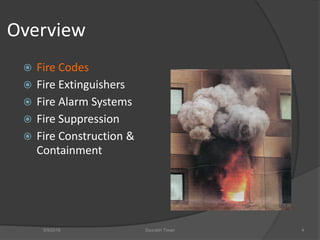
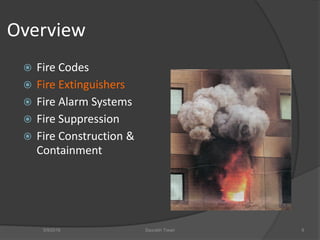
Overview
 Fire Codes
 Fire Extinguishers
 Fire Alarm Systems
 Fire Suppression
 Fire Construction &
Containment
5/9/2016 Saurabh Tiwari 4
Fire Codes
 National Fire Protection Association (NFPA)
5/9/2016 Saurabh Tiwari 5
National Fire Protection Association (NFPA)
 NFPA 13 – Fire Sprinklers
 System requirements & installation
 Water supplies
 System inspection, testing, & maintenance
 NFPA 72 – Fire Alarms
 System design requirements
 Inspection, testing, & maintenance
5/9/2016 Saurabh Tiwari 6
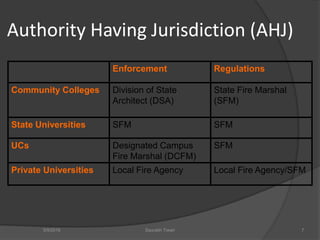
Authority Having Jurisdiction (AHJ)
Enforcement Regulations
Community Colleges Division of State
Architect (DSA)
State Fire Marshal
(SFM)
State Universities SFM SFM
UCs Designated Campus
Fire Marshal (DCFM)
SFM
Private Universities Local Fire Agency Local Fire Agency/SFM
5/9/2016 Saurabh Tiwari 7
Fire Code Questions?
5/9/2016 Saurabh Tiwari 8
Overview
 Fire Codes
 Fire Extinguishers
 Fire Alarm Systems
 Fire Suppression
 Fire Construction &
Containment
5/9/2016 Saurabh Tiwari 9
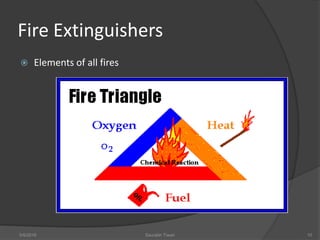
Fire Extinguishers
 Elements of all fires
5/9/2016 Saurabh Tiwari 10
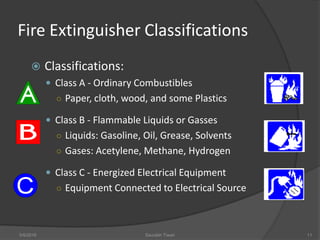
Fire Extinguisher Classifications
 Classifications:
 Class A - Ordinary Combustibles
○ Paper, cloth, wood, and some Plastics
 Class B - Flammable Liquids or Gasses
○ Liquids: Gasoline, Oil, Grease, Solvents
○ Gases: Acetylene, Methane, Hydrogen
 Class C - Energized Electrical Equipment
○ Equipment Connected to Electrical Source
5/9/2016 Saurabh Tiwari 11
Extinguisher Ratings
 Sample extinguisher UL listing
4-A:20-B:C
○ Good for Class A, B, and C fires
○ Will extinguish twice as much Class A fire as a 2-A
rated extinguisher
○ Will extinguish 20 times as much Class B fire as a
1-B rated extinguisher
○ Suitable for Class C fires
5/9/2016 Saurabh Tiwari 12
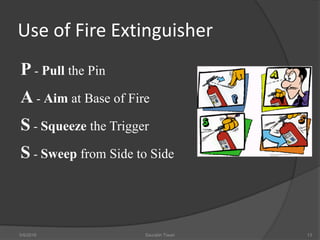
Use of Fire Extinguisher
P - Pull the Pin
A - Aim at Base of Fire
S - Squeeze the Trigger
S - Sweep from Side to Side
5/9/2016 Saurabh Tiwari 13
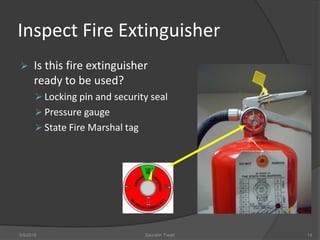
Inspect Fire Extinguisher
 Is this fire extinguisher
ready to be used?
 Locking pin and security seal
 Pressure gauge
 State Fire Marshal tag
5/9/2016 Saurabh Tiwari 14
Fire Extinguisher Questions?
5/9/2016 Saurabh Tiwari 15
Overview
 Fire Codes
 Fire Extinguishers
 Fire Alarm Systems
 Fire Suppression
 Fire Construction &
Containment
5/9/2016 Saurabh Tiwari 16
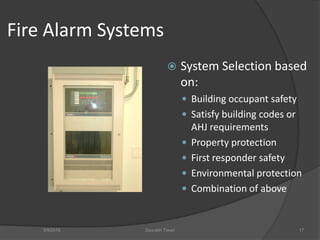
Fire Alarm Systems
 System Selection based
on:
 Building occupant safety
 Satisfy building codes or
AHJ requirements
 Property protection
 First responder safety
 Environmental protection
 Combination of above
5/9/2016 Saurabh Tiwari 17
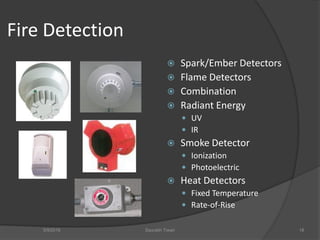
Fire Detection
 Spark/Ember Detectors
 Flame Detectors
 Combination
 Radiant Energy
 UV
 IR
 Smoke Detector
 Ionization
 Photoelectric
 Heat Detectors
 Fixed Temperature
 Rate-of-Rise
5/9/2016 Saurabh Tiwari 18
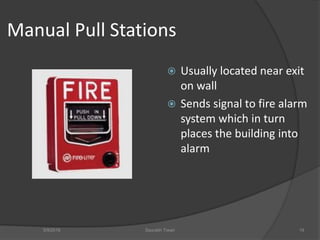
Manual Pull Stations
 Usually located near exit
on wall
 Sends signal to fire alarm
system which in turn
places the building into
alarm
5/9/2016 Saurabh Tiwari 19
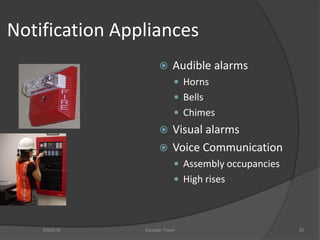
Notification Appliances
 Audible alarms
 Horns
 Bells
 Chimes
 Visual alarms
 Voice Communication
 Assembly occupancies
 High rises
5/9/2016 Saurabh Tiwari 20
Fire Alarm Questions?
5/9/2016 Saurabh Tiwari 21
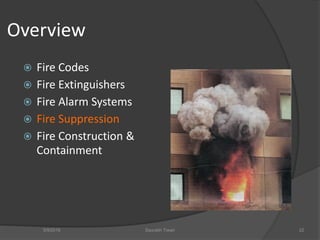
Overview
 Fire Codes
 Fire Extinguishers
 Fire Alarm Systems
 Fire Suppression
 Fire Construction &
Containment
5/9/2016 Saurabh Tiwari 22
Fire Suppression Systems
 4 categories of sprinkler systems
 Wet-Pipe
 Dry-Pipe
 Preaction
 Deluge
5/9/2016 Saurabh Tiwari 23
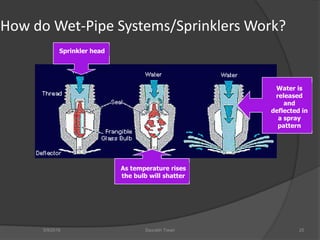
Wet-Pipe System (Sprinklers)
 System contains water under pressure at all
times
 Series of closed sprinkler heads
 Heat activates sprinkler head
 Water discharged immediately from
sprinkler head
5/9/2016 Saurabh Tiwari 24
How do Wet-Pipe Systems/Sprinklers Work?
5/9/2016
Sprinkler head
As temperature rises
the bulb will shatter
Water is
released
and
deflected in
a spray
pattern
Saurabh Tiwari 25
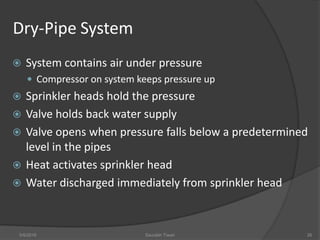
Dry-Pipe System
 System contains air under pressure
 Compressor on system keeps pressure up
 Sprinkler heads hold the pressure
 Valve holds back water supply
 Valve opens when pressure falls below a predetermined
level in the pipes
 Heat activates sprinkler head
 Water discharged immediately from sprinkler head
5/9/2016 Saurabh Tiwari 26
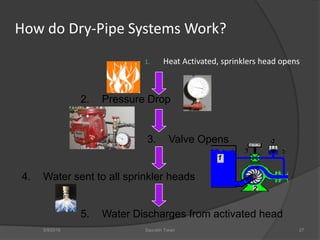
How do Dry-Pipe Systems Work?
1. Heat Activated, sprinklers head opens
5/9/2016
2. Pressure Drop
3. Valve Opens
4. Water sent to all sprinkler heads
5. Water Discharges from activated head
Saurabh Tiwari 27
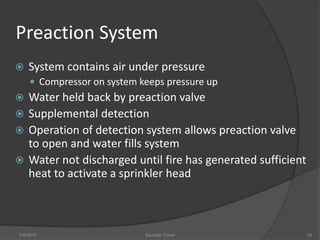
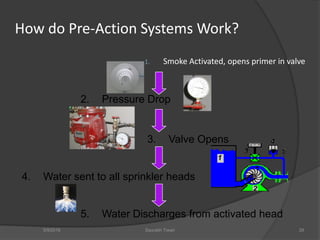
Preaction System
 System contains air under pressure
 Compressor on system keeps pressure up
 Water held back by preaction valve
 Supplemental detection
 Operation of detection system allows preaction valve
to open and water fills system
 Water not discharged until fire has generated sufficient
heat to activate a sprinkler head
5/9/2016 Saurabh Tiwari 28
How do Pre-Action Systems Work?
1. Smoke Activated, opens primer in valve
5/9/2016
2. Pressure Drop
3. Valve Opens
4. Water sent to all sprinkler heads
5. Water Discharges from activated head
Saurabh Tiwari 29
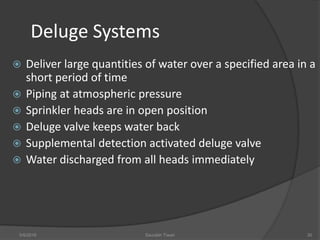
Deluge Systems
 Deliver large quantities of water over a specified area in a
short period of time
 Piping at atmospheric pressure
 Sprinkler heads are in open position
 Deluge valve keeps water back
 Supplemental detection activated deluge valve
 Water discharged from all heads immediately
5/9/2016 Saurabh Tiwari 30
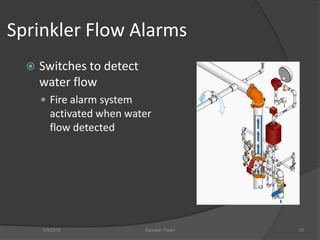
Sprinkler Flow Alarms
 Switches to detect
water flow
 Fire alarm system
activated when water
flow detected
5/9/2016 Saurabh Tiwari 31
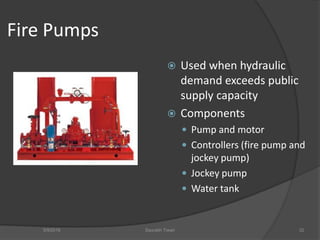
Fire Pumps
 Used when hydraulic
demand exceeds public
supply capacity
 Components
 Pump and motor
 Controllers (fire pump and
jockey pump)
 Jockey pump
 Water tank
5/9/2016 Saurabh Tiwari 32
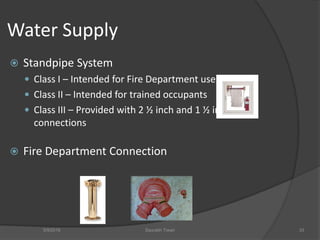
Water Supply
 Standpipe System
 Class I – Intended for Fire Department use
 Class II – Intended for trained occupants
 Class III – Provided with 2 ½ inch and 1 ½ inch hose
connections
 Fire Department Connection
5/9/2016 Saurabh Tiwari 33
Overview
 Fire Codes
 Fire Extinguishers
 Fire Alarm Systems
 Fire Suppression
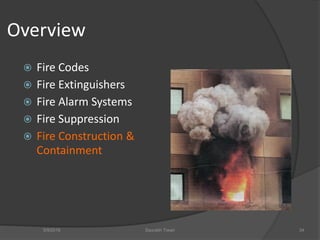
 Fire Construction &
Containment
5/9/2016 Saurabh Tiwari 34
Construction and Containment
 Buildings classified by 9 levels of fire resistant
materials (e.g. walls, roofs, columns)
High level – Type I (High Rise)
Low Level – Type V Non-Rated (Homes)
5/9/2016 Saurabh Tiwari 35
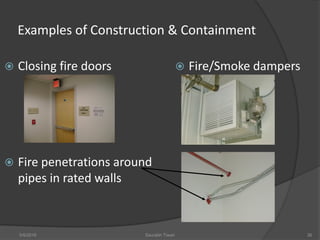
Examples of Construction & Containment
5/9/2016
 Closing fire doors
 Fire penetrations around
pipes in rated walls
 Fire/Smoke dampers
Saurabh Tiwari 36
Know Your Building
 Become familiar with:
 Locations of sprinklers and standpipe
 Location of fire alarm devices
 Locations of exits and egress
 Emergency evacuation routes
 Do you have emergency power – where located?
5/9/2016 Saurabh Tiwari 37
Fire Construction & Containment
Questions?
5/9/2016 Saurabh Tiwari 38
Conclusions
 Codes drive facility fire and life safety
requirements
 Know what codes apply to your operation
 Find out who is your AHJ
 Maintain fire and life safety systems at all times
 Always report non-operational fire systems to
your appropriate department
 Be aware of fire hazards – report as
appropriate
5/9/2016 Saurabh Tiwari 39

Fire safety

  • 2.
    Overview  Awareness ofFire Hazards  Fire Safety Systems ○ Fire Codes ○ Fire Extinguishers ○ Fire Alarms ○ Fire Suppression ○ Fire Construction and Containment 5/9/2016 Saurabh Tiwari 2
  • 3.
    Group Exercise What aresome fire hazards that you may encounter in your facilities? 5/9/2016 Saurabh Tiwari 3
  • 4.
    Overview  Fire Codes Fire Extinguishers  Fire Alarm Systems  Fire Suppression  Fire Construction & Containment 5/9/2016 Saurabh Tiwari 4
  • 5.
    Fire Codes  NationalFire Protection Association (NFPA) 5/9/2016 Saurabh Tiwari 5
  • 6.
    National Fire ProtectionAssociation (NFPA)  NFPA 13 – Fire Sprinklers  System requirements & installation  Water supplies  System inspection, testing, & maintenance  NFPA 72 – Fire Alarms  System design requirements  Inspection, testing, & maintenance 5/9/2016 Saurabh Tiwari 6
  • 7.
    Authority Having Jurisdiction(AHJ) Enforcement Regulations Community Colleges Division of State Architect (DSA) State Fire Marshal (SFM) State Universities SFM SFM UCs Designated Campus Fire Marshal (DCFM) SFM Private Universities Local Fire Agency Local Fire Agency/SFM 5/9/2016 Saurabh Tiwari 7
  • 8.
  • 9.
    Overview  Fire Codes Fire Extinguishers  Fire Alarm Systems  Fire Suppression  Fire Construction & Containment 5/9/2016 Saurabh Tiwari 9
  • 10.
    Fire Extinguishers  Elementsof all fires 5/9/2016 Saurabh Tiwari 10
  • 11.
    Fire Extinguisher Classifications Classifications:  Class A - Ordinary Combustibles ○ Paper, cloth, wood, and some Plastics  Class B - Flammable Liquids or Gasses ○ Liquids: Gasoline, Oil, Grease, Solvents ○ Gases: Acetylene, Methane, Hydrogen  Class C - Energized Electrical Equipment ○ Equipment Connected to Electrical Source 5/9/2016 Saurabh Tiwari 11
  • 12.
    Extinguisher Ratings  Sampleextinguisher UL listing 4-A:20-B:C ○ Good for Class A, B, and C fires ○ Will extinguish twice as much Class A fire as a 2-A rated extinguisher ○ Will extinguish 20 times as much Class B fire as a 1-B rated extinguisher ○ Suitable for Class C fires 5/9/2016 Saurabh Tiwari 12
  • 13.
    Use of FireExtinguisher P - Pull the Pin A - Aim at Base of Fire S - Squeeze the Trigger S - Sweep from Side to Side 5/9/2016 Saurabh Tiwari 13
  • 14.
    Inspect Fire Extinguisher Is this fire extinguisher ready to be used?  Locking pin and security seal  Pressure gauge  State Fire Marshal tag 5/9/2016 Saurabh Tiwari 14
  • 15.
  • 16.
    Overview  Fire Codes Fire Extinguishers  Fire Alarm Systems  Fire Suppression  Fire Construction & Containment 5/9/2016 Saurabh Tiwari 16
  • 17.
    Fire Alarm Systems System Selection based on:  Building occupant safety  Satisfy building codes or AHJ requirements  Property protection  First responder safety  Environmental protection  Combination of above 5/9/2016 Saurabh Tiwari 17
  • 18.
    Fire Detection  Spark/EmberDetectors  Flame Detectors  Combination  Radiant Energy  UV  IR  Smoke Detector  Ionization  Photoelectric  Heat Detectors  Fixed Temperature  Rate-of-Rise 5/9/2016 Saurabh Tiwari 18
  • 19.
    Manual Pull Stations Usually located near exit on wall  Sends signal to fire alarm system which in turn places the building into alarm 5/9/2016 Saurabh Tiwari 19
  • 20.
    Notification Appliances  Audiblealarms  Horns  Bells  Chimes  Visual alarms  Voice Communication  Assembly occupancies  High rises 5/9/2016 Saurabh Tiwari 20
  • 21.
  • 22.
    Overview  Fire Codes Fire Extinguishers  Fire Alarm Systems  Fire Suppression  Fire Construction & Containment 5/9/2016 Saurabh Tiwari 22
  • 23.
    Fire Suppression Systems 4 categories of sprinkler systems  Wet-Pipe  Dry-Pipe  Preaction  Deluge 5/9/2016 Saurabh Tiwari 23
  • 24.
    Wet-Pipe System (Sprinklers) System contains water under pressure at all times  Series of closed sprinkler heads  Heat activates sprinkler head  Water discharged immediately from sprinkler head 5/9/2016 Saurabh Tiwari 24
  • 25.
    How do Wet-PipeSystems/Sprinklers Work? 5/9/2016 Sprinkler head As temperature rises the bulb will shatter Water is released and deflected in a spray pattern Saurabh Tiwari 25
  • 26.
    Dry-Pipe System  Systemcontains air under pressure  Compressor on system keeps pressure up  Sprinkler heads hold the pressure  Valve holds back water supply  Valve opens when pressure falls below a predetermined level in the pipes  Heat activates sprinkler head  Water discharged immediately from sprinkler head 5/9/2016 Saurabh Tiwari 26
  • 27.
    How do Dry-PipeSystems Work? 1. Heat Activated, sprinklers head opens 5/9/2016 2. Pressure Drop 3. Valve Opens 4. Water sent to all sprinkler heads 5. Water Discharges from activated head Saurabh Tiwari 27
  • 28.
    Preaction System  Systemcontains air under pressure  Compressor on system keeps pressure up  Water held back by preaction valve  Supplemental detection  Operation of detection system allows preaction valve to open and water fills system  Water not discharged until fire has generated sufficient heat to activate a sprinkler head 5/9/2016 Saurabh Tiwari 28
  • 29.
    How do Pre-ActionSystems Work? 1. Smoke Activated, opens primer in valve 5/9/2016 2. Pressure Drop 3. Valve Opens 4. Water sent to all sprinkler heads 5. Water Discharges from activated head Saurabh Tiwari 29
  • 30.
    Deluge Systems  Deliverlarge quantities of water over a specified area in a short period of time  Piping at atmospheric pressure  Sprinkler heads are in open position  Deluge valve keeps water back  Supplemental detection activated deluge valve  Water discharged from all heads immediately 5/9/2016 Saurabh Tiwari 30
  • 31.
    Sprinkler Flow Alarms Switches to detect water flow  Fire alarm system activated when water flow detected 5/9/2016 Saurabh Tiwari 31
  • 32.
    Fire Pumps  Usedwhen hydraulic demand exceeds public supply capacity  Components  Pump and motor  Controllers (fire pump and jockey pump)  Jockey pump  Water tank 5/9/2016 Saurabh Tiwari 32
  • 33.
    Water Supply  StandpipeSystem  Class I – Intended for Fire Department use  Class II – Intended for trained occupants  Class III – Provided with 2 ½ inch and 1 ½ inch hose connections  Fire Department Connection 5/9/2016 Saurabh Tiwari 33
  • 34.
    Overview  Fire Codes Fire Extinguishers  Fire Alarm Systems  Fire Suppression  Fire Construction & Containment 5/9/2016 Saurabh Tiwari 34
  • 35.
    Construction and Containment Buildings classified by 9 levels of fire resistant materials (e.g. walls, roofs, columns) High level – Type I (High Rise) Low Level – Type V Non-Rated (Homes) 5/9/2016 Saurabh Tiwari 35
  • 36.
    Examples of Construction& Containment 5/9/2016  Closing fire doors  Fire penetrations around pipes in rated walls  Fire/Smoke dampers Saurabh Tiwari 36
  • 37.
    Know Your Building Become familiar with:  Locations of sprinklers and standpipe  Location of fire alarm devices  Locations of exits and egress  Emergency evacuation routes  Do you have emergency power – where located? 5/9/2016 Saurabh Tiwari 37
  • 38.
    Fire Construction &Containment Questions? 5/9/2016 Saurabh Tiwari 38
  • 39.
    Conclusions  Codes drivefacility fire and life safety requirements  Know what codes apply to your operation  Find out who is your AHJ  Maintain fire and life safety systems at all times  Always report non-operational fire systems to your appropriate department  Be aware of fire hazards – report as appropriate 5/9/2016 Saurabh Tiwari 39