Corporate  Citizenship, Social Responsibility, Responsiveness,  and Performance 12/1/2011 By Saurabh Kumar
Introductions The focus is on corporate social responsibility, which involves responsibilities outside of making a profit and the key questions for corporations include:  Does business have a social responsibility? If so, what is the extent and type of the responsibility? 12/1/2011 By Saurabh Kumar
Corporate Social Responsibility (CSR) Preliminary definitions of CSR The impact of a company’s actions on society Requires a manager to consider his acts in terms of a whole social system, and holds him responsible for the effects of his acts anywhere in that system 12/1/2011 By Saurabh Kumar
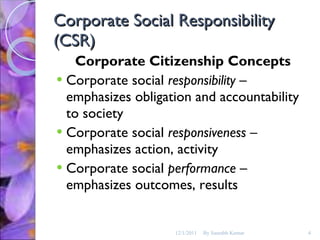
Corporate Social Responsibility (CSR) Corporate Citizenship Concepts Corporate social  responsibility  – emphasizes obligation and accountability to society Corporate social  responsiveness  – emphasizes action, activity Corporate social  performance  – emphasizes outcomes, results 12/1/2011 By Saurabh Kumar
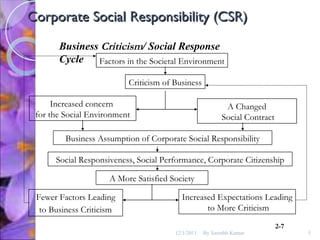
Corporate Social Responsibility (CSR) Business  Criticism / Social Response Cycle Factors in the Societal Environment Criticism of Business Increased concern  for the Social Environment A Changed Social Contract Business Assumption of Corporate Social Responsibility Social Responsiveness, Social Performance, Corporate Citizenship A More Satisfied Society Fewer Factors Leading to Business Criticism   Increased Expectations Leading to More Criticism 2-7 12/1/2011 By Saurabh Kumar
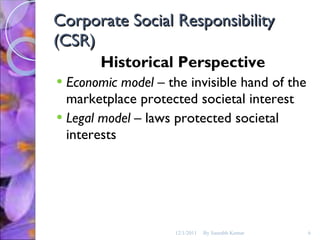
Corporate Social Responsibility (CSR) Historical Perspective Economic model  – the invisible hand of the marketplace protected societal interest Legal model  – laws protected societal interests 12/1/2011 By Saurabh Kumar
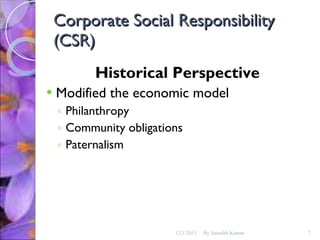
Corporate Social Responsibility (CSR) Historical Perspective Modified the economic model Philanthropy Community obligations Paternalism 12/1/2011 By Saurabh Kumar
Corporate Social Responsibility (CSR) Historical Perspective What was the main motivation? To keep government at arms length 12/1/2011 By Saurabh Kumar
Corporate Social Responsibility (CSR) Historical Perspective From the 1950’s to the present the concept of CSR has gained considerable acceptance and the meaning has been broadened to include additional components 12/1/2011 By Saurabh Kumar
Corporate Social Responsibility (CSR) Evolving Viewpoints CSR considers the impact of the company’s actions on society (Bauer) CSR requires decision makers to take actions that protect and improve the welfare of society as a whole along with their own interests (Davis and Blomstrom) 12/1/2011 By Saurabh Kumar
Corporate Social Responsibility (CSR) Evolving Viewpoints CSR mandates that the corporation has not only economic and legal obligations, but also certain responsibilities to society that extend beyond these obligations (McGuire) 12/1/2011 By Saurabh Kumar
Corporate Social Responsibility (CSR) Evolving Viewpoints CSR relates primarily to achieving outcomes from organizational decisions concerning specific issues or problems, which by some normative standard have beneficial rather than adverse effects upon pertinent corporate stakeholders.  The normative correctness of the products of corporate action have been the main focus of CSR (Epstein) 12/1/2011 By Saurabh Kumar
Corporate Social Responsibility (CSR) Carroll’s Four Part Definition CSR encompasses the economic, legal, ethical and discretionary (philanthropic) expectations that society has of organizations at a given point in time 12/1/2011 By Saurabh Kumar
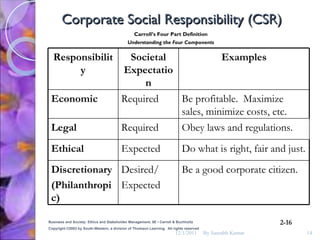
Corporate Social Responsibility (CSR) Carroll’s Four Part Definition Understanding the Four Components Business and Society: Ethics and Stakeholder Management, 5E • Carroll & Buchholtz Copyright ©2003 by South-Western, a division of Thomson Learning.  All rights reserved 2-16 12/1/2011 By Saurabh Kumar Responsibility Societal Expectation Examples Economic Required Be profitable.  Maximize sales, minimize costs, etc. Legal Required Obey laws and regulations. Ethical Expected Do what is right, fair and just. Discretionary (Philanthropic) Desired/ Expected Be a good corporate citizen.
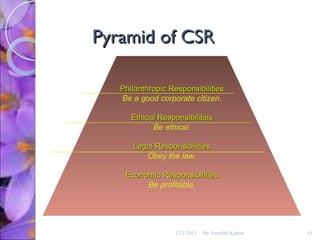
Pyramid of CSR Philanthropic Responsibilities Be a good corporate citizen. Ethical Responsibilities Be ethical. Legal Responsibilities Obey the law. Economic Responsibilities Be profitable. 12/1/2011 By Saurabh Kumar
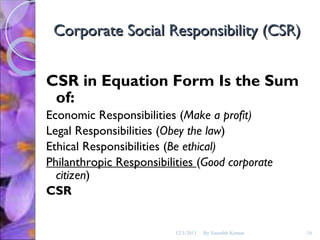
Corporate Social Responsibility (CSR) CSR in Equation Form Is the Sum of: Economic Responsibilities ( Make a profit) Legal Responsibilities ( Obey the law ) Ethical Responsibilities ( Be ethical) Philanthropic Responsibilities  ( Good corporate citizen ) CSR 12/1/2011 By Saurabh Kumar
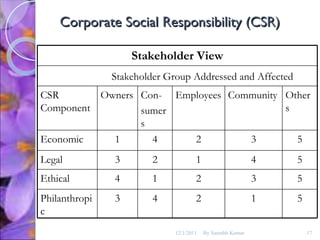
Corporate Social Responsibility (CSR) 12/1/2011 By Saurabh Kumar Stakeholder View Stakeholder Group Addressed and Affected CSR Component Owners Con- sumers Employees Community Others Economic 1 4 2 3 5 Legal 3 2 1 4 5 Ethical 4 1 2 3 5 Philanthropic 3 4 2 1 5
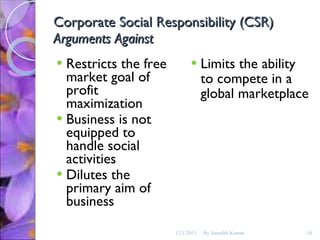
Corporate Social Responsibility (CSR) Arguments Against Restricts the free market goal of profit maximization Business is not equipped to handle social activities Dilutes the primary aim of business Limits the ability to compete in a global marketplace 12/1/2011 By Saurabh Kumar
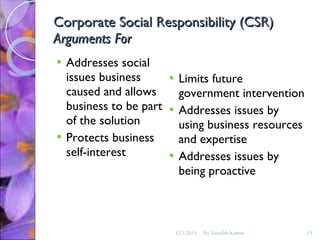
Corporate Social Responsibility (CSR) Arguments For Addresses social issues business caused and allows business to be part of the solution Protects business self-interest Limits future government intervention Addresses issues by using business resources and expertise  Addresses issues by being proactive  12/1/2011 By Saurabh Kumar
Corporate Social Responsibility (CSR) Business  Responsibilities in the 21 st  Century Demonstrate a commitment to society’s values and contribute to society’s social, environmental, and economic goals through action. Insulate society from the negative impacts of  company operations, products and services. Share benefits of company activities with key stakeholders as well as with shareholders. Demonstrate that the company can make more money by doing the right thing.  12/1/2011 By Saurabh Kumar
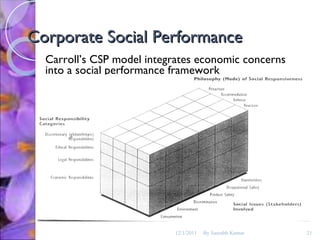
Corporate Social Performance Carroll’s CSP model integrates economic concerns into a social performance framework 12/1/2011 By Saurabh Kumar
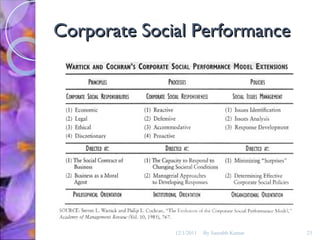
Corporate Social Performance Extensions and Reformulations Wartick and Cochran’s extensions Wood’s reformulations Swanson’s Reorientation 12/1/2011 By Saurabh Kumar
Corporate Social Performance 12/1/2011 By Saurabh Kumar
Corporate Citizenship Corporate citizenship  embraces all the facets of corporate social responsibility, responsiveness and performance 12/1/2011 By Saurabh Kumar
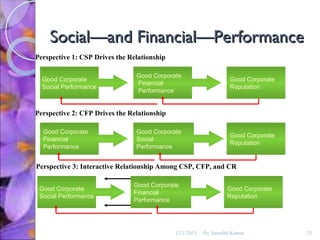
Social—and Financial—Performance Good Corporate Social Performance Perspective 1: CSP Drives the Relationship Good Corporate  Financial  Performance Good Corporate Reputation Good Corporate Financial Performance Perspective 2: CFP Drives the Relationship Good Corporate Social  Performance Good Corporate Reputation Good Corporate Social Performance Perspective 3: Interactive Relationship Among CSP, CFP, and CR Good Corporate Financial Performance Good Corporate Reputation 12/1/2011 By Saurabh Kumar
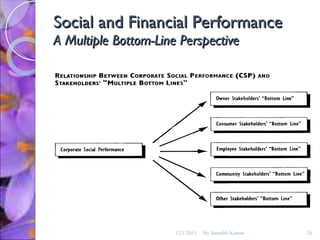
Social and Financial Performance A Multiple Bottom-Line Perspective 12/1/2011 By Saurabh Kumar
Socially Conscious or Ethical Investing Social screening  is a technique used to screen firms for investment purposes 12/1/2011 By Saurabh Kumar

Corporate Social Responsibility ppt.

  • 1.
    Corporate Citizenship,Social Responsibility, Responsiveness, and Performance 12/1/2011 By Saurabh Kumar
  • 2.
    Introductions The focusis on corporate social responsibility, which involves responsibilities outside of making a profit and the key questions for corporations include: Does business have a social responsibility? If so, what is the extent and type of the responsibility? 12/1/2011 By Saurabh Kumar
  • 3.
    Corporate Social Responsibility(CSR) Preliminary definitions of CSR The impact of a company’s actions on society Requires a manager to consider his acts in terms of a whole social system, and holds him responsible for the effects of his acts anywhere in that system 12/1/2011 By Saurabh Kumar
  • 4.
    Corporate Social Responsibility(CSR) Corporate Citizenship Concepts Corporate social responsibility – emphasizes obligation and accountability to society Corporate social responsiveness – emphasizes action, activity Corporate social performance – emphasizes outcomes, results 12/1/2011 By Saurabh Kumar
  • 5.
    Corporate Social Responsibility(CSR) Business Criticism / Social Response Cycle Factors in the Societal Environment Criticism of Business Increased concern for the Social Environment A Changed Social Contract Business Assumption of Corporate Social Responsibility Social Responsiveness, Social Performance, Corporate Citizenship A More Satisfied Society Fewer Factors Leading to Business Criticism Increased Expectations Leading to More Criticism 2-7 12/1/2011 By Saurabh Kumar
  • 6.
    Corporate Social Responsibility(CSR) Historical Perspective Economic model – the invisible hand of the marketplace protected societal interest Legal model – laws protected societal interests 12/1/2011 By Saurabh Kumar
  • 7.
    Corporate Social Responsibility(CSR) Historical Perspective Modified the economic model Philanthropy Community obligations Paternalism 12/1/2011 By Saurabh Kumar
  • 8.
    Corporate Social Responsibility(CSR) Historical Perspective What was the main motivation? To keep government at arms length 12/1/2011 By Saurabh Kumar
  • 9.
    Corporate Social Responsibility(CSR) Historical Perspective From the 1950’s to the present the concept of CSR has gained considerable acceptance and the meaning has been broadened to include additional components 12/1/2011 By Saurabh Kumar
  • 10.
    Corporate Social Responsibility(CSR) Evolving Viewpoints CSR considers the impact of the company’s actions on society (Bauer) CSR requires decision makers to take actions that protect and improve the welfare of society as a whole along with their own interests (Davis and Blomstrom) 12/1/2011 By Saurabh Kumar
  • 11.
    Corporate Social Responsibility(CSR) Evolving Viewpoints CSR mandates that the corporation has not only economic and legal obligations, but also certain responsibilities to society that extend beyond these obligations (McGuire) 12/1/2011 By Saurabh Kumar
  • 12.
    Corporate Social Responsibility(CSR) Evolving Viewpoints CSR relates primarily to achieving outcomes from organizational decisions concerning specific issues or problems, which by some normative standard have beneficial rather than adverse effects upon pertinent corporate stakeholders. The normative correctness of the products of corporate action have been the main focus of CSR (Epstein) 12/1/2011 By Saurabh Kumar
  • 13.
    Corporate Social Responsibility(CSR) Carroll’s Four Part Definition CSR encompasses the economic, legal, ethical and discretionary (philanthropic) expectations that society has of organizations at a given point in time 12/1/2011 By Saurabh Kumar
  • 14.
    Corporate Social Responsibility(CSR) Carroll’s Four Part Definition Understanding the Four Components Business and Society: Ethics and Stakeholder Management, 5E • Carroll & Buchholtz Copyright ©2003 by South-Western, a division of Thomson Learning.  All rights reserved 2-16 12/1/2011 By Saurabh Kumar Responsibility Societal Expectation Examples Economic Required Be profitable. Maximize sales, minimize costs, etc. Legal Required Obey laws and regulations. Ethical Expected Do what is right, fair and just. Discretionary (Philanthropic) Desired/ Expected Be a good corporate citizen.
  • 15.
    Pyramid of CSRPhilanthropic Responsibilities Be a good corporate citizen. Ethical Responsibilities Be ethical. Legal Responsibilities Obey the law. Economic Responsibilities Be profitable. 12/1/2011 By Saurabh Kumar
  • 16.
    Corporate Social Responsibility(CSR) CSR in Equation Form Is the Sum of: Economic Responsibilities ( Make a profit) Legal Responsibilities ( Obey the law ) Ethical Responsibilities ( Be ethical) Philanthropic Responsibilities ( Good corporate citizen ) CSR 12/1/2011 By Saurabh Kumar
  • 17.
    Corporate Social Responsibility(CSR) 12/1/2011 By Saurabh Kumar Stakeholder View Stakeholder Group Addressed and Affected CSR Component Owners Con- sumers Employees Community Others Economic 1 4 2 3 5 Legal 3 2 1 4 5 Ethical 4 1 2 3 5 Philanthropic 3 4 2 1 5
  • 18.
    Corporate Social Responsibility(CSR) Arguments Against Restricts the free market goal of profit maximization Business is not equipped to handle social activities Dilutes the primary aim of business Limits the ability to compete in a global marketplace 12/1/2011 By Saurabh Kumar
  • 19.
    Corporate Social Responsibility(CSR) Arguments For Addresses social issues business caused and allows business to be part of the solution Protects business self-interest Limits future government intervention Addresses issues by using business resources and expertise Addresses issues by being proactive 12/1/2011 By Saurabh Kumar
  • 20.
    Corporate Social Responsibility(CSR) Business Responsibilities in the 21 st Century Demonstrate a commitment to society’s values and contribute to society’s social, environmental, and economic goals through action. Insulate society from the negative impacts of company operations, products and services. Share benefits of company activities with key stakeholders as well as with shareholders. Demonstrate that the company can make more money by doing the right thing. 12/1/2011 By Saurabh Kumar
  • 21.
    Corporate Social PerformanceCarroll’s CSP model integrates economic concerns into a social performance framework 12/1/2011 By Saurabh Kumar
  • 22.
    Corporate Social PerformanceExtensions and Reformulations Wartick and Cochran’s extensions Wood’s reformulations Swanson’s Reorientation 12/1/2011 By Saurabh Kumar
  • 23.
    Corporate Social Performance12/1/2011 By Saurabh Kumar
  • 24.
    Corporate Citizenship Corporatecitizenship embraces all the facets of corporate social responsibility, responsiveness and performance 12/1/2011 By Saurabh Kumar
  • 25.
    Social—and Financial—Performance GoodCorporate Social Performance Perspective 1: CSP Drives the Relationship Good Corporate Financial Performance Good Corporate Reputation Good Corporate Financial Performance Perspective 2: CFP Drives the Relationship Good Corporate Social Performance Good Corporate Reputation Good Corporate Social Performance Perspective 3: Interactive Relationship Among CSP, CFP, and CR Good Corporate Financial Performance Good Corporate Reputation 12/1/2011 By Saurabh Kumar
  • 26.
    Social and FinancialPerformance A Multiple Bottom-Line Perspective 12/1/2011 By Saurabh Kumar
  • 27.
    Socially Conscious orEthical Investing Social screening is a technique used to screen firms for investment purposes 12/1/2011 By Saurabh Kumar

Editor's Notes

  • #2 1
  • #16 Source: Archie B. Carroll, “The Pyramid of Corporate Social Responsibility: Toward the Moral Management of Organizational Stakeholders,” Business Horizons (July-August 1981). © 1991 by the Foundation for the School of Business at Indiana University. Used with permission.