Hazardous Materials & Waste Overview
Agenda
 Purchasing
 Storage
 Use
 Disposal
5/9/2016 Saurabh Tiwari 2
Hazardous Materials
5/9/2016 Saurabh Tiwari 3
Purchasing
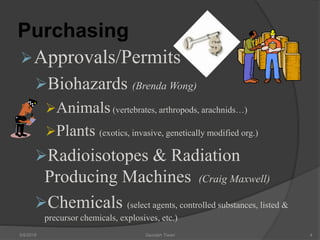
Approvals/Permits
Biohazards (Brenda Wong)
Animals(vertebrates, arthropods, arachnids…)
Plants (exotics, invasive, genetically modified org.)
Radioisotopes & Radiation
Producing Machines (Craig Maxwell)
Chemicals (select agents, controlled substances, listed &
precursor chemicals, explosives, etc.)
5/9/2016 Saurabh Tiwari 4
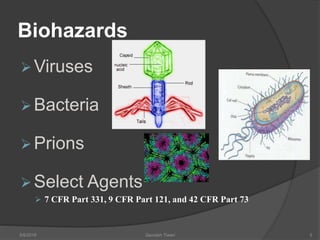
Biohazards
Viruses
 Bacteria
 Prions
Select Agents
 7 CFR Part 331, 9 CFR Part 121, and 42 CFR Part 73
5/9/2016 Saurabh Tiwari 5
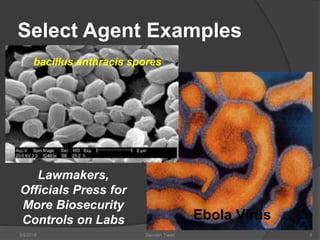
Select Agent Examples
5/9/2016 Saurabh Tiwari 6
Ebola Virus
bacillus anthracis spores
Lawmakers,
Officials Press for
More Biosecurity
Controls on Labs
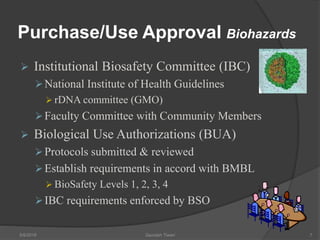
Purchase/Use Approval Biohazards
 Institutional Biosafety Committee (IBC)
National Institute of Health Guidelines
 rDNA committee (GMO)
Faculty Committee with Community Members
 Biological Use Authorizations (BUA)
Protocols submitted & reviewed
Establish requirements in accord with BMBL
 BioSafety Levels 1, 2, 3, 4
IBC requirements enforced by BSO
5/9/2016 Saurabh Tiwari 7
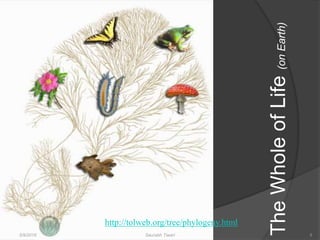
TheWholeofLife(onEarth)
http://tolweb.org/tree/phylogeny.html
5/9/2016 Saurabh Tiwari 8
Purchase/Use Approval
Vertebrate Animals
 Institutional Animal Care and Use Committee
(IACUC)
Federal Laws
 Animal Welfare Act Regulations (7 U.S.C. 2131 et. seq.)
 USDA 1995 (9 C.F.R., Chapter 1, Subchapter A)
 Health Research Extension Act of 1985
 Public Law 99-158 (NIST)
Faculty Committee with Community Members
 Animal Use Authorizations
IACUC enforced by Campus Vet
5/9/2016 Saurabh Tiwari 9
Purchase/Use Approval
Insects & Plants
 Animal & Plant Health Inspection Service
Import/Export permits & controls
Intrastate movement of plants and animals
 California Department of Food & Agriculture
CCR Title 3 et al. www.cdfa.ca.gov/Regulations.html
5/9/2016 Saurabh Tiwari 10
Plant Protection & Quarantine
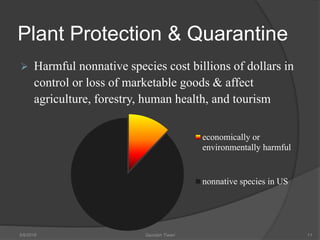
 Harmful nonnative species cost billions of dollars in
control or loss of marketable goods & affect
agriculture, forestry, human health, and tourism
5/9/2016 Saurabh Tiwari 11
economically or
environmentally harmful
nonnative species in US
Purchase/Use Approval
Radioactive Materials & Equipment
 Radiation Safety Committee (RSC)
Faculty Committee with Community Members
Radiologic Health Branch
 Radiation Control Law
 Health & Safety Code Sec. 114960 et seq.
 Radiologic Technology Act
 Health & Safety Code Sec. 27(f)
 Nuclear Medicine Technology Certification
 Health & Safety Code Secs. 107150 through 107175
 Title 17, California Code of Regulations, Division 1,
Chapter 5, Subchapters 4.0, 4.5, & 4.6.
5/9/2016 Saurabh Tiwari 12
Purchase/Use Approval
Non-ionizing Radiation
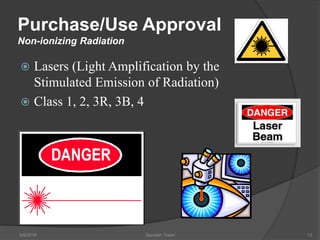
 Lasers (Light Amplification by the
Stimulated Emission of Radiation)
 Class 1, 2, 3R, 3B, 4
5/9/2016 Saurabh Tiwari 13
Laser Classes
 CLASS 1
 Safe under all conditions of normal use
 Class 1M -Safe for all conditions except when passed
through magnifying optics
 Class 2
 Safe because the blink reflex will limit the exposure to
no more than 0.25 seconds
 Class 2M- safe because of the blink reflex if not
viewed through optical instruments
 Class 3R
 Safe if handled carefully with restricted beam viewing
5/9/2016 Saurabh Tiwari 14
Laser Classes (continued)
 Class 3B
 Hazardous if the eye is exposed directly, but diffuse
reflections are not harmful
 Protective eyewear is required where direct viewing of
a class 3B laser beam may occur
 Must be equipped with a key switch and a safety
interlock
5/9/2016 Saurabh Tiwari 15
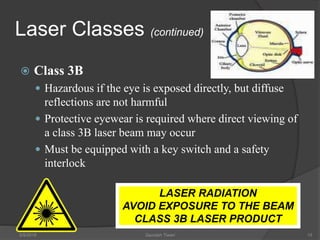
LASER RADIATION
AVOID EXPOSURE TO THE BEAM
CLASS 3B LASER PRODUCT
Laser Classes
(con’t)
 Class 4
 All lasers with beam power greater than class 3B
 Can burn the skin and permanently damage eyes as a
result of direct or diffuse beam viewing
 These lasers may ignite combustible materials, and thus
may represent a fire risk
 Must be equipped with a key switch and a safety interlock
5/9/2016 Saurabh Tiwari 16
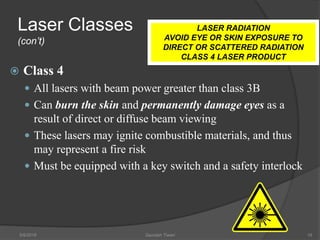
LASER RADIATION
AVOID EYE OR SKIN EXPOSURE TO
DIRECT OR SCATTERED RADIATION
CLASS 4 LASER PRODUCT
Plants
 Exotic & non-native species
 Genetically modified organisms
 Soils and more…
 ePermits www.aphis.usda.gov/permits
U.S. Department of Agriculture (USDA), Animal
and Plant Health Inspection Service (APHIS),
Veterinary Services (VS), National Center for
Import and Export (NCIE)
5/9/2016 Saurabh Tiwari 17
Plant Import & Export Info
 Plant Protection and Quarantine (PPQ)
 www.aphis.usda.gov/import_export/plants/manuals/online_manuals.shtml
 Domestic Programs
Detection, eradication, containment, or suppression of
pests or endangered plants protection
 Port Programs
exclude pests or to protect endangered plants
 Emergency Programs
immediate actions to eradicate a pest
5/9/2016 Saurabh Tiwari 18
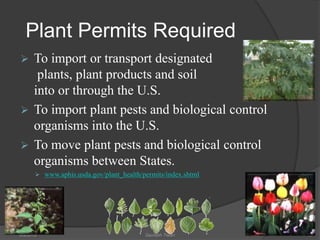
Plant Permits Required
 To import or transport designated
plants, plant products and soil
into or through the U.S.
 To import plant pests and biological control
organisms into the U.S.
 To move plant pests and biological control
organisms between States.
 www.aphis.usda.gov/plant_health/permits/index.shtml
5/9/2016 Saurabh Tiwari 19
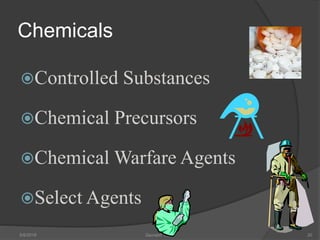
Chemicals
Controlled Substances
Chemical Precursors
Chemical Warfare Agents
Select Agents
5/9/2016 Saurabh Tiwari 20
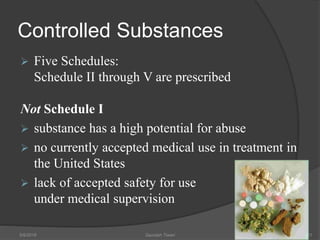
Controlled Substances
 Five Schedules:
Schedule II through V are prescribed
Not Schedule I
 substance has a high potential for abuse
 no currently accepted medical use in treatment in
the United States
 lack of accepted safety for use
under medical supervision
5/9/2016 Saurabh Tiwari 21
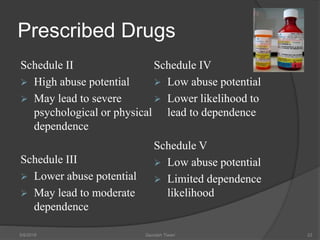
Prescribed Drugs
Schedule II
 High abuse potential
 May lead to severe
psychological or physical
dependence
Schedule III
 Lower abuse potential
 May lead to moderate
dependence
Schedule IV
 Low abuse potential
 Lower likelihood to
lead to dependence
Schedule V
 Low abuse potential
 Limited dependence
likelihood
5/9/2016 Saurabh Tiwari 22
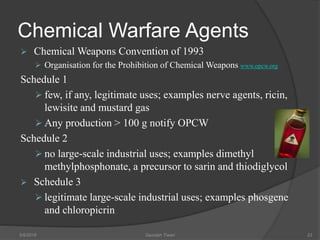
Chemical Warfare Agents
 Chemical Weapons Convention of 1993
 Organisation for the Prohibition of Chemical Weapons www.opcw.org
Schedule 1
 few, if any, legitimate uses; examples nerve agents, ricin,
lewisite and mustard gas
 Any production > 100 g notify OPCW
Schedule 2
 no large-scale industrial uses; examples dimethyl
methylphosphonate, a precursor to sarin and thiodiglycol
 Schedule 3
 legitimate large-scale industrial uses; examples phosgene
and chloropicrin
5/9/2016 Saurabh Tiwari 23
Select Agents
HHS AND USDA Select Agents AND TOXINS 7 CFR
Part 331, 9 CFR Part 121, and 42 CFR Part 73
 Abrin
 Botulinum neurotoxins
 Botulinum neurotoxin
producing species of
Clostridium
 Clostridium perfringens
epsilon toxin
 Conotoxins
 Diacetoxyscirpenol
 Ricin
 Saxitoxin
 Shiga-like ribosome
inactivating proteins
 Shigatoxin
 Staphylococcal enterotoxins
 T-2 toxin
 Tetrodotoxin
 Bovine spongiform
encephalopathy agent
5/9/2016 Saurabh Tiwari 24
Hazardous Materials
5/9/2016 Saurabh Tiwari 25
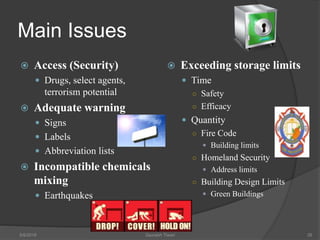
Main Issues
 Access (Security)
 Drugs, select agents,
terrorism potential
 Adequate warning
 Signs
 Labels
 Abbreviation lists
 Incompatible chemicals
mixing
 Earthquakes
 Exceeding storage limits
 Time
○ Safety
○ Efficacy
 Quantity
○ Fire Code
 Building limits
○ Homeland Security
 Address limits
○ Building Design Limits
 Green Buildings
5/9/2016 Saurabh Tiwari 26
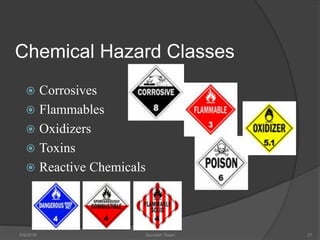
Chemical Hazard Classes
 Corrosives
 Flammables
 Oxidizers
 Toxins
 Reactive Chemicals
5/9/2016 Saurabh Tiwari 27
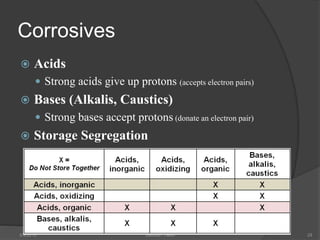
Corrosives
 Acids
 Strong acids give up protons (accepts electron pairs)
 Bases (Alkalis, Caustics)
 Strong bases accept protons (donate an electron pair)
 Storage Segregation
5/9/2016 Saurabh Tiwari 28
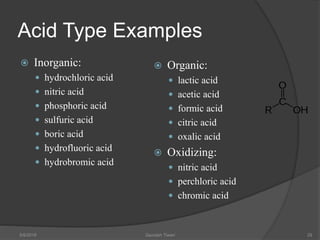
Acid Type Examples
 Inorganic:
 hydrochloric acid
 nitric acid
 phosphoric acid
 sulfuric acid
 boric acid
 hydrofluoric acid
 hydrobromic acid
 Organic:
 lactic acid
 acetic acid
 formic acid
 citric acid
 oxalic acid
 Oxidizing:
 nitric acid
 perchloric acid
 chromic acid
5/9/2016 Saurabh Tiwari 29
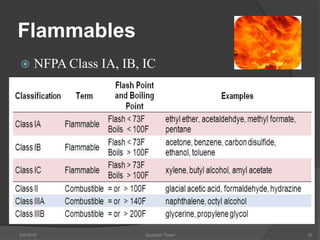
Flammables
 NFPA Class IA, IB, IC
5/9/2016 Saurabh Tiwari 30
Oxidize
4Fe + 3O2  2[Fe2O3]
Fe0  Fe+3 (O0  O-2)
1. combine with oxygen
2. dehydrogenate esp by action of oxygen
3. change (an element or ion) from a lower
to a higher positive valence : remove one
or more electrons
4. coat with oxide; make into an oxide
5/9/2016 Saurabh Tiwari 31
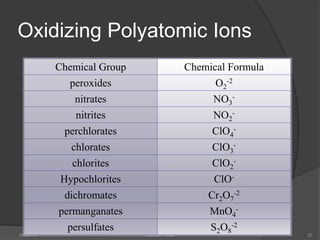
Oxidizing Polyatomic Ions
5/9/2016 Saurabh Tiwari 32
Chemical Group Chemical Formula
peroxides O2
-2
nitrates NO3
-
nitrites NO2
-
perchlorates ClO4
-
chlorates ClO3
-
chlorites ClO2
-
Hypochlorites ClO-
dichromates Cr2O7
-2
permanganates MnO4
-
persulfates S2O8
-2
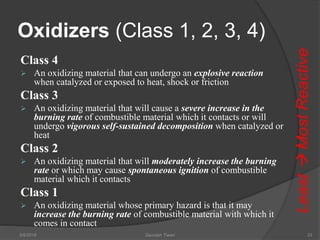
Oxidizers (Class 1, 2, 3, 4)
Class 4
 An oxidizing material that can undergo an explosive reaction
when catalyzed or exposed to heat, shock or friction
Class 3
 An oxidizing material that will cause a severe increase in the
burning rate of combustible material which it contacts or will
undergo vigorous self-sustained decomposition when catalyzed or
heat
Class 2
 An oxidizing material that will moderately increase the burning
rate or which may cause spontaneous ignition of combustible
material which it contacts
Class 1
 An oxidizing material whose primary hazard is that it may
increase the burning rate of combustible material with which it
comes in contact
5/9/2016 Saurabh Tiwari 33
LeastMostReactive
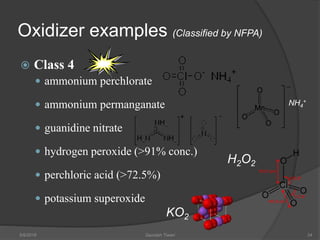
Oxidizer examples (Classified by NFPA)
 Class 4
 ammonium perchlorate
 ammonium permanganate
 guanidine nitrate
 hydrogen peroxide (>91% conc.)
 perchloric acid (>72.5%)
 potassium superoxide
5/9/2016 Saurabh Tiwari 34
NH4
+
H2O2
KO2
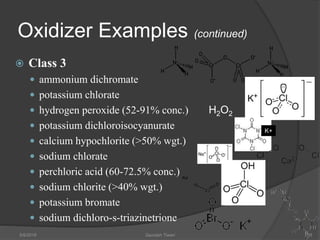
Oxidizer Examples (continued)
 Class 3
 ammonium dichromate
 potassium chlorate
 hydrogen peroxide (52-91% conc.)
 potassium dichloroisocyanurate
 calcium hypochlorite (>50% wgt.)
 sodium chlorate
 perchloric acid (60-72.5% conc.)
 sodium chlorite (>40% wgt.)
 potassium bromate
 sodium dichloro-s-triazinetrione
5/9/2016 Saurabh Tiwari 35
H2O2
K+
Example
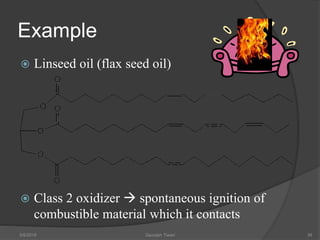
 Linseed oil (flax seed oil)
 Class 2 oxidizer  spontaneous ignition of
combustible material which it contacts
5/9/2016 Saurabh Tiwari 36
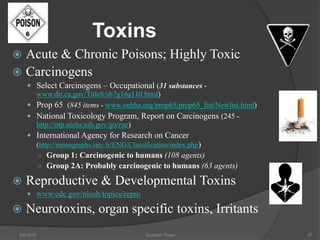
Toxins
 Acute & Chronic Poisons; Highly Toxic
 Carcinogens
 Select Carcinogens – Occupational (31 substances -
www.dir.ca.gov/Title8/sb7g16a110.html)
 Prop 65 (845 items - www.oehha.org/prop65/prop65_list/Newlist.html)
 National Toxicology Program, Report on Carcinogens (245 -
http://ntp.niehs.nih.gov/go/roc)
 International Agency for Research on Cancer
(http://monographs.iarc.fr/ENG/Classification/index.php)
○ Group 1: Carcinogenic to humans (108 agents)
○ Group 2A: Probably carcinogenic to humans (63 agents)
 Reproductive & Developmental Toxins
 www.cdc.gov/niosh/topics/repro
 Neurotoxins, organ specific toxins, Irritants
5/9/2016 Saurabh Tiwari 37
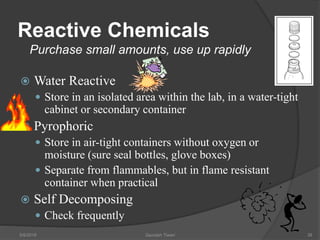
Reactive Chemicals
Purchase small amounts, use up rapidly
 Water Reactive
 Store in an isolated area within the lab, in a water-tight
cabinet or secondary container
 Pyrophoric
 Store in air-tight containers without oxygen or
moisture (sure seal bottles, glove boxes)
 Separate from flammables, but in flame resistant
container when practical
 Self Decomposing
 Check frequently
5/9/2016 Saurabh Tiwari 38
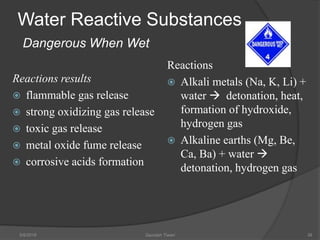
Water Reactive Substances
Dangerous When Wet
Reactions results
 flammable gas release
 strong oxidizing gas release
 toxic gas release
 metal oxide fume release
 corrosive acids formation
Reactions
 Alkali metals (Na, K, Li) +
water  detonation, heat,
formation of hydroxide,
hydrogen gas
 Alkaline earths (Mg, Be,
Ca, Ba) + water 
detonation, hydrogen gas
5/9/2016 Saurabh Tiwari 39
Dangerous When Wet Reactions
(continued)
 Hydrides (LiH, LiAlH4) +
water  hydrogen, caustic
solution
 Carbides of Al, Ca, Mg +
water  acetylene
liberated
 Phosphides + water 
phosphine gas
 Nitrides + water 
ammonia, caustic solution
 Metallic (inorganic, such
as potassium) peroxides +
water  oxygen gas and
heat
 Chlorides of group III
metals, transition metals,
non-metals (Al, Ti, S) +
water  hydrogen
chloride gas
5/9/2016 Saurabh Tiwari 40
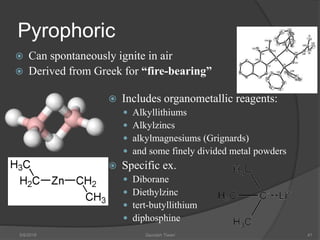
Pyrophoric
 Can spontaneously ignite in air
 Derived from Greek for “fire-bearing”
 Includes organometallic reagents:
 Alkyllithiums
 Alkylzincs
 alkylmagnesiums (Grignards)
 and some finely divided metal powders
 Specific ex.
 Diborane
 Diethylzinc
 tert-butyllithium
 diphosphine
5/9/2016 Saurabh Tiwari 41
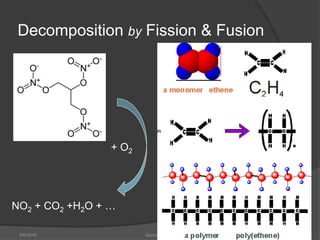
Decomposition by Fission & Fusion
5/9/2016 Saurabh Tiwari 42
NO2 + CO2 +H2O + …
+ O2
Hazardous Materials
5/9/2016 Saurabh Tiwari 43
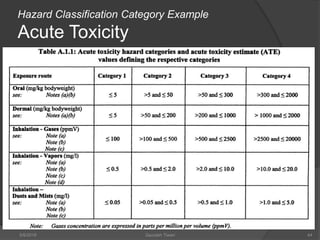
Hazard Classification Category Example
Acute Toxicity
5/9/2016 44Saurabh Tiwari
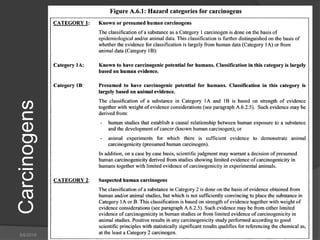
Carcinogens
5/9/2016 45Saurabh Tiwari
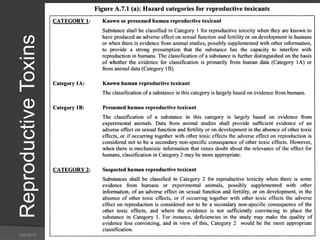
ReproductiveToxins
5/9/2016 46Saurabh Tiwari
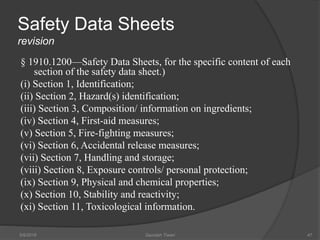
Safety Data Sheets
revision
§ 1910.1200—Safety Data Sheets, for the specific content of each
section of the safety data sheet.)
(i) Section 1, Identification;
(ii) Section 2, Hazard(s) identification;
(iii) Section 3, Composition/ information on ingredients;
(iv) Section 4, First-aid measures;
(v) Section 5, Fire-fighting measures;
(vi) Section 6, Accidental release measures;
(vii) Section 7, Handling and storage;
(viii) Section 8, Exposure controls/ personal protection;
(ix) Section 9, Physical and chemical properties;
(x) Section 10, Stability and reactivity;
(xi) Section 11, Toxicological information.
5/9/2016 Saurabh Tiwari 47
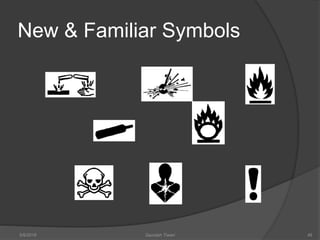
New & Familiar Symbols
5/9/2016 Saurabh Tiwari 48
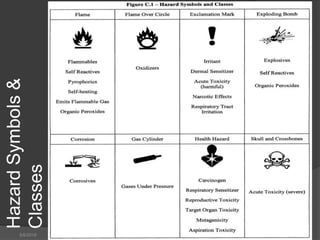
HazardSymbols&
Classes
5/9/2016 Saurabh Tiwari 49
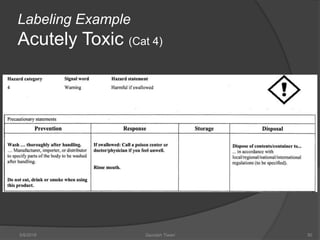
Labeling Example
Acutely Toxic (Cat 4)
5/9/2016 Saurabh Tiwari 50
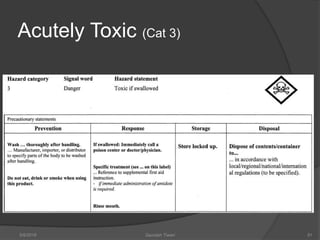
Acutely Toxic (Cat 3)
5/9/2016 51Saurabh Tiwari
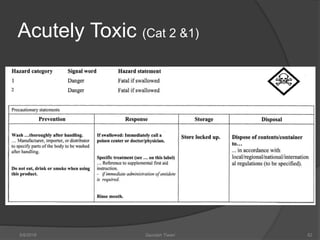
Acutely Toxic (Cat 2 &1)
5/9/2016 Saurabh Tiwari 52
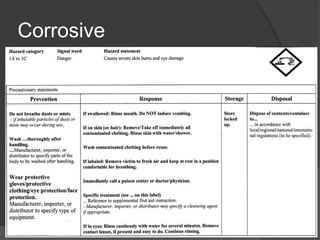
Corrosive
5/9/2016 Saurabh Tiwari 53
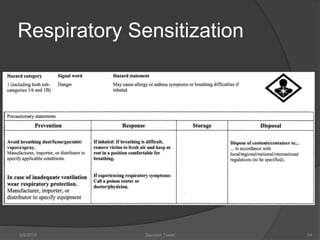
Respiratory Sensitization
5/9/2016 Saurabh Tiwari 54
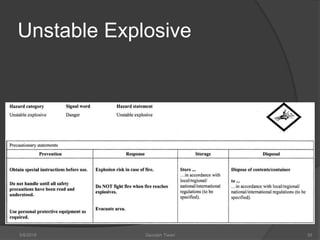
Unstable Explosive
5/9/2016 Saurabh Tiwari 55
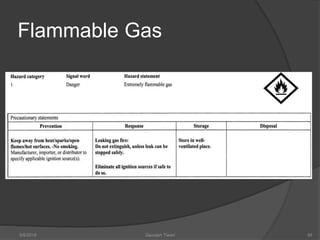
Flammable Gas
5/9/2016 Saurabh Tiwari 56
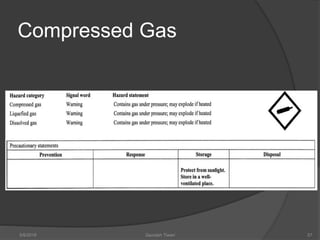
Compressed Gas
5/9/2016 Saurabh Tiwari 57
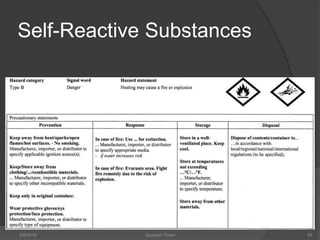
Self-Reactive Substances
5/9/2016 Saurabh Tiwari 58
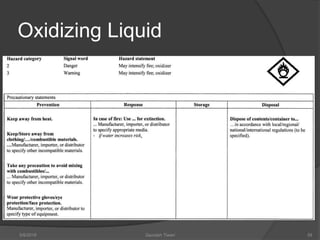
Oxidizing Liquid
5/9/2016 59Saurabh Tiwari
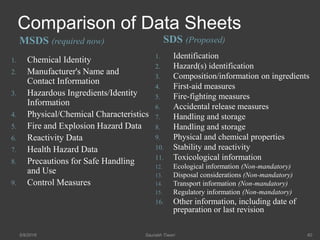
Comparison of Data Sheets
MSDS (required now) SDS (Proposed)
1. Chemical Identity
2. Manufacturer's Name and
Contact Information
3. Hazardous Ingredients/Identity
Information
4. Physical/Chemical Characteristics
5. Fire and Explosion Hazard Data
6. Reactivity Data
7. Health Hazard Data
8. Precautions for Safe Handling
and Use
9. Control Measures
1. Identification
2. Hazard(s) identification
3. Composition/information on ingredients
4. First-aid measures
5. Fire-fighting measures
6. Accidental release measures
7. Handling and storage
8. Handling and storage
9. Physical and chemical properties
10. Stability and reactivity
11. Toxicological information
12. Ecological information (Non-mandatory)
13. Disposal considerations (Non-mandatory)
14. Transport information (Non-mandatory)
15. Regulatory information (Non-mandatory)
16. Other information, including date of
preparation or last revision
5/9/2016 Saurabh Tiwari 60
Hazardous Materials
5/9/2016 Saurabh Tiwari 61
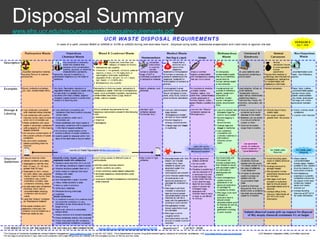
Disposal Summary
www.ehs.ucr.edu/resourceswastedisposalrequirements.pdf
5/9/2016 Saurabh Tiwari 62
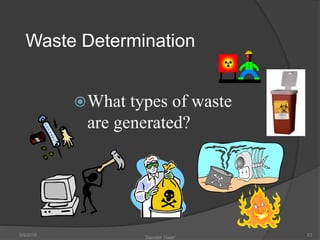
Waste Determination
What types of waste
are generated?
5/9/2016
Saurabh Tiwari
63
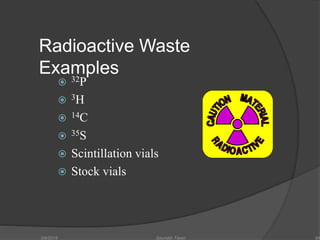
Radioactive Waste
Examples
 32P
 3H
 14C
 35S
 Scintillation vials
 Stock vials
5/9/2016 Saurabh Tiwari 64
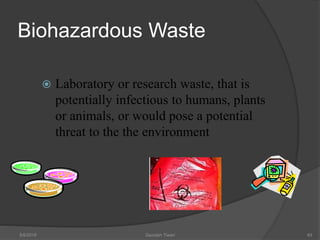
Biohazardous Waste
 Laboratory or research waste, that is
potentially infectious to humans, plants
or animals, or would pose a potential
threat to the the environment
5/9/2016 Saurabh Tiwari 65
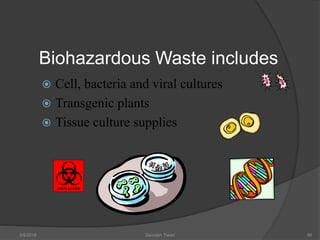
Biohazardous Waste includes
 Cell, bacteria and viral cultures
 Transgenic plants
 Tissue culture supplies
5/9/2016 Saurabh Tiwari 66
BIOHAZARD
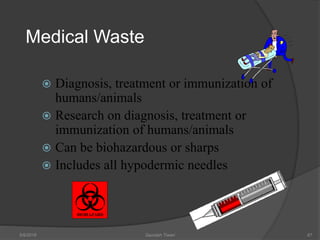
Medical Waste
 Diagnosis, treatment or immunization of
humans/animals
 Research on diagnosis, treatment or
immunization of humans/animals
 Can be biohazardous or sharps
 Includes all hypodermic needles
5/9/2016 Saurabh Tiwari 67
BIOHAZARD
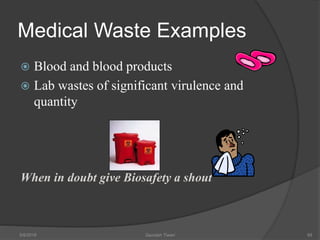
Medical Waste Examples
 Blood and blood products
 Lab wastes of significant virulence and
quantity
When in doubt give Biosafety a shout
5/9/2016 Saurabh Tiwari 68
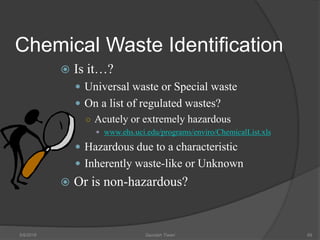
Chemical Waste Identification
 Is it…?
 Universal waste or Special waste
 On a list of regulated wastes?
○ Acutely or extremely hazardous
 www.ehs.uci.edu/programs/enviro/ChemicalList.xls
 Hazardous due to a characteristic
 Inherently waste-like or Unknown
 Or is non-hazardous?
5/9/2016 Saurabh Tiwari 69
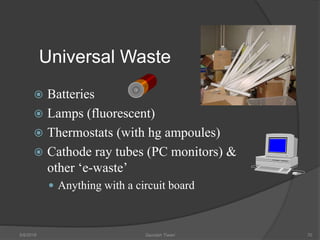
Universal Waste
 Batteries
 Lamps (fluorescent)
 Thermostats (with hg ampoules)
 Cathode ray tubes (PC monitors) &
other ‘e-waste’
 Anything with a circuit board
5/9/2016 Saurabh Tiwari 70
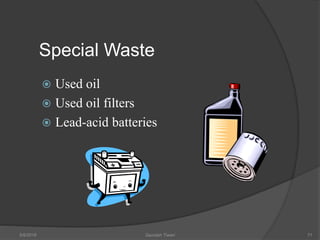
Special Waste
 Used oil
 Used oil filters
 Lead-acid batteries
5/9/2016 Saurabh Tiwari 71
Mixed Waste Examples
 Scintillation cocktail
 Tissue samples containing known or
suspect infectious substances labeled
with radioactive isotopes.
5/9/2016 Saurabh Tiwari 72
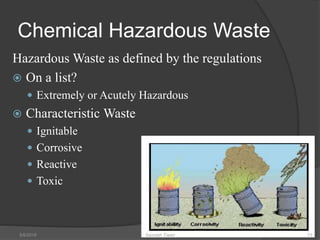
Chemical Hazardous Waste
Hazardous Waste as defined by the regulations
 On a list?
 Extremely or Acutely Hazardous
 Characteristic Waste
 Ignitable
 Corrosive
 Reactive
 Toxic
5/9/2016 Saurabh Tiwari 73
Extremely & Acutely
Hazardous Waste Examples
 Ammonia
 Benzyl chloride
 Chlordane
 Chloroform
 Formaldehyde
http://www.epa.gov/swercepp/ehs/ehsalpha.html
www.dir.ca.gov/title8/5189a.html
 Hydrogen fluoride
 Nitric acid
 Phenol
 Sodium azide
 Vinyl acetate monomer
5/9/2016 Saurabh Tiwari 74
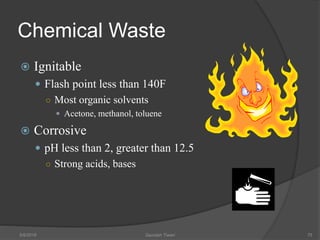
Chemical Waste
 Ignitable
 Flash point less than 140F
○ Most organic solvents
 Acetone, methanol, toluene
 Corrosive
 pH less than 2, greater than 12.5
○ Strong acids, bases
5/9/2016 Saurabh Tiwari 75
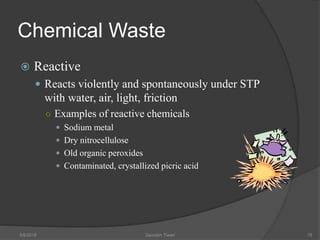
Chemical Waste
 Reactive
 Reacts violently and spontaneously under STP
with water, air, light, friction
○ Examples of reactive chemicals
 Sodium metal
 Dry nitrocellulose
 Old organic peroxides
 Contaminated, crystallized picric acid
5/9/2016 Saurabh Tiwari 76
Chemical Waste
 Toxic
 LD50 (lethal dose at which 50% of the test
population dies) <5000 mg/kg
 May cause environmental harm
 Thousands of chemicals
 Difficult to determine at bench
5/9/2016 Saurabh Tiwari 77
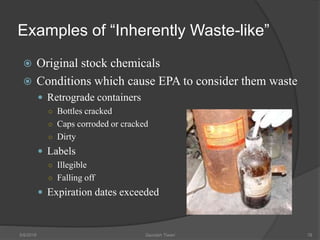
Examples of “Inherently Waste-like”
 Original stock chemicals
 Conditions which cause EPA to consider them waste
 Retrograde containers
○ Bottles cracked
○ Caps corroded or cracked
○ Dirty
 Labels
○ Illegible
○ Falling off
 Expiration dates exceeded
5/9/2016 Saurabh Tiwari 78
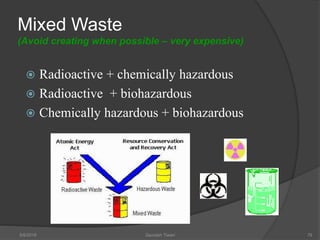
Mixed Waste
(Avoid creating when possible – very expensive)
 Radioactive + chemically hazardous
 Radioactive + biohazardous
 Chemically hazardous + biohazardous
5/9/2016 Saurabh Tiwari 79
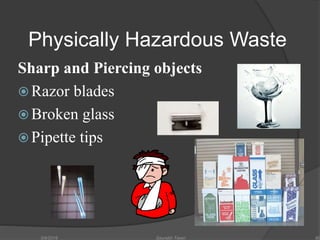
Physically Hazardous Waste
Sharp and Piercing objects
 Razor blades
 Broken glass
 Pipette tips
5/9/2016 Saurabh Tiwari 80
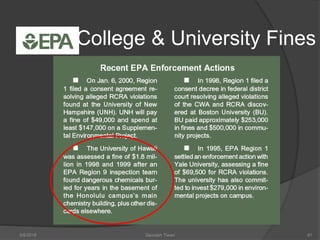
College & University Fines
5/9/2016 Saurabh Tiwari 81
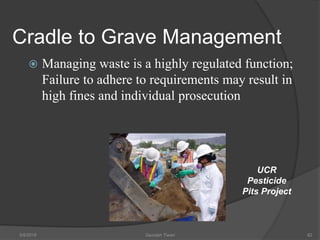
Cradle to Grave Management
 Managing waste is a highly regulated function;
Failure to adhere to requirements may result in
high fines and individual prosecution
5/9/2016 Saurabh Tiwari 82
UCR
Pesticide
Pits Project
Minimize Waste Generated
 When practical, reduce hazard
characteristics of by-products before they
become waste
 Reduce the potential for exposure
 “Green Chemistry”
www.epa.gov/greenchemistry
5/9/2016 Saurabh Tiwari 83
Minimize Waste Generated
 Neutralize
 If pH is the only hazard, and the pH of the waste is between
2 and 12.5, then
 The waste can be neutralized in batches of 5 gallons or less
to a pH of 5 to 9 and may be able to drain dispose
 Documentation & training is required
 Substitute non-hazardous chemicals
 Includes buffer solutions
 Work on a small scale whenever possible
 Use less reagents & create less waste
5/9/2016 Saurabh Tiwari 84
Illegal Actions
 Evaporate waste (atmospheric disposal)
 Drain disposal of untreated chemically
hazardous waste
 Strictly regulated, generally prohibited
 No ‘treatment’ in the pipes
 Only untreated chemicals allowed
○ Bleach (store grade)
○ Non-hazardous salt solutions
5/9/2016 Saurabh Tiwari 85
Store in Appropriate Area
(Large Quantity Generator)
 Satellite accumulation areas
 An area in the lab designated for the proper storage of
chemical hazardous waste
 Store only small quantities
 1 quart max of acutely hazardous waste
 Picked-up at 80 % full or after 6 months
5/9/2016 Saurabh Tiwari 86
Satellite Accumulation Areas
 Under the control of the operator of the
process generating the waste
 Inspected weekly by the lab
 Waste prepared appropriately and
incompatible materials segregated
5/9/2016 Saurabh Tiwari 87
Extremely Hazardous Waste
 Triple rinse containers
 Collect rinseate as waste
 Deface the label
5/9/2016 Saurabh Tiwari 88
Pesticide Waste
 Regulated
 Triple rinse containers
 Make containers unusable
 Use rinseate to dilute next batch when
possible
5/9/2016 Saurabh Tiwari 89
Preparing & Labeling
Universal Waste
 Label as “universal waste” or “used batteries”, or
“used lamps” etc.
 Not “dead batteries”
 Mark with the date that accumulation began
 Request pickup < 9 months
 Contain to prevent damage or leakage
5/9/2016 Saurabh Tiwari 90
Preparing Unknown Waste
 Avoid creating them in the first place!
 Provide as much information as you can
 Process that generated the waste
 Best guess on identification
 HAZCAT analysis
5/9/2016 Saurabh Tiwari 91
Preparing Biohazard/Medical Waste
 Storage requirements for red* bagged waste
and filled sharps containers
 Over zero C - not more than 7 days
 Under zero C – not more than 90 days
 If autoclaving medical waste must use
registered autoclaves
 Bag must be weighted and recorded
 Use autoclave indicator tape
 Contact Biosafety with questions
* Use Red Bags ONLY for biohazard waste, not as general trash bags
5/9/2016 Saurabh Tiwari 92
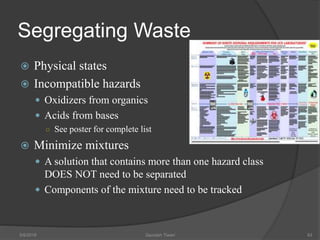
Segregating Waste
 Physical states
 Incompatible hazards
 Oxidizers from organics
 Acids from bases
○ See poster for complete list
 Minimize mixtures
 A solution that contains more than one hazard class
DOES NOT need to be separated
 Components of the mixture need to be tracked
5/9/2016 Saurabh Tiwari 93
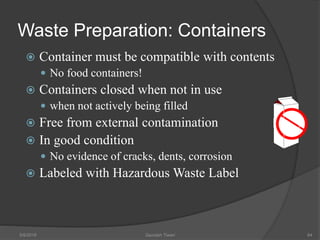
Waste Preparation: Containers
 Container must be compatible with contents
 No food containers!
 Containers closed when not in use
 when not actively being filled
 Free from external contamination
 In good condition
 No evidence of cracks, dents, corrosion
 Labeled with Hazardous Waste Label
5/9/2016 Saurabh Tiwari 94
Secondary Containment
 Waste container must be placed in secondary
containment
 Holds 110% of the volume of the largest container
5/9/2016 Saurabh Tiwari 95
Waste Disposal: When?
 Container should be ~80% full
 Reduces the number of containers shipped
 Reduces amount of time on pickups
 Minimizes costs to the university
5/9/2016 Saurabh Tiwari 96
Accidents and Spills
Ask your self…
 If I do nothing, will it get worse or cause a
release to the environment?
 If it will get worse, call for help (9-1-1)
 If it won’t get worse, do you have necessary
materials and proper training to clean it up?
5/9/2016 Saurabh Tiwari 97
Accidental Releases to the Environment
 Stop
 Action causing the release
 Recover
 As much released material as you safely can
 Report
 The incident as soon as possible!
○ Local CUPA/PA
○ CA Office of Emergency Services 800-852-7550
○ National Response Center 800-424-8802.
5/9/2016 Saurabh Tiwari 98
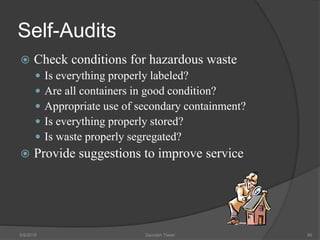
Self-Audits
 Check conditions for hazardous waste
 Is everything properly labeled?
 Are all containers in good condition?
 Appropriate use of secondary containment?
 Is everything properly stored?
 Is waste properly segregated?
 Provide suggestions to improve service
5/9/2016 Saurabh Tiwari 99
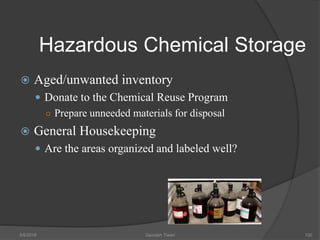
Hazardous Chemical Storage
 Aged/unwanted inventory
 Donate to the Chemical Reuse Program
○ Prepare unneeded materials for disposal
 General Housekeeping
 Are the areas organized and labeled well?
5/9/2016 Saurabh Tiwari 100
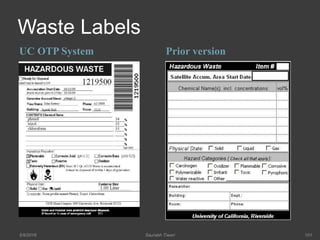
Waste Labels
UC OTP System Prior version
5/9/2016 Saurabh Tiwari 101

Hazardous materials

  • 2.
    Hazardous Materials &Waste Overview Agenda  Purchasing  Storage  Use  Disposal 5/9/2016 Saurabh Tiwari 2
  • 3.
  • 4.
    Purchasing Approvals/Permits Biohazards (Brenda Wong) Animals(vertebrates,arthropods, arachnids…) Plants (exotics, invasive, genetically modified org.) Radioisotopes & Radiation Producing Machines (Craig Maxwell) Chemicals (select agents, controlled substances, listed & precursor chemicals, explosives, etc.) 5/9/2016 Saurabh Tiwari 4
  • 5.
    Biohazards Viruses  Bacteria  Prions SelectAgents  7 CFR Part 331, 9 CFR Part 121, and 42 CFR Part 73 5/9/2016 Saurabh Tiwari 5
  • 6.
    Select Agent Examples 5/9/2016Saurabh Tiwari 6 Ebola Virus bacillus anthracis spores Lawmakers, Officials Press for More Biosecurity Controls on Labs
  • 7.
    Purchase/Use Approval Biohazards Institutional Biosafety Committee (IBC) National Institute of Health Guidelines  rDNA committee (GMO) Faculty Committee with Community Members  Biological Use Authorizations (BUA) Protocols submitted & reviewed Establish requirements in accord with BMBL  BioSafety Levels 1, 2, 3, 4 IBC requirements enforced by BSO 5/9/2016 Saurabh Tiwari 7
  • 8.
  • 9.
    Purchase/Use Approval Vertebrate Animals Institutional Animal Care and Use Committee (IACUC) Federal Laws  Animal Welfare Act Regulations (7 U.S.C. 2131 et. seq.)  USDA 1995 (9 C.F.R., Chapter 1, Subchapter A)  Health Research Extension Act of 1985  Public Law 99-158 (NIST) Faculty Committee with Community Members  Animal Use Authorizations IACUC enforced by Campus Vet 5/9/2016 Saurabh Tiwari 9
  • 10.
    Purchase/Use Approval Insects &Plants  Animal & Plant Health Inspection Service Import/Export permits & controls Intrastate movement of plants and animals  California Department of Food & Agriculture CCR Title 3 et al. www.cdfa.ca.gov/Regulations.html 5/9/2016 Saurabh Tiwari 10
  • 11.
    Plant Protection &Quarantine  Harmful nonnative species cost billions of dollars in control or loss of marketable goods & affect agriculture, forestry, human health, and tourism 5/9/2016 Saurabh Tiwari 11 economically or environmentally harmful nonnative species in US
  • 12.
    Purchase/Use Approval Radioactive Materials& Equipment  Radiation Safety Committee (RSC) Faculty Committee with Community Members Radiologic Health Branch  Radiation Control Law  Health & Safety Code Sec. 114960 et seq.  Radiologic Technology Act  Health & Safety Code Sec. 27(f)  Nuclear Medicine Technology Certification  Health & Safety Code Secs. 107150 through 107175  Title 17, California Code of Regulations, Division 1, Chapter 5, Subchapters 4.0, 4.5, & 4.6. 5/9/2016 Saurabh Tiwari 12
  • 13.
    Purchase/Use Approval Non-ionizing Radiation Lasers (Light Amplification by the Stimulated Emission of Radiation)  Class 1, 2, 3R, 3B, 4 5/9/2016 Saurabh Tiwari 13
  • 14.
    Laser Classes  CLASS1  Safe under all conditions of normal use  Class 1M -Safe for all conditions except when passed through magnifying optics  Class 2  Safe because the blink reflex will limit the exposure to no more than 0.25 seconds  Class 2M- safe because of the blink reflex if not viewed through optical instruments  Class 3R  Safe if handled carefully with restricted beam viewing 5/9/2016 Saurabh Tiwari 14
  • 15.
    Laser Classes (continued) Class 3B  Hazardous if the eye is exposed directly, but diffuse reflections are not harmful  Protective eyewear is required where direct viewing of a class 3B laser beam may occur  Must be equipped with a key switch and a safety interlock 5/9/2016 Saurabh Tiwari 15 LASER RADIATION AVOID EXPOSURE TO THE BEAM CLASS 3B LASER PRODUCT
  • 16.
    Laser Classes (con’t)  Class4  All lasers with beam power greater than class 3B  Can burn the skin and permanently damage eyes as a result of direct or diffuse beam viewing  These lasers may ignite combustible materials, and thus may represent a fire risk  Must be equipped with a key switch and a safety interlock 5/9/2016 Saurabh Tiwari 16 LASER RADIATION AVOID EYE OR SKIN EXPOSURE TO DIRECT OR SCATTERED RADIATION CLASS 4 LASER PRODUCT
  • 17.
    Plants  Exotic &non-native species  Genetically modified organisms  Soils and more…  ePermits www.aphis.usda.gov/permits U.S. Department of Agriculture (USDA), Animal and Plant Health Inspection Service (APHIS), Veterinary Services (VS), National Center for Import and Export (NCIE) 5/9/2016 Saurabh Tiwari 17
  • 18.
    Plant Import &Export Info  Plant Protection and Quarantine (PPQ)  www.aphis.usda.gov/import_export/plants/manuals/online_manuals.shtml  Domestic Programs Detection, eradication, containment, or suppression of pests or endangered plants protection  Port Programs exclude pests or to protect endangered plants  Emergency Programs immediate actions to eradicate a pest 5/9/2016 Saurabh Tiwari 18
  • 19.
    Plant Permits Required To import or transport designated plants, plant products and soil into or through the U.S.  To import plant pests and biological control organisms into the U.S.  To move plant pests and biological control organisms between States.  www.aphis.usda.gov/plant_health/permits/index.shtml 5/9/2016 Saurabh Tiwari 19
  • 20.
    Chemicals Controlled Substances Chemical Precursors ChemicalWarfare Agents Select Agents 5/9/2016 Saurabh Tiwari 20
  • 21.
    Controlled Substances  FiveSchedules: Schedule II through V are prescribed Not Schedule I  substance has a high potential for abuse  no currently accepted medical use in treatment in the United States  lack of accepted safety for use under medical supervision 5/9/2016 Saurabh Tiwari 21
  • 22.
    Prescribed Drugs Schedule II High abuse potential  May lead to severe psychological or physical dependence Schedule III  Lower abuse potential  May lead to moderate dependence Schedule IV  Low abuse potential  Lower likelihood to lead to dependence Schedule V  Low abuse potential  Limited dependence likelihood 5/9/2016 Saurabh Tiwari 22
  • 23.
    Chemical Warfare Agents Chemical Weapons Convention of 1993  Organisation for the Prohibition of Chemical Weapons www.opcw.org Schedule 1  few, if any, legitimate uses; examples nerve agents, ricin, lewisite and mustard gas  Any production > 100 g notify OPCW Schedule 2  no large-scale industrial uses; examples dimethyl methylphosphonate, a precursor to sarin and thiodiglycol  Schedule 3  legitimate large-scale industrial uses; examples phosgene and chloropicrin 5/9/2016 Saurabh Tiwari 23
  • 24.
    Select Agents HHS ANDUSDA Select Agents AND TOXINS 7 CFR Part 331, 9 CFR Part 121, and 42 CFR Part 73  Abrin  Botulinum neurotoxins  Botulinum neurotoxin producing species of Clostridium  Clostridium perfringens epsilon toxin  Conotoxins  Diacetoxyscirpenol  Ricin  Saxitoxin  Shiga-like ribosome inactivating proteins  Shigatoxin  Staphylococcal enterotoxins  T-2 toxin  Tetrodotoxin  Bovine spongiform encephalopathy agent 5/9/2016 Saurabh Tiwari 24
  • 25.
  • 26.
    Main Issues  Access(Security)  Drugs, select agents, terrorism potential  Adequate warning  Signs  Labels  Abbreviation lists  Incompatible chemicals mixing  Earthquakes  Exceeding storage limits  Time ○ Safety ○ Efficacy  Quantity ○ Fire Code  Building limits ○ Homeland Security  Address limits ○ Building Design Limits  Green Buildings 5/9/2016 Saurabh Tiwari 26
  • 27.
    Chemical Hazard Classes Corrosives  Flammables  Oxidizers  Toxins  Reactive Chemicals 5/9/2016 Saurabh Tiwari 27
  • 28.
    Corrosives  Acids  Strongacids give up protons (accepts electron pairs)  Bases (Alkalis, Caustics)  Strong bases accept protons (donate an electron pair)  Storage Segregation 5/9/2016 Saurabh Tiwari 28
  • 29.
    Acid Type Examples Inorganic:  hydrochloric acid  nitric acid  phosphoric acid  sulfuric acid  boric acid  hydrofluoric acid  hydrobromic acid  Organic:  lactic acid  acetic acid  formic acid  citric acid  oxalic acid  Oxidizing:  nitric acid  perchloric acid  chromic acid 5/9/2016 Saurabh Tiwari 29
  • 30.
    Flammables  NFPA ClassIA, IB, IC 5/9/2016 Saurabh Tiwari 30
  • 31.
    Oxidize 4Fe + 3O2 2[Fe2O3] Fe0  Fe+3 (O0  O-2) 1. combine with oxygen 2. dehydrogenate esp by action of oxygen 3. change (an element or ion) from a lower to a higher positive valence : remove one or more electrons 4. coat with oxide; make into an oxide 5/9/2016 Saurabh Tiwari 31
  • 32.
    Oxidizing Polyatomic Ions 5/9/2016Saurabh Tiwari 32 Chemical Group Chemical Formula peroxides O2 -2 nitrates NO3 - nitrites NO2 - perchlorates ClO4 - chlorates ClO3 - chlorites ClO2 - Hypochlorites ClO- dichromates Cr2O7 -2 permanganates MnO4 - persulfates S2O8 -2
  • 33.
    Oxidizers (Class 1,2, 3, 4) Class 4  An oxidizing material that can undergo an explosive reaction when catalyzed or exposed to heat, shock or friction Class 3  An oxidizing material that will cause a severe increase in the burning rate of combustible material which it contacts or will undergo vigorous self-sustained decomposition when catalyzed or heat Class 2  An oxidizing material that will moderately increase the burning rate or which may cause spontaneous ignition of combustible material which it contacts Class 1  An oxidizing material whose primary hazard is that it may increase the burning rate of combustible material with which it comes in contact 5/9/2016 Saurabh Tiwari 33 LeastMostReactive
  • 34.
    Oxidizer examples (Classifiedby NFPA)  Class 4  ammonium perchlorate  ammonium permanganate  guanidine nitrate  hydrogen peroxide (>91% conc.)  perchloric acid (>72.5%)  potassium superoxide 5/9/2016 Saurabh Tiwari 34 NH4 + H2O2 KO2
  • 35.
    Oxidizer Examples (continued) Class 3  ammonium dichromate  potassium chlorate  hydrogen peroxide (52-91% conc.)  potassium dichloroisocyanurate  calcium hypochlorite (>50% wgt.)  sodium chlorate  perchloric acid (60-72.5% conc.)  sodium chlorite (>40% wgt.)  potassium bromate  sodium dichloro-s-triazinetrione 5/9/2016 Saurabh Tiwari 35 H2O2 K+
  • 36.
    Example  Linseed oil(flax seed oil)  Class 2 oxidizer  spontaneous ignition of combustible material which it contacts 5/9/2016 Saurabh Tiwari 36
  • 37.
    Toxins  Acute &Chronic Poisons; Highly Toxic  Carcinogens  Select Carcinogens – Occupational (31 substances - www.dir.ca.gov/Title8/sb7g16a110.html)  Prop 65 (845 items - www.oehha.org/prop65/prop65_list/Newlist.html)  National Toxicology Program, Report on Carcinogens (245 - http://ntp.niehs.nih.gov/go/roc)  International Agency for Research on Cancer (http://monographs.iarc.fr/ENG/Classification/index.php) ○ Group 1: Carcinogenic to humans (108 agents) ○ Group 2A: Probably carcinogenic to humans (63 agents)  Reproductive & Developmental Toxins  www.cdc.gov/niosh/topics/repro  Neurotoxins, organ specific toxins, Irritants 5/9/2016 Saurabh Tiwari 37
  • 38.
    Reactive Chemicals Purchase smallamounts, use up rapidly  Water Reactive  Store in an isolated area within the lab, in a water-tight cabinet or secondary container  Pyrophoric  Store in air-tight containers without oxygen or moisture (sure seal bottles, glove boxes)  Separate from flammables, but in flame resistant container when practical  Self Decomposing  Check frequently 5/9/2016 Saurabh Tiwari 38
  • 39.
    Water Reactive Substances DangerousWhen Wet Reactions results  flammable gas release  strong oxidizing gas release  toxic gas release  metal oxide fume release  corrosive acids formation Reactions  Alkali metals (Na, K, Li) + water  detonation, heat, formation of hydroxide, hydrogen gas  Alkaline earths (Mg, Be, Ca, Ba) + water  detonation, hydrogen gas 5/9/2016 Saurabh Tiwari 39
  • 40.
    Dangerous When WetReactions (continued)  Hydrides (LiH, LiAlH4) + water  hydrogen, caustic solution  Carbides of Al, Ca, Mg + water  acetylene liberated  Phosphides + water  phosphine gas  Nitrides + water  ammonia, caustic solution  Metallic (inorganic, such as potassium) peroxides + water  oxygen gas and heat  Chlorides of group III metals, transition metals, non-metals (Al, Ti, S) + water  hydrogen chloride gas 5/9/2016 Saurabh Tiwari 40
  • 41.
    Pyrophoric  Can spontaneouslyignite in air  Derived from Greek for “fire-bearing”  Includes organometallic reagents:  Alkyllithiums  Alkylzincs  alkylmagnesiums (Grignards)  and some finely divided metal powders  Specific ex.  Diborane  Diethylzinc  tert-butyllithium  diphosphine 5/9/2016 Saurabh Tiwari 41
  • 42.
    Decomposition by Fission& Fusion 5/9/2016 Saurabh Tiwari 42 NO2 + CO2 +H2O + … + O2
  • 43.
  • 44.
    Hazard Classification CategoryExample Acute Toxicity 5/9/2016 44Saurabh Tiwari
  • 45.
  • 46.
  • 47.
    Safety Data Sheets revision §1910.1200—Safety Data Sheets, for the specific content of each section of the safety data sheet.) (i) Section 1, Identification; (ii) Section 2, Hazard(s) identification; (iii) Section 3, Composition/ information on ingredients; (iv) Section 4, First-aid measures; (v) Section 5, Fire-fighting measures; (vi) Section 6, Accidental release measures; (vii) Section 7, Handling and storage; (viii) Section 8, Exposure controls/ personal protection; (ix) Section 9, Physical and chemical properties; (x) Section 10, Stability and reactivity; (xi) Section 11, Toxicological information. 5/9/2016 Saurabh Tiwari 47
  • 48.
    New & FamiliarSymbols 5/9/2016 Saurabh Tiwari 48
  • 49.
  • 50.
    Labeling Example Acutely Toxic(Cat 4) 5/9/2016 Saurabh Tiwari 50
  • 51.
    Acutely Toxic (Cat3) 5/9/2016 51Saurabh Tiwari
  • 52.
    Acutely Toxic (Cat2 &1) 5/9/2016 Saurabh Tiwari 52
  • 53.
  • 54.
  • 55.
  • 56.
  • 57.
  • 58.
  • 59.
  • 60.
    Comparison of DataSheets MSDS (required now) SDS (Proposed) 1. Chemical Identity 2. Manufacturer's Name and Contact Information 3. Hazardous Ingredients/Identity Information 4. Physical/Chemical Characteristics 5. Fire and Explosion Hazard Data 6. Reactivity Data 7. Health Hazard Data 8. Precautions for Safe Handling and Use 9. Control Measures 1. Identification 2. Hazard(s) identification 3. Composition/information on ingredients 4. First-aid measures 5. Fire-fighting measures 6. Accidental release measures 7. Handling and storage 8. Handling and storage 9. Physical and chemical properties 10. Stability and reactivity 11. Toxicological information 12. Ecological information (Non-mandatory) 13. Disposal considerations (Non-mandatory) 14. Transport information (Non-mandatory) 15. Regulatory information (Non-mandatory) 16. Other information, including date of preparation or last revision 5/9/2016 Saurabh Tiwari 60
  • 61.
  • 62.
  • 63.
    Waste Determination What typesof waste are generated? 5/9/2016 Saurabh Tiwari 63
  • 64.
    Radioactive Waste Examples  32P 3H  14C  35S  Scintillation vials  Stock vials 5/9/2016 Saurabh Tiwari 64
  • 65.
    Biohazardous Waste  Laboratoryor research waste, that is potentially infectious to humans, plants or animals, or would pose a potential threat to the the environment 5/9/2016 Saurabh Tiwari 65
  • 66.
    Biohazardous Waste includes Cell, bacteria and viral cultures  Transgenic plants  Tissue culture supplies 5/9/2016 Saurabh Tiwari 66 BIOHAZARD
  • 67.
    Medical Waste  Diagnosis,treatment or immunization of humans/animals  Research on diagnosis, treatment or immunization of humans/animals  Can be biohazardous or sharps  Includes all hypodermic needles 5/9/2016 Saurabh Tiwari 67 BIOHAZARD
  • 68.
    Medical Waste Examples Blood and blood products  Lab wastes of significant virulence and quantity When in doubt give Biosafety a shout 5/9/2016 Saurabh Tiwari 68
  • 69.
    Chemical Waste Identification Is it…?  Universal waste or Special waste  On a list of regulated wastes? ○ Acutely or extremely hazardous  www.ehs.uci.edu/programs/enviro/ChemicalList.xls  Hazardous due to a characteristic  Inherently waste-like or Unknown  Or is non-hazardous? 5/9/2016 Saurabh Tiwari 69
  • 70.
    Universal Waste  Batteries Lamps (fluorescent)  Thermostats (with hg ampoules)  Cathode ray tubes (PC monitors) & other ‘e-waste’  Anything with a circuit board 5/9/2016 Saurabh Tiwari 70
  • 71.
    Special Waste  Usedoil  Used oil filters  Lead-acid batteries 5/9/2016 Saurabh Tiwari 71
  • 72.
    Mixed Waste Examples Scintillation cocktail  Tissue samples containing known or suspect infectious substances labeled with radioactive isotopes. 5/9/2016 Saurabh Tiwari 72
  • 73.
    Chemical Hazardous Waste HazardousWaste as defined by the regulations  On a list?  Extremely or Acutely Hazardous  Characteristic Waste  Ignitable  Corrosive  Reactive  Toxic 5/9/2016 Saurabh Tiwari 73
  • 74.
    Extremely & Acutely HazardousWaste Examples  Ammonia  Benzyl chloride  Chlordane  Chloroform  Formaldehyde http://www.epa.gov/swercepp/ehs/ehsalpha.html www.dir.ca.gov/title8/5189a.html  Hydrogen fluoride  Nitric acid  Phenol  Sodium azide  Vinyl acetate monomer 5/9/2016 Saurabh Tiwari 74
  • 75.
    Chemical Waste  Ignitable Flash point less than 140F ○ Most organic solvents  Acetone, methanol, toluene  Corrosive  pH less than 2, greater than 12.5 ○ Strong acids, bases 5/9/2016 Saurabh Tiwari 75
  • 76.
    Chemical Waste  Reactive Reacts violently and spontaneously under STP with water, air, light, friction ○ Examples of reactive chemicals  Sodium metal  Dry nitrocellulose  Old organic peroxides  Contaminated, crystallized picric acid 5/9/2016 Saurabh Tiwari 76
  • 77.
    Chemical Waste  Toxic LD50 (lethal dose at which 50% of the test population dies) <5000 mg/kg  May cause environmental harm  Thousands of chemicals  Difficult to determine at bench 5/9/2016 Saurabh Tiwari 77
  • 78.
    Examples of “InherentlyWaste-like”  Original stock chemicals  Conditions which cause EPA to consider them waste  Retrograde containers ○ Bottles cracked ○ Caps corroded or cracked ○ Dirty  Labels ○ Illegible ○ Falling off  Expiration dates exceeded 5/9/2016 Saurabh Tiwari 78
  • 79.
    Mixed Waste (Avoid creatingwhen possible – very expensive)  Radioactive + chemically hazardous  Radioactive + biohazardous  Chemically hazardous + biohazardous 5/9/2016 Saurabh Tiwari 79
  • 80.
    Physically Hazardous Waste Sharpand Piercing objects  Razor blades  Broken glass  Pipette tips 5/9/2016 Saurabh Tiwari 80
  • 81.
    College & UniversityFines 5/9/2016 Saurabh Tiwari 81
  • 82.
    Cradle to GraveManagement  Managing waste is a highly regulated function; Failure to adhere to requirements may result in high fines and individual prosecution 5/9/2016 Saurabh Tiwari 82 UCR Pesticide Pits Project
  • 83.
    Minimize Waste Generated When practical, reduce hazard characteristics of by-products before they become waste  Reduce the potential for exposure  “Green Chemistry” www.epa.gov/greenchemistry 5/9/2016 Saurabh Tiwari 83
  • 84.
    Minimize Waste Generated Neutralize  If pH is the only hazard, and the pH of the waste is between 2 and 12.5, then  The waste can be neutralized in batches of 5 gallons or less to a pH of 5 to 9 and may be able to drain dispose  Documentation & training is required  Substitute non-hazardous chemicals  Includes buffer solutions  Work on a small scale whenever possible  Use less reagents & create less waste 5/9/2016 Saurabh Tiwari 84
  • 85.
    Illegal Actions  Evaporatewaste (atmospheric disposal)  Drain disposal of untreated chemically hazardous waste  Strictly regulated, generally prohibited  No ‘treatment’ in the pipes  Only untreated chemicals allowed ○ Bleach (store grade) ○ Non-hazardous salt solutions 5/9/2016 Saurabh Tiwari 85
  • 86.
    Store in AppropriateArea (Large Quantity Generator)  Satellite accumulation areas  An area in the lab designated for the proper storage of chemical hazardous waste  Store only small quantities  1 quart max of acutely hazardous waste  Picked-up at 80 % full or after 6 months 5/9/2016 Saurabh Tiwari 86
  • 87.
    Satellite Accumulation Areas Under the control of the operator of the process generating the waste  Inspected weekly by the lab  Waste prepared appropriately and incompatible materials segregated 5/9/2016 Saurabh Tiwari 87
  • 88.
    Extremely Hazardous Waste Triple rinse containers  Collect rinseate as waste  Deface the label 5/9/2016 Saurabh Tiwari 88
  • 89.
    Pesticide Waste  Regulated Triple rinse containers  Make containers unusable  Use rinseate to dilute next batch when possible 5/9/2016 Saurabh Tiwari 89
  • 90.
    Preparing & Labeling UniversalWaste  Label as “universal waste” or “used batteries”, or “used lamps” etc.  Not “dead batteries”  Mark with the date that accumulation began  Request pickup < 9 months  Contain to prevent damage or leakage 5/9/2016 Saurabh Tiwari 90
  • 91.
    Preparing Unknown Waste Avoid creating them in the first place!  Provide as much information as you can  Process that generated the waste  Best guess on identification  HAZCAT analysis 5/9/2016 Saurabh Tiwari 91
  • 92.
    Preparing Biohazard/Medical Waste Storage requirements for red* bagged waste and filled sharps containers  Over zero C - not more than 7 days  Under zero C – not more than 90 days  If autoclaving medical waste must use registered autoclaves  Bag must be weighted and recorded  Use autoclave indicator tape  Contact Biosafety with questions * Use Red Bags ONLY for biohazard waste, not as general trash bags 5/9/2016 Saurabh Tiwari 92
  • 93.
    Segregating Waste  Physicalstates  Incompatible hazards  Oxidizers from organics  Acids from bases ○ See poster for complete list  Minimize mixtures  A solution that contains more than one hazard class DOES NOT need to be separated  Components of the mixture need to be tracked 5/9/2016 Saurabh Tiwari 93
  • 94.
    Waste Preparation: Containers Container must be compatible with contents  No food containers!  Containers closed when not in use  when not actively being filled  Free from external contamination  In good condition  No evidence of cracks, dents, corrosion  Labeled with Hazardous Waste Label 5/9/2016 Saurabh Tiwari 94
  • 95.
    Secondary Containment  Wastecontainer must be placed in secondary containment  Holds 110% of the volume of the largest container 5/9/2016 Saurabh Tiwari 95
  • 96.
    Waste Disposal: When? Container should be ~80% full  Reduces the number of containers shipped  Reduces amount of time on pickups  Minimizes costs to the university 5/9/2016 Saurabh Tiwari 96
  • 97.
    Accidents and Spills Askyour self…  If I do nothing, will it get worse or cause a release to the environment?  If it will get worse, call for help (9-1-1)  If it won’t get worse, do you have necessary materials and proper training to clean it up? 5/9/2016 Saurabh Tiwari 97
  • 98.
    Accidental Releases tothe Environment  Stop  Action causing the release  Recover  As much released material as you safely can  Report  The incident as soon as possible! ○ Local CUPA/PA ○ CA Office of Emergency Services 800-852-7550 ○ National Response Center 800-424-8802. 5/9/2016 Saurabh Tiwari 98
  • 99.
    Self-Audits  Check conditionsfor hazardous waste  Is everything properly labeled?  Are all containers in good condition?  Appropriate use of secondary containment?  Is everything properly stored?  Is waste properly segregated?  Provide suggestions to improve service 5/9/2016 Saurabh Tiwari 99
  • 100.
    Hazardous Chemical Storage Aged/unwanted inventory  Donate to the Chemical Reuse Program ○ Prepare unneeded materials for disposal  General Housekeeping  Are the areas organized and labeled well? 5/9/2016 Saurabh Tiwari 100
  • 101.
    Waste Labels UC OTPSystem Prior version 5/9/2016 Saurabh Tiwari 101