CONSULTING ENGINEERS LIMITED
BASICS OF FIRE PROTECTION SYSTEM,
HYDRANT SYSTEM
CONSULTING ENGINEERS LIMITED
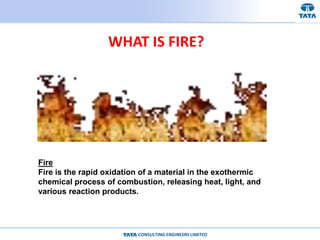
WHAT IS FIRE?
Fire
Fire is the rapid oxidation of a material in the exothermic
chemical process of combustion, releasing heat, light, and
various reaction products.
CONSULTING ENGINEERS LIMITED
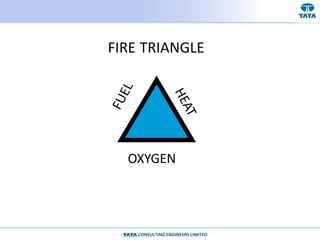
OXYGEN
FIRE TRIANGLE
CONSULTING ENGINEERS LIMITED
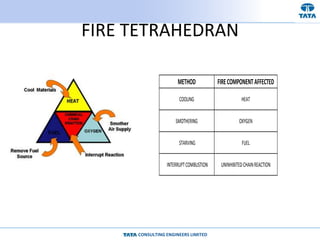
FIRE TETRAHEDRAN
METHOD FIRECOMPONENTAFFECTED
COOLING HEAT
SMOTHERING OXYGEN
STARVING FUEL
INTERRUPTCOMBUSTION UNINHIBITEDCHAINREACTION
CONSULTING ENGINEERS LIMITED
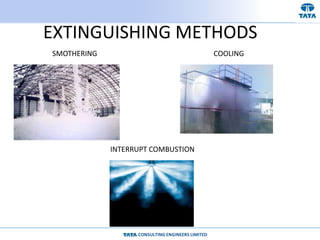
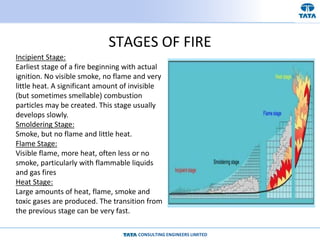
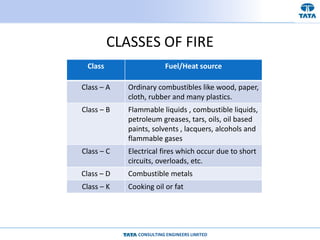
EXTINGUISHING METHODS
SMOTHERING COOLING
INTERRUPT COMBUSTION
CONSULTING ENGINEERS LIMITED
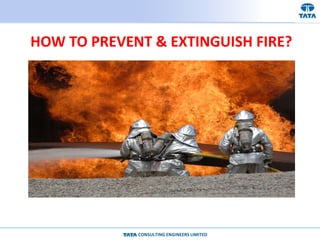
STAGES OF FIRE
Incipient Stage:
Earliest stage of a fire beginning with actual
ignition. No visible smoke, no flame and very
little heat. A significant amount of invisible
(but sometimes smellable) combustion
particles may be created. This stage usually
develops slowly.
Smoldering Stage:
Smoke, but no flame and little heat.
Flame Stage:
Visible flame, more heat, often less or no
smoke, particularly with flammable liquids
and gas fires
Heat Stage:
Large amounts of heat, flame, smoke and
toxic gases are produced. The transition from
the previous stage can be very fast.
CONSULTING ENGINEERS LIMITED
Class Fuel/Heat source
Class – A Ordinary combustibles like wood, paper,
cloth, rubber and many plastics.
Class – B Flammable liquids , combustible liquids,
petroleum greases, tars, oils, oil based
paints, solvents , lacquers, alcohols and
flammable gases
Class – C Electrical fires which occur due to short
circuits, overloads, etc.
Class – D Combustible metals
Class – K Cooking oil or fat
CLASSES OF FIRE
CONSULTING ENGINEERS LIMITED
HOW TO PREVENT & EXTINGUISH FIRE?
CONSULTING ENGINEERS LIMITED
FIRE PREVENTION GOALS
Life Safety
The primary goal of fire safety efforts is to protect
building occupants from injury and to prevent loss of life.
Property Protection
The secondary goal of fire safety is to prevent property
damage.
Protection of Operations
By preventing fires and limiting damage we can assure
that work operations will continue.
CONSULTING ENGINEERS LIMITED
BASIC FIRE PROTECTION SYSTEMS
PASSIVE
COMPARTMENTALIZATION
FIRE SEALANT
FIRE WALL & DOOR
 FIRE RESISTANCERATING
ACTIVE
 FIRE HYDRANT SYSTEM
 WATER SPRAY SYSTEM
 FOAM SYSTEM
SPRINKLER SYSTEM
GASEOUS FIRE SUPPRESSION SYSTEM
FIRE EXTINGUISHERS
FIRE ALARM SYSTEM
CONSULTING ENGINEERS LIMITED
FIRE PROTECTION NORMS / RULES
INTERNATIONAL
• NFPA- National Fire protection
Association, USA
• LPCB- Loss Prevention Council
Board
• FM- Factory Mutual
NATIONAL
• TAC- Tariff Advisory Committee
(Fire Protection Manual)
• OISD- Oil Industry Safety
Directorate
• NBC- National Building Code
• BIS – Bureau of Indian Standards
• AERB Standards for Fire Protection
CONSULTING ENGINEERS LIMITED
FIRE HYDRANT SYSTEM
Hydrant system is a fixed pipe system connected to a
reliable source of water supply and equipped with
Hydrants and water monitors in the fire water ring
main of all the areas of the plant.
The general norms followed are TAC, NFPA-14,BIS
3844
CONSULTING ENGINEERS LIMITED
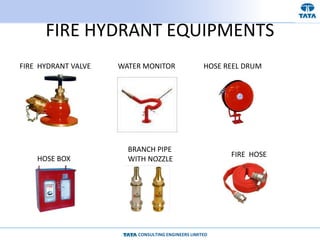
FIRE HYDRANT EQUIPMENTS
FIRE HYDRANT VALVE WATER MONITOR HOSE REEL DRUM
HOSE BOX
BRANCH PIPE
WITH NOZZLE
FIRE HOSE
CONSULTING ENGINEERS LIMITED
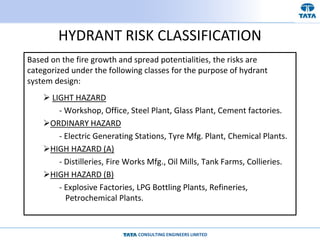
HYDRANT RISK CLASSIFICATION
Based on the fire growth and spread potentialities, the risks are
categorized under the following classes for the purpose of hydrant
system design:
 LIGHT HAZARD
- Workshop, Office, Steel Plant, Glass Plant, Cement factories.
ORDINARY HAZARD
- Electric Generating Stations, Tyre Mfg. Plant, Chemical Plants.
HIGH HAZARD (A)
- Distilleries, Fire Works Mfg., Oil Mills, Tank Farms, Collieries.
HIGH HAZARD (B)
- Explosive Factories, LPG Bottling Plants, Refineries,
Petrochemical Plants.
CONSULTING ENGINEERS LIMITED
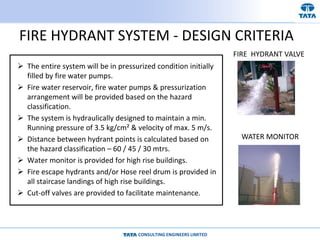
FIRE HYDRANT SYSTEM - DESIGN CRITERIA
 The entire system will be in pressurized condition initially
filled by fire water pumps.
 Fire water reservoir, fire water pumps & pressurization
arrangement will be provided based on the hazard
classification.
 The system is hydraulically designed to maintain a min.
Running pressure of 3.5 kg/cm² & velocity of max. 5 m/s.
 Distance between hydrant points is calculated based on
the hazard classification – 60 / 45 / 30 mtrs.
 Water monitor is provided for high rise buildings.
 Fire escape hydrants and/or Hose reel drum is provided in
all staircase landings of high rise buildings.
 Cut-off valves are provided to facilitate maintenance.
FIRE HYDRANT VALVE
WATER MONITOR
CONSULTING ENGINEERS LIMITED
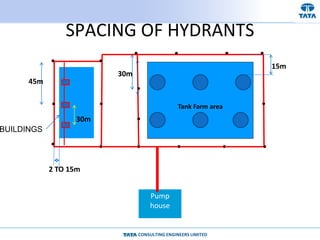
SPACING OF HYDRANTS
Tank Farm area
Pump
house
30m
45m
15m
2 TO 15m
BUILDINGS
30m
CONSULTING ENGINEERS LIMITED
FIRE WATER PUMPS
 Fire water pumps will be motor operated vertical or horizontal type
with stand-by diesel engine operated pumps.
 The quantity, capacity & head of fire water pumps is finalised based
on the no. of hydrant points in the system.
 The standard capacities of pumps selected for fire protection system
are 137 cum/hr, 171 cum/hr, 273 cum/hr & 410 cum/hr and the
standard head selected are 70 mwc, 88 mwc & 110 mwc.
 Jockey or pressurisation pumps are provided to take care of system
losses.
 The capacity of the jockey pumps shall neither be more than 5 % of
the installed pumping capacity nor less than 3 % thereof (with a
minimum of 10.8 m3/hr.)
 The fire water pumps will be located indoor inside a pump house.
CONSULTING ENGINEERS LIMITED
FIRE WATER RESERVOIR
 Water for the fire protection services is stored in an easily accessible
surface/underground lined reservoir or above ground tanks of steel concrete or
masonry.
 The capacity of fire water reservoir is calculated based on the aggregate
pumping capacity of the fire water system is as follows:
 Light hazard – Not less than 1 hr’s aggregate pumping capacity with a
minimum of 1,35,000 litres
 Ordinary hazard – Not less than 2 hr’s aggregate pumping capacity
 High hazard (A) – Not less than 3 hr’s aggregate pumping capacity
 High hazard (B) – Not less than 4 hr’s aggregate pumping capacity
 The water stored for fire protection purpose will be available exclusively for the
same as a dead storage.
 Reservoirs of and over 2,25,000 litres capacity shall be in two interconnected
equal compartments to facilitates cleaning and repairs.
CONSULTING ENGINEERS LIMITED
LIST OF STANDARDS
Fire Hydrant System
 NFPA 14 : Standards for Installation of standpipe and hose
systems.
 NFPA 24 : Standard for Installation for Private Fire Service
mains.
 BIS 3844 : Code of Practice for Installation and Maintenance of
Internal Fire Hydrants and Hose reels on Premises.
TAC FP MANUAL
CONSULTING ENGINEERS LIMITED
LIST OF DMS DOCUMENTS
Fire Hydrant System
 TCE.M6-ME-222-REV-R5 : DESIGN GUIDE FOR FIRE PROTECTION
SYSTEMS
 TCE. M6-ME-617-223 –REV-R4 : DESIGN GUIDE FOR FIRE
HYDRANTSYSTEM
 TCE-M4-111-02-R7 : DATASHEET –A ,B,C FIRE PROTECTION
EQUIPMENT HYDRANT VALVES.
TCE-M4-111-03-R6 : DATASHEET –A ,B,C FIRE PROTECTION
EQUIPMENT WATER MONITOR.

BASICS OF FIRE PROTECTION SYSTEM, HYDRANT SYSTEM.ppt

  • 1.
    CONSULTING ENGINEERS LIMITED BASICSOF FIRE PROTECTION SYSTEM, HYDRANT SYSTEM
  • 2.
    CONSULTING ENGINEERS LIMITED WHATIS FIRE? Fire Fire is the rapid oxidation of a material in the exothermic chemical process of combustion, releasing heat, light, and various reaction products.
  • 3.
  • 4.
    CONSULTING ENGINEERS LIMITED FIRETETRAHEDRAN METHOD FIRECOMPONENTAFFECTED COOLING HEAT SMOTHERING OXYGEN STARVING FUEL INTERRUPTCOMBUSTION UNINHIBITEDCHAINREACTION
  • 5.
    CONSULTING ENGINEERS LIMITED EXTINGUISHINGMETHODS SMOTHERING COOLING INTERRUPT COMBUSTION
  • 6.
    CONSULTING ENGINEERS LIMITED STAGESOF FIRE Incipient Stage: Earliest stage of a fire beginning with actual ignition. No visible smoke, no flame and very little heat. A significant amount of invisible (but sometimes smellable) combustion particles may be created. This stage usually develops slowly. Smoldering Stage: Smoke, but no flame and little heat. Flame Stage: Visible flame, more heat, often less or no smoke, particularly with flammable liquids and gas fires Heat Stage: Large amounts of heat, flame, smoke and toxic gases are produced. The transition from the previous stage can be very fast.
  • 7.
    CONSULTING ENGINEERS LIMITED ClassFuel/Heat source Class – A Ordinary combustibles like wood, paper, cloth, rubber and many plastics. Class – B Flammable liquids , combustible liquids, petroleum greases, tars, oils, oil based paints, solvents , lacquers, alcohols and flammable gases Class – C Electrical fires which occur due to short circuits, overloads, etc. Class – D Combustible metals Class – K Cooking oil or fat CLASSES OF FIRE
  • 8.
    CONSULTING ENGINEERS LIMITED HOWTO PREVENT & EXTINGUISH FIRE?
  • 9.
    CONSULTING ENGINEERS LIMITED FIREPREVENTION GOALS Life Safety The primary goal of fire safety efforts is to protect building occupants from injury and to prevent loss of life. Property Protection The secondary goal of fire safety is to prevent property damage. Protection of Operations By preventing fires and limiting damage we can assure that work operations will continue.
  • 10.
    CONSULTING ENGINEERS LIMITED BASICFIRE PROTECTION SYSTEMS PASSIVE COMPARTMENTALIZATION FIRE SEALANT FIRE WALL & DOOR  FIRE RESISTANCERATING ACTIVE  FIRE HYDRANT SYSTEM  WATER SPRAY SYSTEM  FOAM SYSTEM SPRINKLER SYSTEM GASEOUS FIRE SUPPRESSION SYSTEM FIRE EXTINGUISHERS FIRE ALARM SYSTEM
  • 11.
    CONSULTING ENGINEERS LIMITED FIREPROTECTION NORMS / RULES INTERNATIONAL • NFPA- National Fire protection Association, USA • LPCB- Loss Prevention Council Board • FM- Factory Mutual NATIONAL • TAC- Tariff Advisory Committee (Fire Protection Manual) • OISD- Oil Industry Safety Directorate • NBC- National Building Code • BIS – Bureau of Indian Standards • AERB Standards for Fire Protection
  • 12.
    CONSULTING ENGINEERS LIMITED FIREHYDRANT SYSTEM Hydrant system is a fixed pipe system connected to a reliable source of water supply and equipped with Hydrants and water monitors in the fire water ring main of all the areas of the plant. The general norms followed are TAC, NFPA-14,BIS 3844
  • 13.
    CONSULTING ENGINEERS LIMITED FIREHYDRANT EQUIPMENTS FIRE HYDRANT VALVE WATER MONITOR HOSE REEL DRUM HOSE BOX BRANCH PIPE WITH NOZZLE FIRE HOSE
  • 14.
    CONSULTING ENGINEERS LIMITED HYDRANTRISK CLASSIFICATION Based on the fire growth and spread potentialities, the risks are categorized under the following classes for the purpose of hydrant system design:  LIGHT HAZARD - Workshop, Office, Steel Plant, Glass Plant, Cement factories. ORDINARY HAZARD - Electric Generating Stations, Tyre Mfg. Plant, Chemical Plants. HIGH HAZARD (A) - Distilleries, Fire Works Mfg., Oil Mills, Tank Farms, Collieries. HIGH HAZARD (B) - Explosive Factories, LPG Bottling Plants, Refineries, Petrochemical Plants.
  • 15.
    CONSULTING ENGINEERS LIMITED FIREHYDRANT SYSTEM - DESIGN CRITERIA  The entire system will be in pressurized condition initially filled by fire water pumps.  Fire water reservoir, fire water pumps & pressurization arrangement will be provided based on the hazard classification.  The system is hydraulically designed to maintain a min. Running pressure of 3.5 kg/cm² & velocity of max. 5 m/s.  Distance between hydrant points is calculated based on the hazard classification – 60 / 45 / 30 mtrs.  Water monitor is provided for high rise buildings.  Fire escape hydrants and/or Hose reel drum is provided in all staircase landings of high rise buildings.  Cut-off valves are provided to facilitate maintenance. FIRE HYDRANT VALVE WATER MONITOR
  • 16.
    CONSULTING ENGINEERS LIMITED SPACINGOF HYDRANTS Tank Farm area Pump house 30m 45m 15m 2 TO 15m BUILDINGS 30m
  • 17.
    CONSULTING ENGINEERS LIMITED FIREWATER PUMPS  Fire water pumps will be motor operated vertical or horizontal type with stand-by diesel engine operated pumps.  The quantity, capacity & head of fire water pumps is finalised based on the no. of hydrant points in the system.  The standard capacities of pumps selected for fire protection system are 137 cum/hr, 171 cum/hr, 273 cum/hr & 410 cum/hr and the standard head selected are 70 mwc, 88 mwc & 110 mwc.  Jockey or pressurisation pumps are provided to take care of system losses.  The capacity of the jockey pumps shall neither be more than 5 % of the installed pumping capacity nor less than 3 % thereof (with a minimum of 10.8 m3/hr.)  The fire water pumps will be located indoor inside a pump house.
  • 18.
    CONSULTING ENGINEERS LIMITED FIREWATER RESERVOIR  Water for the fire protection services is stored in an easily accessible surface/underground lined reservoir or above ground tanks of steel concrete or masonry.  The capacity of fire water reservoir is calculated based on the aggregate pumping capacity of the fire water system is as follows:  Light hazard – Not less than 1 hr’s aggregate pumping capacity with a minimum of 1,35,000 litres  Ordinary hazard – Not less than 2 hr’s aggregate pumping capacity  High hazard (A) – Not less than 3 hr’s aggregate pumping capacity  High hazard (B) – Not less than 4 hr’s aggregate pumping capacity  The water stored for fire protection purpose will be available exclusively for the same as a dead storage.  Reservoirs of and over 2,25,000 litres capacity shall be in two interconnected equal compartments to facilitates cleaning and repairs.
  • 19.
    CONSULTING ENGINEERS LIMITED LISTOF STANDARDS Fire Hydrant System  NFPA 14 : Standards for Installation of standpipe and hose systems.  NFPA 24 : Standard for Installation for Private Fire Service mains.  BIS 3844 : Code of Practice for Installation and Maintenance of Internal Fire Hydrants and Hose reels on Premises. TAC FP MANUAL
  • 20.
    CONSULTING ENGINEERS LIMITED LISTOF DMS DOCUMENTS Fire Hydrant System  TCE.M6-ME-222-REV-R5 : DESIGN GUIDE FOR FIRE PROTECTION SYSTEMS  TCE. M6-ME-617-223 –REV-R4 : DESIGN GUIDE FOR FIRE HYDRANTSYSTEM  TCE-M4-111-02-R7 : DATASHEET –A ,B,C FIRE PROTECTION EQUIPMENT HYDRANT VALVES. TCE-M4-111-03-R6 : DATASHEET –A ,B,C FIRE PROTECTION EQUIPMENT WATER MONITOR.