FIRE PREVENTION and SAFETY
• Every 15 seconds, a fire dept. responds to
  a fire somewhere in the United States.
• A residential fire occurs every 66 seconds.
• There is a civilian death from fire every
  118 minutes.
• There is one civilian injury from fire every
  18 minutes.
FIRE PREVENTION and SAFETY
                          Fire Statistics
•   1977 there were 723,500 fires resulting in 5865 deaths
    and 21,640 injuries.
•   2005 there were 381,000 fires resulting in 3,030 deaths
    and 13,300 injuries.
•   Approximately 2/3 (60%) of fires occur in the home.
•   Over 90% of fatalities in buildings are residential
    dwellings.
•   Most fatal residential fires occur between 11:00 PM and
    6:00 AM when people are sleeping.
•   Most people think fire will never happen to them.
FIRE PREVENTION and SAFETY
             COMMON CAUSES OF FIRE
•   Overheated and/or overloaded wiring.
•   Torches.
•   Cigarettes.
•   Equipment in need of repair.
•   Dirty or greasy motors.
•   Oily rags.
•   Incompatible chemicals, etc.
•   Static discharge.
FIRE PREVENTION and SAFETY
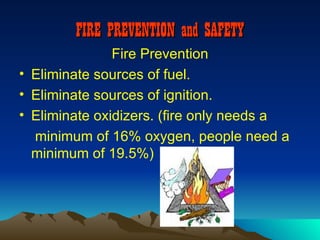
               Fire Prevention
• Eliminate sources of fuel.
• Eliminate sources of ignition.
• Eliminate oxidizers. (fire only needs a
  minimum of 16% oxygen, people need a
  minimum of 19.5%)
FIRE PREVENTION and SAFETY
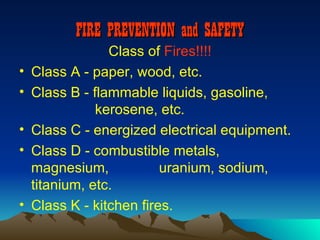
                 Class of Fires!!!!
•   Class A - paper, wood, etc.
•   Class B - flammable liquids, gasoline,
               kerosene, etc.
•   Class C - energized electrical equipment.
•   Class D - combustible metals,
    magnesium,            uranium, sodium,
    titanium, etc.
•   Class K - kitchen fires.
FIRE PREVENTION and SAFETY
        Types of Fire Extinguishers
• Class A for extinguishing class A fires
  only.
FIRE PREVENTION and SAFETY
        Types of Fire Extinguishers
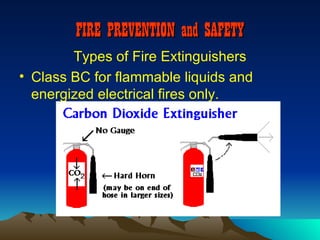
• Class BC for flammable liquids and
  energized electrical fires only.
FIRE PREVENTION and SAFETY
            Types of Fire Extinguishers
• ABC fire extinguisher for all of the above classes
  of fires.


         Contains Ammonium Phosphate
FIRE PREVENTION and SAFETY
         Types of Fire Extinguishers
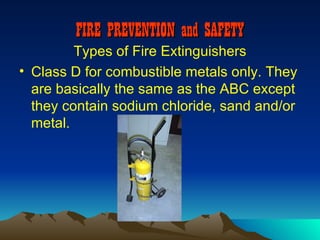
• Class D for combustible metals only. They
  are basically the same as the ABC except
  they contain sodium chloride, sand and/or
  metal.
FIRE PREVENTION and SAFETY
             Types of Fire Extinguishers
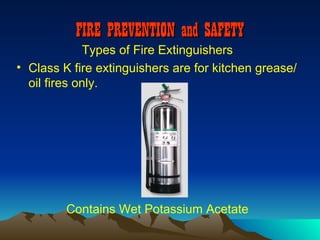
• Class K fire extinguishers are for kitchen grease/
  oil fires only.


         Contains Wet Potassium Acetate
FIRE PREVENTION and SAFETY
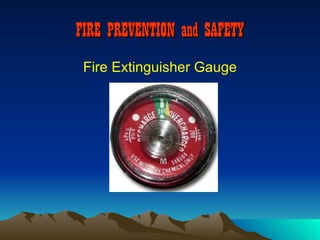
 Fire Extinguisher Gauge
FIRE PREVENTION and SAFETY
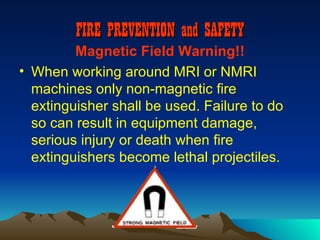
         Magnetic Field Warning!!
• When working around MRI or NMRI
  machines only non-magnetic fire
  extinguisher shall be used. Failure to do
  so can result in equipment damage,
  serious injury or death when fire
  extinguishers become lethal projectiles.
FIRE PREVENTION and SAFETY
 Use a fire extinguisher only if the following
                      apply:
• The building is being evacuated (alarm
  sounded).
• The fire department has been called (911).
• The fire is small, contained and not
  spreading.
• The exit is clear and you can fight the fire
  with the exit at your back.
FIRE PREVENTION and SAFETY
• You can stay low.
• The correct fire extinguisher is
  immediately at hand.
• YOU KNOW HOW TO USE THE FIRE
  EXTINGUISHER!
  If you have any doubt about fighting the
  fire or can not meet all of the above
  conditions, DO NOT fight the fire. Leave
  and close all doors behind you.
FIRE PREVENTION and SAFETY
• Fire extinguishers must have an annual
  certification performed by a fire company
  (businesses only)
• NFPA recommends, OSHA requires
  monthly self inspections.
• Fire extinguishers must be recharged
  immediately after use, regardless of how
  little was used.
• A fire extinguisher that shows an
  overcharge must be serviced.
FIRE PREVENTION and SAFETY
• Fire extinguishers must be have a
  hydrostatic test every 5-12 years
  depending on type of fire extinguisher.
FIRE PREVENTION and SAFETY
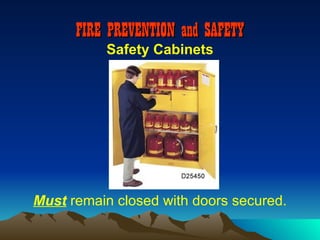
          Safety Cabinets


Must remain closed with doors secured.
FIRE PREVENTION and SAFETY
              Smoke Alarms
• Should be tested monthly.
• Change batteries every 6 months, 12
  months max.
• Should be replaced between 7-10 years
  max.
FIRE PREVENTION and SAFETY
                    TIME IS CRITICAL
•    :30- fire ignites and grows rapidly.
•   1:04- from ignition fire spreads and smoke
          starts to fill room.
•   1:35- smoke layer descends rapidly,
          temperature exceeds 190F.
•   1:50- smoke alarm at foot of stairs sounds.
          There is still time to get out.
•   2:30- temperature above couch exceeds 400F.
FIRE PREVENTION and SAFETY
• 2:48- smoke pours into other rooms.
• 3:03- temperature three feet above floor in
        room of origin exceeds 500F.
• 3:20- upstairs hall filled with smoke –
              chance of escape is reduced.
• 3:41- FLASHOVER- energy in room of
        origin ignites everything.
        Temperature is 1400F.
FIRE PREVENTION and SAFETY
• 3:50- two minutes after the smoke alarm
        has sounded, 2nd floor exit is the only
        means of escape.
• 4:33- flames are just now visible from the
        exterior of the house.
  AT THIS POINT, RESCUE MAY NOT BE
                  POSSIBLE.
FIRE PREVENTION and SAFETY
        Kitchen Fire
FIRE PREVENTION and SAFETY
 Fire Marshall Clyde Says


  Be fire wise, stay alive!
Pull, Aim, Squeeze, Sweep

Fire safety

  • 1.
  • 2.
    FIRE PREVENTION andSAFETY • Every 15 seconds, a fire dept. responds to a fire somewhere in the United States. • A residential fire occurs every 66 seconds. • There is a civilian death from fire every 118 minutes. • There is one civilian injury from fire every 18 minutes.
  • 3.
    FIRE PREVENTION andSAFETY Fire Statistics • 1977 there were 723,500 fires resulting in 5865 deaths and 21,640 injuries. • 2005 there were 381,000 fires resulting in 3,030 deaths and 13,300 injuries. • Approximately 2/3 (60%) of fires occur in the home. • Over 90% of fatalities in buildings are residential dwellings. • Most fatal residential fires occur between 11:00 PM and 6:00 AM when people are sleeping. • Most people think fire will never happen to them.
  • 4.
    FIRE PREVENTION andSAFETY COMMON CAUSES OF FIRE • Overheated and/or overloaded wiring. • Torches. • Cigarettes. • Equipment in need of repair. • Dirty or greasy motors. • Oily rags. • Incompatible chemicals, etc. • Static discharge.
  • 5.
    FIRE PREVENTION andSAFETY Fire Prevention • Eliminate sources of fuel. • Eliminate sources of ignition. • Eliminate oxidizers. (fire only needs a minimum of 16% oxygen, people need a minimum of 19.5%)
  • 6.
    FIRE PREVENTION andSAFETY Class of Fires!!!! • Class A - paper, wood, etc. • Class B - flammable liquids, gasoline, kerosene, etc. • Class C - energized electrical equipment. • Class D - combustible metals, magnesium, uranium, sodium, titanium, etc. • Class K - kitchen fires.
  • 7.
    FIRE PREVENTION andSAFETY Types of Fire Extinguishers • Class A for extinguishing class A fires only.
  • 8.
    FIRE PREVENTION andSAFETY Types of Fire Extinguishers • Class BC for flammable liquids and energized electrical fires only.
  • 9.
    FIRE PREVENTION andSAFETY Types of Fire Extinguishers • ABC fire extinguisher for all of the above classes of fires. Contains Ammonium Phosphate
  • 10.
    FIRE PREVENTION andSAFETY Types of Fire Extinguishers • Class D for combustible metals only. They are basically the same as the ABC except they contain sodium chloride, sand and/or metal.
  • 11.
    FIRE PREVENTION andSAFETY Types of Fire Extinguishers • Class K fire extinguishers are for kitchen grease/ oil fires only. Contains Wet Potassium Acetate
  • 12.
    FIRE PREVENTION andSAFETY Fire Extinguisher Gauge
  • 13.
    FIRE PREVENTION andSAFETY Magnetic Field Warning!! • When working around MRI or NMRI machines only non-magnetic fire extinguisher shall be used. Failure to do so can result in equipment damage, serious injury or death when fire extinguishers become lethal projectiles.
  • 14.
    FIRE PREVENTION andSAFETY Use a fire extinguisher only if the following apply: • The building is being evacuated (alarm sounded). • The fire department has been called (911). • The fire is small, contained and not spreading. • The exit is clear and you can fight the fire with the exit at your back.
  • 15.
    FIRE PREVENTION andSAFETY • You can stay low. • The correct fire extinguisher is immediately at hand. • YOU KNOW HOW TO USE THE FIRE EXTINGUISHER! If you have any doubt about fighting the fire or can not meet all of the above conditions, DO NOT fight the fire. Leave and close all doors behind you.
  • 16.
    FIRE PREVENTION andSAFETY • Fire extinguishers must have an annual certification performed by a fire company (businesses only) • NFPA recommends, OSHA requires monthly self inspections. • Fire extinguishers must be recharged immediately after use, regardless of how little was used. • A fire extinguisher that shows an overcharge must be serviced.
  • 17.
    FIRE PREVENTION andSAFETY • Fire extinguishers must be have a hydrostatic test every 5-12 years depending on type of fire extinguisher.
  • 18.
    FIRE PREVENTION andSAFETY Safety Cabinets Must remain closed with doors secured.
  • 19.
    FIRE PREVENTION andSAFETY Smoke Alarms • Should be tested monthly. • Change batteries every 6 months, 12 months max. • Should be replaced between 7-10 years max.
  • 20.
    FIRE PREVENTION andSAFETY TIME IS CRITICAL • :30- fire ignites and grows rapidly. • 1:04- from ignition fire spreads and smoke starts to fill room. • 1:35- smoke layer descends rapidly, temperature exceeds 190F. • 1:50- smoke alarm at foot of stairs sounds. There is still time to get out. • 2:30- temperature above couch exceeds 400F.
  • 21.
    FIRE PREVENTION andSAFETY • 2:48- smoke pours into other rooms. • 3:03- temperature three feet above floor in room of origin exceeds 500F. • 3:20- upstairs hall filled with smoke – chance of escape is reduced. • 3:41- FLASHOVER- energy in room of origin ignites everything. Temperature is 1400F.
  • 22.
    FIRE PREVENTION andSAFETY • 3:50- two minutes after the smoke alarm has sounded, 2nd floor exit is the only means of escape. • 4:33- flames are just now visible from the exterior of the house. AT THIS POINT, RESCUE MAY NOT BE POSSIBLE.
  • 23.
  • 24.
  • 25.
  • 26.
  • 27.
    FIRE PREVENTION andSAFETY Kitchen Fire
  • 28.
    FIRE PREVENTION andSAFETY Fire Marshall Clyde Says Be fire wise, stay alive! Pull, Aim, Squeeze, Sweep