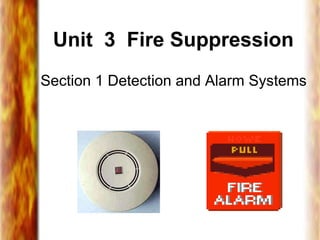
Unit 3 Fire Suppression
Section 1 Detection and Alarm Systems
1. Importance of Fire Detection
and Alarm Systems
1.1. Time Element
1.2. Notification
a. Type A Manual Alarm
b. Type B Automatic Alarm
1.3. Activation
Note: Studies with children and notification!
2. Types of Detectors
2.1. There are three broad classifications
of fire detection:
Heat, Smoke & Flame Detectors.
2.2. Fire Detectors are used in a variety
of fire prevention and suppression
systems.
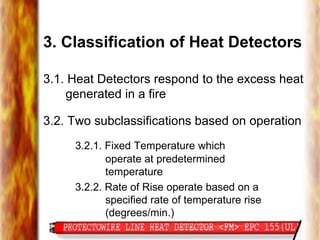
3. Classification of Heat Detectors
3.1. Heat Detectors respond to the excess heat
generated in a fire
3.2. Two subclassifications based on operation
3.2.1. Fixed Temperature which
operate at predetermined
temperature
3.2.2. Rate of Rise operate based on a
specified rate of temperature rise
(degrees/min.)
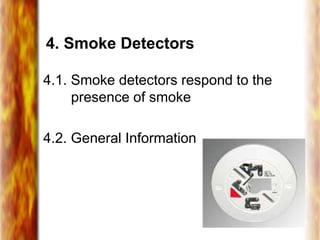
4. Smoke Detectors
4.1. Smoke detectors respond to the
presence of smoke
4.2. General Information
4.3. Classifications of Smoke
Detectors
4.3. Two Classifications
4.3.1. Photoelectric smoke detectors
4.3.2. Ionization smoke detectors
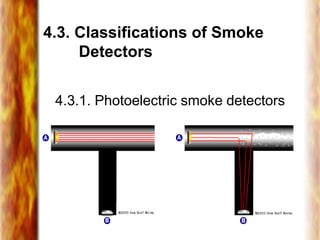
4.3. Classifications of Smoke
Detectors
4.3.1. Photoelectric smoke detectors
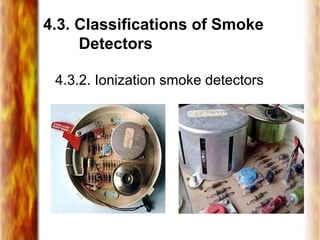
4.3. Classifications of Smoke
Detectors
4.3.2. Ionization smoke detectors
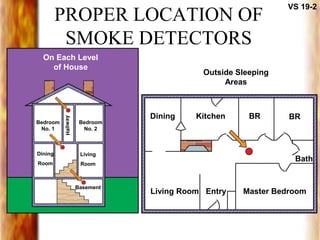
PROPER LOCATION OF
SMOKE DETECTORS
VS 19-2
Outside Sleeping
Areas
On Each Level
of House
Dining Kitchen
EntryLiving Room
Bath
BRBR
Master Bedroom
Dining
Room
Living
Room
Basement
Bedroom
No. 1
Bedroom
No. 2
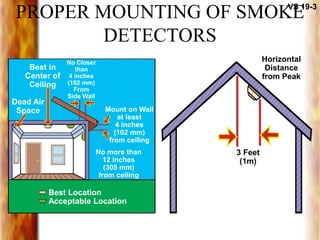
PROPER MOUNTING OF SMOKE
DETECTORS
VS 19-3
3 Feet
(1m)
Horizontal
Distance
from Peak
Mount on Wall
at least
4 inches
(102 mm)
from ceiling
No Closer
than
4 inches
(102 mm)
From
Side Wall
Best in
Center of
Ceiling
Dead Air
Space
No more than
12 inches
(305 mm)
from ceiling
Best Location
Acceptable Location
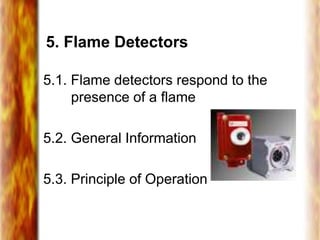
5. Flame Detectors
5.1. Flame detectors respond to the
presence of a flame
5.2. General Information
5.3. Principle of Operation
6.0 Placement of Fire Detectors
6.1. In general, fire detectors are
normally placed on the ceiling or
within 12" of ceiling
6.2. Where possible the detectors
should be located throughout
entire building
6.0 Placement of Fire Detectors
Cont’d
6.3. Spacing of detectors will vary
based on several factors
6.4. Connection to Remote Locations
6.5. Testing & Maintenance of fire
detectors
7.0 Components to a Fire Alarm
System
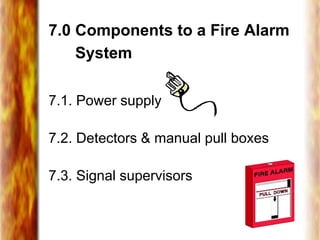
7.1. Power supply
7.2. Detectors & manual pull boxes
7.3. Signal supervisors
7.0 Components to a Fire Alarm
System Cont’d
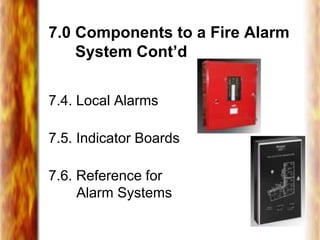
7.4. Local Alarms
7.5. Indicator Boards
7.6. Reference for
Alarm Systems
Unit 3 Fire Suppression
Section 2 “Fixed Extinguishment Systems”
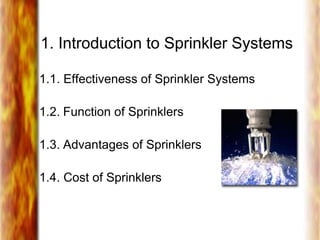
1. Introduction to Sprinkler Systems
1.1. Effectiveness of Sprinkler Systems
1.2. Function of Sprinklers
1.3. Advantages of Sprinklers
1.4. Cost of Sprinklers
2. Types of sprinkler systems
2.1. There are four major classifications
of sprinkler systems
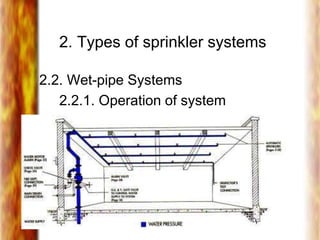
2. Types of sprinkler systems
2.2. Wet-pipe Systems
2.2.1. Operation of system
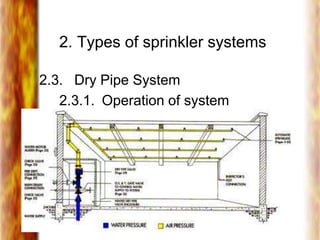
2. Types of sprinkler systems
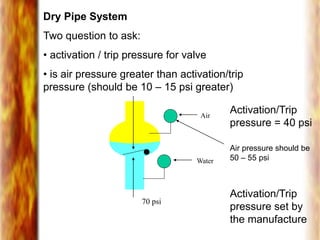
2.3. Dry Pipe System
2.3.1. Operation of system
Air
Water
Dry Pipe System
Two question to ask:
• activation / trip pressure for valve
• is air pressure greater than activation/trip
pressure (should be 10 – 15 psi greater)
Activation/Trip
pressure set by
the manufacture
70 psi
Activation/Trip
pressure = 40 psi
Air pressure should be
50 – 55 psi
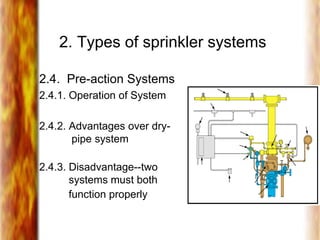
2. Types of sprinkler systems
2.4. Pre-action Systems
2.4.1. Operation of System
2.4.2. Advantages over dry-
pipe system
2.4.3. Disadvantage--two
systems must both
function properly
2. Types of sprinkler systems
2.5. Deluge sprinkler system
2.5.1. Operation of system
2.5.2. Uses of Deluge System
3. Basic Sprinkler System Components
3.1. Water Supplies
3.1.1. Types of water supplies
 Public Water
 Pressure Tanks
Basic Sprinkler System Components
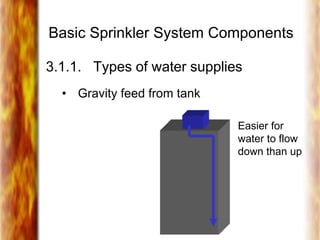
3.1.1. Types of water supplies
• Gravity feed from tank
Easier for
water to flow
down than up
3. Basic Sprinkler System Components
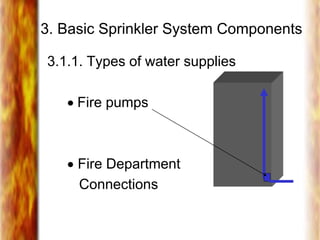
3.1.1. Types of water supplies
 Fire pumps
 Fire Department
Connections
3. Basic Sprinkler System Components
3.1.2. Amount of water supply
a. Hazard of Occupancy—most important
 Light hazard class
 Ordinary hazard class
Group 1
Group 2
 Extra hazard class
Group 1
Group 2
Basic Sprinkler System Components
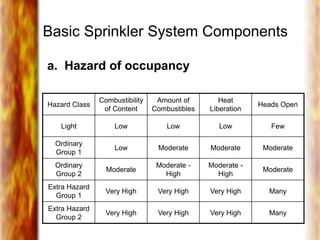
a. Hazard of occupancy
Hazard Class
Combustibility
of Content
Amount of
Combustibles
Heat
Liberation
Heads Open
Light Low Low Low Few
Ordinary
Group 1
Low Moderate Moderate Moderate
Ordinary
Group 2
Moderate
Moderate -
High
Moderate -
High
Moderate
Extra Hazard
Group 1
Very High Very High Very High Many
Extra Hazard
Group 2
Very High Very High Very High Many
3. Basic Sprinkler System Components
3.1.2. Amount of water supply
b. Obstructions to water delivery
c. High ceilings
d. Unprotected vertical openings
between floors
e. Division of spaces
3. Basic Sprinkler System Components
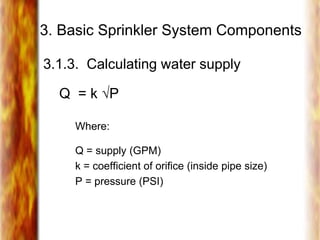
3.1.3. Calculating water supply
Q = k √P
Where:
Q = supply (GPM)
k = coefficient of orifice (inside pipe size)
P = pressure (PSI)
3. Basic Sprinkler System Components
3.2. Sprinkler Piping
3.2.1. The piping and type of valve
will vary depending on type of
system
3.2.2. Types of piping
3.2.3. Hydraulic design
of systems
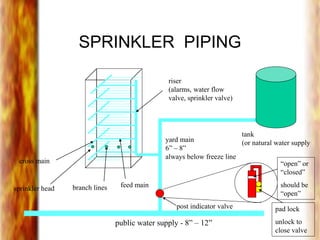
SPRINKLER PIPING
tank
(or natural water supply
public water supply - 8” – 12”
yard main
6” – 8”
always below freeze line
cross main
branch lines feed mainsprinkler head
post indicator valve
“open” or
“closed”
should be
“open”
pad lock
unlock to
close valve
riser
(alarms, water flow
valve, sprinkler valve)
3. Basic Sprinkler System Components
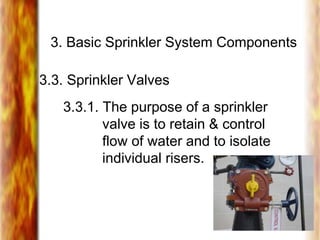
3.3. Sprinkler Valves
3.3.1. The purpose of a sprinkler
valve is to retain & control
flow of water and to isolate
individual risers.
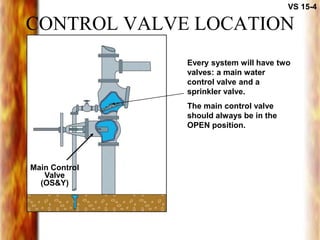
CONTROL VALVE LOCATION
VS 15-4
Main Control
Valve
(OS&Y)
Every system will have two
valves: a main water
control valve and a
sprinkler valve.
The main control valve
should always be in the
OPEN position.
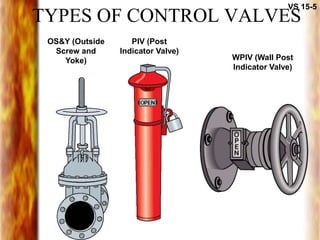
TYPES OF CONTROL VALVES
VS 15-5
OS&Y (Outside
Screw and
Yoke)
PIV (Post
Indicator Valve)
WPIV (Wall Post
Indicator Valve)
3. Basic Sprinkler System Components
3.4. Alarms on Sprinkler Systems
3.4.1. Every sprinkler system should
have an alarm that sounds
when water flows through the
system.
3.4.2. Types of Alarms
3.4.3. Supervisory signals
3. Basic Sprinkler System Components
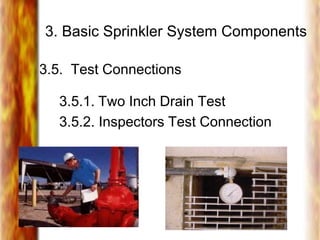
3.5. Test Connections
3.5.1. Two Inch Drain Test
3.5.2. Inspectors Test Connection
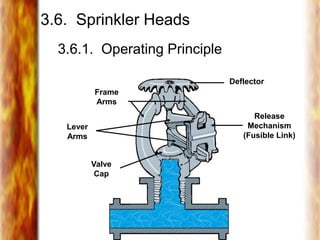
3.6. Sprinkler Heads
3.6.1. Operating Principle
Frame
Arms
Lever
Arms
Valve
Cap
Deflector
Release
Mechanism
(Fusible Link)
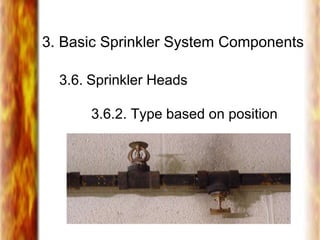
3. Basic Sprinkler System Components
3.6. Sprinkler Heads
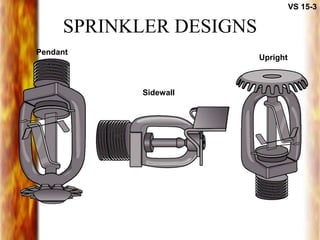
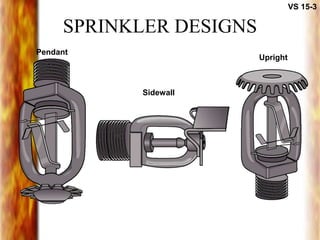
3.6.2. Type based on position
SPRINKLER DESIGNS
VS 15-3
Pendant
Sidewall
Upright
3. Basic Sprinkler System Components
3.6. Sprinkler Heads
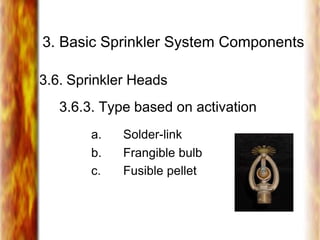
3.6.3. Type based on activation
a. Solder-link
b. Frangible bulb
c. Fusible pellet
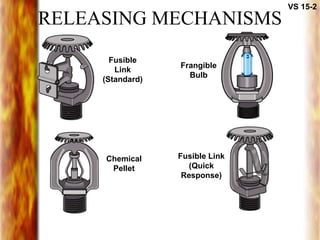
RELEASING MECHANISMS
VS 15-2
Fusible
Link
(Standard)
Chemical
Pellet
Frangible
Bulb
Fusible Link
(Quick
Response)
3. Basic Sprinkler System Components
3.6. Sprinkler Heads
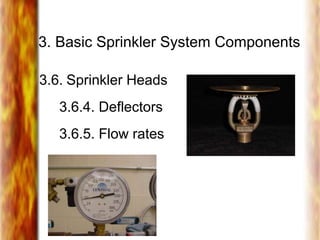
3.6.4. Deflectors
3.6.5. Flow rates
SPRINKLER DESIGNS
VS 15-3
Pendant
Sidewall
Upright
3. Basic Sprinkler System Components
3.6. Sprinkler Heads
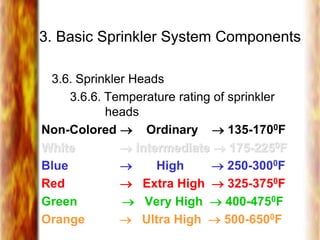
3.6.6. Temperature rating of sprinkler
heads
Non-Colored  Ordinary  135-1700F
White  Intermediate  175-2250F
Blue  High  250-3000F
Red  Extra High  325-3750F
Green  Very High  400-4750F
Orange  Ultra High  500-6500F
3. Basic Sprinkler System Components
3.6. Sprinkler Heads
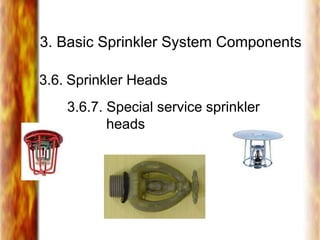
3.6.7. Special service sprinkler
heads
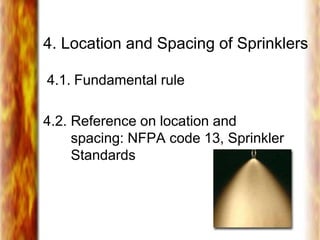
4. Location and Spacing of Sprinklers
4.1. Fundamental rule
4.2. Reference on location and
spacing: NFPA code 13, Sprinkler
Standards
4. Location and spacing of sprinklers
4.3. Spacing depends on the class of
hazard of occupancy and the type of
ceiling construction
4.3.1. Light hazard - 15' maximum
between sprinklers
4.3.2. Ordinary hazard - 12-15' ft.
depending on use of area
4.3.3. Extra hazard - 12' maximum
4. Location and spacing of sprinklers
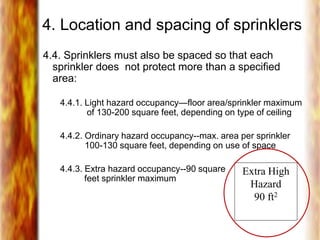
4.4. Sprinklers must also be spaced so that each
sprinkler does not protect more than a specified
area:
4.4.1. Light hazard occupancy—floor area/sprinkler maximum
of 130-200 square feet, depending on type of ceiling
4.4.2. Ordinary hazard occupancy--max. area per sprinkler
100-130 square feet, depending on use of space
4.4.3. Extra hazard occupancy--90 square
feet sprinkler maximum
Extra High
Hazard
90 ft2
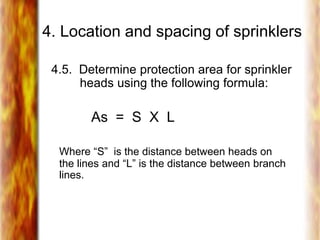
4. Location and spacing of sprinklers
4.5. Determine protection area for sprinkler
heads using the following formula:
As = S X L
Where “S” is the distance between heads on
the lines and “L” is the distance between branch
lines.
4. Location and spacing of sprinklers
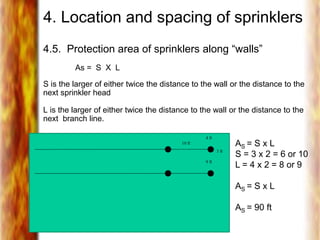
4.5. Protection area of sprinklers along “walls”
As = S X L
S is the larger of either twice the distance to the wall or the distance to the
next sprinkler head
L is the larger of either twice the distance to the wall or the distance to the
next branch line.
10 ft
3 ft
9 ft
4 ft
AS = S x L
S = 3 x 2 = 6 or 10
L = 4 x 2 = 8 or 9
AS = S x L
AS = 90 ft
4. Location and spacing of sprinklers
4.6. Other location specifications that
may influence spacing
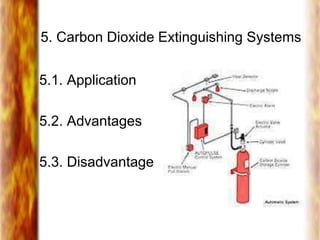
5. Carbon Dioxide Extinguishing Systems
5.1. Application
5.2. Advantages
5.3. Disadvantage
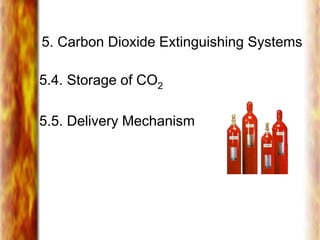
5. Carbon Dioxide Extinguishing Systems
5.4. Storage of CO2
5.5. Delivery Mechanism
5. Carbon Dioxide Extinguishing Systems
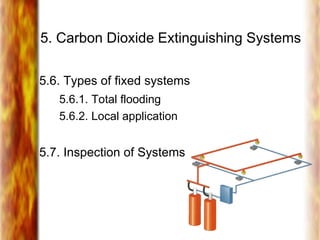
5.6. Types of fixed systems
5.6.1. Total flooding
5.6.2. Local application
5.7. Inspection of Systems
6. Dry Chemical Fire Extinguishing Systems
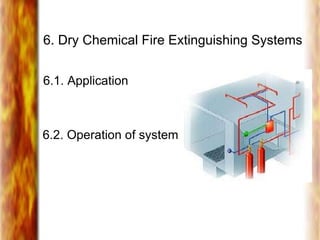
6.1. Application
6.2. Operation of system
Carbon Dioxide Extinguishing Systems
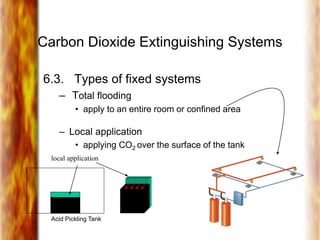
6.3. Types of fixed systems
– Total flooding
• apply to an entire room or confined area
– Local application
• applying CO2 over the surface of the tank
local application
Acid Pickling Tank
6. Dry Chemical Fire Extinguishing Systems
6.4. Quantity and rate of application is
determined by a qualified professional
6.5. Inspection and maintenance must be
completed at least once each year
(NFPA Code #17)
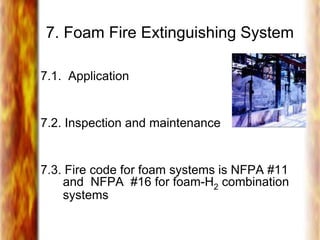
7. Foam Fire Extinguishing System
7.1. Application
7.2. Inspection and maintenance
7.3. Fire code for foam systems is NFPA #11
and NFPA #16 for foam-H2 combination
systems
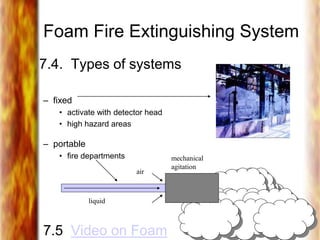
Foam Fire Extinguishing System
7.4. Types of systems
– fixed
• activate with detector head
• high hazard areas
– portable
• fire departments
7.5 Video on Foam
liquid
air
mechanical
agitation
Unit 3 Fire Extinguishment
Section 3 “Explosion Prevention”
1. Introduction
1.1. Principles of Explosion Prevention
a) Venting to relieve the pressure
b) Suppression to extinguish or retard the
deflagration
c) Purging to eliminate the combustible
mixture
2. Fundamentals of explosion venting
2.1. Location of hazardous operations
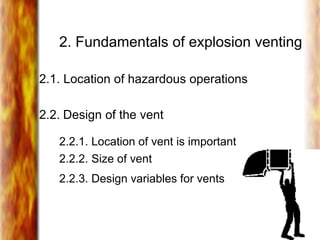
2.2. Design of the vent
2.2.1. Location of vent is important
2.2.2. Size of vent
2.2.3. Design variables for vents
2. Fundamentals of explosion venting
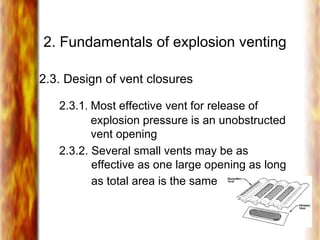
2.3. Design of vent closures
2.3.1. Most effective vent for release of
explosion pressure is an unobstructed
vent opening
2.3.2. Several small vents may be as
effective as one large opening as long
as total area is the same
2. Fundamentals of explosion venting
2.3. Design of vent closures
2.3.3. The nearer a vent is located to the
point of explosion the more effective it
will be
2.3.4. If diaphragms (of the same size and
thickness) are made thicker then more
pressure will be required to rupture
them
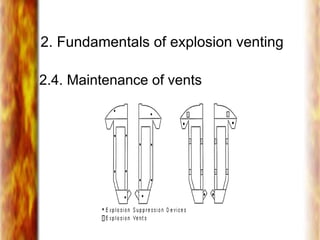
2. Fundamentals of explosion venting
2.4. Maintenance of vents
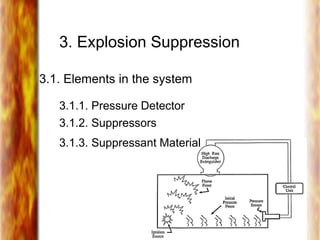
3. Explosion Suppression
3.1. Elements in the system
3.1.1. Pressure Detector
3.1.2. Suppressors
3.1.3. Suppressant Material

Fire suppression

  • 1.
    Unit 3 FireSuppression Section 1 Detection and Alarm Systems
  • 2.
    1. Importance ofFire Detection and Alarm Systems 1.1. Time Element 1.2. Notification a. Type A Manual Alarm b. Type B Automatic Alarm 1.3. Activation Note: Studies with children and notification!
  • 3.
    2. Types ofDetectors 2.1. There are three broad classifications of fire detection: Heat, Smoke & Flame Detectors. 2.2. Fire Detectors are used in a variety of fire prevention and suppression systems.
  • 4.
    3. Classification ofHeat Detectors 3.1. Heat Detectors respond to the excess heat generated in a fire 3.2. Two subclassifications based on operation 3.2.1. Fixed Temperature which operate at predetermined temperature 3.2.2. Rate of Rise operate based on a specified rate of temperature rise (degrees/min.)
  • 5.
    4. Smoke Detectors 4.1.Smoke detectors respond to the presence of smoke 4.2. General Information
  • 6.
    4.3. Classifications ofSmoke Detectors 4.3. Two Classifications 4.3.1. Photoelectric smoke detectors 4.3.2. Ionization smoke detectors
  • 7.
    4.3. Classifications ofSmoke Detectors 4.3.1. Photoelectric smoke detectors
  • 8.
    4.3. Classifications ofSmoke Detectors 4.3.2. Ionization smoke detectors
  • 9.
    PROPER LOCATION OF SMOKEDETECTORS VS 19-2 Outside Sleeping Areas On Each Level of House Dining Kitchen EntryLiving Room Bath BRBR Master Bedroom Dining Room Living Room Basement Bedroom No. 1 Bedroom No. 2
  • 10.
    PROPER MOUNTING OFSMOKE DETECTORS VS 19-3 3 Feet (1m) Horizontal Distance from Peak Mount on Wall at least 4 inches (102 mm) from ceiling No Closer than 4 inches (102 mm) From Side Wall Best in Center of Ceiling Dead Air Space No more than 12 inches (305 mm) from ceiling Best Location Acceptable Location
  • 11.
    5. Flame Detectors 5.1.Flame detectors respond to the presence of a flame 5.2. General Information 5.3. Principle of Operation
  • 12.
    6.0 Placement ofFire Detectors 6.1. In general, fire detectors are normally placed on the ceiling or within 12" of ceiling 6.2. Where possible the detectors should be located throughout entire building
  • 13.
    6.0 Placement ofFire Detectors Cont’d 6.3. Spacing of detectors will vary based on several factors 6.4. Connection to Remote Locations 6.5. Testing & Maintenance of fire detectors
  • 14.
    7.0 Components toa Fire Alarm System 7.1. Power supply 7.2. Detectors & manual pull boxes 7.3. Signal supervisors
  • 15.
    7.0 Components toa Fire Alarm System Cont’d 7.4. Local Alarms 7.5. Indicator Boards 7.6. Reference for Alarm Systems
  • 16.
    Unit 3 FireSuppression Section 2 “Fixed Extinguishment Systems”
  • 17.
    1. Introduction toSprinkler Systems 1.1. Effectiveness of Sprinkler Systems 1.2. Function of Sprinklers 1.3. Advantages of Sprinklers 1.4. Cost of Sprinklers
  • 18.
    2. Types ofsprinkler systems 2.1. There are four major classifications of sprinkler systems
  • 19.
    2. Types ofsprinkler systems 2.2. Wet-pipe Systems 2.2.1. Operation of system
  • 20.
    2. Types ofsprinkler systems 2.3. Dry Pipe System 2.3.1. Operation of system
  • 21.
    Air Water Dry Pipe System Twoquestion to ask: • activation / trip pressure for valve • is air pressure greater than activation/trip pressure (should be 10 – 15 psi greater) Activation/Trip pressure set by the manufacture 70 psi Activation/Trip pressure = 40 psi Air pressure should be 50 – 55 psi
  • 22.
    2. Types ofsprinkler systems 2.4. Pre-action Systems 2.4.1. Operation of System 2.4.2. Advantages over dry- pipe system 2.4.3. Disadvantage--two systems must both function properly
  • 23.
    2. Types ofsprinkler systems 2.5. Deluge sprinkler system 2.5.1. Operation of system 2.5.2. Uses of Deluge System
  • 24.
    3. Basic SprinklerSystem Components 3.1. Water Supplies 3.1.1. Types of water supplies  Public Water  Pressure Tanks
  • 25.
    Basic Sprinkler SystemComponents 3.1.1. Types of water supplies • Gravity feed from tank Easier for water to flow down than up
  • 26.
    3. Basic SprinklerSystem Components 3.1.1. Types of water supplies  Fire pumps  Fire Department Connections
  • 27.
    3. Basic SprinklerSystem Components 3.1.2. Amount of water supply a. Hazard of Occupancy—most important  Light hazard class  Ordinary hazard class Group 1 Group 2  Extra hazard class Group 1 Group 2
  • 28.
    Basic Sprinkler SystemComponents a. Hazard of occupancy Hazard Class Combustibility of Content Amount of Combustibles Heat Liberation Heads Open Light Low Low Low Few Ordinary Group 1 Low Moderate Moderate Moderate Ordinary Group 2 Moderate Moderate - High Moderate - High Moderate Extra Hazard Group 1 Very High Very High Very High Many Extra Hazard Group 2 Very High Very High Very High Many
  • 29.
    3. Basic SprinklerSystem Components 3.1.2. Amount of water supply b. Obstructions to water delivery c. High ceilings d. Unprotected vertical openings between floors e. Division of spaces
  • 30.
    3. Basic SprinklerSystem Components 3.1.3. Calculating water supply Q = k √P Where: Q = supply (GPM) k = coefficient of orifice (inside pipe size) P = pressure (PSI)
  • 31.
    3. Basic SprinklerSystem Components 3.2. Sprinkler Piping 3.2.1. The piping and type of valve will vary depending on type of system 3.2.2. Types of piping 3.2.3. Hydraulic design of systems
  • 32.
    SPRINKLER PIPING tank (or naturalwater supply public water supply - 8” – 12” yard main 6” – 8” always below freeze line cross main branch lines feed mainsprinkler head post indicator valve “open” or “closed” should be “open” pad lock unlock to close valve riser (alarms, water flow valve, sprinkler valve)
  • 33.
    3. Basic SprinklerSystem Components 3.3. Sprinkler Valves 3.3.1. The purpose of a sprinkler valve is to retain & control flow of water and to isolate individual risers.
  • 34.
    CONTROL VALVE LOCATION VS15-4 Main Control Valve (OS&Y) Every system will have two valves: a main water control valve and a sprinkler valve. The main control valve should always be in the OPEN position.
  • 35.
    TYPES OF CONTROLVALVES VS 15-5 OS&Y (Outside Screw and Yoke) PIV (Post Indicator Valve) WPIV (Wall Post Indicator Valve)
  • 36.
    3. Basic SprinklerSystem Components 3.4. Alarms on Sprinkler Systems 3.4.1. Every sprinkler system should have an alarm that sounds when water flows through the system. 3.4.2. Types of Alarms 3.4.3. Supervisory signals
  • 37.
    3. Basic SprinklerSystem Components 3.5. Test Connections 3.5.1. Two Inch Drain Test 3.5.2. Inspectors Test Connection
  • 38.
    3.6. Sprinkler Heads 3.6.1.Operating Principle Frame Arms Lever Arms Valve Cap Deflector Release Mechanism (Fusible Link)
  • 39.
    3. Basic SprinklerSystem Components 3.6. Sprinkler Heads 3.6.2. Type based on position
  • 40.
  • 41.
    3. Basic SprinklerSystem Components 3.6. Sprinkler Heads 3.6.3. Type based on activation a. Solder-link b. Frangible bulb c. Fusible pellet
  • 42.
  • 43.
    3. Basic SprinklerSystem Components 3.6. Sprinkler Heads 3.6.4. Deflectors 3.6.5. Flow rates
  • 44.
  • 45.
    3. Basic SprinklerSystem Components 3.6. Sprinkler Heads 3.6.6. Temperature rating of sprinkler heads Non-Colored  Ordinary  135-1700F White  Intermediate  175-2250F Blue  High  250-3000F Red  Extra High  325-3750F Green  Very High  400-4750F Orange  Ultra High  500-6500F
  • 46.
    3. Basic SprinklerSystem Components 3.6. Sprinkler Heads 3.6.7. Special service sprinkler heads
  • 47.
    4. Location andSpacing of Sprinklers 4.1. Fundamental rule 4.2. Reference on location and spacing: NFPA code 13, Sprinkler Standards
  • 48.
    4. Location andspacing of sprinklers 4.3. Spacing depends on the class of hazard of occupancy and the type of ceiling construction 4.3.1. Light hazard - 15' maximum between sprinklers 4.3.2. Ordinary hazard - 12-15' ft. depending on use of area 4.3.3. Extra hazard - 12' maximum
  • 49.
    4. Location andspacing of sprinklers 4.4. Sprinklers must also be spaced so that each sprinkler does not protect more than a specified area: 4.4.1. Light hazard occupancy—floor area/sprinkler maximum of 130-200 square feet, depending on type of ceiling 4.4.2. Ordinary hazard occupancy--max. area per sprinkler 100-130 square feet, depending on use of space 4.4.3. Extra hazard occupancy--90 square feet sprinkler maximum Extra High Hazard 90 ft2
  • 50.
    4. Location andspacing of sprinklers 4.5. Determine protection area for sprinkler heads using the following formula: As = S X L Where “S” is the distance between heads on the lines and “L” is the distance between branch lines.
  • 51.
    4. Location andspacing of sprinklers 4.5. Protection area of sprinklers along “walls” As = S X L S is the larger of either twice the distance to the wall or the distance to the next sprinkler head L is the larger of either twice the distance to the wall or the distance to the next branch line. 10 ft 3 ft 9 ft 4 ft AS = S x L S = 3 x 2 = 6 or 10 L = 4 x 2 = 8 or 9 AS = S x L AS = 90 ft
  • 52.
    4. Location andspacing of sprinklers 4.6. Other location specifications that may influence spacing
  • 53.
    5. Carbon DioxideExtinguishing Systems 5.1. Application 5.2. Advantages 5.3. Disadvantage
  • 54.
    5. Carbon DioxideExtinguishing Systems 5.4. Storage of CO2 5.5. Delivery Mechanism
  • 55.
    5. Carbon DioxideExtinguishing Systems 5.6. Types of fixed systems 5.6.1. Total flooding 5.6.2. Local application 5.7. Inspection of Systems
  • 56.
    6. Dry ChemicalFire Extinguishing Systems 6.1. Application 6.2. Operation of system
  • 57.
    Carbon Dioxide ExtinguishingSystems 6.3. Types of fixed systems – Total flooding • apply to an entire room or confined area – Local application • applying CO2 over the surface of the tank local application Acid Pickling Tank
  • 58.
    6. Dry ChemicalFire Extinguishing Systems 6.4. Quantity and rate of application is determined by a qualified professional 6.5. Inspection and maintenance must be completed at least once each year (NFPA Code #17)
  • 59.
    7. Foam FireExtinguishing System 7.1. Application 7.2. Inspection and maintenance 7.3. Fire code for foam systems is NFPA #11 and NFPA #16 for foam-H2 combination systems
  • 60.
    Foam Fire ExtinguishingSystem 7.4. Types of systems – fixed • activate with detector head • high hazard areas – portable • fire departments 7.5 Video on Foam liquid air mechanical agitation
  • 61.
    Unit 3 FireExtinguishment Section 3 “Explosion Prevention”
  • 62.
    1. Introduction 1.1. Principlesof Explosion Prevention a) Venting to relieve the pressure b) Suppression to extinguish or retard the deflagration c) Purging to eliminate the combustible mixture
  • 63.
    2. Fundamentals ofexplosion venting 2.1. Location of hazardous operations 2.2. Design of the vent 2.2.1. Location of vent is important 2.2.2. Size of vent 2.2.3. Design variables for vents
  • 64.
    2. Fundamentals ofexplosion venting 2.3. Design of vent closures 2.3.1. Most effective vent for release of explosion pressure is an unobstructed vent opening 2.3.2. Several small vents may be as effective as one large opening as long as total area is the same
  • 65.
    2. Fundamentals ofexplosion venting 2.3. Design of vent closures 2.3.3. The nearer a vent is located to the point of explosion the more effective it will be 2.3.4. If diaphragms (of the same size and thickness) are made thicker then more pressure will be required to rupture them
  • 66.
    2. Fundamentals ofexplosion venting 2.4. Maintenance of vents
  • 67.
    3. Explosion Suppression 3.1.Elements in the system 3.1.1. Pressure Detector 3.1.2. Suppressors 3.1.3. Suppressant Material