Fire Safety
 and other emergency codes
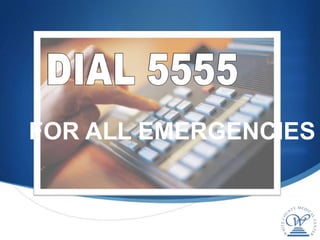
FOR ALL EMERGENCIES
Emergency Codes


o After dialing the emergency number – 5555 – state
  calmly and clearly the location and the name of the code
  that needs to be called
o The operator will then page the code and the location
  overhead three times and (depending on the code) will
  continue paging it until the appropriate help has arrived.
o The Emergency Codes are listed on the back of your
  Associate ID Badge.
Code Red

o   Fire

o   Do Not Use Elevators

o   Follow Departmental Plan

o   Fire doors close throughout the hospital
    • These doors close automatically and should remain closed until
        the Code Red is cleared

o   In patient care areas:
    • Close all doors
    • Place a pillow in front of the door of empty rooms so that time is
        not wasted attempting to rescue patients that are not there in an emergency
Code Red


o The CODE RED page is probably the most often heard
   emergency page in the hospital.

o This is because we are mandated to test the alarms.

o The CODE RED page is heard day and night for this reason – fire
   drills are held each quarter on all shifts.

o In the event of an actual fire, you would first rescue anyone in the
   immediate area and then dial 5555 or activate the nearest manual
   fire alarm device.

o Only when the danger is over is the code cleared.
*R*A*C*E*


Rescue
Alarm
Confine
Extinguish/Evacuate


o This acronym helps to remember the steps to take in the event
  of a fire
Rescue


o When you discover a fire, rescuing people in immediate
  danger is top priority.
Alarm


o Sound the alarm and call your emergency response
  number with the precise location of the fire.
Confine


o Close all doors, windows and chutes.

o Stuff damp towels under doors to prevent smoke from
  spreading

o Extinguish a small fire with the appropriate fire
  extinguisher or smother it.
Evacuate


o Remove any person in immediate danger.

o Direct patients not in immediate danger.

o If necessary route patients away from the site of the fire.

o   Transport by appropriate method.
    --Ambulate   --Wheelchair     --Stretcher

o Leave a pillow outside empty patient rooms to signify
    evacuation is completed.
Isolating the Fire


o After rescue from the fire location is completed, close the door
   and do not re-open except to extinguish the fire.
o Before re-entering a room in the fire area, feel the surface of
   the door for excessive heat.
o If it is hot to the touch, do not re-enter. Place a wet towel at the
   base of the door to help seal the opening.
o Close all doors in the area adjacent to the fire and keep closed
   except to evacuate patients or to provide necessary immediate
   patient care.
How To Use A Portable Fire
          Extinguisher


P        Pull the pin

A        Aim the extinguisher at the base of the Flame

S        Squeeze trigger while holding the extinguisher
         upright

S        Sweep the extinguisher from side to side,
         covering the area of the fire
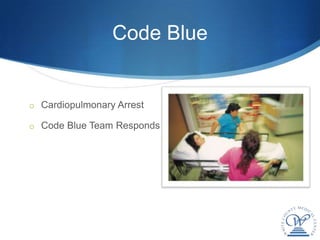
Code Blue


o Cardiopulmonary Arrest

o Code Blue Team Responds
Code Blue


o The operator will continue paging CODE BLUE every 10
  seconds until instructed to discontinue the page

o Notify the operator as soon as the code team is
  assembled to discontinue the overhead page

o To do this dial 5555 and state “Stop paging the code.”
Code Blue


o If a code is called mistakenly, Notify the operator as soon as
   possible.

o To do this dial 5555 and state “Code Blue all clear”

o The operator will page “Code Blue all clear”

o When a code is cleared there is no longer any need to respond.
   Do not clear a code unless the situation has been resolved and
   help is no longer needed.

o Pressing the CODE BLUE button in the patient’s room can also
   activate a CODE BLUE when dialing the phone is not an option.
Code Pink and Code Adam


o Code Pink: Infant

o Code Adam: Child Abduction
Code Pink and Code Adam


o It is important to remember that during this situation, no one is
    allowed to enter or leave the building unless excused by law
    enforcement.
o Associates are encouraged not to speak to the press.

o Each station has duty cards located in the red emergency box
    that direct actions to be taken during a CODE PINK (same
    cards are used during a CODE ADAM.
o   These cards are used to assist in monitoring all outside exits
    and parking lots.
Code Orange


o Plan of Threat of Explosion by Bomb or Other Device
Threat


o Upon receiving a threat alleging the presence of a bomb
  in the hospital, the switchboard operator or any person
  receiving the threat must remain calm and do the
  following:
  •   If a caller, keep the caller talking.
  •   Alert a nearby associate and have them contact the hospital
      operator (dial 5555) immediately telling the operator that a
      bomb threat is in progress
Code Orange


o The associate receiving the call attempts to ascertain
  pertinent information from the caller using the threatening
  telephone call checklist to take the following information:
  •   Bomb location
  •   What causes the bomb to explode
  •   What does the bomb look like
  •   Why did you place the bomb
  •   What is your name and address
Code Orange


o Try to note as much information about the caller as
  possible such as:
   •   Voice characteristics (male/female, any
       accent, lisp, drunk, calm, loud, slow)
   •   Background noise (street sounds, home, bar, etc.)

o If a written threat, contact the hospital operator (dial
  5555) immediately telling the operator that a bomb threat
  is in progress.
Notification


o Upon receiving directions from the president or
  designee, the switchboard operator announces three
  times over the public address system:
  •   “Attention Please, All Associates, Code Orange Is Now In
      Effect.”

o Engineering notifies the police department unless
  otherwise instructed by Administration.
Notification


o After the basic details are provided, the president or
  designee makes all necessary decisions and issues
  orders regarding a search of the premises.

o During bomb threat search procedures, all possible
  precautions are taken to prevent unnecessary alarming
  of patients and visitors.
General Search


o The extent of the search is determined by the president
  or designee in consultation with the police department.

o If police are involved in the search, they are
  accompanied by a person designated by the president
  who is familiar with the area.

o In the event the caller indicates the location of the
  bomb, that area is searched first.
General Search


o Engineering personnel search hallways, gift
  shop, restrooms, stairwells, elevators, utility closets, and
  waiting rooms.
o Hospital personnel involved in the search are instructed
  that their mission is only to look for and report suspicious
  objects – not to move, or touch the object or anything
  attached there to or in the immediate area.
o Dietary personnel search the cafeteria.
General Search


o Supervisory and office personnel search their immediate
  area.
o Patient areas are searched by nursing personnel.

o As the search of each area is completed and no
  suspicious objects are found, the appointed person in
  charge of the area calls the control center stating the
  area or department, followed by “search completed, area
  clear.”
Bomb Discovered


o If a suspected bomb or suspicious object is found:
   • Do not touch, move or jar the suspicious object or
     anything thereto.
   • Remain calm and alert; prevent unnecessary alarming
     of patients, visitors, or other employees.
   • Clear the area of all personnel but do not try to
     evacuate until notified by administration.
   • Immediately telephone hospital operator (dial 5555).
     Report suspected bomb location, time found, and your
     name and title.
STAT-13


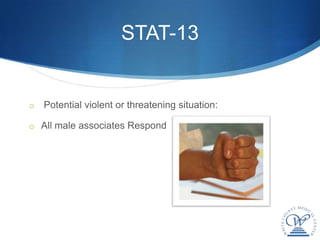
o   Potential violent or threatening situation:

o All male associates Respond
STAT-13


o This code is for a potential violent or threatening situation. The
   keyword here is potential.

o Do not wait until the situation becomes violent to call this code.

o Get help immediately.

o Male associates respond to this code as well as security
   officers when on duty.

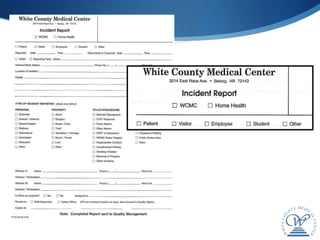
o An incident report must be filed on all STAT 13 pages.
Doctor Strong


o Lifting Assistance
Dr. Strong


o This code is paged when immediate lifting assistance is
  needed.
o This code is generally reserved for situations where it is
  necessary to move someone from the floor that cannot
  assist with this effort, but may be used in any emergency
  situation where heavy lifting is required.
o Male associates respond to this page. An easy way to
  remember this is “a call for Dr. Strong is a call for
  muscles.”
Weather Alert

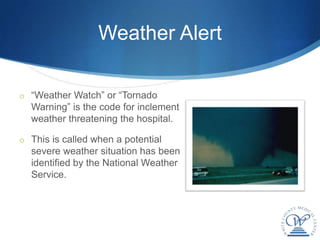
o “Weather Watch” or “Tornado
  Warning” is the code for inclement
  weather threatening the hospital.

o This is called when a potential
  severe weather situation has been
  identified by the National Weather
  Service.
Weather Alert


o When White County Medical Center is in danger from
  severe weather, the president or designee continuously
  monitors the weather along with local authorities and
  local weather stations, and National Weather Service.
o “Weather Watch” is announced in the event of a
  Thunderstorm/Tornado Watch.
o Tornado Warning is announced when a tornado warning
  is imminent to the hospital.
Weather Alert


o Weather is also monitored using a radio located in Emergency
   Department or Internet services of KARK by designated
   associates only.

o Only the president or designee can order and/or cancel a
   “Weather Watch” or “Tornado Warning”

o All associates remain on duty until released by Command
   Center.

o A Red Alert is called when a disaster is confirmed and the red
   alert tree from the “External Disaster” instructions is followed.
General Response


o Close all blinds and drapes

o Stay as far away from windows and glass doors as
  possible

o All associates remain in patient care areas to ensure
  patient safety

o Assign associates to control the potential visitor influx by
  setting up Hubach Conference Center
Patient Area Response


o All Areas:
  • Move patients as far from windows as possible, or in
      corridors if accessible, and cover with a blanket
  • Keep visitors with patient
  • Maintain calm, efficient environnent
  • Safest areas are small, windowless rooms near the center
      of the building

o Safest areas include: Bathrooms, Corridors, Small rooms
  around the nurses’ stations
Weather Alert


o All associates remain on duty until released by Command
  Center.

o Either an “All Clear” or “Red Alert” will be paged.

o A red alert is called if a disaster is confirmed
General Response Under a
          Weather Alert


o Stay in the center of the building.

o If responsible for patient care, stay with the patients.

o If non-direct care giver, move immediately to the Hubach
  Conference Center.
o If responding from off duty, follow directive of the
  Emergency Control Center.
o Await “All Clear” announcement.
Visitors


o Encourage all visitors to remain inside the building.

o They may either stay with their patient or move within the
  center core of the hospital such as the “Canteen” area or
  other waiting areas on the North Campus and to the
  center of the building on the South Campus.

o If all available waiting areas are full the Hubach Center is
  made available.

Fire safety and codes

  • 1.
    Fire Safety andother emergency codes
  • 2.
  • 3.
    Emergency Codes o Afterdialing the emergency number – 5555 – state calmly and clearly the location and the name of the code that needs to be called o The operator will then page the code and the location overhead three times and (depending on the code) will continue paging it until the appropriate help has arrived. o The Emergency Codes are listed on the back of your Associate ID Badge.
  • 4.
    Code Red o Fire o Do Not Use Elevators o Follow Departmental Plan o Fire doors close throughout the hospital • These doors close automatically and should remain closed until the Code Red is cleared o In patient care areas: • Close all doors • Place a pillow in front of the door of empty rooms so that time is not wasted attempting to rescue patients that are not there in an emergency
  • 5.
    Code Red o TheCODE RED page is probably the most often heard emergency page in the hospital. o This is because we are mandated to test the alarms. o The CODE RED page is heard day and night for this reason – fire drills are held each quarter on all shifts. o In the event of an actual fire, you would first rescue anyone in the immediate area and then dial 5555 or activate the nearest manual fire alarm device. o Only when the danger is over is the code cleared.
  • 6.
    *R*A*C*E* Rescue Alarm Confine Extinguish/Evacuate o This acronymhelps to remember the steps to take in the event of a fire
  • 7.
    Rescue o When youdiscover a fire, rescuing people in immediate danger is top priority.
  • 8.
    Alarm o Sound thealarm and call your emergency response number with the precise location of the fire.
  • 9.
    Confine o Close alldoors, windows and chutes. o Stuff damp towels under doors to prevent smoke from spreading o Extinguish a small fire with the appropriate fire extinguisher or smother it.
  • 10.
    Evacuate o Remove anyperson in immediate danger. o Direct patients not in immediate danger. o If necessary route patients away from the site of the fire. o Transport by appropriate method. --Ambulate --Wheelchair --Stretcher o Leave a pillow outside empty patient rooms to signify evacuation is completed.
  • 11.
    Isolating the Fire oAfter rescue from the fire location is completed, close the door and do not re-open except to extinguish the fire. o Before re-entering a room in the fire area, feel the surface of the door for excessive heat. o If it is hot to the touch, do not re-enter. Place a wet towel at the base of the door to help seal the opening. o Close all doors in the area adjacent to the fire and keep closed except to evacuate patients or to provide necessary immediate patient care.
  • 12.
    How To UseA Portable Fire Extinguisher P Pull the pin A Aim the extinguisher at the base of the Flame S Squeeze trigger while holding the extinguisher upright S Sweep the extinguisher from side to side, covering the area of the fire
  • 13.
    Code Blue o CardiopulmonaryArrest o Code Blue Team Responds
  • 14.
    Code Blue o Theoperator will continue paging CODE BLUE every 10 seconds until instructed to discontinue the page o Notify the operator as soon as the code team is assembled to discontinue the overhead page o To do this dial 5555 and state “Stop paging the code.”
  • 15.
    Code Blue o Ifa code is called mistakenly, Notify the operator as soon as possible. o To do this dial 5555 and state “Code Blue all clear” o The operator will page “Code Blue all clear” o When a code is cleared there is no longer any need to respond. Do not clear a code unless the situation has been resolved and help is no longer needed. o Pressing the CODE BLUE button in the patient’s room can also activate a CODE BLUE when dialing the phone is not an option.
  • 16.
    Code Pink andCode Adam o Code Pink: Infant o Code Adam: Child Abduction
  • 17.
    Code Pink andCode Adam o It is important to remember that during this situation, no one is allowed to enter or leave the building unless excused by law enforcement. o Associates are encouraged not to speak to the press. o Each station has duty cards located in the red emergency box that direct actions to be taken during a CODE PINK (same cards are used during a CODE ADAM. o These cards are used to assist in monitoring all outside exits and parking lots.
  • 18.
    Code Orange o Planof Threat of Explosion by Bomb or Other Device
  • 19.
    Threat o Upon receivinga threat alleging the presence of a bomb in the hospital, the switchboard operator or any person receiving the threat must remain calm and do the following: • If a caller, keep the caller talking. • Alert a nearby associate and have them contact the hospital operator (dial 5555) immediately telling the operator that a bomb threat is in progress
  • 20.
    Code Orange o Theassociate receiving the call attempts to ascertain pertinent information from the caller using the threatening telephone call checklist to take the following information: • Bomb location • What causes the bomb to explode • What does the bomb look like • Why did you place the bomb • What is your name and address
  • 21.
    Code Orange o Tryto note as much information about the caller as possible such as: • Voice characteristics (male/female, any accent, lisp, drunk, calm, loud, slow) • Background noise (street sounds, home, bar, etc.) o If a written threat, contact the hospital operator (dial 5555) immediately telling the operator that a bomb threat is in progress.
  • 22.
    Notification o Upon receivingdirections from the president or designee, the switchboard operator announces three times over the public address system: • “Attention Please, All Associates, Code Orange Is Now In Effect.” o Engineering notifies the police department unless otherwise instructed by Administration.
  • 23.
    Notification o After thebasic details are provided, the president or designee makes all necessary decisions and issues orders regarding a search of the premises. o During bomb threat search procedures, all possible precautions are taken to prevent unnecessary alarming of patients and visitors.
  • 24.
    General Search o Theextent of the search is determined by the president or designee in consultation with the police department. o If police are involved in the search, they are accompanied by a person designated by the president who is familiar with the area. o In the event the caller indicates the location of the bomb, that area is searched first.
  • 25.
    General Search o Engineeringpersonnel search hallways, gift shop, restrooms, stairwells, elevators, utility closets, and waiting rooms. o Hospital personnel involved in the search are instructed that their mission is only to look for and report suspicious objects – not to move, or touch the object or anything attached there to or in the immediate area. o Dietary personnel search the cafeteria.
  • 26.
    General Search o Supervisoryand office personnel search their immediate area. o Patient areas are searched by nursing personnel. o As the search of each area is completed and no suspicious objects are found, the appointed person in charge of the area calls the control center stating the area or department, followed by “search completed, area clear.”
  • 27.
    Bomb Discovered o Ifa suspected bomb or suspicious object is found: • Do not touch, move or jar the suspicious object or anything thereto. • Remain calm and alert; prevent unnecessary alarming of patients, visitors, or other employees. • Clear the area of all personnel but do not try to evacuate until notified by administration. • Immediately telephone hospital operator (dial 5555). Report suspected bomb location, time found, and your name and title.
  • 28.
    STAT-13 o Potential violent or threatening situation: o All male associates Respond
  • 29.
    STAT-13 o This codeis for a potential violent or threatening situation. The keyword here is potential. o Do not wait until the situation becomes violent to call this code. o Get help immediately. o Male associates respond to this code as well as security officers when on duty. o An incident report must be filed on all STAT 13 pages.
  • 31.
  • 32.
    Dr. Strong o Thiscode is paged when immediate lifting assistance is needed. o This code is generally reserved for situations where it is necessary to move someone from the floor that cannot assist with this effort, but may be used in any emergency situation where heavy lifting is required. o Male associates respond to this page. An easy way to remember this is “a call for Dr. Strong is a call for muscles.”
  • 33.
    Weather Alert o “WeatherWatch” or “Tornado Warning” is the code for inclement weather threatening the hospital. o This is called when a potential severe weather situation has been identified by the National Weather Service.
  • 34.
    Weather Alert o WhenWhite County Medical Center is in danger from severe weather, the president or designee continuously monitors the weather along with local authorities and local weather stations, and National Weather Service. o “Weather Watch” is announced in the event of a Thunderstorm/Tornado Watch. o Tornado Warning is announced when a tornado warning is imminent to the hospital.
  • 35.
    Weather Alert o Weatheris also monitored using a radio located in Emergency Department or Internet services of KARK by designated associates only. o Only the president or designee can order and/or cancel a “Weather Watch” or “Tornado Warning” o All associates remain on duty until released by Command Center. o A Red Alert is called when a disaster is confirmed and the red alert tree from the “External Disaster” instructions is followed.
  • 36.
    General Response o Closeall blinds and drapes o Stay as far away from windows and glass doors as possible o All associates remain in patient care areas to ensure patient safety o Assign associates to control the potential visitor influx by setting up Hubach Conference Center
  • 37.
    Patient Area Response oAll Areas: • Move patients as far from windows as possible, or in corridors if accessible, and cover with a blanket • Keep visitors with patient • Maintain calm, efficient environnent • Safest areas are small, windowless rooms near the center of the building o Safest areas include: Bathrooms, Corridors, Small rooms around the nurses’ stations
  • 38.
    Weather Alert o Allassociates remain on duty until released by Command Center. o Either an “All Clear” or “Red Alert” will be paged. o A red alert is called if a disaster is confirmed
  • 39.
    General Response Undera Weather Alert o Stay in the center of the building. o If responsible for patient care, stay with the patients. o If non-direct care giver, move immediately to the Hubach Conference Center. o If responding from off duty, follow directive of the Emergency Control Center. o Await “All Clear” announcement.
  • 40.
    Visitors o Encourage allvisitors to remain inside the building. o They may either stay with their patient or move within the center core of the hospital such as the “Canteen” area or other waiting areas on the North Campus and to the center of the building on the South Campus. o If all available waiting areas are full the Hubach Center is made available.