FIRE PROTECTION DEVICES
SUBMITTED TO:
AR.KIRANPREET KAUR
SUBMITTED BY:
ARCHI BATRA
DISHA RAI
HARSHA VERMA
HIMANK JOSHI
JATIN SHARMA
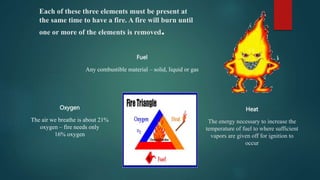
Each of these three elements must be present at
the same time to have a fire. A fire will burn until
one or more of the elements is removed.
Fuel
Any combustible material – solid, liquid or gas
Oxygen
The air we breathe is about 21%
oxygen – fire needs only
16% oxygen
Heat
The energy necessary to increase the
temperature of fuel to where sufficient
vapors are given off for ignition to
occur
CLASSIFICATION:
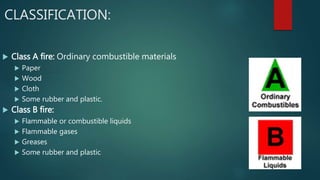
 Class A fire: Ordinary combustible materials
 Paper
 Wood
 Cloth
 Some rubber and plastic.
 Class B fire:
 Flammable or combustible liquids
 Flammable gases
 Greases
 Some rubber and plastic
 Class C fire: Energized electrical equipment
 Employee safety requires nonconductive extinguishing
media
 Class D fire: Combustible metals
 Magnesium
 Titanium
 Zirconium
 Sodium
 Lithium
 Potassium
Dry powder: compound used to extinguish or control Class D fires
Fire Extinguisher
"Fixed extinguishing system" means a permanently installed system that either
extinguishes or controls a fire at the location of the system.
Selection and distribution
 Based on fire classes, size of hazard
 Class A: 75 ft. travel distance to extinguisher, or standpipe
 Class B: 50 ft. travel distance to extinguisher
 Class C: Based on pattern for Class A/B
 Class D: 75 ft. travel distance to extinguishing agent
Different Kinds of Extinguishers
The 4 most common fire extinguishers:
 All Purpose Water
 Carbon Dioxide
 Multi-Purpose Dry Chemical
 Dry Powder
Each kind of extinguisher has a specific use
All Purpose Water
Use on CLASS A fires
Pressurized water
Pressure gauge
Water Mist fire extinguishers are
environmentally friendly, clean, and easy to
use. Water Mist fire extinguishers have no
ODP (ozone depletion potential), no
environmental concerns about its
atmospheric life, and it has no toxic
products of decomposition. Perfect for
Class A fires, especially where a potential
Class C (electrical) hazard exists.
Use on CLASS B and
CLASS C fires
Hard, plastic nozzle
CO2 (Carbon Dioxide):
a) Liquid from while stored in15, 35 and 50 pounds
cylinders under pressure of 850 psi at 70 degrees F.
b) When released from cylinder, 1 cubic inch of liquid CO2
expands to 450 cubic inches of gas.
c) 2 ½ times heavier than air.
d) Colorless, odorless and tasteless.
e) Non-toxic but will not support life.
f) Smothers the fire by displacing the oxygen.
g) Ideal for fighting electrical fire.
h) Non-conductor of electricity and non-corrosive.
When released, the rapid expansion creates extremely low
temperature and forms carbonic or carbon dioxide snow
which will blister the skin on contact similar to frostbite..
k) 35 to 50 lbs CO2 cylinders are used in fixed flooding
system which includes installed hose and reel system.
Multi-Purpose Dry Chemical
Use on CLASS A, CLASS B, and CLASS C fires
Fine powder under pressure
Pressure gauge
EXTINGUISHING AGENT:
Foam: Bubbles form a blanket over liquid, sealing combustible vapors
Application of Foam In Fire:
1) DEFLECTION – off obstruction foam flows gently over
fire makes a complete blanket.
2) DEREFLECTION – Direct stream at 30 degrees angle to
deck foam rolls gently over fire.
3) LOBBING – direct stream into the air. Gives snow
strong effect. Disadvantage: Wind makes control difficult.
IF YOU FIGHT A FIRE, REMEMBER THE WORD
P A S S
PULL . . . AIM . . . SQUEEZE . . . SWEEP
 PULL... the pin. Some extinguishers require releasing a lock latch, pressing a
puncture lever or other motion.
AIM... low, pointing the extinguisher nozzle (or it's horn
or hose) at the base of the fire
SQUEEZE... the handle. This releases the extinguishing agent
SWEEP... from side to side at the base
of the fire until it appears to be out. Watch the fire
area in case fire breaks out again, and repeat use of
extinguisher if necessary
Read and follow the directions on your
extinguisher. If you have the slightest doubt
about whether or not to fight a fire – DON’T!
Get out and close the door behind you.
General: Designed to protect respiratory system in
any harmful atmosphere.
b) Entirely self-contained
1) Independent of outer air.
2) Fire fighting purpose – gives protection from
hazardous and toxic gases, hot gas heat from fire
and vapors while testing compartment.
3) Canister (quick starting)
3a) Green in color.
3b) Instructions labeled in front.
3c) Life of single canister is 45-60 minutes.
3d) Light breathing 60 minutes.
3e) Hard work 45 minutes.
OBA (Oxygen Breathing Apparatus)
ALARM SYSTEMS
Alarm systems can be divided into four groups: local,
auxiliary, central station, and proprietary.
All types of alarm systems should be equipped with a signal
system that clearly communicates to all persons in the
building, plant, or laboratory.
Whenever an alarm is sounded in any portion of the building
or area, all employees must know what the sound means.
Local Alarm Systems
A local alarm consists simply of bells, horns, lights, sirens, or other warning
devices right in the building.
Local alarms are generally used for life protection – that is, to evacuate
everyone and thus limit injury or loss of life from the fire.
A local alarm can be tied in with another system to call the fire department.
Local alarm systems are inexpensive, available from a wide range of
suppliers, and easy to install.
LOCAL SYSTEMS: ALERT ONLY THE OCCUPANTS, WHO MUST CONTACT THE FIRE
DEPARTMENT
Auxiliary Alarm Systems
Auxiliary alarm systems are even less expensive than local alarm systems.
Such a system simply ties a fire detector to a nearby fire call box. In effect, it
becomes a transmit station triggered by fire detectors inside the building.
ALERT THE FIRE DEPARTMENT BY MEANS OF DIRECT IN COMMMUNICATION AND
SIMULATNEOUSLY ALERT LOCAL SYSTEM.
Central Station Systems
Central station systems are available in most major cities around the country.
Operated by trained personnel, a central station continually monitors a number of
establishments and, in case of an alarm, calls a nearby fire station and alerts the
building’s personnel.
: ALERT THE BUILDING OCCUPANTS AND A CENTRAL CONTROL PANEL
Proprietary Alarm Systems
Proprietary alarm systems feed alarms to the building’s maintenance force, and,
optionally, to the fire department as well.
One reason for their acceptance is that insurance regulations generally require
security officers.
ALERT A CENTRAL CONTROL PANEL, INTIATING ACTION BY BUILDING SAFETY
PERSONNEL. NOTIFICATION APPLIANCES
 A MONITORING DEVICE MAY BE USED FOR AUDIBLE, VISIBLE AND
OTHER STIMULI TO ALERT THE OCCUPANTS OF FIRE OR OTHER
EMERGENCY CONDITION REQUIRING ACTION.
 AUDIBLE APPLIANCES HAVE BEEN IN USE LONGER THEN ANY OTHER
METHOD OF MONITORING.
 THESE INCLUDE:
1. AUDIBLE ALARMS
2. VISUAL ALARMS
3. REMOTE ENUCIATORS
4. COMMUNICATION SYSTEMS
5. DATA DISPLAY AND OUTING DEVICES
6. PULL STATIONS
FIRE MONITORING DEVICES
FIRE ALARM CONTROL PANEL ( FCAP) POWER SUPPLIES
INITIATING DEVICES
OUTPUT
DEVICES
BLOCK DIAGRAM OF FDA SYSTEM INPUT
DEVICES OUTPUT DEVICES CONTROL PANEL
INPUT DEVICES CONTROL PANEL
1. Thermal Detectors
2. Fixed-Temperature Detectors
3. Line Thermal Detectors
4. Smoke Detectors
5. Flame Detectors
6. Sensor Systems
• Restore to normal condition ASAP after each test or alarm – spares available
• Maintenance and testing
• Protect from corrosion, physical impact
• Do not support by wires or tubing
• Designed to operate in time, provide a warning
• Delay only if necessary for immediate safety
Fire detection systems
INPUT DEVICES
FIRE BOX (MANUAL PULL STATION)
When shorted trips an alarm (usually fire)
Installed in the normal exit path
Types of Fire Box
•Single Action
Pull handle once
•Glass Break
Glass rod or plate is broken
•Double Action
Lifting of a cover or opening a door
HEAT DETECTORS
fixed temp type heat detector
rate-of-rise type heat detector
SMOKE DETECTORS
Photoelectric
Ionization
FLAME DETECTORS
Ultraviolet light (UV)
Infrared (IR)
FIRE-GAS DETECTORS
HEAT DETECTORS
SMOKE DETECTORS
INPUT DEVICES
PHOTO ELECTRIC SMOKE DETECTOR:
USES COUPLED PHOTOCELLS WITH SPECIFIC LIGHT SOURCE
BASICALLY SMOKE ENTERING THE SMOKE DETECTOR CHAMBER
DIRUPTS THE LIGHT BEAM CAUSING AN ALARM SIGNAL TO INITIATED.
MORE SENSITIVE TO SMOLDERING FIRES.
IONIZATION SMOKE DETECTORS:
INVISIBLE PRODUCTS OF COMBUSTION ENTER THE CHAMBER
DECREASING THE CURRENT BETWEEN THE +VE AND –VE PLATES,
THERENY INITIATING AN ALARM SIGNAL.
GENERALLYB RESPONDS FASTER TO FLAMING FIRE VERSES
SMOLDERING FIRES.
AUTOMATICALLY RESETS WHEN THE ATMOSHPHERE CLAERS.
SMOKE DETECTORS
PHOTO ELECTRIC SMOKE DETECTORS ARE BETTER THEN IONISED SMOKE DETECTORS AS LIGHT
TRAVELS FASTER THAN IONS.
PHOTO ELECTRIC SMOKE DETECTORS IONIZED SMOKE DETECTORS
FIXED TEMP. HEAT DETECTORS
DETECT HEAT BY ONE OR MORE OF 3
PRIMARY PRINCIPLES OF PHYSICS:
Expansion of heated material
Melting of heated material
Changes in resistance of heated material FRANGILE
BULB
DETECTOR
INPUT DEVICES
AUDIBLE OUTPUT DEVICES
An audible alarm signal lets people know the
alarm system has been activated
Devices may be mounted inside or outside
based on level of protection required
may consist of:
Sirens
Bells
Buzzers
Horns
Voice Drivers
OUTPUT DEVICES
SPRINKLER SYSTEMS- A fire sprinkler
system is an active fire protection measure,
consisting of a water supply system, providing
adequate pressure and flow rate to a water
distribution piping system, onto which fire sprinklers
are connected. Sprinkler systems provide early fire
control or extinguishment, helping to mitigate the
hazards for occupants and firefighters alike.
TYPES OF SPRINKLER SYSTEMS
Standpipe system
Wet standpipe system
Dry standpipe- system
Standpipe
A standpipe is a type of rigid water piping which is built into multi-
story buildings in a vertical position, to which fire hoses can be
connected. Standpipes classes are as follows:
• Class I system. A system providing 21 2 -inch (64mm) hose
connections to supply water for use by fire departments and in
handling heavy fire steams.
• Class II system. A system providing 11 2 -inch (38mm) hose
connection to supply water for use by the fire department during initial
response.
• Class III system. A system providing both 11 2 -inch (38mm) and 21 2
-inch (64mm) hose connections.
Types There are two types of standpipes:
• Automatic Dry
• Automatic Wet
• Manual Dry
• Manual Wet
• An emergency exit in a structure is a special exit for emergencies such as a fire: the
combined use of regular and special exits allows for faster evacuation, while it also provides
an alternative if the route to the regular exit is blocked by fire, etc.
• It is usually a strategically located (e.g. in a stairwell, hallway, or other likely place) outward
opening door with a crash bar on it and with exit signs leading to it.
• A fire escape is a special kind of emergency exit, mounted to the outside of a building.
• Local building codes will often dictate the number of fire exits required for a building of a
given size. This may include specifying the number of stairs For any building bigger than a
private house, modern codes invariably specify at least two sets of stairs. Furthermore, such
stairs must be completely separate from each other.
EMERGENCY EXIT
An exit route must be a permanent part of the workplace
Basic Requirement
Eat at
Ma’s
Place
No
ropes
or rope
ladders
Exit separated by fire resistant materials
Construction materials used to separate an exit from other
parts of the workplace:
1 hour resistance 3 stories
2 hours resistance 4 stories
1 hour
2 hour
Exit route capacity may not decrease
toward exit discharge
The capacity of an exit route must be adequate
At least 2 routes must be available
• Except for sufficiently small
occupancy – see (b)(3)
• As far away from each other as
practical in case one is blocked by
fire or smoke
• More than 2 required if all cannot
evacuate through 2 exit routes
Ceiling at least 7’6”
Any projection from the ceiling  6’8”
Exit access  28 inches wide
Including all objects projecting into
route
Exit minimum height and width requirements
7-½ ft.
6 ft.- 8 in.
Building Evacuation
Proceed to nearest exit in an orderly fashion
Assemble at least 100 feet from building
Provide emergency crews with information about people still in the building
Provide information to emergency crews about the reason for evacuation
Never re-enter a building until instructed to by the police department, fire
department.
Inspection of fire equipment should cover the following items:
• control valves on piping that supplies water for fire protection
• hydrants
• fire pumps
• hose houses and associated equipment
• sprinkler system water supplies including tanks
• automatic sprinkler systems
• special type of protection
• portable fire extinguishers
• fire doors, exits and aisles
• alarm and communication systems and routines
• communication to fire department
Fire brigades
Management cannot depend on automatic fire protection equipment,
municipal fire departments to prevent fire losses. Fires can get out of
control before municipal fire department arrives.
One method of providing additional fire protection is to form a fire
brigade. Brigade members should be regular plant employees from all
departments, thoroughly trained in using the plant’s fire fighting
equipment.
Electricians, engineers, mechanics, and safety and fire inspectors all have
special skills, thus making them valuable members of the plant’s
emergency team.
THANK YOU

fire protection

  • 1.
    FIRE PROTECTION DEVICES SUBMITTEDTO: AR.KIRANPREET KAUR SUBMITTED BY: ARCHI BATRA DISHA RAI HARSHA VERMA HIMANK JOSHI JATIN SHARMA
  • 2.
    Each of thesethree elements must be present at the same time to have a fire. A fire will burn until one or more of the elements is removed. Fuel Any combustible material – solid, liquid or gas Oxygen The air we breathe is about 21% oxygen – fire needs only 16% oxygen Heat The energy necessary to increase the temperature of fuel to where sufficient vapors are given off for ignition to occur
  • 3.
    CLASSIFICATION:  Class Afire: Ordinary combustible materials  Paper  Wood  Cloth  Some rubber and plastic.  Class B fire:  Flammable or combustible liquids  Flammable gases  Greases  Some rubber and plastic
  • 4.
     Class Cfire: Energized electrical equipment  Employee safety requires nonconductive extinguishing media  Class D fire: Combustible metals  Magnesium  Titanium  Zirconium  Sodium  Lithium  Potassium
  • 5.
    Dry powder: compoundused to extinguish or control Class D fires
  • 6.
    Fire Extinguisher "Fixed extinguishingsystem" means a permanently installed system that either extinguishes or controls a fire at the location of the system.
  • 7.
    Selection and distribution Based on fire classes, size of hazard  Class A: 75 ft. travel distance to extinguisher, or standpipe  Class B: 50 ft. travel distance to extinguisher  Class C: Based on pattern for Class A/B  Class D: 75 ft. travel distance to extinguishing agent
  • 8.
    Different Kinds ofExtinguishers The 4 most common fire extinguishers:  All Purpose Water  Carbon Dioxide  Multi-Purpose Dry Chemical  Dry Powder Each kind of extinguisher has a specific use
  • 9.
    All Purpose Water Useon CLASS A fires Pressurized water Pressure gauge Water Mist fire extinguishers are environmentally friendly, clean, and easy to use. Water Mist fire extinguishers have no ODP (ozone depletion potential), no environmental concerns about its atmospheric life, and it has no toxic products of decomposition. Perfect for Class A fires, especially where a potential Class C (electrical) hazard exists.
  • 10.
    Use on CLASSB and CLASS C fires Hard, plastic nozzle CO2 (Carbon Dioxide): a) Liquid from while stored in15, 35 and 50 pounds cylinders under pressure of 850 psi at 70 degrees F. b) When released from cylinder, 1 cubic inch of liquid CO2 expands to 450 cubic inches of gas. c) 2 ½ times heavier than air. d) Colorless, odorless and tasteless. e) Non-toxic but will not support life. f) Smothers the fire by displacing the oxygen. g) Ideal for fighting electrical fire. h) Non-conductor of electricity and non-corrosive. When released, the rapid expansion creates extremely low temperature and forms carbonic or carbon dioxide snow which will blister the skin on contact similar to frostbite.. k) 35 to 50 lbs CO2 cylinders are used in fixed flooding system which includes installed hose and reel system.
  • 11.
    Multi-Purpose Dry Chemical Useon CLASS A, CLASS B, and CLASS C fires Fine powder under pressure Pressure gauge
  • 12.
    EXTINGUISHING AGENT: Foam: Bubblesform a blanket over liquid, sealing combustible vapors Application of Foam In Fire: 1) DEFLECTION – off obstruction foam flows gently over fire makes a complete blanket. 2) DEREFLECTION – Direct stream at 30 degrees angle to deck foam rolls gently over fire. 3) LOBBING – direct stream into the air. Gives snow strong effect. Disadvantage: Wind makes control difficult.
  • 13.
    IF YOU FIGHTA FIRE, REMEMBER THE WORD P A S S PULL . . . AIM . . . SQUEEZE . . . SWEEP  PULL... the pin. Some extinguishers require releasing a lock latch, pressing a puncture lever or other motion. AIM... low, pointing the extinguisher nozzle (or it's horn or hose) at the base of the fire SQUEEZE... the handle. This releases the extinguishing agent
  • 14.
    SWEEP... from sideto side at the base of the fire until it appears to be out. Watch the fire area in case fire breaks out again, and repeat use of extinguisher if necessary Read and follow the directions on your extinguisher. If you have the slightest doubt about whether or not to fight a fire – DON’T! Get out and close the door behind you.
  • 15.
    General: Designed toprotect respiratory system in any harmful atmosphere. b) Entirely self-contained 1) Independent of outer air. 2) Fire fighting purpose – gives protection from hazardous and toxic gases, hot gas heat from fire and vapors while testing compartment. 3) Canister (quick starting) 3a) Green in color. 3b) Instructions labeled in front. 3c) Life of single canister is 45-60 minutes. 3d) Light breathing 60 minutes. 3e) Hard work 45 minutes. OBA (Oxygen Breathing Apparatus)
  • 16.
    ALARM SYSTEMS Alarm systemscan be divided into four groups: local, auxiliary, central station, and proprietary. All types of alarm systems should be equipped with a signal system that clearly communicates to all persons in the building, plant, or laboratory. Whenever an alarm is sounded in any portion of the building or area, all employees must know what the sound means.
  • 17.
    Local Alarm Systems Alocal alarm consists simply of bells, horns, lights, sirens, or other warning devices right in the building. Local alarms are generally used for life protection – that is, to evacuate everyone and thus limit injury or loss of life from the fire. A local alarm can be tied in with another system to call the fire department. Local alarm systems are inexpensive, available from a wide range of suppliers, and easy to install. LOCAL SYSTEMS: ALERT ONLY THE OCCUPANTS, WHO MUST CONTACT THE FIRE DEPARTMENT Auxiliary Alarm Systems Auxiliary alarm systems are even less expensive than local alarm systems. Such a system simply ties a fire detector to a nearby fire call box. In effect, it becomes a transmit station triggered by fire detectors inside the building. ALERT THE FIRE DEPARTMENT BY MEANS OF DIRECT IN COMMMUNICATION AND SIMULATNEOUSLY ALERT LOCAL SYSTEM.
  • 19.
    Central Station Systems Centralstation systems are available in most major cities around the country. Operated by trained personnel, a central station continually monitors a number of establishments and, in case of an alarm, calls a nearby fire station and alerts the building’s personnel. : ALERT THE BUILDING OCCUPANTS AND A CENTRAL CONTROL PANEL Proprietary Alarm Systems Proprietary alarm systems feed alarms to the building’s maintenance force, and, optionally, to the fire department as well. One reason for their acceptance is that insurance regulations generally require security officers. ALERT A CENTRAL CONTROL PANEL, INTIATING ACTION BY BUILDING SAFETY PERSONNEL. NOTIFICATION APPLIANCES
  • 20.
     A MONITORINGDEVICE MAY BE USED FOR AUDIBLE, VISIBLE AND OTHER STIMULI TO ALERT THE OCCUPANTS OF FIRE OR OTHER EMERGENCY CONDITION REQUIRING ACTION.  AUDIBLE APPLIANCES HAVE BEEN IN USE LONGER THEN ANY OTHER METHOD OF MONITORING.  THESE INCLUDE: 1. AUDIBLE ALARMS 2. VISUAL ALARMS 3. REMOTE ENUCIATORS 4. COMMUNICATION SYSTEMS 5. DATA DISPLAY AND OUTING DEVICES 6. PULL STATIONS FIRE MONITORING DEVICES
  • 21.
    FIRE ALARM CONTROLPANEL ( FCAP) POWER SUPPLIES
  • 22.
  • 24.
    OUTPUT DEVICES BLOCK DIAGRAM OFFDA SYSTEM INPUT DEVICES OUTPUT DEVICES CONTROL PANEL INPUT DEVICES CONTROL PANEL
  • 25.
    1. Thermal Detectors 2.Fixed-Temperature Detectors 3. Line Thermal Detectors 4. Smoke Detectors 5. Flame Detectors 6. Sensor Systems • Restore to normal condition ASAP after each test or alarm – spares available • Maintenance and testing • Protect from corrosion, physical impact • Do not support by wires or tubing • Designed to operate in time, provide a warning • Delay only if necessary for immediate safety Fire detection systems
  • 26.
    INPUT DEVICES FIRE BOX(MANUAL PULL STATION) When shorted trips an alarm (usually fire) Installed in the normal exit path Types of Fire Box •Single Action Pull handle once •Glass Break Glass rod or plate is broken •Double Action Lifting of a cover or opening a door
  • 27.
    HEAT DETECTORS fixed temptype heat detector rate-of-rise type heat detector SMOKE DETECTORS Photoelectric Ionization FLAME DETECTORS Ultraviolet light (UV) Infrared (IR) FIRE-GAS DETECTORS HEAT DETECTORS SMOKE DETECTORS INPUT DEVICES
  • 28.
    PHOTO ELECTRIC SMOKEDETECTOR: USES COUPLED PHOTOCELLS WITH SPECIFIC LIGHT SOURCE BASICALLY SMOKE ENTERING THE SMOKE DETECTOR CHAMBER DIRUPTS THE LIGHT BEAM CAUSING AN ALARM SIGNAL TO INITIATED. MORE SENSITIVE TO SMOLDERING FIRES. IONIZATION SMOKE DETECTORS: INVISIBLE PRODUCTS OF COMBUSTION ENTER THE CHAMBER DECREASING THE CURRENT BETWEEN THE +VE AND –VE PLATES, THERENY INITIATING AN ALARM SIGNAL. GENERALLYB RESPONDS FASTER TO FLAMING FIRE VERSES SMOLDERING FIRES. AUTOMATICALLY RESETS WHEN THE ATMOSHPHERE CLAERS. SMOKE DETECTORS
  • 29.
    PHOTO ELECTRIC SMOKEDETECTORS ARE BETTER THEN IONISED SMOKE DETECTORS AS LIGHT TRAVELS FASTER THAN IONS. PHOTO ELECTRIC SMOKE DETECTORS IONIZED SMOKE DETECTORS
  • 30.
    FIXED TEMP. HEATDETECTORS DETECT HEAT BY ONE OR MORE OF 3 PRIMARY PRINCIPLES OF PHYSICS: Expansion of heated material Melting of heated material Changes in resistance of heated material FRANGILE BULB DETECTOR INPUT DEVICES
  • 31.
    AUDIBLE OUTPUT DEVICES Anaudible alarm signal lets people know the alarm system has been activated Devices may be mounted inside or outside based on level of protection required may consist of: Sirens Bells Buzzers Horns Voice Drivers OUTPUT DEVICES
  • 32.
    SPRINKLER SYSTEMS- Afire sprinkler system is an active fire protection measure, consisting of a water supply system, providing adequate pressure and flow rate to a water distribution piping system, onto which fire sprinklers are connected. Sprinkler systems provide early fire control or extinguishment, helping to mitigate the hazards for occupants and firefighters alike. TYPES OF SPRINKLER SYSTEMS Standpipe system Wet standpipe system Dry standpipe- system
  • 33.
    Standpipe A standpipe isa type of rigid water piping which is built into multi- story buildings in a vertical position, to which fire hoses can be connected. Standpipes classes are as follows: • Class I system. A system providing 21 2 -inch (64mm) hose connections to supply water for use by fire departments and in handling heavy fire steams. • Class II system. A system providing 11 2 -inch (38mm) hose connection to supply water for use by the fire department during initial response. • Class III system. A system providing both 11 2 -inch (38mm) and 21 2 -inch (64mm) hose connections. Types There are two types of standpipes: • Automatic Dry • Automatic Wet • Manual Dry • Manual Wet
  • 34.
    • An emergencyexit in a structure is a special exit for emergencies such as a fire: the combined use of regular and special exits allows for faster evacuation, while it also provides an alternative if the route to the regular exit is blocked by fire, etc. • It is usually a strategically located (e.g. in a stairwell, hallway, or other likely place) outward opening door with a crash bar on it and with exit signs leading to it. • A fire escape is a special kind of emergency exit, mounted to the outside of a building. • Local building codes will often dictate the number of fire exits required for a building of a given size. This may include specifying the number of stairs For any building bigger than a private house, modern codes invariably specify at least two sets of stairs. Furthermore, such stairs must be completely separate from each other. EMERGENCY EXIT
  • 35.
    An exit routemust be a permanent part of the workplace Basic Requirement Eat at Ma’s Place No ropes or rope ladders
  • 36.
    Exit separated byfire resistant materials Construction materials used to separate an exit from other parts of the workplace: 1 hour resistance 3 stories 2 hours resistance 4 stories 1 hour 2 hour
  • 37.
    Exit route capacitymay not decrease toward exit discharge The capacity of an exit route must be adequate At least 2 routes must be available • Except for sufficiently small occupancy – see (b)(3) • As far away from each other as practical in case one is blocked by fire or smoke • More than 2 required if all cannot evacuate through 2 exit routes
  • 38.
    Ceiling at least7’6” Any projection from the ceiling  6’8” Exit access  28 inches wide Including all objects projecting into route Exit minimum height and width requirements 7-½ ft. 6 ft.- 8 in.
  • 39.
    Building Evacuation Proceed tonearest exit in an orderly fashion Assemble at least 100 feet from building Provide emergency crews with information about people still in the building Provide information to emergency crews about the reason for evacuation Never re-enter a building until instructed to by the police department, fire department. Inspection of fire equipment should cover the following items: • control valves on piping that supplies water for fire protection • hydrants • fire pumps • hose houses and associated equipment • sprinkler system water supplies including tanks • automatic sprinkler systems • special type of protection • portable fire extinguishers • fire doors, exits and aisles • alarm and communication systems and routines • communication to fire department
  • 40.
    Fire brigades Management cannotdepend on automatic fire protection equipment, municipal fire departments to prevent fire losses. Fires can get out of control before municipal fire department arrives. One method of providing additional fire protection is to form a fire brigade. Brigade members should be regular plant employees from all departments, thoroughly trained in using the plant’s fire fighting equipment. Electricians, engineers, mechanics, and safety and fire inspectors all have special skills, thus making them valuable members of the plant’s emergency team.
  • 41.