





INDIAN ETHOS 12/1/2011 By Saurabh Kumar
Meaning Ethos can simply mean the disposition, character, or fundamental values peculiar to a specific person, people, culture, or movement. The Ethos refers to the spirit which motivates the ideas and customs . 12/1/2011 By Saurabh Kumar
INDIAN ETHOS FOR MANAGEMENT Indian ethos for management means the application of principles of management as revealed in our ancient wisdom brought forth in our sacred books like our Gita, Upanishads, Bible and Kuran.  12/1/2011 By Saurabh Kumar
There are  6 basic principles , which come to light in the holy books applicable in today’s management world. They are : Each soul is a potential God Holistic approach Equal importance to Subjectivity/Objectivity Karma yoga Yogah Karmasu Kaushalam Co – operation 12/1/2011 By Saurabh Kumar
Each Soul is a potential God  A human being has a soul, a spark of the Divine. The divine resides in the heart of a person.  The Divine means perfection in knowledge, wisdom and power.  Therefore a human being has immense potential power or energy for self development. 12/1/2011 By Saurabh Kumar
Thus human efforts can achieve even an apparently impossible goal and convert the impossible into a reality. The partnership of God and Man can bring about extraordinary or miraculous results; only if man chooses willingly to collaborate with God and actively participates in the affairs of the society by right action under his guidance and grace. He can bring about not only personal development, harmony, happiness but also prosperity of his own organization and the society without injustice to others.  12/1/2011 By Saurabh Kumar
Holistic Approach  Holistic approach in Management is based on spiritual principle of unity,  oneness, non-dual or Advaita concept. Under this principle of unity, the universe in an undivided whole where each and every particle is connected with every other particle. Thus, entire Humanity is ONE.  Such an integrated human personality of self-developed manager and worker can assure best and competent management of any enterprise, involving collective works and efforts. It will achieve perfection or excellence in whatever sector you work. This is the ideal of Indian ethos  12/1/2011 By Saurabh Kumar
‘ Atmano Mokshartham Jagat Hitya Cha.’ (For gaining perfection in individual life, as well as for the welfare of the world.). This is the message for all managers and workers given by the Indian ethos for management 12/1/2011 By Saurabh Kumar
Equal Importance to Subjectivity / Objectivity  Indian ethos for management distinguishes between subject and object.  Subject is subtle and intangible. Object is concrete and tangible or visible.  We have the concept of the third eye, the eye of wisdom. It can see even that which the normal two eyes cannot. It can see the intangible i.e. invisible.  12/1/2011 By Saurabh Kumar
Human and ethical values or qualities such as courage, vision, social awareness, fearlessness, integrity, pure and clear mind, truth, etc. are subjective, subtle and intangible concepts. These subjective or subtle qualities are as important as money, materials, machines, information or data as well as human skills. 12/1/2011 By Saurabh Kumar
Ethical values/ subjective things 12/1/2011 By Saurabh Kumar
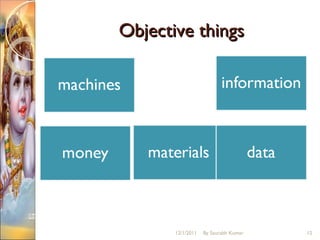
Objective things 12/1/2011 By Saurabh Kumar
Inner resources of human beings are more powerful than external resources. 12/1/2011 By Saurabh Kumar
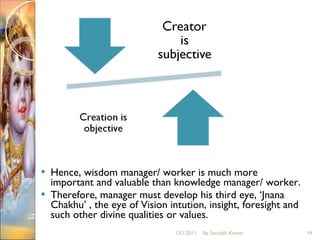
Hence, wisdom manager/ worker is much more important and valuable than knowledge manager/ worker.  Therefore, manager must develop his third eye, ‘Jnana Chakhu’ , the eye of Vision intution, insight, foresight and such other divine qualities or values. 12/1/2011 By Saurabh Kumar
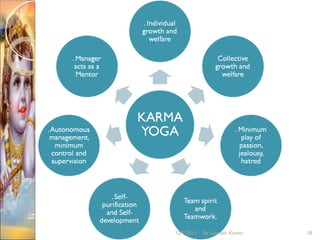
Karma Yoga It is yoga of selfless service to others. Karma Yoga is all about identifying your priorities and trying to achieve them. Also, a person should have accountability i.e. he should always hold only himself responsible for whatever goes right or wrong. This brings about the union of human being with the Divine.  12/1/2011 By Saurabh Kumar
Nishkama Karma One should believe in Nishkama Karma i.e. fruits of work should not be thought of while performing the duty.  Gita says that do your duty without ego and without calculations of gain or loss 12/1/2011 By Saurabh Kumar
The inner joy of doing something gives the doer a sense of achievement and also helps him in respecting himself more than he used to. . When work is performed without passion, hatred, arrogance and desire we have individual development and social good.  Indians always had two great truths of successful, harmonious and happy life 12/1/2011 By Saurabh Kumar
12/1/2011 By Saurabh Kumar
Co – Operation  Healthy competition is a powerful motivator for excellence and success, especially business success. The idea of cut-throat competition is founded on the concept of ‘struggle for existence’ and survival of the fittest.  Indian ethos says that for human beings the royal road is co-operation as a powerful motive for team work. We are human beings having mind and power of discrimination.  12/1/2011 By Saurabh Kumar
Even in the holistic approach, we stress the co-operation integration, synthesis and team – spirit for extraordinary performance, for enduring harmony and peace, because in our hearts chamber is living the pure consciousness of the Divine, i.e., Purnatman Peaceful co-excistence, harmony, not struggle is the rule. Indian insight endorses this in the management of any enterprise. Excessive competition at work can destroy many young people and our social life. Co-operation, united efforts and striving for success leads to all round prosperity and success leads to all round prosperity and success in any field of human enterprise. The Gita says : “ By co – operation and mutual help all shall achieve the highest human welfare.” Unity is strength. 12/1/2011 By Saurabh Kumar
Need for indian ethos for business To develop proper management system in the organisation To ensure all round development ,growth and prosperity Importance of sincearity in work Productivity of human being is more important than plant capacity 12/1/2011 By Saurabh Kumar
APPLICATION OF INDIAN ETHOS Attitude of the management ( ethicsand values )  Self management ( manage and control himself ) Meditation ( transforming of lower conciousness into higher consiousness ) 12/1/2011 By Saurabh Kumar
APPLICABILITY IN LEVELS 1.At basic level Discipline To maintain punctuality Behaving properly with ,superior, colleagues an d subordinates Not wasting time during working hours To do things those are good or right 12/1/2011 By Saurabh Kumar
2.AT top level work culture Loyalty Commitment and responsibility Sense of belongingness Protecting the interest of organisation 12/1/2011 By Saurabh Kumar
Karma Yoga  It is yoga of selfless service to others. Karma Yoga is all about identifying your priorities and trying to achieve them. Also, a person should have accountability i.e. he should always hold only himself responsible for whatever goes right or wrong. This brings about the union of human being with the Divine.  Gita says that do your duty without ego and without calculations of gain or loss. One should believe in Nishkama Karma i.e. fruits of work should not be thought of while performing the duty.  The memorable words of Gita are “ To work only you have the right and you have no right to the fruits of work”. However, this does not mean that one should work day and night and the returns that he gets should be almost negligible. What the Gita tries to say is that let not the fruits of action motivate you as they might just divert your attention from work. When you are doing a job, put your heart and soul in to it. One has no control over the future hence never waste your present in useless dreams of future hopes and fears of present actions.  12/1/2011 By Saurabh Kumar
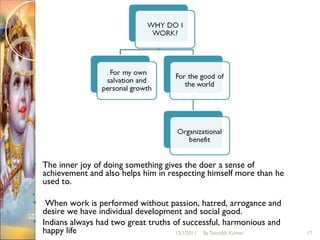
WHY DO I WORK?  1. For my own salvation and personal growth.  2. For the good of the world The inner joy of doing something gives the doer a sense of achievement and also helps him in respecting himself more than he used to. Money is important but running behind money all the time leads to tension, stress and total loss of peace. Self-motivation can assure self-development. When work is performed without passion, hatred, arrogance and desire we have individual development and social good.  Indians always had two great truths of successful, harmonious and happy life 12/1/2011 By Saurabh Kumar
Indians always had two great truths of successful, harmonious and happy life:  1. Divinity of life can be used through self-development for personal growth  and also for social welfare.  2. I cannot cheat you and nature without cheating myself. Working for  harmony and peace results in a sense of fulfillment.  It is becoming clear that a chapter, which had a Western beginning in business management, will have to have an Indian ending. Karma Yoga is not just meant for the common man but also for leaders and managers who if act responsibly will in turn influence the behavior of a number of people.  12/1/2011 By Saurabh Kumar
The memorable words of Gita are “ To work only you have the right and you have no right to the fruits of work”. However, this does not mean that one should work day and night and the returns that he gets should be almost negligible. What the Gita tries to say is that let not the fruits of action motivate you as they might just divert your attention from work. When you are doing a job, put your heart and soul in to it. One has no control over the future hence never waste your present in useless dreams of future hopes and fears of present actions.  12/1/2011 By Saurabh Kumar
Features of Indian Ethos and Insight Divinity of a human being is not merely a notion but a truth which can be  experienced in the stillness of the mind.    Balance is the keynote of Indian thought. We have synthesis, harmony  between the dual concepts.    The Individual is the central focus 12/1/2011 By Saurabh Kumar
Devine element in the individual is only a portion of the universe of the  universal or cosmic consciousness.    Gives greater emphasis on values, human and ethical. Knowledge is not  power.    Indian ethos are based on Indian scripture. Indian thoughts provide  eternal knowledge    All work is worthy and honorable 12/1/2011 By Saurabh Kumar
12/1/2011 By Saurabh Kumar

Ethos ppt.

  • 1.
    INDIAN ETHOS 12/1/2011By Saurabh Kumar
  • 2.
    Meaning Ethos cansimply mean the disposition, character, or fundamental values peculiar to a specific person, people, culture, or movement. The Ethos refers to the spirit which motivates the ideas and customs . 12/1/2011 By Saurabh Kumar
  • 3.
    INDIAN ETHOS FORMANAGEMENT Indian ethos for management means the application of principles of management as revealed in our ancient wisdom brought forth in our sacred books like our Gita, Upanishads, Bible and Kuran. 12/1/2011 By Saurabh Kumar
  • 4.
    There are 6 basic principles , which come to light in the holy books applicable in today’s management world. They are : Each soul is a potential God Holistic approach Equal importance to Subjectivity/Objectivity Karma yoga Yogah Karmasu Kaushalam Co – operation 12/1/2011 By Saurabh Kumar
  • 5.
    Each Soul isa potential God A human being has a soul, a spark of the Divine. The divine resides in the heart of a person. The Divine means perfection in knowledge, wisdom and power. Therefore a human being has immense potential power or energy for self development. 12/1/2011 By Saurabh Kumar
  • 6.
    Thus human effortscan achieve even an apparently impossible goal and convert the impossible into a reality. The partnership of God and Man can bring about extraordinary or miraculous results; only if man chooses willingly to collaborate with God and actively participates in the affairs of the society by right action under his guidance and grace. He can bring about not only personal development, harmony, happiness but also prosperity of his own organization and the society without injustice to others. 12/1/2011 By Saurabh Kumar
  • 7.
    Holistic Approach Holistic approach in Management is based on spiritual principle of unity, oneness, non-dual or Advaita concept. Under this principle of unity, the universe in an undivided whole where each and every particle is connected with every other particle. Thus, entire Humanity is ONE. Such an integrated human personality of self-developed manager and worker can assure best and competent management of any enterprise, involving collective works and efforts. It will achieve perfection or excellence in whatever sector you work. This is the ideal of Indian ethos 12/1/2011 By Saurabh Kumar
  • 8.
    ‘ Atmano MoksharthamJagat Hitya Cha.’ (For gaining perfection in individual life, as well as for the welfare of the world.). This is the message for all managers and workers given by the Indian ethos for management 12/1/2011 By Saurabh Kumar
  • 9.
    Equal Importance toSubjectivity / Objectivity Indian ethos for management distinguishes between subject and object. Subject is subtle and intangible. Object is concrete and tangible or visible. We have the concept of the third eye, the eye of wisdom. It can see even that which the normal two eyes cannot. It can see the intangible i.e. invisible. 12/1/2011 By Saurabh Kumar
  • 10.
    Human and ethicalvalues or qualities such as courage, vision, social awareness, fearlessness, integrity, pure and clear mind, truth, etc. are subjective, subtle and intangible concepts. These subjective or subtle qualities are as important as money, materials, machines, information or data as well as human skills. 12/1/2011 By Saurabh Kumar
  • 11.
    Ethical values/ subjectivethings 12/1/2011 By Saurabh Kumar
  • 12.
  • 13.
    Inner resources ofhuman beings are more powerful than external resources. 12/1/2011 By Saurabh Kumar
  • 14.
    Hence, wisdom manager/worker is much more important and valuable than knowledge manager/ worker. Therefore, manager must develop his third eye, ‘Jnana Chakhu’ , the eye of Vision intution, insight, foresight and such other divine qualities or values. 12/1/2011 By Saurabh Kumar
  • 15.
    Karma Yoga Itis yoga of selfless service to others. Karma Yoga is all about identifying your priorities and trying to achieve them. Also, a person should have accountability i.e. he should always hold only himself responsible for whatever goes right or wrong. This brings about the union of human being with the Divine. 12/1/2011 By Saurabh Kumar
  • 16.
    Nishkama Karma Oneshould believe in Nishkama Karma i.e. fruits of work should not be thought of while performing the duty. Gita says that do your duty without ego and without calculations of gain or loss 12/1/2011 By Saurabh Kumar
  • 17.
    The inner joyof doing something gives the doer a sense of achievement and also helps him in respecting himself more than he used to. . When work is performed without passion, hatred, arrogance and desire we have individual development and social good. Indians always had two great truths of successful, harmonious and happy life 12/1/2011 By Saurabh Kumar
  • 18.
  • 19.
    Co – Operation Healthy competition is a powerful motivator for excellence and success, especially business success. The idea of cut-throat competition is founded on the concept of ‘struggle for existence’ and survival of the fittest. Indian ethos says that for human beings the royal road is co-operation as a powerful motive for team work. We are human beings having mind and power of discrimination. 12/1/2011 By Saurabh Kumar
  • 20.
    Even in theholistic approach, we stress the co-operation integration, synthesis and team – spirit for extraordinary performance, for enduring harmony and peace, because in our hearts chamber is living the pure consciousness of the Divine, i.e., Purnatman Peaceful co-excistence, harmony, not struggle is the rule. Indian insight endorses this in the management of any enterprise. Excessive competition at work can destroy many young people and our social life. Co-operation, united efforts and striving for success leads to all round prosperity and success leads to all round prosperity and success in any field of human enterprise. The Gita says : “ By co – operation and mutual help all shall achieve the highest human welfare.” Unity is strength. 12/1/2011 By Saurabh Kumar
  • 21.
    Need for indianethos for business To develop proper management system in the organisation To ensure all round development ,growth and prosperity Importance of sincearity in work Productivity of human being is more important than plant capacity 12/1/2011 By Saurabh Kumar
  • 22.
    APPLICATION OF INDIANETHOS Attitude of the management ( ethicsand values ) Self management ( manage and control himself ) Meditation ( transforming of lower conciousness into higher consiousness ) 12/1/2011 By Saurabh Kumar
  • 23.
    APPLICABILITY IN LEVELS1.At basic level Discipline To maintain punctuality Behaving properly with ,superior, colleagues an d subordinates Not wasting time during working hours To do things those are good or right 12/1/2011 By Saurabh Kumar
  • 24.
    2.AT top levelwork culture Loyalty Commitment and responsibility Sense of belongingness Protecting the interest of organisation 12/1/2011 By Saurabh Kumar
  • 25.
    Karma Yoga It is yoga of selfless service to others. Karma Yoga is all about identifying your priorities and trying to achieve them. Also, a person should have accountability i.e. he should always hold only himself responsible for whatever goes right or wrong. This brings about the union of human being with the Divine. Gita says that do your duty without ego and without calculations of gain or loss. One should believe in Nishkama Karma i.e. fruits of work should not be thought of while performing the duty. The memorable words of Gita are “ To work only you have the right and you have no right to the fruits of work”. However, this does not mean that one should work day and night and the returns that he gets should be almost negligible. What the Gita tries to say is that let not the fruits of action motivate you as they might just divert your attention from work. When you are doing a job, put your heart and soul in to it. One has no control over the future hence never waste your present in useless dreams of future hopes and fears of present actions. 12/1/2011 By Saurabh Kumar
  • 26.
    WHY DO IWORK? 1. For my own salvation and personal growth. 2. For the good of the world The inner joy of doing something gives the doer a sense of achievement and also helps him in respecting himself more than he used to. Money is important but running behind money all the time leads to tension, stress and total loss of peace. Self-motivation can assure self-development. When work is performed without passion, hatred, arrogance and desire we have individual development and social good. Indians always had two great truths of successful, harmonious and happy life 12/1/2011 By Saurabh Kumar
  • 27.
    Indians always hadtwo great truths of successful, harmonious and happy life: 1. Divinity of life can be used through self-development for personal growth and also for social welfare. 2. I cannot cheat you and nature without cheating myself. Working for harmony and peace results in a sense of fulfillment. It is becoming clear that a chapter, which had a Western beginning in business management, will have to have an Indian ending. Karma Yoga is not just meant for the common man but also for leaders and managers who if act responsibly will in turn influence the behavior of a number of people. 12/1/2011 By Saurabh Kumar
  • 28.
    The memorable wordsof Gita are “ To work only you have the right and you have no right to the fruits of work”. However, this does not mean that one should work day and night and the returns that he gets should be almost negligible. What the Gita tries to say is that let not the fruits of action motivate you as they might just divert your attention from work. When you are doing a job, put your heart and soul in to it. One has no control over the future hence never waste your present in useless dreams of future hopes and fears of present actions. 12/1/2011 By Saurabh Kumar
  • 29.
    Features of IndianEthos and Insight Divinity of a human being is not merely a notion but a truth which can be experienced in the stillness of the mind.  Balance is the keynote of Indian thought. We have synthesis, harmony between the dual concepts.  The Individual is the central focus 12/1/2011 By Saurabh Kumar
  • 30.
    Devine element inthe individual is only a portion of the universe of the universal or cosmic consciousness.  Gives greater emphasis on values, human and ethical. Knowledge is not power.  Indian ethos are based on Indian scripture. Indian thoughts provide eternal knowledge  All work is worthy and honorable 12/1/2011 By Saurabh Kumar
  • 31.

Editor's Notes