Basic Fire Fighting
Awareness Session
Instructor
M. Toufique Khan
Station Officer, Karachi Fire Brigade
Basic Fire Fighting
Awareness Session
• Fire
• History of Fire
Chemistry of Fire
Definition
Fire is a chemical reaction in
which fuel and oxygen is chemical combines
with suitable heat. And creates flame and
different dangerous gasses is called FIRE
Triangle of Fire
Three things must be present at the same time to
produce fire:
• Suitable OXYGEN to sustain combustion
• Suitable HEAT to reach ignition temperature
• Suitable FUEL or combustible material
Together, they produce the CHEMICAL REACTION that is fire
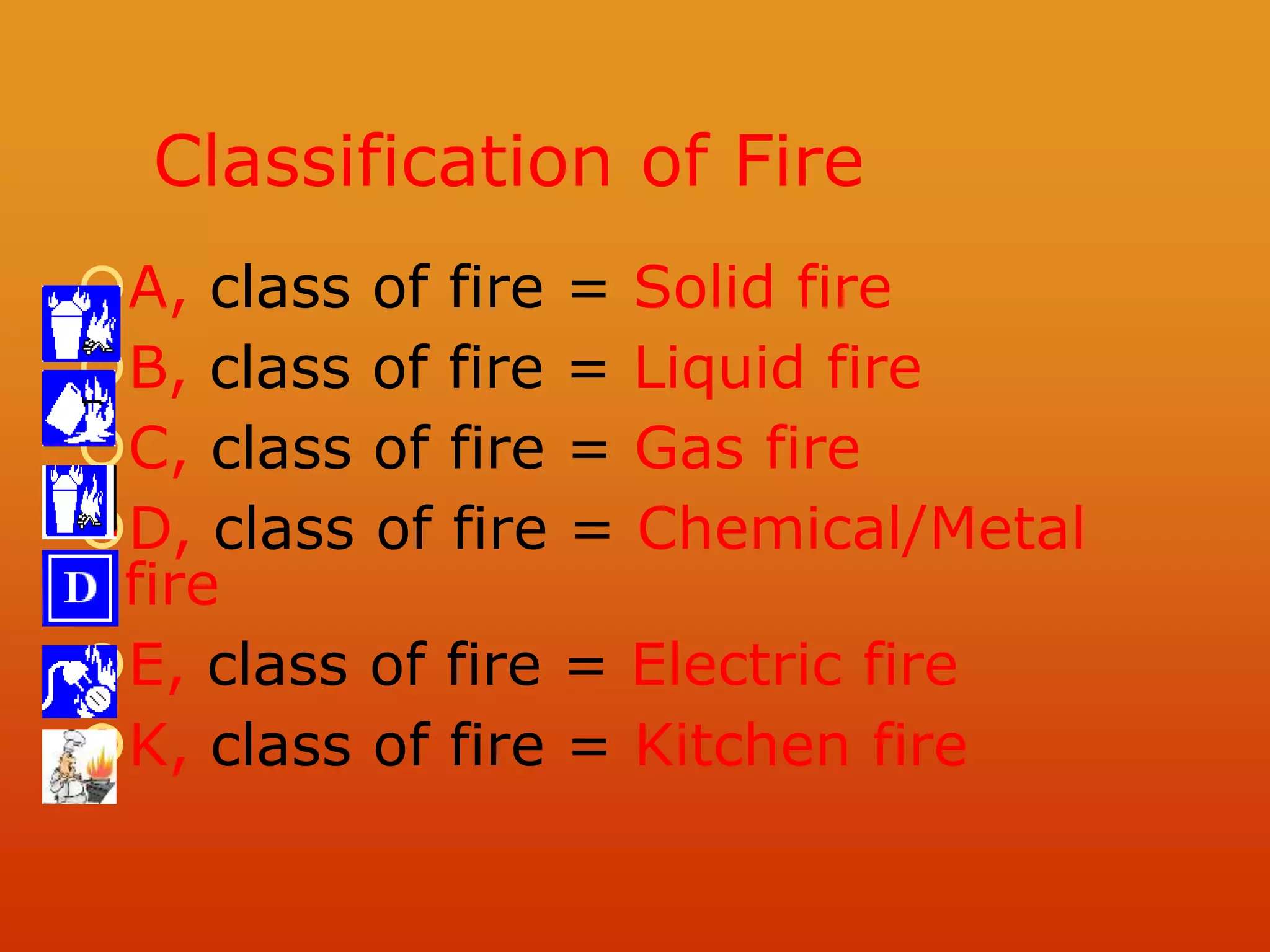
Classification of Fire
A, class of fire = Solid fire
B, class of fire = Liquid fire
C, class of fire = Gas fire
D, class of fire = Chemical/Metal
fire
E, class of fire = Electric fire
K, class of fire = Kitchen fire
Split of Fire
 Conduction
 Convection
 Radiation
Method of extinguish
Cooling Method
Smothering Method
Starvation Method
Common causes of Fire
 Burning of cigarettes
 Children playing with fire
 Overheating of electric appliances
 Boosting of Stove
 Burning of charcoal
 Smoldering
 Naked lamps
 Friction
Special causes of Fire
 Chemical Reaction
 Biological effects
 Nuclear effects
 Dust/vapors explosion
 Arson/Sabotage
 Short circuit
Fire Fighting Techniques
Safety procedure
Trained Personals
Personal protective equipments
Fire extinguisher
Dry Chemical Powder
Carbon dio Oxide
AFFF
Foam type
Soda acid
Installation
 Smoke detector
 Heat detector
 Infra-red detector (Flame)
 Hydrant system
 Sprinkler system
P.A.S.S
It’s easy to remember how to use a fire extinguisher if you
remember the acronym PASS
P= Pull
A= Aim
S= Squeeze
S= Sweep
How to Use a Fire Extinguisher
Pull the pin…
This will allow you to discharge
the extinguisher
How to Use a Fire Extinguisher
Aim at the base of the fire
Hit the fuel.
If you aim at the flames...
How to Use a Fire Extinguisher
Squeeze the top handle…
Squeeze the top handle…
How to Use a Fire Extinguisher
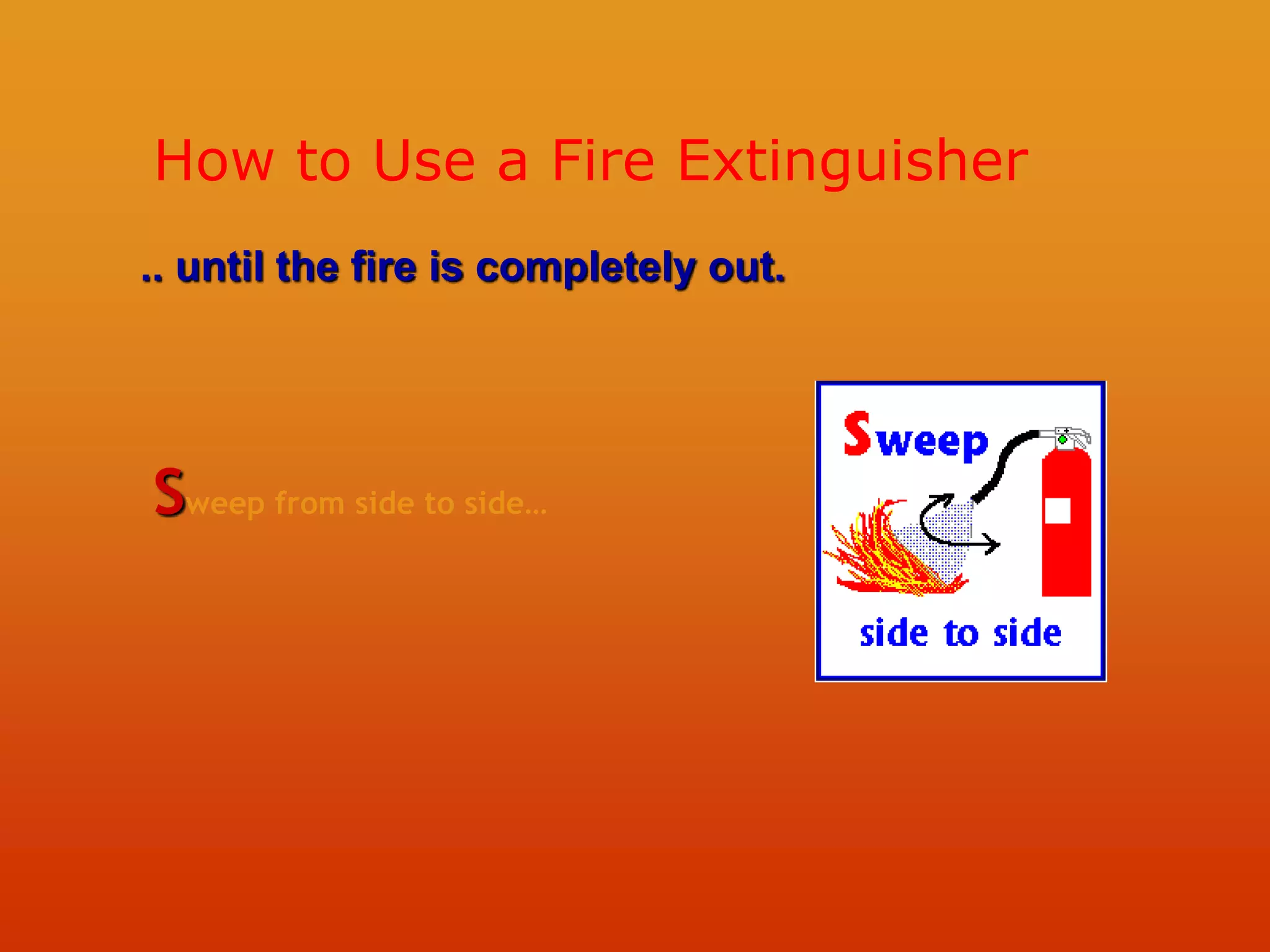
Sweep from side to side…
.. until the fire is completely out.
Rules for Fighting Fires
Fires can be very dangerous and you should always be
certain that you will not endanger yourself or others
when attempting to put out a fire.
For this reason, when a fire is discovered…
1. Assist any person in immediate danger to safety, if it
can be accomplished without risk to yourself.
2. Call 16 or activate the building fire alarm.
If the fire is small (and Only after having done these
2 things), you may attempt to use an extinguisher to
put it out. However . . . .
Rules for Fighting Fires
. . . before deciding to fight the fire, keep these
things in mind:
1. Know what is burning. If you don’t know what’s
burning, you won’t know what kind of extinguisher to
use.
2. Even if you have an ABC fire extinguisher, there may be
something in the fire that is going to explode or
produce toxic fumes.
Chances are you will know what’s burning, or at
least have a pretty good idea, but if you don’t, let
the fire department handle it.
Rules for Fighting Fires
. . . before deciding to fight the fire, keep these
things in mind:
3. Is the fire spreading rapidly beyond the point where it
started? The time to use an extinguisher is at the
beginning stages of the fire.
4. If the fire is already spreading quickly, it is best to
simply evacuate the building.
As you evacuate a building, close doors and windows
behind you as you leave. This will help to slow the
spread of smoke and fire.
Rules for Fighting Fires
The final rule is to always position yourself with an exit
or means of escape at your back before you attempt to
use an extinguisher to put out a fire.
In case the extinguisher malfunctions, or something
unexpected happens, you need to be able to get out
quickly. You don’t want to become trapped.
.
Rules for Fighting Fires
Do not fight the fire if:
 You don’t have adequate or appropriate equipment. If
you don’t have the correct type or large enough
extinguisher, it is best not to try fighting the fire.
 You might inhale toxic smoke. When synthetic materials
such as the nylon in carpeting or foam padding in a sofa
burn, they can produce hydrogen cyanide, acrolein, and
ammonia in addition to carbon monoxide. These gases
can be fatal in very small amounts.
 Your instincts tell you not to. If you are uncomfortable
with the situation for any reason, just let the fire
department do their job.
THE END
Thank you for being with us
PAKISTAN EMERGENCY
RESPONSE LEARNING
PROGRAM

Fire fighting training sessions.ppt

  • 1.
    Basic Fire Fighting AwarenessSession Instructor M. Toufique Khan Station Officer, Karachi Fire Brigade
  • 2.
    Basic Fire Fighting AwarenessSession • Fire • History of Fire
  • 3.
    Chemistry of Fire Definition Fireis a chemical reaction in which fuel and oxygen is chemical combines with suitable heat. And creates flame and different dangerous gasses is called FIRE
  • 4.
    Triangle of Fire Threethings must be present at the same time to produce fire: • Suitable OXYGEN to sustain combustion • Suitable HEAT to reach ignition temperature • Suitable FUEL or combustible material Together, they produce the CHEMICAL REACTION that is fire
  • 5.
    Classification of Fire A,class of fire = Solid fire B, class of fire = Liquid fire C, class of fire = Gas fire D, class of fire = Chemical/Metal fire E, class of fire = Electric fire K, class of fire = Kitchen fire
  • 6.
    Split of Fire Conduction  Convection  Radiation
  • 7.
    Method of extinguish CoolingMethod Smothering Method Starvation Method
  • 8.
    Common causes ofFire  Burning of cigarettes  Children playing with fire  Overheating of electric appliances  Boosting of Stove  Burning of charcoal  Smoldering  Naked lamps  Friction
  • 9.
    Special causes ofFire  Chemical Reaction  Biological effects  Nuclear effects  Dust/vapors explosion  Arson/Sabotage  Short circuit
  • 10.
    Fire Fighting Techniques Safetyprocedure Trained Personals Personal protective equipments
  • 11.
    Fire extinguisher Dry ChemicalPowder Carbon dio Oxide AFFF Foam type Soda acid
  • 12.
    Installation  Smoke detector Heat detector  Infra-red detector (Flame)  Hydrant system  Sprinkler system
  • 13.
    P.A.S.S It’s easy toremember how to use a fire extinguisher if you remember the acronym PASS P= Pull A= Aim S= Squeeze S= Sweep
  • 14.
    How to Usea Fire Extinguisher Pull the pin… This will allow you to discharge the extinguisher
  • 15.
    How to Usea Fire Extinguisher Aim at the base of the fire Hit the fuel. If you aim at the flames...
  • 16.
    How to Usea Fire Extinguisher Squeeze the top handle… Squeeze the top handle…
  • 17.
    How to Usea Fire Extinguisher Sweep from side to side… .. until the fire is completely out.
  • 20.
    Rules for FightingFires Fires can be very dangerous and you should always be certain that you will not endanger yourself or others when attempting to put out a fire. For this reason, when a fire is discovered… 1. Assist any person in immediate danger to safety, if it can be accomplished without risk to yourself. 2. Call 16 or activate the building fire alarm. If the fire is small (and Only after having done these 2 things), you may attempt to use an extinguisher to put it out. However . . . .
  • 21.
    Rules for FightingFires . . . before deciding to fight the fire, keep these things in mind: 1. Know what is burning. If you don’t know what’s burning, you won’t know what kind of extinguisher to use. 2. Even if you have an ABC fire extinguisher, there may be something in the fire that is going to explode or produce toxic fumes. Chances are you will know what’s burning, or at least have a pretty good idea, but if you don’t, let the fire department handle it.
  • 22.
    Rules for FightingFires . . . before deciding to fight the fire, keep these things in mind: 3. Is the fire spreading rapidly beyond the point where it started? The time to use an extinguisher is at the beginning stages of the fire. 4. If the fire is already spreading quickly, it is best to simply evacuate the building. As you evacuate a building, close doors and windows behind you as you leave. This will help to slow the spread of smoke and fire.
  • 23.
    Rules for FightingFires The final rule is to always position yourself with an exit or means of escape at your back before you attempt to use an extinguisher to put out a fire. In case the extinguisher malfunctions, or something unexpected happens, you need to be able to get out quickly. You don’t want to become trapped.
  • 24.
    . Rules for FightingFires Do not fight the fire if:  You don’t have adequate or appropriate equipment. If you don’t have the correct type or large enough extinguisher, it is best not to try fighting the fire.  You might inhale toxic smoke. When synthetic materials such as the nylon in carpeting or foam padding in a sofa burn, they can produce hydrogen cyanide, acrolein, and ammonia in addition to carbon monoxide. These gases can be fatal in very small amounts.  Your instincts tell you not to. If you are uncomfortable with the situation for any reason, just let the fire department do their job.
  • 25.
    THE END Thank youfor being with us PAKISTAN EMERGENCY RESPONSE LEARNING PROGRAM