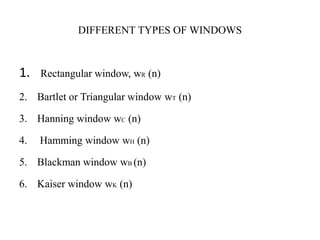
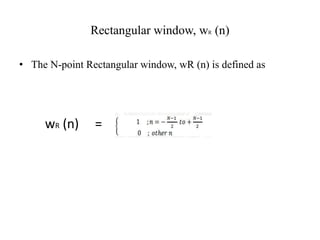
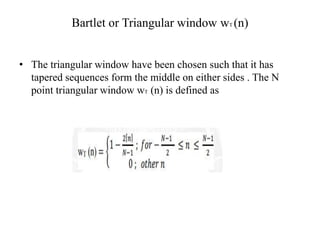
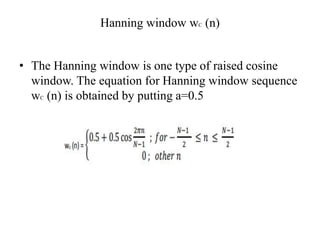
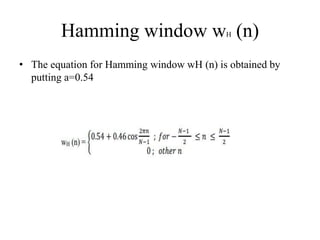
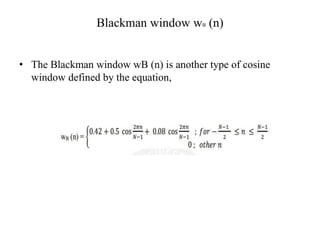
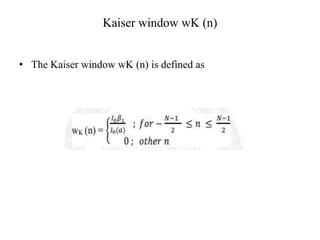
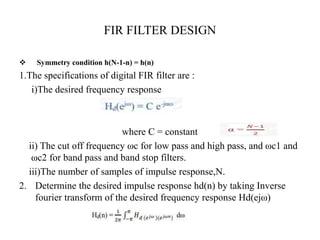
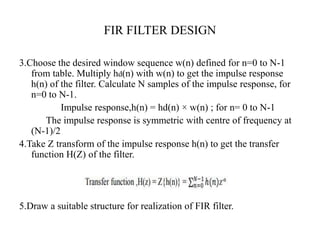
This document discusses windowing techniques for FIR filter design. It introduces several types of window functions, including rectangular, triangular, Hanning, Hamming, Blackman, and Kaiser windows. These windows are finite sequences that are multiplied with the desired impulse response to modify the FIR filter's impulse response in order to reduce ripples in the passband and stopband, and achieve a smooth transition between bands. The document outlines the basic steps in FIR filter design using windowing, which involves determining the desired impulse response from the frequency response, selecting a window function, multiplying it with the impulse response, and realizing the filter structure.