Conquering the Term
Sheet
Everything You Need to Know About Deal Terms
Part 3
David Stark
Partner, OurCrowd
@starkupnation
Zack Miller
Partner, OurCrowd
@newrulesinvest
OurCrowd
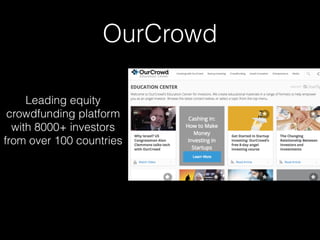
Leading equity
crowdfunding platform
with 8000+ investors
from over 100 countries
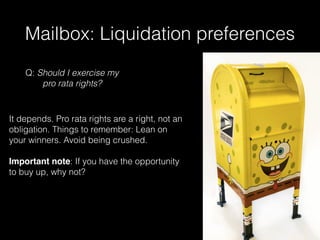
Mailbox: Liquidation preferences
It depends. Pro rata rights are a right, not an
obligation. Things to remember: Lean on
your winners. Avoid being crushed.
Important note: If you have the opportunity
to buy up, why not?
Q: Should I exercise my
pro rata rights?
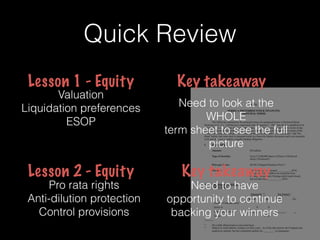
Quick Review
Lesson 1 - Equity
Valuation
Liquidation preferences
ESOP
Key takeaway
Need to look at the
WHOLE
term sheet to see the full
picture
Lesson 2 - Equity
Pro rata rights
Anti-dilution protection
Control provisions
Key takeaway
Need to have
opportunity to continue
backing your winners
Today’s agenda
Convertible notes
Pros and cons (investor/entrepreneur)
Amount/maturity
Interest
Conversion
Discount
Cap
Auto/voluntary conversion
Repayment
SAFE
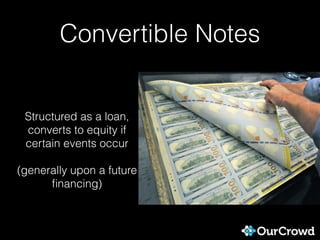
Convertible Notes
Structured as a loan,
converts to equity if
certain events occur
(generally upon a future
financing)
Why use a convertible loan?
• Increases STM (Speed to Money)
• Can be a “bridge” to next round, maximizing value creation
and reducing dilution
• Increased flexibility with size of investment, equity stake sold
• Often no control provisions, board representation
The entrepreneur’s Perspective
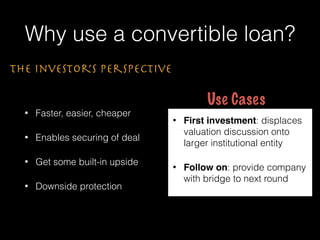
Why use a convertible loan?
• Faster, easier, cheaper
• Enables securing of deal
• Get some built-in upside
• Downside protection
The Investor’s Perspective
• First investment: displaces
valuation discussion onto
larger institutional entity
• Follow on: provide company
with bridge to next round
Use Cases
Keeping the faith
Eventual rights and preferences are unknown at the time
of investment…
Loan Amount
How much money is going
to be invested by you
+
How much money will be
invested by others
(What is the timeframe for
others to join)
Maturity
Length of the loan period
Typically 12-24 months
Interest
Convertibles are loans and have interest rate associated with them
Secured vs.
Non-secured
Underlying assets to seize
or personal guarantee
Prepayment
Note may not be prepaid
without the consent of the
lender
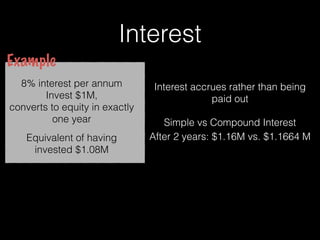
Interest
Interest accrues rather than being
paid out
Simple vs Compound Interest
8% interest per annum
Invest $1M,
converts to equity in exactly
one year
Equivalent of having
invested $1.08M
Example
After 2 years: $1.16M vs. $1.1664 M
Conversion
Move from debt to equity
Automatic vs. Voluntary
Conversion
Exactly as it sounds, some conversions are
forced when certain conditions are met
Others are optional
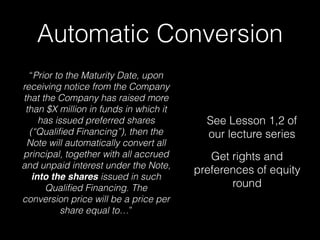
Automatic Conversion
“Prior to the Maturity Date, upon
receiving notice from the Company
that the Company has raised more
than $X million in funds in which it

has issued preferred shares
(“Qualified Financing”), then the
Note will automatically convert all
principal, together with all accrued
and unpaid interest under the Note,
into the shares issued in such
Qualified Financing. The
conversion price will be a price per
share equal to…”
Automatic Conversion
“Prior to the Maturity Date, upon
receiving notice from the Company
that the Company has raised more
than $X million in funds in which it
has issued preferred shares
(“Qualified Financing”), then the
Note will automatically convert all
principal, together with all accrued
and unpaid interest under the Note,
into the shares issued in such
Qualified Financing. The
conversion price will be a price per
share equal to…”
Threshold ensures
balance between
institutional lead investor
and pragmatic
fundraising plans
Automatic Conversion
“Prior to the Maturity Date, upon
receiving notice from the Company
that the Company has raised more
than $X million in funds in which it
has issued preferred shares
(“Qualified Financing”), then the
Note will automatically convert all
principal, together with all accrued
and unpaid interest under the Note,
into the shares issued in such
Qualified Financing. The
conversion price will be a price per
share equal to…”
Important because
don’t want
common stock
Automatic Conversion
“Prior to the Maturity Date, upon
receiving notice from the Company
that the Company has raised more
than $X million in funds in which it
has issued preferred shares
(“Qualified Financing”), then the
Note will automatically convert all
principal, together with all accrued
and unpaid interest under the Note,
into the shares issued in such
Qualified Financing. The
conversion price will be a price per
share equal to…”
Well, it’s just automatic
Automatic Conversion
“Prior to the Maturity Date, upon
receiving notice from the Company
that the Company has raised more
than $X million in funds in which it
has issued preferred shares
(“Qualified Financing”), then the
Note will automatically convert all
principal, together with all accrued
and unpaid interest under the Note,
into the shares issued in such
Qualified Financing. The
conversion price will be a price per
share equal to…”
See Lesson 1,2 of
our lecture series
Get rights and
preferences of equity
round
So, now you know which shares
you’ll receive.
But what are you paying for them??
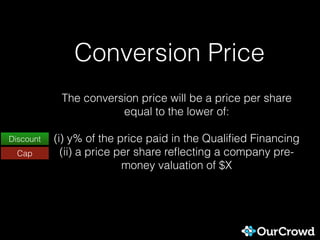
Conversion Price
The conversion price will be a price per share
equal to the lower of:
(i) y% of the price paid in the Qualified Financing
(ii) a price per share reflecting a company pre-
money valuation of $X
Discount
Cap
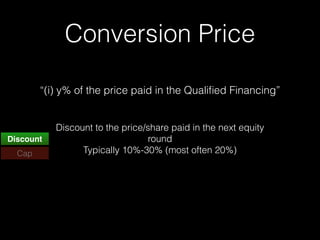
Conversion Price
Discount to the price/share paid in the next equity
round
Typically 10%-30% (most often 20%)
Discount
Cap
“(i) y% of the price paid in the Qualified Financing”
Conversion Price
Discount
Cap
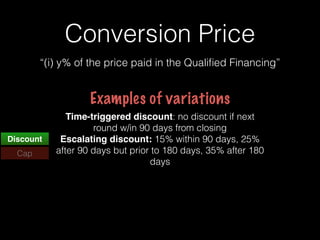
“(i) y% of the price paid in the Qualified Financing”
Time-triggered discount: no discount if next
round w/in 90 days from closing
Escalating discount: 15% within 90 days, 25%
after 90 days but prior to 180 days, 35% after 180
days
Examples of variations
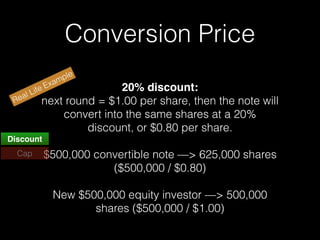
Real Life Example
Conversion Price
20% discount:
next round = $1.00 per share, then the note will
convert into the same shares at a 20%
discount, or $0.80 per share.
$500,000 convertible note —> 625,000 shares
($500,000 / $0.80)
New $500,000 equity investor —> 500,000
shares ($500,000 / $1.00)
Discount
Cap
Conversion Price
Discount
Cap
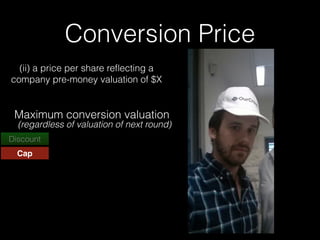
(ii) a price per share reflecting a
company pre-money valuation of $X
Maximum conversion valuation
(regardless of valuation of next round)
Conversion Price
Discount
Cap
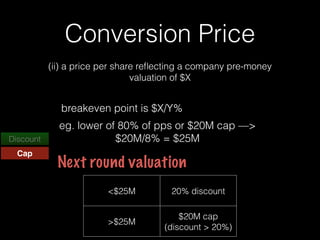
(ii) a price per share reflecting a company pre-money
valuation of $X
breakeven point is $X/Y%
eg. lower of 80% of pps or $20M cap —>
$20M/8% = $25M
<$25M 20% discount
>$25M
$20M cap
(discount > 20%)
Next round valuation
Conversion Price
Discount
Cap
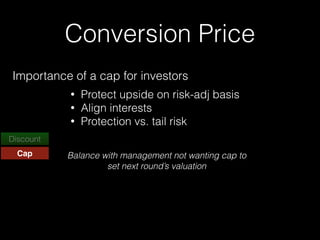
Importance of a cap for investors
• Protect upside on risk-adj basis
• Align interests
• Protection vs. tail risk
Balance with management not wanting cap to
set next round’s valuation
Non Qualified
Financing
Financing round that doesn’t
meet the criteria
Can voluntarily convert
M&A prior to conversion
Don’t want to just get repaid
1. Receive multiple of investment (e.g. 2x or 3x)
2. Convert at a discount to purchase price
3. Convert at predetermined price (e.g. last
round’s post money)
3 options
What happens at maturity?
Repayment or Conversion at Predetermined Price
Repayment (w/ option to convert):
• entrepreneur can view as ticking time bomb
• investor unlikely to get repaid anyways
• inability to repay = insolvency
Automatic Conversion @ Predetermined Price:
• valuation signal when trying to raise equity
round?
Issues with Convertibles
• have more downside protection than full ratchet
(Lesson 2!)
• can result in >1x liquidation preference (Lesson
1!)
• have features of debt even though intention is
equity
Alternatives
Priced
Convertible
Debt
Floor to go with the ceiling
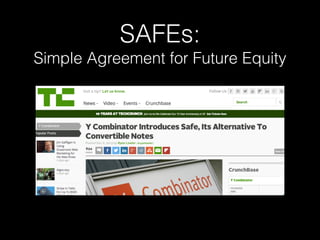
SAFEs:
Simple Agreement for Future Equity
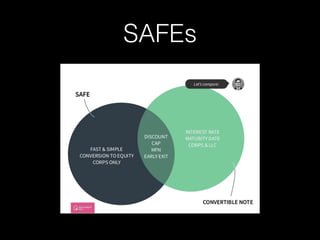
SAFEs
Next step?
Thanks for joining us for our Term
Sheet series
OurCrowd.com
Check out our real-life
term sheets by
accrediting on our
website

Conquering The Term Sheet Everything You Need To Know About Deal Terms Part 3

  • 1.
    Conquering the Term Sheet EverythingYou Need to Know About Deal Terms Part 3
  • 2.
    David Stark Partner, OurCrowd @starkupnation ZackMiller Partner, OurCrowd @newrulesinvest
  • 3.
    OurCrowd Leading equity crowdfunding platform with8000+ investors from over 100 countries
  • 4.
    Mailbox: Liquidation preferences Itdepends. Pro rata rights are a right, not an obligation. Things to remember: Lean on your winners. Avoid being crushed. Important note: If you have the opportunity to buy up, why not? Q: Should I exercise my pro rata rights?
  • 5.
    Quick Review Lesson 1- Equity Valuation Liquidation preferences ESOP Key takeaway Need to look at the WHOLE term sheet to see the full picture Lesson 2 - Equity Pro rata rights Anti-dilution protection Control provisions Key takeaway Need to have opportunity to continue backing your winners
  • 6.
    Today’s agenda Convertible notes Prosand cons (investor/entrepreneur) Amount/maturity Interest Conversion Discount Cap Auto/voluntary conversion Repayment SAFE
  • 7.
    Convertible Notes Structured asa loan, converts to equity if certain events occur (generally upon a future financing)
  • 8.
    Why use aconvertible loan? • Increases STM (Speed to Money) • Can be a “bridge” to next round, maximizing value creation and reducing dilution • Increased flexibility with size of investment, equity stake sold • Often no control provisions, board representation The entrepreneur’s Perspective
  • 9.
    Why use aconvertible loan? • Faster, easier, cheaper • Enables securing of deal • Get some built-in upside • Downside protection The Investor’s Perspective • First investment: displaces valuation discussion onto larger institutional entity • Follow on: provide company with bridge to next round Use Cases
  • 10.
    Keeping the faith Eventualrights and preferences are unknown at the time of investment…
  • 11.
    Loan Amount How muchmoney is going to be invested by you + How much money will be invested by others (What is the timeframe for others to join)
  • 12.
    Maturity Length of theloan period Typically 12-24 months
  • 13.
    Interest Convertibles are loansand have interest rate associated with them
  • 14.
    Secured vs. Non-secured Underlying assetsto seize or personal guarantee
  • 15.
    Prepayment Note may notbe prepaid without the consent of the lender
  • 16.
    Interest Interest accrues ratherthan being paid out Simple vs Compound Interest 8% interest per annum Invest $1M, converts to equity in exactly one year Equivalent of having invested $1.08M Example After 2 years: $1.16M vs. $1.1664 M
  • 17.
  • 18.
    Automatic vs. Voluntary Conversion Exactlyas it sounds, some conversions are forced when certain conditions are met Others are optional
  • 19.
    Automatic Conversion “Prior tothe Maturity Date, upon receiving notice from the Company that the Company has raised more than $X million in funds in which it has issued preferred shares (“Qualified Financing”), then the Note will automatically convert all principal, together with all accrued and unpaid interest under the Note, into the shares issued in such Qualified Financing. The conversion price will be a price per share equal to…”
  • 20.
    Automatic Conversion “Prior tothe Maturity Date, upon receiving notice from the Company that the Company has raised more than $X million in funds in which it has issued preferred shares (“Qualified Financing”), then the Note will automatically convert all principal, together with all accrued and unpaid interest under the Note, into the shares issued in such Qualified Financing. The conversion price will be a price per share equal to…” Threshold ensures balance between institutional lead investor and pragmatic fundraising plans
  • 21.
    Automatic Conversion “Prior tothe Maturity Date, upon receiving notice from the Company that the Company has raised more than $X million in funds in which it has issued preferred shares (“Qualified Financing”), then the Note will automatically convert all principal, together with all accrued and unpaid interest under the Note, into the shares issued in such Qualified Financing. The conversion price will be a price per share equal to…” Important because don’t want common stock
  • 22.
    Automatic Conversion “Prior tothe Maturity Date, upon receiving notice from the Company that the Company has raised more than $X million in funds in which it has issued preferred shares (“Qualified Financing”), then the Note will automatically convert all principal, together with all accrued and unpaid interest under the Note, into the shares issued in such Qualified Financing. The conversion price will be a price per share equal to…” Well, it’s just automatic
  • 23.
    Automatic Conversion “Prior tothe Maturity Date, upon receiving notice from the Company that the Company has raised more than $X million in funds in which it has issued preferred shares (“Qualified Financing”), then the Note will automatically convert all principal, together with all accrued and unpaid interest under the Note, into the shares issued in such Qualified Financing. The conversion price will be a price per share equal to…” See Lesson 1,2 of our lecture series Get rights and preferences of equity round
  • 24.
    So, now youknow which shares you’ll receive. But what are you paying for them??
  • 25.
    Conversion Price The conversionprice will be a price per share equal to the lower of: (i) y% of the price paid in the Qualified Financing (ii) a price per share reflecting a company pre- money valuation of $X Discount Cap
  • 26.
    Conversion Price Discount tothe price/share paid in the next equity round Typically 10%-30% (most often 20%) Discount Cap “(i) y% of the price paid in the Qualified Financing”
  • 27.
    Conversion Price Discount Cap “(i) y%of the price paid in the Qualified Financing” Time-triggered discount: no discount if next round w/in 90 days from closing Escalating discount: 15% within 90 days, 25% after 90 days but prior to 180 days, 35% after 180 days Examples of variations
  • 28.
    Real Life Example ConversionPrice 20% discount: next round = $1.00 per share, then the note will convert into the same shares at a 20% discount, or $0.80 per share. $500,000 convertible note —> 625,000 shares ($500,000 / $0.80) New $500,000 equity investor —> 500,000 shares ($500,000 / $1.00) Discount Cap
  • 29.
    Conversion Price Discount Cap (ii) aprice per share reflecting a company pre-money valuation of $X Maximum conversion valuation (regardless of valuation of next round)
  • 30.
    Conversion Price Discount Cap (ii) aprice per share reflecting a company pre-money valuation of $X breakeven point is $X/Y% eg. lower of 80% of pps or $20M cap —> $20M/8% = $25M <$25M 20% discount >$25M $20M cap (discount > 20%) Next round valuation
  • 31.
    Conversion Price Discount Cap Importance ofa cap for investors • Protect upside on risk-adj basis • Align interests • Protection vs. tail risk Balance with management not wanting cap to set next round’s valuation
  • 32.
    Non Qualified Financing Financing roundthat doesn’t meet the criteria Can voluntarily convert
  • 33.
    M&A prior toconversion Don’t want to just get repaid 1. Receive multiple of investment (e.g. 2x or 3x) 2. Convert at a discount to purchase price 3. Convert at predetermined price (e.g. last round’s post money) 3 options
  • 34.
    What happens atmaturity?
  • 35.
    What happens atmaturity? Repayment or Conversion at Predetermined Price Repayment (w/ option to convert): • entrepreneur can view as ticking time bomb • investor unlikely to get repaid anyways • inability to repay = insolvency Automatic Conversion @ Predetermined Price: • valuation signal when trying to raise equity round?
  • 36.
    Issues with Convertibles •have more downside protection than full ratchet (Lesson 2!) • can result in >1x liquidation preference (Lesson 1!) • have features of debt even though intention is equity
  • 37.
  • 38.
  • 39.
  • 40.
  • 41.
    Next step? Thanks forjoining us for our Term Sheet series OurCrowd.com Check out our real-life term sheets by accrediting on our website