ARBITRAGE PRICING
THEORY (APT)
SUBMITTED BY : - RAMAN SINDHWANI (24095)
YAJUSH ARORA (24094)
WHAT IS ARBITRAGE PRICING
THEORY (APT)?
Arbitrage Pricing Theory (APT) is a well-known
method of estimating the price of an asset. The
theory assumes an asset's return is dependent on
various factors-
1. Macroeconomic
2. Market
3. Security –specific factors
THE GENERAL IDEA BEHIND
APT
Two things can explain the expected return on a
financial asset:
1) Macroeconomic/security-specific influences and
2) The asset's sensitivity to those influences.
This relationship takes the form of the linear
regression formula below.
ARBITRAGE PRICING THEORY
(APT)
⚫The arbitrage pricing theory, or APT, is a model of pricing that
is based on the concept that an asset can have its returns
predicted. To do so, the relationship between the asset and its
common risk factors must be analyzed.
⚫APT was first created by Stephen Ross in 1976 to examine the
influence of macroeconomic factors. That allows for the
returns of a portfolio and the returns of specific asset to be
predicted by examining the various variables that are
independent within the relationship.
APT FORMULA
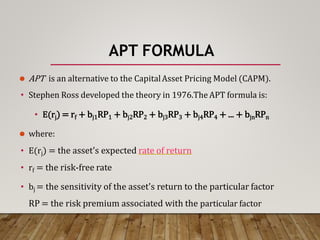
⚫ APT is an alternative to the CapitalAsset Pricing Model (CAPM).
• Stephen Ross developed the theory in 1976.The APT formula is:
• E(rj) = rf + bj1RP1 + bj2RP2 + bj3RP3 + bj4RP4 + ... + bjnRPn
⚫ where:
• E(rj) = the asset's expected rate of return
• rf = the risk-free rate
• bj = the sensitivity of the asset's return to the particular factor
RP = the risk premium associated with the particular factor
SECURITY-SPECIFIC
INFLUENCES
⚫There are an infinite number of security-specific influences
for any given security including
⚫inflation,
⚫production measures,
⚫ investor confidence,
⚫exchange rates,
⚫ market indices or
⚫changes in interest rates.
It is up to the analyst to decide which influences are relevant
to the asset being analyzed.
PRICI
NG
⚫Once the analyst derive the expected rate of
return of asset from the APT theory he would
decide the correct price of the asset.
⚫APT can be applied to portfolios as well as
individual securities also.
⚫A portfolio can have exposure and sensitivities to
certain kind of risk also.
WHY DOES ARBITRAGE
PORTFOLIO THEORY
MATTERS?
⚫It is a revolutionary model
⚫It allow the users to analyze the security.
⚫It is used to identify that either security is
undervalue or overvalued so can investors can
get benefit through the information.
⚫It is useful in formation of portfolio as it provide
information that whether portfolio is exposed to
certain factor.
ADVANTAGES
1. It has fewer restrictions.
The APT does not have the same requirements about individual portfolios as other
predictive theories. It also has fewer restrictions regarding the types of information
allowed to perform predictions. Because there is more information available, with
fewer overall restrictions, the results tend to be more reliable with the arbitrage
pricing theory than with competitive models.
2. It allows for more sources of risk.
The APT allows for multiple risk factors to be included within the data set being
examined instead of excluding them. This makes it possible for individual investors
to see more information about why certain stock returns are moving in specific
ways. It eliminates many of the questions on movement that other theories leave
behind because there are more sources of risks included within the data set.
• 3. It does not specify specific factors.
• Although APT does not offer specific factors like other pricing models, there are
four important factors that are taken into account by the theory. APT looks at
changes in inflation, changes in industrial production, shifts in risk premiums,
and shifts in the structure of interest rates when creating long-term predictive
factors.
• 4. It allows for unanticipated changes.
• APT is based on the idea that no surprises are going to happen. That is an
unrealistic expectation, so Ross included an equation to support the presence
of an unanticipated change. That makes it easier for investors to identify assets
which have the strongest potential for growth or the strongest potential for
failure, based on the information that is provided by the opportunity itself.
DISADVANTA
GES
1. It generates a large amount of data.
For someone unfamiliar with the arbitrage pricing theory, the amount of data that needs to
be sorted through can feel overwhelming. The information is generated by a specific
analyzation of the various factors involved that create growth or loss, allowing for the
predictive qualities to be factors in portfolio decisions. Someone not familiar with the
purpose of each data point will not understand the results APT generates, which makes it a
useless tool for them.
2. It requires risk sources to be accurate.
Every portfolio encounters some level of risk. For APT to be useful, it requires investors to
have a clear perception of the risk, as well as the source of that risk. Only then, will this
theory be able to factor in reasonable estimates with factoring sensitivities with a higher
level of accuracy. If there is no clear definition of a risk source, then there will be more
potential outcomes that reduce the effectiveness of the predictive qualities that APT
provides.
• 3. It requires the portfolio to be examined singularly.
• The APT is only useful when examining a single item for risk. Because of that
feature, trying to examine an entire portfolio with diverse investments is
virtually impossible to do. That is why the entire portfolio is examined using
the arbitrage pricing theory instead. Because it doesn’t account for each
account, only the portfolio, there are certain assumptions which must be
made during the evaluation. That can lead to factors of uncertainty, which
reduces the accuracy of the outcomes being analyzed.
• 4. It is not a guarantee of results.
• The arbitrage pricing theory does not guarantee that profits will happen.
There are securities which are undervalued on the market today for reasons
that fall outside of the scope of what APT considers. Some risks are not
“real” risks, as they are built into the pricing mechanisms by the investors
themselves, who have a certain fear of specific securities in certain market
conditions.
ARBITRAGE PRICING THEORY.pptx

ARBITRAGE PRICING THEORY.pptx

  • 1.
    ARBITRAGE PRICING THEORY (APT) SUBMITTEDBY : - RAMAN SINDHWANI (24095) YAJUSH ARORA (24094)
  • 2.
    WHAT IS ARBITRAGEPRICING THEORY (APT)? Arbitrage Pricing Theory (APT) is a well-known method of estimating the price of an asset. The theory assumes an asset's return is dependent on various factors- 1. Macroeconomic 2. Market 3. Security –specific factors
  • 3.
    THE GENERAL IDEABEHIND APT Two things can explain the expected return on a financial asset: 1) Macroeconomic/security-specific influences and 2) The asset's sensitivity to those influences. This relationship takes the form of the linear regression formula below.
  • 4.
    ARBITRAGE PRICING THEORY (APT) ⚫Thearbitrage pricing theory, or APT, is a model of pricing that is based on the concept that an asset can have its returns predicted. To do so, the relationship between the asset and its common risk factors must be analyzed. ⚫APT was first created by Stephen Ross in 1976 to examine the influence of macroeconomic factors. That allows for the returns of a portfolio and the returns of specific asset to be predicted by examining the various variables that are independent within the relationship.
  • 5.
    APT FORMULA ⚫ APTis an alternative to the CapitalAsset Pricing Model (CAPM). • Stephen Ross developed the theory in 1976.The APT formula is: • E(rj) = rf + bj1RP1 + bj2RP2 + bj3RP3 + bj4RP4 + ... + bjnRPn ⚫ where: • E(rj) = the asset's expected rate of return • rf = the risk-free rate • bj = the sensitivity of the asset's return to the particular factor RP = the risk premium associated with the particular factor
  • 6.
    SECURITY-SPECIFIC INFLUENCES ⚫There are aninfinite number of security-specific influences for any given security including ⚫inflation, ⚫production measures, ⚫ investor confidence, ⚫exchange rates, ⚫ market indices or ⚫changes in interest rates. It is up to the analyst to decide which influences are relevant to the asset being analyzed.
  • 7.
    PRICI NG ⚫Once the analystderive the expected rate of return of asset from the APT theory he would decide the correct price of the asset. ⚫APT can be applied to portfolios as well as individual securities also. ⚫A portfolio can have exposure and sensitivities to certain kind of risk also.
  • 8.
    WHY DOES ARBITRAGE PORTFOLIOTHEORY MATTERS? ⚫It is a revolutionary model ⚫It allow the users to analyze the security. ⚫It is used to identify that either security is undervalue or overvalued so can investors can get benefit through the information. ⚫It is useful in formation of portfolio as it provide information that whether portfolio is exposed to certain factor.
  • 9.
    ADVANTAGES 1. It hasfewer restrictions. The APT does not have the same requirements about individual portfolios as other predictive theories. It also has fewer restrictions regarding the types of information allowed to perform predictions. Because there is more information available, with fewer overall restrictions, the results tend to be more reliable with the arbitrage pricing theory than with competitive models. 2. It allows for more sources of risk. The APT allows for multiple risk factors to be included within the data set being examined instead of excluding them. This makes it possible for individual investors to see more information about why certain stock returns are moving in specific ways. It eliminates many of the questions on movement that other theories leave behind because there are more sources of risks included within the data set.
  • 10.
    • 3. Itdoes not specify specific factors. • Although APT does not offer specific factors like other pricing models, there are four important factors that are taken into account by the theory. APT looks at changes in inflation, changes in industrial production, shifts in risk premiums, and shifts in the structure of interest rates when creating long-term predictive factors. • 4. It allows for unanticipated changes. • APT is based on the idea that no surprises are going to happen. That is an unrealistic expectation, so Ross included an equation to support the presence of an unanticipated change. That makes it easier for investors to identify assets which have the strongest potential for growth or the strongest potential for failure, based on the information that is provided by the opportunity itself.
  • 11.
    DISADVANTA GES 1. It generatesa large amount of data. For someone unfamiliar with the arbitrage pricing theory, the amount of data that needs to be sorted through can feel overwhelming. The information is generated by a specific analyzation of the various factors involved that create growth or loss, allowing for the predictive qualities to be factors in portfolio decisions. Someone not familiar with the purpose of each data point will not understand the results APT generates, which makes it a useless tool for them. 2. It requires risk sources to be accurate. Every portfolio encounters some level of risk. For APT to be useful, it requires investors to have a clear perception of the risk, as well as the source of that risk. Only then, will this theory be able to factor in reasonable estimates with factoring sensitivities with a higher level of accuracy. If there is no clear definition of a risk source, then there will be more potential outcomes that reduce the effectiveness of the predictive qualities that APT provides.
  • 12.
    • 3. Itrequires the portfolio to be examined singularly. • The APT is only useful when examining a single item for risk. Because of that feature, trying to examine an entire portfolio with diverse investments is virtually impossible to do. That is why the entire portfolio is examined using the arbitrage pricing theory instead. Because it doesn’t account for each account, only the portfolio, there are certain assumptions which must be made during the evaluation. That can lead to factors of uncertainty, which reduces the accuracy of the outcomes being analyzed. • 4. It is not a guarantee of results. • The arbitrage pricing theory does not guarantee that profits will happen. There are securities which are undervalued on the market today for reasons that fall outside of the scope of what APT considers. Some risks are not “real” risks, as they are built into the pricing mechanisms by the investors themselves, who have a certain fear of specific securities in certain market conditions.