CHAPTER - 1
Introduction to
Behavioral Finance
LEARNING OBJECTIVES
 Explain Behavioral finance as “Modern Finance”
 Explain the Nature and Scope of Behavioral
Finance
 Describe the Objectives of Behavioral Finance
 Explain the history of Behavioral Finance
Behavioral finance defies the
concept of TRADITIONAL
FINANCE
MEANING
 Behavioral Finance is a concept developed with the inputs
taken from the field of psychology and finance, which
tries to understand various puzzling observations in stock
markets with better explanations.
 Behavioral finance is a new area of financial research that
explores the psychological factors affecting investment
decisions.
 It attempts to explain market anomalies and other market
activity that is not explained by the efficient market
hypothesis.
 It is a field of finance that proposes psychology-based
theories to explain stock market anomalies.
DEFINITION Daniel Kahneman and Amos Tversky – are considered as the
fathers of Behavioral Finance
“Behavioral finance is a field of finance that
proposes psychology-based theories to
explain stock market anomalies such as
severe rises or falls in stock price. Within
behavioral finance, it is assumed the
information structure and the
characteristics of market participants
systematically influence individuals'
investment decisions as well as market
outcomes.”
BEHAVIORAL FINANCE: INTRODUCTION
 Nature of Behavioral Finance
 Behavioral Finance is just not a part of
finance.
 It is something which is much broader
and wider and includes the insights
from behavioral economics,
psychology and microeconomic theory.
 The main theme of the traditional
finance is to avoid all the possible
effects of individual’s personality and
mindset.
Behavioral finance is divided into
two branches.
 Micro Behavioral Finance
 Macro Behavioral Finance
Behavioral Finance as a Science
Behavioral Finance as an Art
 Practically it is an Art
BEHAVIORAL FINANCE: INTRODUCTION
 Scope
 To understand the Reasons of Market
Anomalies
 To Identify Investor’s Personalities
 Helps to identify the risks and their
hedging strategies
 Provides an explanation to various
corporate activities
 To enhance the skill set of investment
advisors
Objectives
1. To review the debatable issues in Standard Finance and the interest
of stakeholders.
2. To examine the relationship between theories of Standard Finance
and Behavioral Finance.
3. To examine the various social responsibilities of the subject.
4. To discuss emerging issues in the financial world.
5. To discuss the development of new financial instruments
6. To familiarize themselves with trend of changed events over years,
across various economies.
7. To examine the contagion effect of various events.
8. An effort towards more elaborated identification of investor’s
personalities.
9. More emphasis on optimum Asset Allocation/portfolio
 Behavioral Approach is an approach to
understand the movements in financial markets,
which is contrary to Efficient market Hypothesis
(EMH), which has been the key preposition of
traditional finance, which believed that the
financial markets are efficient and highly
analytical. Fama defined efficient markets are
those markets in which, “ Security prices always
fully reflect the available information.”
 Classical view, Behavioral finance assumes that
the investors are irrational and due to combined
and multiplied effect of investor’s personalities,
markets will not always be efficient. This
inefficiency of financial markets causes the stock
prices to deviate from the predictions of
BEHAVIORAL FINANCE: MAJOR CONTRIBUTORS IN
BEHAVIORAL FINANCE
 Alan Greenspan, the Federal Reserve Chairman for
raising concern for Irrational exuberance with respect to
Japan in his lecture in 1996.
 Professor Richard Thaler, from University of Chicago
Graduate School of Business, studied investors behavior
responsible for the creation of Tech Bubble.
 Professor Hersh Shefrin from University in Santa Clara,
California contributed in the field by writing the book
“Beyond Greed and Fear : Understanding behavioral
Finance and the Psychology of Investing”.
 Professor Daniel Kahneman and Amos Tversky
formulated the Prospect Theory. As a alternative to
standard finance, prospect theory described that the
human judgments are influenced by Heuristic and
disagree with the basic principles of probability
BEHAVIORAL FINANCE: MAJOR RESEARCH WORK
IN BEHAVIORAL FINANCE
 While dealing with various investment options, the fundamental question people
face in their asset management is that “what is the best strategy for investing in
the stock market and to what extent can the past movements in stock prices
be used to make predictions of the future prices? Is it better to be focused on
‘fundamentals’, whatever they are and whatever way they have been
measured, or to follow the ‘psychology of the market.”
 Markowitz theorem and Markowitz’s portfolio selection Markowitz (1952).
 The assumption of being risk averse in standard finance is seriously challenged by
Friedman and Savage (1948).
 The expected utility theory, developed by Von Neumann and Morgenstern (1944)
 The Expected Utility Theory (EU) was developed by Von Neumann and
Morgenstern in 1944. Hayek (1937)
BEHAVIORAL FINANCE: MAJOR RESEARCH WORK
IN BEHAVIORAL FINANCE
 Ramsey (1928) was among the first to frame some models for
individual’s utility as the concave function of consumption,
which giving rise to numerous of such concave functions.
 Tversky and Kahneman (1981) found that, contrary to the
expected utility theory, people assign different weights to
gains and losses
 Kahneman and Tverksy (1979) derived the observation that
the marginal value of both gains and losses decreases with
their magnitude.
 Harrison and Kreps (1978) argued that some beliefs force
agents to buy stocks even though they believe stocks are
already above their ‘fundamental value’.
 Two parameters, centrality and between ness are discussed
by Freeman (1977) regarding the trade of securities.
 Ellsberg (1961) first identified the concept of ambiguity
aversion, which occurs when people prefer to bet on lotteries
BEHAVIORAL FINANCE: MAJOR RESEARCH WORK
IN BEHAVIORAL FINANCE
 Behavioral finance is defined by Shefrin (1999) as, “A rapidly growing
area that deals with the influence of psychology on the behavior of
financial practitioners”.
 demographical features systematically influence individual’s behavior
and their investment decision. “Modern financial economics at times
behave with extreme rationality; but, markets don’t”. As explained by
Barber and Odean (2001).
 Cumulative Prospect Theory coined by Tversky and Kahneman (1992)
provided a good explanation for the emergence of deposit accounts by
simultaneously integrating the risk-averse and risk-seeking behavior of
investors.
 and many more……..
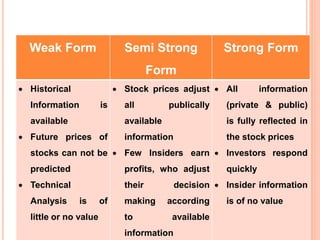
Weak Form Semi Strong
Form
Strong Form
 Historical
Information is
available
 Future prices of
stocks can not be
predicted
 Technical
Analysis is of
little or no value
 Stock prices adjust
all publically
available
information
 Few Insiders earn
profits, who adjust
their decision
making according
to available
information
 All information
(private & public)
is fully reflected in
the stock prices
 Investors respond
quickly
 Insider information
is of no value
EFFICIENT MARKET HYPOTHESIS
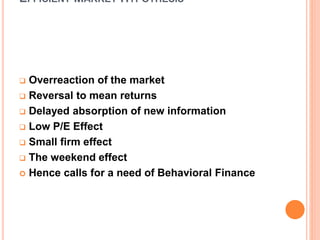
 Overreaction of the market
 Reversal to mean returns
 Delayed absorption of new information
 Low P/E Effect
 Small firm effect
 The weekend effect
 Hence calls for a need of Behavioral Finance
BEHAVIORAL FINANCE
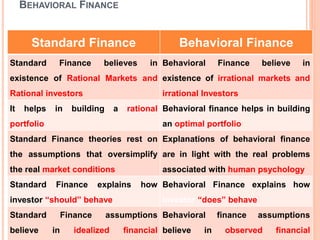
Standard Finance Behavioral Finance
Standard Finance believes in
existence of Rational Markets and
Rational investors
Behavioral Finance believe in
existence of irrational markets and
irrational Investors
It helps in building a rational
portfolio
Behavioral finance helps in building
an optimal portfolio
Standard Finance theories rest on
the assumptions that oversimplify
the real market conditions
Explanations of behavioral finance
are in light with the real problems
associated with human psychology
Standard Finance explains how
investor “should” behave
Behavioral Finance explains how
investor “does” behave
Standard Finance assumptions
believe in idealized financial
Behavioral finance assumptions
believe in observed financial

Behavioral Finance

  • 1.
    CHAPTER - 1 Introductionto Behavioral Finance
  • 2.
    LEARNING OBJECTIVES  ExplainBehavioral finance as “Modern Finance”  Explain the Nature and Scope of Behavioral Finance  Describe the Objectives of Behavioral Finance  Explain the history of Behavioral Finance
  • 3.
    Behavioral finance defiesthe concept of TRADITIONAL FINANCE
  • 4.
    MEANING  Behavioral Financeis a concept developed with the inputs taken from the field of psychology and finance, which tries to understand various puzzling observations in stock markets with better explanations.  Behavioral finance is a new area of financial research that explores the psychological factors affecting investment decisions.  It attempts to explain market anomalies and other market activity that is not explained by the efficient market hypothesis.  It is a field of finance that proposes psychology-based theories to explain stock market anomalies.
  • 5.
    DEFINITION Daniel Kahnemanand Amos Tversky – are considered as the fathers of Behavioral Finance “Behavioral finance is a field of finance that proposes psychology-based theories to explain stock market anomalies such as severe rises or falls in stock price. Within behavioral finance, it is assumed the information structure and the characteristics of market participants systematically influence individuals' investment decisions as well as market outcomes.”
  • 6.
    BEHAVIORAL FINANCE: INTRODUCTION Nature of Behavioral Finance  Behavioral Finance is just not a part of finance.  It is something which is much broader and wider and includes the insights from behavioral economics, psychology and microeconomic theory.  The main theme of the traditional finance is to avoid all the possible effects of individual’s personality and mindset.
  • 7.
    Behavioral finance isdivided into two branches.  Micro Behavioral Finance  Macro Behavioral Finance Behavioral Finance as a Science Behavioral Finance as an Art  Practically it is an Art
  • 8.
    BEHAVIORAL FINANCE: INTRODUCTION Scope  To understand the Reasons of Market Anomalies  To Identify Investor’s Personalities  Helps to identify the risks and their hedging strategies  Provides an explanation to various corporate activities  To enhance the skill set of investment advisors
  • 9.
    Objectives 1. To reviewthe debatable issues in Standard Finance and the interest of stakeholders. 2. To examine the relationship between theories of Standard Finance and Behavioral Finance. 3. To examine the various social responsibilities of the subject. 4. To discuss emerging issues in the financial world. 5. To discuss the development of new financial instruments 6. To familiarize themselves with trend of changed events over years, across various economies. 7. To examine the contagion effect of various events. 8. An effort towards more elaborated identification of investor’s personalities. 9. More emphasis on optimum Asset Allocation/portfolio
  • 10.
     Behavioral Approachis an approach to understand the movements in financial markets, which is contrary to Efficient market Hypothesis (EMH), which has been the key preposition of traditional finance, which believed that the financial markets are efficient and highly analytical. Fama defined efficient markets are those markets in which, “ Security prices always fully reflect the available information.”  Classical view, Behavioral finance assumes that the investors are irrational and due to combined and multiplied effect of investor’s personalities, markets will not always be efficient. This inefficiency of financial markets causes the stock prices to deviate from the predictions of
  • 11.
    BEHAVIORAL FINANCE: MAJORCONTRIBUTORS IN BEHAVIORAL FINANCE  Alan Greenspan, the Federal Reserve Chairman for raising concern for Irrational exuberance with respect to Japan in his lecture in 1996.  Professor Richard Thaler, from University of Chicago Graduate School of Business, studied investors behavior responsible for the creation of Tech Bubble.  Professor Hersh Shefrin from University in Santa Clara, California contributed in the field by writing the book “Beyond Greed and Fear : Understanding behavioral Finance and the Psychology of Investing”.  Professor Daniel Kahneman and Amos Tversky formulated the Prospect Theory. As a alternative to standard finance, prospect theory described that the human judgments are influenced by Heuristic and disagree with the basic principles of probability
  • 12.
    BEHAVIORAL FINANCE: MAJORRESEARCH WORK IN BEHAVIORAL FINANCE  While dealing with various investment options, the fundamental question people face in their asset management is that “what is the best strategy for investing in the stock market and to what extent can the past movements in stock prices be used to make predictions of the future prices? Is it better to be focused on ‘fundamentals’, whatever they are and whatever way they have been measured, or to follow the ‘psychology of the market.”  Markowitz theorem and Markowitz’s portfolio selection Markowitz (1952).  The assumption of being risk averse in standard finance is seriously challenged by Friedman and Savage (1948).  The expected utility theory, developed by Von Neumann and Morgenstern (1944)  The Expected Utility Theory (EU) was developed by Von Neumann and Morgenstern in 1944. Hayek (1937)
  • 13.
    BEHAVIORAL FINANCE: MAJORRESEARCH WORK IN BEHAVIORAL FINANCE  Ramsey (1928) was among the first to frame some models for individual’s utility as the concave function of consumption, which giving rise to numerous of such concave functions.  Tversky and Kahneman (1981) found that, contrary to the expected utility theory, people assign different weights to gains and losses  Kahneman and Tverksy (1979) derived the observation that the marginal value of both gains and losses decreases with their magnitude.  Harrison and Kreps (1978) argued that some beliefs force agents to buy stocks even though they believe stocks are already above their ‘fundamental value’.  Two parameters, centrality and between ness are discussed by Freeman (1977) regarding the trade of securities.  Ellsberg (1961) first identified the concept of ambiguity aversion, which occurs when people prefer to bet on lotteries
  • 14.
    BEHAVIORAL FINANCE: MAJORRESEARCH WORK IN BEHAVIORAL FINANCE  Behavioral finance is defined by Shefrin (1999) as, “A rapidly growing area that deals with the influence of psychology on the behavior of financial practitioners”.  demographical features systematically influence individual’s behavior and their investment decision. “Modern financial economics at times behave with extreme rationality; but, markets don’t”. As explained by Barber and Odean (2001).  Cumulative Prospect Theory coined by Tversky and Kahneman (1992) provided a good explanation for the emergence of deposit accounts by simultaneously integrating the risk-averse and risk-seeking behavior of investors.  and many more……..
  • 15.
    Weak Form SemiStrong Form Strong Form  Historical Information is available  Future prices of stocks can not be predicted  Technical Analysis is of little or no value  Stock prices adjust all publically available information  Few Insiders earn profits, who adjust their decision making according to available information  All information (private & public) is fully reflected in the stock prices  Investors respond quickly  Insider information is of no value
  • 16.
    EFFICIENT MARKET HYPOTHESIS Overreaction of the market  Reversal to mean returns  Delayed absorption of new information  Low P/E Effect  Small firm effect  The weekend effect  Hence calls for a need of Behavioral Finance
  • 17.
    BEHAVIORAL FINANCE Standard FinanceBehavioral Finance Standard Finance believes in existence of Rational Markets and Rational investors Behavioral Finance believe in existence of irrational markets and irrational Investors It helps in building a rational portfolio Behavioral finance helps in building an optimal portfolio Standard Finance theories rest on the assumptions that oversimplify the real market conditions Explanations of behavioral finance are in light with the real problems associated with human psychology Standard Finance explains how investor “should” behave Behavioral Finance explains how investor “does” behave Standard Finance assumptions believe in idealized financial Behavioral finance assumptions believe in observed financial