CSI Global Education Inc. Investment Products CHAPTER 8:  Equity Securities:  Common and Preferred Shares
Chapter Highlights The purchase of common or preferred shares represents an ‘ownership’ stake in the company. The return on the investment is tied to how well the company does.  With an investment in a corporate bond, volatility in interest rates can have a big impact on the value of the investment. However, as a ‘creditor’ of the company bondholders are given first priority in the event of bankruptcy.
Common Shares Why do investors purchase common shares?  What are some of the main reasons for selecting this type of investment?
Common Share Rights & Advantages Potential for capital appreciation The right to dividends Favourable tax treatment for dividends and capital gains Voting privileges Limited liability Marketability
Dividends Not a contractual obligation until announced Record Date – recorded shareholders on this date receive the dividend Cum Dividend – if buy stock will receive dividend – up to 3 rd  business day before record date Ex Dividend – if buy stock will  not  receive dividend – 2 nd  business day before record date
Dividends Regular Dividends payment of the dividend is maintained, barring changes to the firm’s finances/operations Extra Dividends a bonus paid in addition to the regular dividend does not imply this extra payment will be made regularly Stock Dividends in the form of additional stock rather than cash typically paid by rapidly growing companies treated as regular dividends for tax purposes
Dividends DRIP (Dividend Reinvestment Plan) dividends are used to purchase additional stock in the company and  not  paid as cash taxable same as cash dividend shareholders benefit by saving on commission to purchase the underlying stock benefit from dollar cost averaging
Restricted Shares Shares which have the right to participate to an unlimited degree in the earnings of a company and in its assets on liquidation, but do not have full voting rights.  There are three categories of restricted or special shares: Non-voting Subordinate voting   Restricted voting Can you describe how they differ?
Restricted Shares  (continued) Non-voting  – shares that are not voting, except perhaps in certain limited circumstances. Subordinate voting  – shares which carry a right to vote, where there is another class of shares outstanding that carry a greater voting right on a per share basis. Restricted voting  – shares which carry a right to vote, subject to a limit or restriction on the number or percentage of shares that may be voted by a person, company or group.
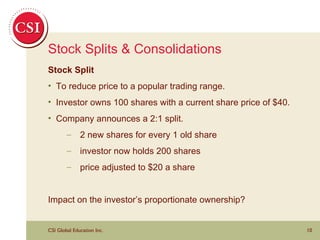
Stock Splits & Consolidations Stock Split To reduce price to a popular trading range. Investor owns 100 shares with a current share price of $40.  Company announces a 2:1 split. 2 new shares for every 1 old share investor now holds 200 shares price adjusted to $20 a share Impact on the investor’s proportionate ownership?
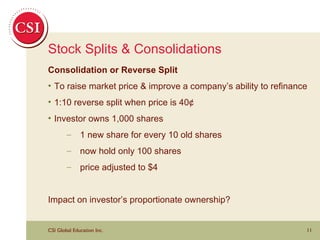
Stock Splits & Consolidations Consolidation or Reverse Split  To raise market price & improve a company’s ability to refinance 1:10 reverse split when price is 40¢  Investor owns 1,000 shares 1 new share for every 10 old shares now hold only 100 shares price adjusted to $4 Impact on investor’s proportionate ownership?
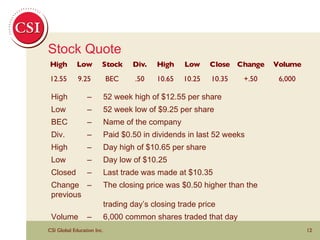
Stock Quote High – 52 week high of $12.55 per share Low –  52 week low of $9.25 per share BEC –  Name of the company Div. –  Paid $0.50 in dividends in last 52 weeks High –  Day high of $10.65 per share Low –  Day low of $10.25 Closed –  Last trade was made at $10.35 Change –  The closing price was $0.50 higher than the previous trading day’s closing trade price Volume –  6,000 common shares traded that day
Preferred Shares Why are they called Preferred Shares? Dividends must be paid before common share dividends. In cases of business failure, preferreds rank ahead of common shareholders.
Why Issue Preferred Shares? Over Debt No “contractual obligations” to pay dividends No maturity date Greater flexibility for company Over Common Preferred shareholders are only entitled to a “fixed” return (no dilution of earnings) No dilution of control – most are non-voting
Why Preferreds as an Investment? Cash flows – tax advantaged dividends  Preference in dividends and assets on wind-ups Dangers Purchasing power risk Increases in interest rates Dividends could be passed over The company could fail
Preferred Share Features Par value Maturity Date  no maturity date Voting Rights     non-voting if dividends paid on schedule Cumulative  – unpaid dividends accumulate in arrears – preferred dividend arrears must be paid – before common dividends paid  Redeemable/Call Feature Sinking/Purchase Fund
Types of Preferreds Retractable creates a “maturity” date investor can force company to buy back at a specified time & price Convertible right to convert to common shares at specified time & price Variable Rate dividend fluctuates with changes in interest rates Foreign Pay dividend payable in foreign currency
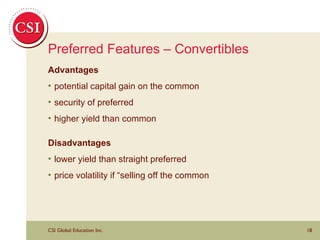
Preferred Features – Convertibles Advantages potential capital gain on the common security of preferred higher yield than common Disadvantages  lower yield than straight preferred price volatility if “selling off the common
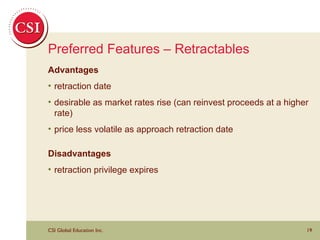
Preferred Features – Retractables Advantages retraction date desirable as market rates rise (can reinvest proceeds at a higher rate) price less volatile as approach retraction date Disadvantages retraction privilege expires
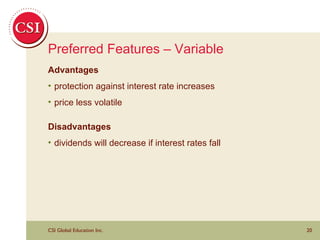
Preferred Features – Variable Advantages protection against interest rate increases price less volatile Disadvantages dividends will decrease if interest rates fall
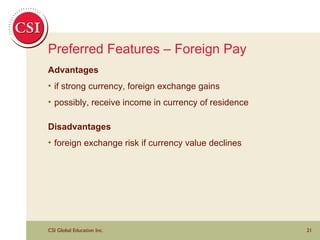
Preferred Features – Foreign Pay Advantages if strong currency, foreign exchange gains possibly, receive income in currency of residence Disadvantages foreign exchange risk if currency value declines
Other Types of Preferreds COPrS  (Canadian Originated Preferred Securities) Preferreds with warrants Deferred preferreds Split shares Participating preferreds
Canadian Originated Preferred Securities COPrS are long term (49 years) junior subordinate fixed income instruments Quarterly distributions treated as interest for tax purposes Trade “cum dividend” – i.e. accrued interest is paid out not accumulated Traded on exchanges Other: Can defer payments up to 5 years Shows up as equity on the balance sheet Non-callable for first 5 years
Other Types of Preferreds Deferred Shares: Pays no dividend until a future maturity date.  Dividends compound without having to pay annual taxes.  The ‘dividend premium’ is not eligible for the dividend tax credit. At maturity the accrued dividends are treated as interest income.  If sold prior, it is treated as a capital gain (or loss).
Other Types of Preferreds Split Shares: Share that have two components – equity dividend share and capital share.  Equity shares trade on yields but may share in dividends.  The maturity value of both are determined by the value of the underlying stock.
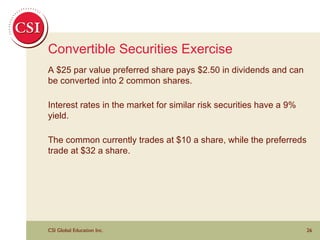
Convertible Securities Exercise A $25 par value preferred share pays $2.50 in dividends and can be converted into 2 common shares.  Interest rates in the market for similar risk securities have a 9% yield. The common currently trades at $10 a share, while the preferreds trade at $32 a share.
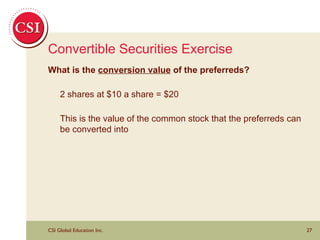
Convertible Securities Exercise What is the  conversion value  of the preferreds?  2 shares at $10 a share = $20 This is the value of the common stock that the preferreds can be converted into
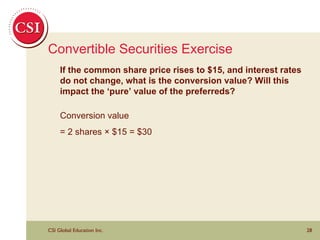
Convertible Securities Exercise If the common share price rises to $15, and interest rates do not change, what is the conversion value? Will this impact the ‘pure’ value of the preferreds? Conversion value  = 2 shares × $15 = $30
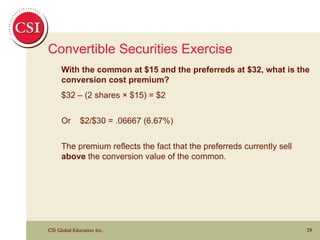
Convertible Securities Exercise With the common at $15 and the preferreds at $32, what is the conversion cost premium?  $32 – (2 shares × $15) = $2  Or  $2/$30 = .06667 (6.67%)  The premium reflects the fact that the preferreds currently sell  above  the conversion value of the common.
Convertible Securities Exercise If the dividend yield on the common shares is 5% and 7.8% on the preferreds, what is the payback period? Pay back premium = 6.67/(7.8 – 5) = 2.38 years
Convertible Securities Rule: “Convertible securities trade at the higher of either their conversion value or their pure investment value.”

Csc3 Inv Products Ch 8

  • 1.
    CSI Global EducationInc. Investment Products CHAPTER 8: Equity Securities: Common and Preferred Shares
  • 2.
    Chapter Highlights Thepurchase of common or preferred shares represents an ‘ownership’ stake in the company. The return on the investment is tied to how well the company does. With an investment in a corporate bond, volatility in interest rates can have a big impact on the value of the investment. However, as a ‘creditor’ of the company bondholders are given first priority in the event of bankruptcy.
  • 3.
    Common Shares Whydo investors purchase common shares? What are some of the main reasons for selecting this type of investment?
  • 4.
    Common Share Rights& Advantages Potential for capital appreciation The right to dividends Favourable tax treatment for dividends and capital gains Voting privileges Limited liability Marketability
  • 5.
    Dividends Not acontractual obligation until announced Record Date – recorded shareholders on this date receive the dividend Cum Dividend – if buy stock will receive dividend – up to 3 rd business day before record date Ex Dividend – if buy stock will not receive dividend – 2 nd business day before record date
  • 6.
    Dividends Regular Dividendspayment of the dividend is maintained, barring changes to the firm’s finances/operations Extra Dividends a bonus paid in addition to the regular dividend does not imply this extra payment will be made regularly Stock Dividends in the form of additional stock rather than cash typically paid by rapidly growing companies treated as regular dividends for tax purposes
  • 7.
    Dividends DRIP (DividendReinvestment Plan) dividends are used to purchase additional stock in the company and not paid as cash taxable same as cash dividend shareholders benefit by saving on commission to purchase the underlying stock benefit from dollar cost averaging
  • 8.
    Restricted Shares Shareswhich have the right to participate to an unlimited degree in the earnings of a company and in its assets on liquidation, but do not have full voting rights. There are three categories of restricted or special shares: Non-voting Subordinate voting Restricted voting Can you describe how they differ?
  • 9.
    Restricted Shares (continued) Non-voting – shares that are not voting, except perhaps in certain limited circumstances. Subordinate voting – shares which carry a right to vote, where there is another class of shares outstanding that carry a greater voting right on a per share basis. Restricted voting – shares which carry a right to vote, subject to a limit or restriction on the number or percentage of shares that may be voted by a person, company or group.
  • 10.
    Stock Splits &Consolidations Stock Split To reduce price to a popular trading range. Investor owns 100 shares with a current share price of $40. Company announces a 2:1 split. 2 new shares for every 1 old share investor now holds 200 shares price adjusted to $20 a share Impact on the investor’s proportionate ownership?
  • 11.
    Stock Splits &Consolidations Consolidation or Reverse Split To raise market price & improve a company’s ability to refinance 1:10 reverse split when price is 40¢ Investor owns 1,000 shares 1 new share for every 10 old shares now hold only 100 shares price adjusted to $4 Impact on investor’s proportionate ownership?
  • 12.
    Stock Quote High– 52 week high of $12.55 per share Low – 52 week low of $9.25 per share BEC – Name of the company Div. – Paid $0.50 in dividends in last 52 weeks High – Day high of $10.65 per share Low – Day low of $10.25 Closed – Last trade was made at $10.35 Change – The closing price was $0.50 higher than the previous trading day’s closing trade price Volume – 6,000 common shares traded that day
  • 13.
    Preferred Shares Whyare they called Preferred Shares? Dividends must be paid before common share dividends. In cases of business failure, preferreds rank ahead of common shareholders.
  • 14.
    Why Issue PreferredShares? Over Debt No “contractual obligations” to pay dividends No maturity date Greater flexibility for company Over Common Preferred shareholders are only entitled to a “fixed” return (no dilution of earnings) No dilution of control – most are non-voting
  • 15.
    Why Preferreds asan Investment? Cash flows – tax advantaged dividends Preference in dividends and assets on wind-ups Dangers Purchasing power risk Increases in interest rates Dividends could be passed over The company could fail
  • 16.
    Preferred Share FeaturesPar value Maturity Date  no maturity date Voting Rights  non-voting if dividends paid on schedule Cumulative – unpaid dividends accumulate in arrears – preferred dividend arrears must be paid – before common dividends paid Redeemable/Call Feature Sinking/Purchase Fund
  • 17.
    Types of PreferredsRetractable creates a “maturity” date investor can force company to buy back at a specified time & price Convertible right to convert to common shares at specified time & price Variable Rate dividend fluctuates with changes in interest rates Foreign Pay dividend payable in foreign currency
  • 18.
    Preferred Features –Convertibles Advantages potential capital gain on the common security of preferred higher yield than common Disadvantages lower yield than straight preferred price volatility if “selling off the common
  • 19.
    Preferred Features –Retractables Advantages retraction date desirable as market rates rise (can reinvest proceeds at a higher rate) price less volatile as approach retraction date Disadvantages retraction privilege expires
  • 20.
    Preferred Features –Variable Advantages protection against interest rate increases price less volatile Disadvantages dividends will decrease if interest rates fall
  • 21.
    Preferred Features –Foreign Pay Advantages if strong currency, foreign exchange gains possibly, receive income in currency of residence Disadvantages foreign exchange risk if currency value declines
  • 22.
    Other Types ofPreferreds COPrS (Canadian Originated Preferred Securities) Preferreds with warrants Deferred preferreds Split shares Participating preferreds
  • 23.
    Canadian Originated PreferredSecurities COPrS are long term (49 years) junior subordinate fixed income instruments Quarterly distributions treated as interest for tax purposes Trade “cum dividend” – i.e. accrued interest is paid out not accumulated Traded on exchanges Other: Can defer payments up to 5 years Shows up as equity on the balance sheet Non-callable for first 5 years
  • 24.
    Other Types ofPreferreds Deferred Shares: Pays no dividend until a future maturity date. Dividends compound without having to pay annual taxes. The ‘dividend premium’ is not eligible for the dividend tax credit. At maturity the accrued dividends are treated as interest income. If sold prior, it is treated as a capital gain (or loss).
  • 25.
    Other Types ofPreferreds Split Shares: Share that have two components – equity dividend share and capital share. Equity shares trade on yields but may share in dividends. The maturity value of both are determined by the value of the underlying stock.
  • 26.
    Convertible Securities ExerciseA $25 par value preferred share pays $2.50 in dividends and can be converted into 2 common shares. Interest rates in the market for similar risk securities have a 9% yield. The common currently trades at $10 a share, while the preferreds trade at $32 a share.
  • 27.
    Convertible Securities ExerciseWhat is the conversion value of the preferreds? 2 shares at $10 a share = $20 This is the value of the common stock that the preferreds can be converted into
  • 28.
    Convertible Securities ExerciseIf the common share price rises to $15, and interest rates do not change, what is the conversion value? Will this impact the ‘pure’ value of the preferreds? Conversion value = 2 shares × $15 = $30
  • 29.
    Convertible Securities ExerciseWith the common at $15 and the preferreds at $32, what is the conversion cost premium? $32 – (2 shares × $15) = $2 Or $2/$30 = .06667 (6.67%) The premium reflects the fact that the preferreds currently sell above the conversion value of the common.
  • 30.
    Convertible Securities ExerciseIf the dividend yield on the common shares is 5% and 7.8% on the preferreds, what is the payback period? Pay back premium = 6.67/(7.8 – 5) = 2.38 years
  • 31.
    Convertible Securities Rule:“Convertible securities trade at the higher of either their conversion value or their pure investment value.”

Editor's Notes

  • #23 This material is optional, as it is quite straight-forward.