Filters
Provided by :
- Imad Gourrad
- Achraf Kalakhy
Framed by :
Mr.Ahmed Neddami
OUTLINE :
• 1- Filter definition .
• 2- Advantages and desadvantages of
filters .
• 3- Low pass filter .
• 4- High pass filter .
WHAT IS A FILTER
GENERAL
• They are used in circuits
which require the separation
of signals according to their
frequencies
• They are widely
used in
communication
And signal
processing
COMMONLY USED FILTERS
• The most commonly used filters are :
• Low Pass Filter
• High Pass Filter
• Band Pass Filter
• Band Reject Filter
• All Pass Filter &
• Universal Filters.
The Advantages of Each Filter Type
PASSIVE ACTIVE
• No power supply required
• they Can handle large currents and high
voltages
• they include few components
• they have no bandwidth limitation
• ...
• No inductors
• Easier to design
• Can produce high gains
• Generally easier to tune
• Small in size and weight
• …
passive filters require no power supply
, they can handle large currents and
high voltages and are very reliable ,
they include few components and they
hav no bandwith limitations
while active filters include no inductors
,are easier to design, can produce high
gains ,generally easier to repair and
they are small in size and weight
Now we
move to
While The Disadvantages of Each Filter
Type for
PASSIVE ACTIVE
•Include large inductors for lower
frequencies .
•Some of them require shielding
•Are produced in limited standard sizes
•Requiring variable inductors
•Must be designed with output and input
consideration in mind
• Power supply required
• Can require many components
passive filters include large inductors
for lower frequencies while some of
them require shielding they are
produced in limited standard sizes
requiring variable inductors they must
be designed with output and input
consideration in mind
while active filters
require a power supply and can
require many components
Low Pass Filter
Passive Low Pass Filter
• In this type of filter the input
signal Vin is applied to the
series combination
• But the output signal
Vout is taken across
the capacitor only
this type of filter is
known generally as a
first order filter
Active Low Pass Filter
• The most common and
easily understood active
filter is the active low
pass filter
• Its principle of
operation and frequency
response is exactly the
same as those for the
previously seen passive
filter
FREQUENCY RESPONSE OF
LOW PASS FILTER:
FREQUENCY RESPONSE OF
LOW PASS FILTER:
• At very low frequencies, ƒ < ƒc
• At the cut-off frequency, ƒ = ƒc
• At very high frequencies, ƒ > ƒc
High Pass Filters
• 1 – passive high pass filter
• 2 – active high pass filter
Passive High Pass Filter
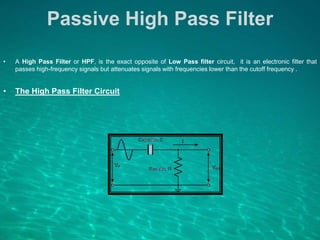
• A High Pass Filter or HPF, is the exact opposite of Low Pass filter circuit, it is an electronic filter that
passes high-frequency signals but attenuates signals with frequencies lower than the cutoff frequency .
• The High Pass Filter Circuit
Frequency Response of a High Pass Filter
A high pass filter is a circuit whose amplitude
response increases with f as shown in figure.
This filter passes frequencies that are higher than
the cutoff frequency Fc and rejects those that are
lower than fc .
That is, the pass band is f > fc
the bandwith can be obtained by reducing the stop
band range
Cut-off Frequency
The circuit gain Av is calculated as:
At low frequency , when Xc is infinitly high , Vout = 0
At high fre , when Xc tends to be null , Vout = vin
Active High Pass Filter
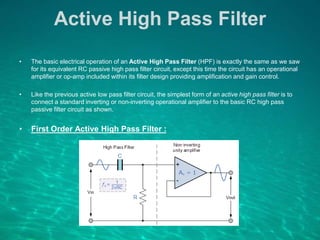
• The basic electrical operation of an Active High Pass Filter (HPF) is exactly the same as we saw
for its equivalent RC passive high pass filter circuit, except this time the circuit has an operational
amplifier or op-amp included within its filter design providing amplification and gain control.
• Like the previous active low pass filter circuit, the simplest form of an active high pass filter is to
connect a standard inverting or non-inverting operational amplifier to the basic RC high pass
passive filter circuit as shown.
• First Order Active High Pass Filter :
Cut-off Frequency and Phase Shift
Cutoff frequency is the same to the passive high pass filter
Filters

Filters

  • 1.
    Filters Provided by : -Imad Gourrad - Achraf Kalakhy Framed by : Mr.Ahmed Neddami
  • 2.
    OUTLINE : • 1-Filter definition . • 2- Advantages and desadvantages of filters . • 3- Low pass filter . • 4- High pass filter .
  • 3.
    WHAT IS AFILTER
  • 4.
    GENERAL • They areused in circuits which require the separation of signals according to their frequencies
  • 5.
    • They arewidely used in communication And signal processing
  • 6.
    COMMONLY USED FILTERS •The most commonly used filters are : • Low Pass Filter • High Pass Filter • Band Pass Filter • Band Reject Filter • All Pass Filter & • Universal Filters.
  • 7.
    The Advantages ofEach Filter Type PASSIVE ACTIVE • No power supply required • they Can handle large currents and high voltages • they include few components • they have no bandwidth limitation • ... • No inductors • Easier to design • Can produce high gains • Generally easier to tune • Small in size and weight • … passive filters require no power supply , they can handle large currents and high voltages and are very reliable , they include few components and they hav no bandwith limitations while active filters include no inductors ,are easier to design, can produce high gains ,generally easier to repair and they are small in size and weight Now we move to
  • 8.
    While The Disadvantagesof Each Filter Type for PASSIVE ACTIVE •Include large inductors for lower frequencies . •Some of them require shielding •Are produced in limited standard sizes •Requiring variable inductors •Must be designed with output and input consideration in mind • Power supply required • Can require many components passive filters include large inductors for lower frequencies while some of them require shielding they are produced in limited standard sizes requiring variable inductors they must be designed with output and input consideration in mind while active filters require a power supply and can require many components
  • 9.
  • 10.
    Passive Low PassFilter • In this type of filter the input signal Vin is applied to the series combination
  • 11.
    • But theoutput signal Vout is taken across the capacitor only this type of filter is known generally as a first order filter
  • 12.
    Active Low PassFilter • The most common and easily understood active filter is the active low pass filter • Its principle of operation and frequency response is exactly the same as those for the previously seen passive filter
  • 13.
  • 14.
  • 15.
    • At verylow frequencies, ƒ < ƒc • At the cut-off frequency, ƒ = ƒc • At very high frequencies, ƒ > ƒc
  • 16.
    High Pass Filters •1 – passive high pass filter • 2 – active high pass filter
  • 17.
    Passive High PassFilter • A High Pass Filter or HPF, is the exact opposite of Low Pass filter circuit, it is an electronic filter that passes high-frequency signals but attenuates signals with frequencies lower than the cutoff frequency . • The High Pass Filter Circuit
  • 18.
    Frequency Response ofa High Pass Filter A high pass filter is a circuit whose amplitude response increases with f as shown in figure. This filter passes frequencies that are higher than the cutoff frequency Fc and rejects those that are lower than fc . That is, the pass band is f > fc the bandwith can be obtained by reducing the stop band range
  • 19.
    Cut-off Frequency The circuitgain Av is calculated as: At low frequency , when Xc is infinitly high , Vout = 0 At high fre , when Xc tends to be null , Vout = vin
  • 20.
    Active High PassFilter • The basic electrical operation of an Active High Pass Filter (HPF) is exactly the same as we saw for its equivalent RC passive high pass filter circuit, except this time the circuit has an operational amplifier or op-amp included within its filter design providing amplification and gain control. • Like the previous active low pass filter circuit, the simplest form of an active high pass filter is to connect a standard inverting or non-inverting operational amplifier to the basic RC high pass passive filter circuit as shown. • First Order Active High Pass Filter :
  • 21.
    Cut-off Frequency andPhase Shift Cutoff frequency is the same to the passive high pass filter