Field Research
Introduction to qualitative
methodology
 Data in words rather than numbers
 Non-positivistic orientation
 Includes:
 Field research
 Qualitative interviewing
 Historical comparative analysis
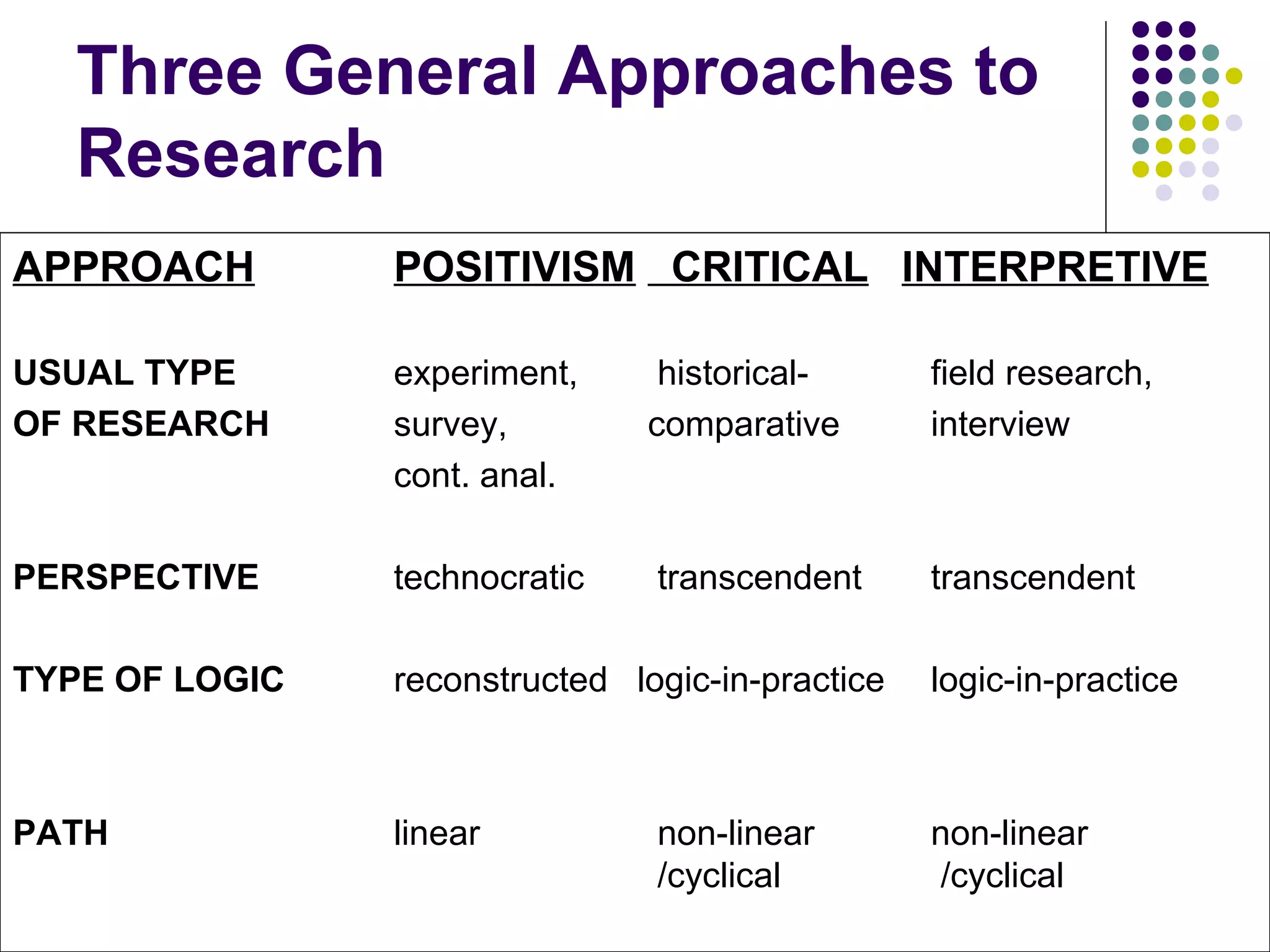
Three General Approaches to
Research
APPROACH POSITIVISM CRITICAL INTERPRETIVE
USUAL TYPE experiment, historical- field research,
OF RESEARCH survey, comparative interview
cont. anal.
PERSPECTIVE technocratic transcendent transcendent
TYPE OF LOGIC reconstructed logic-in-practice logic-in-practice
PATH linear non-linear non-linear
/cyclical /cyclical
Characteristics of Qualitative
Research
 Context is critical
 In depth, detailed
 Researcher immerses self in data (non-
objective)
 Researcher integrity
 Bias recognized
 Use of grounded theory
 Can detect process and sequence
 Data are interpreted rather than analyzed
Elite Studies
 Special type of field research
 Elites difficult to study, especially with
quantitative methods
 Preferred method is field study
 But special problems
 Gatekeepers
 Need for connections/contacts
 Danger of manipulation
 Difficulty of establishing trust
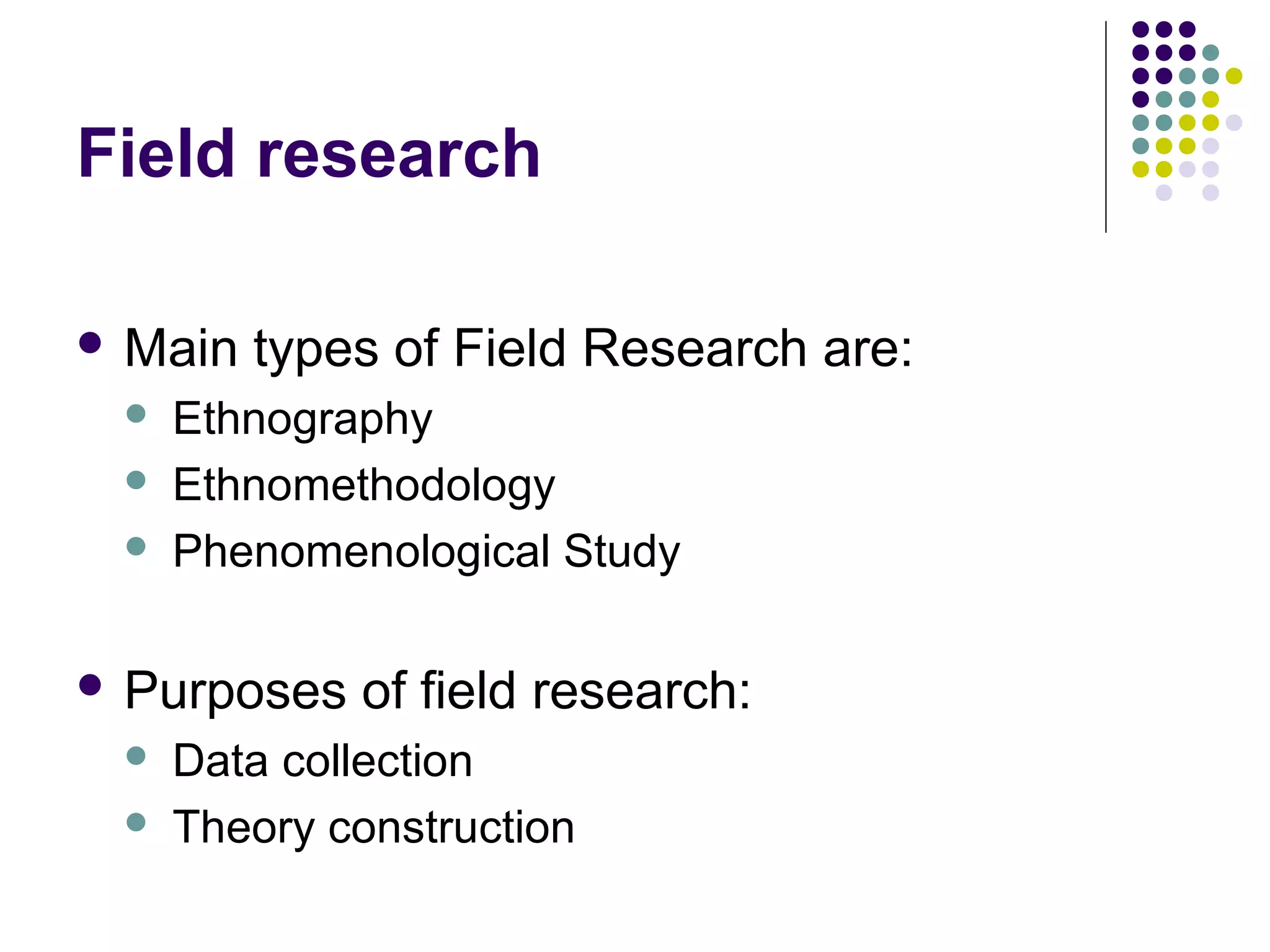
Field research
 Main types of Field Research are:
 Ethnography
 Ethnomethodology
 Phenomenological Study
 Purposes of field research:
 Data collection
 Theory construction
Ethnography
 A way of building an understanding the
culture and behaviours of a group as a whole.
 Done in a setting or field site where a group
of people share a common culture.
 In sociology, ethnography usually called a
field study
 Uses:
 Participant Observation
 Interviews with Informants
 Examination of documents and cultural artifacts
Ethnography Video
Getting People to Talk: An Ethnograph
(Copyright © 2008 Gabriel Biller & Kristy
Scovel)
Ethnomethodology
 The study of commonsense knowledge
 How do individuals make sense of social
situations and act on their knowledge?
 What are the tacit rules used by members of
a culture?
 Detailed studies of interactions
 Breaching experiments (Garfinkel)
 To uncover hidden norms
Phenomenological Study
 Understanding an experience from a
research participant's point of view
 Interview several participants as to their
perceptions of an experience
 Try to build a picture of the experience
through using a combination of theories,
literature in the area, illustrated by anecdotes,
to build a detailed portrait of the experience
 Use of Max Weber’s “verstehen”
Topics For Field Research
 Topics that defy simple quantification.
 Topics where attitudes and behaviours are best
understood within their natural setting.
 Social processes that take place over time.
 The study of meanings, practices, episodes,
encounters, roles, relationships, groups,
organizations, and settlements.
Sampling in field research
 Types of nonprobability sampling methods
commonly used:
 Quota sampling
 Snowball sampling
 Deviant cases
 Purposive sampling or judgmental sampling
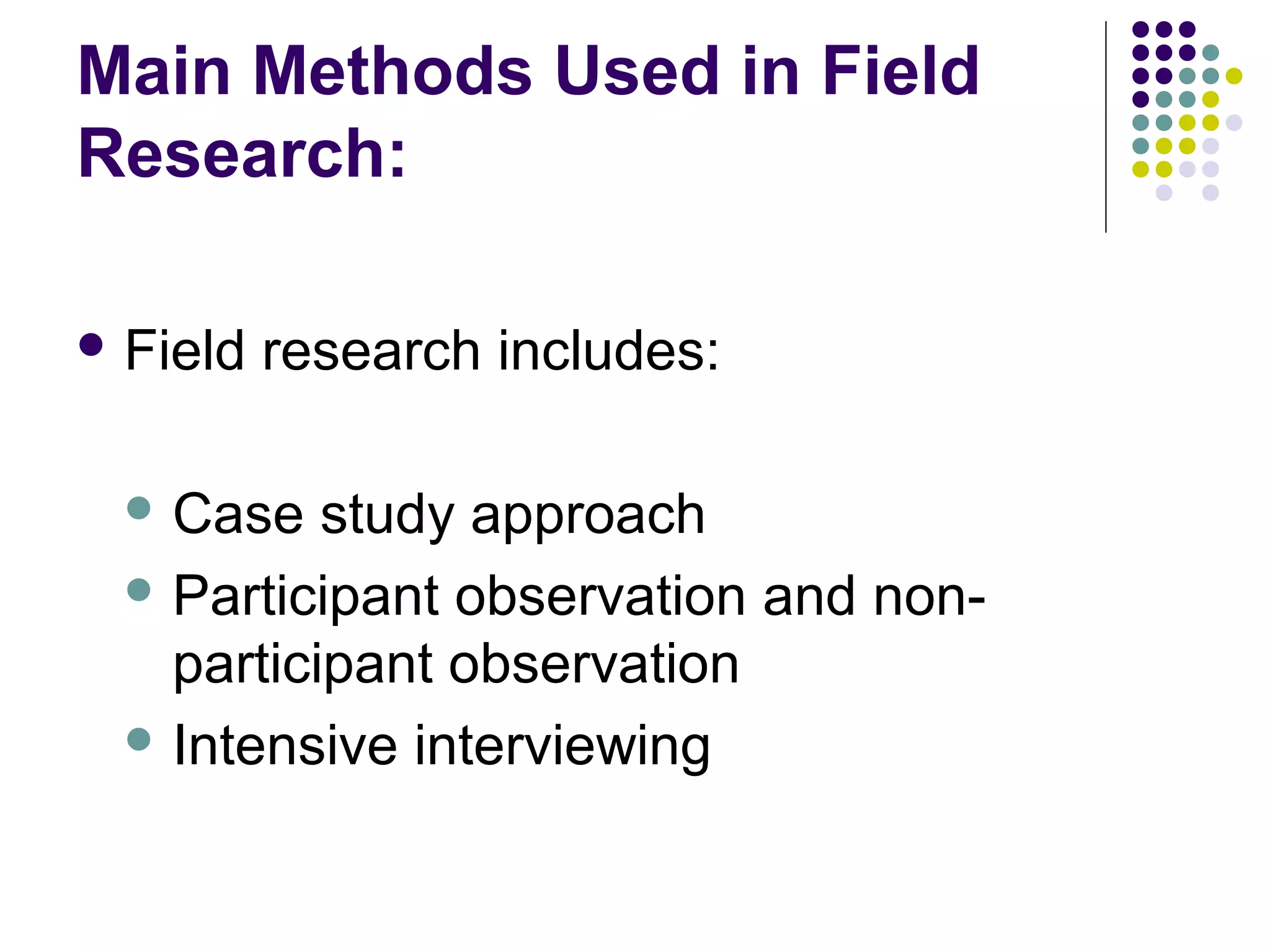
Main Methods Used in Field
Research:
 Field research includes:
 Case study approach
 Participant observation and non-
participant observation
 Intensive interviewing
The Case Study Approach
 To try to develop an understanding of a social
process by studying one case or a small
number of cases in depth
 Can be done using a combination of
intensive interviewing and observation
 Snapshot case studies
 Longitudinal case studies
 Pre-post case studies
 Patchwork case studies
 Comparative case studies.
Observation in Field Research
 Preparing for the field:
 1. Background preparation and literature review
 2. Talking to informants
 3. Gaining entry into the group
 Gatekeepers
 Public vs. private settings
The Various Roles of the Observer
(Raymond Gold’s levels)
 A. Complete participant
 B. Participant-as-observer
 C. Observer-as-participant
 D. Complete observer
Recording observations
 Field journal
 To record empirical data
 To record interpretations
 Guidelines for note taking
 Don't trust your memory
 Take notes in stages
 Record everything
Organizing and Writing Notes
 Rewrite your notes as soon as possible after making
observations
 type or enter into a word-processing program
 Creating files helps organize field notes for analysis.
 a. Chronological file as a master file.
 b. Background files (from literature review, and
documentation of topic's history.)
 c. Biographical files on key subjects in the study.
 d. Bibliographical files of all references related to study.
 e. Analytical files to categorize what you are observing.
 f. Cross-reference files may be useful to retrieve data.
Using computers in field
research
 some software programs are now available for
field research notes and analysis of data
 Can save time, especially when analyzing data
 See free demos of NVivo and XSight at:
http://www.qsrinternational.com/products_free-trial-so
Data analysis in field work
 Data analysis in field work is an ongoing
process
 Constant interaction between data collection
and data analysis.
 Look for:
 Similarities, norms, and universals
 Dissimilarities, differences, and deviations from
norms
 Selective perception can be a problem as
you learn more about the topic
Asking Questions: The Field
Research Interview
 Types of qualitative interviews:
 Structured
 Semistructured
 Depth
 Field research most often uses unstructured
interviews
 The use of probes is important in field
research
Conducting interviews
 Try to be interactive and sensitive to the language
and concepts used by the interviewee
 Try to keep the agenda flexible
 Aim to go below the surface of the topic being
discussed
 Explore what people say in detail
 Check you have understood respondents' meanings
 Try to discover the interviewee's own framework of
meanings
 Avoid imposing own structures and assumptions
 Need to consider how perceived by interviewees and
the effects of characteristics such as class, race, sex,
and social distance on the interview
Repertoire Techniques
Copyright © Allyn & Bacon 2010
Matching and mirroring
Indicates rapport
Uncomfortable silence
Create a long silent pause after a question
Echoing
“that happened to me too, “ or “I know what
you mean”
Letting people talk
Avoid unintentional interruptions
Types of questions for
qualitative interviews
 Behaviour or experience
 Opinion or belief
 Feelings
 Knowledge
 Sensory
 Background or demographic
Questions to avoid:
 Affectively worded ones: avoid inducing negative
emotional response. Make questions as neutral as
possible.
 Avoid asking “why?” directly.
 Double-barrelled questions: only 1 issue, topic per
question.
 Overly complex questions. Try to speak at same
level, be clear, know the cultural background of the
person to ensure you don’t offend
 Do some prior study of the group, be culturally
sensitive and respectful of traditions and culture
Recording interviews
 Notes written at the time
 Notes written afterwards
 Audio or videotaping
Researcher as research instrument
 Qualitative interviews require considerable
skill on the part of the interviewer.
 The interviewer needs to notice how
directive he or she is being
 Whether leading questions are being asked
whether cues are picked up or ignored
 Whether interviewees are given enough time
to explain what they mean
Maintaining control of the
interview
 Know what it is you want to find out
 Ask the right questions to get the information
you need
 Give appropriate verbal and non-verbal
feedback
 Good feedback vs. bad feedback
 Avoiding bias
Whyte’s Directiveness Scale
 1. Making encouraging noises
 2. Reflecting on remarks made by the informant
 3. Probing on the last remark by the informant
 4. Probing an idea preceding the last remark by the
informant
 5. Probing an idea expressed earlier in the interview
 6. Introducing a new topic
(1=least directive, 6=most directive)
Focus Group
Copyright © Allyn & Bacon 2010
Group interview or discussion
Facilitated by a skilled moderator
Manageable size
Good for triangulation
The Moderator’s Role
Copyright © Allyn & Bacon 2010
Uses moderator’s guide
Draws out information
Monitors informal group discussion
Encourages free speaking
Uses “aware listening”
The Moderator’s Guide
Copyright © Allyn & Bacon 2010
Systematic and procedural guide
Introduction and introductory activities
Basic rules or guidelines
Question-and-answer
Special activities or exercises
Sensitive issues
Bracketing Your Biases
 First, make a list of your characteristics:
 1. your gender;
 2. your age;
 3. your ethnic or national identification;
 4. your religion or philosophy of life;
 5. your political party or orientation;
 6. your favourite psychological theory.
 Add four more characteristics: words or
phrases that are descriptive of you as an
individual.
Bracketing (cont.)
 1. List ways in which your characteristics
might bias you in your efforts at research
interviewing.
 2. Then write how you might counteract
these biases.
 3. And then write how these efforts to
counteract your biases might themselves
lead to other biases!
Advantages of field research
 Can study nonverbal behaviour
 93% of communication non-verbal
 Words 7%, voice quality 38%, mannerisms 55%
 Flexibility
 Natural environment
 Longitudinal analysis
 Relatively inexpensive
Disadvantages of field research
 Not applicable to the investigation of large
social settings
 Making generalizations can be problematic
 Biases, attitudes, and assumptions of the
researcher can be problem
 Selective perception and memory
 Selectivity in data collection
 Presence of the researcher may change the
system or group being studied
 Virtually impossible to replicate the findings
Validity and Reliability
 Validity very high
 Can document complexity of human behaviour
 Detailed descriptions
 Reliability low
 Subjective
 Difficult to replicate
 Low external validity (generalizability)

Field research

  • 1.
  • 2.
    Introduction to qualitative methodology Data in words rather than numbers  Non-positivistic orientation  Includes:  Field research  Qualitative interviewing  Historical comparative analysis
  • 3.
    Three General Approachesto Research APPROACH POSITIVISM CRITICAL INTERPRETIVE USUAL TYPE experiment, historical- field research, OF RESEARCH survey, comparative interview cont. anal. PERSPECTIVE technocratic transcendent transcendent TYPE OF LOGIC reconstructed logic-in-practice logic-in-practice PATH linear non-linear non-linear /cyclical /cyclical
  • 4.
    Characteristics of Qualitative Research Context is critical  In depth, detailed  Researcher immerses self in data (non- objective)  Researcher integrity  Bias recognized  Use of grounded theory  Can detect process and sequence  Data are interpreted rather than analyzed
  • 5.
    Elite Studies  Specialtype of field research  Elites difficult to study, especially with quantitative methods  Preferred method is field study  But special problems  Gatekeepers  Need for connections/contacts  Danger of manipulation  Difficulty of establishing trust
  • 6.
    Field research  Maintypes of Field Research are:  Ethnography  Ethnomethodology  Phenomenological Study  Purposes of field research:  Data collection  Theory construction
  • 7.
    Ethnography  A wayof building an understanding the culture and behaviours of a group as a whole.  Done in a setting or field site where a group of people share a common culture.  In sociology, ethnography usually called a field study  Uses:  Participant Observation  Interviews with Informants  Examination of documents and cultural artifacts
  • 8.
    Ethnography Video Getting Peopleto Talk: An Ethnograph (Copyright © 2008 Gabriel Biller & Kristy Scovel)
  • 9.
    Ethnomethodology  The studyof commonsense knowledge  How do individuals make sense of social situations and act on their knowledge?  What are the tacit rules used by members of a culture?  Detailed studies of interactions  Breaching experiments (Garfinkel)  To uncover hidden norms
  • 10.
    Phenomenological Study  Understandingan experience from a research participant's point of view  Interview several participants as to their perceptions of an experience  Try to build a picture of the experience through using a combination of theories, literature in the area, illustrated by anecdotes, to build a detailed portrait of the experience  Use of Max Weber’s “verstehen”
  • 11.
    Topics For FieldResearch  Topics that defy simple quantification.  Topics where attitudes and behaviours are best understood within their natural setting.  Social processes that take place over time.  The study of meanings, practices, episodes, encounters, roles, relationships, groups, organizations, and settlements.
  • 12.
    Sampling in fieldresearch  Types of nonprobability sampling methods commonly used:  Quota sampling  Snowball sampling  Deviant cases  Purposive sampling or judgmental sampling
  • 13.
    Main Methods Usedin Field Research:  Field research includes:  Case study approach  Participant observation and non- participant observation  Intensive interviewing
  • 14.
    The Case StudyApproach  To try to develop an understanding of a social process by studying one case or a small number of cases in depth  Can be done using a combination of intensive interviewing and observation  Snapshot case studies  Longitudinal case studies  Pre-post case studies  Patchwork case studies  Comparative case studies.
  • 15.
    Observation in FieldResearch  Preparing for the field:  1. Background preparation and literature review  2. Talking to informants  3. Gaining entry into the group  Gatekeepers  Public vs. private settings
  • 16.
    The Various Rolesof the Observer (Raymond Gold’s levels)  A. Complete participant  B. Participant-as-observer  C. Observer-as-participant  D. Complete observer
  • 17.
    Recording observations  Fieldjournal  To record empirical data  To record interpretations  Guidelines for note taking  Don't trust your memory  Take notes in stages  Record everything
  • 18.
    Organizing and WritingNotes  Rewrite your notes as soon as possible after making observations  type or enter into a word-processing program  Creating files helps organize field notes for analysis.  a. Chronological file as a master file.  b. Background files (from literature review, and documentation of topic's history.)  c. Biographical files on key subjects in the study.  d. Bibliographical files of all references related to study.  e. Analytical files to categorize what you are observing.  f. Cross-reference files may be useful to retrieve data.
  • 19.
    Using computers infield research  some software programs are now available for field research notes and analysis of data  Can save time, especially when analyzing data  See free demos of NVivo and XSight at: http://www.qsrinternational.com/products_free-trial-so
  • 20.
    Data analysis infield work  Data analysis in field work is an ongoing process  Constant interaction between data collection and data analysis.  Look for:  Similarities, norms, and universals  Dissimilarities, differences, and deviations from norms  Selective perception can be a problem as you learn more about the topic
  • 21.
    Asking Questions: TheField Research Interview  Types of qualitative interviews:  Structured  Semistructured  Depth  Field research most often uses unstructured interviews  The use of probes is important in field research
  • 22.
    Conducting interviews  Tryto be interactive and sensitive to the language and concepts used by the interviewee  Try to keep the agenda flexible  Aim to go below the surface of the topic being discussed  Explore what people say in detail  Check you have understood respondents' meanings  Try to discover the interviewee's own framework of meanings  Avoid imposing own structures and assumptions  Need to consider how perceived by interviewees and the effects of characteristics such as class, race, sex, and social distance on the interview
  • 23.
    Repertoire Techniques Copyright ©Allyn & Bacon 2010 Matching and mirroring Indicates rapport Uncomfortable silence Create a long silent pause after a question Echoing “that happened to me too, “ or “I know what you mean” Letting people talk Avoid unintentional interruptions
  • 24.
    Types of questionsfor qualitative interviews  Behaviour or experience  Opinion or belief  Feelings  Knowledge  Sensory  Background or demographic
  • 25.
    Questions to avoid: Affectively worded ones: avoid inducing negative emotional response. Make questions as neutral as possible.  Avoid asking “why?” directly.  Double-barrelled questions: only 1 issue, topic per question.  Overly complex questions. Try to speak at same level, be clear, know the cultural background of the person to ensure you don’t offend  Do some prior study of the group, be culturally sensitive and respectful of traditions and culture
  • 26.
    Recording interviews  Noteswritten at the time  Notes written afterwards  Audio or videotaping
  • 27.
    Researcher as researchinstrument  Qualitative interviews require considerable skill on the part of the interviewer.  The interviewer needs to notice how directive he or she is being  Whether leading questions are being asked whether cues are picked up or ignored  Whether interviewees are given enough time to explain what they mean
  • 28.
    Maintaining control ofthe interview  Know what it is you want to find out  Ask the right questions to get the information you need  Give appropriate verbal and non-verbal feedback  Good feedback vs. bad feedback  Avoiding bias
  • 29.
    Whyte’s Directiveness Scale 1. Making encouraging noises  2. Reflecting on remarks made by the informant  3. Probing on the last remark by the informant  4. Probing an idea preceding the last remark by the informant  5. Probing an idea expressed earlier in the interview  6. Introducing a new topic (1=least directive, 6=most directive)
  • 30.
    Focus Group Copyright ©Allyn & Bacon 2010 Group interview or discussion Facilitated by a skilled moderator Manageable size Good for triangulation
  • 31.
    The Moderator’s Role Copyright© Allyn & Bacon 2010 Uses moderator’s guide Draws out information Monitors informal group discussion Encourages free speaking Uses “aware listening”
  • 32.
    The Moderator’s Guide Copyright© Allyn & Bacon 2010 Systematic and procedural guide Introduction and introductory activities Basic rules or guidelines Question-and-answer Special activities or exercises Sensitive issues
  • 33.
    Bracketing Your Biases First, make a list of your characteristics:  1. your gender;  2. your age;  3. your ethnic or national identification;  4. your religion or philosophy of life;  5. your political party or orientation;  6. your favourite psychological theory.  Add four more characteristics: words or phrases that are descriptive of you as an individual.
  • 34.
    Bracketing (cont.)  1.List ways in which your characteristics might bias you in your efforts at research interviewing.  2. Then write how you might counteract these biases.  3. And then write how these efforts to counteract your biases might themselves lead to other biases!
  • 35.
    Advantages of fieldresearch  Can study nonverbal behaviour  93% of communication non-verbal  Words 7%, voice quality 38%, mannerisms 55%  Flexibility  Natural environment  Longitudinal analysis  Relatively inexpensive
  • 36.
    Disadvantages of fieldresearch  Not applicable to the investigation of large social settings  Making generalizations can be problematic  Biases, attitudes, and assumptions of the researcher can be problem  Selective perception and memory  Selectivity in data collection  Presence of the researcher may change the system or group being studied  Virtually impossible to replicate the findings
  • 37.
    Validity and Reliability Validity very high  Can document complexity of human behaviour  Detailed descriptions  Reliability low  Subjective  Difficult to replicate  Low external validity (generalizability)