Research Design:
Ethnography
Lecturer: Yee Bee Choo
IPGKTHO
Topic 1e
What is Ethnography
• It is built upon the social science specialism known as
‘anthropology’.
• Ethnographic designs are qualitative research
procedures for describing, analysing, and interpreting a
culture-sharing group’s shared patterns of behavior,
beliefs, and language that develop over time.
• A culture is “everything having to do with human
behavior and belief” (LeCompte, Preissle, & Tesch, 1993,
p. 5).
• It can include language, rituals, economic and political
structures, life stages, interactions, and communication
styles.
(Creswell, 2012).
What is Ethnography
• To understand the patterns of a culture sharing
group, the ethnographer typically spends
considerable time “in the field” interviewing,
observing, and gathering documents about the
group to understand their culture-sharing
behaviours, beliefs, and language. (Creswell,
2012).
• The aim of the ethnographic researcher is to
learn from [rather than study] members of a
cultural group.
What is Ethnography
• It studies people, ethnic groups and other ethnic
formations, their ethno genesis, composition,
resettlement, social welfare characteristics, as
well as their material and spiritual culture.
• The purpose of ethnographic research is to
attempt to understand what is happening
naturally in the setting and to interpret the data
gathered to see what implications could be
formed from the data.
When do Use Ethnography
• You conduct an ethnography when the study of a group provides
understanding of a larger issue.
• You also conduct an ethnography when you have a culture-sharing
group to study—one that has been together for some time and has
developed shared values, beliefs, and language.
• The culture-sharing group may be:
• narrowly framed (e.g., teachers, students, or staff members)

• broadly framed (e.g., entire schools and their success, innovation,
or violence).
• a family (e.g. a 12-year-old child with Down syndrome and his
family)
• group may be representative or illustrative of some larger
processes, events, or activities (e.g., participating in a graduate
program).
• group with shared-practice (e.g. the culture of one fraternity and
its practices that rendered women powerless and marginalised).
When do Use Ethnography
• You conduct an ethnography when you have long-term
access to a culture-sharing group so that you can build a
detailed record of their behaviours and beliefs over time.
• You may be a participant in the group or simply an
observer, but you gather extensive fieldnotes, interview
many people, and collect letters and documents to
establish the record of the culture-sharing group.
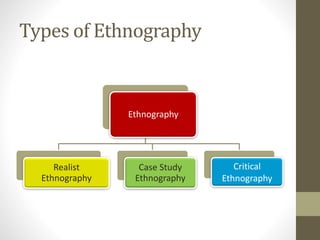
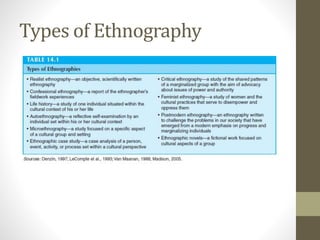
Types of Ethnography
Ethnography
Realist
Ethnography
Case Study
Ethnography
Critical
Ethnography
Types of Ethnography
Realist Ethnography
• A realist ethnography is an objective account of the
situation, typically written in the third-person point of
view, reporting objectively on the information learned
from participants at a field site.
• The focus is on understanding a culture-sharing group
and using the group to develop a deeper understanding
of a cultural theme.
• The realist ethnographer narrates the study and reports
on observations of participants and their views.
• The ethnographer does not offer personal reflections in
the research report and remains in the background as an
omniscient reporter of the “facts.”
Types of Ethnography
Realist Ethnography
• The researcher reports objective data in a measured style
uncontaminated by personal bias, political goals, and
judgment.
• The researcher may provide mundane details of everyday life
among the people studied.
• The ethnographer also uses standard categories for cultural
description (e.g., family life, work life, social networks, and
status systems).
• The ethnographer produces the participants’ views through
closely edited quotations and has the final word on the
interpretation and presentation of the culture (Van Maanen,
1988).
Types of Ethnography
Case Study Ethnography
• A case study is an important type of ethnography,
although it differs from an ethnography in several
important ways.
• The focus is on developing an in-depth understanding of
a case, such as an event, activity, or process.
• Case study researchers may focus on a program, event,
or activity involving individuals rather than a group per
se ( Stake, 1995 ).
• Also, when case study writers research a group, they may
be more interested in describing the activities of the
group instead of identifying shared patterns of behaviour
exhibited by the group.
Types of Ethnography
Case Study Ethnography
• The ethnographer searches for the shared
patterns that develop as a group interacts over
time.
• Finally, case study researchers are less likely to
identify a cultural theme to examine at the
beginning of a study, especially one from
anthropology; instead, they focus on an in-depth
exploration of the actual “case” ( Yin, 2008 ).
Types of Ethnography
Critical Ethnography
• Critical ethnographies are a type of ethnographic
research in which the author is interested in
advocating for the emancipation of groups
marginalised in our society (Thomas, 1993).
• Critical researchers seek to address an inequity in
society or schools, plans to use the research to
advocate and call for changes, and typically
identifies a specific issue (e.g., inequality,
dominance, oppression, or empowerment) to study.
Types of Ethnography
Critical Ethnography
• For example, critical ethnographers might study schools
that provide privileges to certain types of students,
create inequitable situations among members of
different social classes, and perpetuate boys “speaking
up” and girls being silent participants in class.
• The major components of a critical ethnography are
factors such as a value-laden orientation, empowering
people by giving them more authority, challenging the
status quo, and a concern about power and control
(Madison, 2005 ).
Types of Ethnography
Characteristics of Ethnography
1. Cultural themes
2. A culture-sharing group
3. Shared patterns of behavior, belief, and
language
4. Fieldwork
5. Description, themes, and interpretation
6. Context or setting
7. Researcher reflexivity
Characteristics of Ethnography
1. Cultural themes
• A cultural theme in ethnography is a general position,
declared or implied, that is openly approved or
promoted in a society or group. For example,
• Persistence in distance education courses (Garland,
1993)
• The “coming out” stages of gay identity development
(Rhoads, 1997)
• Development of students’ social skills in Japan
(LeTendre, 1999)
• Enculturation in an early childhood programme among
the Maori in New Zealand (Bauermeister, 1998)
Characteristics of Ethnography
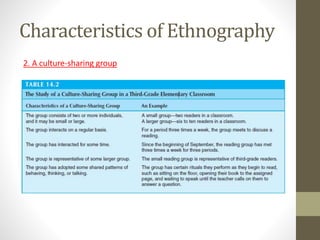
2. A culture-sharing group
• A culture-sharing group in ethnography is two or more
individuals who have shared behaviors, beliefs, and
language. For example,
• 47 students in a distance education course in resource
management and environmental subjects (Garland,
1993)
• 16 elementary education student teachers (Goodman
& Adler, 1985)
• 40 college students in an organization who had identifi
ed themselves as either gay or bisexual (Rhoads, 1997)
Characteristics of Ethnography
2. A culture-sharing group
• Gatekeepers - these are the people who can
allow the researcher access to the group and to
the members of the group.
• Key informants - these are the people on whom
the researcher relies for direction and assistance
in terms of acceptance by individual members.
Characteristics of Ethnography
2. A culture-sharing group
Characteristics of Ethnography
3. Shared patterns of behavior, belief, and
language
• A shared pattern in ethnography is a common social
interaction that stabilises as tacit rules and expectations
of the group (Spindler & Spindler, 1992).
• The group shares any one or a combination of behaviors,
beliefs, and language.
Characteristics of Ethnography
3. Shared patterns of behavior, belief, and language
• A behavior in an ethnography is an action taken by an
individual in a cultural setting. For example, Wolcott (1974,
1994) studied how a principal’s selection committee acted as
they deliberated about selecting a candidate.
• A belief in an ethnography is how an individual thinks about or
perceives things in a cultural setting. For example, Padula and
Miller (1999) found that women doctoral students in
psychology shared the concern that they were not able to
invest much energy in their families.
• Language in an ethnography is how an individual talks to
others in a cultural setting. In a study of life-history narratives
of two African American women, Nelson (1990) analysed
code-switching (changing from Standard English to Black
English vernacular).
Characteristics of Ethnography
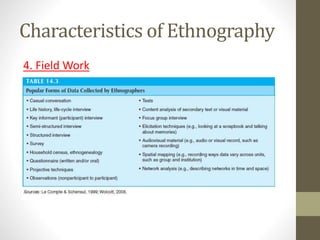
4. Field Work
• To understand best the patterns of a cultural group,
an ethnographer spends considerable time with the
group.
• The ethnographer goes “to the field,” lives with or
frequently visits the people being studied, and
slowly learns the cultural ways in which the group
behaves or thinks.
• Fieldwork in ethnography means that the researcher
gathers data in the setting where the participants
are located and where their shared patterns can be
studied.
Characteristics of Ethnography
4. Field Work
Data Collection involves:
• Emic data is information supplied by participants in a study. Emic
often refers to first-order concepts, such as local language and ways
of expression used by members in a cultural-sharing group
(Schwandt, 2007).
• Etic data is information representing the ethnographer’s
interpretation of the participants’ perspectives. Etic typically refers
to second-order concepts, such as the language used by the social
scientist or educator to refer to the same phenomena mentioned by
the participants (Schwandt, 2007).
• Negotiation data consist of information that the participant and the
researcher agree to use in a study. Negotiation occurs at different
stages in research, such as agreeing to entry procedures for a
research site, mutually respecting individuals at the site, and
developing a plan for giving back or reciprocating with the
individuals.
Characteristics of Ethnography
4. Field Work
Characteristics of Ethnography
5. Description, themes, and interpretation
• A description in ethnography is a detailed rendering of
individuals and scenes to depict what is going on in the
culture-sharing group.
• This description needs to be detailed and thick, and it
needs to identify specifics.
• It serves to place the reader figuratively in the setting, to
transport the reader to the actual scene, to make it real.
• This involves awakening the reader’s senses through
adjectives, nouns, and verbs that elicit sounds, sights,
feelings, and smells.
Characteristics of Ethnography
5. Description, themes, and interpretation
• Thematic data analysis in ethnography consists of
distilling how things work and naming the essential
features in themes in the cultural setting.
• Consistent with the process about describing and
developing themes from data, the ethnographer
segments the text (or images), codes them, and
formulates a small set of non-overlapping themes.
• In an ethnography, however, these themes map the
shared patterns of behavior, thinking, or talking.
Characteristics of Ethnography
5. Description, themes, and interpretation
• In interpretation in ethnography, the ethnographer draws
inferences and forms conclusions about what was learned.
• This phase of analysis is the most subjective. The researcher
relates both the description and the themes back to a larger
portrait of what was learned, which often reflects some
combination of the researcher making a personal assessment,
returning to the literature on the cultural theme, and raising
further questions based on the data.
• It might also include addressing problems that arose during
the fieldwork that render the account tentative and
hypothetical, at best.
Characteristics of Ethnography
6. Context or Setting
• The context for an ethnography is the setting, situation, or
environment that surrounds the cultural group being studied.
• It is multilayered and interrelated, consisting of such factors as
history, religion, politics, economy, and the environment (
Fetterman, 2010 ).
• This context may be:
• physical location,
• historical context of individuals in the group, whether they have
experienced suppression or domination
• social condition of the individuals like their longtime reunions to
build kinship
• economic conditions (income levels, working-class or blue-collar
background)
Characteristics of Ethnography
7. Researcher Reflexivity
• Reflexivity in ethnography refers to the researcher being
aware of and openly discussing his or her role in the
study in a way that honors and respects the site and
participants.
• Because ethnographic research involves a prolonged stay
at a site, researchers are concerned about their impact
on the site and the people.
• They negotiate entry with key individuals and plan to
leave the site as undisturbed as they found it.
Advantages of Ethnography
• Direct observation
• Internal Validity (Because the researcher is directly
involved with members of the group and experiencing
what they are experiencing (i.e. all data collected is first
hand evidence), then validity is much more assured, than
relying upon external observation or other's experiences
and reports)
• Detailed data (Because of the length of time spent with
the participants, also the close proximity and
observations as well as shared experiences)
• Holistic (The researcher, by being a participant over a
prolonged period of time, is able to see many facets of
the group/culture, rather than just one or two parts of it,
and therefore have a much more holistic view of the
culture/group.)
Disadvantages of Ethnography
• Time-consuming
• Difficult in presenting the results
• Reliability (The researcher often works alone)
• Invasion of privacy
• Personal safety of the researcher in peril
• Requires sustainable effort and engagement
Steps in Conducting Ethnography
1. Identify intent and the type of design, and
relate intent to your research problem (realist,
case study, or critical ethnography?)
2. Discuss approval and access considerations
3. Use appropriate data collection procedures
4. Analyse and interpret data within a design
5. Write the report consistent with your design
A Good Ethnography
• Pay attention to identifying a cultural issue to
study
• Select a group to observe or interview over time
• Note shared patterns of behaviour, language,
and beliefs that the group has developed over
time
• The account needs to both describe the group
and identify themes.
• Provide evidence of being reflexive about the
researcher’s role in the study.
Let’s do an Ethnography
Topic
• A story of Secondary School Inclusion
Background of Study
• There must be a better way of educating children with disabilities
than a separate special education system with its separate classes
and separate schools.
Statement of Problem
• Although the momentum for inclusion of children with severe
disabilities at the primary school level was strengthened by research
and clinical experience, there was little evidence to guide inclusion
efforts for students with severe disabilities at the secondary school
level.
• The process of including students with severe disabilities in general
education secondary school classes has not been sufficiently studied
so as to establish guidelines for practitioners
Let’s do an Ethnography
Purpose of Study
• To examine the individual roles of the education professionals and
parents during the first two years of secondary school inclusion for a
student with severe disabilities in a secondary school.
Research Objective
• To examine the beliefs, attitudes, and experiences of the educational
professionals and parents in one case of secondary school inclusion
Research Question
1. How do those key individuals, parents and professionals (e.g.,
school administrators, special education staff, general education
teachers, AEA special education consultants) involved in the
process of the inclusion of a student with severe disabilities in
general education secondary school classes define inclusion?
2. How do they characterise their attitudes toward it?
3. What role did each of them play in preparing for the student’s
inclusion?
Let’s do an Ethnography
Scope of Study
• The study took place at this secondary school because Inclusion of a
student with severe disabilities was taking place there for the first
time.
• The student was 15-16 years old at the time of this study. He has
severe disabilities which include partial paralysis, a visual
impairment, and a moderate cognitive impairment caused by a
traumatic brain injury.
• For this study a total of 17 people were interviewed at least once
over a two year period.
• The individuals interviewed included two administrators (the
principal and assistant principal), three special education staff
(resource room teacher and two paraeducators), eight general
education teachers, two Area Education Agency (AEA) special
education consultants, and the adoptive mother and father of the
student with severe disabilities.
Let’s do an Ethnography
Limitations of Study
• This study gave representative of parents who were willing to
participate and did not include those solicited for participation
but who did not not respond. Those parents may reflect a
different point-of-view.
• This study was limited in that it examined the reported
perceptions and experiences of educators who included
students with severe disabilities in their classrooms.
• Corroborating data, such as classroom observations and
specific student data were not collected as part of this
research.
• The findings from this study are limited to the one school
district in a specific region of the country, it cannot be
generalised to a greater population, thus no external validity.
Let’s do an Ethnography
Significance of Study
• It raises awareness among the people of the importance
of school inclusion in educational system.
• It raises awareness among school administrators, special
education staff, general education teachers, Area
Education Agency (AEA) special education consultants,
and parents about how their goals and expectations—
training and experience—and ultimately successes that
affect the implementation of high school inclusion for
any given student.
Let’s do an Ethnography
Operational Definitions
1. Inclusion
• Schulz and Carpenter (1995) define inclusion as the
delivery of services to children with disabilities who are
assigned to an age-appropriate general education
classroom and general education teacher in their
neighborhood school.
• Special education is viewed as a support service for
children with disabilities and their teachers.
• Inclusion means include students with disabilities to
learn together with the normal students in the same
classroom using the same syllabus.
Let’s do an Ethnography
Operational Definitions
2. Severe Disabilities
• It refers to a range of characteristics. First, it means that the
individual has a moderate, severe, or profound intellectual disability
(i.e., I. Q. score of 55 or below and below average functioning in at
least two of the ten areas of adaptive behavior, e.g., daily living
skills, communication).
• Second, a severe disability is present throughout a person’s life.
• Third, the individual has support needs that are limited (i.e.,
consistent but time-limited), or extensive (ongoing and not time-
limited), or pervasive (i.e., provided at a high level throughout the
day) (Kennedy & Horn, 2004).
Source:
McKee, A.M. (2011). A story of high school inclusion: an ethnographic case study.
PhD (Doctor of Philosophy) thesis, University of Iowa. Retrieved from
http://ir.uiowa.edu/cgi/viewcontent.cgi?article=2631&context=etd
Tutorial 1e (Pair Work)
• Read the article from Creswell (2012) pages 485-500
• Based on the article, identify the following:
• Title
• Author
• Problem/Issue
• Suggestion(s) to overcome the problem/issue
• Research objectives/questions
• Research hypotheses
• Sample
• Research methodology
• Research instruments
• Findings/ Discussion of findings
• You can type or handwrite your answer.
• Write your answers in not more than two sentences.
Main Reference
• Creswell, J.W. (2012). Educational research:
planning, conducting and evaluating quantitative
and qualitative research. (4th Ed.). Boston, MA:
Pearson Education Inc.
Source for Ethnography Sample:
• McKee, A.M. (2011). A story of high school
inclusion: an ethnographic case study. PhD
(Doctor of Philosophy) thesis, University of Iowa.
Retrieved from
http://ir.uiowa.edu/cgi/viewcontent.cgi?article=
2631&context=etd

TSLB3143 Topic 1e Ethnography Research

  • 1.
  • 2.
    What is Ethnography •It is built upon the social science specialism known as ‘anthropology’. • Ethnographic designs are qualitative research procedures for describing, analysing, and interpreting a culture-sharing group’s shared patterns of behavior, beliefs, and language that develop over time. • A culture is “everything having to do with human behavior and belief” (LeCompte, Preissle, & Tesch, 1993, p. 5). • It can include language, rituals, economic and political structures, life stages, interactions, and communication styles. (Creswell, 2012).
  • 3.
    What is Ethnography •To understand the patterns of a culture sharing group, the ethnographer typically spends considerable time “in the field” interviewing, observing, and gathering documents about the group to understand their culture-sharing behaviours, beliefs, and language. (Creswell, 2012). • The aim of the ethnographic researcher is to learn from [rather than study] members of a cultural group.
  • 4.
    What is Ethnography •It studies people, ethnic groups and other ethnic formations, their ethno genesis, composition, resettlement, social welfare characteristics, as well as their material and spiritual culture. • The purpose of ethnographic research is to attempt to understand what is happening naturally in the setting and to interpret the data gathered to see what implications could be formed from the data.
  • 5.
    When do UseEthnography • You conduct an ethnography when the study of a group provides understanding of a larger issue. • You also conduct an ethnography when you have a culture-sharing group to study—one that has been together for some time and has developed shared values, beliefs, and language. • The culture-sharing group may be: • narrowly framed (e.g., teachers, students, or staff members) • broadly framed (e.g., entire schools and their success, innovation, or violence). • a family (e.g. a 12-year-old child with Down syndrome and his family) • group may be representative or illustrative of some larger processes, events, or activities (e.g., participating in a graduate program). • group with shared-practice (e.g. the culture of one fraternity and its practices that rendered women powerless and marginalised).
  • 6.
    When do UseEthnography • You conduct an ethnography when you have long-term access to a culture-sharing group so that you can build a detailed record of their behaviours and beliefs over time. • You may be a participant in the group or simply an observer, but you gather extensive fieldnotes, interview many people, and collect letters and documents to establish the record of the culture-sharing group.
  • 7.
    Types of Ethnography Ethnography Realist Ethnography CaseStudy Ethnography Critical Ethnography
  • 8.
    Types of Ethnography RealistEthnography • A realist ethnography is an objective account of the situation, typically written in the third-person point of view, reporting objectively on the information learned from participants at a field site. • The focus is on understanding a culture-sharing group and using the group to develop a deeper understanding of a cultural theme. • The realist ethnographer narrates the study and reports on observations of participants and their views. • The ethnographer does not offer personal reflections in the research report and remains in the background as an omniscient reporter of the “facts.”
  • 9.
    Types of Ethnography RealistEthnography • The researcher reports objective data in a measured style uncontaminated by personal bias, political goals, and judgment. • The researcher may provide mundane details of everyday life among the people studied. • The ethnographer also uses standard categories for cultural description (e.g., family life, work life, social networks, and status systems). • The ethnographer produces the participants’ views through closely edited quotations and has the final word on the interpretation and presentation of the culture (Van Maanen, 1988).
  • 10.
    Types of Ethnography CaseStudy Ethnography • A case study is an important type of ethnography, although it differs from an ethnography in several important ways. • The focus is on developing an in-depth understanding of a case, such as an event, activity, or process. • Case study researchers may focus on a program, event, or activity involving individuals rather than a group per se ( Stake, 1995 ). • Also, when case study writers research a group, they may be more interested in describing the activities of the group instead of identifying shared patterns of behaviour exhibited by the group.
  • 11.
    Types of Ethnography CaseStudy Ethnography • The ethnographer searches for the shared patterns that develop as a group interacts over time. • Finally, case study researchers are less likely to identify a cultural theme to examine at the beginning of a study, especially one from anthropology; instead, they focus on an in-depth exploration of the actual “case” ( Yin, 2008 ).
  • 12.
    Types of Ethnography CriticalEthnography • Critical ethnographies are a type of ethnographic research in which the author is interested in advocating for the emancipation of groups marginalised in our society (Thomas, 1993). • Critical researchers seek to address an inequity in society or schools, plans to use the research to advocate and call for changes, and typically identifies a specific issue (e.g., inequality, dominance, oppression, or empowerment) to study.
  • 13.
    Types of Ethnography CriticalEthnography • For example, critical ethnographers might study schools that provide privileges to certain types of students, create inequitable situations among members of different social classes, and perpetuate boys “speaking up” and girls being silent participants in class. • The major components of a critical ethnography are factors such as a value-laden orientation, empowering people by giving them more authority, challenging the status quo, and a concern about power and control (Madison, 2005 ).
  • 14.
  • 15.
    Characteristics of Ethnography 1.Cultural themes 2. A culture-sharing group 3. Shared patterns of behavior, belief, and language 4. Fieldwork 5. Description, themes, and interpretation 6. Context or setting 7. Researcher reflexivity
  • 16.
    Characteristics of Ethnography 1.Cultural themes • A cultural theme in ethnography is a general position, declared or implied, that is openly approved or promoted in a society or group. For example, • Persistence in distance education courses (Garland, 1993) • The “coming out” stages of gay identity development (Rhoads, 1997) • Development of students’ social skills in Japan (LeTendre, 1999) • Enculturation in an early childhood programme among the Maori in New Zealand (Bauermeister, 1998)
  • 17.
    Characteristics of Ethnography 2.A culture-sharing group • A culture-sharing group in ethnography is two or more individuals who have shared behaviors, beliefs, and language. For example, • 47 students in a distance education course in resource management and environmental subjects (Garland, 1993) • 16 elementary education student teachers (Goodman & Adler, 1985) • 40 college students in an organization who had identifi ed themselves as either gay or bisexual (Rhoads, 1997)
  • 18.
    Characteristics of Ethnography 2.A culture-sharing group • Gatekeepers - these are the people who can allow the researcher access to the group and to the members of the group. • Key informants - these are the people on whom the researcher relies for direction and assistance in terms of acceptance by individual members.
  • 19.
    Characteristics of Ethnography 2.A culture-sharing group
  • 20.
    Characteristics of Ethnography 3.Shared patterns of behavior, belief, and language • A shared pattern in ethnography is a common social interaction that stabilises as tacit rules and expectations of the group (Spindler & Spindler, 1992). • The group shares any one or a combination of behaviors, beliefs, and language.
  • 21.
    Characteristics of Ethnography 3.Shared patterns of behavior, belief, and language • A behavior in an ethnography is an action taken by an individual in a cultural setting. For example, Wolcott (1974, 1994) studied how a principal’s selection committee acted as they deliberated about selecting a candidate. • A belief in an ethnography is how an individual thinks about or perceives things in a cultural setting. For example, Padula and Miller (1999) found that women doctoral students in psychology shared the concern that they were not able to invest much energy in their families. • Language in an ethnography is how an individual talks to others in a cultural setting. In a study of life-history narratives of two African American women, Nelson (1990) analysed code-switching (changing from Standard English to Black English vernacular).
  • 22.
    Characteristics of Ethnography 4.Field Work • To understand best the patterns of a cultural group, an ethnographer spends considerable time with the group. • The ethnographer goes “to the field,” lives with or frequently visits the people being studied, and slowly learns the cultural ways in which the group behaves or thinks. • Fieldwork in ethnography means that the researcher gathers data in the setting where the participants are located and where their shared patterns can be studied.
  • 23.
    Characteristics of Ethnography 4.Field Work Data Collection involves: • Emic data is information supplied by participants in a study. Emic often refers to first-order concepts, such as local language and ways of expression used by members in a cultural-sharing group (Schwandt, 2007). • Etic data is information representing the ethnographer’s interpretation of the participants’ perspectives. Etic typically refers to second-order concepts, such as the language used by the social scientist or educator to refer to the same phenomena mentioned by the participants (Schwandt, 2007). • Negotiation data consist of information that the participant and the researcher agree to use in a study. Negotiation occurs at different stages in research, such as agreeing to entry procedures for a research site, mutually respecting individuals at the site, and developing a plan for giving back or reciprocating with the individuals.
  • 24.
  • 25.
    Characteristics of Ethnography 5.Description, themes, and interpretation • A description in ethnography is a detailed rendering of individuals and scenes to depict what is going on in the culture-sharing group. • This description needs to be detailed and thick, and it needs to identify specifics. • It serves to place the reader figuratively in the setting, to transport the reader to the actual scene, to make it real. • This involves awakening the reader’s senses through adjectives, nouns, and verbs that elicit sounds, sights, feelings, and smells.
  • 26.
    Characteristics of Ethnography 5.Description, themes, and interpretation • Thematic data analysis in ethnography consists of distilling how things work and naming the essential features in themes in the cultural setting. • Consistent with the process about describing and developing themes from data, the ethnographer segments the text (or images), codes them, and formulates a small set of non-overlapping themes. • In an ethnography, however, these themes map the shared patterns of behavior, thinking, or talking.
  • 27.
    Characteristics of Ethnography 5.Description, themes, and interpretation • In interpretation in ethnography, the ethnographer draws inferences and forms conclusions about what was learned. • This phase of analysis is the most subjective. The researcher relates both the description and the themes back to a larger portrait of what was learned, which often reflects some combination of the researcher making a personal assessment, returning to the literature on the cultural theme, and raising further questions based on the data. • It might also include addressing problems that arose during the fieldwork that render the account tentative and hypothetical, at best.
  • 28.
    Characteristics of Ethnography 6.Context or Setting • The context for an ethnography is the setting, situation, or environment that surrounds the cultural group being studied. • It is multilayered and interrelated, consisting of such factors as history, religion, politics, economy, and the environment ( Fetterman, 2010 ). • This context may be: • physical location, • historical context of individuals in the group, whether they have experienced suppression or domination • social condition of the individuals like their longtime reunions to build kinship • economic conditions (income levels, working-class or blue-collar background)
  • 29.
    Characteristics of Ethnography 7.Researcher Reflexivity • Reflexivity in ethnography refers to the researcher being aware of and openly discussing his or her role in the study in a way that honors and respects the site and participants. • Because ethnographic research involves a prolonged stay at a site, researchers are concerned about their impact on the site and the people. • They negotiate entry with key individuals and plan to leave the site as undisturbed as they found it.
  • 30.
    Advantages of Ethnography •Direct observation • Internal Validity (Because the researcher is directly involved with members of the group and experiencing what they are experiencing (i.e. all data collected is first hand evidence), then validity is much more assured, than relying upon external observation or other's experiences and reports) • Detailed data (Because of the length of time spent with the participants, also the close proximity and observations as well as shared experiences) • Holistic (The researcher, by being a participant over a prolonged period of time, is able to see many facets of the group/culture, rather than just one or two parts of it, and therefore have a much more holistic view of the culture/group.)
  • 31.
    Disadvantages of Ethnography •Time-consuming • Difficult in presenting the results • Reliability (The researcher often works alone) • Invasion of privacy • Personal safety of the researcher in peril • Requires sustainable effort and engagement
  • 32.
    Steps in ConductingEthnography 1. Identify intent and the type of design, and relate intent to your research problem (realist, case study, or critical ethnography?) 2. Discuss approval and access considerations 3. Use appropriate data collection procedures 4. Analyse and interpret data within a design 5. Write the report consistent with your design
  • 33.
    A Good Ethnography •Pay attention to identifying a cultural issue to study • Select a group to observe or interview over time • Note shared patterns of behaviour, language, and beliefs that the group has developed over time • The account needs to both describe the group and identify themes. • Provide evidence of being reflexive about the researcher’s role in the study.
  • 34.
    Let’s do anEthnography Topic • A story of Secondary School Inclusion Background of Study • There must be a better way of educating children with disabilities than a separate special education system with its separate classes and separate schools. Statement of Problem • Although the momentum for inclusion of children with severe disabilities at the primary school level was strengthened by research and clinical experience, there was little evidence to guide inclusion efforts for students with severe disabilities at the secondary school level. • The process of including students with severe disabilities in general education secondary school classes has not been sufficiently studied so as to establish guidelines for practitioners
  • 35.
    Let’s do anEthnography Purpose of Study • To examine the individual roles of the education professionals and parents during the first two years of secondary school inclusion for a student with severe disabilities in a secondary school. Research Objective • To examine the beliefs, attitudes, and experiences of the educational professionals and parents in one case of secondary school inclusion Research Question 1. How do those key individuals, parents and professionals (e.g., school administrators, special education staff, general education teachers, AEA special education consultants) involved in the process of the inclusion of a student with severe disabilities in general education secondary school classes define inclusion? 2. How do they characterise their attitudes toward it? 3. What role did each of them play in preparing for the student’s inclusion?
  • 36.
    Let’s do anEthnography Scope of Study • The study took place at this secondary school because Inclusion of a student with severe disabilities was taking place there for the first time. • The student was 15-16 years old at the time of this study. He has severe disabilities which include partial paralysis, a visual impairment, and a moderate cognitive impairment caused by a traumatic brain injury. • For this study a total of 17 people were interviewed at least once over a two year period. • The individuals interviewed included two administrators (the principal and assistant principal), three special education staff (resource room teacher and two paraeducators), eight general education teachers, two Area Education Agency (AEA) special education consultants, and the adoptive mother and father of the student with severe disabilities.
  • 37.
    Let’s do anEthnography Limitations of Study • This study gave representative of parents who were willing to participate and did not include those solicited for participation but who did not not respond. Those parents may reflect a different point-of-view. • This study was limited in that it examined the reported perceptions and experiences of educators who included students with severe disabilities in their classrooms. • Corroborating data, such as classroom observations and specific student data were not collected as part of this research. • The findings from this study are limited to the one school district in a specific region of the country, it cannot be generalised to a greater population, thus no external validity.
  • 38.
    Let’s do anEthnography Significance of Study • It raises awareness among the people of the importance of school inclusion in educational system. • It raises awareness among school administrators, special education staff, general education teachers, Area Education Agency (AEA) special education consultants, and parents about how their goals and expectations— training and experience—and ultimately successes that affect the implementation of high school inclusion for any given student.
  • 39.
    Let’s do anEthnography Operational Definitions 1. Inclusion • Schulz and Carpenter (1995) define inclusion as the delivery of services to children with disabilities who are assigned to an age-appropriate general education classroom and general education teacher in their neighborhood school. • Special education is viewed as a support service for children with disabilities and their teachers. • Inclusion means include students with disabilities to learn together with the normal students in the same classroom using the same syllabus.
  • 40.
    Let’s do anEthnography Operational Definitions 2. Severe Disabilities • It refers to a range of characteristics. First, it means that the individual has a moderate, severe, or profound intellectual disability (i.e., I. Q. score of 55 or below and below average functioning in at least two of the ten areas of adaptive behavior, e.g., daily living skills, communication). • Second, a severe disability is present throughout a person’s life. • Third, the individual has support needs that are limited (i.e., consistent but time-limited), or extensive (ongoing and not time- limited), or pervasive (i.e., provided at a high level throughout the day) (Kennedy & Horn, 2004). Source: McKee, A.M. (2011). A story of high school inclusion: an ethnographic case study. PhD (Doctor of Philosophy) thesis, University of Iowa. Retrieved from http://ir.uiowa.edu/cgi/viewcontent.cgi?article=2631&context=etd
  • 41.
    Tutorial 1e (PairWork) • Read the article from Creswell (2012) pages 485-500 • Based on the article, identify the following: • Title • Author • Problem/Issue • Suggestion(s) to overcome the problem/issue • Research objectives/questions • Research hypotheses • Sample • Research methodology • Research instruments • Findings/ Discussion of findings • You can type or handwrite your answer. • Write your answers in not more than two sentences.
  • 42.
    Main Reference • Creswell,J.W. (2012). Educational research: planning, conducting and evaluating quantitative and qualitative research. (4th Ed.). Boston, MA: Pearson Education Inc. Source for Ethnography Sample: • McKee, A.M. (2011). A story of high school inclusion: an ethnographic case study. PhD (Doctor of Philosophy) thesis, University of Iowa. Retrieved from http://ir.uiowa.edu/cgi/viewcontent.cgi?article= 2631&context=etd

Editor's Notes

  • #31 http://www.health.herts.ac.uk/immunology/Qualitative%20research/ethnography.htm http://www.health.herts.ac.uk/immunology/Qualitative%20research/advantages.htm
  • #35 http://ir.uiowa.edu/cgi/viewcontent.cgi?article=2631&context=etd