Brief solution Focus Therapy
(BSFT)
By: Muhammad Musawar Ali
MPHIL, ICAP
Psychmmusawarali@gmail.com1
Brief Counseling Approaches
 Brief in regard to treatment.
 Important in an age where people and institutions are demanding quick and
effective mental health service.
2
Skills Employed in brief Approaches
 Promote Health services.
 Do more in Less time.
 Manage care setting.
3
Brief Counseling Approaches are
Characterized by
 Foci (center of interest)
 Time limited Emphasis.
 Most of Brief counseling are not systematic in nature.
4
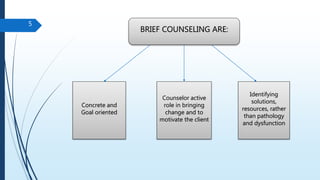
BRIEF COUNSELING ARE:
Concrete and
Goal oriented
Counselor active
role in bringing
change and to
motivate the client
Identifying
solutions,
resources, rather
than pathology
and dysfunction
5
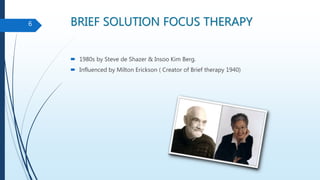
BRIEF SOLUTION FOCUS THERAPY
 1980s by Steve de Shazer & Insoo Kim Berg.
 Influenced by Milton Erickson ( Creator of Brief therapy 1940)
6
View Of Human Nature
 Focus on client Strength and health. (Fernando, 2007).
 Its roots are linked with Erickson idea that “ People have within themselves the
resources & abilities to solve their own problems even if they don’t have casual
understanding of them”.
 Erickson also believed that a small change in ones behavior is often all that is
necessary to lead to more profound changes in a problem context.(Lawson, 1994,
p, 244).
7
ERICKSON HERITAGE
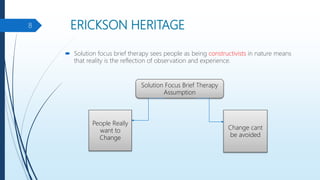
 Solution focus brief therapy sees people as being constructivists in nature means
that reality is the reflection of observation and experience.
8
Solution Focus Brief Therapy
Assumption
People Really
want to
Change
Change cant
be avoided
Role of Counselor
 Counselor Role is to determine how active and committed a client is to the process
of change.
 Counselor also act as facilitator of change to help clients access the resources and
strength they have but they are not aware of or are not utilizing it.
 They encourage challenge and setup expectations for change.
 They do not blame or ask why. They are not particular interested in how a problem
arose.
 Rather they are concerned with the client to arrive at a solution to the problem.
 They allow the client to be expert of his/her life.
9
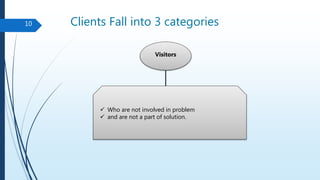
Clients Fall into 3 categories10
Visitors
 Who are not involved in problem
 and are not a part of solution.
11
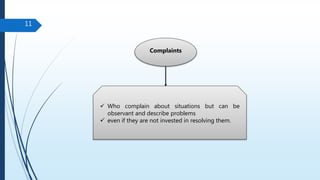
Complaints
 Who complain about situations but can be
observant and describe problems
 even if they are not invested in resolving them.
12
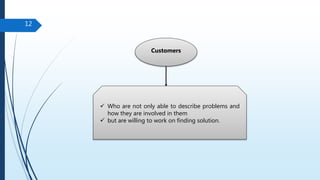
Customers
 Who are not only able to describe problems and
how they are involved in them
 but are willing to work on finding solution.
Goals
 To help the client tap inner resources and to notice exceptions to the time when
they are distressed.
 The goal is then directed toward the solution to situations that already exists in
these expectations.
 Focus on sessions and homework is on positive and possibilities either now or
future.
13
Ask questions about. . .
 Client's story
 Client's strengths
 Client's resources
 Client's exceptions
 Relationships
 Self-esteem issues
14
How Brief a Therapy?
 Aim for 5 sessions
 45 mins each session
 Rarely beyond 8 sessions
 Sometimes 1 session enough
 Any improvements after 3 sessions?
 Increase gap between sessions as time goes on
15
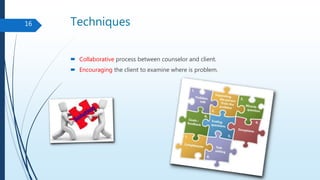
Techniques
 Collaborative process between counselor and client.
 Encouraging the client to examine where is problem.
16
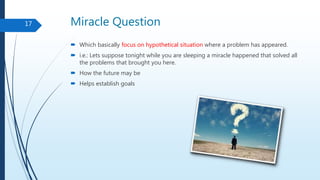
Miracle Question
 Which basically focus on hypothetical situation where a problem has appeared.
 i.e.: Lets suppose tonight while you are sleeping a miracle happened that solved all
the problems that brought you here.
 How the future may be
 Helps establish goals
17
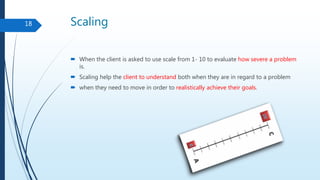
Scaling
 When the client is asked to use scale from 1- 10 to evaluate how severe a problem
is.
 Scaling help the client to understand both when they are in regard to a problem
 when they need to move in order to realistically achieve their goals.
18
Complements
 Written messages designed to praise clients for their strength and build a yes set
within them.
 Beliefs that can resolve difficulties.
 Compliments are usually given right before clients are given tasks or assignments.
19
Internal Resources
 Help clients attend to their resources, skills and abilities
 Empowers client in identifying their own strengths
 Skills
 Strengths
 Qualities
 Beliefs
 Capacity
20
External Resources
 Supportive relationships
 Friends
 Partners
 Faith
 Workplace
 Unions
 Social services
21
Two Final techniques
 Clues: which are intended to alert the client to the idea that some behaviors they
are doing are likely to continuous and they should not worry about them.
 Skeleton keys: which are procedures that have universal application in regard to
unlocking a variety of problems.
22
Self-change Model
 Pre-contemplation:
 The client does not recognize that they have a difficulty and will blame others:
“it’s your problem not mine.”
 People may be in this stage because they lack awareness or they may have tried
to change a number of times and become demoralized about their ability to
change.
 Both groups tend to avoid reading, talking or thinking about their problems. They
may characterized as resistant or unmotivated or as not ready for any
intervention.
23
Self-change Model
 Contemplation:
 The client starts to recognize that they have a problem and is the stage in which
people are intending to change in the near future.
 They are more aware of the pros of changing but are also acutely aware of the
cons.
 This balance between the costs and benefits of changing can produce profound
ambivalence that can keep people stuck in this stage for long periods of time.
24
Self-change Model
 Preparation:
 The stage in which people are intending to take action soon.
 They may have made that initial phone call to therapist and have turned up for
the first session.
 These individuals have a plan of action, such as consulting a counsellor, talking to
their doctor, buying a self-help book or relying on a self-change approach.
25
Self-change Model
 Action:
 Clients have committed to a course of action and have taken steps to change
their behavior, modifying thoughts and feelings. They may now have a sense of
timescale, how long the change process may last.
 Maintenance:
 Clients are working at keeping the changes going; it is important not to allow
relapse to take place.
 Relapse:
 Possible and may be of different degrees of severity. Ideally people can move
back into the action phase as soon as possible.
26
Strengths
 Emphasis on empowerment of client.
 Approach displays flexibility and excellent research in support of its effectiveness.
 Positive nature to working with variety of clients in various settings including
school children.
 Focus on change and small changes in behavior.
 Can be combined with other approaches such as extentialism.
27
Limitations
 No attention to clients history.
 Has lack of focus on insight.
 Approach uses teams at least by some practitioners to make the cost of treatment
high.
28
Role Play ……………..
 MR A
 Smoker
 Failure in exam of ACCA
 Session 5th
29
References
 Berg, I. K. (1991) Family Preservation: A Brief Therapy Workbook. London: BT Press.
 Berg, I.K. & Miller, S. (1992) Working with the Problem Drinker: A Solution Focused
Approach. New York: Norton.
 de Shazer, S. (1985) Keys to Solution in Brief Therapy. New York: Norton.
 George, E., Iveson, C. & Ratner, H. (1999) Problem to Solution: Brief Therapy with
Individuals and Families. London: BT Press.
 Hawkes, D., Marsh, T. & Wilgosh, R. (1998) Solution-Focused Therapy: A Handbook for
Health Care Professionals. Oxford: Butterworth–Heinemann.
 Hoyt, M. F. (1984) Single session solutions. In Constructive Therapies (ed. M. F. Hoyt).
New York: Guilford.
30
Thanks for Patience………. 
31

Brief solution focus therapy

  • 1.
    Brief solution FocusTherapy (BSFT) By: Muhammad Musawar Ali MPHIL, ICAP Psychmmusawarali@gmail.com1
  • 2.
    Brief Counseling Approaches Brief in regard to treatment.  Important in an age where people and institutions are demanding quick and effective mental health service. 2
  • 3.
    Skills Employed inbrief Approaches  Promote Health services.  Do more in Less time.  Manage care setting. 3
  • 4.
    Brief Counseling Approachesare Characterized by  Foci (center of interest)  Time limited Emphasis.  Most of Brief counseling are not systematic in nature. 4
  • 5.
    BRIEF COUNSELING ARE: Concreteand Goal oriented Counselor active role in bringing change and to motivate the client Identifying solutions, resources, rather than pathology and dysfunction 5
  • 6.
    BRIEF SOLUTION FOCUSTHERAPY  1980s by Steve de Shazer & Insoo Kim Berg.  Influenced by Milton Erickson ( Creator of Brief therapy 1940) 6
  • 7.
    View Of HumanNature  Focus on client Strength and health. (Fernando, 2007).  Its roots are linked with Erickson idea that “ People have within themselves the resources & abilities to solve their own problems even if they don’t have casual understanding of them”.  Erickson also believed that a small change in ones behavior is often all that is necessary to lead to more profound changes in a problem context.(Lawson, 1994, p, 244). 7
  • 8.
    ERICKSON HERITAGE  Solutionfocus brief therapy sees people as being constructivists in nature means that reality is the reflection of observation and experience. 8 Solution Focus Brief Therapy Assumption People Really want to Change Change cant be avoided
  • 9.
    Role of Counselor Counselor Role is to determine how active and committed a client is to the process of change.  Counselor also act as facilitator of change to help clients access the resources and strength they have but they are not aware of or are not utilizing it.  They encourage challenge and setup expectations for change.  They do not blame or ask why. They are not particular interested in how a problem arose.  Rather they are concerned with the client to arrive at a solution to the problem.  They allow the client to be expert of his/her life. 9
  • 10.
    Clients Fall into3 categories10 Visitors  Who are not involved in problem  and are not a part of solution.
  • 11.
    11 Complaints  Who complainabout situations but can be observant and describe problems  even if they are not invested in resolving them.
  • 12.
    12 Customers  Who arenot only able to describe problems and how they are involved in them  but are willing to work on finding solution.
  • 13.
    Goals  To helpthe client tap inner resources and to notice exceptions to the time when they are distressed.  The goal is then directed toward the solution to situations that already exists in these expectations.  Focus on sessions and homework is on positive and possibilities either now or future. 13
  • 14.
    Ask questions about.. .  Client's story  Client's strengths  Client's resources  Client's exceptions  Relationships  Self-esteem issues 14
  • 15.
    How Brief aTherapy?  Aim for 5 sessions  45 mins each session  Rarely beyond 8 sessions  Sometimes 1 session enough  Any improvements after 3 sessions?  Increase gap between sessions as time goes on 15
  • 16.
    Techniques  Collaborative processbetween counselor and client.  Encouraging the client to examine where is problem. 16
  • 17.
    Miracle Question  Whichbasically focus on hypothetical situation where a problem has appeared.  i.e.: Lets suppose tonight while you are sleeping a miracle happened that solved all the problems that brought you here.  How the future may be  Helps establish goals 17
  • 18.
    Scaling  When theclient is asked to use scale from 1- 10 to evaluate how severe a problem is.  Scaling help the client to understand both when they are in regard to a problem  when they need to move in order to realistically achieve their goals. 18
  • 19.
    Complements  Written messagesdesigned to praise clients for their strength and build a yes set within them.  Beliefs that can resolve difficulties.  Compliments are usually given right before clients are given tasks or assignments. 19
  • 20.
    Internal Resources  Helpclients attend to their resources, skills and abilities  Empowers client in identifying their own strengths  Skills  Strengths  Qualities  Beliefs  Capacity 20
  • 21.
    External Resources  Supportiverelationships  Friends  Partners  Faith  Workplace  Unions  Social services 21
  • 22.
    Two Final techniques Clues: which are intended to alert the client to the idea that some behaviors they are doing are likely to continuous and they should not worry about them.  Skeleton keys: which are procedures that have universal application in regard to unlocking a variety of problems. 22
  • 23.
    Self-change Model  Pre-contemplation: The client does not recognize that they have a difficulty and will blame others: “it’s your problem not mine.”  People may be in this stage because they lack awareness or they may have tried to change a number of times and become demoralized about their ability to change.  Both groups tend to avoid reading, talking or thinking about their problems. They may characterized as resistant or unmotivated or as not ready for any intervention. 23
  • 24.
    Self-change Model  Contemplation: The client starts to recognize that they have a problem and is the stage in which people are intending to change in the near future.  They are more aware of the pros of changing but are also acutely aware of the cons.  This balance between the costs and benefits of changing can produce profound ambivalence that can keep people stuck in this stage for long periods of time. 24
  • 25.
    Self-change Model  Preparation: The stage in which people are intending to take action soon.  They may have made that initial phone call to therapist and have turned up for the first session.  These individuals have a plan of action, such as consulting a counsellor, talking to their doctor, buying a self-help book or relying on a self-change approach. 25
  • 26.
    Self-change Model  Action: Clients have committed to a course of action and have taken steps to change their behavior, modifying thoughts and feelings. They may now have a sense of timescale, how long the change process may last.  Maintenance:  Clients are working at keeping the changes going; it is important not to allow relapse to take place.  Relapse:  Possible and may be of different degrees of severity. Ideally people can move back into the action phase as soon as possible. 26
  • 27.
    Strengths  Emphasis onempowerment of client.  Approach displays flexibility and excellent research in support of its effectiveness.  Positive nature to working with variety of clients in various settings including school children.  Focus on change and small changes in behavior.  Can be combined with other approaches such as extentialism. 27
  • 28.
    Limitations  No attentionto clients history.  Has lack of focus on insight.  Approach uses teams at least by some practitioners to make the cost of treatment high. 28
  • 29.
    Role Play …………….. MR A  Smoker  Failure in exam of ACCA  Session 5th 29
  • 30.
    References  Berg, I.K. (1991) Family Preservation: A Brief Therapy Workbook. London: BT Press.  Berg, I.K. & Miller, S. (1992) Working with the Problem Drinker: A Solution Focused Approach. New York: Norton.  de Shazer, S. (1985) Keys to Solution in Brief Therapy. New York: Norton.  George, E., Iveson, C. & Ratner, H. (1999) Problem to Solution: Brief Therapy with Individuals and Families. London: BT Press.  Hawkes, D., Marsh, T. & Wilgosh, R. (1998) Solution-Focused Therapy: A Handbook for Health Care Professionals. Oxford: Butterworth–Heinemann.  Hoyt, M. F. (1984) Single session solutions. In Constructive Therapies (ed. M. F. Hoyt). New York: Guilford. 30
  • 31.