Research Methodology
DATA COLLECTION IN
QUALITATIVE RESEARCH
Week: 6
Semester: 5 / Credits: 3
COURSE OVERVIEW
• Discuss the main techniques to collect qualitative
data
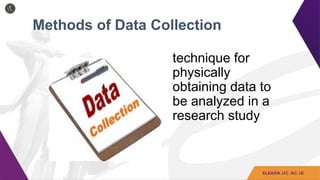
Methods of Data Collection
technique for
physically
obtaining data to
be analyzed in a
research study
Main Techniques to Collect
Qualitative Data
 Interview
 Observation
 Visual Data Collection
 Secondary Data Collection
INTERVIEW
A data-collection method in which an interviewer asks
an interviewee
 In-person interview – an interview conducted face
to face
 Telephone interview – an interview conducted over
the phone
TYPES OF INTERVIEW
 Closed, fixed-response interview
• Questions and response categories are determined in
advance. Responses are fixed; respondent chooses from
among these fixed responses
 Standardized Open-Ended Interview
• The exact wording and sequence of questions are
determined in advance. All interviewees are asked the
same basic questions in the same order. Questions are
worded in a completely open-ended format (Patton, 2008)
• also called the structured interview
TYPES OF INTERVIEW (cont.)
 Interview Guide Approach
• Topics and issues to be covered are specified in advance, in
outline form; interviewer decides sequence and wording of
questions in the course of the interview
• also called as the guided interview
 Informal Conversation Interview
• Questions emerge from the immediate context and are asked in
the natural course of things; there is no predetermination of
question topics or wording
• also called the in-depth interview; style of interviewing that did
not recommend a specific set of questions; allow respondents to
tell their own story in their own terms
IN-DEPTH INTERVIEW
A type of qualitative interview that is being described as a
conversation between the interviewer and participant in
which the interviewer hears what the participant has to say in
his own words, in his voice, with his language and narrative.
Types of Questions
1. Grand Tour Question – this type of question is very general and is a
good way to begin because it gets the participants talking to you
 Tell me about yourself.
 Tell me what being in school is like for you.
 What can you say about going to ABC National High School?
2. Specific or Concrete Example Question – this type of questions
gives the participant an opportunity to provide relevant information
because it is personal and immediate
 What was something that happened last week that you think
contributes to your stress?
 Tell me something that happened at this school that you think is a
direct result of the new Site-Based Management Plan
Types of Questions (cont.)
3. Comparison/Contrast Question – this type of question challenges
the participant to think about other times, situations, places, events,
or people and draw comparisons between them
 How could you compare what you are doing now to what you did in
the past?
4. New Elements/Topics Question – this type of questions are used
when shifting to a new topic especially if the participant is “stuck” on
a particular things and keeps repeating information
 We’ve talked for a while about discipline in the schools. Are there
other aspects of working in school you would like to discuss?
Types of Questions (cont.)
5. Closing Question – this type of question provides a
chance for the participant to add anything else that has
not been mentioned.
 Can you think of anything else you would like to say
about working in a school?
 Is there anything else you would like to add to what you
have already said?
Dos in Interviewing
1. Develop rapport
2. Use a recorder and have a note pad to jot down notes
3. Make eye contact
4. Ask open-ended questions
5. Provide an atmosphere for respondents to tell their own story in their own terms
6. Remain unobtrusive
7. Phrase questions in a general and non-directive manner.
8. Avoid leading questions
9. Use some questioning strategies, such as repeating the last word of the
response or lifting an eyebrow
10. Make sure you get specific and detailed information
11. Avoid jargon or situations that are too technical.
12. Make sure you have enough discussion about the key issues to use later for
data analysis
Don’ts in Interviewing
1. Don’t depend on your memory. Write it down.
2. Don’t answer questions for respondents.
3. Don’t ask 3 or 4 questions as the same time.
4. Don’t ask a question and then provide the answer (“I agree that
such and such is a good thing”)
5. Don’t stop the respondent in the middle of the conversation
6. Don’t allow the respondent to spend too much time on one topic
7. Don’t act nervous or uninterested
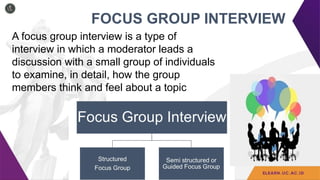
FOCUS GROUP INTERVIEW
A focus group interview is a type of
interview in which a moderator leads a
discussion with a small group of individuals
to examine, in detail, how the group
members think and feel about a topic
OBSERVATION
 Watching the behavioral patterns of people in
certain situations to obtain information about the
phenomenon of interest.
 Observational data are collected in two different
types of environments.
 Laboratory observation – carried out in settings
that are set up by the researcher and inside the
confines of a research lab.
 Naturalistic observation is carried out in the real
world
4 Main Roles That a Researcher Can Take
During Qualitative Observation
1. Complete participant – researcher becomes member of group
being studied and does not tell members they are being studied
2. Participant-as-observer – researcher spends extended time with
the group as an insider and tells members they are being studied
3. Observer-as-participant – researcher spends a limited amount of
time of observing group members and tells members they are
being studied
4. Complete observer – researcher observes an outsider and does
not tell people they are being observed
Visual Data Collection
Process of collecting data using visual
sources, such as photographs, drawings,
graphics, paintings, film, and video
Secondary Data Collection
Existing data originally collected or
left behind at an earlier time by a
different person for a different
purpose
Types of Secondary Data
1. Personal Documents - Anything written, photographed, or recorded for
private purposes (letters, diaries, correspondence, family videos, pictures)
2. Official Documents – anything written, photographed, or recorded by an
organization (newspapers, educational journals, magazines, school
curriculum guides, annual reports, minutes of school board meetings,
student records, student work, books, year books, published articles,
speeches, personnel files, news videos, program videos, advertisement
videos)
3. Physical Data – any material thing created or left by humans that might
provide information about a phenomenon of interest to a researcher
4. Archived Research Data – data originally used for research purposes and
then stored (census data)
Suggested Methods of Data
Collection
1. Phenomenology – in-depth interview
2. Ethnography – observation
3. Case study – eclectic (combination)
4. Grounded Theory – interview and observation
THANK YOU
&
You’ll Never Walk Alone

Data Collection for Qualitative Research

  • 1.
    Research Methodology DATA COLLECTIONIN QUALITATIVE RESEARCH Week: 6 Semester: 5 / Credits: 3
  • 2.
    COURSE OVERVIEW • Discussthe main techniques to collect qualitative data
  • 3.
    Methods of DataCollection technique for physically obtaining data to be analyzed in a research study
  • 4.
    Main Techniques toCollect Qualitative Data  Interview  Observation  Visual Data Collection  Secondary Data Collection
  • 5.
    INTERVIEW A data-collection methodin which an interviewer asks an interviewee  In-person interview – an interview conducted face to face  Telephone interview – an interview conducted over the phone
  • 6.
    TYPES OF INTERVIEW Closed, fixed-response interview • Questions and response categories are determined in advance. Responses are fixed; respondent chooses from among these fixed responses  Standardized Open-Ended Interview • The exact wording and sequence of questions are determined in advance. All interviewees are asked the same basic questions in the same order. Questions are worded in a completely open-ended format (Patton, 2008) • also called the structured interview
  • 7.
    TYPES OF INTERVIEW(cont.)  Interview Guide Approach • Topics and issues to be covered are specified in advance, in outline form; interviewer decides sequence and wording of questions in the course of the interview • also called as the guided interview  Informal Conversation Interview • Questions emerge from the immediate context and are asked in the natural course of things; there is no predetermination of question topics or wording • also called the in-depth interview; style of interviewing that did not recommend a specific set of questions; allow respondents to tell their own story in their own terms
  • 8.
    IN-DEPTH INTERVIEW A typeof qualitative interview that is being described as a conversation between the interviewer and participant in which the interviewer hears what the participant has to say in his own words, in his voice, with his language and narrative.
  • 9.
    Types of Questions 1.Grand Tour Question – this type of question is very general and is a good way to begin because it gets the participants talking to you  Tell me about yourself.  Tell me what being in school is like for you.  What can you say about going to ABC National High School? 2. Specific or Concrete Example Question – this type of questions gives the participant an opportunity to provide relevant information because it is personal and immediate  What was something that happened last week that you think contributes to your stress?  Tell me something that happened at this school that you think is a direct result of the new Site-Based Management Plan
  • 10.
    Types of Questions(cont.) 3. Comparison/Contrast Question – this type of question challenges the participant to think about other times, situations, places, events, or people and draw comparisons between them  How could you compare what you are doing now to what you did in the past? 4. New Elements/Topics Question – this type of questions are used when shifting to a new topic especially if the participant is “stuck” on a particular things and keeps repeating information  We’ve talked for a while about discipline in the schools. Are there other aspects of working in school you would like to discuss?
  • 11.
    Types of Questions(cont.) 5. Closing Question – this type of question provides a chance for the participant to add anything else that has not been mentioned.  Can you think of anything else you would like to say about working in a school?  Is there anything else you would like to add to what you have already said?
  • 12.
    Dos in Interviewing 1.Develop rapport 2. Use a recorder and have a note pad to jot down notes 3. Make eye contact 4. Ask open-ended questions 5. Provide an atmosphere for respondents to tell their own story in their own terms 6. Remain unobtrusive 7. Phrase questions in a general and non-directive manner. 8. Avoid leading questions 9. Use some questioning strategies, such as repeating the last word of the response or lifting an eyebrow 10. Make sure you get specific and detailed information 11. Avoid jargon or situations that are too technical. 12. Make sure you have enough discussion about the key issues to use later for data analysis
  • 13.
    Don’ts in Interviewing 1.Don’t depend on your memory. Write it down. 2. Don’t answer questions for respondents. 3. Don’t ask 3 or 4 questions as the same time. 4. Don’t ask a question and then provide the answer (“I agree that such and such is a good thing”) 5. Don’t stop the respondent in the middle of the conversation 6. Don’t allow the respondent to spend too much time on one topic 7. Don’t act nervous or uninterested
  • 14.
    FOCUS GROUP INTERVIEW Afocus group interview is a type of interview in which a moderator leads a discussion with a small group of individuals to examine, in detail, how the group members think and feel about a topic
  • 15.
    OBSERVATION  Watching thebehavioral patterns of people in certain situations to obtain information about the phenomenon of interest.  Observational data are collected in two different types of environments.  Laboratory observation – carried out in settings that are set up by the researcher and inside the confines of a research lab.  Naturalistic observation is carried out in the real world
  • 16.
    4 Main RolesThat a Researcher Can Take During Qualitative Observation 1. Complete participant – researcher becomes member of group being studied and does not tell members they are being studied 2. Participant-as-observer – researcher spends extended time with the group as an insider and tells members they are being studied 3. Observer-as-participant – researcher spends a limited amount of time of observing group members and tells members they are being studied 4. Complete observer – researcher observes an outsider and does not tell people they are being observed
  • 17.
    Visual Data Collection Processof collecting data using visual sources, such as photographs, drawings, graphics, paintings, film, and video
  • 18.
    Secondary Data Collection Existingdata originally collected or left behind at an earlier time by a different person for a different purpose
  • 19.
    Types of SecondaryData 1. Personal Documents - Anything written, photographed, or recorded for private purposes (letters, diaries, correspondence, family videos, pictures) 2. Official Documents – anything written, photographed, or recorded by an organization (newspapers, educational journals, magazines, school curriculum guides, annual reports, minutes of school board meetings, student records, student work, books, year books, published articles, speeches, personnel files, news videos, program videos, advertisement videos) 3. Physical Data – any material thing created or left by humans that might provide information about a phenomenon of interest to a researcher 4. Archived Research Data – data originally used for research purposes and then stored (census data)
  • 20.
    Suggested Methods ofData Collection 1. Phenomenology – in-depth interview 2. Ethnography – observation 3. Case study – eclectic (combination) 4. Grounded Theory – interview and observation
  • 21.