Mexico City • 14 June 2019
Using Qualitative Methods for Library and
Information Science Research:
An Interactive Workshop
Lynn Silipigni Connaway, PhD
Director of Library Trends and User Research, OCLC
connawal@oclc.org
@LynnConnaway
“Much of the library-related research has been applied research
dealing with everything from evaluating e-collections, to
assessment of reference services, to analyzing integrated library
systems.”
(Connaway & Radford, 2017)
Image: https://pixabay.com/photos/mexico-city-mexico-city-mexican-2706607/ by Xavier Espinosa / Pixabay License
Method: “Any
procedure employed to
attain a certain end”
(e.g., focus groups)
Methodology: “A study
of the plans which are
used to obtain
knowledge” (Runes, 2001, 346)
(Polkinghorne, 1983, 5)
Image: https://pixabay.com/photos/books-students-library-university-1281581/ by Pexels / Pixabay license
Image: https://www.flickr.com/photos/pjotr_savitski/2701378287 by Pjotr Savitski / CC BY 2.0
“To identify how and why people get
information, it is necessary first to
listen.”
(Connaway, 2017)
DEFINE THE PROBLEM
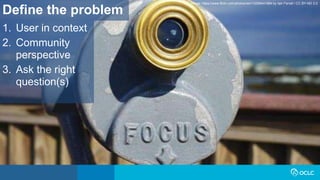
1. User in context
2. Community
perspective
3. Ask the right
question(s)
Define the problem
Image: https://www.flickr.com/photos/iain/13298441884 by Iain Farrell / CC BY-ND 2.0
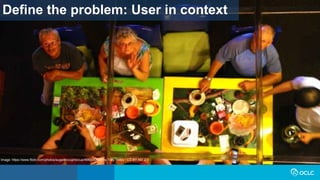
Define the problem: User in context
Image: https://www.flickr.com/photos/sugarhiccuphiccup/4843083598 by Troy Tolley / CC BY-ND 2.0
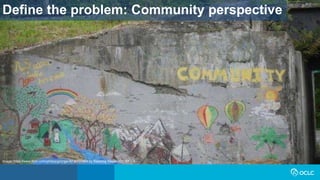
Define the problem: Community perspective
Image: https://www.flickr.com/photos/grongar/8736701984 by Rebecca Siegel / CC BY 2.0
Define the problem: Ask the right question(s)
Image: https://www.flickr.com/photos/mcleod/7150176087 by Scott McLeod / CC BY 2.0
Qualitative Research Definition
A type of scientific research that:
• Seeks answers to a question
• Systematically uses predefined set of
procedures to answer question
• Collects evidence
• Produces findings that:
• Are not determined in advance
• Apply beyond immediate boundaries of
study
Image: https://www.flickr.com/photos/katesheets/5772901616/ by katesheets / CC BY-NC 2.0
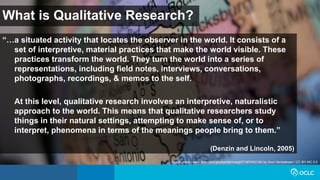
What is Qualitative Research?
“…a situated activity that locates the observer in the world. It consists of a
set of interpretive, material practices that make the world visible. These
practices transform the world. They turn the world into a series of
representations, including field notes, interviews, conversations,
photographs, recordings, & memos to the self.
At this level, qualitative research involves an interpretive, naturalistic
approach to the world. This means that qualitative researchers study
things in their natural settings, attempting to make sense of, or to
interpret, phenomena in terms of the meanings people bring to them.”
(Denzin and Lincoln, 2005)
Image: https://www.flickr.com/photos/ddrmaxgt37/387453140/ by Arun Venkatesan / CC BY-NC 2.0
QUALITATIVE RESEARCH
DATA COLLECTION METHODS
AND TOOLS
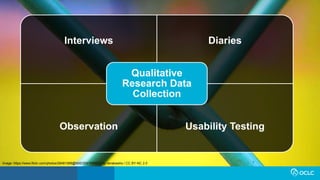
Interviews Diaries
Observation Usability Testing
Qualitative
Research Data
Collection
Image: https://www.flickr.com/photos/28481088@N00/3091698923/ by tanakawho / CC BY-NC 2.0
INTERVIEWS
Conversation involving two or more people
guided by a predetermined purpose.
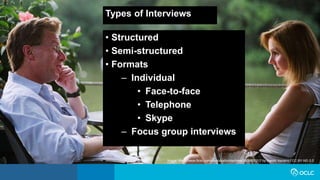
Types of Interviews
• Structured
• Semi-structured
• Formats
– Individual
• Face-to-face
• Telephone
• Skype
– Focus group interviews
Image: https://www.flickr.com/photos/allkindsofnew/9500650217 by Harold Navarro / CC BY-ND 2.0
Key components
• Good questions
• Good listening skills
• Good interpersonal skills
Image: https://www.flickr.com/photos/10332960@N03/13305699454 by John Blower / CC BY-NC-ND 2.0
Conducting the Interview
1. Thematizing: Clarifying the interview’s purpose
2. Designing: Defining the interview’s purpose
3. Interviewing: Conducting the interview
4. Transcribing: Creating a written verbatim text of the interview
5. Analyzing: Figuring out the meaning of data
6. Verifying: Determining the reliability & validity of the data
7. Reporting: Telling others about the findings
(Connaway and Radford 2017, 244)
Image: https://www.flickr.com/photos/meanestindian/903380690 by Meena Kadri / CC BY 2.0
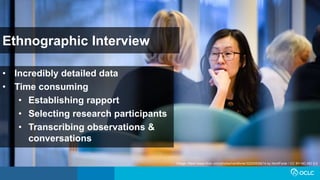
Ethnographic Interview
• Incredibly detailed data
• Time consuming
• Establishing rapport
• Selecting research participants
• Transcribing observations &
conversations
Image: https://www.flickr.com/photos/nordforsk/32225539214 by NordForsk / CC BY-NC-ND 2.0
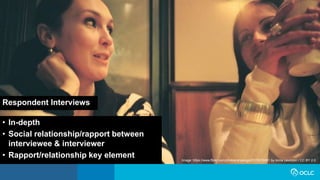
Respondent Interviews
• In-depth
• Social relationship/rapport between
interviewee & interviewer
• Rapport/relationship key element Image: https://www.flickr.com/photos/anyalogic/2315310261 by Anna Levinzon / CC BY 2.0
Example:
Digital Visitors & Residents Informant Questions
1. Describe the things you enjoy
doing with technology and the web
each week.
2. Think of the ways you have used
technology and the web for your
studies. Describe a typical week.
3. Think about the next stage of your
education. Tell me what you think
this will be like.
(White & Connaway, 2011)
Image: https://pixabay.com/photos/library-la-trobe-study-students-1400313/ by Andrew Tan / Pixabay License
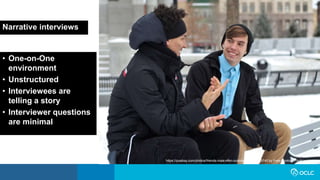
Narrative interviews
• One-on-One
environment
• Unstructured
• Interviewees are
telling a story
• Interviewer questions
are minimal
https://pixabay.com/photos/friends-male-men-outside-winter-1209740 by Free-Photos / Pixabay License
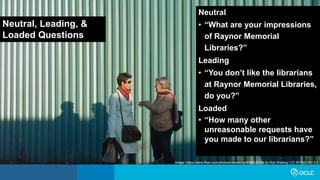
Neutral, Leading, &
Loaded Questions
Neutral
• “What are your impressions
of Raynor Memorial
Libraries?”
Leading
• “You don’t like the librarians
at Raynor Memorial Libraries,
do you?”
Loaded
• “How many other
unreasonable requests have
you made to our librarians?”
Image: https://www.flickr.com/photos/robwatling/5089229734 by Rob Watling / CC BY-NC-ND 2.0
ACTIVITY
Interviewing Exercise
Interviews: Advantages
• Face-2-face interaction
• In-depth information
• Understand experiences & meanings
• Highlight individual’s voice
• Preliminary information to
“triangulate”
• Control sampling
– Include underrepresented groups
• Greater range of topics
Image: https://www.flickr.com/photos/thomashawk/12012985364 by Thomas Hawk / CC BY-NC 2.0
Interviews: Disadvantages
• Time Factors
– Varies by # & depth
– Staff intensive
• Cost Factors
– Higher the #, higher the cost
• Additional Factors
– Self-reported data
– Errors in note taking possible
Image: https://www.flickr.com/photos/29668365@N08/2777606227 by Danae / CC BY 2.0
Sampling for the Interview
Key features of qualitative sampling
• Work with small samples of people
nested in their context
• Tend to be purposive rather than random
• Often theory-driven
Actions involving the sampling for interview
Setting boundaries
Creation of a sampling frame
(Miles & Huberman, 1994)
Image: https://www.flickr.com/photos/khouri/6793949601/ by Michael Cory CC BY-NC 2.0
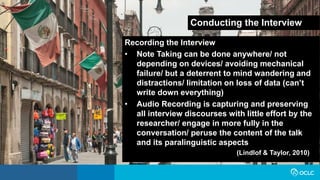
Conducting the Interview
Recording the Interview
• Note Taking can be done anywhere/ not
depending on devices/ avoiding mechanical
failure/ but a deterrent to mind wandering and
distractions/ limitation on loss of data (can’t
write down everything)
• Audio Recording is capturing and preserving
all interview discourses with little effort by the
researcher/ engage in more fully in the
conversation/ peruse the content of the talk
and its paralinguistic aspects
(Lindlof & Taylor, 2010)
Conducting the Interview
Listening
• Listening = the most crucial way to build rapport
after an interview has started
• Listening = paying attention
• Active listening
– as the conversation unfolds, you monitor your own
understandings in relation to the possible meanings of what
the person is saying
– suggest questions that are urgent enough to warrant
breaking into the subject’s talk
– not being a caretaker for the audio recorder
(Lindlof & Taylor, 2010)
Image: https://www.flickr.com/photos/108404544@N07/12941711194 by Chris Searle / CC BY-NC-ND 2.0
ACTIVITY
Listening Behaviors Exercise:
Self-Assessment
Conducting Interviews
• Obtain permission to use information
– Report and/or publication
• Create safe climate, assure confidentiality
• Be prepared, flexible, & stay on task
• Listen & know when to probe
• Accept that some interviews won’t go well
• Thank them!
Image: https://www.flickr.com/photos/62833283@N00/17217078330 by Seamus McCauley / CC BY 2.0
BREAK TIME!
FOCUS GROUP INTERVIEWS
“…interview of a group of 8 to 12
people representing some target group
and centered on a single topic.”
(Zweizig, Johnson, Robbins, & Besant, 1996)
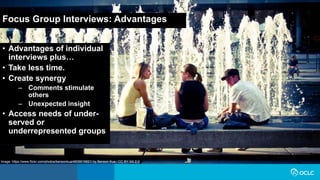
Focus Group Interviews: Advantages
• Advantages of individual
interviews plus…
• Take less time.
• Create synergy
– Comments stimulate
others
– Unexpected insight
• Access needs of under-
served or
underrepresented groups
Image: https://www.flickr.com/photos/bensonkua/4839019821/ by Benson Kua / CC BY-SA 2.0
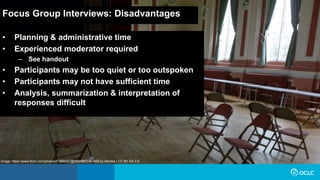
Focus Group Interviews: Disadvantages
• Planning & administrative time
• Experienced moderator required
‒ See handout
• Participants may be too quiet or too outspoken
• Participants may not have sufficient time
• Analysis, summarization & interpretation of
responses difficult
Image: https://www.flickr.com/photos/17989497@N00/8651401959 by Monika / CC BY-SA 2.0
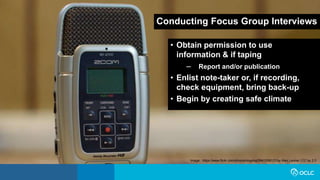
Conducting Focus Group Interviews
• Obtain permission to use
information & if taping
– Report and/or publication
• Enlist note-taker or, if recording,
check equipment, bring back-up
• Begin by creating safe climate
Image: https://www.flickr.com/photos/cogdog/5841058123 by Alan Levine / CC by 2.0
Conducting Focus Group Interviews
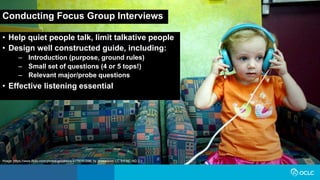
• Help quiet people talk, limit talkative people
• Design well constructed guide, including:
– Introduction (purpose, ground rules)
– Small set of questions (4 or 5 tops!)
– Relevant major/probe questions
• Effective listening essential
Image: https://www.flickr.com/photos/gozalewis/4776747298/ by timlewisnm CC BY-NC-ND 2.0
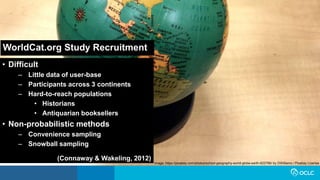
WorldCat.org Study Recruitment
• Difficult
– Little data of user-base
– Participants across 3 continents
– Hard-to-reach populations
• Historians
• Antiquarian booksellers
• Non-probabilistic methods
– Convenience sampling
– Snowball sampling
(Connaway & Wakeling, 2012)
Image: https://pixabay.com/photos/school-geography-world-globe-earth-622766/ by DWilliams / Pixabay License
Example:
WorldCat.org Focus Group Interview Questions
Tell us about your
experiences with
WorldCat.org
Broad introductory question to
reveal the extent to which users
have engaged with WorldCat.org,
and the information-seeking
contexts within which they use
the system.
PURPOSE
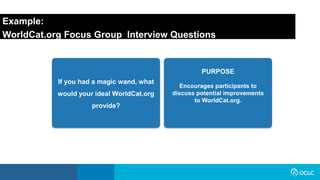
Example:
WorldCat.org Focus Group Interview Questions
If you had a magic wand, what
would your ideal WorldCat.org
provide?
Encourages participants to
discuss potential improvements
to WorldCat.org.
PURPOSE
Individual Interviews & Focus Group Interviews
Analysis
• Review notes/transcribe tapes
• Ways to analyze:
– Code data into pre-determined categories
– Use data to identify categories
– Use data for summary statements
“capture the essence”
• Compare all groups
• Compile & summarize
• Look for trends/patterns
• Don’t overgeneralize from results
Image: https://www.flickr.com/photos/arwilkinson/10830400356 by Andy Wilkinson / CC BY-SA 2.0
• Parts of Report
– List of issues
– Explain how data collected/analyzed
– Summary of findings: What was said on each issue?
– Sample quotes (anonymous)
– Interviewer’s impressions
– Recommendations:
• Short term (low hanging fruit)
• Long term
Individual Interviews & Focus Group Interviews
Reporting Results
Image: https://www.flickr.com/photos/jenosaur/4731463366 by jen Collins / CC BY-NC-ND 2.0
Individual Interviews & Focus Group Interviews
Limitations
• Difficult to generalize
• May not be representative
• Analyzes perceptions, not facts
• Subjective analysis (reliability)
• Raw data could be misleading
• Results can be limited by:
– Poor/inexperienced moderator/
interviewer
– Poorly constructed discussion
guide/interview questions
• Compensate by combining methods
Image: https://www.flickr.com/photos/furibond/3267102279 by jim / CC BY-SA 2.0
STRUCTURED OBSERVATIONS:
Systematic description focusing on
designated aspects of behavior to test
causal hypotheses.
(Connaway & Radford, 2017, 272)
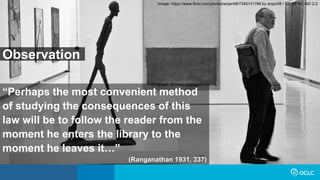
“Perhaps the most convenient method
of studying the consequences of this
law will be to follow the reader from the
moment he enters the library to the
moment he leaves it…”
(Ranganathan 1931, 337)
Image: https://www.flickr.com/photos/anjan58/7346141798 by anjan58 / CC BY-NC-ND 2.0
Observation
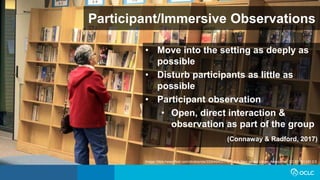
Participant/Immersive Observations
• Move into the setting as deeply as
possible
• Disturb participants as little as
possible
• Participant observation
• Open, direct interaction &
observation as part of the group
(Connaway & Radford, 2017)
Image: https://www.flickr.com/photos/njla/3306454031/ by NJLA: New Jersey Library Association CC BY-NC-ND 2.0
Unstructured vs. Structured Observations
• Unstructured observation
• No predetermined categories of behavior
• Flexible, exploratory
• Notes should be recorded as soon as possible
• Structured observation
• Predeveloped observational categories
• Rating scales and/or checklists
• Audio and/or video recording
(Connaway and Radford, 2017)
Image: https://www.flickr.com/photos/jafsegal/5438336871 by Juan Antonio Segal / CC BY 2.0
Unstructured Observations
• Obtrusive vs. Unobtrusive
• Active vs. Passive
• Improve accuracy by:
• Comparing data from two sources
• Avoiding interpretation
• Not taking behavior for granted
• Getting feedback from participants
(Connaway & Radford, 2017)
Image: https://www.flickr.com/photos/28481088@N00/14270095212 by tanakawho / CC BY 2.0
Structured Observations
• More formal, quantitative
• Develop observational categories
• Define appropriate, measurable actions
• Establish units of time or length of
observations
• Anticipate patterns
• Determine frame of reference
• Select a rating scale
• Create a checklist sheet if applicable
(Connaway & Radford, 2017)
Image: https://www.flickr.com/photos/fng_photo/32806522008 by fnugry / CC BY-NC 2.0
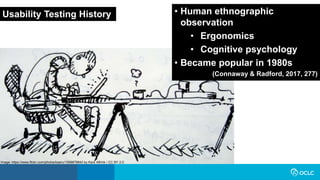
Usability Testing History • Human ethnographic
observation
• Ergonomics
• Cognitive psychology
• Became popular in 1980s
(Connaway & Radford, 2017, 277)
Image: https://www.flickr.com/photos/kaeru/1599676842 by Kars Alfrink / CC BY 2.0
Usability Testing
• Degree to which a user can successfully learn
& use a product to achieve a goal
• Evaluation research methodology
• Observation & analysis of user behavior while
users use a product or product prototype to
achieve a goal
(Dumas and Redish 1993, 22)
Image: https://www.flickr.com/photos/deanhochman/14481958642/ by Dean Hochman / CC BY 2.0
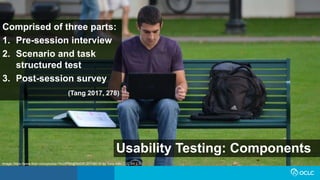
Usability Testing: Components
Comprised of three parts:
1. Pre-session interview
2. Scenario and task
structured test
3. Post-session survey
(Tang 2017, 278)
Image: https://www.flickr.com/photos/78428166@N00/8120708019/ by Tony Alter / CC BY 2.0
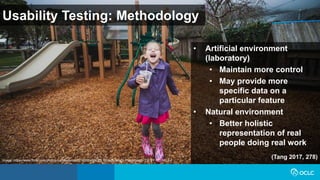
Usability Testing: Methodology
• Artificial environment
(laboratory)
• Maintain more control
• May provide more
specific data on a
particular feature
• Natural environment
• Better holistic
representation of real
people doing real work
(Tang 2017, 278)Image: https://www.flickr.com/photos/carnesaurus/32160924864/ by Stinson Beach Playground / CC BY-NC-ND 2.0
V&R Mapping App Usability Testing
TASK
• Think of around 10 websites you use or online activities that you
regularly perform. Place each of these websites or activities on
the map in a way that represents how you feel you use them (as
a 'Visitor' or as a 'Resident') and the typical context in which you
use them ('Personal' or 'Institutional’).
PROCEDURE
1. Read the task aloud
2. Using the app, complete the task while thinking aloud
3. Indicate when they felt they had completed the task
Image: https://www.flickr.com/photos/marcelxxl/14217231657/ by M.G.N. – Marcel / CC BY-NC-ND 2.0
V&R Mapping App Usability Study Questions
• Why did you select the shapes you did?
• Why did you place them in these locations?
• Were the tasks fun to do? Discuss your answer.
• What would make it more fun?
• What devices do you use to access the web?
• If you could change this product in any way, what
would you do?
Image: https://www.flickr.com/photos/glassholic/16948415183/ by Etienne / CC BY-NC-ND 2.0
ETHNOGRAPHIC RESEARCH:
(Connaway & Radford, 2017, 263)
How individuals interact and behave
Ethnographic Research
“…a way of seeing how individuals interact and behave in
situations by utilizing different qualitative data collection and
analysis methods.”
(Connaway and Radford 2017, 263)
Image: https://www.flickr.com/photos/pmillera4/13570027834/ by Peter Miller / CC BY-NC-ND 2.0
Ethnographic research
• Incredibly detailed data
• Time consuming
– Establishing rapport
– Selecting research participants
– Transcribing observations &
conversations
– Keeping diaries
(Connaway & Radford, 2017, 254-255)
(Khoo, Rozaklis, & Hall, 2012, 83)
Image: https://www.flickr.com/photos/severalseconds/8476908394/ by shadow group / CC BY-NC-ND 2.0
Diaries
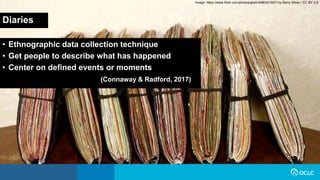
• Ethnographic data collection technique
• Get people to describe what has happened
• Center on defined events or moments
(Connaway & Radford, 2017)
Image: https://www.flickr.com/photos/gbsk/4980421657/ by Barry Silver / CC BY 2.0
Diaries
• Keep directions minimal and open
• Offer participants a variety of ways to report
• Written
• Photo
• Video
• Audio
• Data can be rich and detailed, but is self-reported
• Does not require researcher presence
(Connaway and Radford, 2017)
Image: https://www.flickr.com/photos/10154402@N03/8421806383 by Bruce Guenter / CC BY 2.0
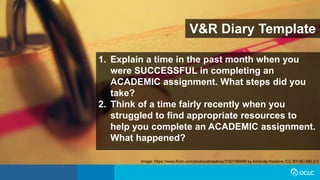
V&R Diary Template
1. Explain a time in the past month when you
were SUCCESSFUL in completing an
ACADEMIC assignment. What steps did you
take?
2. Think of a time fairly recently when you
struggled to find appropriate resources to
help you complete an ACADEMIC assignment.
What happened?
Image: https://www.flickr.com/photos/ahawkins/3182186456 by Amanda Hawkins /CC BY-NC-ND 2.0
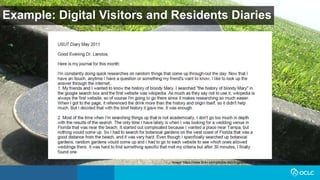
Example: Digital Visitors and Residents Diaries
Image: https://www.flickr.com/photos/dancingpapa2007/3674686528 by Naoki Tomeno / CC BY 2.0
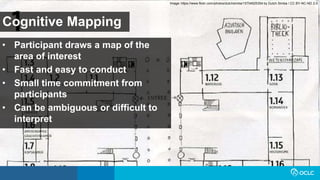
Cognitive Mapping
• Participant draws a map of the
area of interest
• Fast and easy to conduct
• Small time commitment from
participants
• Can be ambiguous or difficult to
interpret
Image: https://www.flickr.com/photos/dutchsimba/15704925354 by Dutch Simba / CC BY-NC-ND 2.0
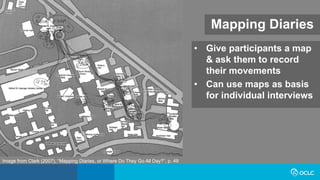
Mapping Diaries
• Give participants a map
& ask them to record
their movements
• Can use maps as basis
for individual interviews
Image from Clark (2007), “Mapping Diaries, or Where Do They Go All Day?”, p. 49
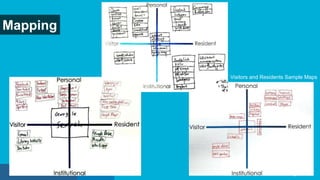
Mapping
Visitors and Residents Sample Maps
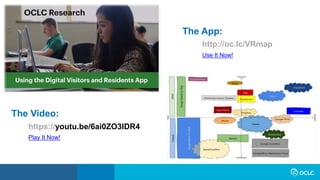
https://youtu.be/6ai0ZO3lDR4
The Video:
Play It Now!
http://oc.lc/VRmap
The App:
Use It Now!
ACTIVITY
V&R Mapping Exercise
BREAK TIME!
QUALITATIVE RESEARCH DATA ANALYSIS:
summary of observations or data in
such a manner that they provide
answers to the hypothesis or research
questions (Connaway & Radford, 2017, 177)
Analysis
• Collection of data affects analysis of data
• Ongoing process
• Feeds back into research design
• Theory, model, or hypothesis must grow from
data analysis
Image: https://www.flickr.com/photos/creatocrat/4423113441/ by creatocrat / CC BY-NC-ND 2.0
Ethnographic Analysis
• Use people’s own categories
• Avoid assuming what one will find
• Complementary to quantitative methods
• Retain ‘richness’/‘thick description’
• Numerous compatibility
(Asher 2017, 264)
(Connaway and Radford 2017, 282)
Image: https://www.flickr.com/photos/respres/6041698098/ by Jeff Turner / CC BY 2.0
• Draw on data...in service of
developing new conceptual
categories
• Develop inductive abstract
analytic categories through
systematic data analysis
• Emphasize theory construction
rather than description or
application of current theories
(Connaway and Radford, 2017)
Grounded Theory
Image: https://www.flickr.com/photos/adambindslev/4727853016/ by Adam Bindslev / CC BY-NC 2.0
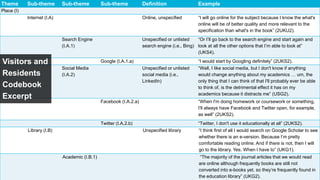
Theme Sub-theme Sub-theme Sub-theme Definition Example
Place (I)
Internet (I.A) Online, unspecified “I will go online for the subject because I know the what's
online will be of better quality and more relevant to the
specification than what's in the book” (2UKU2).
Search Engine
(I.A.1)
Unspecified or unlisted
search engine (i.e., Bing)
“Or I’ll go back to the search engine and start again and
look at all the other options that I’m able to look at”
(UKS4).
Google (I.A.1.a) “I would start by Googling definitely” (2UKS2).
Social Media
(I.A.2)
Unspecified or unlisted
social media (i.e.,
LinkedIn)
“Well, I like social media, but I don't know if anything
would change anything about my academics … um, the
only thing that I can think of that I'll probably ever be able
to think of, is the detrimental effect it has on my
academics because it distracts me” (USG2).
Facebook (I.A.2.a) “When I'm doing homework or coursework or something,
I'll always have Facebook and Twitter open, for example,
as well” (2UKS2).
Twitter (I.A.2.b) “Twitter, I don't use it educationally at all” (2UKS2).
Library (I.B) Unspecified library “I think first of all I would search on Google Scholar to see
whether there is an e-version. Because I’m pretty
comfortable reading online. And if there is not, then I will
go to the library. Yes. When I have to” (UKG1).
Academic (I.B.1) “The majority of the journal articles that we would read
are online although frequently books are still not
converted into e-books yet, so they’re frequently found in
the education library” (UKG2).
Visitors and
Residents
Codebook
Excerpt
Theme Sub-theme Sub-theme Definition Example
Sources (II) Unspecified source “I spent a few weeks struggling to find a part time job for the
Christmas holidays. I mainly searched the internet but also
search for help from my university, asked friends, walked the
streets handing out my CV etc.” (UKG303).
Human (II.A) Unspecified human source “So the ideal way is to ask and receive an answer, just like in
human to human interaction” (UKF401).
Mother (II.A.1) [If “parents” stated, code for Mother
and Father]
“…had a chat with my mother on the phone” (UKG320).
Father (II.A.2) [If “parents” stated, code for Mother
and Father]
“Parents…they know me the best so I know that they would
have my best interests at heart…” (UKS125).
Extended Family
(II.A.3)
Siblings, cousins, relatives, children,
spouses. [If “family” stated, code for
Mother, Father, and Extended
Family]
“Seek friends and families help because they are
trustworthy” (UKS108).
Digital (II.B) Unspecified or unlisted digital source “The idea of having the desired information in front of your
eyes as and when I need it. This is, of course, something
made possible by technology such as Google Glass”
(UKG303).
E-books (II.B.1) “I do not like e-readers. For me personally, I need to feel the
pages of a book in my fingers for it too be real” (USS116).
Academic (I.B.1) “The majority of the journal articles that we would read are
online although frequently books are still not converted into
e-books yet, so they’re frequently found in the education
library” (UKG2).
Visitors and
Residents
Codebook
Excerpt
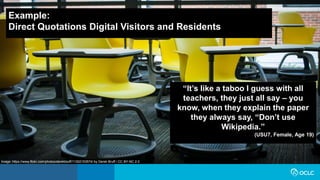
“It’s like a taboo I guess with all
teachers, they just all say – you
know, when they explain the paper
they always say, “Don’t use
Wikipedia.”
(USU7, Female, Age 19)
Example:
Direct Quotations Digital Visitors and Residents
Image: https://www.flickr.com/photos/derekbruff/11302153574/ by Derek Bruff / CC BY-NC 2.0
• Contain all data sources
• Creating & applying codes
• Queries
• Visualizations
• Reports
(Connaway and Radford 2017)
Computer-Assisted Qualitative Data Analysis
Software (CAQDAS)
Image: https://www.flickr.com/photos/flakepardigm/4687752030/ by Tyler Nienhouse / CC BY 2.0
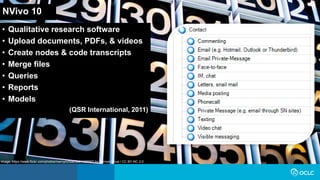
NVivo 10
• Qualitative research software
• Upload documents, PDFs, & videos
• Create nodes & code transcripts
• Merge files
• Queries
• Reports
• Models
(QSR International, 2011)
Image: https://www.flickr.com/photos/mervynchua/5441109097/ by Mervyn Chua / CC BY-NC 2.0
“A major strategy for analysis of
qualitative data is the use of the
constant comparative method, which
embraces ‘constant comparisons’
defined as ‘the analytic process of
comparing different pieces of data
against each other for similarities
and differences.’”
(Connaway and Radford 2017, 298)
Image: https://www.flickr.com/photos/carleycomartin/4030726428/ by Carley Comartin / CC BY-NC 2.0
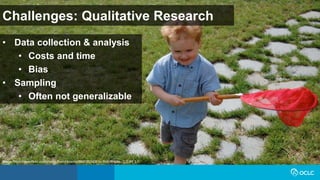
Challenges: Qualitative Research
• Data collection & analysis
• Costs and time
• Bias
• Sampling
• Often not generalizable
Image: https://www.flickr.com/photos/therichbrooks/2600080329/ by Rich Brooks / CC BY 2.0
Opportunities: Qualitative Research
• Rich data and thick description
• Can answer why and how questions
• Provides information to support decisions
about resources and services
• Can help motivate and increase buy-in for
change
• Provides the opportunity to build
relationships
(Connaway and Radford, 2017; Asher and Miller, 2011)
Image: https://www.flickr.com/photos/dougww/2132598574 by Doug Waldron / CC BY-SA 2.0
“The creative process is not like a situation
where you get struck by a single lightning
bolt. You have ongoing discoveries, and
there are ongoing creative revelations. Yes,
it's really helpful to be marching toward a
specific destination, but, along the way, you
must allow yourself room for your ideas to
blossom, take root, and grow.”
–Carlton Cuse
Image: https://flic.kr/p/AuDyn by Pete Hunt / CC BY-NC 2.0
ACKNOWLEDGEMENTS
I would like to thank Brittany Brannon and Brooke Doyle
for their assistance in preparing this presentation.
References
Asher, A. (2017). On ethnographic research: How do students find the information they need? In Research methods for library
and information science, 6th ed., edited by L. S. Connaway and M. L. Radford, 264. Santa Barbara: Libraries Unlimited.
Asher, A. & Miller, S. (2011). So You Want to Do Anthropology in Your Library? Or a Practical Guide to Ethnographic Research in
Academic Libraries. Chicago: The ERIAL Project.
Baik, E., Seol, K., Pichugin, A.E., & Sun, Si. Presentation 603: Qualitative Approaches Seminar Asking Questions - The Interview.
Clark, K. (2007). Mapping Diaries, or Where Do They Go All Day? In N. Foster & S. Gibbons (Eds.), Studying Students: The
Undergraduate Research Project at the University of Rochester. Chicago: Association College and Research Libraries.
Connaway, L. S. (2017, June 19). Putting the library in the life of the user: Listen, then lead, to promote a unique and compelling
role for academic libraries. Guest of Choice, Choice360 blog. Retrieved from http://www.choice360.org/blog/putting-the-library-in-
the-life-of-the-user
Connaway, L. S., & Faniel, I. M. (2014). Reordering Ranganathan: Shifting user behaviors, shifting priorities. Dublin, OH: OCLC
Research. http://www.oclc.org/content/dam/research/publications/library/2014/oclcresearch-reordering-ranganathan-2014.pdf.
Connaway, L. S., Lanclos, D., & Hood, E. M. (2013). “I find Google a lot easier than going to the library website.” Imagine ways to
innovate and inspire students to use the academic library. In Proceedings of the Association of College & Research Libraries
(ACRL) 2013 conference, 289-300. Retrieved from
http://www.ala.org/acrl/sites/ala.org.acrl/files/content/conferences/confsandpreconfs/2013/papers/Connaway_Google.pdf
References
Connaway, L. S., Lanclos, D., White, D., Le Cornu, A., & Hood, E. M. (2013). User-centered decision making: A new model
for developing academic library services and systems. IFLA Journal, 39(1), 30-36.
Connaway, L. S., & Powell, R. R. (2010). Basic research methods for librarians (5th ed.). Littleton, CO: Libraries Unlimited.
Connaway, L. S., & Radford, M. L. (2017). Research methods in library and information science. Santa Barbara: Libraries
Unlimited.
Connaway, L. S., & Wakeling, S. (2012). To use or not to use Worldcat.org: An international perspective from different user
groups. OCLC Internal Report.
Connaway, L. S., White, D., Lanclos, D., & Le Cornu, A. (2013). Visitors and residents: What motivates engagement with the
digital information environment? Information Research, 18(1). Retrieved from http://informationr.net/ir/18-1/infres181.html
Denzin, N. K., & Lincoln, Y. S. (2005). The Sage Handbook of Qualitative Research, 4th ed. Thousand Oaks, CA: Sage
Publications.
Dumas, J. S., & Redish, J. C. (1993). A Practical Guide to Usability Testing. Portland, OR: Intellect Books.
Flanagan, J. C. (1954). The critical incident technique. Psychological Bulletin, 51(4), 327-358.
Geertz, C. (1973). The interpretation of cultures: Selected essays. New York: Basic Books.
References
Khoo, M., Rozaklis, L., & Hall, C. (2012). A survey of the use of ethnographic methods in the study of libraries and library
users. Library and Information Science Research, 34(2), 82-91.
Lederman, L. C. (1996). Asking questions and listening to answers: A guide to using individual, focus group, and debriefing
interviews. Dubuque, IA: Kendall/Hunt.
Lindlof, T., & Taylor, B. (2010). Qualitative communication research methods (3rd ed.). Thousand Oaks, CA: Sage
Publications.
Miles, M., & Huberman, A. M. (1994). Qualitative data analysis: An expanded sourcebook (2nd ed.). Thousand Oaks, CA:
Sage Publications.
OCLC Research. (2016). Using the Digital Visitors and Residents App. YouTube video. May 5.
https://www.youtube.com/watch?v=6ai0ZO3lDR4.
Polkinghorne, D. (1983). Methodology for the human sciences: Systems of inquiry. Albany, NY: State University of New
York Press.
QSR International. (2011). NVivo 9: Getting started. Retrieved from
http://download.qsrinternational.com/Document/NVivo9/NVivo9-Getting-Started-Guide.pdf
References
Ranganathan, S. R. (1931). The five laws of library science. London: Edward Goldston, Ltd.
Runes, D. D. (Ed.). (2001). The dictionary of philosophy. New York, NY: Citadel Press.
Tang, R. (2017). Usability research. In Research methods for library and information science, 6th ed., edited by L. S.
Connaway and M. L. Radford, 277-278. Santa Barbara: Libraries Unlimited.
White, D. S., & Connaway, L. S. (2011-2014). Digital visitors and residents: What motivates engagement with the digital
information environment. Funded by JISC, OCLC, and Oxford University. http://www.oclc.org/research/activities/vandr.html
Zweizig, D., Johnson, D. W., Robbins, J., & Besant, M. (1996). The tell it! manual. Chicago: ALA.
Questions &
Discussion
Lynn Silipigni Connaway, PhD
Director of Library Trends and
User Research, OCLC
connawal@oclc.org
@LynnConnaway

Using qualitative methods for library and information science research: An interactive workshop.

  • 1.
    Mexico City •14 June 2019 Using Qualitative Methods for Library and Information Science Research: An Interactive Workshop Lynn Silipigni Connaway, PhD Director of Library Trends and User Research, OCLC connawal@oclc.org @LynnConnaway
  • 2.
    “Much of thelibrary-related research has been applied research dealing with everything from evaluating e-collections, to assessment of reference services, to analyzing integrated library systems.” (Connaway & Radford, 2017) Image: https://pixabay.com/photos/mexico-city-mexico-city-mexican-2706607/ by Xavier Espinosa / Pixabay License
  • 3.
    Method: “Any procedure employedto attain a certain end” (e.g., focus groups) Methodology: “A study of the plans which are used to obtain knowledge” (Runes, 2001, 346) (Polkinghorne, 1983, 5) Image: https://pixabay.com/photos/books-students-library-university-1281581/ by Pexels / Pixabay license
  • 4.
    Image: https://www.flickr.com/photos/pjotr_savitski/2701378287 byPjotr Savitski / CC BY 2.0 “To identify how and why people get information, it is necessary first to listen.” (Connaway, 2017)
  • 5.
  • 6.
    1. User incontext 2. Community perspective 3. Ask the right question(s) Define the problem Image: https://www.flickr.com/photos/iain/13298441884 by Iain Farrell / CC BY-ND 2.0
  • 7.
    Define the problem:User in context Image: https://www.flickr.com/photos/sugarhiccuphiccup/4843083598 by Troy Tolley / CC BY-ND 2.0
  • 8.
    Define the problem:Community perspective Image: https://www.flickr.com/photos/grongar/8736701984 by Rebecca Siegel / CC BY 2.0
  • 9.
    Define the problem:Ask the right question(s) Image: https://www.flickr.com/photos/mcleod/7150176087 by Scott McLeod / CC BY 2.0
  • 10.
    Qualitative Research Definition Atype of scientific research that: • Seeks answers to a question • Systematically uses predefined set of procedures to answer question • Collects evidence • Produces findings that: • Are not determined in advance • Apply beyond immediate boundaries of study Image: https://www.flickr.com/photos/katesheets/5772901616/ by katesheets / CC BY-NC 2.0
  • 11.
    What is QualitativeResearch? “…a situated activity that locates the observer in the world. It consists of a set of interpretive, material practices that make the world visible. These practices transform the world. They turn the world into a series of representations, including field notes, interviews, conversations, photographs, recordings, & memos to the self. At this level, qualitative research involves an interpretive, naturalistic approach to the world. This means that qualitative researchers study things in their natural settings, attempting to make sense of, or to interpret, phenomena in terms of the meanings people bring to them.” (Denzin and Lincoln, 2005) Image: https://www.flickr.com/photos/ddrmaxgt37/387453140/ by Arun Venkatesan / CC BY-NC 2.0
  • 12.
  • 13.
    Interviews Diaries Observation UsabilityTesting Qualitative Research Data Collection Image: https://www.flickr.com/photos/28481088@N00/3091698923/ by tanakawho / CC BY-NC 2.0
  • 14.
    INTERVIEWS Conversation involving twoor more people guided by a predetermined purpose.
  • 15.
    Types of Interviews •Structured • Semi-structured • Formats – Individual • Face-to-face • Telephone • Skype – Focus group interviews Image: https://www.flickr.com/photos/allkindsofnew/9500650217 by Harold Navarro / CC BY-ND 2.0
  • 16.
    Key components • Goodquestions • Good listening skills • Good interpersonal skills Image: https://www.flickr.com/photos/10332960@N03/13305699454 by John Blower / CC BY-NC-ND 2.0
  • 17.
    Conducting the Interview 1.Thematizing: Clarifying the interview’s purpose 2. Designing: Defining the interview’s purpose 3. Interviewing: Conducting the interview 4. Transcribing: Creating a written verbatim text of the interview 5. Analyzing: Figuring out the meaning of data 6. Verifying: Determining the reliability & validity of the data 7. Reporting: Telling others about the findings (Connaway and Radford 2017, 244) Image: https://www.flickr.com/photos/meanestindian/903380690 by Meena Kadri / CC BY 2.0
  • 18.
    Ethnographic Interview • Incrediblydetailed data • Time consuming • Establishing rapport • Selecting research participants • Transcribing observations & conversations Image: https://www.flickr.com/photos/nordforsk/32225539214 by NordForsk / CC BY-NC-ND 2.0
  • 19.
    Respondent Interviews • In-depth •Social relationship/rapport between interviewee & interviewer • Rapport/relationship key element Image: https://www.flickr.com/photos/anyalogic/2315310261 by Anna Levinzon / CC BY 2.0
  • 20.
    Example: Digital Visitors &Residents Informant Questions 1. Describe the things you enjoy doing with technology and the web each week. 2. Think of the ways you have used technology and the web for your studies. Describe a typical week. 3. Think about the next stage of your education. Tell me what you think this will be like. (White & Connaway, 2011) Image: https://pixabay.com/photos/library-la-trobe-study-students-1400313/ by Andrew Tan / Pixabay License
  • 21.
    Narrative interviews • One-on-One environment •Unstructured • Interviewees are telling a story • Interviewer questions are minimal https://pixabay.com/photos/friends-male-men-outside-winter-1209740 by Free-Photos / Pixabay License
  • 22.
    Neutral, Leading, & LoadedQuestions Neutral • “What are your impressions of Raynor Memorial Libraries?” Leading • “You don’t like the librarians at Raynor Memorial Libraries, do you?” Loaded • “How many other unreasonable requests have you made to our librarians?” Image: https://www.flickr.com/photos/robwatling/5089229734 by Rob Watling / CC BY-NC-ND 2.0
  • 23.
  • 24.
    Interviews: Advantages • Face-2-faceinteraction • In-depth information • Understand experiences & meanings • Highlight individual’s voice • Preliminary information to “triangulate” • Control sampling – Include underrepresented groups • Greater range of topics Image: https://www.flickr.com/photos/thomashawk/12012985364 by Thomas Hawk / CC BY-NC 2.0
  • 25.
    Interviews: Disadvantages • TimeFactors – Varies by # & depth – Staff intensive • Cost Factors – Higher the #, higher the cost • Additional Factors – Self-reported data – Errors in note taking possible Image: https://www.flickr.com/photos/29668365@N08/2777606227 by Danae / CC BY 2.0
  • 26.
    Sampling for theInterview Key features of qualitative sampling • Work with small samples of people nested in their context • Tend to be purposive rather than random • Often theory-driven Actions involving the sampling for interview Setting boundaries Creation of a sampling frame (Miles & Huberman, 1994) (Miles & Huberman, 1994) Image: https://www.flickr.com/photos/khouri/6793949601/ by Michael Cory CC BY-NC 2.0
  • 27.
    Conducting the Interview Recordingthe Interview • Note Taking can be done anywhere/ not depending on devices/ avoiding mechanical failure/ but a deterrent to mind wandering and distractions/ limitation on loss of data (can’t write down everything) • Audio Recording is capturing and preserving all interview discourses with little effort by the researcher/ engage in more fully in the conversation/ peruse the content of the talk and its paralinguistic aspects (Lindlof & Taylor, 2010)
  • 28.
    Conducting the Interview Listening •Listening = the most crucial way to build rapport after an interview has started • Listening = paying attention • Active listening – as the conversation unfolds, you monitor your own understandings in relation to the possible meanings of what the person is saying – suggest questions that are urgent enough to warrant breaking into the subject’s talk – not being a caretaker for the audio recorder (Lindlof & Taylor, 2010) Image: https://www.flickr.com/photos/108404544@N07/12941711194 by Chris Searle / CC BY-NC-ND 2.0
  • 29.
  • 30.
    Conducting Interviews • Obtainpermission to use information – Report and/or publication • Create safe climate, assure confidentiality • Be prepared, flexible, & stay on task • Listen & know when to probe • Accept that some interviews won’t go well • Thank them! Image: https://www.flickr.com/photos/62833283@N00/17217078330 by Seamus McCauley / CC BY 2.0
  • 31.
  • 32.
    FOCUS GROUP INTERVIEWS “…interviewof a group of 8 to 12 people representing some target group and centered on a single topic.” (Zweizig, Johnson, Robbins, & Besant, 1996)
  • 33.
    Focus Group Interviews:Advantages • Advantages of individual interviews plus… • Take less time. • Create synergy – Comments stimulate others – Unexpected insight • Access needs of under- served or underrepresented groups Image: https://www.flickr.com/photos/bensonkua/4839019821/ by Benson Kua / CC BY-SA 2.0
  • 34.
    Focus Group Interviews:Disadvantages • Planning & administrative time • Experienced moderator required ‒ See handout • Participants may be too quiet or too outspoken • Participants may not have sufficient time • Analysis, summarization & interpretation of responses difficult Image: https://www.flickr.com/photos/17989497@N00/8651401959 by Monika / CC BY-SA 2.0
  • 35.
    Conducting Focus GroupInterviews • Obtain permission to use information & if taping – Report and/or publication • Enlist note-taker or, if recording, check equipment, bring back-up • Begin by creating safe climate Image: https://www.flickr.com/photos/cogdog/5841058123 by Alan Levine / CC by 2.0
  • 36.
    Conducting Focus GroupInterviews • Help quiet people talk, limit talkative people • Design well constructed guide, including: – Introduction (purpose, ground rules) – Small set of questions (4 or 5 tops!) – Relevant major/probe questions • Effective listening essential Image: https://www.flickr.com/photos/gozalewis/4776747298/ by timlewisnm CC BY-NC-ND 2.0
  • 37.
    WorldCat.org Study Recruitment •Difficult – Little data of user-base – Participants across 3 continents – Hard-to-reach populations • Historians • Antiquarian booksellers • Non-probabilistic methods – Convenience sampling – Snowball sampling (Connaway & Wakeling, 2012) Image: https://pixabay.com/photos/school-geography-world-globe-earth-622766/ by DWilliams / Pixabay License
  • 38.
    Example: WorldCat.org Focus GroupInterview Questions Tell us about your experiences with WorldCat.org Broad introductory question to reveal the extent to which users have engaged with WorldCat.org, and the information-seeking contexts within which they use the system. PURPOSE
  • 39.
    Example: WorldCat.org Focus GroupInterview Questions If you had a magic wand, what would your ideal WorldCat.org provide? Encourages participants to discuss potential improvements to WorldCat.org. PURPOSE
  • 40.
    Individual Interviews &Focus Group Interviews Analysis • Review notes/transcribe tapes • Ways to analyze: – Code data into pre-determined categories – Use data to identify categories – Use data for summary statements “capture the essence” • Compare all groups • Compile & summarize • Look for trends/patterns • Don’t overgeneralize from results Image: https://www.flickr.com/photos/arwilkinson/10830400356 by Andy Wilkinson / CC BY-SA 2.0
  • 41.
    • Parts ofReport – List of issues – Explain how data collected/analyzed – Summary of findings: What was said on each issue? – Sample quotes (anonymous) – Interviewer’s impressions – Recommendations: • Short term (low hanging fruit) • Long term Individual Interviews & Focus Group Interviews Reporting Results Image: https://www.flickr.com/photos/jenosaur/4731463366 by jen Collins / CC BY-NC-ND 2.0
  • 42.
    Individual Interviews &Focus Group Interviews Limitations • Difficult to generalize • May not be representative • Analyzes perceptions, not facts • Subjective analysis (reliability) • Raw data could be misleading • Results can be limited by: – Poor/inexperienced moderator/ interviewer – Poorly constructed discussion guide/interview questions • Compensate by combining methods Image: https://www.flickr.com/photos/furibond/3267102279 by jim / CC BY-SA 2.0
  • 43.
    STRUCTURED OBSERVATIONS: Systematic descriptionfocusing on designated aspects of behavior to test causal hypotheses. (Connaway & Radford, 2017, 272)
  • 44.
    “Perhaps the mostconvenient method of studying the consequences of this law will be to follow the reader from the moment he enters the library to the moment he leaves it…” (Ranganathan 1931, 337) Image: https://www.flickr.com/photos/anjan58/7346141798 by anjan58 / CC BY-NC-ND 2.0 Observation
  • 45.
    Participant/Immersive Observations • Moveinto the setting as deeply as possible • Disturb participants as little as possible • Participant observation • Open, direct interaction & observation as part of the group (Connaway & Radford, 2017) Image: https://www.flickr.com/photos/njla/3306454031/ by NJLA: New Jersey Library Association CC BY-NC-ND 2.0
  • 46.
    Unstructured vs. StructuredObservations • Unstructured observation • No predetermined categories of behavior • Flexible, exploratory • Notes should be recorded as soon as possible • Structured observation • Predeveloped observational categories • Rating scales and/or checklists • Audio and/or video recording (Connaway and Radford, 2017) Image: https://www.flickr.com/photos/jafsegal/5438336871 by Juan Antonio Segal / CC BY 2.0
  • 47.
    Unstructured Observations • Obtrusivevs. Unobtrusive • Active vs. Passive • Improve accuracy by: • Comparing data from two sources • Avoiding interpretation • Not taking behavior for granted • Getting feedback from participants (Connaway & Radford, 2017) Image: https://www.flickr.com/photos/28481088@N00/14270095212 by tanakawho / CC BY 2.0
  • 48.
    Structured Observations • Moreformal, quantitative • Develop observational categories • Define appropriate, measurable actions • Establish units of time or length of observations • Anticipate patterns • Determine frame of reference • Select a rating scale • Create a checklist sheet if applicable (Connaway & Radford, 2017) Image: https://www.flickr.com/photos/fng_photo/32806522008 by fnugry / CC BY-NC 2.0
  • 49.
    Usability Testing History• Human ethnographic observation • Ergonomics • Cognitive psychology • Became popular in 1980s (Connaway & Radford, 2017, 277) Image: https://www.flickr.com/photos/kaeru/1599676842 by Kars Alfrink / CC BY 2.0
  • 50.
    Usability Testing • Degreeto which a user can successfully learn & use a product to achieve a goal • Evaluation research methodology • Observation & analysis of user behavior while users use a product or product prototype to achieve a goal (Dumas and Redish 1993, 22) Image: https://www.flickr.com/photos/deanhochman/14481958642/ by Dean Hochman / CC BY 2.0
  • 51.
    Usability Testing: Components Comprisedof three parts: 1. Pre-session interview 2. Scenario and task structured test 3. Post-session survey (Tang 2017, 278) Image: https://www.flickr.com/photos/78428166@N00/8120708019/ by Tony Alter / CC BY 2.0
  • 52.
    Usability Testing: Methodology •Artificial environment (laboratory) • Maintain more control • May provide more specific data on a particular feature • Natural environment • Better holistic representation of real people doing real work (Tang 2017, 278)Image: https://www.flickr.com/photos/carnesaurus/32160924864/ by Stinson Beach Playground / CC BY-NC-ND 2.0
  • 53.
    V&R Mapping AppUsability Testing TASK • Think of around 10 websites you use or online activities that you regularly perform. Place each of these websites or activities on the map in a way that represents how you feel you use them (as a 'Visitor' or as a 'Resident') and the typical context in which you use them ('Personal' or 'Institutional’). PROCEDURE 1. Read the task aloud 2. Using the app, complete the task while thinking aloud 3. Indicate when they felt they had completed the task Image: https://www.flickr.com/photos/marcelxxl/14217231657/ by M.G.N. – Marcel / CC BY-NC-ND 2.0
  • 54.
    V&R Mapping AppUsability Study Questions • Why did you select the shapes you did? • Why did you place them in these locations? • Were the tasks fun to do? Discuss your answer. • What would make it more fun? • What devices do you use to access the web? • If you could change this product in any way, what would you do? Image: https://www.flickr.com/photos/glassholic/16948415183/ by Etienne / CC BY-NC-ND 2.0
  • 55.
    ETHNOGRAPHIC RESEARCH: (Connaway &Radford, 2017, 263) How individuals interact and behave
  • 56.
    Ethnographic Research “…a wayof seeing how individuals interact and behave in situations by utilizing different qualitative data collection and analysis methods.” (Connaway and Radford 2017, 263) Image: https://www.flickr.com/photos/pmillera4/13570027834/ by Peter Miller / CC BY-NC-ND 2.0
  • 57.
    Ethnographic research • Incrediblydetailed data • Time consuming – Establishing rapport – Selecting research participants – Transcribing observations & conversations – Keeping diaries (Connaway & Radford, 2017, 254-255) (Khoo, Rozaklis, & Hall, 2012, 83) Image: https://www.flickr.com/photos/severalseconds/8476908394/ by shadow group / CC BY-NC-ND 2.0
  • 58.
    Diaries • Ethnographic datacollection technique • Get people to describe what has happened • Center on defined events or moments (Connaway & Radford, 2017) Image: https://www.flickr.com/photos/gbsk/4980421657/ by Barry Silver / CC BY 2.0
  • 59.
    Diaries • Keep directionsminimal and open • Offer participants a variety of ways to report • Written • Photo • Video • Audio • Data can be rich and detailed, but is self-reported • Does not require researcher presence (Connaway and Radford, 2017) Image: https://www.flickr.com/photos/10154402@N03/8421806383 by Bruce Guenter / CC BY 2.0
  • 60.
    V&R Diary Template 1.Explain a time in the past month when you were SUCCESSFUL in completing an ACADEMIC assignment. What steps did you take? 2. Think of a time fairly recently when you struggled to find appropriate resources to help you complete an ACADEMIC assignment. What happened? Image: https://www.flickr.com/photos/ahawkins/3182186456 by Amanda Hawkins /CC BY-NC-ND 2.0
  • 61.
    Example: Digital Visitorsand Residents Diaries Image: https://www.flickr.com/photos/dancingpapa2007/3674686528 by Naoki Tomeno / CC BY 2.0
  • 62.
    Cognitive Mapping • Participantdraws a map of the area of interest • Fast and easy to conduct • Small time commitment from participants • Can be ambiguous or difficult to interpret Image: https://www.flickr.com/photos/dutchsimba/15704925354 by Dutch Simba / CC BY-NC-ND 2.0
  • 63.
    Mapping Diaries • Giveparticipants a map & ask them to record their movements • Can use maps as basis for individual interviews Image from Clark (2007), “Mapping Diaries, or Where Do They Go All Day?”, p. 49
  • 64.
  • 65.
    https://youtu.be/6ai0ZO3lDR4 The Video: Play ItNow! http://oc.lc/VRmap The App: Use It Now!
  • 66.
  • 67.
  • 68.
    QUALITATIVE RESEARCH DATAANALYSIS: summary of observations or data in such a manner that they provide answers to the hypothesis or research questions (Connaway & Radford, 2017, 177)
  • 69.
    Analysis • Collection ofdata affects analysis of data • Ongoing process • Feeds back into research design • Theory, model, or hypothesis must grow from data analysis Image: https://www.flickr.com/photos/creatocrat/4423113441/ by creatocrat / CC BY-NC-ND 2.0
  • 70.
    Ethnographic Analysis • Usepeople’s own categories • Avoid assuming what one will find • Complementary to quantitative methods • Retain ‘richness’/‘thick description’ • Numerous compatibility (Asher 2017, 264) (Connaway and Radford 2017, 282) Image: https://www.flickr.com/photos/respres/6041698098/ by Jeff Turner / CC BY 2.0
  • 71.
    • Draw ondata...in service of developing new conceptual categories • Develop inductive abstract analytic categories through systematic data analysis • Emphasize theory construction rather than description or application of current theories (Connaway and Radford, 2017) Grounded Theory Image: https://www.flickr.com/photos/adambindslev/4727853016/ by Adam Bindslev / CC BY-NC 2.0
  • 72.
    Theme Sub-theme Sub-themeSub-theme Definition Example Place (I) Internet (I.A) Online, unspecified “I will go online for the subject because I know the what's online will be of better quality and more relevant to the specification than what's in the book” (2UKU2). Search Engine (I.A.1) Unspecified or unlisted search engine (i.e., Bing) “Or I’ll go back to the search engine and start again and look at all the other options that I’m able to look at” (UKS4). Google (I.A.1.a) “I would start by Googling definitely” (2UKS2). Social Media (I.A.2) Unspecified or unlisted social media (i.e., LinkedIn) “Well, I like social media, but I don't know if anything would change anything about my academics … um, the only thing that I can think of that I'll probably ever be able to think of, is the detrimental effect it has on my academics because it distracts me” (USG2). Facebook (I.A.2.a) “When I'm doing homework or coursework or something, I'll always have Facebook and Twitter open, for example, as well” (2UKS2). Twitter (I.A.2.b) “Twitter, I don't use it educationally at all” (2UKS2). Library (I.B) Unspecified library “I think first of all I would search on Google Scholar to see whether there is an e-version. Because I’m pretty comfortable reading online. And if there is not, then I will go to the library. Yes. When I have to” (UKG1). Academic (I.B.1) “The majority of the journal articles that we would read are online although frequently books are still not converted into e-books yet, so they’re frequently found in the education library” (UKG2). Visitors and Residents Codebook Excerpt
  • 73.
    Theme Sub-theme Sub-themeDefinition Example Sources (II) Unspecified source “I spent a few weeks struggling to find a part time job for the Christmas holidays. I mainly searched the internet but also search for help from my university, asked friends, walked the streets handing out my CV etc.” (UKG303). Human (II.A) Unspecified human source “So the ideal way is to ask and receive an answer, just like in human to human interaction” (UKF401). Mother (II.A.1) [If “parents” stated, code for Mother and Father] “…had a chat with my mother on the phone” (UKG320). Father (II.A.2) [If “parents” stated, code for Mother and Father] “Parents…they know me the best so I know that they would have my best interests at heart…” (UKS125). Extended Family (II.A.3) Siblings, cousins, relatives, children, spouses. [If “family” stated, code for Mother, Father, and Extended Family] “Seek friends and families help because they are trustworthy” (UKS108). Digital (II.B) Unspecified or unlisted digital source “The idea of having the desired information in front of your eyes as and when I need it. This is, of course, something made possible by technology such as Google Glass” (UKG303). E-books (II.B.1) “I do not like e-readers. For me personally, I need to feel the pages of a book in my fingers for it too be real” (USS116). Academic (I.B.1) “The majority of the journal articles that we would read are online although frequently books are still not converted into e-books yet, so they’re frequently found in the education library” (UKG2). Visitors and Residents Codebook Excerpt
  • 74.
    “It’s like ataboo I guess with all teachers, they just all say – you know, when they explain the paper they always say, “Don’t use Wikipedia.” (USU7, Female, Age 19) Example: Direct Quotations Digital Visitors and Residents Image: https://www.flickr.com/photos/derekbruff/11302153574/ by Derek Bruff / CC BY-NC 2.0
  • 75.
    • Contain alldata sources • Creating & applying codes • Queries • Visualizations • Reports (Connaway and Radford 2017) Computer-Assisted Qualitative Data Analysis Software (CAQDAS) Image: https://www.flickr.com/photos/flakepardigm/4687752030/ by Tyler Nienhouse / CC BY 2.0
  • 76.
    NVivo 10 • Qualitativeresearch software • Upload documents, PDFs, & videos • Create nodes & code transcripts • Merge files • Queries • Reports • Models (QSR International, 2011) Image: https://www.flickr.com/photos/mervynchua/5441109097/ by Mervyn Chua / CC BY-NC 2.0
  • 77.
    “A major strategyfor analysis of qualitative data is the use of the constant comparative method, which embraces ‘constant comparisons’ defined as ‘the analytic process of comparing different pieces of data against each other for similarities and differences.’” (Connaway and Radford 2017, 298) Image: https://www.flickr.com/photos/carleycomartin/4030726428/ by Carley Comartin / CC BY-NC 2.0
  • 78.
    Challenges: Qualitative Research •Data collection & analysis • Costs and time • Bias • Sampling • Often not generalizable Image: https://www.flickr.com/photos/therichbrooks/2600080329/ by Rich Brooks / CC BY 2.0
  • 79.
    Opportunities: Qualitative Research •Rich data and thick description • Can answer why and how questions • Provides information to support decisions about resources and services • Can help motivate and increase buy-in for change • Provides the opportunity to build relationships (Connaway and Radford, 2017; Asher and Miller, 2011) Image: https://www.flickr.com/photos/dougww/2132598574 by Doug Waldron / CC BY-SA 2.0
  • 80.
    “The creative processis not like a situation where you get struck by a single lightning bolt. You have ongoing discoveries, and there are ongoing creative revelations. Yes, it's really helpful to be marching toward a specific destination, but, along the way, you must allow yourself room for your ideas to blossom, take root, and grow.” –Carlton Cuse Image: https://flic.kr/p/AuDyn by Pete Hunt / CC BY-NC 2.0
  • 81.
    ACKNOWLEDGEMENTS I would liketo thank Brittany Brannon and Brooke Doyle for their assistance in preparing this presentation.
  • 82.
    References Asher, A. (2017).On ethnographic research: How do students find the information they need? In Research methods for library and information science, 6th ed., edited by L. S. Connaway and M. L. Radford, 264. Santa Barbara: Libraries Unlimited. Asher, A. & Miller, S. (2011). So You Want to Do Anthropology in Your Library? Or a Practical Guide to Ethnographic Research in Academic Libraries. Chicago: The ERIAL Project. Baik, E., Seol, K., Pichugin, A.E., & Sun, Si. Presentation 603: Qualitative Approaches Seminar Asking Questions - The Interview. Clark, K. (2007). Mapping Diaries, or Where Do They Go All Day? In N. Foster & S. Gibbons (Eds.), Studying Students: The Undergraduate Research Project at the University of Rochester. Chicago: Association College and Research Libraries. Connaway, L. S. (2017, June 19). Putting the library in the life of the user: Listen, then lead, to promote a unique and compelling role for academic libraries. Guest of Choice, Choice360 blog. Retrieved from http://www.choice360.org/blog/putting-the-library-in- the-life-of-the-user Connaway, L. S., & Faniel, I. M. (2014). Reordering Ranganathan: Shifting user behaviors, shifting priorities. Dublin, OH: OCLC Research. http://www.oclc.org/content/dam/research/publications/library/2014/oclcresearch-reordering-ranganathan-2014.pdf. Connaway, L. S., Lanclos, D., & Hood, E. M. (2013). “I find Google a lot easier than going to the library website.” Imagine ways to innovate and inspire students to use the academic library. In Proceedings of the Association of College & Research Libraries (ACRL) 2013 conference, 289-300. Retrieved from http://www.ala.org/acrl/sites/ala.org.acrl/files/content/conferences/confsandpreconfs/2013/papers/Connaway_Google.pdf
  • 83.
    References Connaway, L. S.,Lanclos, D., White, D., Le Cornu, A., & Hood, E. M. (2013). User-centered decision making: A new model for developing academic library services and systems. IFLA Journal, 39(1), 30-36. Connaway, L. S., & Powell, R. R. (2010). Basic research methods for librarians (5th ed.). Littleton, CO: Libraries Unlimited. Connaway, L. S., & Radford, M. L. (2017). Research methods in library and information science. Santa Barbara: Libraries Unlimited. Connaway, L. S., & Wakeling, S. (2012). To use or not to use Worldcat.org: An international perspective from different user groups. OCLC Internal Report. Connaway, L. S., White, D., Lanclos, D., & Le Cornu, A. (2013). Visitors and residents: What motivates engagement with the digital information environment? Information Research, 18(1). Retrieved from http://informationr.net/ir/18-1/infres181.html Denzin, N. K., & Lincoln, Y. S. (2005). The Sage Handbook of Qualitative Research, 4th ed. Thousand Oaks, CA: Sage Publications. Dumas, J. S., & Redish, J. C. (1993). A Practical Guide to Usability Testing. Portland, OR: Intellect Books. Flanagan, J. C. (1954). The critical incident technique. Psychological Bulletin, 51(4), 327-358. Geertz, C. (1973). The interpretation of cultures: Selected essays. New York: Basic Books.
  • 84.
    References Khoo, M., Rozaklis,L., & Hall, C. (2012). A survey of the use of ethnographic methods in the study of libraries and library users. Library and Information Science Research, 34(2), 82-91. Lederman, L. C. (1996). Asking questions and listening to answers: A guide to using individual, focus group, and debriefing interviews. Dubuque, IA: Kendall/Hunt. Lindlof, T., & Taylor, B. (2010). Qualitative communication research methods (3rd ed.). Thousand Oaks, CA: Sage Publications. Miles, M., & Huberman, A. M. (1994). Qualitative data analysis: An expanded sourcebook (2nd ed.). Thousand Oaks, CA: Sage Publications. OCLC Research. (2016). Using the Digital Visitors and Residents App. YouTube video. May 5. https://www.youtube.com/watch?v=6ai0ZO3lDR4. Polkinghorne, D. (1983). Methodology for the human sciences: Systems of inquiry. Albany, NY: State University of New York Press. QSR International. (2011). NVivo 9: Getting started. Retrieved from http://download.qsrinternational.com/Document/NVivo9/NVivo9-Getting-Started-Guide.pdf
  • 85.
    References Ranganathan, S. R.(1931). The five laws of library science. London: Edward Goldston, Ltd. Runes, D. D. (Ed.). (2001). The dictionary of philosophy. New York, NY: Citadel Press. Tang, R. (2017). Usability research. In Research methods for library and information science, 6th ed., edited by L. S. Connaway and M. L. Radford, 277-278. Santa Barbara: Libraries Unlimited. White, D. S., & Connaway, L. S. (2011-2014). Digital visitors and residents: What motivates engagement with the digital information environment. Funded by JISC, OCLC, and Oxford University. http://www.oclc.org/research/activities/vandr.html Zweizig, D., Johnson, D. W., Robbins, J., & Besant, M. (1996). The tell it! manual. Chicago: ALA.
  • 86.
    Questions & Discussion Lynn SilipigniConnaway, PhD Director of Library Trends and User Research, OCLC connawal@oclc.org @LynnConnaway